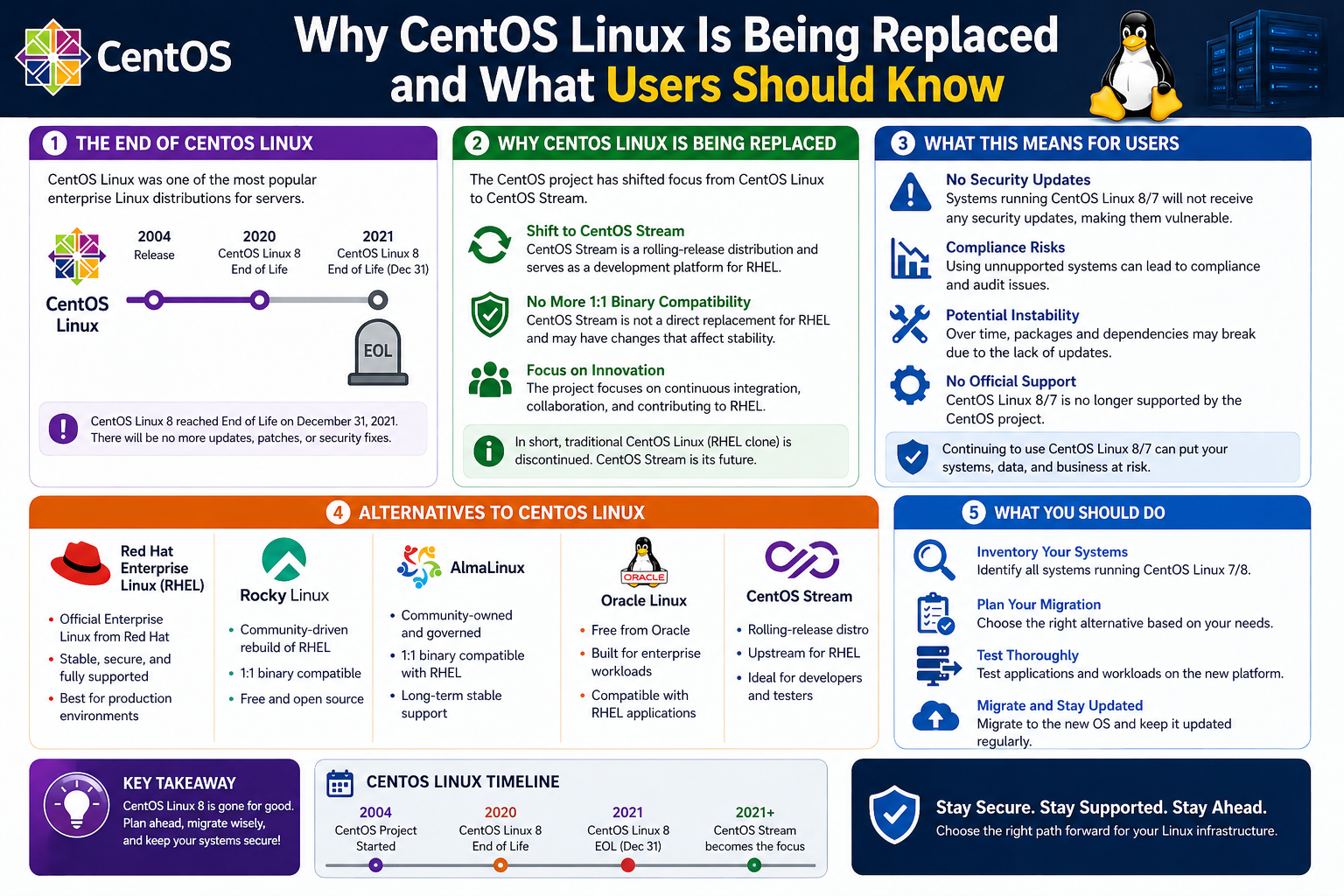
The story of CentOS begins with a simple but powerful idea: making enterprise-grade Linux freely available to everyone. In the early 2000s, organizations needed a stable, secure, and predictable operating system for servers and critical workloads, but commercial enterprise Linux distributions were expensive and tied to subscription models. Around 2004, CentOS emerged as a community-driven project built to replicate the functionality of a leading enterprise Linux system without the associated licensing costs.
At its core, CentOS was designed to be binary-compatible with a major enterprise distribution. This meant that software designed for that enterprise system could run on CentOS without modification. For developers, system administrators, and businesses, this compatibility was extremely valuable because it removed barriers to entry while preserving stability.
Unlike experimental or fast-moving Linux distributions, CentOS focused on consistency. Updates were carefully tested, and changes were introduced conservatively. This made it particularly attractive for environments where downtime or unexpected behavior could lead to serious consequences. Over time, CentOS became known as a dependable foundation for servers, hosting environments, and infrastructure systems that needed long-term reliability.
What made CentOS especially unique was its position in the Linux ecosystem. It was not a separate invention of a new system architecture or philosophy. Instead, it was a rebuild of enterprise Linux sources, carefully compiled and repackaged into a freely accessible operating system. This approach allowed it to inherit enterprise-level robustness while remaining open and community-supported.
As adoption grew, CentOS evolved from a niche alternative into a mainstream choice for infrastructure deployments. Its growth was not driven by marketing or commercial promotion but by organic trust built within the technical community. System administrators recommended it to one another, organizations adopted it quietly in production systems, and educational environments used it as a training platform for enterprise Linux skills.
This organic growth helped CentOS become a cornerstone in server environments across the world, powering web services, databases, internal enterprise tools, and scientific computing systems.
Relationship Between CentOS and Red Hat Enterprise Linux
To understand CentOS, it is essential to understand its close relationship with Red Hat Enterprise Linux (RHEL). CentOS was not an independent Linux distribution built from scratch. Instead, it was constructed from the publicly available source code of RHEL, which is one of the most widely used commercial Linux systems in enterprise environments.
RHEL itself is developed by Red Hat as a commercial product. It offers long-term support, certified stability, security updates, and enterprise support services. Organizations pay subscription fees to gain access to official support channels and certified software compatibility. This business model relies on providing value through reliability, documentation, and professional assistance.
CentOS, in contrast, took the publicly released source code of RHEL and rebuilt it into a free operating system. The key distinction was that while RHEL included branding, certifications, and official support, CentOS provided the same core functionality without those commercial elements. This made it highly attractive for users who wanted enterprise-level stability but did not require paid support services.
Because of this relationship, CentOS was often described as a downstream rebuild of RHEL. “Downstream” means it was derived from a stable version of another system rather than influencing its development. Updates in RHEL would eventually appear in CentOS after being processed and rebuilt by the community.
This structure created a predictable and stable environment. RHEL acted as the source of enterprise-tested features, while CentOS delivered those features freely to users who needed them. The synchronization between the two systems ensured that CentOS remained compatible with RHEL software ecosystems, making migration between them relatively seamless.
Many organizations used CentOS as a staging or testing environment before deploying workloads to RHEL production systems. Others used CentOS directly in production because its stability closely mirrored that of RHEL, making it a cost-effective alternative.
This relationship between a commercial enterprise system and a community rebuild became one of the most defining characteristics of CentOS. It represented a rare balance between open-source accessibility and enterprise-grade reliability.
Why CentOS Became Popular in Production Environments
CentOS gained widespread adoption for several practical reasons that aligned with real-world infrastructure needs. One of the most important factors was stability. Unlike distributions that prioritized frequent feature updates, CentOS focused on maintaining a consistent environment over long periods of time. This made it ideal for systems where predictability was more important than access to the latest software versions.
Another key reason for its popularity was its long lifecycle support model. Organizations that deploy servers and infrastructure typically prefer operating systems that remain stable for many years without requiring major upgrades. CentOS provided extended support timelines, allowing administrators to plan infrastructure strategies with minimal disruption.
Cost efficiency also played a significant role. Since CentOS was free to use, it allowed businesses to deploy enterprise-grade systems without licensing fees. This was particularly valuable for startups, educational institutions, hosting providers, and research facilities with limited budgets. The ability to scale infrastructure without increasing software costs made CentOS a practical choice across industries.
In addition, CentOS offered compatibility with enterprise software ecosystems. Many commercial applications were designed specifically for RHEL-compatible environments. Because CentOS shared the same binary structure, these applications could run smoothly without modification. This reduced complexity for developers and system administrators, who could rely on predictable behavior across systems.
Another factor was documentation and familiarity. Since CentOS closely mirrored RHEL, it benefited from the extensive documentation and knowledge base built around enterprise Linux systems. Administrators trained on RHEL could easily work with CentOS, and vice versa. This reduced the learning curve and made it easier for organizations to build Linux expertise internally.
CentOS also became popular in hosting environments. Web hosting providers frequently use it as the base operating system for servers due to its reliability and low cost. Its stability ensured consistent performance for websites and applications, while its compatibility with server software stacks made deployment straightforward.
In scientific and academic computing environments, CentOS found another strong foothold. Research institutions often require stable systems capable of running complex simulations and data processing workloads over long periods. CentOS provided the consistency needed for such tasks, which contributed to its adoption in fields like physics, engineering, and data science.
Overall, CentOS became popular not because it introduced innovations, but because it delivered a dependable foundation that met the practical needs of a wide range of users.
Community and Industry Adoption Patterns
The adoption of CentOS followed a distinctive pattern that combined grassroots community support with enterprise-level usage. Unlike commercial operating systems driven by marketing campaigns, CentOS spread primarily through word-of-mouth within technical communities.
System administrators often recommend CentOS to colleagues as a reliable alternative to paid enterprise Linux systems. Once adopted in one environment, it frequently expanded into broader infrastructure usage within the same organization. This organic growth pattern helped CentOS establish a strong presence in server environments worldwide.
Another important adoption pattern was its role as a transitional platform. Many organizations used CentOS as an intermediate step when moving from older systems to enterprise-grade Linux environments. Because it closely resembled RHEL, it allowed teams to gain experience without immediately investing in commercial subscriptions.
Educational institutions also played a significant role in adoption. Students learning Linux system administration often use CentOS because it provides an authentic enterprise-like environment without licensing restrictions. This contributed to its long-term popularity, as many professionals entering the industry were already familiar with it.
In the hosting industry, CentOS became a default choice for many providers. Its stability and compatibility with common server software stacks made it ideal for shared hosting environments, virtual private servers, and dedicated server deployments. Hosting companies valued its predictable behavior, which reduced maintenance overhead and support complexity.
Large-scale enterprise environments also adopted CentOS selectively. While some organizations preferred full commercial support through RHEL, others used CentOS for non-critical systems, development environments, or internal tools. This hybrid usage allowed companies to balance cost efficiency with operational stability.
Over time, CentOS developed a reputation as a “safe default” choice. It was not necessarily the most innovative or cutting-edge Linux distribution, but it was trusted, familiar, and widely supported. This reputation contributed significantly to its widespread deployment across industries.
Key Organizations Behind the CentOS Ecosystem
The CentOS ecosystem is shaped by several interconnected organizations, each playing a distinct role in its development and direction.
The CentOS Project is the central community-driven initiative responsible for managing the operating system’s development. It coordinates contributions, oversees releases, and ensures alignment with upstream enterprise Linux sources. Although community-focused, the project operates within a broader ecosystem influenced by corporate contributors.
Red Hat plays a major role in this ecosystem. As the developer of Red Hat Enterprise Linux, Red Hat provides the source code that CentOS is built from. Over time, Red Hat has become deeply involved in CentOS governance and infrastructure support. This involvement has helped ensure alignment between CentOS and enterprise Linux standards, but it has also introduced questions about independence and long-term direction.
IBM entered the picture when it acquired Red Hat in a major industry deal. This acquisition positioned IBM as the parent company of Red Hat, and by extension, a significant stakeholder in the broader ecosystem. However, operational decisions related to CentOS are primarily handled by Red Hat and the CentOS Project rather than IBM directly. Still, the presence of such a large corporate entity has influenced how the community perceives the direction of the project.
The interaction between these organizations creates a layered structure. At the community level, contributors and users influence development through feedback and participation. At the corporate level, Red Hat provides engineering resources and upstream code. At the enterprise level, IBM’s ownership context adds a broader commercial dimension to strategic decisions.
This multi-layered governance model has contributed both stability and complexity to CentOS. On one hand, it ensures strong technical alignment with enterprise Linux development. On the other hand, it introduces debates about control, independence, and the balance between community and corporate interests.
The Open Source Business Model Context
CentOS exists within a broader open source ecosystem that balances community collaboration with commercial sustainability. Understanding this context is essential to understanding why CentOS became so widely used and why its evolution has drawn significant attention.
Open source software allows users to access, modify, and redistribute code freely. However, maintaining large-scale systems requires significant engineering resources. Companies like Red Hat build business models around providing value-added services such as support, certification, and long-term maintenance rather than charging for the software itself.
In this model, enterprise Linux distributions are developed through a combination of open-source contributions and commercial investment. The source code is made available publicly, but the official product includes additional testing, branding, and support services.
CentOS emerged as a community-driven response to this model by taking enterprise source code and rebuilding it into a freely available system. This created a unique dynamic where a commercial product and a free community version coexisted closely.
This relationship worked effectively for many years, but it also created structural tension. The commercial distribution needed to maintain a sustainable business model, while the community distribution provided similar functionality without associated costs. This balance influenced how both systems evolved.
Within the open source ecosystem, CentOS represented a bridge between enterprise-grade reliability and community accessibility. It allowed users who could not afford commercial subscriptions to still access enterprise-level technology, while also providing a familiar environment for developers and system administrators.
This positioning made CentOS a critical part of the Linux infrastructure landscape. It was not just another distribution; it was a foundational layer that supported learning, experimentation, and production workloads across industries.
The Strategic Shift Toward CentOS Stream
The announcement that CentOS Linux would transition into CentOS Stream marked a fundamental restructuring of how the CentOS ecosystem operates. Instead of continuing as a downstream rebuild of Red Hat Enterprise Linux, CentOS would reposition itself as a continuously evolving development branch placed between Fedora and RHEL.
This shift changed the identity of CentOS in a profound way. For nearly two decades, CentOS has been understood as a stable, predictable system that mirrors enterprise Linux releases after they are finalized. With CentOS Stream, that model was reversed. Instead of following RHEL, it would now precede it.
CentOS Stream functions as a rolling preview of what will eventually become part of RHEL. Changes are introduced into Stream first, where they undergo testing and refinement before potentially being integrated into official RHEL minor releases. This makes CentOS Stream a dynamic environment rather than a fixed, versioned system.
From a strategic perspective, this repositioning reflects a broader shift in enterprise software development. Instead of treating operating systems as static releases, CentOS Stream embraces a continuous integration model. Updates flow more frequently, and feedback loops between development and production are shortened.
However, this also means that CentOS Stream cannot guarantee the same level of long-term stability that CentOS Linux provided. Because it sits ahead of RHEL in the development pipeline, it is inherently more fluid. Features, updates, and changes may appear in Stream that are later modified or removed before reaching a stable RHEL release.
This structural change redefined CentOS from a stable endpoint into an active development participant within the enterprise Linux lifecycle.
Architectural Differences Between CentOS Linux and CentOS Stream
One of the most significant aspects of the transition lies in the architectural difference between CentOS Linux and CentOS Stream. While both systems share the same upstream source ecosystem, their position within the development pipeline determines how they behave in practice.
CentOS Linux was built from the finalized source code of RHEL releases. Once a version of RHEL was officially released, CentOS would take that stable codebase, rebuild it, and distribute it with minimal modifications. This ensured that CentOS and RHEL were functionally identical at the binary level.
CentOS Stream, however, operates differently. Instead of waiting for RHEL to be released, it tracks the ongoing development of the next RHEL version. This means that changes enter CentOS Stream before they are officially included in RHEL.
This architectural shift transforms CentOS Stream into a continuously updated platform. Rather than receiving periodic major updates, it receives incremental changes as they are developed. This creates a more fluid environment where the system evolves rather than remaining fixed between release cycles.
The implications of this change are significant for system administrators. In CentOS Linux, system behavior remained consistent over long periods. In CentOS Stream, behavior can evolve as new updates are introduced, requiring more active monitoring and testing.
Another key difference lies in validation. CentOS Linux benefited from the extensive testing pipeline of RHEL before receiving updates. CentOS Stream, on the other hand, introduces changes earlier in the development lifecycle, meaning that users may encounter experimental or pre-stabilization features.
This architectural redesign shifts CentOS from a passive consumer of enterprise Linux releases into an active participant in their creation.
The Role of Rolling Release Development in CentOS Stream
CentOS Stream adopts a rolling release model, which represents a major departure from the traditional versioned release structure used by CentOS Linux. In a rolling release system, updates are continuously delivered to the system without waiting for major version boundaries.
This approach contrasts sharply with point-release systems, where updates are grouped into fixed versions such as CentOS 7 or CentOS 8. In those systems, users typically upgrade from one major version to another only after long intervals.
With CentOS Stream, updates are integrated continuously. This means that the system does not have clearly defined long-term snapshots in the same way traditional enterprise distributions do. Instead, it evolves incrementally as changes are introduced upstream.
The rolling release model offers certain advantages. It allows developers to test updates earlier in the lifecycle, providing feedback that can influence the final design of RHEL releases. It also enables faster innovation cycles, since changes do not need to wait for major version releases to be distributed.
However, this model also introduces variability. Because updates are continuous, system behavior may change more frequently. This requires more active testing and validation from users, particularly in production environments.
For organizations accustomed to the stability of CentOS Linux, this represents a significant operational shift. Systems that previously remained unchanged for years may now require ongoing monitoring to ensure compatibility with evolving software components.
The rolling release approach effectively transforms CentOS Stream into a living development platform rather than a static operating system release.
Positioning CentOS Stream Between Fedora and RHEL
The introduction of CentOS Stream restructured the relationship between Fedora, CentOS, and RHEL into a more defined development pipeline. Each system now occupies a specific stage in the lifecycle of enterprise Linux development.
Fedora serves as the upstream innovation platform. It is where new features, experimental technologies, and major architectural changes are first introduced. Fedora moves quickly and is designed for rapid iteration, making it suitable for testing cutting-edge ideas.
CentOS Stream sits between Fedora and RHEL. It acts as a staging area where changes from Fedora are refined and stabilized before being integrated into enterprise-ready releases. This middle position allows CentOS Stream to serve as a preview of what will eventually appear in RHEL.
RHEL represents the downstream stable enterprise product. It receives carefully tested and validated updates that have passed through both Fedora and CentOS Stream. This ensures that RHEL maintains the highest level of stability and reliability.
This pipeline creates a structured flow of development:
Fedora introduces innovation, CentOS Stream refines it, and RHEL delivers stability.
This model is intended to improve collaboration between community development and enterprise deployment. By involving CentOS Stream in the development cycle, feedback from users can potentially influence RHEL more directly than before.
However, this also changes the expectations of CentOS users. Instead of acting as a stable endpoint, CentOS Stream requires users to engage with a more dynamic and evolving system. This shift alters how organizations plan infrastructure, testing, and deployment strategies.
Impact on Stability Expectations in Enterprise Environments
One of the most significant consequences of the shift to CentOS Stream is the change in stability expectations. CentOS Linux was widely valued for its predictable behavior and long-term consistency. Systems could be deployed and left unchanged for extended periods, making it ideal for production environments.
CentOS Stream introduces a different stability model. Because it tracks ongoing development, it does not guarantee the same level of long-term consistency. Updates may introduce changes that affect system behavior, requiring more active management.
For enterprise environments, this creates a shift in operational philosophy. Instead of treating the operating system as a fixed foundation, administrators must treat it as an evolving platform. This requires continuous testing, monitoring, and validation.
In traditional CentOS Linux environments, stability was achieved through minimal change. Once a system was deployed, it would typically remain unchanged except for security updates. This reduced operational overhead and simplified long-term maintenance.
In CentOS Stream environments, stability is achieved through active adaptation. Systems must be regularly tested against updates to ensure compatibility. This increases the complexity of system administration but also provides earlier access to new features.
This trade-off between stability and innovation is at the core of the CentOS Stream transition. While it enables faster development cycles, it also requires a higher level of engagement from users.
The CentOS 8 Lifecycle Change and Its Industry Impact
One of the most controversial aspects of the CentOS transition was the change to the CentOS 8 lifecycle. Originally, CentOS 8 was expected to follow a long-term support model similar to previous CentOS releases, with updates planned for nearly a decade.
However, after the shift to CentOS Stream, the support timeline for CentOS 8 was significantly shortened. Instead of continuing long-term maintenance, CentOS 8 reached its end of life much earlier than originally planned.
This sudden change had a major impact on organizations that had already deployed CentOS 8 in production environments. Many systems were built with the expectation of long-term stability, and the revised lifecycle created unexpected migration challenges.
The shortened support window meant that administrators had to accelerate their planning for system upgrades or replacements. Infrastructure that was designed for long-term use suddenly required near-term intervention.
This situation highlighted the risks associated with dependency on lifecycle guarantees. When support timelines change unexpectedly, organizations must quickly adapt their infrastructure strategies.
The CentOS 8 lifecycle adjustment became a defining moment in the broader conversation about trust and predictability in open source enterprise systems.
Migration Challenges and Infrastructure Reassessment
The transition away from CentOS Linux created significant migration challenges for organizations across industries. Systems that were built on CentOS 7 and CentOS 8 had to be reassessed, with administrators forced to evaluate alternative operating systems or new deployment strategies.
Migration is not simply a technical process. It involves application compatibility, infrastructure redesign, testing environments, and operational planning. For large-scale systems, migration can take months or even years.
One of the primary challenges was application dependency compatibility. Many enterprise applications were built specifically for RHEL-compatible environments. While CentOS Stream maintains some compatibility, its rolling release nature introduces potential variations that require validation.
Another challenge was infrastructure consistency. Organizations often rely on standardized environments across development, testing, and production systems. Introducing CentOS Stream into this pipeline required reevaluating how consistency is maintained across environments.
In addition, migration required the retraining of system administrators. The operational model of CentOS Stream differs from CentOS Linux, requiring updated practices for patch management, testing, and deployment.
These challenges forced organizations to reconsider their infrastructure strategies. Some chose to adopt alternative RHEL-compatible distributions, while others began transitioning toward commercial enterprise subscriptions.
The migration process became not just a technical upgrade but a strategic reassessment of long-term infrastructure direction.
Security Update Flow and Validation Changes
Another important dimension of the CentOS Stream transition is the change in how security updates are handled. In CentOS Linux, security patches were applied after being fully tested and integrated into stable RHEL releases. This ensured a high level of validation before updates reached production systems.
CentOS Stream changes this model by introducing updates earlier in the development cycle. Security fixes may appear in Stream before they are fully incorporated into RHEL stable releases.
This accelerates the feedback loop but also introduces variability in how updates are validated. Instead of receiving fully stabilized patches, users may encounter updates that are still undergoing refinement.
For security-conscious environments, this requires a more proactive approach to testing and validation. Administrators must ensure that security updates do not introduce unexpected system behavior.
At the same time, this model allows security improvements to propagate more quickly through the development pipeline. Issues can be identified and addressed earlier, potentially improving overall security responsiveness.
The trade-off between speed and validation is a defining characteristic of CentOS Stream’s security model.
Ecosystem Fragmentation and the Rise of Alternatives
The transition from CentOS Linux to CentOS Stream also led to fragmentation within the enterprise Linux ecosystem. As users sought stability comparable to CentOS Linux, several alternative distributions began to gain attention.
These alternatives aim to replicate the functionality of CentOS Linux by providing RHEL-compatible environments with long-term stability. Some are community-driven, while others are supported by commercial organizations.
This fragmentation reflects the demand for stable, predictable Linux environments that are not tied to rolling release models. It also demonstrates how deeply CentOS Linux had been integrated into infrastructure ecosystems.
As organizations migrate away from CentOS Linux, the ecosystem is diversifying. Different distributions now compete to fill the gap left by CentOS Linux, each offering variations in support models, compatibility, and governance structures.
This diversification is reshaping the enterprise Linux landscape, creating multiple pathways for organizations depending on their priorities.
Governance and Community Trust Considerations
The shift to CentOS Stream also raised important questions about governance and community trust. CentOS had long been viewed as a community-aligned project, even though it was closely associated with Red Hat.
Changes to its structure and lifecycle introduced concerns about how decisions are made and how much influence the community has over the direction of the project.
Trust in open source ecosystems is built on predictability and transparency. When major changes occur unexpectedly, it can affect how users perceive the reliability of the project.
The transition to CentOS Stream highlighted the complexity of balancing corporate involvement with community expectations. While corporate contributions provide resources and engineering support, they also introduce strategic priorities that may not always align with community preferences.
This tension is an ongoing aspect of modern open source governance models, where collaboration between communities and corporations is both necessary and complex.
The Long-Term Impact of CentOS Stream on Enterprise Linux Strategy
The transition to CentOS Stream not only changed a single Linux distribution; it reshaped how many organizations think about enterprise Linux strategy as a whole. For years, CentOS Linux acted as a stable foundation that organizations could depend on without major architectural changes over long periods. With its shift to a rolling development model, enterprises were forced to rethink how they structure their infrastructure planning, deployment pipelines, and system lifecycle management.
One of the most immediate impacts has been the shift in how organizations define “stable infrastructure.” Previously, stability meant minimal change over time. Systems were installed, configured, and left largely untouched except for security updates. With CentOS Stream, stability becomes more dynamic. It is no longer defined by the absence of change but by the ability to manage controlled, continuous change.
This requires a different mindset across IT teams. Instead of building systems that are expected to remain static for years, teams now need to design environments that can adapt continuously. This includes more frequent testing cycles, improved automation, and stronger monitoring systems.
Over time, this shift is likely to influence not just CentOS users but the broader enterprise Linux ecosystem. As more organizations adopt continuous integration principles at the operating system level, traditional long-term static distributions may become less dominant in certain environments.
However, this transition is not uniform. Many industries still require highly stable systems where change is tightly controlled. Banking systems, healthcare infrastructure, government systems, and industrial control environments often prioritize predictability above all else. In such cases, CentOS Stream’s model may not align with operational requirements, reinforcing the need for alternative stable distributions.
Changing Role of Linux in Modern Infrastructure Architectures
Linux has evolved from being a server operating system into a foundational layer of modern infrastructure. It powers cloud environments, container platforms, virtualization systems, and edge computing deployments. The shift from CentOS Linux to CentOS Stream reflects this broader evolution in how Linux is used in enterprise environments.
In traditional setups, Linux distributions were treated as static operating system layers. Once deployed, they remained unchanged for long periods. However, modern infrastructure architectures are increasingly dynamic. Containers are frequently rebuilt, virtual machines are dynamically provisioned, and cloud workloads are continuously scaled.
In this context, a rolling release system like CentOS Stream aligns more closely with modern development practices. It supports continuous integration and continuous delivery pipelines, where software is frequently updated and deployed in small incremental changes.
This alignment makes CentOS Stream potentially more suitable for development and testing environments where rapid iteration is important. Developers can test upcoming changes earlier in the lifecycle, identifying compatibility issues before they reach production systems.
However, production environments still require careful consideration. While modern infrastructure is more dynamic, production systems still require reliability and predictability. This creates a dual requirement: environments must support both rapid innovation and controlled stability.
CentOS Stream sits at the intersection of these two requirements. It enables early access to changes while still maintaining a structured path toward enterprise stability through RHEL. This positioning reflects the broader shift in Linux from static systems to integrated infrastructure components.
Influence on DevOps and Continuous Delivery Practices
The introduction of CentOS Stream has had a noticeable influence on DevOps practices and continuous delivery workflows. DevOps emphasizes collaboration between development and operations teams, with a focus on automation, rapid iteration, and continuous feedback loops.
CentOS Stream fits naturally into this model because it delivers updates continuously rather than in large, infrequent releases. This allows DevOps teams to integrate operating system updates into their pipelines more frequently.
In traditional CentOS Linux environments, DevOps pipelines often assumed a stable underlying operating system that changed only occasionally. Application updates were decoupled from operating system changes, allowing teams to focus primarily on application-level deployments.
With CentOS Stream, operating system updates become part of the continuous delivery process. This means that DevOps teams must incorporate OS-level testing into their workflows. Automation becomes even more important, as manual testing cannot scale effectively with continuous updates.
This also encourages closer integration between infrastructure and application development. Since changes in the operating system can affect application behavior, teams must coordinate more closely across layers of the stack.
Over time, this may lead to more unified deployment pipelines where operating system updates, application updates, and configuration changes are treated as part of a single continuous system.
However, this increased integration also adds complexity. Teams must ensure that updates do not introduce instability into production environments, requiring more robust testing frameworks and rollback mechanisms.
Enterprise Risk Management and System Predictability
One of the most important considerations in enterprise environments is risk management. Organizations must carefully balance innovation with operational stability, ensuring that systems remain reliable while still evolving to meet new requirements.
CentOS Linux provided a predictable environment that simplified risk management. Because updates were infrequent and well-tested, organizations could plan long-term infrastructure strategies with confidence.
CentOS Stream introduces a more dynamic risk profile. While it enables earlier access to updates, it also introduces variability in system behavior over time. This requires organizations to adopt more sophisticated risk mitigation strategies.
One key approach is increased use of staging environments. Instead of deploying directly into production, updates are first tested in controlled environments that mirror production systems. This allows teams to identify potential issues before they affect live systems.
Another important strategy is automation of testing and validation. Continuous integration systems can be used to automatically test system updates against predefined criteria, reducing the risk of unexpected failures.
Risk management also becomes more closely tied to monitoring systems. Organizations must continuously observe system behavior to detect anomalies that may arise from updates. This requires more advanced observability tools and alerting systems.
Ultimately, CentOS Stream shifts risk management from a passive model to an active one. Instead of relying on long-term stability guarantees, organizations must actively manage system evolution.
Compatibility Considerations Across Software Ecosystems
One of the strengths of CentOS Linux is its high level of compatibility with enterprise software ecosystems. Many commercial and open-source applications were tested specifically for RHEL-compatible systems, and CentOS inherited that compatibility directly.
With CentOS Stream, compatibility remains an important consideration, but the dynamic nature of the system introduces new challenges. Because updates are continuously integrated, application behavior may need to be validated more frequently.
Some applications depend on specific versions of system libraries, kernel features, or configuration behaviors. In a static system like CentOS Linux, these dependencies remained stable over long periods. In CentOS Stream, they may evolve more frequently.
This requires application developers to adopt more flexible compatibility strategies. Instead of targeting a fixed operating system version, applications may need to be tested across multiple update states.
In containerized environments, this challenge is somewhat mitigated. Containers encapsulate application dependencies, reducing reliance on the underlying operating system. However, even in containerized systems, the host operating system still plays a critical role in performance, networking, and security.
As a result, CentOS Stream encourages a more holistic approach to compatibility management, where both application and infrastructure layers are continuously validated.
Scientific Computing and High-Performance Workloads
CentOS has historically been widely used in scientific computing environments, including physics research, data analysis, and high-performance computing clusters. These environments often require extremely stable systems that can run complex workloads over long periods without interruption.
The shift to CentOS Stream introduces new considerations for these use cases. While it may offer earlier access to performance improvements and hardware support, it also introduces more frequent system changes that may affect computational reproducibility.
In scientific computing, reproducibility is critical. Experiments and simulations must produce consistent results over time. Even minor changes in system libraries or kernel behavior can affect outcomes.
For this reason, many scientific institutions prefer long-term stable operating systems where the environment remains consistent across years of computation.
CentOS Stream may still be useful in research environments where rapid innovation is important, particularly during development phases. However, for production-level simulations and long-term research projects, stability remains a key requirement.
This creates a separation between development environments and production research environments, with CentOS Stream potentially playing a more experimental role.
Cloud Computing and Virtualized Infrastructure Adaptation
Cloud computing has transformed how operating systems are deployed and managed. Instead of running on fixed physical hardware, operating systems are now often deployed as virtual machines or container hosts within large-scale cloud environments.
In this context, CentOS Stream aligns more closely with modern cloud-native principles. Cloud environments already rely on frequent updates, automation, and dynamic scaling. A rolling release operating system fits naturally into this model.
Cloud providers often emphasize automation and infrastructure as code. CentOS Stream can integrate into these workflows by providing continuously updated base images that reflect the latest upstream changes.
However, cloud environments also require stability guarantees. Many enterprise customers rely on cloud platforms to host critical workloads that must remain stable and predictable. This creates tension between innovation and reliability.
To address this, cloud environments often provide multiple operating system options, allowing users to choose between stable long-term releases and more dynamic rolling releases depending on their needs.
CentOS Stream may be more suitable for development workloads in the cloud, while stable enterprise distributions may continue to dominate production workloads.
Security Posture Evolution in a Continuous Update Model
Security is one of the most important aspects of any operating system, particularly in enterprise environments. The transition to CentOS Stream introduces a different security update model compared to CentOS Linux.
In traditional CentOS Linux environments, security patches were applied after being fully tested and validated through the RHEL release pipeline. This ensured a high level of confidence in each update.
In CentOS Stream, security updates may be integrated earlier in the development cycle. This allows vulnerabilities to be addressed more quickly in the upstream development process, potentially improving overall responsiveness.
However, earlier integration also means that security updates may undergo additional changes before reaching stable enterprise releases. This requires organizations to validate security updates more actively within their own environments.
Security teams must now consider not only whether an update fixes a vulnerability but also how it interacts with the evolving system state.
This introduces a more proactive security management model, where continuous monitoring and validation are essential components of the security lifecycle.
Conclusion
The transition from CentOS Linux to CentOS Stream represents one of the most significant shifts in the enterprise Linux ecosystem in recent years. For nearly two decades, CentOS Linux served as a stable, free, and widely trusted alternative to Red Hat Enterprise Linux, providing organizations with a dependable foundation for servers, applications, and infrastructure without licensing costs. Its strength lay in predictability, long-term support, and close compatibility with enterprise systems, which made it a cornerstone in production environments, education, scientific computing, and web hosting.
With the introduction of CentOS Stream, that traditional model has fundamentally changed. Instead of functioning as a downstream rebuild of RHEL, CentOS now operates as an upstream development platform positioned between Fedora and RHEL. This shift transforms CentOS from a static, stability-focused operating system into a continuously evolving distribution that participates directly in the development lifecycle of enterprise Linux. While this enables faster innovation and earlier access to system changes, it also introduces a more dynamic environment that requires continuous testing, monitoring, and adaptation.
For organizations, this change has brought both opportunity and challenge. On one hand, CentOS Stream offers a closer connection to the future of RHEL, allowing developers and system administrators to anticipate changes earlier and potentially influence enterprise Linux development. On the other hand, it removes the long-term predictability that many production environments relied on, forcing businesses to reassess their infrastructure strategies and consider alternative distributions or subscription-based enterprise solutions.
The broader impact extends beyond CentOS itself. The shift has accelerated diversification within the Linux ecosystem, encouraging the rise of alternative RHEL-compatible distributions and prompting organizations to rethink how they manage stability versus innovation. It has also reinforced the importance of automation, testing, and continuous integration practices in modern infrastructure management.
Ultimately, the evolution of CentOS reflects a larger trend in technology: the move from static systems toward continuous, integrated development cycles. While CentOS Linux represented stability and long-term consistency, CentOS Stream represents adaptability and forward-looking development. Both models serve different needs, and their coexistence within the broader Linux ecosystem highlights the ongoing balance between reliability and innovation in enterprise computing.