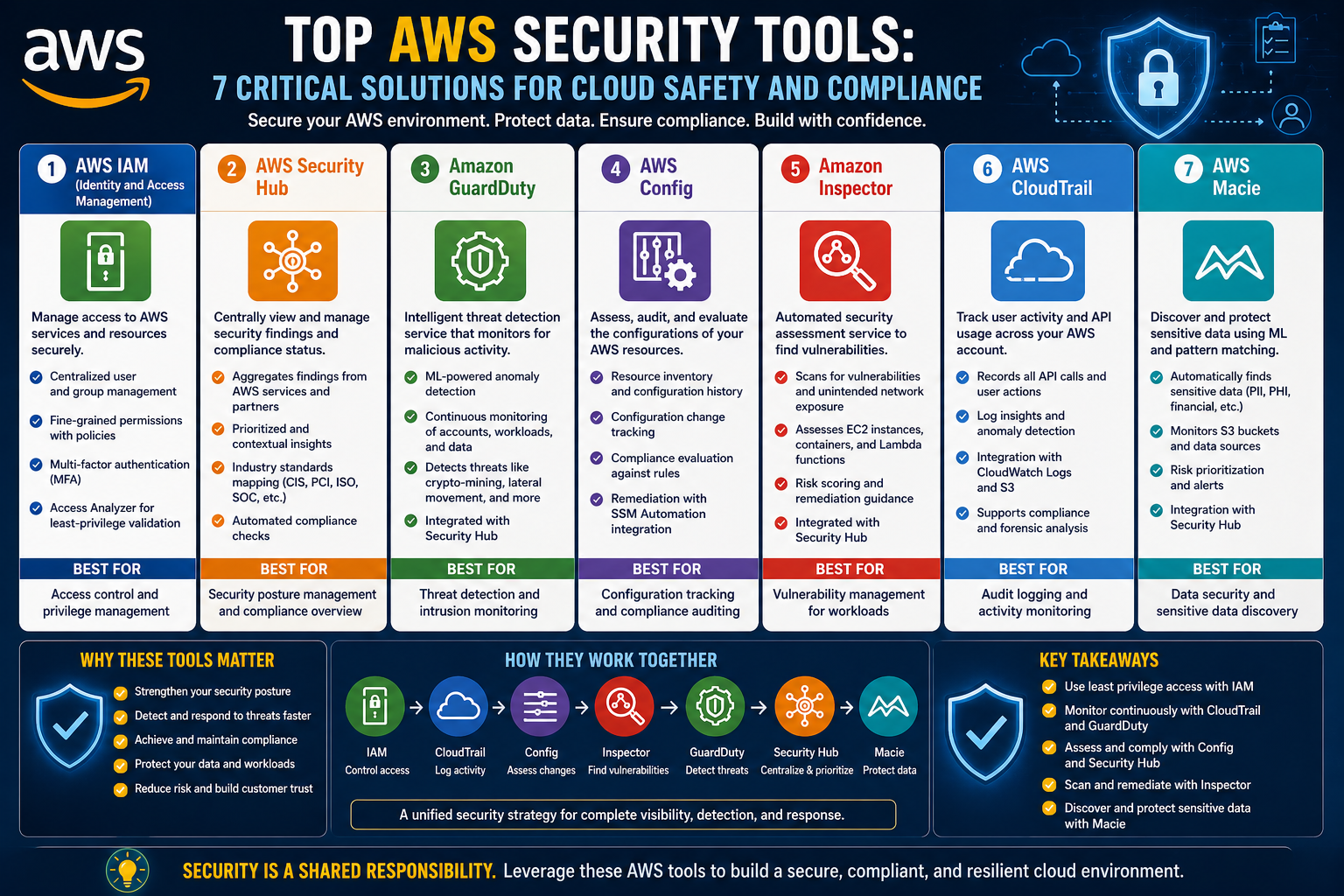
Amazon Web Services (AWS) has fundamentally changed how organizations build, deploy, and scale digital systems. Instead of investing heavily in physical infrastructure, companies can now provision computing resources in minutes and expand them globally with minimal friction. This flexibility has made cloud computing the default architecture for modern applications, from small startups to large enterprises handling massive workloads.
However, this shift also changes how security must be approached. In traditional data centers, organizations controlled every layer of infrastructure, from physical servers to network hardware. In cloud environments like AWS, that responsibility is shared. AWS secures the underlying infrastructure, but customers are responsible for configuring and managing the services they deploy.
This shared responsibility model is the foundation of cloud security. It ensures that while AWS protects its global infrastructure, users remain accountable for how they configure identity access, network exposure, data storage, and application behavior. Misconfigurations, rather than platform weaknesses, are often the leading cause of cloud security incidents.
To address these challenges, AWS provides a wide range of built-in security tools that help organizations monitor, detect, and respond to threats. These tools are designed to integrate directly into cloud environments, reducing the need for complex external security systems. The goal is to provide security at scale without slowing down innovation or deployment speed.
AWS security tools are not isolated products. Instead, they form an interconnected ecosystem where monitoring, detection, prevention, and response work together. This layered security approach ensures that threats can be identified at multiple points and addressed before they escalate into major incidents.
Layered Security Approach in AWS Environments
Modern cloud security relies heavily on the concept of layered defense. Instead of depending on a single security barrier, multiple protective layers work together to reduce risk. If one layer fails or is bypassed, another layer can still detect or stop malicious activity.
In AWS, these layers typically include identity management, network security, threat detection, data protection, and continuous monitoring. Each layer is supported by specialized services that provide visibility and control over different parts of the cloud environment.
One of the most important aspects of this model is automation. Cloud environments change rapidly, with new resources being created and removed constantly. Manual security monitoring is not sufficient at this scale. AWS security tools are designed to automatically analyze activity, detect anomalies, and trigger alerts or responses without requiring constant human intervention.
Another key principle is integration. AWS security services are built to work together. For example, monitoring tools can feed data into threat detection systems, which can then trigger automated responses or alerts. This interconnected design reduces blind spots and improves response time during security incidents.
Understanding how these tools function individually and collectively is essential for building secure cloud environments. Among the most critical services in this ecosystem are AWS Shield, GuardDuty, CloudWatch, Macie, and AWS Inspector. Each of these plays a specific role in protecting cloud workloads from different types of threats.
AWS Shield and Protection Against Distributed Denial of Service Attacks
One of the most common and disruptive types of cyberattacks in cloud environments is the Distributed Denial of Service (DDoS) attack. These attacks aim to overwhelm systems with excessive traffic, making applications slow or completely unavailable. For businesses that rely on constant uptime, even short periods of disruption can lead to financial loss and reputational damage.
AWS Shield is designed specifically to defend against these types of attacks. It is a managed security service that provides automatic protection for applications running on AWS. Instead of requiring manual configuration or constant monitoring, Shield operates continuously in the background, analyzing traffic patterns and filtering out malicious requests.
It protects several key AWS services, including virtual servers, content delivery networks, load balancing systems, and domain name services. By operating at the network edge, it can block harmful traffic before it reaches critical infrastructure, reducing the impact of large-scale attacks.
One of the most important advantages of AWS Shield is its ability to respond quickly. In many cases, malicious traffic is detected and mitigated almost instantly. This speed is essential because DDoS attacks often rely on overwhelming systems in a very short time frame. Even brief exposure can cause significant disruption if not handled immediately.
AWS Shield also benefits from global traffic visibility. Because it operates across a massive cloud infrastructure, it can detect attack patterns that might not be visible within a single organization’s environment. This large-scale perspective allows it to identify and neutralize threats more effectively than isolated security systems.
Another important aspect of Shield is its ability to protect applications even when they are not fully hosted within AWS. This flexibility allows organizations to extend protection to hybrid environments, ensuring that external-facing applications remain secure regardless of where they are deployed.
The strength of AWS Shield lies in its simplicity. Organizations do not need to build complex defense systems or manually adjust configurations for every potential threat. Instead, protection is automatically applied, allowing teams to focus on application development rather than network defense.
AWS GuardDuty and Intelligent Threat Detection
While AWS Shield focuses on protecting against external traffic-based attacks, AWS GuardDuty addresses a broader range of security threats within cloud environments. It is a threat detection service that continuously monitors activity across accounts, workloads, and services to identify suspicious behavior.
GuardDuty analyzes a wide variety of data sources, including network logs, account activity, and service-level events. It uses advanced analytics and machine learning techniques to identify patterns that may indicate malicious activity. This includes unauthorized access attempts, unusual API calls, compromised instances, and potential data exfiltration.
What makes GuardDuty particularly powerful is its ability to process massive volumes of data in real time. Cloud environments generate enormous amounts of activity logs, making it impossible for human teams to manually analyze everything. GuardDuty automates this process, scanning billions of events to detect anomalies that might otherwise go unnoticed.
Unlike traditional security systems that rely heavily on predefined rules, GuardDuty adapts to changing behavior patterns. This allows it to detect previously unknown threats or subtle indicators of compromise. For example, if a user account suddenly begins accessing unusual resources or performing unexpected actions, GuardDuty can flag this behavior for investigation.
The service is designed to be fully managed, meaning it requires minimal setup and maintenance. Once enabled, it continuously operates in the background, requiring no manual tuning for most use cases. This makes it particularly valuable for organizations with limited security personnel or complex cloud architectures.
GuardDuty also integrates with other AWS services to enable automated responses. Alerts can be sent to monitoring systems, and automated workflows can be triggered to isolate compromised resources or restrict access. This integration reduces response time and helps contain threats before they spread.
One of the key strengths of GuardDuty is its scalability. As cloud environments grow, the volume of data increases significantly. GuardDuty is designed to scale automatically, ensuring consistent protection regardless of infrastructure size.
In essence, GuardDuty acts as a continuous security analyst, monitoring cloud activity and identifying risks that require attention. It reduces the burden on security teams while improving overall visibility into potential threats.
AWS CloudWatch and Centralized Monitoring Visibility
Security in cloud environments depends heavily on visibility. Without accurate and timely information about system behavior, it becomes difficult to detect issues or respond effectively to incidents. AWS CloudWatch serves as the central monitoring and observability service within the AWS ecosystem.
CloudWatch collects and processes data from a wide range of AWS services. This includes system logs, performance metrics, application events, and infrastructure-level data. Aggregating this information into a single platform, it provides a unified view of cloud operations.
One of the key benefits of CloudWatch is its ability to turn raw data into actionable insights. Instead of manually reviewing logs, administrators can define metrics, set thresholds, and create alerts that trigger when unusual activity is detected. This allows for proactive monitoring rather than reactive troubleshooting.
From a security perspective, CloudWatch plays a crucial role in incident detection and response. It can highlight unusual spikes in traffic, repeated authentication failures, or unexpected changes in resource usage. These indicators often signal potential security issues that require further investigation.
CloudWatch also integrates closely with other AWS security services. For example, alerts generated by GuardDuty can be sent to CloudWatch for centralized tracking. This integration ensures that security events are not isolated but are instead part of a broader monitoring framework.
Another important capability is automation. CloudWatch can trigger automated actions when specific conditions are met. This might include scaling resources, initiating remediation scripts, or sending notifications to security teams. Automation reduces response time and minimizes the impact of potential incidents.
In addition to security monitoring, CloudWatch also supports performance optimization. Tracking resource utilization, it helps organizations ensure that applications are running efficiently. This dual role of performance and security monitoring makes it an essential component of AWS environments.
CloudWatch essentially acts as the nervous system of AWS infrastructure, collecting signals from across the environment and making them visible in real time. Without this level of observability, managing cloud security at scale would be significantly more challenging.
AWS Macie and Data Protection Intelligence
Data protection is one of the most critical aspects of cloud security. As organizations store increasing amounts of sensitive information in cloud storage systems, ensuring that data is not exposed or misused becomes essential. AWS Macie is designed specifically to address this challenge.
Macie is a data security and privacy service that uses machine learning to discover, classify, and protect sensitive data stored in cloud storage environments. It continuously scans data repositories to identify information such as personal records, credentials, financial data, and other sensitive content.
One of the primary functions of Macie is anomaly detection. It monitors how data is accessed and identifies unusual patterns that may indicate unauthorized access or potential data leaks. For example, if a system suddenly begins downloading large volumes of sensitive files, Macie can flag this behavior as suspicious.
The service is particularly useful in environments where large amounts of unstructured data are stored. Manually tracking sensitive information in such environments is nearly impossible, making automated classification essential.
Macie also helps organizations maintain compliance with data protection requirements by providing visibility into where sensitive data resides. This reduces the risk of accidental exposure due to misconfigured storage permissions or unauthorized access.
Deep Dive into AWS Inspector and Modern Vulnerability Management
Security in cloud environments is not a one-time configuration task. It is an ongoing process that requires continuous evaluation of systems, applications, and infrastructure. As cloud workloads evolve, new vulnerabilities can emerge through updates, configuration changes, or software dependencies. This makes vulnerability management a continuous responsibility rather than a periodic activity.
AWS Inspector plays a central role in this process by providing automated security assessments across cloud resources. It focuses on identifying vulnerabilities and deviations from security best practices within compute environments. Instead of relying on manual penetration testing or occasional audits, Inspector continuously evaluates systems as they operate in real time.
One of the key strengths of Inspector is its ability to integrate directly with compute workloads. It can analyze running instances, container environments, and application components without requiring extensive manual setup. This allows organizations to maintain continuous awareness of security weaknesses without disrupting operations.
An inspector works by comparing system configurations and software states against known vulnerability databases and security guidelines. It identifies outdated software versions, misconfigured settings, and potential exposure points that could be exploited by attackers. These findings are then categorized based on severity, helping security teams prioritize their response.
What makes vulnerability management in AWS environments particularly powerful is the automation behind it. Once the Inspector identifies a potential issue, it can integrate with other AWS services to trigger alerts or remediation workflows. This reduces the time between detection and resolution, which is critical in preventing exploitation.
In modern cloud architectures, systems are frequently updated and scaled dynamically. This constant change makes traditional static vulnerability assessments insufficient. The inspector adapts to this environment by continuously reassessing resources as they change, ensuring that security evaluations remain accurate over time.
Another important aspect is the alignment with best practices. Inspector does not only detects vulnerabilities, but it also evaluates whether systems are configured according to recommended security standards. This helps organizations maintain consistent security hygiene across large and complex infrastructures.
Identity and Access Management as the Core Security Foundation
While vulnerability management focuses on system weaknesses, identity and access control address one of the most critical aspects of cloud security: who can access what. In AWS environments, Identity and Access Management (IAM) forms the foundation of all security controls.
IAM defines users, roles, and permissions that determine how resources are accessed. Every action within AWS is governed by identity-based policies, making IAM a central control point for enforcing security boundaries. Without proper identity management, even the most secure infrastructure can be exposed to unauthorized access.
One of the key principles of IAM is least privilege access. This means that users and services should only be granted the minimum level of permissions necessary to perform their tasks. By limiting access rights, organizations reduce the risk of accidental or malicious misuse of resources.
IAM also supports role-based access control, which allows permissions to be assigned to roles rather than individual users. This is particularly useful in large organizations where multiple teams require access to different systems. Roles can be assumed temporarily, reducing the need for permanent credentials and improving security posture.
Another important feature is the use of temporary security credentials. Instead of relying solely on long-term access keys, IAM enables short-lived credentials that automatically expire. This significantly reduces the risk of credential theft and misuse.
Identity management also extends beyond human users. In cloud environments, applications and services often need to interact with each other. IAM roles allow these services to securely communicate without embedding sensitive credentials into code or configuration files.
Proper identity governance requires continuous monitoring and auditing. IAM integrates with logging systems to track access activity, ensuring that any unusual or unauthorized actions can be detected and investigated. This visibility is essential for maintaining security accountability across cloud environments.
AWS Key Management Service and Encryption Control
Data protection in cloud environments depends heavily on encryption. Even if unauthorized access occurs, encrypted data remains unreadable without the appropriate keys. AWS Key Management Service (KMS) provides centralized control over encryption keys used across cloud services.
KMS allows organizations to create, manage, and rotate cryptographic keys used to encrypt data. These keys can be applied to storage systems, databases, and application data, ensuring that sensitive information remains protected both at rest and in transit.
One of the most important aspects of KMS is centralized key management. Instead of handling encryption separately across multiple services, organizations can manage all cryptographic keys from a single system. This improves consistency and reduces the risk of misconfiguration.
KMS also supports automated key rotation. Regularly changing encryption keys is a key security practice because it limits the potential impact of compromised credentials. Automated rotation ensures that this process occurs consistently without manual intervention.
Access to encryption keys is tightly controlled through IAM policies. This ensures that only authorized users and services can decrypt sensitive data. Even if an attacker gains access to storage systems, they cannot interpret the data without proper key permissions.
Another important feature is integration with other AWS services. KMS is used by a wide range of AWS tools to encrypt data by default. This includes storage services, databases, and messaging systems. This deep integration ensures that encryption is not an optional add-on but a built-in part of cloud security.
Encryption governance is not just about protecting data from external threats. It also helps organizations meet compliance requirements and data protection standards. By ensuring that all sensitive data is encrypted, organizations reduce regulatory risks and improve their overall security posture.
AWS Config and Continuous Compliance Monitoring
Cloud environments are highly dynamic. Resources are constantly created, modified, and deleted. This constant change makes it difficult to maintain consistent security configurations over time. AWS Config addresses this challenge by continuously monitoring resource configurations and evaluating them against defined policies.
AWS Config records configuration changes across cloud resources and maintains a history of how systems evolve. This allows organizations to track changes, identify misconfigurations, and understand the state of their environment at any point in time.
One of the key capabilities of AWS Config is compliance evaluation. It allows organizations to define rules that represent desired security configurations. These rules are then automatically evaluated against existing resources to determine whether they comply with security standards.
When a resource deviates from a defined rule, AWS Config generates a compliance finding. This provides immediate visibility into configuration issues that could potentially introduce security risks. These findings can then be used to trigger remediation actions or alerts.
AWS Config is particularly valuable in large-scale environments where manual tracking of configurations is not feasible. It ensures that security policies are consistently applied across all resources, regardless of how frequently the environment changes.
Another important feature is configuration history tracking. AWS Config stores historical data about resource changes, allowing security teams to investigate how and when a misconfiguration occurred. This is critical for forensic analysis and incident response.
By providing continuous visibility into configuration states, AWS Config helps organizations maintain long-term security consistency and reduce configuration drift across cloud environments.
AWS Security Hub and Unified Security Posture Management
As cloud environments grow, security data becomes distributed across multiple services. Different tools generate alerts, findings, and logs, making it difficult to maintain a unified view of security posture. AWS Security Hub addresses this challenge by aggregating security findings into a centralized platform.
Security Hub collects data from multiple AWS security services and presents it in a standardized format. This allows security teams to view all findings in a single location, rather than managing separate dashboards for each service.
One of the key advantages of Security Hub is normalization. Since different tools produce different types of outputs, Security Hub converts them into a consistent format. This makes it easier to analyze trends, prioritize risks, and understand the overall security state of an environment.
Security Hub also provides compliance frameworks that help organizations evaluate their security posture against industry standards. These frameworks offer structured guidance on how well cloud environments align with best practices.
By aggregating and organizing security data, Security Hub reduces complexity and improves decision-making. Instead of reacting to isolated alerts, security teams can focus on broader patterns and systemic issues.
AWS Organizations and Multi-Account Security Strategy
Large organizations often operate multiple AWS accounts to separate workloads, teams, or environments. Managing security across multiple accounts can quickly become complex without centralized governance. AWS Organizations provides a framework for managing multiple accounts under a single structure.
This service allows organizations to define policies that apply across all accounts, ensuring consistent security controls. It also enables centralized billing, access management, and policy enforcement.
One of the key benefits of multi-account architecture is isolation. By separating workloads into different accounts, organizations reduce the risk of cross-environment impact. If one account is compromised, others remain unaffected.
Organizations can also enforce service control policies that restrict what actions can be performed within accounts. This provides an additional layer of security by limiting potential misuse of resources.
Centralized management simplifies governance and ensures that security standards are consistently applied across all environments.
Network Security Foundations in AWS Environments
Network security is a fundamental aspect of cloud protection. In AWS environments, virtual networks are created using isolated network spaces that allow organizations to define traffic flow and access rules.
Security groups act as virtual firewalls that control inbound and outbound traffic for resources. They define which connections are allowed based on protocols, ports, and IP ranges. These rules operate at the instance level and provide fine-grained control over network access.
Network access control lists provide an additional layer of security at the subnet level. They act as stateless filters that evaluate traffic entering and leaving network segments. Together, these tools allow organizations to build layered network defenses.
Proper network segmentation is essential for minimizing attack surfaces. By isolating sensitive workloads from public-facing systems, organizations reduce the risk of unauthorized access.
AWS WAF and Application Layer Protection
While network security protects infrastructure, application-layer threats require specialized defenses. AWS Web Application Firewall (WAF) is designed to protect applications from common web-based attacks.
WAF filters incoming traffic based on customizable rules. These rules can block malicious requests, prevent injection attacks, and restrict access based on defined conditions. This helps protect applications from vulnerabilities that may exist at the code level.
WAF operates at the edge of application delivery, ensuring that malicious traffic is blocked before it reaches backend systems. This reduces load on infrastructure and improves overall security.
Event-Driven Security Automation in Cloud Environments
One of the most powerful aspects of cloud security is automation. AWS environments allow security responses to be triggered automatically based on events detected by monitoring systems.
When security tools identify suspicious activity, events can be routed through automated workflows. These workflows can trigger remediation actions, isolate resources, or notify security teams. This reduces response time and ensures consistent handling of incidents.
Automation plays a critical role in maintaining security at scale. As cloud environments grow, manual response becomes impractical. Event-driven security ensures that threats are addressed quickly and consistently across all systems.
Operational Security Maturity in Cloud Architectures
As organizations mature in their cloud adoption, security evolves from isolated tools to integrated systems. Instead of relying on individual services, security becomes a coordinated ecosystem where identity, monitoring, encryption, compliance, and automation work together.
This maturity involves continuous improvement, where security practices are refined over time based on evolving threats and operational experience. Cloud environments require ongoing attention to maintain resilience, adaptability, and protection against emerging risks.
Advanced Security Monitoring and Incident Response in AWS Environments
As cloud environments grow in scale and complexity, security monitoring evolves from simple alerting into a continuous, intelligence-driven discipline. Organizations no longer deal with isolated systems; instead, they operate highly distributed architectures where applications, data stores, APIs, and services interact constantly. This interconnectedness increases both efficiency and risk.
In AWS environments, security monitoring is not limited to detecting issues after they occur. It is designed to identify abnormal behavior early, correlate signals across services, and support rapid incident response. This proactive approach reduces the time between detection and mitigation, which is critical in minimizing damage during security events.
A key principle of modern cloud security monitoring is correlation. Individual events may seem harmless on their own, but when analyzed together, they can reveal meaningful patterns of compromise. AWS security tools are designed to aggregate and correlate data from multiple sources to provide a clearer picture of potential threats.
For example, unusual login activity combined with unexpected API calls and data transfer spikes may indicate account compromise. Without centralized monitoring and correlation, these signals could easily be overlooked.
This is where integrated security systems become essential. AWS services are built to work together, allowing monitoring tools to feed into detection engines, which then trigger automated responses. This layered visibility enables faster identification of threats and more efficient containment strategies.
Behavioral Analysis and Anomaly Detection in Cloud Security
Traditional security systems often rely on predefined rules, such as blocking known malicious IP addresses or detecting specific attack signatures. While this approach is still useful, it is not sufficient in dynamic cloud environments where threats evolve rapidly.
Behavioral analysis introduces a more adaptive approach to security monitoring. Instead of focusing solely on known threats, it evaluates how systems and users typically behave and identifies deviations from those patterns.
In AWS environments, behavioral analysis is used to detect anomalies such as unusual login locations, abnormal data access patterns, or unexpected service interactions. These anomalies may not match known attack signatures but can still indicate malicious activity.
Machine learning plays a significant role in this process. By analyzing large volumes of historical data, systems can establish baseline behavior profiles for users, applications, and infrastructure components. Once these baselines are established, any deviation can be flagged for further investigation.
This approach is particularly effective in detecting insider threats and compromised credentials. Since attackers often use legitimate access points, traditional rule-based systems may fail to detect them. Behavioral analysis, however, can identify when access patterns do not align with normal usage.
Another advantage of behavioral detection is adaptability. As systems evolve, baseline behaviors are continuously updated, ensuring that monitoring remains relevant even as cloud environments change.
Incident Detection, Triage, and Response Automation
Detecting a security issue is only the first step in managing cloud incidents. Once an anomaly is identified, it must be assessed, prioritized, and addressed. This process is known as incident triage, and it plays a crucial role in determining how quickly and effectively threats are handled.
In AWS environments, incident response is increasingly automated. Instead of relying solely on manual intervention, predefined workflows can be triggered automatically when specific conditions are met. This reduces response time and ensures consistent handling of incidents.
For example, if suspicious activity is detected on a compute instance, automated workflows can isolate the instance, revoke access credentials, and notify security teams simultaneously. This prevents further damage while allowing investigation to proceed.
Automation also helps reduce the burden on security teams. In large environments, the volume of alerts can be overwhelming. Without automation, teams may struggle to prioritize incidents effectively. Automated triage systems help filter and categorize alerts based on severity and context.
Incident response in cloud environments is not limited to containment. It also involves forensic analysis, where systems are examined to understand how and why a security event occurred. This information is critical for preventing future incidents and improving overall security posture.
Threat Intelligence Integration in AWS Security Ecosystems
Effective cloud security relies not only on internal monitoring but also on external intelligence. Threat intelligence refers to information about known attack patterns, malicious actors, and emerging vulnerabilities. Integrating this intelligence into cloud security systems enhances detection capabilities.
AWS security services incorporate threat intelligence feeds to identify known malicious IP addresses, domains, and attack signatures. This allows systems to block or flag suspicious activity based on global threat data.
By combining internal behavioral analysis with external intelligence, organizations gain a more comprehensive view of potential risks. This dual-layer approach improves detection accuracy and reduces false positives.
Threat intelligence is constantly evolving, as attackers continuously develop new techniques. Cloud security systems must therefore be capable of adapting to new information in real time. AWS services are designed to automatically update threat detection models as new intelligence becomes available.
This integration ensures that organizations are not only defending against known threats but are also prepared for emerging attack patterns.
Security Automation with Event-Driven Architectures
One of the defining characteristics of cloud environments is their ability to support event-driven architectures. In this model, actions are triggered by specific events rather than continuous manual processes. This approach is particularly powerful for security automation.
When a security-related event occurs, such as unauthorized access or configuration changes, it can trigger automated workflows that execute predefined responses. These workflows can include logging actions, isolating resources, revoking permissions, or escalating alerts.
Event-driven security automation reduces response time significantly. Instead of waiting for human intervention, systems can react immediately to potential threats. This is especially important in fast-moving attack scenarios where delays can lead to widespread impact.
Another advantage of this model is scalability. As cloud environments grow, the number of security events increases. Event-driven systems can handle large volumes of triggers without requiring additional manual effort.
Automation also improves consistency. Human responses to incidents may vary depending on experience or context, but automated workflows ensure that predefined security policies are applied uniformly across all events.
Data Protection Strategies Beyond Encryption
While encryption is a fundamental component of cloud security, effective data protection requires a broader strategy. Data must be secured not only at rest and in transit but also during access and processing.
One important aspect of data protection is access control. Even encrypted data can be vulnerable if unauthorized users are able to access decryption keys or sensitive interfaces. This makes identity management and permission controls critical components of data security.
Another important strategy is data classification. Not all data carries the same level of sensitivity. By classifying data based on its importance and risk level, organizations can apply appropriate security controls. Highly sensitive data may require stricter access policies, enhanced monitoring, and additional encryption layers.
Data lifecycle management also plays a key role in security. Information should not be stored indefinitely without a purpose. By defining retention policies, organizations can reduce the risk of unnecessary exposure and ensure that outdated data is securely removed.
Backup and recovery strategies are equally important. Secure backups ensure that data can be restored in case of accidental deletion, corruption, or ransomware attacks. These backups must also be protected with the same level of security as primary data.
Together, these strategies create a comprehensive data protection framework that extends beyond basic encryption.
Secure Application Development in Cloud Environments
Security is not only a concern for infrastructure but also for application development. In cloud environments, applications are frequently deployed and updated, which introduces potential vulnerabilities if security is not integrated into the development lifecycle.
Secure application development involves embedding security practices into every stage of the software lifecycle. This includes design, development, testing, deployment, and maintenance.
One key principle is secure coding. Developers must follow best practices to avoid introducing vulnerabilities such as injection flaws, insecure authentication mechanisms, or improper error handling.
Another important aspect is dependency management. Modern applications rely heavily on external libraries and frameworks. If these dependencies contain vulnerabilities, they can introduce risks into otherwise secure applications. Continuous scanning of dependencies is therefore essential.
Infrastructure as code also plays a role in secure development. By defining infrastructure configurations in code, organizations can apply version control, review processes, and automated validation to infrastructure changes. This reduces the risk of misconfiguration during deployment.
Security testing is another critical component. Automated tools can be used to scan applications for vulnerabilities before they are deployed. This helps identify issues early in the development cycle, reducing the cost and complexity of remediation.
Multi-Layer Defense and Defense-in-Depth Strategy
A strong cloud security posture is built on multiple layers of defense. This concept, known as defense-in-depth, ensures that even if one security layer fails, others remain in place to prevent compromise.
At the network level, firewalls and segmentation controls restrict access to resources. At the identity level, authentication and authorization mechanisms ensure that only permitted users can access systems. At the application level, security controls protect against malicious input and unauthorized actions.
At the monitoring level, detection systems continuously analyze behavior to identify anomalies. At the data level, encryption and access controls protect sensitive information.
Each layer operates independently but also complements the others. This redundancy ensures that attackers must bypass multiple barriers to achieve their objectives.
Defense-in-depth is particularly important in cloud environments because of their distributed nature. With resources spread across multiple services and regions, no single security control is sufficient to protect the entire system.
Continuous Improvement in Cloud Security Posture
Cloud security is not static. It evolves continuously in response to new threats, technologies, and organizational changes. Maintaining a strong security posture requires ongoing assessment and improvement.
Continuous improvement involves regularly reviewing security configurations, updating policies, and refining detection mechanisms. It also includes learning from incidents and applying those lessons to future defenses.
As organizations scale their cloud usage, security must scale alongside it. This requires automation, integration, and proactive monitoring to ensure that security remains effective at all levels.
Over time, mature cloud security environments become highly adaptive systems that can respond quickly to emerging threats while maintaining operational efficiency.
Conclusion
As organizations continue shifting critical workloads to the cloud, AWS has emerged as one of the most powerful platforms for building scalable and flexible digital infrastructure. However, this flexibility introduces a parallel responsibility: ensuring that systems are configured, monitored, and protected correctly throughout their lifecycle. Cloud security is not a single tool or one-time setup; it is an evolving discipline that requires continuous attention, layered defenses, and intelligent automation.
The AWS security ecosystem demonstrates how modern cloud environments can be both highly scalable and deeply secure when the right tools and practices are applied. Services such as Shield, GuardDuty, CloudWatch, Macie, Inspector, and others are not isolated solutions. Instead, they function as interconnected components of a larger security framework designed to address different aspects of risk, from external attacks to internal misconfigurations and data exposure.
One of the most important takeaways is the shared responsibility model. AWS secures the underlying infrastructure, but organizations remain responsible for how they configure and use cloud services. This distinction is critical because most cloud security incidents do not result from weaknesses in AWS itself but from misconfigurations, excessive permissions, weak identity management, or a lack of monitoring. Understanding this model helps organizations focus their efforts where they matter most.
Another key insight is the importance of layered security. No single tool or control can fully protect a complex cloud environment. Instead, security must be distributed across multiple layers, including identity management, network protection, application security, data encryption, and continuous monitoring. Each layer plays a distinct role, and together they form a resilient defense system capable of handling diverse threats.
Identity and access management remains the foundation of cloud security. Without proper control over who can access what, even the most advanced security tools lose effectiveness. Strong identity policies, least privilege principles, and role-based access control ensure that users and systems only have the permissions they genuinely need. This significantly reduces the attack surface and limits potential damage from compromised credentials.
Equally important is visibility. Tools like CloudWatch and GuardDuty provide continuous insight into system behavior, enabling organizations to detect anomalies early. In cloud environments where thousands of events occur every second, visibility is essential for distinguishing normal activity from potential threats. Without centralized monitoring, security teams would struggle to identify risks in time to respond effectively.
Data protection also plays a central role in cloud security strategy. Encryption, key management, and data classification ensure that sensitive information remains protected even in the event of unauthorized access. Services such as Macie enhance this protection by automatically identifying sensitive data and detecting unusual access patterns. This helps organizations prevent data leaks and maintain compliance with regulatory requirements.
At the same time, vulnerability management through tools like Inspector ensures that systems remain secure over time. Cloud environments are constantly changing, and new vulnerabilities can emerge as applications are updated or scaled. Continuous assessment helps identify weaknesses early, allowing organizations to remediate issues before they are exploited.
Automation is another defining characteristic of effective cloud security. Manual processes cannot keep up with the speed and scale of modern cloud environments. Event-driven security responses, automated remediation workflows, and intelligent alerting systems ensure that threats are addressed quickly and consistently. This reduces response time and minimizes human error during critical incidents.
Network security and application protection further strengthen the overall defense strategy. Firewalls, segmentation, and web application protection tools help control traffic flow and block malicious requests before they reach sensitive systems. These controls add another layer of defense that complements identity, monitoring, and data protection mechanisms.
Perhaps most importantly, cloud security must be viewed as a continuous process rather than a static configuration. Threats evolve, systems change, and new services are introduced regularly. Organizations that succeed in securing their AWS environments are those that continuously review, adapt, and improve their security posture over time.
Security at scale requires coordination across people, processes, and technology. It is not enough to deploy tools; they must be configured correctly, integrated effectively, and monitored consistently. Teams must also develop strong operational discipline, ensuring that security practices are followed across all environments and workloads.
Ultimately, AWS provides a powerful foundation for building secure cloud systems, but the effectiveness of that foundation depends on how it is used. When properly implemented, the AWS security ecosystem enables organizations to innovate rapidly while maintaining strong protection against evolving threats. It allows businesses to scale globally without compromising on safety, resilience, or compliance.
In a digital landscape where threats are becoming more sophisticated and frequent, cloud security is no longer optional. It is a fundamental requirement for any organization operating in the cloud. By adopting a layered, automated, and continuously evolving security approach, organizations can confidently build systems that are not only scalable and efficient but also resilient and secure in the face of modern cyber risks.