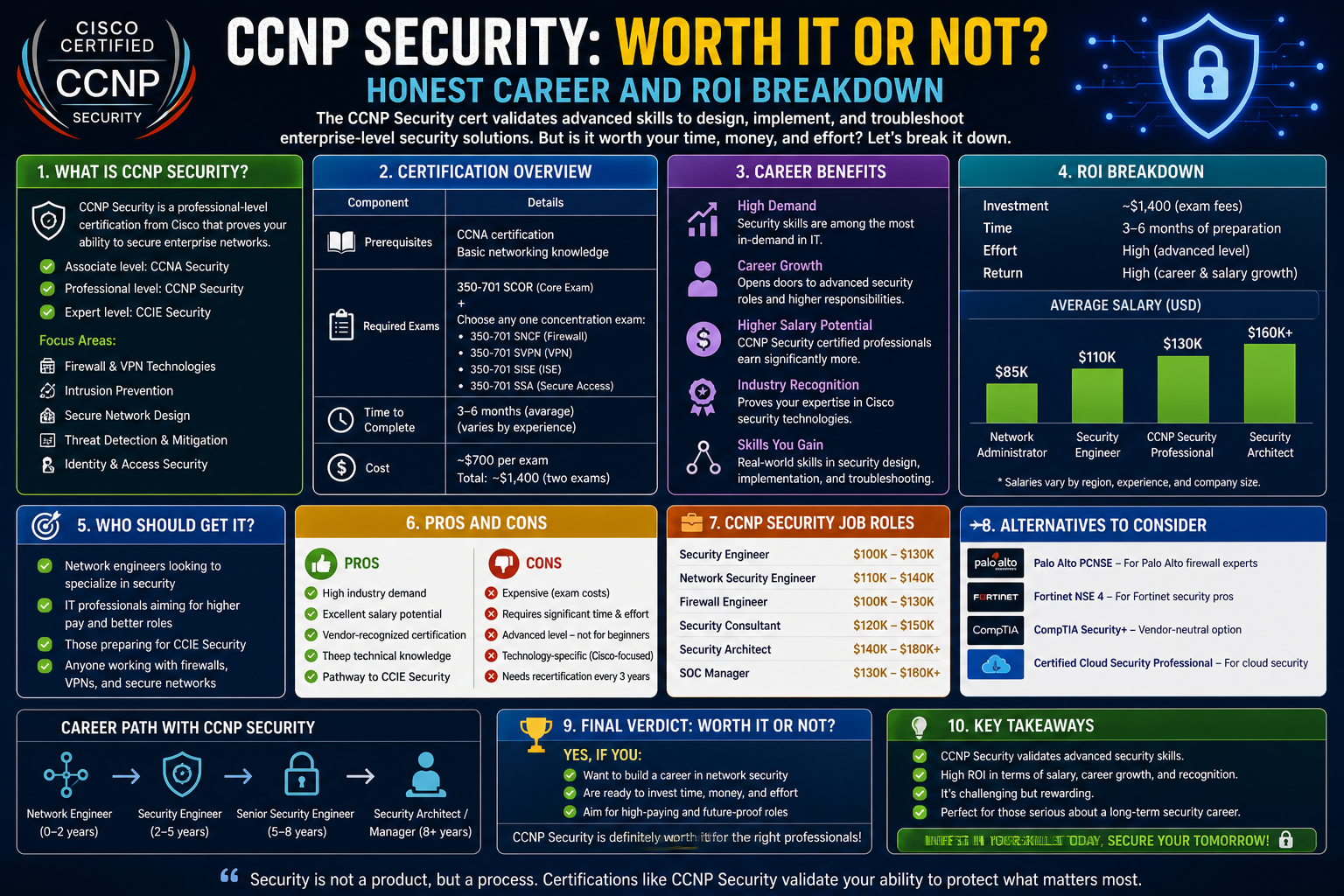
The CCNP Security certification sits in a very important position within the cybersecurity industry because it bridges foundational networking knowledge with advanced security concepts that are used in real enterprise environments. As organizations continue to expand their digital infrastructure across cloud platforms, remote access systems, and hybrid environments, the demand for professionals who can secure these complex systems has grown significantly. This certification reflects that shift by focusing not only on traditional network defense mechanisms but also on modern challenges such as cloud exposure, identity-based attacks, and automated threat detection.
What makes CCNP Security particularly relevant today is that cybersecurity is no longer a static field. Threat actors are constantly evolving their techniques, and organizations are forced to respond with equally adaptive security strategies. This has resulted in a stronger emphasis on professionals who understand both the technical and architectural aspects of security. CCNP Security aligns with this need by preparing candidates to think beyond individual devices or configurations and instead focus on securing entire ecosystems.
In addition to technical relevance, the certification also reflects a broader industry transformation where security is deeply integrated into every layer of IT infrastructure. From application development to network design and endpoint management, security considerations are now embedded in every stage of system deployment. CCNP Security prepares professionals to operate within this environment where security is not an isolated function but a continuous requirement.
Evolution of Cisco Security Certifications and Industry Alignment
Cisco has continuously evolved its certification structure to match the changing demands of the IT industry. Earlier versions of security certifications were heavily focused on device configuration and perimeter-based defense models. However, modern IT environments have become significantly more distributed, requiring a broader approach that incorporates cloud services, identity management, and automation.
The shift in 2026 reflects this evolution more clearly than ever before. Cisco has refined its certification paths to emphasize real-world applicability, particularly in areas such as Zero Trust architecture, Security Service Edge frameworks, and AI-driven threat intelligence. These updates are not simply cosmetic changes; they represent a fundamental shift in how security professionals are expected to think and operate.
One of the key motivations behind these changes is the increasing complexity of enterprise environments. Organizations are no longer operating within a single data center or a controlled internal network. Instead, they rely on multiple cloud providers, remote workforces, and interconnected applications that span across global infrastructure. This complexity requires security professionals who can design systems that are resilient, scalable, and adaptable.
Another important aspect of Cisco’s evolution is the growing influence of automation and artificial intelligence. Security operations today rely heavily on automated monitoring systems that can detect anomalies and respond to threats in real time. CCNP Security now reflects this shift by incorporating concepts that address how automation interacts with security infrastructure, ensuring professionals are prepared for modern operational demands.
Core Structure of CCNP Security and Its Role in Skill Development
The CCNP Security certification is structured in a way that allows professionals to develop both broad and specialized knowledge. At its core lies a comprehensive understanding of security technologies that form the backbone of enterprise protection systems. This includes areas such as secure network access, threat defense mechanisms, identity services, and endpoint protection.
The certification is designed to build progressively layered expertise. Candidates begin with foundational security concepts and gradually move toward more advanced topics that require analytical thinking and architectural understanding. This structured progression ensures that individuals are not just learning isolated technical tasks but are instead developing a holistic view of security systems.
A key component of this structure is the focus on real-world application. Rather than emphasizing theoretical knowledge alone, the certification encourages learners to engage with scenarios that reflect actual enterprise challenges. This includes handling multi-cloud environments, securing remote access systems, and managing large-scale security infrastructures.
Another important aspect of CCNP Security is its emphasis on adaptability. As cybersecurity threats continue to evolve, professionals must be capable of adjusting their strategies in response to new attack vectors. The certification encourages this mindset by exposing learners to dynamic environments where security configurations must be continuously evaluated and improved.
SCOR Exam and Its Strategic Importance in Security Careers
At the center of the CCNP Security certification is the SCOR exam, which serves as the foundational requirement for earning the certification. This exam is designed to evaluate a candidate’s understanding of core security technologies and their ability to implement them in complex environments.
The SCOR exam covers a wide range of topics that reflect the diverse nature of modern cybersecurity. These include network security principles, cloud-based protection strategies, secure access methods, endpoint defense mechanisms, and visibility tools used for monitoring and enforcement. Each of these areas plays a critical role in maintaining the integrity of enterprise systems.
One of the most important aspects of the SCOR exam is its alignment with advanced certifications such as CCIE Security. By passing SCOR, candidates not only move closer to CCNP Security but also unlock eligibility for higher-level certification paths. This creates a structured career progression that allows professionals to continuously build on their knowledge.
The exam also emphasizes integration across multiple security domains. Rather than treating each topic as an isolated subject, SCOR encourages candidates to understand how different components interact within a unified security architecture. This includes how identity systems influence access control, how cloud environments impact data protection, and how network visibility tools contribute to threat detection.
Another defining feature of the SCOR exam is its focus on operational security. Candidates are expected to understand not only how systems are designed but also how they function under real-world conditions. This includes monitoring traffic patterns, analyzing security logs, and responding to incidents as they occur.
Changing Exam Landscape and the 2026 Update Shift
The 2026 update to Cisco’s security certification structure marks one of the most significant changes in recent years. Several concentration exams have been updated, retired, or redefined to align with modern cybersecurity requirements. This reflects Cisco’s commitment to keeping its certification ecosystem aligned with current industry practices.
One of the most notable shifts is the retirement of older exams that focused heavily on traditional perimeter security models. These models, while still relevant in some contexts, no longer represent the full scope of modern enterprise security challenges. As a result, Cisco has introduced new areas of focus that prioritize cloud security, Zero Trust principles, and AI-driven threat analysis.
The updated structure places a stronger emphasis on architectural thinking. Instead of focusing solely on implementation details, candidates are now expected to understand how entire security systems are designed and integrated. This shift reflects the increasing complexity of enterprise environments where security decisions must account for scalability, automation, and cross-platform compatibility.
Another important change is the introduction of more advanced topics related to emerging technologies. Areas such as machine learning-based threat detection, quantum-resistant encryption concepts, and adaptive security frameworks are now part of the certification landscape. These topics highlight the forward-looking nature of Cisco’s certification strategy.
The changes also reflect the growing importance of cloud-native environments. As organizations continue to migrate workloads to cloud platforms, security professionals must be equipped to manage distributed systems that operate outside traditional network boundaries. The updated certification structure addresses this need by incorporating cloud-focused security concepts more deeply into its framework.
Introduction to Modern Security Design Thinking in CCNP Security
One of the most significant shifts in CCNP Security is the emphasis on design-oriented thinking rather than purely operational tasks. This approach encourages professionals to think like architects who are responsible for building secure systems from the ground up.
Design thinking in cybersecurity involves understanding how different components of an infrastructure interact and influence one another. It requires professionals to evaluate risks at a systemic level rather than focusing solely on individual vulnerabilities. This includes assessing how user identities, application layers, network configurations, and cloud services all contribute to the overall security posture of an organization.
This shift is particularly important in modern environments where security threats are no longer limited to external attacks. Internal misconfigurations, identity misuse, and application-level vulnerabilities have become just as significant as traditional network-based threats. As a result, security professionals must adopt a holistic perspective when designing systems.
CCNP Security encourages this mindset by introducing scenarios that require strategic decision-making. Instead of simply configuring devices, candidates must analyze complex environments and determine the most effective security architecture. This includes selecting appropriate technologies, designing scalable systems, and ensuring compliance with organizational policies.
Another important aspect of design thinking is adaptability. Security systems must be able to evolve as new threats emerge and as organizational requirements change. This requires professionals to design flexible architectures that can be modified without compromising overall system integrity.
Expanding Role of Cloud Security and Hybrid Infrastructure Protection
Cloud computing has become a dominant force in modern IT environments, and its influence on cybersecurity is profound. Organizations are increasingly adopting hybrid infrastructures that combine on-premises systems with cloud-based services. This creates new challenges for security professionals who must ensure consistent protection across multiple environments.
CCNP Security addresses this challenge by incorporating cloud security principles into its curriculum. Professionals are expected to understand how to secure cloud workloads, manage identity across distributed systems, and ensure data protection in environments that span multiple providers.
One of the key challenges in cloud security is visibility. Unlike traditional networks, where traffic flows through controlled points, cloud environments are highly dynamic and often lack centralized monitoring. This makes it more difficult to detect anomalies and respond to threats in real time. CCNP Security emphasizes the importance of implementing tools and strategies that provide visibility across these distributed environments.
Another important consideration is access control. In hybrid environments, users may access resources from multiple locations and devices. This requires advanced identity management systems that can enforce consistent policies regardless of where the user is connecting from. CCNP Security explores these concepts in detail, helping professionals understand how to implement secure access frameworks.
Data protection is also a critical component of cloud security. Organizations must ensure that sensitive information remains secure both at rest and in transit. This involves encryption strategies, secure communication protocols, and strict access controls that prevent unauthorized access.
Integration of AI, Automation, and Modern Threat Intelligence
Artificial intelligence and automation are transforming the cybersecurity landscape at a rapid pace. Modern security systems rely heavily on automated tools that can analyze large volumes of data, detect anomalies, and respond to threats without human intervention. CCNP Security incorporates these concepts to ensure professionals are prepared for this evolving environment.
AI-driven security tools are capable of identifying patterns that would be difficult for humans to detect manually. These tools can analyze network traffic, user behavior, and system logs to identify potential threats in real time. This allows organizations to respond to incidents more quickly and effectively.
Automation also plays a key role in reducing operational complexity. Security teams often deal with large volumes of alerts and events, many of which require immediate attention. Automated systems can prioritize these alerts, filter out false positives, and even initiate predefined response actions.
Threat intelligence is another important area where AI and automation intersect. Modern security systems rely on continuously updated threat intelligence feeds that provide information about emerging vulnerabilities and attack techniques. CCNP Security helps professionals understand how to integrate these feeds into their security infrastructure.
The combination of AI, automation, and threat intelligence represents a significant shift in how cybersecurity is managed. Instead of relying solely on manual processes, organizations are increasingly adopting intelligent systems that can adapt to changing conditions in real time.
Enterprise Security Architecture in Real-World Environments
Modern enterprise environments are far more complex than traditional network setups, and this complexity is one of the main reasons why CCNP Security remains relevant. Organizations today operate across multiple layers of infrastructure, including on-premises data centers, hybrid cloud systems, SaaS platforms, and remote workforce endpoints. Each layer introduces its own security challenges, and these challenges must be addressed through a unified architectural approach.
Enterprise security architecture is not just about deploying tools or configuring firewalls. It is about designing an interconnected system where each security component supports the others. This includes identity management systems, access control policies, intrusion detection mechanisms, and data protection strategies working together in a coordinated manner.
A key challenge in enterprise environments is maintaining consistency. Security policies must be enforced uniformly across all systems, regardless of location or platform. This becomes particularly difficult when organizations rely on multiple cloud providers or support remote employees accessing resources from different geographic locations. CCNP Security emphasizes the importance of designing architectures that maintain consistency while still allowing flexibility.
Another critical aspect is scalability. As organizations grow, their security infrastructure must be able to expand without requiring complete redesigns. This requires modular security architectures that can adapt to increasing workloads, additional users, and new application deployments without compromising performance or protection levels.
Zero Trust Security Models and Their Increasing Importance
One of the most significant shifts in modern cybersecurity is the adoption of Zero Trust principles. Unlike traditional security models that assume everything inside a network perimeter is trusted, Zero Trust operates on the principle that no user, device, or application should be trusted by default.
This approach has become essential in today’s environment because traditional network boundaries no longer exist in the same way they once did. With cloud computing, remote work, and mobile access, users connect from anywhere, making it impossible to rely solely on perimeter-based defenses.
Zero Trust requires continuous verification of identity, device health, and access permissions. Every access request must be authenticated and authorized before it is granted. This significantly reduces the risk of unauthorized access and lateral movement within networks.
CCNP Security incorporates Zero Trust concepts by emphasizing identity-based security models. Professionals are expected to understand how to implement policies that dynamically adjust based on user behavior, device posture, and contextual factors such as location and risk level.
Another important element of Zero Trust is segmentation. Instead of allowing broad access across a network, systems are divided into smaller segments where access is strictly controlled. This limits the potential damage that can occur if a breach happens.
Zero Trust also relies heavily on continuous monitoring. Security systems must constantly analyze activity patterns to detect anomalies that may indicate compromised credentials or malicious behavior. This requires integration between identity systems, network monitoring tools, and threat intelligence platforms.
Identity and Access Management in Modern Security Frameworks
Identity and Access Management (IAM) has become one of the most critical components of cybersecurity architecture. In modern environments, identity is the new perimeter, meaning that controlling who has access to what resources is more important than controlling physical network boundaries.
IAM systems are responsible for verifying user identities, managing authentication processes, and enforcing access policies. These systems ensure that only authorized individuals can access sensitive resources, and they play a central role in preventing unauthorized access.
One of the key challenges in IAM is managing multiple identity sources. Organizations often use a combination of internal directories, cloud-based identity providers, and third-party authentication systems. CCNP Security focuses on how these systems can be integrated into a unified access control framework.
Another important aspect is multi-factor authentication. Relying solely on passwords is no longer sufficient in modern security environments. Multi-factor authentication adds additional layers of verification, such as biometrics, security tokens, or mobile-based authentication apps.
IAM systems also play a critical role in enforcing least privilege principles. This means users are only given the minimum level of access required to perform their job functions. This reduces the risk of internal misuse and limits exposure in the event of credential compromise.
In addition to user identity, modern IAM systems also manage machine identities. With the rise of automated systems, APIs, and cloud services, non-human identities have become just as important as human users. CCNP Security helps professionals understand how to secure these machine-to-machine interactions.
Advanced Threat Detection and Incident Response Strategies
Cyber threats have become increasingly sophisticated, requiring advanced detection and response mechanisms. Traditional security tools that rely on static rules are no longer sufficient to identify modern attack techniques. Instead, organizations rely on behavioral analysis, machine learning, and real-time monitoring systems.
Advanced threat detection involves analyzing large volumes of data to identify unusual patterns that may indicate malicious activity. This includes monitoring network traffic, user behavior, system logs, and application activity. CCNP Security emphasizes the importance of understanding how these systems work together to provide comprehensive visibility.
One of the key challenges in threat detection is distinguishing between legitimate and malicious activity. Modern environments generate a high volume of alerts, many of which are false positives. Security professionals must be able to analyze these alerts and determine which ones require immediate attention.
Incident response is closely linked to threat detection. Once a potential threat is identified, organizations must have predefined response strategies in place. These strategies outline how to contain the threat, investigate its origin, and restore normal operations.
A well-designed incident response plan includes multiple stages such as detection, containment, eradication, recovery, and post-incident analysis. Each stage requires coordination between different security tools and teams.
Automation plays an increasingly important role in incident response. Automated systems can quickly isolate affected systems, block malicious traffic, and initiate remediation processes. This reduces response times and minimizes the impact of security incidents.
Cloud Security Challenges in Distributed Environments
Cloud computing has fundamentally changed how organizations build and manage IT infrastructure. While it offers flexibility and scalability, it also introduces new security challenges that require specialized knowledge and strategies.
One of the primary challenges in cloud security is the shared responsibility model. Cloud providers are responsible for securing the underlying infrastructure, but customers are responsible for securing their own data, applications, and configurations. This division of responsibility often leads to misconfigurations, which are a common cause of security breaches.
Another challenge is visibility. In traditional environments, organizations have full control over their network infrastructure. In cloud environments, however, resources are often distributed across multiple regions and providers, making it more difficult to monitor activity.
Data security is also a major concern in cloud environments. Organizations must ensure that sensitive information is properly encrypted both at rest and in transit. They must also implement strict access controls to prevent unauthorized access.
CCNP Security addresses these challenges by emphasizing cloud security architecture principles. Professionals are expected to understand how to design secure cloud environments that integrate with existing on-premises systems.
Hybrid cloud environments introduce additional complexity because they combine multiple infrastructure types. Ensuring consistent security policies across these environments requires careful planning and coordination.
Security Automation and Orchestration in Modern Operations
Security automation has become essential in managing large-scale enterprise environments. As organizations grow, the number of security events and alerts increases dramatically, making it impossible for human teams to manage everything manually.
Automation helps streamline security operations by performing repetitive tasks, filtering alerts, and initiating predefined responses to known threats. This allows security teams to focus on more complex and strategic issues.
Security Orchestration, Automation, and Response (SOAR) systems play a central role in modern security operations. These systems integrate multiple security tools and coordinate their actions based on predefined workflows.
For example, when a potential threat is detected, a SOAR system can automatically gather relevant data, analyze the severity of the threat, isolate affected systems, and notify security personnel. This significantly reduces response times and improves overall efficiency.
CCNP Security introduces professionals to the concept of integrating automation into security architectures. This includes understanding how automated systems interact with identity management, network monitoring, and threat intelligence platforms.
Another important aspect of automation is reducing human error. Manual security processes are often prone to mistakes, especially in high-pressure situations. Automation helps ensure that responses are consistent and follow predefined security policies.
Network Security Infrastructure and Defensive Design Principles
Network security remains a foundational element of cybersecurity architecture, even as environments become more distributed and cloud-focused. Protecting network infrastructure involves implementing multiple layers of defense that work together to prevent unauthorized access and detect malicious activity.
Firewalls play a central role in network security by controlling traffic between different network segments. Modern firewalls are far more advanced than traditional packet-filtering systems. They can inspect application-level traffic, detect anomalies, and enforce complex security policies.
Intrusion detection and prevention systems (IDPS) are also critical components of network security. These systems monitor network traffic for signs of malicious activity and can automatically block or alert administrators when threats are detected.
Another important concept in network security is segmentation. By dividing networks into smaller segments, organizations can limit the spread of attacks and reduce the overall attack surface. Each segment can have its own security policies and access controls.
Secure communication protocols are also essential for protecting data in transit. Encryption ensures that even if data is intercepted, it cannot be read without the appropriate decryption keys.
CCNP Security emphasizes the importance of designing network infrastructures that are both secure and efficient. This requires balancing security requirements with performance considerations to ensure that systems remain functional while still being protected.
Endpoint Protection and Modern Device Security Challenges
Endpoints have become one of the most vulnerable components in modern IT environments. With the rise of remote work, mobile devices, and personal device usage, endpoints now represent a major entry point for cyberattacks.
Endpoint protection involves securing devices such as laptops, smartphones, and tablets that connect to organizational networks. These devices often operate outside traditional network boundaries, making them more difficult to monitor and control.
One of the key challenges in endpoint security is ensuring consistent protection across all devices. Organizations must implement security policies that apply regardless of device type or location.
Endpoint detection and response (EDR) systems are commonly used to monitor device activity and detect potential threats. These systems can identify suspicious behavior, such as unauthorized file access or unusual network connections.
Another important aspect of endpoint security is patch management. Keeping software and operating systems up to date is critical for preventing vulnerabilities from being exploited.
CCNP Security highlights the importance of integrating endpoint protection into broader security architectures. Endpoints are not isolated systems; they are part of a larger ecosystem that includes networks, cloud services, and identity systems.
Role of Security Visibility and Monitoring Systems
Visibility is one of the most important aspects of modern cybersecurity. Without proper visibility, organizations cannot detect threats, analyze incidents, or enforce security policies effectively.
Security monitoring systems collect and analyze data from multiple sources, including network traffic, system logs, application activity, and user behavior. This data is used to identify anomalies and potential security incidents.
One of the key challenges in security monitoring is managing the volume of data. Large organizations generate massive amounts of logs and alerts, making it difficult to identify meaningful patterns.
To address this challenge, modern security systems use correlation techniques to combine data from multiple sources and identify relationships between events. This helps security teams focus on the most relevant threats.
Real-time monitoring is also essential for detecting and responding to threats quickly. Delays in detection can result in significant damage, especially in fast-moving attack scenarios.
CCNP Security emphasizes the importance of integrating visibility tools into security architectures. Without proper monitoring, even the most advanced security systems can fail to detect critical threats.
Risk Management and Adaptive Security Strategies
Risk management is a fundamental part of cybersecurity strategy. It involves identifying potential threats, assessing their impact, and implementing measures to reduce risk levels.
Adaptive security strategies take risk management a step further by continuously adjusting security policies based on changing conditions. This includes responding to new threats, updating configurations, and modifying access controls.
One of the key principles of risk management is prioritization. Not all threats have the same level of impact, so organizations must focus on the most critical risks first.
CCNP Security introduces professionals to the concept of dynamic risk assessment, where security decisions are made based on real-time data rather than static policies.
Adaptive security also involves continuous improvement. Security systems must be regularly evaluated and updated to ensure they remain effective against evolving threats.
This approach requires collaboration between different teams, including network engineers, security analysts, and system administrators.
Future of CCNP Security in an AI-Driven Cybersecurity World
The direction of CCNP Security is strongly influenced by how quickly cybersecurity itself is evolving. As organizations adopt more automation, cloud-native systems, and AI-driven security tools, the expectations from security professionals are also changing. The certification is no longer just about configuring firewalls or managing access controls. It is increasingly about understanding how security ecosystems behave as a whole and how intelligent systems can be used to strengthen defenses.
Artificial intelligence is one of the most important forces shaping this future. Security tools now rely on machine learning models to detect unusual behavior patterns that traditional rule-based systems would miss. These systems continuously learn from network traffic, user activity, and historical attack data to improve detection accuracy. CCNP Security aligns with this shift by introducing concepts that help professionals understand how AI integrates into security operations rather than replacing human decision-making entirely.
However, AI in cybersecurity is not only a defensive tool. Attackers are also using AI to create more sophisticated phishing campaigns, automate vulnerability discovery, and bypass traditional defenses. This creates a constant arms race between attackers and defenders. Security professionals are now expected to understand how AI-based threats operate so they can design systems capable of resisting them.
This evolution highlights a key shift in CCNP Security’s purpose. It is no longer just about technical configuration but about strategic defense planning in environments where threats are dynamic and intelligent. Professionals are expected to evaluate how automated systems make decisions, how machine learning models detect anomalies, and how to adjust security architectures when those systems fail or produce false positives.
Shift Toward Security Service Edge and Distributed Defense Models
Another major trend shaping CCNP Security is the move toward Security Service Edge (SSE) and distributed security models. Traditional perimeter-based security is no longer effective because users and applications are no longer confined to a single network boundary. Instead, they exist across multiple environments, including cloud platforms, remote devices, and third-party services.
Security Service Edge represents a shift where security is delivered from the cloud rather than centralized hardware. This allows organizations to enforce consistent security policies regardless of where users are located. CCNP Security incorporates these concepts by focusing on how security controls can be applied in distributed environments without relying on traditional perimeter defenses.
This distributed approach also introduces new challenges. For example, latency, identity verification, and policy enforcement must be handled in real time across geographically dispersed systems. Security professionals must understand how to design architectures that maintain performance while still enforcing strict security controls.
Zero Trust and SSE are closely related because both rely on the assumption that no user or device should be trusted by default. Instead, every access request must be verified continuously. This includes checking user identity, device health, location, and behavioral patterns before granting access.
The shift toward distributed defense models also means that visibility becomes more complex. Security teams must monitor activity across multiple cloud providers, remote endpoints, and network segments. This requires centralized logging, advanced analytics, and real-time correlation of security events.
Growing Importance of Security Architecture Thinking
One of the most significant developments in CCNP Security is the increasing emphasis on architecture-level thinking. Instead of focusing only on implementation tasks, professionals are now expected to design entire security ecosystems.
Security architecture thinking involves understanding how different components of an IT environment interact. This includes networks, identity systems, applications, endpoints, and cloud platforms. The goal is to create a unified security strategy that protects all layers of the infrastructure.
This approach is especially important in modern hybrid environments. Organizations often use multiple cloud providers along with on-premises systems, which creates complexity in managing security policies. A well-designed security architecture ensures that policies remain consistent and enforceable across all environments.
Another key aspect of architectural thinking is resilience. Security systems must be designed to continue functioning even when parts of the infrastructure fail or are compromised. This includes redundancy, failover systems, and adaptive security controls that respond automatically to threats.
CCNP Security encourages professionals to think in terms of systems rather than individual devices. This means considering how a change in one part of the infrastructure affects the entire security posture. For example, modifying an identity policy may impact cloud access, endpoint security, and application behavior simultaneously.
Integration of DevSecOps and Continuous Security Practices
Modern software development has shifted toward DevOps practices, where development and operations teams work together to deliver applications faster. Security has now become an integrated part of this process, leading to the concept of DevSecOps.
DevSecOps ensures that security is embedded into every stage of the software development lifecycle. Instead of treating security as a final step, it is continuously applied from design to deployment and beyond. This reduces vulnerabilities and improves overall system resilience.
CCNP Security reflects this shift by introducing concepts related to continuous security monitoring and automated policy enforcement within development pipelines. Security professionals must understand how applications are built, tested, and deployed to protect them effectively.
One of the key challenges in DevSecOps is maintaining speed without sacrificing security. Automated tools help address this by scanning code for vulnerabilities, enforcing security policies, and monitoring application behavior in real time.
Another important aspect is collaboration. Developers, operations teams, and security professionals must work together to ensure that security requirements are properly implemented without slowing down development cycles.
Continuous security practices also extend beyond development into production environments. Systems must be constantly monitored for vulnerabilities, misconfigurations, and unusual behavior patterns. This creates a feedback loop where security insights are used to improve future development processes.
Expanding Role of Cybersecurity Professionals in Enterprise Strategy
Cybersecurity is no longer just a technical function within organizations. It has become a strategic business priority that influences decision-making at the highest levels. As a result, cybersecurity professionals are expected to contribute not only to technical implementation but also to organizational strategy.
CCNP Security plays a role in preparing professionals for this expanded responsibility. It encourages a broader understanding of how security impacts business operations, risk management, and regulatory compliance.
One of the key areas where cybersecurity intersects with business strategy is risk management. Organizations must evaluate potential security risks in terms of their financial, operational, and reputational impact. Security professionals help guide these decisions by providing technical insight into potential threats and mitigation strategies.
Another important area is compliance. Many industries are subject to strict regulatory requirements that govern how data is stored, accessed, and protected. Security professionals must ensure that systems meet these requirements while still supporting business operations.
Cybersecurity also plays a role in enabling digital transformation. As organizations adopt new technologies such as cloud computing, artificial intelligence, and IoT devices, security becomes a critical factor in determining whether these technologies can be safely deployed.
This expanded role means that CCNP Security is not just a technical certification. It is also a pathway for professionals to move into leadership roles where they influence how organizations approach cybersecurity at a strategic level.
Long-Term Value of CCNP Security in Career Progression
The long-term value of CCNP Security lies in its ability to provide both technical depth and strategic understanding. Professionals who earn this certification gain skills that are applicable across a wide range of industries and job roles.
One of the most important aspects of this value is career mobility. CCNP Security opens doors to roles such as security engineer, network security architect, SOC analyst, and cybersecurity consultant. These roles are in high demand across industries such as finance, healthcare, government, and technology.
Another key benefit is career progression. CCNP Security often serves as a stepping stone toward more advanced certifications and roles. Professionals who continue developing their skills can move into senior architecture positions or pursue expert-level certifications.
The certification also provides long-term relevance because it evolves alongside industry trends. As cybersecurity continues to change, CCNP Security updates its content to reflect new technologies and threats. This ensures that certified professionals remain aligned with current industry expectations.
In addition to technical and career benefits, CCNP Security also enhances problem-solving abilities. Professionals learn how to analyze complex environments, identify risks, and design effective solutions. These skills are valuable not only in cybersecurity roles but also in broader IT leadership positions.
As organizations continue to invest in digital transformation, the need for skilled security professionals will continue to grow. CCNP Security positions individuals to take advantage of these opportunities by providing a strong foundation in both current and emerging cybersecurity practices.
Conclusion
The CCNP Security certification holds a strong position in the modern cybersecurity ecosystem because it reflects how dramatically the industry has evolved over the past decade. What once focused heavily on perimeter defense and device-level configuration has now transformed into a much broader discipline that includes cloud security, identity management, automation, AI-driven threat detection, and architectural design thinking. This shift is exactly what makes CCNP Security relevant today, especially for professionals who want to move beyond entry-level roles and step into more advanced, decision-making positions in cybersecurity.
One of the most important takeaways from evaluating CCNP Security is that it is not just a technical credential. It is a career-defining certification that signals readiness for complex, enterprise-scale environments. Organizations today are not looking for professionals who only know how to configure security tools; they are looking for individuals who understand how entire systems interact, how threats evolve across hybrid infrastructures, and how to design security frameworks that remain effective under constant change.
The inclusion of modern technologies such as Zero Trust architecture, cloud-native security, and AI-based threat intelligence demonstrates that CCNP Security is aligned with the direction cybersecurity is heading rather than where it has been. This future-focused approach ensures that professionals who invest in this certification are not learning outdated concepts but are instead preparing for real-world challenges that are actively shaping enterprise security strategies.
Another key factor that strengthens the value of CCNP Security is its impact on career progression. The certification opens doors to high-demand roles such as security engineer, security architect, SOC analyst, and cybersecurity consultant. These roles are not only well-compensated but also critical to organizational resilience. As cyber threats become more sophisticated and frequent, companies are increasingly prioritizing professionals who can build, maintain, and evolve secure infrastructures.
In addition to job opportunities, CCNP Security also contributes significantly to salary growth and long-term career stability. Cybersecurity remains one of the fastest-growing fields in IT, and professionals with advanced certifications are consistently positioned in higher salary brackets. More importantly, the demand for skilled security professionals is not limited to a single industry. Finance, healthcare, government, telecommunications, and cloud service providers all require strong security expertise, making this certification widely applicable.
However, it is also important to recognize that CCNP Security is not an entry-level certification and should not be approached casually. It requires a solid foundation in networking and security concepts, along with practical experience in enterprise environments. The depth of knowledge required means that candidates must invest significant time in preparation and hands-on practice. This difficulty level is intentional, as it ensures that certified professionals are capable of handling real-world security challenges.
The certification also requires ongoing commitment. With recertification cycles and continuous changes in exam content, professionals must stay updated with evolving technologies and security practices. While this may seem demanding, it also ensures that CCNP Security holders remain relevant in an industry that changes rapidly.
Perhaps one of the most important aspects of CCNP Security is how it changes the way professionals think. It shifts the focus from reactive troubleshooting to proactive security design. Instead of simply responding to threats, certified professionals are trained to anticipate them, design systems that minimize risk, and build architectures that adapt to new attack vectors. This mindset is extremely valuable in modern cybersecurity environments where threats are constantly evolving.
Ultimately, CCNP Security stands out because it is not just about passing exams or memorizing configurations. It is about developing a comprehensive understanding of how security works at scale and how it integrates into every layer of modern IT infrastructure. For professionals who are serious about advancing their careers in cybersecurity, especially those already in networking or IT roles, this certification provides a clear and structured path toward higher responsibility and expertise.
In a world where cyber threats are becoming more advanced and digital systems are becoming more interconnected, the need for skilled security professionals has never been greater. CCNP Security sits directly in the center of this demand, offering both technical depth and strategic insight. It prepares professionals not just for today’s challenges but for the evolving security landscape of the future, making it a highly valuable investment for those committed to long-term growth in the cybersecurity field.