Modern system administration is no longer limited to simply “keeping servers running.” The role has evolved into a multi-layered discipline that touches nearly every part of an organization’s digital infrastructure. A system administrator is expected to maintain stability across operating systems, ensure security compliance, support end users, manage networks, and often assist in cloud or virtualization environments.
This expansion of responsibilities has made the role both more valuable and more demanding. In earlier IT environments, administrators could specialize narrowly in one operating system or platform. Today, that approach is rarely enough. Businesses typically operate hybrid environments that include multiple operating systems working together, sometimes across physical data centers and cloud infrastructure.
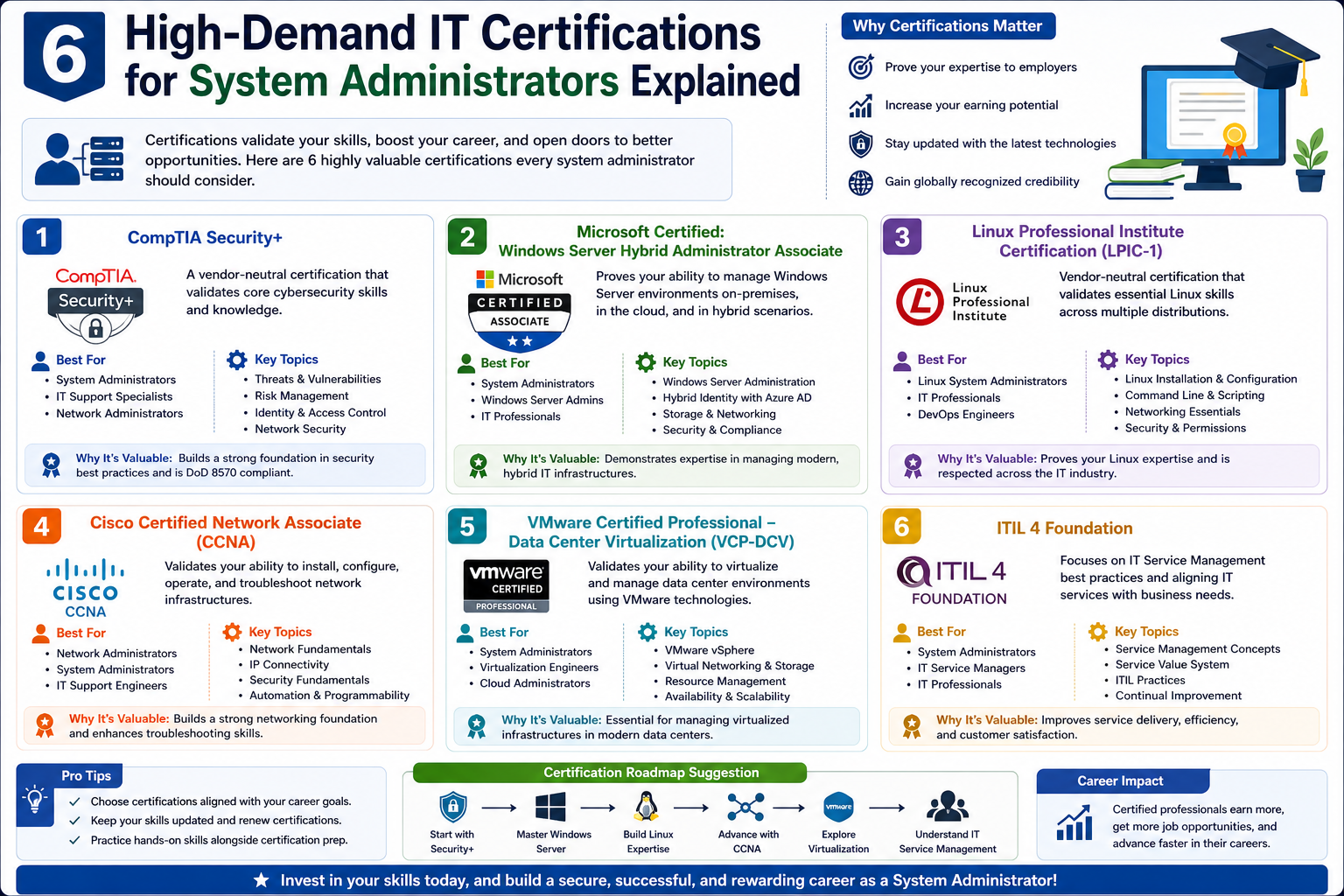
Because of this complexity, certifications have become an efficient way for aspiring and practicing system administrators to demonstrate competence. Rather than spending years learning through trial and error in production environments, certifications provide structured learning paths that cover essential operating systems and technologies in a controlled, measurable way.
Operating system certifications, in particular, form the foundation of a system administrator’s skill set. They validate the ability to work across platforms such as Windows Server environments, desktop operating systems, and Linux distributions. These three areas alone form the backbone of most enterprise IT ecosystems.
Why Operating System Certifications Matter in Modern IT Environments
Operating systems are the foundation of every IT infrastructure. Whether a company runs applications, databases, virtual machines, or cloud services, all of these ultimately rely on operating systems to function. For a system administrator, understanding how these systems behave under load, how they are configured, and how they recover from failure is essential.
Certifications provide structured exposure to these environments. Instead of learning only what is required for a specific job role, candidates gain a broader understanding of system design principles, administrative tools, and troubleshooting techniques.
Another important reason certifications matter is standardization. Different organizations may configure systems in slightly different ways, but certification programs are built around widely accepted best practices. This allows administrators to enter new environments and adapt quickly, even if the specific implementation is unfamiliar.
Additionally, employers often use certifications as a filtering mechanism during hiring. While real-world experience remains important, certifications demonstrate baseline knowledge and commitment to professional development. In competitive job markets, this can significantly improve employability.
Microsoft Server Environments as the Backbone of Enterprise Infrastructure
Microsoft Server technologies remain one of the most widely deployed systems in enterprise environments. Many organizations rely on Microsoft-based infrastructure for identity management, file services, application hosting, and internal communication systems.
A system administrator working in such environments must understand how these services interact. Microsoft Server operating systems often function as domain controllers, managing authentication and authorization across the network. Active Directory plays a central role in this structure, controlling user access, permissions, and organizational policies.
Beyond identity services, Microsoft Server systems may also host applications, manage email services, or provide remote desktop capabilities. Each of these roles requires a strong understanding of system configuration, resource allocation, and performance monitoring.
Certifications focused on Microsoft Server environments help administrators understand how to configure and maintain these roles effectively. They also provide insight into system recovery, backup strategies, and security hardening techniques. These skills are critical in preventing downtime and ensuring business continuity.
As enterprise environments continue to evolve, newer versions of Microsoft Server introduce enhanced virtualization support, improved security frameworks, and better integration with cloud services. System administrators must remain adaptable, as organizations may run multiple server versions simultaneously during migration periods or hybrid deployments.
Active Directory and Identity Management Fundamentals
One of the most important components within Microsoft Server environments is identity management. Active Directory serves as the central system for managing users, devices, and access permissions across an organization.
For system administrators, understanding how Active Directory functions is essential. It determines how users log in, what resources they can access, and how policies are enforced across devices. Misconfiguration in this area can lead to serious security vulnerabilities or operational disruptions.
Active Directory is also responsible for organizing network resources into logical structures such as domains, trees, and forests. These structures allow large organizations to maintain order and scalability as they grow.
Certifications covering Microsoft Server environments typically emphasize these concepts, ensuring that administrators understand both the technical configuration and the strategic design behind identity management systems.
The Importance of Microsoft Desktop Operating Systems in IT Support
While servers form the backbone of IT infrastructure, desktop operating systems represent the primary point of interaction for end users. Most employees in an organization rely on desktop systems to perform daily tasks such as communication, documentation, and application usage.
Microsoft desktop operating systems remain the dominant choice in corporate environments. As a result, system administrators must be proficient in managing these systems at scale. This includes installation, configuration, troubleshooting, and maintenance.
Desktop administration also involves managing updates, enforcing security policies, and ensuring compatibility with organizational software. Even small misconfigurations on desktop systems can lead to productivity loss across entire departments.
Certifications related to desktop environments help administrators understand how these systems integrate with broader network infrastructure. They also cover essential troubleshooting techniques, allowing administrators to resolve common issues such as performance degradation, software conflicts, and connectivity problems.
Entry-Level Certifications and Their Role in System Administration Careers
For individuals entering the IT field, foundational certifications provide an important starting point. These certifications typically cover basic concepts in networking, hardware, operating systems, and security.
Rather than focusing on deep specialization, entry-level certifications emphasize broad understanding. This ensures that candidates can support a wide range of IT tasks, which is especially important in junior system administration roles.
These foundational certifications also introduce candidates to structured troubleshooting methodologies. Instead of guessing at solutions, learners are taught how to systematically diagnose and resolve technical issues. This approach is essential in real-world IT environments, where efficiency and accuracy are critical.
As system administrators gain experience, these foundational skills serve as a base for more advanced specialization in server management, virtualization, cloud computing, or security engineering.
The Growing Importance of Linux in Enterprise Systems
Linux has become one of the most important operating systems in modern IT infrastructure. Although it was once considered a niche platform used primarily by developers and technical specialists, it now plays a central role in servers, cloud computing, and enterprise applications.
Many web servers, database systems, and cloud environments rely on Linux due to its stability, flexibility, and performance efficiency. Unlike some proprietary systems, Linux allows administrators to customize nearly every aspect of system behavior.
This flexibility, however, comes with complexity. Linux systems are often managed through command-line interfaces rather than graphical tools. This requires system administrators to develop strong familiarity with shell commands, file system structures, and system configuration files.
Certifications related to Linux administration help bridge this gap by teaching structured approaches to system management. They cover essential topics such as user permissions, process management, package installation, and system monitoring.
Understanding the Linux Philosophy and System Structure
One of the key differences between Linux and other operating systems is its design philosophy. Linux is built around modularity and transparency. Instead of hiding system processes behind graphical interfaces, it exposes them in a way that allows administrators to understand exactly how the system operates.
This structure gives system administrators greater control but also requires deeper technical understanding. Configuration files play a central role in system behavior, and even small changes can significantly impact performance or security.
Linux also treats devices, processes, and files in a unified way, which differs from more segmented operating system architectures. Understanding this model is essential for effective system administration.
Certifications in Linux administration often emphasize these conceptual differences, helping learners develop a mindset suited for managing complex server environments.
Linux in Modern Infrastructure and Cloud Environments
The rise of cloud computing has significantly increased the importance of Linux systems. Many cloud platforms rely heavily on Linux-based virtual machines and containers. This has made Linux skills highly valuable for system administrators working in modern infrastructure environments.
Linux is also commonly used in containerization technologies, which allow applications to run in isolated environments. These technologies depend on efficient resource management and system-level control, both of which are core strengths of Linux.
As organizations continue to adopt hybrid and cloud-native architectures, Linux proficiency has become a standard requirement in many system administration roles.
Introduction to Virtualization as a Core System Administration Skill
Although virtualization is not an operating system, it is closely tied to system administration across all platforms. Virtualization allows multiple operating systems to run on a single physical machine by dividing hardware resources into virtual environments.
This technology has transformed IT infrastructure by improving resource utilization, reducing hardware costs, and increasing system flexibility. Instead of dedicating a physical server to a single task, organizations can now run multiple virtual machines on the same hardware.
System administrators must understand how virtualization platforms allocate resources such as CPU, memory, and storage. They must also be able to monitor performance and ensure that virtual machines operate efficiently.
Virtualization skills complement operating system certifications by providing a broader understanding of how systems interact at an infrastructure level.
Resource Allocation and Efficiency in Virtual Environments
One of the most important aspects of virtualization is resource management. Virtual machines depend on shared physical resources, which means administrators must carefully balance workloads to avoid performance degradation.
Modern virtualization systems allow dynamic resource allocation, enabling virtual machines to request additional resources when needed. This flexibility improves efficiency but also requires careful monitoring to prevent overutilization.
System administrators working with virtual environments must understand how to configure resource limits, prioritize workloads, and troubleshoot performance issues. These skills are increasingly important in enterprise IT environments where virtualization is widely used.
The Interconnected Nature of Operating Systems in IT Ecosystems
In real-world environments, operating systems rarely operate in isolation. Windows servers may communicate with Linux-based applications, while desktop systems interact with both cloud services and on-premise infrastructure.
System administrators must therefore understand how these systems integrate and communicate. Networking protocols, authentication systems, and file-sharing services all play a role in enabling interoperability.
Operating system certifications help build this understanding by exposing learners to cross-platform concepts and integration techniques. This ensures that administrators are not limited to a single technology but can manage diverse environments effectively.
As IT ecosystems continue to evolve, this ability to work across multiple operating systems becomes increasingly valuable, forming the foundation of a successful system administration career.
The Growing Demand for Multi-Platform System Administrators
System administration has shifted from a single-platform responsibility into a multi-ecosystem discipline. In modern organizations, it is no longer unusual to find Windows servers running alongside Linux-based application stacks, macOS devices in corporate environments, and cloud-hosted virtual infrastructure operating across multiple providers.
This diversity means that system administrators are expected to understand how different operating systems behave, communicate, and integrate within a shared infrastructure. Employers increasingly value professionals who can move fluidly between platforms rather than specialists confined to a single system.
As a result, certification paths have expanded beyond traditional Windows-focused training. They now include Linux administration, Apple ecosystem management, virtualization technologies, and automation tools that unify these environments. Each of these areas contributes to a system administrator’s ability to manage complex infrastructure reliably and efficiently.
Linux as a Strategic Skill in Modern Infrastructure
Linux has evolved from a niche operating system into a foundational technology for enterprise computing. Its presence is particularly strong in cloud environments, web hosting platforms, containerized applications, and high-performance computing systems.
Unlike proprietary operating systems, Linux offers flexibility and transparency. Administrators can modify configurations at a granular level, optimize performance based on workload requirements, and automate system behavior using scripts and tools. This level of control makes it highly attractive in environments where scalability and efficiency are critical.
However, Linux administration requires a different mindset compared to graphical operating systems. Many tasks are performed through the command line, where precision and understanding of system structure are essential. Files, processes, and hardware resources are managed through textual commands rather than visual interfaces.
This command-driven approach encourages system administrators to develop deeper technical competence. Instead of relying on automated tools, they learn to interact directly with system components, gaining insight into how the operating system functions internally.
File System Architecture and Linux System Behavior
One of the defining characteristics of Linux is its unified file system structure. Unlike operating systems that separate system components into distinct categories, Linux treats almost everything as part of a single hierarchical file structure.
Devices, processes, and configurations are represented as files or directories. This design simplifies certain aspects of system management while also requiring administrators to understand how these elements interact.
System configuration files play a particularly important role. Unlike centralized configuration interfaces, Linux systems often rely on distributed configuration files stored in specific directories. Modifying system behavior typically involves editing these files directly.
This approach provides flexibility but also introduces complexity. A small misconfiguration can affect system stability or security. For this reason, system administrators working with Linux must develop strong attention to detail and a structured approach to system changes.
Process Management and Resource Control in Linux Environments
Linux systems are designed to handle multiple processes efficiently. Each running application or service is treated as an independent process with its own resource allocation.
System administrators must understand how to monitor, control, and terminate processes when necessary. This includes managing CPU usage, memory consumption, and process prioritization.
Resource control is particularly important in server environments where multiple applications run simultaneously. Without proper management, a single process can consume excessive resources and degrade overall system performance.
Linux provides a range of tools that allow administrators to observe system behavior in real time. These tools help identify bottlenecks, track performance trends, and diagnose system issues.
Understanding process hierarchies is also essential. Processes are often spawned by parent processes, forming a tree-like structure. Managing this structure effectively is key to maintaining system stability.
Package Management and Software Deployment
Software installation in Linux environments differs significantly from traditional desktop operating systems. Instead of downloading individual installation files, Linux systems typically use package managers that handle software installation, updates, and dependency resolution.
Package management systems ensure that software components are compatible with each other and with the operating system. They also simplify the process of updating multiple applications simultaneously.
System administrators must understand how to work with these package management systems to ensure that software remains secure and up to date. This includes managing repositories, verifying package integrity, and resolving dependency conflicts.
In enterprise environments, consistent software deployment is critical. Standardized package management ensures that all systems within an organization maintain the same software baseline, reducing configuration drift and improving reliability.
Introduction to Apple Ecosystems in Enterprise Environments
Although traditionally associated with consumer markets, Apple operating systems have become increasingly common in enterprise environments. Many organizations now support macOS devices for employees, particularly in creative, design, and executive roles.
This shift has introduced new challenges for system administrators. Unlike open systems such as Linux, Apple operating systems are tightly controlled and less customizable at the system level. However, they still require administrative oversight for deployment, configuration, and security management.
macOS systems are built on a UNIX foundation, which provides some familiarity for administrators experienced with Linux. However, Apple’s implementation includes proprietary components and graphical management tools that differ from traditional UNIX-based systems.
System administrators working in mixed environments must therefore understand both the similarities and differences between these systems.
Device Management and Configuration in macOS Environments
Managing macOS systems in an enterprise setting often involves centralized device management tools. These tools allow administrators to configure settings, deploy applications, enforce security policies, and monitor device health across multiple endpoints.
Unlike traditional manual configuration methods, centralized management enables large-scale administration with minimal user disruption. Devices can be configured remotely, ensuring consistency across the organization.
Security is also a key consideration in macOS environments. Administrators must ensure that devices comply with organizational policies, including encryption, authentication requirements, and software restrictions.
The increasing use of mobile devices has further expanded the scope of Apple ecosystem management. iOS devices used within organizations must also be integrated into broader security and management frameworks.
The Role of Virtualization in Modern System Architecture
Virtualization has fundamentally changed the way IT infrastructure is designed and managed. Instead of relying on dedicated physical servers for each application or service, organizations can now run multiple virtual systems on shared hardware.
This approach improves efficiency, reduces hardware costs, and increases flexibility. Virtual machines can be created, modified, and deleted without affecting physical infrastructure, making it easier to scale systems based on demand.
System administrators must understand how virtualization platforms allocate resources and isolate workloads. Each virtual machine operates independently, but shares underlying physical resources such as CPU, memory, and storage.
This shared environment requires careful monitoring. Over-allocation of resources can lead to performance issues, while under-utilization results in inefficiency.
Hypervisors and Virtual Machine Management
At the core of virtualization technology is the hypervisor. This software layer manages the creation and operation of virtual machines by controlling access to physical hardware resources.
There are two main types of hypervisors: those that run directly on hardware and those that run on top of an existing operating system. Each type has its own advantages depending on the use case.
System administrators working with virtualization must understand how to configure virtual machines, allocate resources, and monitor performance. They must also be able to troubleshoot issues that arise within virtual environments.
Snapshots, backups, and cloning are common features used in virtualization systems. These tools allow administrators to preserve system states, recover from failures, and deploy standardized environments quickly.
Resource Optimization in Virtualized Infrastructure
Efficient resource management is one of the key challenges in virtualization. Since multiple virtual machines share the same physical hardware, administrators must ensure that resources are distributed effectively.
CPU allocation, memory limits, and storage configuration all play a role in system performance. Improper configuration can lead to resource contention, where multiple virtual machines compete for limited resources.
Monitoring tools help administrators track usage patterns and adjust configurations accordingly. This ensures that systems remain responsive even under heavy workloads.
Dynamic resource allocation allows virtual machines to scale based on demand. This flexibility is particularly useful in environments with fluctuating workloads.
Automation as a Core System Administration Skill
Automation has become an essential part of modern system administration. As infrastructure grows in complexity, manual management becomes inefficient and prone to error.
Automation allows administrators to perform repetitive tasks consistently and efficiently. This includes system configuration, software deployment, monitoring, and maintenance operations.
Scripting languages play a central role in automation. They allow administrators to define sequences of commands that can be executed automatically, reducing the need for manual intervention.
Automation not only improves efficiency but also enhances reliability. Automated processes are less likely to be affected by human error and can be executed consistently across multiple systems.
Shell Scripting in Linux Environments
Shell scripting is one of the most powerful tools available to Linux system administrators. It allows users to combine multiple commands into a single executable script that performs complex tasks.
Scripts can be used for system monitoring, log analysis, backup operations, and configuration management. The flexibility of shell scripting makes it suitable for a wide range of administrative tasks.
Understanding how to structure scripts, handle input and output, and manage errors is essential for effective automation. Scripts can range from simple command sequences to complex programs that interact with system components.
In enterprise environments, shell scripts are often used to standardize system configuration across multiple servers. This ensures consistency and reduces the risk of misconfiguration.
PowerShell and Automation in Microsoft Environments
In Microsoft-based environments, automation is commonly achieved through PowerShell. This scripting environment provides administrators with powerful tools for managing system configuration, network settings, and application deployment.
PowerShell allows administrators to interact with system components using structured commands. These commands can be combined into scripts that automate complex administrative tasks.
One of the key advantages of PowerShell is its integration with system-level components. It provides access to a wide range of administrative functions, making it suitable for both simple and advanced automation tasks.
As organizations increasingly adopt hybrid environments, PowerShell is also being used in conjunction with other automation tools, creating unified workflows across different platforms.
The Intersection of Operating Systems and Automation
Operating systems and automation are deeply interconnected in modern IT environments. System administrators must not only understand how operating systems function but also how to control them programmatically.
Automation bridges the gap between human decision-making and system execution. It allows administrators to define policies and procedures that are consistently applied across all systems.
This reduces operational complexity and improves scalability. Instead of managing each system individually, administrators can manage entire infrastructure environments through automated processes.
As IT environments continue to evolve, automation is becoming a core requirement rather than an optional skill.
The Evolution of System Administration into Enterprise Architecture
System administration today extends far beyond maintaining servers and user accounts. In modern organizations, system administrators increasingly operate as infrastructure architects who design, manage, and secure complex, distributed environments.
These environments are rarely confined to a single data center or operating system. Instead, they span on-premises servers, cloud platforms, virtualization clusters, containerized applications, mobile devices, and hybrid identity systems. Each layer introduces its own operational requirements and security considerations.
Because of this complexity, system administrators are expected to think in terms of systems rather than individual machines. The focus shifts from fixing isolated issues to ensuring the overall stability, scalability, and security of the entire IT ecosystem.
This evolution has made advanced certifications and cross-platform expertise essential for long-term career growth. Employers now expect administrators to understand not only operating systems but also how those systems integrate into broader enterprise architectures.
Hybrid Infrastructure and the Blending of IT Environments
One of the most significant trends in modern IT is the adoption of hybrid infrastructure. Organizations increasingly combine on-premises systems with cloud-based services, creating environments that are flexible, scalable, and globally accessible.
This hybrid approach introduces new administrative challenges. Systems must be synchronized across environments, identity management must be unified, and data must remain consistent regardless of where it is stored or processed.
System administrators play a key role in maintaining this balance. They must ensure that local servers communicate effectively with cloud services, that authentication systems remain consistent, and that workloads can move seamlessly between environments when needed.
Hybrid infrastructure also requires a deeper understanding of networking, security protocols, and data flow management. Without careful planning, inconsistencies between environments can lead to performance issues or security vulnerabilities.
Identity and Access Management in Distributed Systems
As infrastructure becomes more distributed, identity and access management becomes increasingly important. Organizations must ensure that users can securely access resources regardless of where those resources are hosted.
Identity systems act as the central control point for authentication and authorization. They determine who can access systems, what resources they can use, and under what conditions access is granted.
In hybrid environments, identity management often spans multiple platforms. This requires synchronization between on-premises directory services and cloud-based identity providers.
System administrators must ensure that user accounts remain consistent across all systems. Any discrepancies can lead to access issues or security gaps.
Multi-factor authentication has also become a standard requirement in modern identity systems. Administrators must implement and manage these security layers while ensuring usability for end users.
Security as a Core Responsibility in System Administration
Security is no longer a specialized field separate from system administration. It is now a fundamental responsibility embedded in every aspect of infrastructure management.
System administrators are responsible for securing operating systems, applications, network connections, and user access. This includes applying security patches, configuring firewalls, monitoring system logs, and responding to potential threats.
Security also involves proactive measures. Administrators must anticipate vulnerabilities and implement safeguards before issues arise. This requires continuous monitoring and regular system updates.
One of the most important aspects of system security is least privilege access. This principle ensures that users and applications only have the permissions necessary to perform their tasks. Implementing this correctly reduces the risk of unauthorized access or accidental system changes.
Encryption is another critical component of system security. Data must be protected both at rest and in transit to prevent unauthorized interception or modification.
Operating System Hardening Techniques
Operating system hardening refers to the process of securing a system by reducing its attack surface. This involves disabling unnecessary services, configuring security settings, and applying strict access controls.
Each operating system has its own hardening practices. Windows systems require configuration of group policies, service restrictions, and security baselines. Linux systems require careful management of permissions, service configurations, and kernel parameters. macOS systems require control over system settings and application permissions.
System administrators must understand how to apply these techniques consistently across environments. Hardening is not a one-time task but an ongoing process that evolves with new security threats.
Regular audits are often conducted to ensure compliance with security standards. These audits evaluate system configurations, access controls, and patch levels.
Patch Management and System Maintenance
Patch management is a critical aspect of system administration. Operating system vendors regularly release updates to fix security vulnerabilities, improve performance, and add new features.
System administrators must ensure that these updates are applied in a controlled and timely manner. Delayed patching can leave systems exposed to known vulnerabilities, while poorly tested updates can cause system instability.
Effective patch management involves testing updates in controlled environments before deploying them to production systems. This minimizes the risk of disruption while maintaining security compliance.
Automated patch management tools are often used in enterprise environments to streamline this process. These tools help ensure consistency across large numbers of systems.
Logging, Monitoring, and Incident Response
Modern system administration relies heavily on monitoring and logging systems. These tools provide visibility into system behavior, allowing administrators to detect issues before they escalate.
Logs contain detailed information about system activity, including user actions, system errors, and security events. Analyzing these logs helps administrators identify patterns and diagnose problems.
Monitoring systems track performance metrics such as CPU usage, memory consumption, and network traffic. Alerts can be configured to notify administrators when certain thresholds are exceeded.
Incident response is the process of reacting to system failures or security breaches. This involves identifying the issue, isolating affected systems, resolving the problem, and restoring normal operations.
System administrators must be prepared to respond quickly and effectively to minimize downtime and data loss.
Cloud Computing and Its Impact on System Administration
Cloud computing has fundamentally transformed system administration. Instead of managing physical hardware, administrators now often manage virtualized infrastructure hosted in remote data centers.
Cloud platforms provide scalable computing resources that can be provisioned on demand. This allows organizations to adjust their infrastructure based on workload requirements without investing in physical hardware.
System administrators working in cloud environments must understand concepts such as virtual machines, storage services, networking configurations, and identity management within cloud platforms.
Cloud environments also introduce new security considerations. Data is stored off-premises, and access is controlled through cloud-based identity systems. Administrators must ensure that security policies are correctly configured to protect sensitive information.
Infrastructure as a Service and Platform as a Service Models
Cloud computing is typically divided into different service models. Infrastructure as a Service provides virtualized computing resources such as servers and storage. Platform as a Service provides development environments and tools for application deployment.
System administrators are primarily responsible for managing Infrastructure as a Service environments. This includes configuring virtual machines, managing storage, and setting up networking components.
Platform as a Service environments require less direct system management but still involve oversight of application performance and resource usage.
Understanding these models is essential for system administrators working in cloud environments, as responsibilities vary depending on the service structure.
Containerization and Modern Application Deployment
Containerization is another important advancement in modern infrastructure. Containers allow applications to run in isolated environments with all required dependencies included.
Unlike traditional virtual machines, containers are lightweight and share the host operating system kernel. This makes them more efficient and faster to deploy.
System administrators must understand how containerized applications are deployed, managed, and scaled. This includes working with container orchestration systems that automate deployment across multiple environments.
Containers are widely used in cloud-native architectures, where applications are designed to be scalable and resilient.
Networking Fundamentals in Enterprise System Administration
Networking is a core component of system administration. All systems rely on network communication to interact with users, applications, and other systems.
System administrators must understand concepts such as IP addressing, subnetting, routing, and DNS resolution. These fundamentals are essential for troubleshooting connectivity issues and designing scalable networks.
In enterprise environments, networks are often segmented into different zones for security and performance reasons. Administrators must ensure that communication between these zones is properly configured and secured.
Firewalls, load balancers, and network monitoring tools are commonly used to manage traffic flow and protect systems from external threats.
The Importance of Backup and Disaster Recovery
Backup and disaster recovery strategies are essential for maintaining business continuity. System failures, hardware issues, or security incidents can result in data loss or system downtime.
System administrators are responsible for ensuring that critical data is regularly backed up and can be restored when needed. This includes configuring backup schedules, verifying backup integrity, and testing recovery procedures.
Disaster recovery planning involves preparing for large-scale system failures. This includes defining recovery time objectives and recovery point objectives, which determine how quickly systems must be restored and how much data loss is acceptable.
Effective disaster recovery planning ensures that organizations can continue operations even in the event of major disruptions.
Career Growth and Specialization Paths in System Administration
As system administrators gain experience, they often move into specialized roles. These may include cloud engineering, security administration, DevOps engineering, or infrastructure architecture.
Each specialization builds on foundational system administration skills but focuses on different aspects of IT infrastructure.
Cloud engineers focus on managing cloud-based environments and services. Security administrators focus on protecting systems and responding to threats. DevOps engineers focus on automating infrastructure and application deployment. Infrastructure architects design large-scale IT systems.
Certifications play an important role in this progression, helping professionals validate their skills and transition into more advanced roles.
Continuous Learning as a Requirement in Modern IT
Technology evolves rapidly, and system administrators must continuously update their skills to remain effective. New operating systems, security threats, cloud technologies, and automation tools are constantly emerging.
Continuous learning is not optional in this field. Professionals must stay informed about industry trends and adapt to changing technologies.
This ongoing development ensures that system administrators remain capable of managing increasingly complex IT environments while supporting organizational goals.
The Increasing Complexity of Multi-Cloud and Distributed Systems
Modern enterprise environments are no longer limited to a single cloud provider or a single data center. Many organizations now operate across multiple cloud platforms simultaneously, combining services from different providers to improve resilience, reduce dependency risks, and optimize performance.
This multi-cloud approach introduces a new level of complexity for system administrators. Each platform has its own configuration tools, identity systems, networking models, and monitoring frameworks. While the core principles of system administration remain consistent, their implementation varies significantly across platforms.
Administrators must ensure that workloads can move between environments without disruption. This requires careful planning around compatibility, data synchronization, and security policy alignment. Even small inconsistencies between environments can lead to operational inefficiencies or system failures.
Distributed systems also require strong coordination between services that may be geographically separated. Latency, bandwidth limitations, and regional compliance requirements all influence how systems are designed and maintained.
The Shift Toward Infrastructure as Code
One of the most significant advancements in system administration practices is the concept of Infrastructure as Code. Instead of manually configuring servers and services, administrators define infrastructure using structured configuration files.
This approach allows infrastructure to be version-controlled, reviewed, and reproduced consistently across environments. It reduces human error and ensures that systems are deployed in a predictable manner.
Infrastructure as Code also improves scalability. Entire environments can be deployed or modified through automated processes, reducing the time required for provisioning.
System administrators must now understand not only how systems function but also how to define them programmatically. This requires a combination of operational knowledge and structured thinking, similar to software development practices.
Configuration Management and System Consistency
Configuration management tools are used to ensure that systems remain consistent over time. Without proper management, systems can drift from their intended configurations due to manual changes, updates, or environmental differences.
This drift can lead to performance inconsistencies, security vulnerabilities, and unexpected behavior. Configuration management systems continuously enforce predefined states, ensuring that systems remain aligned with organizational standards.
System administrators must define desired system states and ensure that these configurations are applied consistently across all environments. This includes software versions, system settings, security policies, and service configurations.
Consistency is particularly important in large-scale environments where hundreds or thousands of systems must operate in harmony.
Advanced Security Threats and Defensive Strategies
As IT environments become more complex, security threats have also evolved. Attackers now target not only individual systems but entire infrastructure ecosystems. This includes cloud services, identity systems, and network communication channels.
System administrators must be aware of advanced threats such as privilege escalation attacks, lateral movement within networks, and credential theft. These threats often bypass traditional security measures by exploiting misconfigurations or weak access controls.
Defensive strategies involve multiple layers of protection. Network segmentation limits the spread of attacks. Identity verification systems ensure that only authorized users can access sensitive resources. Continuous monitoring helps detect unusual activity patterns.
Security is no longer a static configuration but a dynamic process that requires constant adaptation.
The Role of System Administrators in Compliance and Governance
Organizations are increasingly required to comply with regulatory frameworks that govern data protection, privacy, and operational security. System administrators play a key role in ensuring that IT systems meet these requirements.
Compliance involves maintaining proper documentation, enforcing security policies, and ensuring that systems are configured according to regulatory standards.
Governance extends beyond technical configuration. It includes defining access policies, managing data retention rules, and ensuring accountability for system changes.
System administrators must balance operational efficiency with regulatory compliance, ensuring that systems remain both functional and legally compliant.
Observability and Deep System Insights
Observability has become a critical concept in modern system administration. Unlike traditional monitoring, which focuses on predefined metrics, observability allows administrators to understand system behavior through logs, metrics, and traces.
This provides deeper insight into how systems interact internally. Instead of simply detecting that a system is failing, observability tools help identify why it is failing.
System administrators use this information to diagnose complex issues that may not be visible through standard monitoring tools. This is especially important in distributed systems where failures may originate from interactions between multiple components.
Observability enhances decision-making and improves system reliability by providing a more complete understanding of system behavior.
Conclusion
System administration has transformed into a highly dynamic and multi-dimensional profession that extends far beyond traditional server maintenance. What once required familiarity with a single operating system now demands fluency across multiple platforms, including Windows Server environments, Linux distributions, macOS systems, virtualization technologies, and increasingly complex cloud infrastructures. This shift reflects the broader evolution of IT systems, which are now distributed, interconnected, and deeply integrated into every aspect of business operations.
Certifications remain one of the most effective ways to build and validate the wide range of skills required in this field. They provide structured learning paths that help system administrators understand not only how individual operating systems function, but also how they interact within larger enterprise ecosystems. From identity management and security hardening to automation and virtualization, each certification layer strengthens an administrator’s ability to manage real-world environments with confidence and precision.
At the same time, technical expertise alone is no longer sufficient. Modern system administrators must also develop adaptability, problem-solving ability, and a strong understanding of evolving technologies such as cloud computing, infrastructure automation, and containerization. These areas continue to reshape how systems are deployed, managed, and scaled across organizations of all sizes.
Security, in particular, has become a central responsibility rather than a separate discipline. Every configuration decision, system update, and access control policy contributes to the overall resilience of an organization’s infrastructure. Similarly, automation and orchestration have become essential tools for maintaining efficiency and consistency in large-scale environments.
Ultimately, system administration is a career defined by continuous learning and adaptation. As technology advances, the most successful professionals will be those who remain flexible, expand their knowledge across multiple domains, and embrace new tools and methodologies. In doing so, they ensure not only their own career growth but also the stability and progress of the systems they are entrusted to manage.