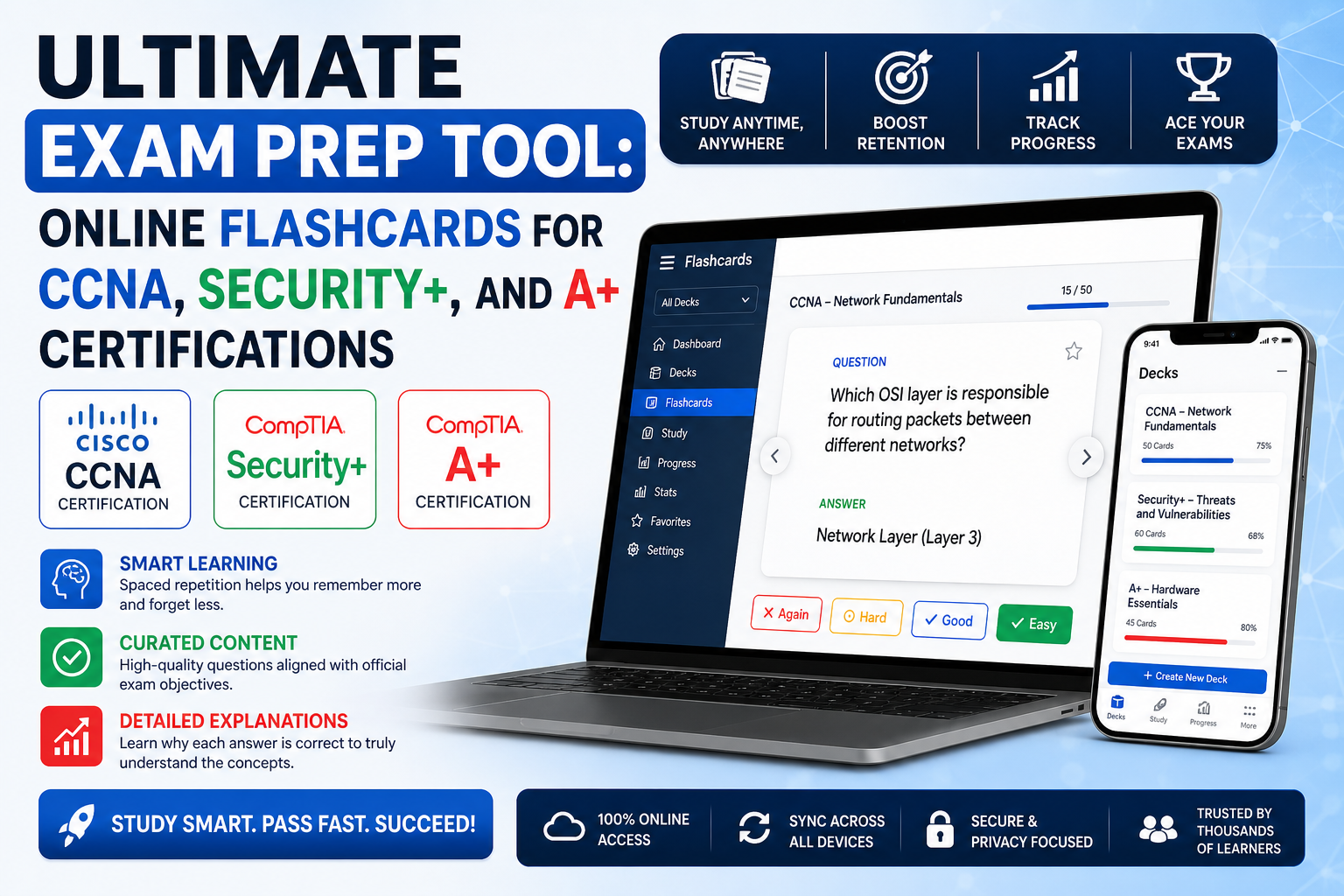
Learning technical skills is rarely a one-time event. Whether it involves networking concepts, cybersecurity principles, cloud computing fundamentals, or troubleshooting methodologies, most learners experience an initial phase of understanding followed by a much harder phase: retention. It is one thing to follow along with an explanation and feel confident in the moment, and quite another to recall that same information days or weeks later when it is needed under pressure.
This gap between understanding and recall becomes especially visible in certification preparation. Many learners can follow along during study sessions, nodding at each concept and solving guided examples with ease. However, when the study material is set aside and time passes, the same information often feels less accessible. This is not a reflection of ability, but rather a natural limitation of how human memory works.
Technical learning intensifies this challenge because it is cumulative. Each new concept tends to build on earlier ones, meaning that forgetting foundational ideas can create a ripple effect. A small gap in understanding can grow into larger confusion when more advanced topics depend on it. As a result, retention becomes just as important as initial comprehension.
The difficulty is not just about remembering isolated facts. It is about maintaining a connected mental model of systems, processes, and behaviors. Without reinforcement, even well-understood material can fade, leaving learners feeling less confident than they should be.
Why Memory Fades After Learning New Skills
Forgetting is often misunderstood as failure, but in reality it is a normal and expected process. The human brain is constantly filtering information, prioritizing what it considers useful and discarding what appears unnecessary. When new technical knowledge is first introduced, it is temporarily stored, but without reinforcement, it gradually loses priority.
One of the main reasons this happens is the absence of repeated retrieval. When information is only encountered once, the brain has no reason to strengthen its storage. It treats the information as temporary unless it is accessed again. Over time, this leads to a natural decay of recall strength.
Another factor is interference. Technical subjects often involve similar-sounding terms, overlapping concepts, and closely related procedures. As new material is introduced, it can blend with earlier information, making it harder to distinguish one concept from another. Without structured reinforcement, this overlap contributes to confusion.
Cognitive overload also plays a role. During study sessions, learners are often exposed to large volumes of information in a short period of time. While this can create a sense of progress, it also stretches the brain’s processing capacity. Without breaks or revisits, much of the information remains in short-term storage rather than becoming part of long-term memory.
This is why simply consuming content is not enough. Retention requires interaction with the material over time, not just during the initial learning phase.
The Role of Active Recall in Long-Term Learning
Among the many approaches to improving memory, active recall stands out as one of the most effective. Instead of passively reviewing notes or rewatching explanations, active recall requires the learner to retrieve information from memory without prompts. This act of retrieval strengthens neural pathways and improves the likelihood of remembering the same information later.
The key difference lies in effort. Passive review creates familiarity, but active recall builds retrieval strength. When the brain is challenged to produce an answer without immediate cues, it learns to access that information more efficiently in the future.
This process is particularly valuable in technical subjects where precision matters. It is not enough to recognize a concept; one must be able to describe it, apply it, or differentiate it from similar ideas. Active recall trains the brain for this kind of precision.
Over time, repeated retrieval leads to improved confidence. Learners begin to notice that information comes to mind more quickly and with less hesitation. This sense of readiness is not accidental; it is the result of structured mental practice.
However, active recall is most effective when it is applied consistently. Occasional testing is helpful, but regular engagement with the material is what transforms short-term understanding into long-term mastery.
Breaking the Cycle of Passive Studying
Many learners fall into a pattern of passive studying without realizing it. Watching explanations, reading notes, and highlighting text can all create a sense of productivity, but they do not always guarantee retention. The problem is not the methods themselves, but the lack of retrieval-based reinforcement.
Passive studying often feels easier because it does not require effortful thinking. The material appears familiar, and this familiarity can be mistaken for mastery. However, recognition is not the same as recall. When learners are later asked to produce information without cues, the gap becomes clear.
Breaking this cycle requires introducing moments where the learner must actively engage with the material. Instead of simply reviewing content, the focus shifts toward testing memory and identifying what is truly understood.
This shift can feel uncomfortable at first, especially when answers are not immediately available. However, this discomfort is an important part of the learning process. It signals that the brain is being challenged to strengthen its connections.
Over time, this approach reduces reliance on external prompts and builds internal confidence. The learner becomes less dependent on notes and more capable of independent recall.
Introducing Structured Recall Tools
Structured recall tools are designed to support active memory retrieval in a consistent and organized way. Rather than leaving recall to chance, these tools present information in a format that encourages repeated engagement with key concepts.
One of the most effective formats for this purpose is the use of short prompts paired with answers. These prompts act as cues that trigger memory retrieval, while the answers provide immediate feedback. This cycle of question, recall, and confirmation strengthens understanding over time.
The structured nature of these tools is important. Without structure, review sessions can become random or unfocused. Learners may revisit familiar material repeatedly while avoiding weaker areas. A structured system helps distribute attention more evenly across topics.
Another advantage is scalability. Structured recall tools can be used frequently without requiring long study sessions. Even brief moments of review can contribute to long-term retention when they are consistent and targeted.
This makes them particularly useful for technical subjects, where the volume of information can be large and complex. By breaking knowledge into smaller, manageable pieces, structured recall becomes more approachable and sustainable.
How Immediate Review Strengthens Memory
Timing plays a critical role in how well information is retained. Reviewing material immediately after learning it takes advantage of a period when the memory is still fresh but not yet fully stable. This is often referred to as the early consolidation phase.
During this phase, the brain is still organizing new information. A quick review helps reinforce correct pathways before they weaken. This reduces the likelihood of early forgetting and strengthens the initial memory trace.
Immediate review also helps identify misunderstandings early. If a concept was not fully understood during the initial learning phase, attempting to recall it right away reveals gaps in comprehension. This allows for quick correction before incorrect interpretations become reinforced.
Another benefit is momentum. Reviewing material immediately after learning it creates a sense of continuity. Instead of treating learning and review as separate activities, they become part of a single process. This improves engagement and reduces the chance of forgetting to revisit the material later.
Over time, this habit builds a stronger foundation. Concepts that are reinforced early require less effort to maintain, freeing up mental capacity for more advanced topics.
The Science of Confidence-Based Learning
Self-assessment is an important part of effective studying. When learners evaluate how well they understand a concept, they engage in a form of metacognition—thinking about their own thinking. This awareness helps guide future study decisions.
Confidence-based learning involves rating how well a concept is understood during review. This simple action has two important effects. First, it encourages honesty. Learners must confront whether they truly know a concept or are only partially familiar with it. Second, it helps identify weak areas that need additional attention.
Without self-assessment, it is easy to assume that everything has been understood equally well. In reality, knowledge is often uneven. Some concepts are deeply understood, while others are only partially retained. Confidence-based evaluation helps reveal this imbalance.
Over time, patterns begin to emerge. Certain topics consistently receive lower confidence ratings, signaling areas that require more focus. This allows study time to be allocated more effectively.
This method also reduces overconfidence. Feeling familiar with a topic does not always mean it can be recalled accurately. By regularly testing confidence, learners develop a more realistic understanding of their readiness.
Self-Assessment as a Learning Mechanism
Self-assessment is not just a measurement tool; it is also a learning mechanism. Each time a learner evaluates their understanding, they reinforce their engagement with the material.
When confidence is low, it signals the need for additional review. When confidence is high, it confirms mastery. Both outcomes are valuable because they guide future study behavior.
This feedback loop helps create a more adaptive learning process. Instead of following a fixed study plan regardless of progress, learners can adjust their focus based on actual performance.
Self-assessment also encourages reflection. It forces learners to pause and consider not just whether they recognize information, but whether they can actively retrieve it. This distinction is critical for long-term retention.
By integrating self-assessment into regular study routines, learners develop a more accurate sense of their strengths and weaknesses. This leads to more efficient use of study time and improved overall performance.
Why Timing Matters in Reinforcement
Reinforcement is most effective when it is spaced appropriately. If review happens too soon after learning, it may not challenge memory enough. If it happens too late, the information may already be partially forgotten.
The ideal timing involves revisiting material at intervals that gradually increase over time. This approach strengthens memory each time it is accessed, while also testing how well it has been retained between sessions.
This spacing effect helps move information from short-term awareness into long-term memory. Each successful retrieval reinforces the neural pathway, making future recall easier.
Timing also helps prevent burnout. Instead of repeatedly reviewing the same material in long sessions, spaced reinforcement distributes effort across shorter, more manageable intervals.
This approach aligns well with the realities of modern learning schedules. Many learners do not have extended uninterrupted study time, so structured intervals make reinforcement more practical and sustainable.
Building Study Habits Around Short Review Sessions
Consistency is often more important than duration when it comes to studying. Short, focused review sessions can be more effective than long, infrequent ones.
Brief sessions reduce cognitive fatigue and allow the brain to focus more intensely on specific concepts. This improves the quality of engagement and reduces the likelihood of distraction.
Short sessions also make it easier to integrate studying into daily routines. Even small time windows can be used effectively when the material is structured for quick review.
Over time, these short sessions accumulate into significant learning gains. The repetition strengthens memory while preventing overload.
This approach also reduces resistance to studying. Large study blocks can feel overwhelming, but short sessions feel more manageable and easier to begin.
Managing Cognitive Load in Technical Subjects
Technical subjects often involve multiple layers of information, including definitions, processes, and relationships between systems. Managing this complexity requires careful control of cognitive load.
Cognitive load refers to the amount of mental effort being used in working memory. When too much information is introduced at once, it becomes difficult to process and retain.
Breaking information into smaller segments helps reduce this load. Each segment can be understood and reinforced before moving on to the next.
Structured recall tools support this process by isolating individual concepts and presenting them in a focused way. This prevents overload and improves clarity.
By controlling cognitive load, learners can maintain better focus and retain more information over time.
Turning Complex Topics into Manageable Pieces
One of the most effective strategies for learning technical material is segmentation. Instead of attempting to understand large systems all at once, they are broken into smaller, interconnected parts.
Each part can be studied independently before being integrated into a larger understanding. This makes complex topics more approachable and less intimidating.
Segmented learning also improves retention. Smaller pieces of information are easier to recall and reinforce than large, abstract concepts.
Over time, these pieces form a complete mental model. This gradual construction allows for deeper understanding and stronger long-term memory.
The Importance of Consistency Over Intensity
Intense study sessions can create short-term progress, but consistency is what leads to lasting retention. Regular engagement with material ensures that knowledge remains active in memory.
Consistency prevents long gaps between reviews, which are often responsible for forgetting. It also reinforces learning through repetition, which strengthens recall pathways.
Even small, repeated interactions with material can produce significant improvements over time. The key is maintaining a steady rhythm rather than relying on occasional effort spikes.
This approach aligns with how memory naturally works, supporting gradual reinforcement rather than abrupt overload.
The Neuroscience Behind Retrieval and Memory Strengthening
Understanding why certain study techniques work becomes much easier when viewed through the lens of how the brain actually stores and retrieves information. Memory is not a static repository of facts; it is a dynamic system that changes each time information is accessed. Every successful attempt to recall a concept subtly reshapes the strength and accessibility of that memory.
When information is first learned, it exists in a fragile state. Neural connections are formed, but they are not yet stable. Without reinforcement, these connections weaken over time. However, when the information is retrieved, those same connections are reactivated and strengthened. This process is what makes retrieval such a powerful learning mechanism.
There are two important aspects of memory strength that often get overlooked. One is storage strength, which refers to how well information has been learned in the first place. The other is retrieval strength, which refers to how easily that information can be accessed when needed. These two strengths do not always develop at the same rate.
It is possible for information to have high storage strength but low retrieval strength if it has not been accessed recently. This creates the common experience of “I know this, but I can’t recall it right now.” Strengthening retrieval requires repeated access under varied conditions, which helps make recall more automatic and reliable.
The brain prioritizes information that appears useful through repeated use. Each retrieval event signals that the information matters, encouraging the brain to allocate more resources to maintaining it. This is why active engagement with material is more effective than passive exposure.
The Role of Spaced Reinforcement in Long-Term Retention
Memory does not improve in a straight line. Instead, it follows a pattern where forgetting happens quickly at first and then slows over time. This pattern is often described as a natural decline that can be interrupted through strategic reinforcement.
Spaced reinforcement takes advantage of this pattern by reintroducing information at carefully timed intervals. Instead of reviewing material continuously or all at once, the learner revisits it after increasing periods of time. Each revisit strengthens memory further because it requires the brain to reconstruct the information from partial forgetting.
The key benefit of this approach is that it creates desirable difficulty. When information is slightly harder to recall, the brain works harder to retrieve it, which strengthens the memory trace. If review happens too soon, there is no challenge. If it happens too late, the information may be completely lost. The balance between these extremes is what makes spacing effective.
Another advantage is efficiency. Repeated exposure without spacing often leads to diminishing returns. In contrast, spaced reinforcement ensures that each review session contributes meaningfully to long-term retention.
This method also helps reduce overconfidence. When information is reviewed too frequently in a short period, it can create a false sense of mastery. Spacing introduces natural forgetting, which provides a more accurate measure of what has truly been learned.
Interleaving as a Strategy for Deeper Understanding
Another powerful approach to learning involves mixing different types of concepts during study sessions. Instead of focusing on one topic for an extended period, interleaving introduces variation by alternating between related subjects.
This method improves learning because it forces the brain to constantly adjust and identify which strategy or concept applies to each situation. Unlike blocked practice, where repetition can become mechanical, interleaving requires active discrimination between ideas.
In technical subjects, this is especially valuable because many concepts appear similar on the surface but behave differently in practice. By switching between them, learners develop stronger mental boundaries that prevent confusion.
Interleaving also improves transfer of knowledge. When concepts are learned in isolation, it can be difficult to apply them in unfamiliar contexts. Mixing topics encourages the brain to form connections between ideas, making it easier to adapt knowledge to new problems.
Although interleaving may feel more challenging during study sessions, this difficulty is beneficial. It reflects deeper processing, which leads to stronger long-term retention.
Metacognitive Awareness and Learning Accuracy
One of the most important yet often overlooked aspects of effective studying is metacognitive awareness. This refers to the ability to evaluate one’s own understanding accurately. Without it, learners may overestimate or underestimate their level of preparedness.
Overestimation is particularly common. When material feels familiar, it is easy to assume it is fully understood. However, familiarity does not guarantee recall ability. This mismatch can lead to surprises during assessments when information cannot be retrieved under pressure.
Developing metacognitive awareness involves regularly questioning how well a concept is truly understood. This includes distinguishing between recognition and recall, as well as identifying gaps in reasoning.
Accurate self-evaluation helps guide study decisions more effectively. Instead of spending equal time on all topics, learners can focus more attention on weaker areas. This leads to more efficient improvement over time.
Metacognition also supports long-term learning because it encourages reflection. Each review session becomes an opportunity not only to reinforce content but also to assess how learning is progressing.
Error-Driven Learning and Memory Correction
Mistakes play an essential role in learning, especially when they are used as feedback rather than failure. When an incorrect answer is identified and corrected, the brain receives a strong signal that the previous understanding needs adjustment.
This process is known as error-driven learning. It strengthens memory by updating incorrect or incomplete mental models. The correction process is often more memorable than the original exposure because it involves emotional and cognitive engagement.
However, errors only contribute to learning if they are recognized and addressed. Unnoticed mistakes can reinforce incorrect understanding, making them harder to correct later.
This is why immediate feedback is so valuable. It ensures that errors are identified while the material is still active in memory. The correction can then be integrated before misconceptions become stable.
Over time, repeated exposure to corrected errors reduces their likelihood of reoccurrence. The brain learns not only the correct information but also how to distinguish it from similar but incorrect variations.
Building Durable Knowledge Structures
As learning progresses, isolated facts begin to form larger interconnected structures. These structures, often referred to as schemas, represent organized knowledge frameworks that help the brain process complex information more efficiently.
Schemas allow new information to be integrated more easily because they provide a framework for interpretation. Instead of treating each new concept as separate, the brain connects it to existing structures.
The development of schemas is a gradual process. It begins with basic understanding and evolves as more related information is added. Over time, these structures become more refined and efficient.
Strong schemas improve recall because they reduce the need to retrieve individual facts in isolation. Instead, related concepts are grouped together, making them easier to access as a unit.
This also improves problem-solving ability. When faced with new scenarios, the brain can draw from existing structures and adapt them to fit the situation.
Exam Conditions and Cognitive Pressure
The environment in which knowledge is recalled plays a significant role in performance. Under relaxed conditions, information may be easy to access. However, under time pressure or stress, retrieval becomes more difficult.
This is because stress affects working memory and attention. When cognitive resources are divided, fewer resources are available for recall. Even well-known information can feel temporarily inaccessible.
Training under conditions that simulate pressure can help reduce this effect. By practicing retrieval in varied environments, the brain becomes more adaptable and resilient.
Another factor is familiarity with the retrieval process itself. The more often information is recalled under different conditions, the less dependent it becomes on specific cues or environments.
This adaptability is important for real-world performance, where conditions are rarely identical to study environments.
Attention Management and Cognitive Focus
Attention plays a central role in learning effectiveness. Without focused attention, information may be processed superficially and fail to enter long-term memory.
Modern study environments often include distractions that fragment attention. Even small interruptions can disrupt the encoding process, reducing retention quality.
Sustained attention allows deeper processing of material. When focus is maintained, the brain has more opportunity to connect new information with existing knowledge.
Managing attention involves creating conditions that reduce unnecessary interruptions. It also involves training the ability to return focus quickly when distractions occur.
Over time, improved attention control leads to more efficient learning sessions and stronger retention outcomes.
Habit Formation in Learning Behavior
Effective study practices are easier to maintain when they become habitual. Habits reduce the need for constant decision-making, allowing learning to occur more consistently.
A learning habit typically consists of a cue, a routine, and a reward. The cue triggers the behavior, the routine is the study activity itself, and the reward is the sense of progress or understanding.
Once established, habits help maintain consistency even during periods of low motivation. This consistency is critical for long-term retention because memory benefits from repeated reinforcement over time.
Habits also reduce friction. When study behavior becomes automatic, less effort is required to initiate it. This increases the likelihood of regular engagement with material.
Designing Effective Memory Prompts
The way information is presented during review has a significant impact on recall effectiveness. Well-designed prompts encourage deeper thinking and more accurate retrieval.
Effective prompts are specific enough to trigger a clear memory but open enough to require active recall. If prompts are too vague, they fail to guide retrieval. If they are too detailed, they may provide too many cues, reducing effort.
The goal is to strike a balance that encourages the brain to reconstruct information rather than recognize it passively.
Well-structured prompts also help identify gaps in understanding. If a prompt cannot be answered, it signals that the underlying concept requires further review.
Over time, exposure to well-designed prompts strengthens both accuracy and speed of recall.
Optimizing Review Intervals for Retention Efficiency
The timing of review sessions can significantly influence how well information is retained. If review occurs too frequently, it becomes redundant. If it occurs too infrequently, information may be lost.
Optimal intervals gradually increase over time. Early reviews happen shortly after learning, followed by progressively longer gaps between sessions.
This pattern takes advantage of the brain’s natural forgetting curve, reinforcing memory just as it begins to weaken.
Each successful recall strengthens both storage and retrieval strength, making future recall more efficient.
Adjusting intervals based on performance can further improve outcomes. Difficult material may require shorter intervals, while well-known material can be reviewed less frequently.
Addressing Misconceptions Before They Solidify
One of the biggest challenges in learning is preventing incorrect understanding from becoming permanent. Once a misconception is reinforced, it can be difficult to correct.
Early identification of misunderstandings is crucial. When incorrect interpretations are corrected quickly, they are less likely to become embedded in long-term memory.
Repeated exposure to corrected information helps overwrite earlier errors. However, this process requires attention and deliberate effort.
Allowing misconceptions to persist can create confusion later, especially when new information builds on incorrect foundations.
Regular review and feedback help ensure that understanding remains accurate and aligned with correct principles.
Transfer of Learning to New Contexts
True mastery of a subject is demonstrated not just by recalling information, but by applying it in new situations. This ability is known as transfer of learning.
Transfer occurs when knowledge is flexible enough to be used outside its original learning context. This requires deep understanding rather than surface-level memorization.
Practicing concepts in varied scenarios helps improve transfer. When information is encountered in different forms, the brain learns to recognize its underlying structure.
This flexibility is essential in technical fields, where problems rarely appear in identical formats.
Over time, strong transfer ability leads to greater confidence in applying knowledge under unfamiliar conditions.
Stress, Recall, and Cognitive Stability
Stress has a direct impact on memory retrieval. Under high pressure, the brain prioritizes immediate survival responses over complex recall tasks.
This can make previously learned information feel temporarily inaccessible. However, the information is not lost; it is simply harder to access under stress.
Repeated exposure to retrieval under varied emotional states can improve resilience. The brain learns to access information even when conditions are not ideal.
Building this resilience is important for real-world performance, where stress is often unavoidable.
Gradual exposure to challenging recall conditions helps stabilize performance and reduce the impact of pressure on memory access.
Integrating Recall Practice into Everyday Learning
Effective learning is not defined by how much time is spent studying, but by how consistently the brain is challenged to retrieve and apply information. When recall practice becomes a natural part of the learning routine, knowledge stops feeling fragmented and starts becoming more stable and usable.
In technical subjects, this integration is especially important because concepts are often interconnected. A single idea in networking, cybersecurity, or systems administration rarely stands alone. Instead, it connects to multiple other concepts that must be understood together. When recall practice is used regularly, these connections become stronger and more intuitive.
One of the most effective ways to integrate recall into everyday learning is through short, frequent interactions with material rather than long, infrequent sessions. The brain responds better to repeated activation of memory traces than to large bursts of passive exposure. Each time a concept is retrieved, it becomes easier to access in the future.
This approach also helps normalize uncertainty during learning. Instead of expecting immediate mastery, learners begin to expect gradual improvement through repetition. This shift in mindset reduces frustration and encourages persistence, especially when dealing with complex topics that require multiple passes to fully understand.
Over time, recall practice stops feeling like an additional task and becomes part of the learning rhythm itself. The transition from passive exposure to active engagement marks a significant improvement in how knowledge is absorbed and retained.
Strengthening Weak Knowledge Areas Through Targeted Review
Not all information is retained equally. Some concepts are naturally easier to understand, while others require more repetition and reinforcement. Identifying and strengthening weaker areas is essential for building balanced knowledge.
Weak areas often become visible through inconsistent recall. A concept that is sometimes remembered correctly and sometimes forgotten indicates partial understanding. This inconsistency is a signal that further reinforcement is needed.
Targeted review focuses attention on these weaker areas rather than repeatedly revisiting already mastered material. This ensures that study time is used efficiently and that improvement is concentrated where it is most needed.
As weaker concepts are reinforced, they gradually become more stable. Over time, the difference between strong and weak areas begins to narrow, leading to more consistent overall performance.
This process also improves confidence. When learners notice that previously difficult concepts are becoming easier to recall, it reinforces a sense of progress and capability. This positive feedback loop encourages continued effort and deeper engagement with the material.
The Role of Repetition in Building Automatic Recall
Repetition is one of the most fundamental principles of memory formation, but its effectiveness depends on how it is applied. Simple repetition without active engagement often leads to diminishing returns. However, repetition combined with active recall creates strong and durable memory pathways.
When information is repeatedly retrieved rather than simply reviewed, the brain begins to automate the process. What once required conscious effort becomes faster and more instinctive over time. This is known as automatic recall.
Automatic recall is especially valuable in technical environments where quick decision-making is important. When foundational knowledge is readily accessible, more mental capacity is available for problem-solving and analysis.
However, achieving automatic recall requires consistent exposure over time. It is not the result of a single study session, but rather the accumulation of repeated retrieval events spaced across days and weeks.
Each repetition strengthens neural connections and reduces the effort required for future recall. Eventually, the information becomes so well integrated that it can be accessed with minimal conscious effort.
Reducing Cognitive Friction in Study Routines
Cognitive friction refers to the mental effort required to start and maintain a learning activity. High friction makes studying feel difficult to begin, while low friction makes it easier to stay consistent.
One of the main causes of cognitive friction is fragmentation. When study materials are scattered across multiple tools or formats, additional effort is required to organize and access them. This added complexity can discourage regular engagement.
Reducing cognitive friction involves simplifying the learning environment so that focus remains on the material rather than on managing resources. When everything needed for learning is easily accessible in one place, it becomes easier to maintain consistency.
Another aspect of reducing friction is minimizing decision fatigue. When learners do not need to decide what to study next or where to find material, they can direct their energy toward actual learning instead of planning.
Over time, lower cognitive friction leads to more frequent study sessions. Even short interactions with material become easier to initiate, which contributes to better long-term retention.
Building Confidence Through Repeated Exposure
Confidence in technical knowledge is not simply about feeling prepared; it is about having repeated evidence of successful recall. Each time information is correctly retrieved, it reinforces the belief that the knowledge is stable and accessible.
However, confidence must be grounded in accuracy. It is possible to feel confident without being fully prepared if learning has been mostly passive. This is why active recall plays such an important role in building genuine confidence.
Repeated exposure through recall helps align perceived understanding with actual ability. As learners consistently retrieve information correctly, their confidence becomes more reliable.
This confidence also reduces anxiety during performance situations. When learners have repeatedly tested themselves under low-pressure conditions, they are less likely to be affected by stress during high-pressure situations.
Over time, confidence becomes a byproduct of preparation rather than a separate goal. It emerges naturally from consistent practice and successful retrieval.
Sustaining Long-Term Learning Momentum
Maintaining progress over long periods of study can be challenging, especially when motivation fluctuates. Without structure, learning often becomes inconsistent, leading to periods of intense study followed by gaps in engagement.
Sustainable learning requires a system that supports continuous but manageable progress. Short, regular interactions with material help maintain momentum without causing burnout.
Momentum is important because it reduces the effort required to restart studying after breaks. When learning is consistent, there is less need to rebuild familiarity with the material each time.
This continuity also improves retention. Regular reinforcement prevents knowledge from decaying significantly between sessions, making each study session more effective.
Over time, sustained momentum creates a compounding effect. Each session builds on the last, gradually strengthening understanding and reducing the need for repeated re-learning.
Adapting Learning Strategies to Different Types of Material
Not all information is learned in the same way. Some concepts require memorization, while others require understanding of processes or relationships. Effective learning strategies must adapt to these differences.
Factual information benefits strongly from repeated retrieval. Definitions, terminology, and specific details are reinforced through active recall.
Conceptual information requires deeper processing. Understanding how systems interact or how processes function involves connecting multiple ideas together rather than memorizing isolated facts.
Procedural knowledge, such as troubleshooting steps or configuration processes, benefits from both repetition and application. Practicing the sequence of actions helps reinforce both memory and understanding.
Adapting study methods to match the type of material being learned leads to more efficient retention. It ensures that each concept is reinforced in a way that aligns with how it will be used in practice.
Preparing for Real-World Application of Knowledge
The ultimate goal of technical learning is not just to remember information, but to apply it effectively in real-world situations. This requires more than memorization; it requires flexible understanding.
Real-world application often involves unpredictable scenarios. Problems may not appear in the same form as they did during study sessions. This is where adaptable knowledge becomes essential.
When information has been learned through active recall and varied practice, it becomes easier to apply in unfamiliar contexts. The brain is trained not just to recognize patterns, but to interpret and respond to them.
This adaptability is what separates surface-level learning from practical expertise. It allows learners to move beyond recall and into problem-solving.
Over time, repeated practice under varied conditions builds the confidence and flexibility needed for real-world performance.
Maintaining Long-Term Retention Beyond Initial Study
Learning does not end when material is first understood. Without continued reinforcement, even well-learned information can fade over time. Long-term retention depends on periodic re-engagement with material.
This does not require constant review of everything learned. Instead, occasional reinforcement is enough to maintain stability in memory.
Each revisit strengthens existing knowledge and prevents decay. It also helps integrate new information with older concepts, creating a more complete understanding over time.
Long-term retention is a gradual process. It is built through consistent reinforcement rather than intensive short-term effort.
By maintaining periodic engagement with material, knowledge remains accessible even long after initial learning has taken place.
Creating a Sustainable Learning Cycle
A sustainable learning cycle is one where acquisition, reinforcement, and application are continuously connected. Each stage supports the others, creating a stable system of growth.
New information is first introduced and understood. It is then reinforced through active recall and repetition. Finally, it is applied in practice, which further strengthens understanding.
This cycle repeats continuously as new material is introduced. Over time, it creates a layered structure of knowledge that becomes increasingly strong and interconnected.
Sustainability in learning comes from balance. Too much focus on acquisition without reinforcement leads to forgetting. Too much repetition without application limits growth. A balanced cycle ensures steady progress.
When this cycle becomes habitual, learning becomes more efficient and less stressful. Knowledge builds naturally over time, supported by consistent reinforcement and meaningful application.
Conclusion
Learning technical concepts is not defined by how well something is understood in the moment, but by how reliably it can be recalled and applied when it matters. Understanding alone is fragile; retention is what transforms knowledge into skill. Without reinforcement, even strong initial learning can fade, creating gaps that only become visible under pressure.
The most effective learning approaches work with the way memory naturally behaves rather than against it. The brain strengthens information through repetition, especially when that repetition involves active recall rather than passive exposure. Each time a concept is retrieved, it becomes more stable, more accessible, and more resistant to forgetting.
Structured recall practice plays a key role in this process by encouraging consistent engagement with important ideas. Instead of treating studying as a single event, it becomes an ongoing cycle of retrieval, reflection, and reinforcement. This cycle helps ensure that knowledge is not only learned but maintained over time.
Spaced reinforcement, targeted review, and confidence-based self-assessment all contribute to a more accurate understanding of what has truly been mastered. These approaches reduce overconfidence, close retention gaps, and help identify weaker areas before they become problematic.
Over time, consistent recall practice builds more than just memory. It builds familiarity, confidence, and adaptability. Concepts that once required effort to remember become easier to access, allowing more mental space for problem-solving and deeper understanding.
Ultimately, strong retention is not the result of a single technique but the combination of repeated, intentional practice and thoughtful review. When learning is approached as an active process rather than a passive one, knowledge becomes more durable, more flexible, and far more useful in real-world situations.