Modern digital products rarely succeed by accident. When an app feels smooth or a website feels intuitive, it is usually the result of deliberate planning and deep understanding of user behavior. This is where UX design has become one of the most important disciplines in the technology and product landscape.
As more businesses move online, user expectations have increased dramatically. People no longer tolerate confusing navigation, slow onboarding, or poorly structured interfaces. If a product feels difficult to use, users simply leave and switch to alternatives. This shift has forced companies to invest heavily in user experience design, making it a core part of product development rather than an optional enhancement.
UX designers sit at the center of this transformation. They are responsible for shaping how users interact with digital systems, ensuring that every interaction feels logical, efficient, and friction-free. Their work often begins long before a single screen is designed and continues even after a product is launched, as real user behavior informs continuous improvements.
Because of this growing importance, UX design has moved from a niche creative role into a high-demand, strategically valuable profession. Companies now recognize that better user experiences directly impact revenue, customer retention, and brand trust. As a result, compensation for UX designers has steadily increased across industries and regions.
What UX Designers Actually Do Beyond the Surface
At first glance, UX design may appear to be about creating visually appealing screens or arranging buttons in a clean layout. In reality, the role is far more analytical and research-driven.
UX designers begin by studying users. This involves understanding their motivations, frustrations, and behaviors when interacting with a product. Rather than relying on assumptions, designers gather insights through structured observation and feedback. The goal is to identify real problems rather than imagined ones.
Once insights are gathered, UX designers translate them into design decisions. They map out user journeys, define interaction flows, and structure information in a way that reduces cognitive effort. This stage is less about aesthetics and more about logic and clarity.
After planning comes prototyping. Designers create early versions of the product experience, allowing teams to test ideas before full development begins. These prototypes are not final products but tools for exploration and validation. They help answer questions such as whether users can complete a task efficiently or whether a certain layout creates confusion.
Collaboration is another major part of the role. UX designers rarely work in isolation. They constantly interact with developers, product managers, researchers, and business stakeholders. Each group brings a different perspective, and the UX designer acts as a bridge that aligns user needs with technical and business constraints.
This combination of research, design, and collaboration makes UX design a multidisciplinary field. It requires both creative thinking and analytical reasoning, which is one of the reasons salaries in this field vary so widely.
UX Design vs Related Roles in Digital Product Teams
Understanding UX designer salaries also requires understanding how the role differs from similar positions.
A UX designer focuses primarily on how a product works from the user’s perspective. Their responsibility is to ensure that interactions are smooth, meaningful, and aligned with user expectations.
A UI designer, on the other hand, focuses more on visual presentation. This includes typography, color systems, spacing, and interactive elements. While UX defines structure and flow, UI defines appearance.
A product designer often combines both UX and UI responsibilities but also takes a broader view of business goals, product strategy, and long-term product direction. In some organizations, product designers have greater ownership and influence, which can also affect compensation levels.
UX researchers specialize even further. Instead of designing interfaces, they focus entirely on studying user behavior and generating insights that guide design decisions.
Despite these distinctions, many job titles overlap in practice. Smaller companies may expect a UX designer to handle UI tasks as well, while larger organizations may separate roles more strictly. This variation contributes to differences in salary expectations across companies and regions.
Why UX Designer Salaries Vary So Widely
UX design salaries are not fixed or uniform. Instead, they are influenced by a combination of market conditions, skill level, industry demand, and geographic location.
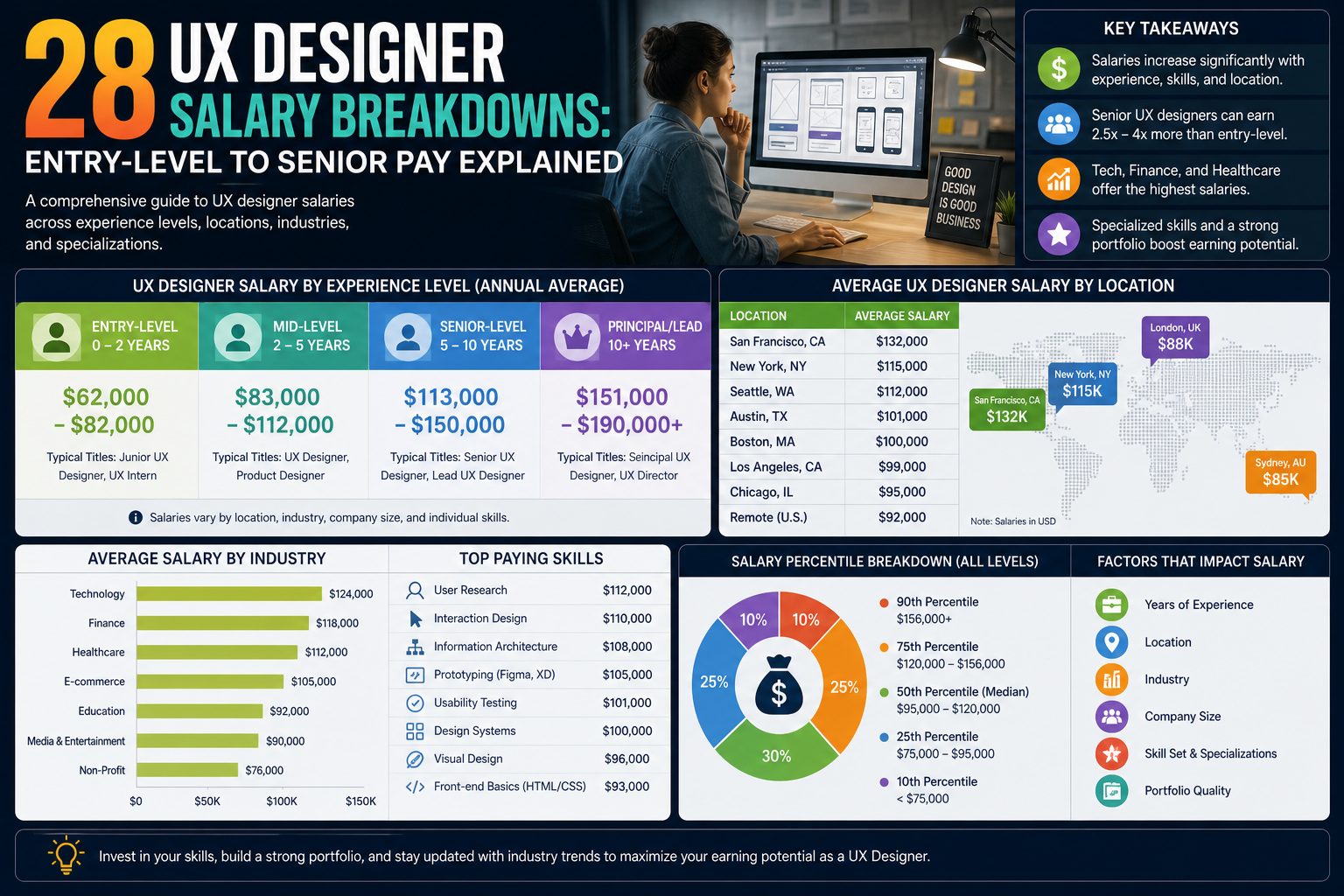
One of the most significant factors is location. In major technology hubs, companies compete aggressively for experienced designers, driving salaries upward. In contrast, regions with fewer tech companies may offer lower base salaries, even if the cost of living is also lower.
However, location is no longer the only determining factor. The rise of remote work has introduced new dynamics. Designers in smaller cities can now work for companies based in high-paying markets, narrowing traditional salary gaps. Even so, companies often adjust pay based on regional benchmarks.
Experience is another major factor. Entry-level designers typically focus on execution and support tasks, while senior designers influence strategy and product direction. As responsibility increases, so does compensation.
Industry also plays a critical role. Sectors such as finance, healthcare, and enterprise software often pay more because the stakes are higher. In these industries, poor user experience can lead to significant financial or operational risks, making skilled UX designers especially valuable.
Company size matters as well. Large organizations often have structured salary bands and benefits, while startups may offer lower base pay but compensate with equity or faster growth opportunities.
Finally, specialization can significantly impact earnings. Designers who develop expertise in areas like accessibility, enterprise systems, or complex data-driven interfaces often command higher salaries due to the scarcity of such skills.
Understanding National UX Salary Trends
On a broader level, UX design salaries in the United States show a clear pattern of strong mid-range earnings with wide variation at both ends.
Most UX designers fall into a broad national range where early-career professionals earn significantly less than experienced designers, while senior roles can exceed six figures comfortably.
At a national level, UX designers often start with moderate salaries that increase steadily with experience. The progression is not strictly linear, but there is a consistent trend where each stage of experience brings noticeable financial growth.
The lower range typically includes newer designers who are still building portfolios and gaining practical experience. These roles often focus on executing tasks under guidance rather than leading projects independently.
The mid-range represents designers who have developed strong technical and collaborative skills. At this stage, professionals are capable of managing projects from start to finish and making design decisions with minimal supervision.
The upper range includes senior designers and specialists. These professionals often contribute to strategic decisions, mentor junior team members, and influence product direction at a higher level.
What is particularly interesting is how wide the gap can be within the same role title. Two UX designers with the same job title may earn significantly different salaries depending on their skill depth, negotiation ability, and industry context.
The Role of Market Demand in Salary Growth
UX design has experienced rapid growth over the past decade, driven by digital transformation across industries. As more services move online, the demand for intuitive digital experiences has increased.
This demand has created a competitive hiring environment. Companies are not only competing for developers but also for designers who can improve product usability and customer satisfaction.
In many organizations, UX design is no longer seen as a support function. Instead, it is considered a strategic role that directly influences user retention and business success. This shift has elevated the importance of UX professionals and contributed to higher salary expectations.
Another factor driving demand is the increasing complexity of digital products. Modern applications often involve multiple platforms, integrations, and user flows. Designing such systems requires more than basic design skills; it requires systems thinking and an understanding of user psychology.
As complexity increases, so does the value of experienced UX designers who can simplify these systems for end users.
The Relationship Between Skills and Compensation
While external factors like location and industry matter, individual skills remain one of the strongest determinants of salary.
UX designers who can conduct effective user research tend to produce more impactful designs. Understanding user behavior allows them to make informed decisions rather than relying on assumptions. This ability often distinguishes mid-level designers from entry-level professionals.
Technical proficiency also plays an important role. Designers who are comfortable with modern design tools and prototyping environments can work more efficiently and collaborate better with development teams.
Equally important is the ability to communicate design decisions clearly. UX designers often need to justify their choices to stakeholders who may not have a design background. Strong storytelling and presentation skills can significantly increase perceived value within a company.
Another valuable skill is systems thinking. Instead of focusing on individual screens, experienced designers think in terms of entire user journeys and ecosystems. This broader perspective is highly valued in larger organizations.
Soft skills such as empathy, adaptability, and collaboration also contribute to career growth. UX design is inherently human-centered, and the ability to understand different perspectives is essential for success.
Early Career UX Designers and Entry-Level Expectations
At the beginning of a UX design career, professionals typically focus on learning and execution. Entry-level designers often work under supervision, contributing to smaller parts of larger projects.
Their responsibilities may include creating wireframes, supporting usability testing, and refining existing designs based on feedback. While the work may seem limited in scope, it is a crucial stage for skill development.
During this phase, salary levels reflect both learning potential and limited experience. However, this stage is also where rapid growth often occurs. Designers who actively build portfolios, seek feedback, and expand their skill sets tend to progress faster than those who remain in passive roles.
The transition from entry-level to mid-level typically happens when designers begin taking ownership of projects and demonstrating independent decision-making ability.
Mid-Level UX Designers and Expanding Responsibility
Mid-level UX designers represent the core workforce of most design teams. At this stage, professionals are expected to manage full design projects, collaborate directly with stakeholders, and contribute to product decisions.
Their work becomes more strategic, involving trade-offs between user needs, technical constraints, and business goals. They are often responsible for ensuring consistency across multiple features or products.
Salary growth at this stage reflects increased responsibility and trust. Designers who demonstrate leadership potential, strong problem-solving abilities, and consistent delivery quality often see significant compensation increases.
This stage is also where specialization begins to matter more. Designers who focus on specific domains or complex problem areas often position themselves for higher earning potential.
Senior UX Designers and Strategic Influence
Senior UX designers operate at a higher level of influence within organizations. Their role extends beyond execution into shaping product direction and design strategy.
They often mentor junior designers, define design standards, and collaborate closely with leadership teams. Their decisions have a direct impact on product success and user satisfaction at scale.
At this level, compensation reflects both expertise and impact. Senior designers are not just evaluated on what they create, but on how their work influences broader business outcomes.
Many senior professionals eventually transition into lead designer, principal designer, or design management roles, where their focus shifts even further toward strategy and team development.
UX Salary Growth in a Remote-First Work Environment
The way UX designers are hired and compensated has changed significantly with the rise of remote work. Not long ago, salary was tightly tied to geography. Designers living in high-cost tech cities earned more simply because companies were concentrated in those regions. Today, that connection is weaker, but not completely gone.
Remote work has created a more flexible talent market. Companies can hire designers from different regions without requiring relocation, which has expanded opportunities for professionals in smaller cities. At the same time, it has introduced new salary structures that attempt to balance fairness with cost efficiency.
In many organizations, remote UX designers are still paid according to regional salary bands. This means a designer living in a lower-cost area might earn less than someone in a major tech hub, even if they perform identical work. However, more companies are shifting toward location-agnostic pay models, especially in competitive industries where attracting talent is more important than controlling geographic costs.
This shift has created a unique situation where UX designers can access higher-paying jobs without moving, but they must also navigate more competitive global hiring environments. Instead of competing with local candidates, they may be competing with designers from across the country or even internationally.
Another important aspect of remote UX work is increased emphasis on communication skills. Without in-person collaboration, designers must rely heavily on digital communication tools to present ideas, explain design decisions, and gather feedback. This has made clarity of expression a more valuable skill than ever before.
Remote environments have also influenced how performance is evaluated. Companies now focus more on measurable outcomes rather than physical presence or hours worked. UX designers who can demonstrate impact through improved conversion rates, reduced user errors, or increased engagement often see stronger salary growth.
Industry-Specific Salary Differences in UX Design
Not all UX design jobs are equal in terms of compensation. One of the most important factors influencing salary is the industry in which a designer works.
Certain industries consistently offer higher salaries due to the complexity of their products, the scale of their user base, or the financial consequences of poor design decisions.
Financial technology is one of the strongest-paying sectors for UX designers. In this industry, user experience directly affects transactions, security, and customer trust. Even small design flaws can lead to significant financial losses or user drop-off. As a result, companies invest heavily in skilled designers who can simplify complex financial systems.
Healthcare is another high-value industry. Digital healthcare systems must be both user-friendly and compliant with strict regulations. UX designers in this field often deal with sensitive information and must design interfaces that reduce user error in critical situations. The responsibility involved often leads to higher compensation.
Enterprise software companies also tend to pay well. These products are often used by large organizations and involve complex workflows. Designing for enterprise users requires a deep understanding of business processes, which increases the demand for experienced UX professionals.
On the other hand, industries such as education, non-profits, or early-stage startups may offer lower base salaries. However, they may provide other benefits such as creative freedom, flexible work environments, or faster skill development opportunities.
Gaming, media, and entertainment industries can vary widely. Some companies offer competitive pay, especially if their products operate at scale, while others prioritize creative output over compensation levels.
Understanding industry differences is essential for UX designers who want to maximize their earning potential. Moving between industries can often result in larger salary increases than simply changing roles within the same sector.
Company Size and Its Impact on UX Compensation
The size of a company plays a significant role in determining UX designer salaries. Large organizations and small startups operate very differently when it comes to compensation structures.
Large technology companies typically offer higher base salaries along with structured benefits packages. These organizations often have well-defined career ladders, making it easier for designers to understand how to progress financially over time. However, competition for roles at these companies is also intense, and hiring processes can be highly selective.
Mid-sized companies often strike a balance between structure and flexibility. Salaries in these environments are generally competitive, and designers may have more influence over product decisions compared to larger corporations. Career growth can be faster, but compensation structures may be less standardized.
Startups present a different dynamic. Early-stage startups may offer lower base salaries due to limited funding, but they often compensate with equity or stock options. For UX designers willing to take on risk, this can lead to significant financial rewards if the company grows successfully.
In addition to salary, company size also affects the scope of work. In smaller companies, UX designers often wear multiple hats, handling research, design, and sometimes even front-end collaboration. In larger companies, roles are more specialized, allowing designers to focus deeply on specific areas.
This difference in role structure influences how experience is gained and how quickly designers can advance their careers.
The Role of Specialization in Increasing UX Salaries
As UX design matures as a field, specialization has become increasingly important. Designers who develop expertise in specific areas often command higher salaries than generalists.
One of the most in-demand specializations is UX research. Professionals in this area focus entirely on understanding user behavior through structured studies, interviews, and data analysis. Their insights directly shape product decisions, making their role highly valuable.
Interaction design is another important specialization. This involves designing how users move through a product, including transitions, animations, and feedback systems. Strong interaction design improves usability and creates smoother user experiences.
Accessibility design has also gained significant importance. Companies are increasingly required to ensure that their digital products are usable by people with disabilities. Designers who understand accessibility standards and inclusive design principles are in high demand.
Enterprise UX is another specialized area that focuses on complex systems used by businesses rather than consumers. These products often involve dense workflows, requiring designers who can simplify complexity without losing functionality.
Voice and conversational UX is an emerging specialization driven by AI assistants and voice-based interfaces. Designers in this field must understand natural language interaction and human communication patterns.
Design systems expertise is also highly valuable. Designers who can create and manage scalable design systems help organizations maintain consistency across large product ecosystems.
Specialization not only increases salary potential but also provides career stability. As companies face increasingly complex design challenges, they rely more on experts rather than generalists.
UX Design Compensation Beyond Base Salary
When discussing UX designer salaries, it is important to understand that total compensation often includes more than just base pay.
Many companies offer bonuses tied to performance metrics or company success. These bonuses can vary depending on individual contributions and overall business performance.
Equity or stock options are common in startups and large technology companies. While equity does not provide immediate income, it can become highly valuable if the company grows or goes public. For some designers, equity has resulted in earnings far exceeding base salary over time.
Benefits also play a role in total compensation. Health coverage, retirement contributions, paid leave, and wellness programs can significantly increase the overall value of a compensation package.
Some companies offer learning budgets that allow designers to attend workshops or purchase tools and resources for skill development. While not direct salary, these benefits contribute to long-term career growth.
Flexible work arrangements, such as remote work options or flexible hours, are also considered part of compensation by many professionals, even though they do not directly affect income.
Understanding total compensation is important when comparing job offers. A lower base salary with strong equity or benefits may be more valuable than a higher salary with limited long-term growth potential.
UX Interview Processes and Their Influence on Salary Offers
The UX design hiring process plays a major role in determining salary outcomes. Unlike some roles that rely heavily on technical testing, UX interviews often focus on portfolio evaluation, problem-solving ability, and communication skills.
A strong portfolio is one of the most influential factors in salary negotiation. Employers look for evidence of real impact rather than just visual design quality. Projects that demonstrate improved user outcomes, clear problem-solving approaches, and thoughtful decision-making tend to result in higher offers.
Case study presentations are often a key part of UX interviews. Designers are expected to explain their process, justify decisions, and show how their work contributed to measurable improvements.
Some interviews include practical design exercises or whiteboard challenges. These exercises test how designers think through problems in real time, rather than how polished their final output is.
Behavioral interviews also play an important role. Employers assess how well candidates collaborate, handle feedback, and communicate with non-design stakeholders.
Salary offers are often influenced by how confidently a candidate presents their experience. Designers who clearly articulate their value and impact are more likely to receive higher compensation.
Negotiation also begins during the interview process. Early signals about salary expectations can shape the final offer, making it important for designers to understand their market value before entering discussions.
Geographic Salary Clusters and Cost-of-Living Adjustments
Even though remote work has reduced geographic constraints, location still plays a meaningful role in UX salary differences.
High-cost cities continue to offer higher salaries due to competitive job markets and increased living expenses. These cities often host major technology companies that set industry salary benchmarks.
Mid-tier cities offer balanced compensation relative to cost of living. In these regions, UX designers may enjoy stronger purchasing power even if base salaries are slightly lower than top-tier tech hubs.
Smaller cities or emerging tech regions may offer lower base salaries, but the gap is often offset by lower living costs and increasing remote opportunities.
Cost-of-living adjustments are common in companies with distributed teams. These adjustments attempt to balance fairness while maintaining budget control. However, they are not always applied consistently across all organizations.
Over time, the difference between high-cost and low-cost regions has begun to narrow, especially for experienced designers. Companies are increasingly valuing skill level and impact over location alone.
The Influence of Portfolio Quality on Salary Potential
A UX designer’s portfolio is often the strongest factor influencing salary offers. Unlike traditional resumes, portfolios demonstrate actual problem-solving ability and design thinking.
Strong portfolios focus on storytelling rather than just visuals. They explain the problem, the research process, the design decisions, and the final outcomes. Employers are particularly interested in how a designer thinks, not just what they produce.
Projects that show measurable impact tend to stand out. For example, demonstrating improvements in user engagement, conversion rates, or task completion success can significantly increase perceived value.
Portfolios that include diverse project types are also more attractive. This shows adaptability and the ability to handle different challenges.
However, quality matters more than quantity. A few well-documented, impactful projects are often more effective than a large collection of unfinished or shallow work.
A strong portfolio can sometimes compensate for limited professional experience. This is especially important for entry-level designers trying to secure higher starting salaries.
Evolving Expectations in UX Roles and Future Salary Trends
The expectations placed on UX designers continue to evolve as technology advances. Artificial intelligence, automation, and data-driven design are changing how UX work is performed.
Designers are increasingly expected to understand data analytics and user behavior metrics. Decisions are no longer based purely on intuition but supported by measurable evidence.
There is also growing demand for designers who can work across multiple platforms, including mobile, web, and emerging interfaces such as voice or augmented reality systems.
As products become more complex, UX designers are expected to think more strategically. This includes understanding business goals, product roadmaps, and long-term user engagement strategies.
These evolving expectations are influencing salary trends. Designers who adapt to new tools, methodologies, and technologies are likely to see stronger compensation growth.
At the same time, competition is increasing as more people enter the field. This makes continuous skill development essential for maintaining and increasing earning potential.
Companies are also placing greater emphasis on cross-functional collaboration. Designers who can work effectively with engineers, data analysts, and product managers are more valuable in modern product teams.
As UX design continues to mature, salary structures will likely become more differentiated based on specialization, impact, and strategic contribution rather than just years of experience.
The Expanding Role of UX Designers in Modern Product Ecosystems
UX design has evolved far beyond creating simple interfaces or improving visual layouts. In today’s digital ecosystems, UX designers play a central role in shaping entire product experiences from the ground up. This shift has significantly influenced how organizations value UX talent and, as a result, how salaries are structured across industries.
Modern digital products are no longer standalone applications. They are interconnected systems that involve multiple platforms, user journeys, and data-driven interactions. UX designers are responsible for ensuring that all these moving parts feel cohesive and intuitive to the user. This requires not only design expertise but also a strong understanding of systems thinking.
In many companies, UX designers now participate in early-stage product discussions. They contribute to defining features, identifying user problems, and shaping the overall direction of product development. This strategic involvement has elevated the profession from execution-focused to decision-influencing.
As UX designers take on more responsibility, their compensation reflects this expanded scope. Companies are no longer paying solely for design output; they are investing in professionals who can influence product success at a structural level.
UX Design as a Strategic Business Function
One of the most important shifts in recent years is the recognition of UX design as a strategic business function rather than just a creative discipline. Organizations now understand that user experience directly impacts revenue, customer retention, and brand reputation.
A poorly designed product can lead to user frustration, increased support costs, and lost customers. On the other hand, a well-designed experience can increase engagement, improve conversion rates, and build long-term loyalty. UX designers sit at the center of this equation.
Because of this direct connection to business outcomes, UX designers are increasingly included in high-level discussions with executives and stakeholders. They are asked not only to design interfaces but also to justify design decisions in terms of business impact.
This shift has changed how salary decisions are made. Instead of evaluating UX designers purely based on design output, companies now assess their ability to contribute to business performance. Designers who can clearly connect their work to measurable results often find themselves in higher salary brackets.
In many organizations, UX teams are also becoming part of product strategy departments rather than isolated design units. This integration further increases the perceived value of UX professionals within the corporate structure.
The Psychology Behind UX Value Perception and Pay
UX design is deeply rooted in human psychology, and understanding this connection helps explain why the role is so valuable. At its core, UX design is about reducing friction, simplifying decisions, and guiding users toward meaningful actions.
When users interact with a well-designed system, they often do not consciously notice the design itself. Instead, they focus on completing tasks smoothly. This invisibility paradox means that good UX is often underestimated by users but highly valued by organizations.
From a business perspective, this invisible value translates into measurable outcomes. When users can complete tasks easily, they are more likely to return, recommend the product, and engage more deeply over time. These behaviors directly affect revenue streams.
UX designers who understand this psychological dimension are able to create more effective experiences. They consider cognitive load, decision fatigue, attention patterns, and emotional responses during the design process.
This ability to influence user behavior through design decisions is one of the reasons UX designers are compensated at higher levels compared to many other creative roles. They are not just shaping visuals; they are shaping behavior at scale.
Advanced UX Skills That Influence Senior-Level Salaries
As UX designers progress in their careers, technical and strategic skills become increasingly important. Senior-level compensation is often tied to a designer’s ability to handle complexity and guide larger systems.
One of the most valuable advanced skills is design systems management. A design system ensures consistency across all products and platforms within an organization. Designers who can build and maintain these systems help reduce redundancy and improve scalability.
Another key skill is cross-platform experience design. Modern users interact with products across mobile devices, desktops, tablets, and sometimes even wearable technologies. Designers who can create seamless experiences across these platforms are highly valued.
Data-informed design is another critical area. Senior UX designers are expected to interpret user analytics, A/B testing results, and behavioral metrics to make informed design decisions. This shifts the role from subjective design choices to evidence-based decision-making.
Leadership and mentorship skills also play a major role in senior compensation. Experienced designers are often responsible for guiding junior team members, reviewing work, and setting design standards within teams.
Strategic communication is equally important. Senior UX designers frequently present their ideas to executives, product managers, and stakeholders who may not have a design background. The ability to clearly explain design decisions and connect them to business outcomes is a key factor in salary advancement.
The Relationship Between UX Design and Product Success Metrics
UX design is one of the few disciplines that directly influences multiple business metrics simultaneously. These include user acquisition, retention, engagement, conversion rates, and customer satisfaction.
For example, a simplified onboarding process can significantly increase user activation rates. A clearer navigation structure can reduce drop-off rates. A more intuitive checkout flow can improve conversion performance.
Because UX design affects these metrics, companies increasingly track design impact through data. UX designers are now expected to understand how their work contributes to measurable outcomes.
This data-driven approach has changed how performance is evaluated. Instead of focusing solely on aesthetic quality, companies assess how design decisions influence user behavior.
Designers who can demonstrate improvements in key performance indicators often have stronger negotiating power during salary discussions. Their work is no longer subjective; it is tied directly to business performance.
This connection between UX design and metrics is one of the strongest reasons for salary growth in the field. As companies become more data-driven, the value of UX professionals who understand analytics continues to rise.
The Impact of Emerging Technologies on UX Careers
Technology evolution is reshaping UX design in significant ways. Artificial intelligence, machine learning, and automation are changing how digital products are built and experienced.
AI-driven interfaces are becoming more common, requiring UX designers to rethink traditional interaction patterns. Instead of static screens, designers are now working with adaptive systems that change based on user behavior.
This introduces new challenges, such as designing for unpredictability and ensuring transparency in automated decisions. UX designers must now consider how users interact with systems that evolve in real time.
Voice interfaces and conversational design are also growing areas. These interfaces require a different approach compared to traditional visual design. Designers must think in terms of dialogue, intent, and natural language flow.
Augmented reality and virtual reality are further expanding the scope of UX design. These environments require spatial thinking and an understanding of three-dimensional interaction patterns.
As technology becomes more complex, UX designers who adapt to these new environments become more valuable. Companies are willing to pay higher salaries for professionals who can navigate emerging design challenges.
The Role of UX Design in Reducing Business Risk
One of the less visible but highly important aspects of UX design is risk reduction. Poor user experience can lead to financial loss, legal issues, or reputational damage.
In industries such as healthcare, finance, and government services, UX design plays a critical role in ensuring accuracy and compliance. A poorly designed interface can lead to user errors with serious consequences.
For example, confusing forms can result in incorrect data entry. Poor navigation can cause users to miss important information. These issues can have significant operational and legal implications.
UX designers help reduce these risks by creating clear, predictable, and accessible interfaces. They ensure that users can complete tasks correctly and efficiently.
Because of this risk-reducing function, UX designers are often viewed as essential contributors to product safety and reliability. This perception further increases their value within organizations.
Companies operating in high-risk industries tend to offer higher salaries to UX professionals because the consequences of design failures are more severe.
Collaboration Between UX Designers and Other Disciplines
UX design does not exist in isolation. It is deeply integrated with other disciplines such as software engineering, product management, data analysis, and marketing.
Effective collaboration is essential for successful product development. UX designers must translate user needs into actionable design requirements that engineers can implement.
They also work closely with product managers to ensure that design decisions align with business goals and development timelines. This requires strong communication and negotiation skills.
In addition, UX designers often collaborate with data analysts to understand user behavior and validate design decisions. This partnership helps ensure that design changes are backed by evidence.
Marketing teams also benefit from UX insights, particularly when designing user journeys for acquisition and retention campaigns.
Designers who excel at cross-functional collaboration are often more valuable to organizations. Their ability to bridge gaps between different teams improves overall efficiency and product quality.
This collaborative nature of UX design also influences salary levels. Professionals who can operate effectively across departments are often rewarded with higher compensation.
The Increasing Importance of UX Research in Design Decisions
UX research has become a foundational part of modern design processes. It involves studying users to understand their needs, behaviors, and motivations.
Research methods include interviews, usability testing, surveys, and behavioral analytics. These methods provide insights that guide design decisions and reduce guesswork.
UX designers who incorporate research into their workflow are able to create more effective and user-centered designs. This leads to better product outcomes and higher user satisfaction.
Organizations increasingly rely on research-driven design to minimize risk and maximize efficiency. As a result, UX professionals with strong research capabilities are in high demand.
Research also plays a critical role in validating design ideas before full implementation. This reduces development costs and prevents unnecessary redesigns.
Because of its strategic importance, UX research skills often lead to higher salaries. Designers who can both design and conduct research are especially valuable in many organizations.
Career Progression Paths and Long-Term UX Growth
UX design offers multiple career progression paths, each with different salary implications.
One path leads toward senior individual contributor roles, where designers focus on complex problem-solving and high-impact projects. These roles often include titles such as senior designer, lead designer, or principal designer.
Another path leads toward management, where designers take on responsibility for teams, processes, and organizational strategy. These roles often include design manager or head of UX positions.
Some professionals transition into specialized roles such as UX researcher, design systems architect, or interaction design specialist.
Others move into broader product roles, such as product management or product strategy, where they apply their UX knowledge at a higher level of business decision-making.
Each of these paths offers different salary trajectories, but all are influenced by the same core principle: increased responsibility leads to increased compensation.
Over time, UX designers who continue to develop their skills, adapt to new technologies, and expand their strategic influence tend to see consistent salary growth.
The field remains dynamic, with new opportunities emerging as digital products become more complex and deeply integrated into everyday life.
Conclusion
UX design has become one of the most influential roles in the modern digital economy, shaping how people interact with technology in everyday life. What was once considered a niche creative skill has now evolved into a strategic profession that directly impacts business performance, user satisfaction, and long-term product success. As a result, UX designer salaries reflect not only artistic ability but also analytical thinking, technical awareness, and business understanding.
Across different cities, industries, and experience levels, compensation varies significantly. High-demand tech hubs continue to offer premium salaries, while remote work has gradually reduced the strict dependency on location. However, factors such as specialization, research capability, and cross-functional collaboration often matter just as much as geography when determining earning potential.
One of the most consistent patterns in UX design careers is that growth in responsibility leads to growth in income. Entry-level designers typically focus on execution and learning, while mid-level professionals take ownership of projects and senior designers influence product strategy and organizational direction. At each stage, the ability to demonstrate measurable impact becomes increasingly important.
The future of UX design is closely tied to emerging technologies such as artificial intelligence, automation, and multi-platform ecosystems. These advancements are expanding the scope of the role and creating new opportunities for designers who can adapt to complex, evolving systems. As digital products become more intelligent and interconnected, the need for skilled UX professionals will continue to grow.
Ultimately, UX design is no longer just about making interfaces visually appealing or easy to use. It is about solving real human problems, improving digital experiences at scale, and contributing directly to business success. For those who continue to develop their skills, understand user behavior deeply, and align their work with meaningful outcomes, the field offers strong long-term career stability and steadily increasing earning potential.