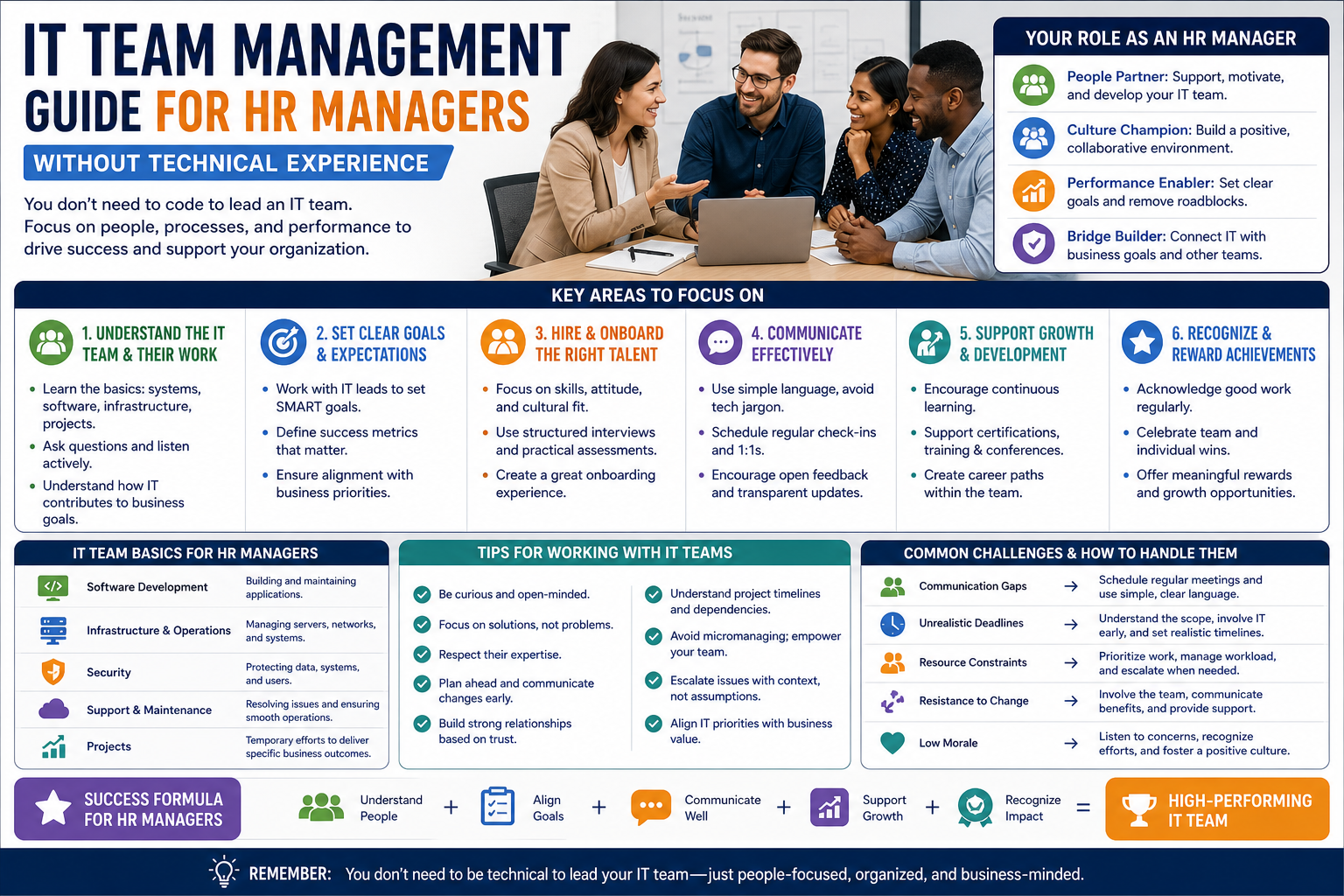
Managing an IT team without a technical background can feel challenging at the beginning. Many HR managers are highly skilled in recruitment, employee relations, workplace culture, performance management, and leadership development, yet they may have limited exposure to technical environments. When stepping into a role that involves leading software developers, support specialists, engineers, or cybersecurity staff, it is natural to feel uncertain. Technical teams often use specialized language, work on systems that seem complex, and solve problems that may not be visible to the rest of the organization.
However, successful leadership does not depend on knowing how to code, configure networks, or troubleshoot servers. It depends on understanding people, setting direction, building trust, and creating an environment where skilled professionals can perform at their best. In many organizations, some of the most effective leaders manage teams whose technical expertise exceeds their own. Their value comes from leadership, not from doing the specialist work themselves.
For HR managers, this means leading an IT team is entirely possible when approached with confidence, curiosity, and a willingness to learn the basics while focusing on strong management principles.
Why IT Teams Often Operate Differently
IT teams often function differently from many other departments because the nature of their work demands a different rhythm. Employees in technical roles frequently solve complex problems that require concentration, precision, and uninterrupted thinking time. A developer working through a software issue or a systems engineer diagnosing a network problem may need long periods of focused attention. Frequent interruptions can slow progress and increase errors.
Another factor is that much of IT’s success is invisible. When systems run smoothly, email works properly, applications stay online, and employees can access tools without issue, most people do not notice the work happening behind the scenes. Attention often comes only when something fails. This can create frustration among technical staff who spend large amounts of time preventing problems rather than receiving recognition for visible achievements.
IT teams also face constant change. New software, security risks, updates, user requests, and evolving business demands create an environment where learning never stops. This pace can be energizing, but it can also become exhausting if priorities are unclear or workloads are unmanaged. HR managers who understand these realities are better prepared to lead fairly and effectively.
The Leadership Role of a Non-Technical HR Manager
An HR manager leading an IT team does not need to become a technical expert. The real responsibility is to guide people, create structure, and connect the team’s work to organizational goals. Technical specialists are hired for their expertise. Managers are there to help that expertise produce results.
This includes setting expectations, ensuring workloads are realistic, supporting collaboration, addressing conflict, and making sure employees feel valued. It also involves helping senior leadership understand the needs of the IT function while helping technical staff understand business priorities.
Many technical employees appreciate managers who are organized, consistent, and respectful more than managers who attempt to control technical decisions without the necessary background. Strong leadership gives people room to do their jobs well while providing direction and accountability.
When HR managers focus on removing barriers, improving communication, and supporting professional growth, they add tremendous value to technical teams.
Understanding the Main Functions Within IT
Although deep technical knowledge is unnecessary, it helps to understand the broad categories of work inside IT. This creates stronger communication and more realistic expectations. Software professionals may build internal systems, websites, applications, or customer-facing platforms. Their work often involves planning features, fixing bugs, and improving user experience over time.
Infrastructure specialists focus on the systems that keep the organization operating. They may manage servers, storage, user access, and internal tools that employees rely on daily. Network professionals ensure communication between offices, devices, remote workers, and digital platforms remains stable and secure.
Cybersecurity teams focus on protecting systems, data, and people from threats. Their work may include monitoring suspicious activity, strengthening controls, responding to incidents, and guiding employees on safe practices. Support staff help employees solve day-to-day technical issues such as access problems, device failures, or software errors.
Understanding these areas at a high level helps HR managers make better staffing decisions, interpret requests more effectively, and appreciate the pressures different specialists face.
Overcoming the Barrier of Technical Language
One of the most common reasons non-technical managers feel uncomfortable around IT teams is language. Technical professionals often use acronyms, product names, system terms, and shorthand expressions that make perfect sense to peers but sound confusing to others. This can create an unnecessary divide between departments.
The solution is not to memorize every term. It is to encourage communication in plain language. A strong manager should feel comfortable asking what something means, why it matters, and what the impact will be. Asking for clarity is a sign of leadership, not weakness.
When employees learn to explain technical matters clearly, everyone benefits. Decisions become faster, misunderstandings decrease, and senior leaders can prioritize resources more effectively. Over time, teams become stronger when they know how to translate technical needs into business language.
HR managers who normalize clear communication often improve collaboration across the entire organization.
Building Trust with Technical Professionals
Trust is essential when managing experts in any field. IT professionals want to know that leadership respects their skills, listens to concerns, and makes thoughtful decisions. They do not expect managers to know everything, but they do expect honesty and fairness.
A manager who pretends to understand technical details they do not understand can quickly lose credibility. By contrast, a leader who openly says they rely on the team’s expertise while focusing on strategic decisions often gains respect. Confidence does not require pretending. It requires clarity about roles.
Trust also grows when managers follow through on commitments. If employees raise concerns about workload, outdated tools, or unclear priorities, they need to see meaningful action. Even when problems cannot be solved immediately, transparent communication builds confidence.
Consistency matters as well. Teams feel secure when priorities are clear, expectations are stable, and decisions are made with logic rather than emotion. HR managers who lead calmly and reliably create an environment where technical staff can focus on their work.
Understanding Pressure Inside IT Roles
Technical teams often work under pressures that are not obvious from the outside. A failed system can disrupt operations instantly. Security issues may require urgent action. Software defects can affect customers or internal productivity. Because technology supports so many business functions, small technical issues can create large organizational consequences.
Many IT professionals also carry after-hours responsibilities. They may be expected to respond during evenings, weekends, or holidays if systems fail. Even when emergencies are rare, the possibility of interruption creates stress over time.
There is also pressure from competing priorities. Different departments may all view their requests as urgent. Leadership may want faster delivery, while technical staff may need more time for testing and quality control. This tension can become exhausting if not managed properly.
HR managers who recognize these stress patterns are better able to advocate for staffing, realistic timelines, healthy boundaries, and employee wellbeing.
Setting Effective Expectations
One of the greatest contributions a non-technical manager can make is setting clear expectations. Technical teams struggle when goals are vague. Instructions such as improve systems, modernize technology, or fix issues do not provide enough direction.
Better expectations focus on business outcomes. A team may be asked to improve response times, reduce downtime, increase employee satisfaction with support services, strengthen data security, or deliver a project by a certain date. These goals are measurable and meaningful.
When outcomes are clear, technical professionals can decide the best way to achieve them. This respects their expertise while maintaining accountability. It also reduces micromanagement, which often damages morale and slows progress.
HR managers who emphasize results rather than controlling every process help IT teams work more effectively.
Respecting Different Work Styles
Technical professionals often vary widely in personality and communication style. Some are highly outgoing and collaborative. Others are quieter, reflective, and more comfortable expressing ideas through written communication. Strong managers avoid judging competence based on personality alone.
In many workplaces, outspoken employees receive more attention than quiet high performers. This can be especially unfair in technical environments where thoughtful analysis and deep focus are valuable strengths. Managers should evaluate employees based on contribution, reliability, teamwork, and growth rather than social style.
It is also important to protect focused work time. Excessive meetings and constant interruptions can damage productivity significantly. A technical employee may lose momentum every time concentration is broken. Respecting time and creating space for deep work shows maturity in leadership.
When HR managers understand these differences, they create fairer and more productive environments.
Managing Performance Without Deep Technical Knowledge
Many non-technical leaders worry they cannot evaluate IT employees properly. In reality, performance management can be highly effective when based on outcomes, behavior, and informed input from technical leads.
Managers can assess whether deadlines are met, communication is professional, collaboration is strong, documentation is clear, and responsibilities are handled reliably. They can observe whether employees solve problems constructively, support teammates, and respond well under pressure.
Technical depth can be assessed with support from senior specialists who understand the quality of work. HR managers do not need to personally review code or system architecture to make fair performance decisions.
The most successful approach combines business results with expert technical feedback. This creates balanced evaluations that recognize both professional behavior and specialist contribution.
Recognition and Morale in IT Teams
Because IT work is often noticed only when something goes wrong, recognition is especially important. Employees who quietly maintain systems, prevent outages, improve security, or solve recurring issues may receive little attention despite making major contributions.
A thoughtful manager changes this pattern by acknowledging meaningful work regularly. Recognition should be specific and sincere. Praising someone for leading a successful upgrade, improving internal response times, mentoring a junior colleague, or solving a persistent issue has more impact than generic compliments.
Public appreciation can also improve how the rest of the company views IT. When leaders highlight technical achievements, other departments gain awareness of the value being delivered behind the scenes.
Morale improves when employees feel seen, respected, and appreciated for their effort.
Supporting Growth and Career Development
Technology changes quickly, so many IT professionals care deeply about learning and career progression. If employees feel their skills are stagnating, they may look elsewhere for opportunity. This makes development a major retention issue.
Growth does not always mean promotion into management. Some employees want to deepen technical expertise rather than supervise people. Others may be interested in project leadership, mentoring, process improvement, or cross-functional responsibilities.
HR managers can have valuable career conversations by understanding each employee’s ambitions. Some may want broader business exposure. Others may want to specialize. Different paths should be respected equally.
When employees believe their future matters to leadership, engagement rises and turnover risk declines.
Creating Confidence as a Non-Technical Leader
Confidence in this role does not come from pretending to be an engineer. It comes from understanding what leadership truly means. A manager brings value through judgment, communication, fairness, structure, and people development.
Technical teams often respect leaders who remove obstacles, secure resources, clarify priorities, and protect the team from chaos. They appreciate managers who listen carefully, make reasoned decisions, and represent their needs honestly.
Over time, a non-technical HR manager can become highly effective by learning the business context of IT work while staying grounded in strong management practices. Leadership credibility grows through actions, not through jargon.
An HR professional who supports people well, leads with integrity, and respects expertise can successfully manage even the most technical teams.
Building Strong Communication, Performance, and Culture in IT Teams
Leading an IT team successfully requires far more than assigning tasks or approving budgets. Once a non-technical HR manager understands the structure of the department and the nature of technical work, the next stage is building an environment where communication flows clearly, performance is managed fairly, and team culture supports long-term success. These areas often determine whether a technically skilled department becomes highly effective or consistently frustrated.
Many organizations hire talented IT professionals but struggle to create the conditions that allow them to perform at their highest level. Miscommunication with leadership, unclear priorities, poor recognition, unnecessary bureaucracy, and weak team culture can reduce the impact of even the strongest technical staff. This is where thoughtful management becomes essential.
A non-technical HR manager can make a major difference by focusing on how people work together, how goals are understood, how effort is recognized, and how trust is built across the organization. These leadership functions often matter just as much as technical ability when it comes to delivering results.
Why Communication Is the Foundation of IT Team Success
Communication problems are one of the most common reasons IT departments struggle. In many cases, the technical work itself is not the issue. The real challenge is that expectations are unclear, updates are misunderstood, priorities are changing too often, or different departments speak in ways that confuse one another.
IT professionals often communicate with precision because their work depends on accuracy. Business leaders may communicate in broader strategic language focused on growth, cost, speed, or customer outcomes. When these styles collide, both sides can become frustrated. Technical employees may feel leadership is unrealistic, while leadership may feel the IT team is overly cautious or slow.
An HR manager can bridge this divide by encouraging language that connects technical action with business impact. Instead of discussing only systems, teams should also explain value. Instead of requesting only urgency, leadership should also explain business reasons.
When communication improves, tension often decreases immediately. People usually become more cooperative when they understand each other clearly.
Helping IT Professionals Communicate with Non-Technical Stakeholders
Many skilled technical employees have never been taught how to explain their work to non-technical audiences. They may know exactly how a system functions but struggle to describe why a delay matters, why a risk is serious, or why a request needs more resources.
This does not mean they lack professionalism. It simply means communication across disciplines requires a different skill set than technical execution.
HR managers can help by coaching employees to present information in practical terms. Instead of describing only the technical process, they should explain outcomes, consequences, timelines, and options. When discussing a security upgrade, for example, the key issue is not only what software will be installed but how risk will be reduced and what business interruption may occur during implementation.
Encouraging concise updates, executive summaries, and plain-language explanations can strengthen the department’s influence inside the organization. Teams that communicate clearly are more likely to receive support, budget approval, and strategic trust.
Improving Communication from Leadership to IT Teams
Communication must also improve in the opposite direction. IT teams often become frustrated when leadership sends vague or constantly changing instructions. A request such as improve the system or make this faster does not provide enough clarity for effective planning.
Strong leadership communication includes clear priorities, context, deadlines, and decision ownership. Employees need to understand why a project matters, what success looks like, who will approve milestones, and how urgent the timeline truly is.
When priorities shift, explain why. Technical teams can usually adapt to change if they understand the business reason. What damages morale is unexplained disruption that forces people to abandon carefully planned work repeatedly.
Managers who communicate transparently reduce confusion and create trust. Even difficult decisions are easier for teams to accept when they are explained honestly.
The Importance of Listening in Technical Environments
Many managers focus heavily on speaking and directing but underestimate the power of listening. In IT environments, listening is especially valuable because specialists often hold information leadership cannot see.
A systems engineer may recognize infrastructure risks long before an outage occurs. A support analyst may notice recurring employee frustrations that reveal deeper process issues. A developer may understand why a proposed deadline is unrealistic based on technical dependencies.
When managers listen carefully, they gain access to insight that improves decisions. When they dismiss technical concerns too quickly, they may create preventable problems.
Listening also strengthens morale. Employees who feel heard are more engaged, even when every request cannot be approved. Respectful attention communicates that expertise matters.
For non-technical HR managers, listening is one of the most effective leadership tools available because it allows knowledge to flow upward from those closest to the work.
Running Meetings That IT Teams Respect
Many technical employees dislike meetings, not because they oppose collaboration, but because poorly managed meetings waste time and interrupt concentration. A one-hour meeting with no clear purpose may destroy several hours of productive focus when preparation and recovery time are included.
Managers can improve this dramatically by making meetings intentional. Every meeting should have a reason, a relevant attendee list, and a clear desired outcome. If information can be shared in writing, that option may be better. If discussion is needed, the conversation should stay focused and conclude with ownership of next steps.
IT teams often appreciate shorter meetings with specific agendas. They also value meetings that solve real blockers rather than simply repeating status updates.
When meetings are useful, participation improves. When meetings feel performative, disengagement grows quickly.
Creating Accountability Without Micromanagement
Some non-technical managers become anxious when they cannot directly judge every detail of technical work. In response, they may over-monitor tasks, request constant updates, or attempt to control methods they do not fully understand. This often harms productivity and trust.
Accountability does not require micromanagement. It requires clarity, visibility, and follow-through.
Employees should know what outcomes are expected, what timeline has been agreed, and what risks must be escalated early. Managers should receive meaningful progress updates without demanding unnecessary detail. If delays occur, teams should communicate them promptly along with revised plans.
This model respects professional autonomy while maintaining responsibility. Most experienced IT employees prefer being trusted to solve problems rather than being watched constantly.
A manager who focuses on outcomes instead of hovering over execution often gets stronger performance and healthier morale.
Managing Performance in a Fair and Practical Way
Performance management in technical departments should balance measurable results with professional behavior. Some organizations make the mistake of evaluating only visible output, while others focus too heavily on personality or self-promotion. Neither approach is effective.
Strong performance reviews consider whether employees complete meaningful work, solve problems effectively, communicate responsibly, collaborate well, and continue developing their capabilities. Reliability matters greatly in IT because missed commitments can affect many others.
Managers should also recognize that some technical work is preventative. A cybersecurity specialist who quietly blocks threats or an infrastructure engineer who prevents outages may create enormous value without producing flashy visible output.
Fair evaluation requires understanding impact, not only appearances. HR managers are well positioned to ensure that quieter contributors are not overlooked in favor of louder personalities.
Using Feedback to Improve Performance
Feedback is most effective when it is timely, specific, and balanced. Waiting until an annual review to mention recurring issues creates frustration and missed opportunities.
In IT settings, feedback should focus on behaviors employees can change. This may include communication habits, missed handovers, weak documentation, collaboration problems, or failure to raise risks early enough. It should also recognize strengths such as calm incident handling, initiative, mentoring, or process improvement.
Constructive feedback should not feel like punishment. It should feel like support for growth. Employees are more receptive when they believe the manager is fair and invested in their success.
Positive feedback matters equally. Many technical professionals hear mostly complaints because problems attract attention. Managers who regularly acknowledge strong work build confidence and motivation.
Understanding Motivation in IT Professionals
Not all employees are motivated by the same factors. This is especially true in technical teams where people may have very different personalities and career goals.
Some employees are driven by challenging work and solving difficult problems. Others care deeply about learning new tools or building expertise. Some value flexibility and autonomy. Others are motivated by recognition, leadership opportunities, or contributing to meaningful projects.
Managers who assume everyone is motivated mainly by salary or promotion often miss important drivers of engagement. Regular conversations help reveal what matters to each individual.
When employees receive work that aligns with their strengths and motivations, performance often improves naturally. Motivation is not about perks alone. It is about meaningful alignment between the person and the work.
Building a Healthy Culture Inside IT Teams
Culture is the everyday experience of working in a team. It includes how people treat one another, how conflict is handled, whether ideas are welcomed, whether blame is common, and whether success feels shared.
A healthy IT culture encourages professionalism, respect, learning, and accountability. People feel comfortable asking for help, admitting mistakes early, and offering suggestions. Knowledge is shared rather than hoarded. Credit is given fairly. Pressure exists, but toxicity does not.
An unhealthy culture may include constant blame, gatekeeping, dismissive behavior, ego-driven conflict, secrecy, burnout, or hostility toward non-technical colleagues.
HR managers can influence culture significantly by setting expectations for behavior, intervening when disrespect appears, rewarding collaboration, and modeling professionalism.
Culture grows through repeated habits. Small tolerated behaviors often become the norm.
Reducing Silos Between IT Specializations
Large IT departments sometimes become fragmented. Developers may blame infrastructure teams. Security may frustrate product teams. Support staff may feel undervalued compared with engineering groups. Each function can become protective of its own priorities.
This silo effect reduces performance because modern technology work is interconnected. Systems, software, support, security, and operations depend on one another.
Managers can reduce silos by encouraging shared goals, cross-functional planning, and mutual respect. When teams understand how others contribute, empathy increases. Joint problem-solving also improves relationships.
Recognition should reflect collective success, not only isolated departments. If one team receives all praise while another carries hidden operational burdens, resentment can grow.
Strong leaders help employees see themselves as one department with different specialties rather than separate camps competing internally.
Managing Conflict Productively
Conflict is normal in IT teams because intelligent professionals often hold strong views. Disagreement about architecture, timelines, security controls, vendor choices, or priorities does not automatically indicate dysfunction. In many cases, thoughtful debate improves outcomes.
The problem begins when disagreement becomes personal, political, or hostile.
Managers should distinguish between healthy conflict and destructive conflict. Healthy conflict focuses on ideas and evidence. Destructive conflict focuses on ego, blame, or disrespect.
When intervention is needed, leaders should bring people back to shared goals. What problem are we trying to solve? What trade-offs exist? What data supports each option? What decision process will be used?
Technical teams often respond well to fair, rational conflict resolution. They usually lose patience with emotional politics and inconsistent decision-making.
Supporting Inclusion and Respect in Technical Teams
Some technical workplaces develop cultures that unintentionally exclude certain personalities or backgrounds. This may happen through dismissive communication, insider language, social cliques, or assumptions about who “fits” technical work.
HR managers play a crucial role in ensuring that professionalism and inclusion are real expectations. Every employee should feel respected regardless of communication style, gender, age, experience level, or non-traditional career path.
Inclusion also means making space for junior voices. Newer employees often notice outdated habits or hidden inefficiencies that long-tenured staff overlook. If only senior voices are heard, valuable ideas may be lost.
A respectful environment attracts stronger talent and improves retention. Technical excellence and inclusive culture can and should exist together.
Handling Mistakes Without Creating Fear
Mistakes happen in every department, but in IT they can be highly visible. A deployment issue may interrupt service. A misconfiguration may cause downtime. A rushed change may create user frustration.
If managers react with blame and anger, employees learn to hide problems. This increases future risk because issues surface later and in worse form.
A stronger approach is accountability with learning. What happened, why did it happen, and what process improvement can reduce recurrence? Responsibility still matters, but fear should not dominate the response.
When employees know they can report issues quickly without humiliation, organizations recover faster and improve systems more effectively.
Recognition as a Cultural Tool
Recognition does more than make people feel appreciated. It signals what the organization values. If only heroic last-minute rescue efforts are praised, teams may neglect planning and prevention. If collaboration, reliability, mentorship, and steady excellence are recognized, those behaviors become stronger.
Managers should notice both visible wins and quiet consistency. The employee who prevents recurring problems may deserve as much praise as the employee who solves a dramatic outage.
Recognition should be credible and connected to real contribution. Empty praise loses meaning quickly.
Used wisely, recognition becomes one of the simplest ways to shape a positive team culture.
Building Long-Term Credibility as a Non-Technical Manager
Over time, technical teams judge managers less by technical vocabulary and more by leadership behavior. Do they protect the team from unnecessary chaos? Do they make fair decisions? Do they communicate honestly? Do they listen? Do they support growth? Do they hold people accountable consistently?
These questions matter far more than whether a manager can explain advanced technical concepts.
Credibility is built through repeated evidence of competence. When employees see that leadership improves their environment and helps them succeed, respect grows naturally.
For HR managers, this is encouraging. You do not need to become an engineer to lead engineers well. You need to become excellent at management in a technical context. That difference is where many successful leaders create lasting impact.
Strategic Leadership, Decision-Making, and Long-Term Growth in IT Teams
Leading an IT team as a non-technical HR manager becomes most impactful when the focus shifts from day-to-day coordination to long-term strategy, organizational alignment, and sustainable team growth. At this stage of leadership, the emphasis is not only on communication and culture, but also on how IT contributes to business direction, how decisions are made under uncertainty, and how teams evolve over time in a fast-changing technological environment.
While technical experts handle implementation, HR leadership plays a crucial role in ensuring that IT functions remain aligned with the organization’s priorities, properly resourced, and structurally prepared for future demands. This requires judgment, foresight, and the ability to balance competing needs across departments without becoming involved in technical execution.
A non-technical HR manager can be highly effective in this space by focusing on clarity of priorities, organizational structure, talent planning, risk awareness, and leadership development. These areas define whether an IT department becomes reactive and overwhelmed or proactive and strategically valuable.
Understanding IT as a Business Function, Not Just a Technical One
One of the most important mindset shifts for HR managers is recognizing that IT is not simply a support function that fixes problems. In modern organizations, IT is deeply connected to business performance. Almost every department relies on technology in some way, whether through communication tools, customer platforms, internal systems, or data management.
This means IT decisions are not purely technical. They are business decisions with technical implications. For example, choosing to upgrade a system is not just about software performance; it is also about cost, employee productivity, risk exposure, downtime, and long-term scalability.
HR managers contribute value by helping leadership understand these trade-offs in human and organizational terms. When IT is treated as a strategic partner rather than a background service, it becomes easier to justify investment, plan resources, and prioritize initiatives effectively.
The Role of HR in IT Strategic Alignment
Strategic alignment refers to ensuring that IT work directly supports organizational goals. Without alignment, technical teams may focus on interesting or urgent tasks that do not necessarily contribute to business direction. With alignment, every major initiative connects back to measurable outcomes such as efficiency, customer experience, security, or growth.
HR managers often play an indirect but important role in this alignment by facilitating communication between executives and technical teams. They help translate business objectives into workforce needs and ensure that IT staffing, skills, and priorities match organizational expectations.
This requires asking the right questions rather than providing technical answers. What business problem is this solving? How does this improve performance or reduce risk? What happens if this is delayed? How does this initiative compare to other priorities? These questions help ensure clarity and prevent misalignment between departments.
Decision-Making Without Technical Ownership
Non-technical managers often worry about making decisions in IT environments where they do not fully understand the technical details. However, effective leadership does not require owning technical solutions. It requires understanding impact, managing trade-offs, and ensuring accountability.
Technical teams should be responsible for proposing solutions based on expertise. HR and leadership should evaluate those proposals based on business needs, resource constraints, risk tolerance, and strategic direction. This separation of responsibilities is essential for healthy decision-making.
For example, if a technical team recommends delaying a software release due to stability concerns, the HR manager does not need to evaluate the code or system design. Instead, they focus on understanding the risk of delay versus the risk of release and ensuring that stakeholders are aligned on the decision.
Good decision-making in IT environments is collaborative rather than hierarchical. It combines technical insight with organizational judgment.
Managing Risk in IT Environments
Risk management is a core part of IT leadership. Technology systems carry risks related to security, data protection, downtime, compliance, and operational disruption. While technical teams identify and mitigate these risks, leadership is responsible for ensuring they are understood and appropriately prioritized.
HR managers contribute by ensuring that risk discussions are not ignored or rushed. In fast-paced environments, there is often pressure to prioritize speed over caution. However, ignoring risk can lead to long-term consequences that are far more costly than short delays.
Risk conversations should include clarity about likelihood, impact, and mitigation strategies. Not all risks require immediate action, but all risks should be acknowledged and evaluated properly.
Encouraging a culture where risk can be openly discussed without fear of blame helps improve organizational resilience. Employees should feel safe raising concerns early, even when those concerns slow down delivery.
Workforce Planning for IT Teams
One of the most important strategic responsibilities in IT management is workforce planning. Technology environments evolve quickly, and skill requirements change over time. Without planning, teams may become overloaded, under-skilled, or misaligned with future needs.
HR managers play a key role in ensuring that staffing levels match workload demands and that hiring strategies reflect long-term requirements rather than short-term pressure. This includes understanding when additional roles are needed, when skill development is more appropriate than hiring, and when restructuring may improve efficiency.
Workforce planning also involves anticipating future changes. New systems, digital transformation initiatives, cybersecurity requirements, and cloud migration projects can all impact staffing needs. Preparing early reduces stress and improves execution quality.
A well-planned IT team is more stable, more efficient, and less reactive to crises.
Talent Retention in Technical Environments
Retention is especially important in IT because experienced professionals carry significant institutional knowledge. Losing key employees can disrupt systems, slow projects, and increase operational risk.
Retention is influenced by more than salary. Employees stay when they feel challenged, supported, respected, and valued. They also stay when they see opportunities for growth and when workloads are manageable.
Burnout is a major risk in IT roles due to deadlines, on-call responsibilities, and constant change. HR managers can help by monitoring workload distribution, ensuring fair scheduling, and addressing signs of fatigue early.
Career stagnation is another common reason for turnover. If employees feel they are not learning or progressing, they may seek new opportunities elsewhere. Providing development pathways, mentoring, and cross-functional exposure helps reduce this risk.
Retention improves significantly when employees trust leadership and feel their contributions are recognized.
Building Leadership Capacity Within IT Teams
Strong IT departments are not dependent on a single manager. They include multiple layers of leadership, including technical leads, senior engineers, project coordinators, and emerging managers.
HR managers play a vital role in identifying leadership potential and developing it over time. Not all excellent technical employees naturally become good managers, but many can grow into leadership roles with proper support.
Leadership development includes communication training, decision-making exposure, conflict resolution experience, and responsibility for guiding smaller teams or projects. It also involves learning how to balance technical depth with people management.
Developing internal leaders reduces dependency on external hiring and strengthens organizational stability. It also creates career pathways that improve retention.
Managing Change in IT Systems and Processes
Change is constant in technology environments. Systems are upgraded, tools are replaced, security requirements evolve, and business needs shift. While change is necessary, it can also create resistance and disruption if not managed carefully.
HR managers support change by ensuring that communication is clear, timelines are realistic, and employees understand the reasons behind transitions. People are more likely to accept change when they understand its purpose and impact.
Change management also involves training, support, and phased implementation. Rushed transitions often lead to confusion, errors, and frustration. Structured rollout plans reduce risk and improve adoption.
IT teams benefit when change is treated as an organized process rather than a sudden directive.
Managing External Vendors and Technology Partners
Many IT departments rely on external vendors for software, infrastructure, support, or specialized services. Managing these relationships is part of strategic IT leadership.
HR managers may be involved indirectly through procurement decisions, contract discussions, or performance evaluation of service providers. While technical teams assess functionality, leadership evaluates cost, reliability, accountability, and long-term value.
Vendor relationships require clear expectations and communication. Poorly managed external partners can introduce delays, security risks, or misalignment with business goals.
Strong oversight ensures that external services complement internal capabilities rather than creating additional complexity.
Balancing Innovation and Stability
One of the ongoing challenges in IT leadership is balancing innovation with stability. Organizations want new features, improved systems, and modern tools, but they also depend on stable systems that do not fail.
Technical teams often feel this tension directly. Innovation requires experimentation and change, while stability requires caution and control. Both are important.
HR managers support balance by helping prioritize initiatives and ensuring that not all effort is focused on short-term innovation or long-term maintenance alone. A healthy IT environment invests in both improvement and reliability.
This balance ensures that systems evolve without becoming unstable or outdated.
Measuring Success in IT Departments
Measuring IT success requires more than technical metrics. While system performance, uptime, and error rates are important, they do not fully reflect business impact.
Success should also be measured in terms of user satisfaction, efficiency improvements, cost optimization, security strength, and alignment with organizational goals. Employee experience is also a valuable metric, especially for internal IT services.
HR managers help broaden the definition of success beyond technical performance alone. This ensures that IT is evaluated based on its contribution to the organization rather than isolated technical indicators.
Balanced measurement leads to better decision-making and more meaningful performance evaluation.
Conclusion
Managing an IT team as a non-technical HR manager is less about mastering technology and more about mastering leadership. Throughout the different aspects of IT management, one idea remains consistent: technical expertise is important, but it is not the foundation of effective leadership. The real strength of an HR manager lies in their ability to guide people, build trust, and create a structured environment where skilled professionals can perform at their best.
IT teams operate in fast-moving, high-pressure environments where clarity, communication, and prioritization are essential. Without strong leadership, even highly skilled technical professionals can become overwhelmed, misaligned with business goals, or disengaged from their work. When HR managers focus on setting clear expectations, supporting collaboration, and ensuring fair workloads, they help transform technical capability into organizational value.
Another key takeaway is the importance of communication. Bridging the gap between technical language and business understanding allows both sides to work together more effectively. When managers encourage transparency, ask meaningful questions, and ensure that decisions are clearly explained, they reduce confusion and strengthen trust across the organization.
Equally important is the human side of IT management. Recognition, career development, psychological safety, and respectful treatment all play a major role in performance and retention. IT professionals thrive in environments where they feel valued not only for what they produce but also for how they contribute to the team.
Ultimately, successful IT leadership is built on consistency, fairness, and the ability to support expertise rather than replace it. Non-technical HR managers do not need to become engineers to lead IT teams effectively. Instead, they need to become strong facilitators of people, process, and purpose. When these elements come together, IT teams become more stable, more productive, and far better aligned with the long-term success of the organization.