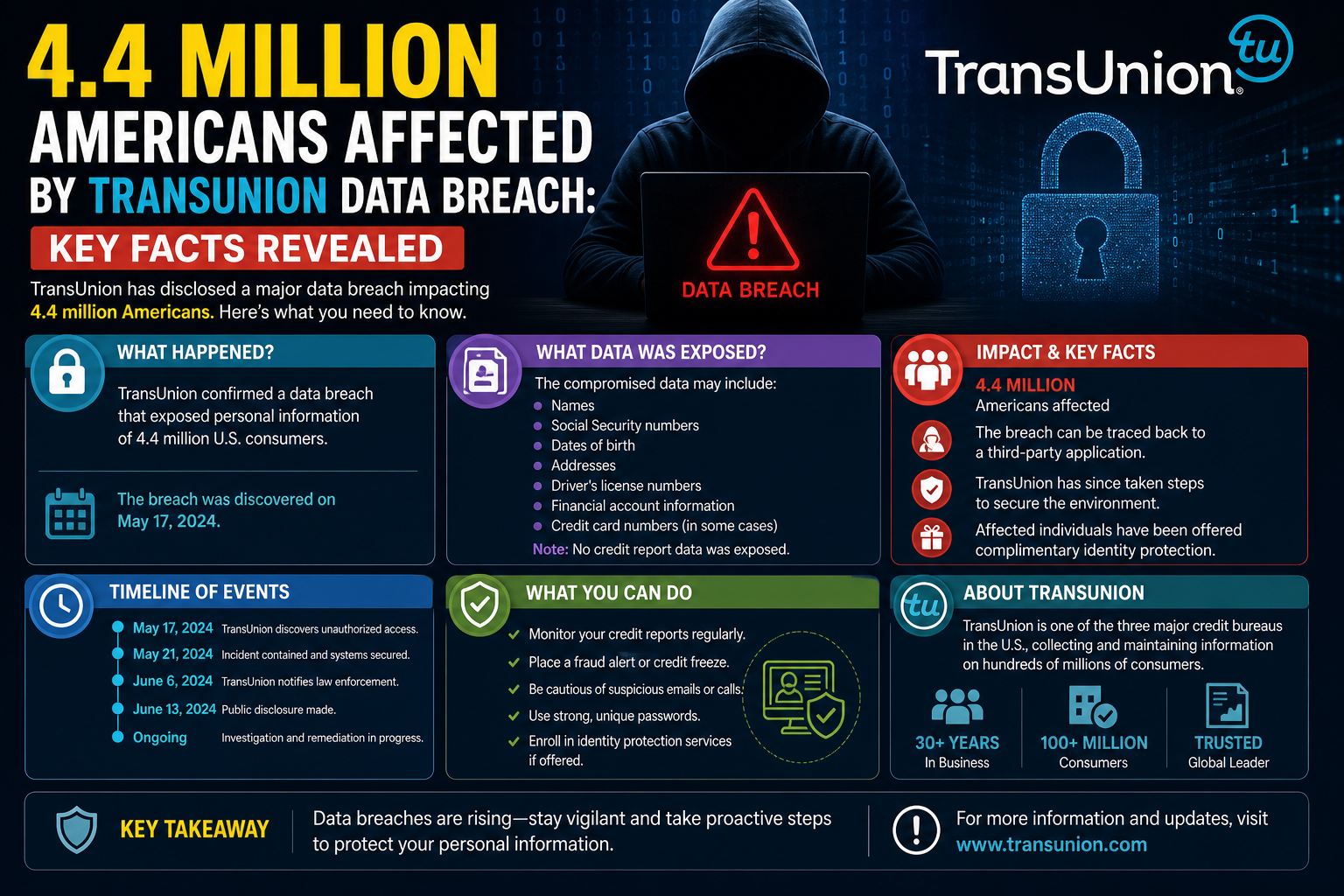
A major security incident affecting TransUnion has drawn attention because of the type and scale of information involved. Reports indicate that data tied to approximately 4.4 million individuals may have been exposed after unauthorized access to internal systems. Unlike breaches that involve simple login credentials, this incident involves deeply personal identity details such as names, addresses, phone numbers, and Social Security numbers. These are not easily replaceable pieces of information, and their exposure creates long-term risks for affected individuals.
What makes this situation more concerning is not only the number of people impacted but also the nature of the organization involved. Credit bureaus operate at the center of financial identity systems, meaning the data they store is widely used to verify identity across lending, banking, housing, and other financial services. When such a system is compromised, the consequences extend far beyond a single platform or account.
The Role of Credit Bureaus in Personal Financial Identity
Credit bureaus function as large-scale data repositories that track borrowing and repayment behavior over time. They collect information from banks, credit card issuers, lenders, and public records to build detailed financial profiles of individuals. These profiles help determine creditworthiness and are used in decisions related to loans, mortgages, rentals, and sometimes employment screening.
Because these institutions aggregate data from so many sources, they hold extremely comprehensive identity profiles. A typical record may include personal identification details, residential history, credit account activity, and financial behavior patterns. This level of detail is what makes credit bureaus essential to modern financial systems, but it also makes them highly attractive targets for cybercriminals.
When systems like these are breached, attackers do not simply gain access to isolated fragments of data. Instead, they may obtain structured identity profiles that can be used for impersonation, fraud, and long-term exploitation.
Nature of the Information Exposed in the Breach
The exposed data reportedly includes some of the most sensitive identifiers used in financial systems. Names and addresses are common in many databases, but when combined with Social Security numbers and contact information, the risk increases significantly.
A Social Security number is particularly critical because it functions as a universal identifier in many financial and administrative systems. Unlike passwords or credit card numbers, it is not designed to change frequently. In many cases, it remains constant throughout a person’s life. This permanence makes it especially valuable to criminals.
When such identifiers are paired with additional personal details like phone numbers and addresses, they can be used to construct convincing identity profiles. These profiles may allow attackers to pass verification checks or manipulate customer service systems that rely on personal data for authentication.
How Unauthorized Access to Systems May Occur
Although the exact method of intrusion in this incident has not been fully confirmed publicly, breaches of this type often involve a combination of vulnerabilities. Cybercriminals may exploit weak authentication systems, outdated software, misconfigured servers, or social engineering tactics that target employees.
In some cases, attackers do not break in through advanced technical means alone. Instead, they may trick individuals into revealing access credentials or gain entry through compromised third-party vendors. Once inside a system, they often move laterally through networks, identifying databases that contain high-value information.
The process of extracting data is usually stealthy. Attackers may attempt to avoid detection by gradually copying files or disguising their activity within normal system operations. By the time the breach is discovered, significant amounts of data may already have been exfiltrated.
Why Social Security Number Exposure Is Especially Serious
Among all types of personal data, Social Security numbers are among the most dangerous when exposed. The reason is their widespread use as identity anchors across multiple systems. They are often used in combination with other data points to verify identity for financial accounts, government records, and employment-related processes.
Unlike passwords, which can be reset, Social Security numbers are permanent. Once exposed, they cannot be changed in a practical sense. This creates a long-term vulnerability for individuals whose data is compromised.
Criminals value this type of information because it allows them to construct synthetic identities or impersonate real individuals. Even partial knowledge of a Social Security number, when combined with other personal details, can be enough to bypass certain verification systems.
How Stolen Identity Data Is Typically Used
Once personal data is stolen, it rarely remains unused. Instead, it enters a cycle of exploitation that can span months or years. One common outcome is identity theft, where criminals attempt to open financial accounts in someone else’s name. These accounts may include credit cards, loans, or utility services.
Another common use is account takeover. If criminals have enough personal information, they may attempt to reset passwords or convince customer support representatives to grant access to existing accounts. This can lead to unauthorized transactions or changes in account details.
Stolen identity data is also frequently used in targeted scams. Fraudsters may contact individuals pretending to represent banks, government agencies, or financial institutions. Because they already possess accurate personal information, these scams can appear highly legitimate.
The Role of Underground Markets in Data Exploitation
Stolen data often does not remain with the original attacker. Instead, it is frequently sold or traded in underground markets. These markets operate in layers, with data being resold multiple times to different criminal groups.
Once personal information enters this ecosystem, it can be combined with other breached datasets to create more complete identity profiles. Over time, fragmented information from multiple breaches can be assembled into highly detailed records that are far more valuable than individual data points.
This resale cycle means that even if immediate fraud does not occur, the risk persists. Data can resurface months or even years after the original breach, used in entirely different schemes by unrelated actors.
Delayed Impact and Long-Term Risk Exposure
One of the most misunderstood aspects of data breaches is timing. Many individuals assume that if fraud does not occur shortly after a breach, they are safe. However, identity data does not lose value quickly.
Criminals often wait for attention to fade before using stolen information. This delay helps them avoid detection and increases the likelihood that victims will not be actively monitoring for suspicious activity.
As a result, the effects of a breach can unfold gradually. A person may not notice any immediate issues but could later encounter unauthorized accounts, suspicious credit inquiries, or fraudulent activity linked to their identity.
Misconceptions About Personal Risk After Breaches
A common misunderstanding is that only individuals who directly interact with a company are affected by its data breach. In reality, credit bureaus collect information from a wide range of financial institutions, meaning many individuals may be included in their databases without ever directly engaging with them.
Another misconception is that low financial activity reduces risk. Even individuals with limited credit usage may still have sufficient personal data stored in these systems to be useful to attackers.
There is also a belief that strong passwords alone provide protection. While password security is important, identity-based fraud often relies on personal data rather than account credentials. This means that even well-secured accounts can be indirectly affected.
How Identity Information Supports Social Engineering
Social engineering is one of the most effective methods used by criminals after data breaches. This technique relies on psychological manipulation rather than technical hacking.
When attackers have access to accurate personal details, they can create highly convincing messages or phone calls. They may reference real addresses, account numbers, or partial identity information to gain trust. Victims are more likely to comply when information sounds legitimate.
These tactics are often used to obtain additional sensitive data, such as one-time verification codes or login credentials. Once this information is obtained, criminals can escalate their access to financial accounts or services.
Weak Points in Identity Verification Systems
Many identity verification systems still rely on static personal information such as birth dates, addresses, and government identifiers. While these data points were once considered secure, widespread breaches have made them more accessible.
Because this information does not change frequently, it becomes less effective as a security layer once exposed. Attackers who obtain it from one breach can reuse it across multiple systems.
This creates a structural weakness in identity verification processes. Systems that rely heavily on fixed personal data become more vulnerable when that data is widely exposed.
Emotional and Practical Effects on Individuals
Beyond financial risk, data breaches can create ongoing stress for affected individuals. The uncertainty of not knowing whether personal information is being used can lead to persistent concern.
Managing the aftermath of identity exposure may involve monitoring financial accounts, reviewing credit reports, and dealing with suspicious activity. In some cases, individuals may need to resolve fraudulent accounts or disputes, which can take considerable time and effort.
The emotional impact often comes from the feeling of lost control. Personal identity information is deeply tied to trust in financial and administrative systems, and its exposure can undermine that sense of security.
Ongoing Exposure and the Persistence of Risk
Even after systems are secured following a breach, the data that was taken cannot be retrieved from those who already accessed it. This means the risk remains external to the organization that was originally compromised.
As time passes, the same data may appear in different contexts, sometimes combined with other leaked information. This creates an evolving risk landscape where the same breach can have multiple downstream effects.
Because identity information is permanent and widely usable, its exposure represents a long-term condition rather than a short-term incident.
How Investigators Work to Understand a Large-Scale Data Breach
When a breach involving millions of records is discovered, the first priority is not public communication but understanding the scope and method of intrusion. Investigators typically begin by examining system logs, access records, and network activity to identify unusual behavior. This includes tracking when unauthorized access began, what systems were touched, and how long the attacker remained undetected.
In incidents involving complex organizations like credit bureaus, the investigation can be especially difficult. These systems often contain multiple layers of infrastructure, legacy databases, and interconnected services. Attackers may move through these layers in ways that are not immediately obvious, especially if they use legitimate credentials or exploit trusted internal pathways.
Another challenge is determining exactly what data was accessed versus what was simply exposed. In many breaches, attackers may reach a database but only extract a portion of its contents. However, even partial access can still involve millions of records, especially when the target system is large and centralized.
The Technical Pathways Commonly Used in Data Breaches
Cyberattacks that lead to large-scale breaches often follow a few recurring patterns. One common method is exploiting unpatched software vulnerabilities. When systems are not updated regularly, attackers may use known security flaws to gain entry. These vulnerabilities can exist in web applications, server software, or database management systems.
Another frequent method involves compromised credentials. Attackers may obtain usernames and passwords from previous breaches and attempt to reuse them across different systems. This approach works because many people reuse login information across multiple platforms, making credential reuse attacks surprisingly effective.
Phishing is also a major entry point. In these cases, attackers send deceptive emails or messages designed to trick employees into revealing login credentials or downloading malicious software. Once access is obtained, attackers can escalate privileges and move deeper into internal systems.
In more advanced cases, attackers may combine multiple methods. For example, they might use phishing to obtain initial access, then exploit software vulnerabilities to gain administrative control, and finally extract data over time in small, less detectable batches.
Why Credit Bureau Systems Are High-Value Targets
Credit bureaus are attractive targets because they concentrate vast amounts of identity data in one place. Instead of attacking thousands of separate institutions, criminals can focus on a single organization that aggregates information from many sources.
This centralization increases efficiency for attackers. A successful breach can yield structured identity profiles that include financial history, personal identifiers, and contact information. These profiles are far more useful than isolated fragments of data.
Additionally, credit bureaus are deeply integrated into financial systems. Their data is used to validate identity in lending, housing, and other critical services. This makes their records especially valuable for fraud operations, as they can be used to bypass verification systems or create convincing impersonations.
The Lifecycle of Stolen Identity Data
Once personal information is stolen, it typically enters a structured lifecycle within criminal networks. The first stage involves extraction, where data is collected from compromised systems. After that, it is often cleaned and organized to remove duplicates or incomplete entries.
The next stage is distribution. Data may be sold in bulk on underground marketplaces or shared among affiliated criminal groups. Pricing often depends on completeness, with full identity profiles being more valuable than partial records.
After distribution, the data enters the exploitation phase. Different actors may use it for different purposes, such as opening fraudulent accounts, executing phishing campaigns, or performing targeted social engineering attacks.
Finally, data may be archived for future use. Even if it is not immediately exploited, it remains valuable and can be combined with future breaches to create more detailed identity profiles.
How Identity Theft Typically Unfolds After a Breach
Identity theft is rarely an immediate, obvious event. Instead, it often develops gradually over time. In some cases, criminals may wait weeks or months before using stolen information. This delay helps them avoid detection and reduces the likelihood that victims are actively monitoring for suspicious activity.
One common early stage involves small-scale testing. Criminals may attempt minor transactions or account openings to see whether stolen data is valid. If these attempts succeed, they may escalate to larger fraudulent activities.
Another pattern involves synthetic identity creation. In these cases, criminals combine real stolen information with fabricated details to create new identities. These synthetic identities can then be used to build credit histories over time, making detection more difficult.
Some fraud schemes also involve long-term exploitation. For example, criminals may open accounts and maintain them for months before defaulting, maximizing financial gain before detection occurs.
The Role of Social Engineering in Post-Breach Fraud
Social engineering becomes significantly more effective after a data breach because attackers already possess partial personal information. This allows them to build credibility when contacting victims or institutions.
A scammer might reference accurate details such as addresses, partial Social Security numbers, or previous financial activity. This makes their communication appear legitimate, increasing the likelihood that victims will comply with requests.
Common social engineering tactics include impersonating bank fraud departments, government agencies, or credit monitoring services. The goal is often to extract additional sensitive information, such as one-time verification codes, passwords, or account access.
Because these attacks rely on trust rather than technical exploitation, they are difficult to prevent through software alone. Awareness and skepticism become key defenses.
How Criminal Networks Monetize Stolen Data
Stolen identity data is rarely used by a single individual. Instead, it is typically monetized through organized networks that specialize in different stages of fraud.
Some actors focus on data acquisition, while others specialize in selling or trading information. Another group may focus on executing fraud, such as opening accounts or draining financial resources. Additional actors may handle laundering stolen funds or converting digital gains into usable assets.
This division of labor creates an efficient underground economy. It also means that once data is stolen, it can circulate widely and be reused multiple times by different groups.
The value of data depends on several factors, including freshness, completeness, and verification potential. Recently stolen data is often more valuable because it is less likely to have been flagged or invalidated.
Why Detection of Fraud Often Happens Late
One of the biggest challenges in identity-related breaches is delayed detection. Financial institutions often detect fraud only after suspicious patterns emerge, such as unusual spending behavior or multiple account applications in a short period.
However, by the time these signals are identified, criminals may have already extracted significant value. In some cases, fraudulent accounts may remain undetected for extended periods if they are used carefully.
For individuals, detection often happens even later. A person may only discover fraud when reviewing a credit report, receiving unexpected bills, or being denied credit for legitimate applications.
This delay creates a window of opportunity for criminals to maximize exploitation before countermeasures are applied.
The Expansion of Fraud Beyond Financial Accounts
Identity data is not only used for financial fraud. It can also be used in other areas such as tax fraud, medical identity theft, and government benefit scams.
Tax fraud involves filing false returns using stolen identities to claim refunds. Medical identity theft can involve using someone else’s information to receive healthcare services or prescriptions. Government benefit fraud may involve applying for assistance programs under stolen identities.
These forms of fraud can be especially damaging because they may remain undetected for long periods and can create complications in official records that take time to resolve.
Weaknesses in Traditional Identity Verification Methods
Many identity verification systems still rely on static data points that do not change over time. These include birth dates, addresses, and government-issued identifiers. While these were once considered secure, widespread data breaches have reduced their reliability.
When attackers obtain enough of these data points, they can pass verification checks that assume possession of such information indicates legitimacy. This creates a structural vulnerability in systems that depend heavily on knowledge-based authentication.
Modern security approaches increasingly attempt to move away from static verification toward dynamic or multi-layered authentication, but many legacy systems still rely on older methods.
The Psychological Impact of Identity Exposure
Beyond financial risks, identity exposure can have a psychological effect on individuals. Knowing that personal information is circulating in unknown environments can create ongoing anxiety.
People may feel uncertain about when or how their data will be used. This uncertainty can lead to heightened vigilance, frequent monitoring of accounts, and stress over potential future incidents.
In some cases, individuals may also experience frustration due to the complexity of resolving identity-related issues. Contacting financial institutions, disputing fraudulent accounts, and correcting records can be time-consuming and emotionally draining.
The Challenge of Coordinated Institutional Response
When a breach occurs, multiple institutions often become involved in response efforts. These may include the affected organization, financial institutions, law enforcement agencies, and cybersecurity experts.
Coordinating communication between these entities can be complex. Each group may have different priorities, timelines, and levels of access to information. Investigations may also need to balance transparency with the need to avoid compromising ongoing security analysis.
Another challenge is ensuring that affected individuals receive clear and actionable guidance. Information overload or inconsistent messaging can make it difficult for consumers to understand what steps to take.
The Evolution of Cybercriminal Techniques
Cybercriminals continuously adapt their methods in response to improved security measures. As organizations strengthen defenses against direct attacks, criminals increasingly rely on indirect methods such as social engineering, supply chain compromise, and credential reuse.
This evolution means that breaches are not always the result of a single failure. Instead, they may involve multiple weak points across systems, users, and third-party services.
As defenses improve in one area, attackers often shift to another, creating an ongoing cycle of adaptation between security systems and criminal tactics.
The Expanding Value of Personal Data in Digital Systems
Personal data has become a highly valuable resource in modern digital economies. It is used not only for identity verification but also for analytics, marketing, risk assessment, and financial decision-making.
This broad use increases the incentive for attackers to target data-rich organizations. The more systems rely on personal information, the more attractive that information becomes when aggregated at scale.
As a result, data breaches involving identity systems have consequences that extend far beyond immediate financial fraud. They affect trust, system design, and long-term digital security practices.
The Immediate Steps Individuals Take After a Major Identity Data Breach
When a large-scale identity breach occurs involving an organization like TransUnion, the most important shift for individuals is moving from awareness to action. At this stage, the breach itself has already happened, and no consumer can reverse the exposure of their data. The focus instead becomes reducing risk, limiting potential damage, and strengthening personal financial security systems.
The challenge for most people is that identity protection is not a single action but a layered process. It involves credit systems, banking systems, communication habits, and ongoing monitoring. Many individuals are not familiar with how these systems interact, which can make the response feel overwhelming at first. However, breaking the process into structured steps makes it manageable and significantly more effective.
The first and most impactful action typically involves controlling access to credit files. Because credit reports are central to financial identity verification, restricting their use can prevent unauthorized accounts from being opened even if personal data has been exposed.
Credit Freezes and How They Change Identity Risk Exposure
A credit freeze is one of the strongest protective measures available to consumers after a breach. It restricts access to a person’s credit report, meaning lenders cannot review it to approve new credit applications. Without this access, most fraudulent attempts to open new accounts are blocked at the earliest stage.
What makes a credit freeze particularly effective is that it does not rely on detecting fraud after it happens. Instead, it prevents the possibility of new credit-based identity fraud from occurring in the first place. Even if a criminal has full personal information, they cannot proceed through standard lending processes without credit file access.
A freeze is also reversible. Individuals can temporarily lift it when they need to apply for legitimate credit, then reinstate it afterward. This flexibility allows protection without permanently restricting financial activity.
In the context of a breach involving millions of identity records, credit freezes become especially important because attackers often rely on mass attempts to open accounts. Blocking system access reduces the effectiveness of such large-scale fraud campaigns.
Fraud Alerts and Their Role in Identity Protection
In addition to credit freezes, fraud alerts provide another layer of defense. Unlike freezes, fraud alerts do not block access to credit reports. Instead, they require lenders to take additional steps to verify identity before approving new credit applications.
This extra verification step creates friction for attackers. Even if they possess accurate personal information, they may still be challenged during the approval process. Fraud alerts are particularly useful for individuals who do not want to fully restrict credit access but still want added protection.
Fraud alerts are often temporary and may need renewal after a set period. They are also widely recognized by financial institutions, making them a practical middle-ground option for many consumers.
Monitoring Credit Reports for Unusual Activity
After a breach, monitoring credit reports becomes an ongoing necessity rather than a one-time action. Credit reports show detailed records of financial activity, including new accounts, inquiries, loans, and payment history.
By reviewing these reports regularly, individuals can identify signs of fraud early. This might include accounts they did not open, credit inquiries they did not authorize, or changes in personal information.
Early detection is critical because it limits how long fraudulent activity can continue unchecked. The longer fraud remains undetected, the more damage it can cause to credit history and financial standing.
Monitoring also helps individuals understand whether their identity is being actively misused or simply stored in criminal databases without immediate exploitation. Both scenarios carry risk, but they require different levels of urgency.
Banking Alerts and Real-Time Transaction Monitoring
Beyond credit systems, banking accounts represent another key area of protection. Many financial institutions now offer real-time alerts for transactions, login attempts, and account changes.
These alerts serve as an early warning system. If a criminal attempts unauthorized access or makes suspicious transactions, the account holder can respond quickly by locking accounts or contacting the institution.
Real-time monitoring is particularly useful because it detects activity after exposure has already occurred. While credit freezes prevent new accounts, banking alerts help detect misuse of existing accounts.
Combining both approaches creates a layered defense system that addresses different stages of identity exploitation.
Phishing Attacks After Large Data Breaches
One of the most immediate risks following a breach is an increase in phishing attempts. Criminals often use stolen data to craft highly convincing messages that appear legitimate.
These messages may reference real personal details such as names, addresses, or financial institutions. Because the information feels accurate, recipients are more likely to trust the communication.
Phishing attempts after a breach often claim urgent issues such as account verification, security updates, or suspicious activity. The goal is to create pressure that leads individuals to click links or provide sensitive information.
A key defense against phishing is behavioral caution. Legitimate institutions rarely request sensitive information through unsolicited messages. Accessing accounts directly through official websites rather than clicking links reduces exposure to fraudulent pages.
How Criminals Exploit Stolen Identity Data Over Time
Identity data from breaches is rarely used immediately in a single wave of fraud. Instead, it often circulates through multiple stages of exploitation.
Initially, data may be tested in small-scale fraud attempts. Criminals may attempt to open low-value accounts or verify whether information is valid. If successful, they escalate to more significant actions.
Over time, data may be combined with other breaches to create more complete identity profiles. This increases the accuracy and usefulness of the information for future fraud schemes.
In some cases, stolen identity data may remain dormant for extended periods before being used. This delayed exploitation makes it difficult for individuals to know when they are at risk or whether their data is still being actively used.
Institutional Response and Security Reinforcement
When organizations like TransUnion experience a breach, their response typically involves multiple layers of action. These include internal investigation, system containment, forensic analysis, and security reinforcement.
Containment focuses on stopping further unauthorized access. This may involve shutting down affected systems, revoking credentials, or isolating compromised infrastructure.
Forensic analysis aims to understand how the breach occurred and what data was affected. This process can take time, especially in complex systems with large volumes of interconnected data.
Security reinforcement involves strengthening defenses to prevent similar incidents in the future. This may include software updates, architectural changes, or improved access controls.
However, even after systems are secured, the exposed data remains outside organizational control. This is why consumer protection becomes equally important.
The Limits of Organizational Control After Data Exposure
Once personal data has been stolen, organizations cannot fully retrieve or erase it from external environments. This creates a permanent shift in risk exposure for affected individuals.
Even if attackers are identified or systems are secured, copies of the data may already exist in multiple locations. It may have been downloaded, shared, or sold before detection occurred.
This reality highlights the difference between system security and data security. A system can be repaired, but data that has already been exposed cannot be unexposed.
As a result, post-breach responsibility becomes shared between organizations and individuals. Organizations must improve security, while individuals must adapt their identity protection practices.
Regulatory Oversight and Consumer Protection Frameworks
Data breaches involving financial identity systems often fall under regulatory scrutiny. Government agencies may investigate whether proper security measures were in place and whether timely disclosure occurred.
Regulations typically require organizations to notify affected individuals when sensitive data has been exposed. This allows consumers to take protective action as quickly as possible.
Regulatory frameworks also encourage organizations to adopt stronger cybersecurity practices. These may include encryption standards, access controls, and continuous monitoring requirements.
However, regulatory systems vary by region and are not always uniform. This creates differences in how breaches are handled and how quickly consumers are informed.
Identity Theft Reporting and Recovery Processes
When identity misuse occurs, individuals often need to engage in formal reporting processes. These may involve financial institutions, credit agencies, and law enforcement systems.
Reporting fraud helps create official records of identity theft, which can be used to dispute unauthorized accounts or transactions. It also helps prevent fraudulent activity from continuing unchecked.
Recovery processes may involve correcting credit reports, closing unauthorized accounts, and restoring accurate identity records. This can take time and requires careful documentation.
The complexity of recovery highlights why prevention and early detection are so important. Once identity fraud becomes deeply embedded, resolution becomes significantly more difficult.
The Role of Digital Behavior in Reducing Exposure Risk
While individuals cannot prevent large-scale breaches, they can reduce their exposure to secondary risks through digital behavior. This includes minimizing unnecessary sharing of personal information and being cautious about where sensitive data is stored.
Avoiding repeated use of the same passwords across platforms reduces the risk of credential reuse attacks. Limiting the sharing of personal identifiers on unsecured platforms also reduces exposure pathways.
Digital hygiene does not prevent breaches at organizations like credit bureaus, but it reduces the overall attack surface that criminals can exploit.
The Evolution of Identity Security Systems
Traditional identity verification systems rely heavily on static information such as Social Security numbers, addresses, and birth dates. However, these systems are increasingly vulnerable due to widespread data exposure.
Modern approaches are gradually shifting toward dynamic authentication methods. These include multi-factor authentication, biometric verification, and behavioral analysis.
Dynamic systems are harder to exploit because they rely on changing or context-based signals rather than fixed data points. Even if personal information is stolen, attackers may still struggle to replicate dynamic authentication factors.
Despite this evolution, many institutions still rely on legacy systems, which creates a gap between modern security capabilities and real-world implementation.
The Growing Importance of Multi-Layered Identity Protection
Identity protection is no longer dependent on a single method. Instead, it requires multiple overlapping defenses. These include credit monitoring, account alerts, authentication systems, and behavioral awareness.
No single layer is sufficient on its own. Credit freezes prevent new account creation, but do not stop existing account misuse. Banking alerts detect fraud but do not prevent data exposure. Phishing awareness reduces risk but does not eliminate systemic vulnerabilities.
A multi-layered approach ensures that even if one defense fails, others remain in place to reduce damage.
Long-Term Shifts in How Identity Is Managed
Large-scale breaches contribute to broader changes in how identity is understood and managed in digital systems. There is increasing recognition that static identity data is no longer sufficient as a secure foundation.
Future identity systems are likely to rely more on encrypted identifiers, decentralized verification, and real-time authentication signals. These systems aim to reduce reliance on information that can be stolen and reused.
However, transition takes time. Legacy systems remain deeply embedded in financial and administrative infrastructure. This means traditional identity risks will continue to exist alongside newer security models.
The ongoing challenge is bridging the gap between outdated verification methods and modern security expectations while maintaining accessibility for users.
Expanding Digital Ecosystems and Increasing Data Exposure Points
As digital systems expand, the number of places where personal data is stored continues to grow. Banks, retailers, healthcare providers, government systems, and online services all maintain databases containing identity-related information.
Each additional storage point represents a potential exposure risk. Even if one system is highly secure, another connected system may be less protected.
This interconnected structure means that identity security is only as strong as its weakest link. A breach in one organization can affect individuals across multiple unrelated systems.
The scale of modern data ecosystems makes complete risk elimination nearly impossible, reinforcing the importance of continuous monitoring and layered protection strategies.
Continuing Risks After a Major Identity Data Breach
Even after immediate defensive actions are taken, identity exposure from a breach at an organization like TransUnion continues to create risk in ways that are not always visible. One of the most important realities about identity data is that it does not lose value quickly. Unlike passwords or temporary tokens, personal identity details can remain useful to attackers for years. This means that even if no fraud is detected in the first few months after a breach, the situation cannot be considered resolved.
A key reason for this long-term risk is the way identity information is reused across systems. Many institutions still depend on overlapping identity verification methods, meaning the same core data points—such as names, addresses, and Social Security numbers—can be used in multiple contexts. When this information is exposed, it becomes a reusable tool for attackers attempting to pass identity checks in different environments.
Delayed Fraud Attempts and Long-Term Exploitation Patterns
One of the most underestimated aspects of identity breaches is the delay between exposure and exploitation. Criminal networks often do not use stolen data immediately. Instead, they may store it, test it, or combine it with other datasets before launching larger fraud campaigns.
This delay serves several purposes. First, it reduces the chance of detection because victims are less likely to be actively monitoring for fraud long after a breach is announced. Second, it allows criminals to refine their targeting, focusing on individuals whose profiles appear more valuable based on credit strength or financial stability.
In many cases, identity data resurfaces months or even years later in completely different fraud schemes. A person who appears unaffected shortly after a breach may still encounter suspicious credit activity much later, often without immediately connecting it to the original incident.
The Role of Data Aggregation in Increasing Fraud Value
Stolen identity data becomes significantly more dangerous when it is combined with other breaches. Criminals often operate by aggregating information from multiple sources to build more complete identity profiles.
For example, one breach may contain names and addresses, while another contains email addresses or partial financial data. When combined, these fragments create a more complete picture of an individual’s identity. This process is known informally as data stitching, and it dramatically increases the usability of stolen records.
Over time, these aggregated profiles can become detailed enough to bypass weak verification systems. Even if individual datasets are incomplete, their combination can produce highly convincing identity replicas.
Increasing Sophistication of Fraud Techniques
Modern identity fraud is no longer limited to simple account openings or unauthorized transactions. Criminal methods have evolved into more sophisticated operations that exploit multiple weaknesses simultaneously.
One such method is synthetic identity creation, where real stolen identity elements are combined with fabricated information. These synthetic identities may be used to build credit histories slowly over time, making them harder to detect through standard fraud monitoring systems.
Another advanced technique involves account layering, where multiple fraudulent accounts are created and linked together to obscure financial activity. This allows criminals to move money or resources through complex pathways, making detection more difficult for institutions.
As fraud techniques become more advanced, they rely less on brute-force attacks and more on subtle manipulation of identity systems.
Conclusion
A large-scale identity breach involving an organization like TransUnion highlights how deeply personal data is embedded in modern financial systems and how vulnerable that data can become once centralized in digital databases. When information such as names, addresses, phone numbers, and Social Security numbers is exposed, the impact extends far beyond immediate financial inconvenience. It creates a long-term security condition where affected individuals may face ongoing exposure to fraud, impersonation, and targeted scams.
What makes this type of incident particularly significant is the permanence of the data involved. Unlike passwords or credit card numbers, core identity details cannot simply be changed once compromised. This means the risk does not disappear after initial disclosure but continues to evolve as stolen data circulates through underground markets, becomes combined with other breaches, and is reused in new forms of fraud over time.
At the same time, the response to such breaches is not without structure. Tools such as credit freezes, fraud alerts, account monitoring, and behavioral caution provide meaningful ways to reduce risk. While no single measure can fully eliminate exposure, layered protection significantly limits the ability of criminals to exploit stolen information effectively.
The broader lesson from incidents like this is that identity security is no longer purely an institutional responsibility or an individual concern—it is a shared and ongoing process. Organizations must strengthen defenses, improve monitoring, and modernize outdated verification systems, while individuals must remain aware of how their information is used and protected across different platforms.
Ultimately, the breach serves as a reminder that identity in the digital age is both valuable and vulnerable. Protecting it requires continuous attention, informed decision-making, and an understanding that security is not a one-time action but an ongoing commitment.