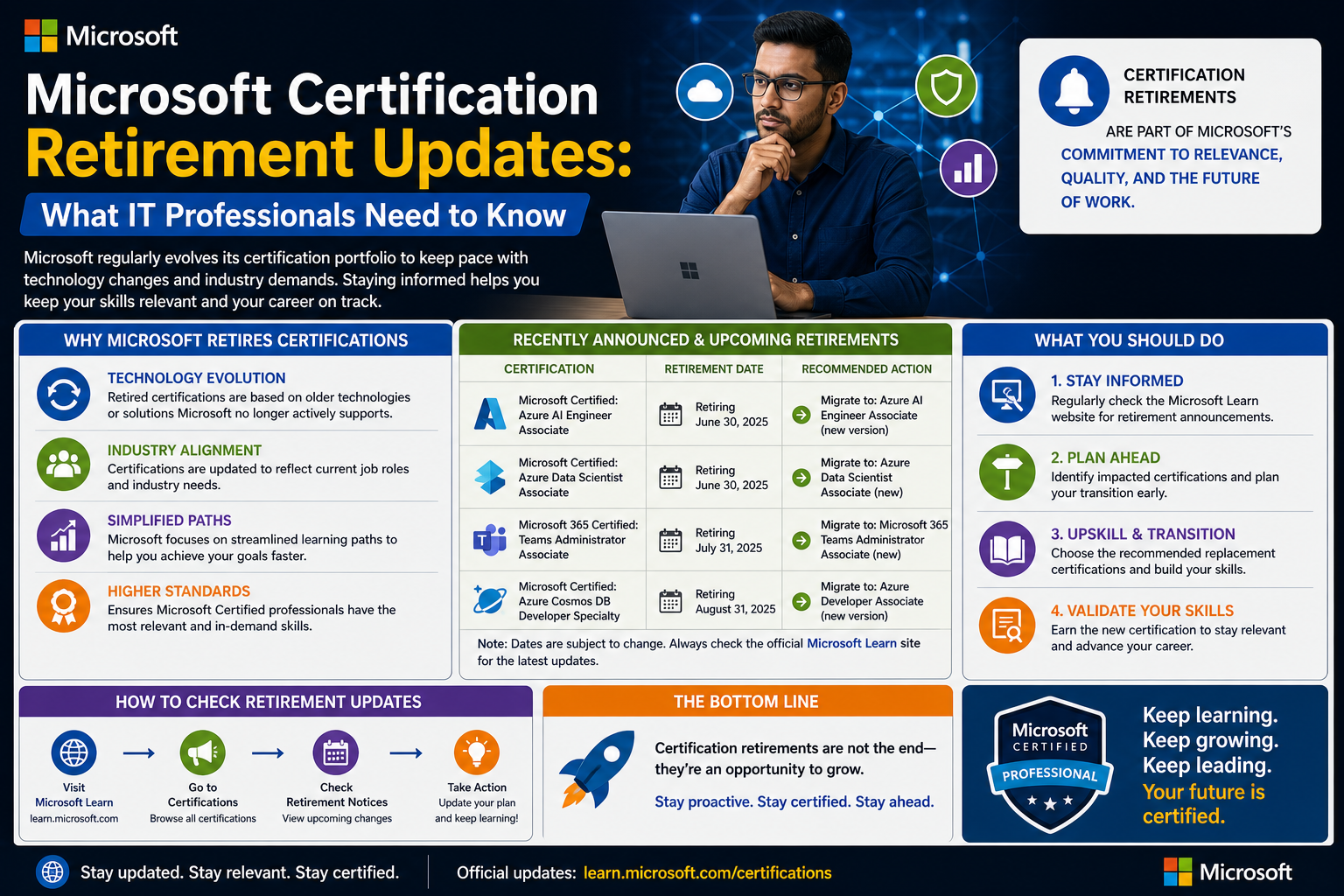
Microsoft certification programs have long been one of the most recognized pathways for validating technical skills in cloud computing, enterprise systems, and productivity tools. Over time, these certifications have evolved to reflect changes in technology, industry demand, and workplace expectations. The latest round of certification retirements signals another significant adjustment in how Microsoft structures its learning ecosystem.
Rather than maintaining a wide range of foundational certifications indefinitely, Microsoft is gradually reshaping its certification portfolio to align more closely with modern IT priorities. These priorities are increasingly centered around artificial intelligence, cloud-native infrastructure, cybersecurity, and role-based technical expertise. As a result, several long-standing entry-level certifications are being phased out, especially those designed to provide broad introductions to Microsoft technologies.
This shift does not indicate a reduction in learning opportunities. Instead, it reflects a transition toward more specialized, practical, and skills-based certifications that match real-world job requirements. For learners, professionals, and organizations, this change introduces both challenges and opportunities. Understanding what is changing, why it is happening, and how it impacts certification planning is essential for anyone involved in IT training or career development.
The Evolution of Microsoft Certification Philosophy
Microsoft certification programs have historically gone through multiple phases. In earlier years, certifications were often structured around product versions, such as specific Windows Server releases or Office suites. These certifications helped professionals demonstrate knowledge of particular software environments, but they often became outdated quickly as new versions were released.
Over time, Microsoft shifted toward role-based certifications. This change aligned certifications with job functions such as administrator, developer, engineer, and architect. Instead of focusing solely on product knowledge, certifications began emphasizing practical skills required to perform specific roles in IT environments.
The current shift represents the next stage in this evolution. Microsoft is now refining its certification structure further by reducing emphasis on broad, general-purpose fundamentals exams. These entry-level certifications were designed to provide introductory knowledge of Microsoft ecosystems. While they were valuable for beginners, they often overlapped with more advanced learning paths and did not always reflect the specialized skills demanded by modern IT roles.
The new direction places stronger emphasis on applied technical knowledge. Instead of testing general awareness, certifications are increasingly designed to evaluate how professionals apply tools and services in real-world environments. This includes working with cloud infrastructure, implementing security controls, and leveraging artificial intelligence solutions within enterprise systems.
This evolution reflects a broader industry trend. Employers are no longer just looking for theoretical knowledge. They are seeking professionals who can configure systems, manage cloud workloads, secure digital environments, and integrate AI-driven tools into business processes. Microsoft’s certification strategy is adapting accordingly.
Overview of Recent Certification Retirements
The latest updates include the retirement of several entry-level Microsoft certifications that have historically served as starting points for many IT learners. These certifications include:
- Dynamics 365 Fundamentals (CRM) – MB-910
- Dynamics 365 Fundamentals (ERP) – MB-920
- Microsoft 365 Certified: Fundamentals – MS-900
These certifications are widely recognized as foundational stepping stones into Microsoft’s ecosystem. They introduced learners to core concepts of customer relationship management, enterprise resource planning, and productivity services within Microsoft 365 environments.
The Dynamics 365 fundamentals certifications were officially retired at the end of December 2025. The Microsoft 365 fundamentals certification remains available for a limited period but is scheduled for retirement by the end of March 2026.
Once these retirement dates pass, candidates will no longer be able to register for or take these exams. However, individuals who have already earned these certifications will retain them in their certification records. They will continue to appear on official transcripts, even after retirement.
The retirement of these exams represents a strategic adjustment rather than an elimination of entry-level learning. Microsoft is effectively restructuring how foundational knowledge is delivered and assessed, shifting toward more integrated and role-focused learning paths.
How Certification Retirements Affect Learners
For individuals pursuing Microsoft certifications, especially those at the beginning of their IT journey, these changes can have a noticeable impact. Entry-level certifications often serve as confidence-building milestones, helping learners understand core concepts before progressing to more advanced topics.
With the retirement of foundational exams, learners may need to adjust their study strategies. Instead of relying on general fundamentals certifications as starting points, individuals may now be encouraged to begin directly with role-based certifications or more specialized learning tracks.
This transition can feel challenging for beginners who prefer structured, step-by-step progression. Fundamentals certifications traditionally provided a low-pressure introduction to complex technologies. Without them, learners may need to adapt to more technical content earlier in their studies.
However, this shift also encourages faster skill development. By engaging with role-based content sooner, learners are exposed to practical scenarios earlier in their training journey. This can accelerate readiness for real-world IT roles, especially in areas such as cloud administration, cybersecurity operations, and enterprise system management.
Another important consideration is certification planning. Individuals currently preparing for retiring exams must be aware of deadlines and adjust their schedules accordingly. Once an exam is retired, alternative pathways may need to be selected to achieve similar learning outcomes.
Impact on Organizational Training Strategies
Organizations that rely on Microsoft certifications as part of their employee development programs are also affected by these changes. Many companies use fundamentals certifications as onboarding tools for new IT staff. These certifications help establish a baseline understanding of Microsoft technologies across teams.
With the retirement of these entry-level certifications, organizations may need to revise their training frameworks. This includes identifying alternative learning paths that provide similar foundational knowledge but align with newer certification structures.
Training teams may also need to reassess how they structure progression pathways. Previously, employees might begin with fundamentals certifications before advancing to associate or expert-level credentials. With fundamentals certifications being phased out, organizations may need to introduce more direct pathways into role-based certifications.
This adjustment requires careful planning to ensure that new employees are not overwhelmed by technical complexity too early in their training. At the same time, it presents an opportunity to streamline training programs and focus more directly on job-relevant skills.
For many organizations, this change also reinforces the importance of continuous learning. As Microsoft certifications evolve, training strategies must remain flexible enough to adapt to shifting certification landscapes. This ensures that workforce development remains aligned with industry standards and technological advancements.
The Growing Emphasis on AI and Cloud Technologies
One of the most significant reasons behind these certification changes is the growing importance of artificial intelligence and cloud computing in modern IT environments. Microsoft has been heavily investing in AI-driven technologies and cloud services, integrating them across its product ecosystem.
As a result, certifications are increasingly designed to reflect these priorities. Instead of focusing on general introductions to products, new certification pathways emphasize practical use of cloud platforms and AI tools within business environments.
Artificial intelligence is no longer a niche area of study. It is becoming a core component of enterprise systems. From automated workflows to intelligent data analysis, AI is transforming how organizations operate. Microsoft’s certification structure is adapting to ensure professionals are equipped with the skills needed to work with these technologies.
Similarly, cloud computing remains a foundational element of modern IT infrastructure. Microsoft Azure continues to expand as a central platform for hosting applications, managing data, and deploying services. Certifications are increasingly aligned with real-world cloud scenarios, requiring learners to understand configuration, security, scalability, and performance optimization.
This shift away from general fundamentals certifications reflects a broader strategy. Instead of teaching broad concepts in isolation, Microsoft is integrating AI and cloud concepts directly into role-based certifications. This ensures that learners develop relevant, applied skills rather than purely theoretical knowledge.
The Role of Cybersecurity in Certification Changes
Alongside AI and cloud computing, cybersecurity has become a major focus in Microsoft’s certification ecosystem. As digital environments become more complex, the need for strong security expertise has increased significantly.
Modern IT professionals are expected to understand how to protect systems, manage identities, secure data, and respond to threats. These responsibilities are no longer limited to specialized security roles; they are now integrated into many IT job functions.
Microsoft’s certification updates reflect this reality by placing greater emphasis on security-related competencies. Instead of separating security as a standalone concept, it is increasingly embedded across multiple certification paths.
This integration ensures that professionals are not only aware of security principles but also capable of applying them within cloud environments, enterprise systems, and AI-driven platforms.
The retirement of foundational certifications is partially connected to this shift. Rather than offering broad introductions that lightly cover security concepts, Microsoft is prioritizing deeper, more practical assessments that require applied security knowledge.
Transitioning from Fundamentals to Role-Based Learning
With the reduction of fundamentals certifications, learners are encouraged to transition more directly into role-based certification paths. These paths are designed around specific job functions and require more detailed technical understanding.
For example, instead of beginning with a general introduction to Microsoft 365, learners may now progress directly into certifications focused on administration, security, or endpoint management. Similarly, cloud-focused learners may begin with Azure administration or development tracks rather than introductory overviews.
This approach reflects a more targeted learning strategy. Rather than spending time on broad foundational content, learners engage earlier with job-relevant skills. This can lead to faster career readiness, but it also requires more structured planning.
The transition also highlights the importance of understanding prerequisite knowledge independently. Without formal fundamentals certifications, learners may need to build basic understanding through alternative study methods before progressing into advanced certifications.
Despite this change, the overall certification ecosystem remains structured. Role-based certifications still provide clear pathways for progression, allowing learners to advance from associate-level to expert-level credentials over time.
Adapting to a Changing Certification Landscape
The ongoing evolution of Microsoft certifications reflects the broader transformation of the IT industry. Technologies are advancing rapidly, and certification programs must adapt to remain relevant.
For learners and professionals, this means staying informed about certification updates and being flexible in their learning approaches. Certification retirement is not an endpoint but part of a continuous cycle of renewal within the IT education ecosystem.
As older certifications are phased out, new ones are introduced to reflect emerging technologies and industry demands. This ensures that certification holders continue to represent current, applicable skills in the workplace.
Understanding these shifts is essential for long-term career planning. It allows professionals to align their learning paths with future industry directions rather than relying solely on outdated certification frameworks.
Microsoft’s Strategic Shift Toward AI-Driven Certification Design
The most significant factor behind recent Microsoft certification retirements is not simply a restructuring of exams, but a broader transformation in how Microsoft defines technical competency. The company is increasingly aligning its certification ecosystem with the rapid expansion of artificial intelligence across enterprise environments.
AI is no longer treated as an advanced specialization reserved for data scientists or research engineers. Instead, it is becoming a foundational component of modern IT systems. Microsoft has integrated AI capabilities across its ecosystem, including cloud platforms, productivity tools, development environments, and security systems. This integration has reshaped what it means to be “qualified” in Microsoft technologies.
As a result, certification design is shifting away from general introductory knowledge and toward applied, scenario-based skills. Instead of simply understanding what a service does, professionals are now expected to demonstrate how to use AI-powered tools within real business contexts. This includes automating workflows, enhancing decision-making processes, and improving operational efficiency using intelligent systems.
The retirement of foundational certifications reflects this shift in emphasis. General fundamentals exams often focused on broad overviews of Microsoft products. While useful for awareness, they did not fully reflect the depth of knowledge required to work effectively with modern AI-enhanced systems. Microsoft’s updated approach prioritizes hands-on understanding and role-specific application.
This change also reflects industry expectations. Organizations adopting AI technologies are no longer satisfied with theoretical familiarity. They require professionals who can configure, deploy, and manage AI-driven solutions in production environments. Certifications are being redesigned to match these expectations more closely.
The Declining Role of General Fundamentals Certifications
For many years, fundamentals certifications served as the entry point into Microsoft’s certification ecosystem. They provided structured introductions to cloud computing, enterprise software, and productivity platforms. These certifications were particularly useful for individuals transitioning into IT from non-technical backgrounds.
However, as the IT landscape evolved, the role of these certifications began to change. Employers increasingly prioritized practical skills over introductory knowledge. While fundamentals certifications helped learners understand concepts, they did not always demonstrate the ability to apply those concepts in real-world environments.
Another factor contributing to their decline is the increasing accessibility of technical knowledge. With the rise of interactive learning platforms, documentation, and hands-on labs, learners can now acquire foundational knowledge through multiple channels. This reduces the need for standalone introductory certifications.
Microsoft has recognized this shift and is restructuring its certification model accordingly. Instead of maintaining separate exams for basic concepts, foundational knowledge is being embedded within more advanced certification paths. This ensures that learners are exposed to essential concepts while simultaneously developing practical skills.
The retirement of fundamentals certifications does not eliminate beginner-level learning. Rather, it redistributes foundational content into broader learning pathways. This creates a more integrated approach to skill development, where theoretical understanding and practical application are combined within the same certification journey.
Dynamics Between Cloud Expansion and Certification Evolution
Cloud computing continues to be one of the most influential forces shaping Microsoft’s certification strategy. As organizations migrate infrastructure, applications, and services to cloud platforms, the demand for cloud-related expertise has increased significantly.
Microsoft Azure plays a central role in this transformation. It serves as a core platform for hosting enterprise workloads, managing data services, and deploying scalable applications. As Azure adoption grows, certifications have become more focused on validating real-world cloud skills.
This evolution has led to a reduction in certifications that are purely conceptual or introductory in nature. Instead, certifications now emphasize practical cloud administration, architecture design, and operational management. Professionals are expected to understand not only how cloud services function, but how to optimize and secure them in production environments.
The shift also reflects the increasing complexity of cloud ecosystems. Modern cloud environments are no longer simple infrastructure replacements. They include hybrid configurations, multi-cloud strategies, containerized applications, and AI-integrated services. This complexity requires deeper technical understanding than what fundamentals certifications typically provided.
As a result, Microsoft is aligning its certification structure with these advanced requirements. Entry-level certifications are being streamlined, while intermediate and advanced certifications are becoming more comprehensive. This ensures that professionals entering the cloud workforce are better prepared for real operational challenges.
Security as a Core Pillar of Modern Certification Paths
Cybersecurity has become one of the most critical components of Microsoft’s certification strategy. As digital transformation accelerates, the number and sophistication of cyber threats continue to increase. Organizations are prioritizing security expertise across all IT roles, not just specialized security teams.
This shift has influenced how certifications are designed and delivered. Security concepts are no longer isolated within dedicated certifications. Instead, they are embedded across multiple learning paths, including cloud administration, identity management, and enterprise system configuration.
The integration of security into broader certification paths reflects the reality of modern IT environments. Security is not a standalone function; it is a continuous requirement across all systems and services. Professionals must understand how to implement secure configurations, monitor threats, and respond to incidents within their daily responsibilities.
This approach also raises the baseline expectation for certification candidates. Even entry-level roles now require awareness of security principles. This reduces the need for separate foundational certifications that lightly cover security concepts, since those concepts are now integrated into role-based learning.
The retirement of certain certifications is therefore partially driven by the desire to create more cohesive learning experiences. Instead of separating topics into isolated introductory exams, Microsoft is embedding them within comprehensive certification journeys that reflect real-world responsibilities.
Changing Expectations for Entry-Level IT Professionals
The definition of an entry-level IT professional has changed significantly over the past decade. In earlier stages of the industry, beginners were expected to learn basic concepts before gradually progressing into technical roles. Fundamentals certifications supported this gradual progression by providing structured entry points.
Today, however, entry-level expectations are more advanced. Many organizations expect new IT professionals to have familiarity with cloud systems, basic automation tools, and security principles from the outset. This shift has been driven by the increasing complexity of IT environments and the need for faster onboarding.
As a result, certification pathways are adapting to meet these expectations. Instead of focusing heavily on introductory content, certification programs now assume a baseline level of technical awareness. This allows training to progress more quickly into practical, job-related skills.
This change can create challenges for beginners who are new to IT concepts. Without dedicated fundamentals certifications, learners must often engage directly with more technical material. However, this also accelerates skill development and reduces the time required to become job-ready.
For many learners, this shift represents a more efficient learning model. Rather than spending extended time on general overviews, they are introduced to practical tools and scenarios earlier in their training journey. This can lead to stronger technical competence in less time, provided that learning pathways are structured effectively.
Organizational Implications of Certification Retirement
Organizations that rely on Microsoft certifications for workforce development must carefully adjust their training strategies in response to these changes. Certification retirements affect not only individual learners but also broader training frameworks used to develop IT teams.
Many organizations previously used fundamentals certifications as standardized onboarding tools. These certifications ensured that all employees had a consistent baseline understanding of Microsoft technologies before progressing into specialized roles. With the retirement of these certifications, organizations must identify alternative methods for establishing this baseline.
One approach is to integrate foundational learning directly into role-based training programs. Instead of relying on separate entry-level certifications, organizations can structure internal training to cover essential concepts as part of broader skill development pathways.
This approach requires more customized training design but offers greater alignment with job-specific requirements. Employees are introduced to foundational concepts within the context of their actual roles, making the learning experience more relevant and practical.
Another important consideration is certification planning. Organizations must ensure that employees currently pursuing retiring certifications are supported through the transition period. This may involve adjusting timelines, revising training objectives, or redirecting learners toward alternative certifications.
The overall goal is to maintain continuity in skill development while adapting to changes in the certification landscape. This requires ongoing evaluation of training programs and close alignment with evolving certification structures.
The Increasing Importance of Role-Based Certification Depth
As Microsoft reduces emphasis on fundamentals certifications, role-based certifications are becoming more detailed and comprehensive. These certifications now serve as the primary structure for validating technical skills across different IT domains.
Role-based certifications are designed around specific job functions such as cloud administration, solution architecture, security engineering, and application development. Each certification path includes a combination of theoretical knowledge and practical application.
The increased depth of these certifications reflects the growing complexity of IT roles. Professionals are expected to manage interconnected systems, integrate multiple services, and respond to dynamic operational challenges. Certifications must therefore evaluate not only knowledge but also applied problem-solving ability.
This shift also changes how learners approach certification preparation. Instead of progressing through a series of general introductory exams, learners now engage directly with specialized content. This requires a more focused and intentional approach to skill development.
The benefit of this structure is greater alignment with real-world job roles. Certifications more accurately reflect the skills required in professional environments, making them more valuable for both employers and employees.
How AI Integration Is Reshaping Certification Content
Artificial intelligence is increasingly embedded within Microsoft’s core platforms, and this integration is reshaping certification content across multiple domains. AI is no longer treated as a standalone subject but as a functional component of many IT systems.
In cloud environments, AI is used for resource optimization, predictive analytics, and automated system management. In productivity tools, AI enhances collaboration, content creation, and workflow automation. In security systems, AI helps detect anomalies and respond to threats in real time.
This widespread integration means that certifications must now include AI-related competencies across multiple roles. Professionals are expected to understand how AI tools function within their specific areas of responsibility.
This does not necessarily mean that all certification candidates must become AI experts. Instead, they must understand how to use AI features effectively within their roles. This includes configuring AI-driven tools, interpreting AI-generated insights, and applying AI recommendations in decision-making processes.
The retirement of older certifications reflects this shift in emphasis. Rather than maintaining separate foundational certifications that lightly introduce AI concepts, Microsoft is embedding AI understanding directly into role-based learning paths.
Transitioning Learning Pathways in a Changing Ecosystem
As certification structures evolve, learning pathways are becoming more dynamic and interconnected. Instead of following linear progression models, learners now navigate flexible pathways based on job roles, skill levels, and technology domains.
This flexibility allows for more personalized learning experiences. Individuals can focus on specific areas of interest while still building the broader skill sets required for their roles. However, it also requires greater awareness of certification changes and requirements.
The retirement of certain certifications highlights the importance of adaptability in learning strategies. Learners must remain informed about updates and be prepared to adjust their study plans as certification structures evolve.
This dynamic environment reflects the broader nature of the IT industry itself. Technologies change rapidly, and professionals must continuously update their skills to remain relevant. Certification systems are evolving to support this continuous learning model.
By integrating foundational knowledge into advanced learning paths, Microsoft is encouraging ongoing skill development rather than static credential accumulation. This ensures that certifications remain aligned with current industry needs and technological advancements.
Reframing IT Career Pathways in a Post-Fundamentals Certification Era
The retirement of Microsoft fundamentals certifications marks more than a simple adjustment in exam availability. It signals a deeper restructuring of how IT career pathways are defined, especially for individuals entering the technology field for the first time. For many years, foundational certifications acted as structured gateways into the Microsoft ecosystem, offering a gradual introduction to complex systems.
With these entry-level certifications being phased out, the traditional staircase model of learning—beginner, intermediate, advanced—is becoming less rigid. Instead, Microsoft is encouraging a more integrated model where learners engage with role-based skills earlier in their journey. This change reflects the reality of modern IT environments, where job roles are increasingly interconnected and require a blend of foundational and specialized knowledge from the beginning.
In practical terms, this means that individuals are no longer expected to spend extended time on general conceptual certifications before moving into applied technical learning. Instead, learners are introduced directly to role-based scenarios such as cloud administration, identity management, or security operations, even at early stages of their certification journey.
This shift has a significant impact on career planning. Professionals must now take a more active role in structuring their own learning paths, identifying which roles align with their goals and selecting certifications accordingly. The absence of a formal fundamentals tier places greater emphasis on self-directed learning and strategic decision-making.
At the same time, this evolution creates opportunities for faster career progression. Without a long preliminary stage of general certifications, learners can reach job-relevant skills more quickly. This is particularly important in industries experiencing rapid digital transformation, where demand for skilled professionals often outpaces traditional training timelines.
The Changing Nature of Entry-Level IT Roles
Entry-level IT roles have evolved considerably in recent years, and this evolution is closely tied to changes in certification structures. In earlier periods, entry-level positions were often focused on basic system maintenance, user support, and introductory infrastructure tasks. These roles required foundational knowledge but limited exposure to complex systems.
Today, entry-level roles are significantly more technical. Even junior positions may require familiarity with cloud platforms, basic automation workflows, identity systems, and security protocols. This increased complexity is driven by the widespread adoption of cloud computing and the integration of advanced technologies into everyday business operations.
As a result, the expectations placed on new IT professionals have risen. Employers are less interested in candidates who only understand theoretical concepts and more focused on individuals who can demonstrate practical capability in real environments.
This shift helps explain why Microsoft is retiring general fundamentals certifications. These certifications were designed for a different era of IT learning, where gradual progression through basic concepts was the norm. In the current environment, that model is less aligned with employer expectations.
Instead, certification pathways now reflect the realities of modern job roles. Even at the earliest stages, learners are introduced to applied skills that directly relate to workplace tasks. This ensures that certification holders are better prepared for the demands of entry-level positions.
However, this also means that learners must adapt more quickly to technical content. The learning curve may be steeper, but it is also more closely aligned with real-world responsibilities. This alignment helps reduce the gap between certification and job performance, which has been a long-standing concern in IT training programs.
The Role of Continuous Learning in Certification Strategy
One of the most important implications of Microsoft’s certification changes is the increased emphasis on continuous learning. In earlier certification models, professionals often progressed through a defined sequence of exams and then maintained their credentials for extended periods.
In the current model, certifications are more closely tied to evolving technologies. As cloud platforms, AI systems, and security frameworks change, certification content is updated more frequently. This creates a dynamic learning environment where professionals must continuously update their skills to remain current.
The retirement of older certifications is part of this continuous cycle. As new technologies emerge and existing systems evolve, older exams become less representative of current job requirements. Rather than maintaining outdated certifications indefinitely, Microsoft phases them out and introduces updated alternatives.
This approach ensures that certifications remain relevant to modern industry needs. However, it also means that certification holders must engage in ongoing learning to maintain alignment with current standards.
Continuous learning is no longer optional in IT careers; it is a core expectation. Professionals are expected to adapt to new tools, platforms, and methodologies throughout their careers. Certification systems are increasingly designed to support this ongoing development rather than static achievement milestones.
Impact on Learning Motivation and Skill Development
The removal of fundamentals certifications also influences how learners approach motivation and skill development. For many individuals, entry-level certifications provided a sense of structure and progression. They offered clear milestones that marked the beginning of a certification journey.
Without these foundational milestones, learners may initially feel that their pathway is less clearly defined. However, this change also encourages a more outcome-focused approach to learning. Instead of focusing on completing a series of introductory exams, learners are encouraged to focus on achieving role-specific competencies.
This shift can enhance motivation by making learning more directly relevant to career goals. When learners see a clear connection between certification content and job responsibilities, they are more likely to remain engaged and committed.
Skill development also becomes more practical. Instead of spending time on abstract concepts, learners engage more frequently with real-world scenarios. This includes configuring cloud environments, managing security settings, and implementing automated workflows.
Over time, this approach can lead to deeper technical competence. By working with applied scenarios earlier in their learning journey, individuals develop stronger problem-solving skills and a better understanding of how systems interact in real environments.
Organizational Training Adaptation in a Dynamic Certification Landscape
Organizations face a unique set of challenges as Microsoft certification structures evolve. Training programs that were once built around fundamentals certifications must now be restructured to align with new learning pathways.
One of the primary adjustments involves redefining onboarding processes for new IT staff. Previously, organizations could rely on fundamentals certifications to ensure a consistent baseline of knowledge across employees. With these certifications being retired, organizations must develop alternative methods for establishing foundational understanding.
This often involves integrating foundational concepts directly into internal training programs. Instead of relying on external certifications, organizations may create structured learning modules that cover essential topics within the context of job roles.
This approach allows for greater customization but requires more investment in training design and delivery. Organizations must ensure that foundational knowledge is still effectively communicated while also preparing employees for more advanced responsibilities.
Another key consideration is workforce planning. As certification structures evolve, organizations must ensure that employees are guided toward relevant learning paths. This includes identifying appropriate role-based certifications and aligning them with career development goals.
Training managers also need to monitor certification updates closely. As Microsoft continues to refine its certification ecosystem, new exams may replace retired ones, requiring adjustments to training plans and skill development strategies.
The Increasing Convergence of AI, Cloud, and Security Skills
One of the most important trends shaping Microsoft certification evolution is the convergence of AI, cloud computing, and cybersecurity skills. These three domains are increasingly interconnected, forming the foundation of modern IT systems.
Artificial intelligence is integrated into cloud platforms to enhance automation, analytics, and decision-making processes. Cloud environments provide the infrastructure needed to deploy and scale AI solutions. Cybersecurity ensures that both cloud systems and AI models remain protected from threats and vulnerabilities.
This convergence means that professionals can no longer treat these areas as separate disciplines. Instead, they must understand how they interact and support each other within enterprise environments.
Certification programs are reflecting this reality by embedding cross-domain skills into role-based learning paths. For example, cloud administrators are expected to understand basic security principles, while security professionals must be familiar with cloud architectures and AI-driven threat detection systems.
The retirement of general fundamentals certifications supports this integrated approach. Rather than introducing these topics separately at a basic level, Microsoft is embedding them within more advanced, role-specific contexts.
This ensures that learners develop a more holistic understanding of modern IT systems. Instead of viewing technologies in isolation, they learn how different components work together within complex digital environments.
Long-Term Implications for IT Certification Value
As certification structures evolve, the perceived value of Microsoft certifications is also changing. In earlier years, certifications were often viewed as standalone achievements that demonstrated general technical knowledge.
In the current landscape, certifications are increasingly seen as indicators of applied capability. Employers are less interested in whether a candidate has completed introductory exams and more focused on whether they can perform specific technical tasks.
This shift enhances the value of role-based certifications while reducing reliance on foundational credentials. Certifications that demonstrate practical skills in cloud administration, security engineering, or AI integration are becoming more valuable in the job market.
At the same time, the retirement of fundamentals certifications may lead to a more streamlined certification ecosystem. With fewer overlapping entry-level exams, the certification structure becomes more focused and efficient.
This can improve clarity for learners, making it easier to understand which certifications align with specific career goals. Instead of navigating multiple introductory options, learners can focus directly on role-based pathways.
Over time, this may lead to stronger alignment between certification outcomes and job performance expectations. As certifications become more closely tied to practical skills, their relevance in hiring and career advancement decisions is likely to increase.
Preparing for a Continuously Evolving Certification Environment
The ongoing evolution of Microsoft certifications highlights an important reality of the modern IT landscape: change is constant. Technologies evolve, industry expectations shift, and certification programs must adapt accordingly.
For learners and professionals, this means that flexibility is essential. Rather than relying on static certification plans, individuals must remain aware of updates and be prepared to adjust their learning strategies.
This includes monitoring certification retirements, understanding new exam structures, and aligning learning goals with current industry trends. It also involves developing a mindset of continuous skill development rather than one-time certification achievement.
Organizations, too, must adopt this adaptive mindset. Training programs must be regularly reviewed and updated to ensure alignment with current certification structures and technological developments.
Ultimately, the retirement of fundamentals certifications represents part of a larger transformation in how IT skills are defined, learned, and validated. The emphasis is shifting toward practical expertise, integrated knowledge, and continuous adaptation to emerging technologies.
Conclusion
The recent wave of Microsoft certification retirements reflects a broader transformation in how IT skills are defined, measured, and applied in modern technology environments. Rather than functioning as a simple update cycle for exams, these changes signal a deeper restructuring of the certification ecosystem—one that prioritizes practical capability, emerging technologies, and real-world job readiness over general introductory knowledge.
At the center of this shift is the recognition that the IT industry itself has changed dramatically. Cloud computing is now the default foundation for enterprise infrastructure. Artificial intelligence is embedded into everyday business tools. Cybersecurity is no longer a specialized function but a core requirement across all roles. In this environment, traditional fundamentals certifications, which once played a crucial role in introducing learners to Microsoft technologies, are becoming less aligned with industry expectations.
The retirement of certifications such as Dynamics 365 Fundamentals (CRM), Dynamics 365 Fundamentals (ERP), and Microsoft 365 Fundamentals represents a clear move away from broad introductory learning paths. These certifications were valuable in helping new learners understand basic concepts and gain confidence in Microsoft ecosystems. However, they were often disconnected from the hands-on responsibilities required in modern IT roles. As a result, their relevance has gradually diminished in a landscape that demands more applied and role-specific expertise.
What is emerging in their place is a more streamlined and focused certification structure. Instead of separating knowledge into rigid beginner, intermediate, and advanced categories, Microsoft is embedding foundational concepts directly into role-based certifications. This allows learners to engage with practical scenarios earlier in their journey, while still gaining exposure to essential concepts such as cloud architecture, identity management, and security principles.
This shift also reflects a broader change in how professional readiness is defined. Employers are no longer satisfied with theoretical understanding alone. They expect candidates to demonstrate the ability to configure systems, manage cloud environments, respond to security incidents, and leverage AI-driven tools in real operational settings. Certifications are increasingly being designed to validate these applied skills rather than general awareness.
For learners, this evolution introduces both challenges and opportunities. On one hand, the removal of entry-level certifications may reduce the availability of structured beginner pathways. Individuals new to IT may need to engage with more technical material earlier than before. This can make the learning curve feel steeper, especially for those without prior experience.
The increasing integration of artificial intelligence, cloud computing, and cybersecurity further reinforces the need for this shift. These technologies are no longer separate domains but interconnected components of modern IT systems. Professionals are expected to understand how they interact and how to apply them in combination to solve complex business challenges. Certification programs must therefore reflect this interconnected reality.
Another important implication of these changes is the growing emphasis on continuous learning. In a rapidly evolving technological landscape, certifications can no longer be viewed as static achievements. Instead, they represent milestones within an ongoing learning journey. As technologies evolve, certification content must also evolve, ensuring that professionals remain aligned with current industry standards.
The retirement of older certifications is part of this continuous cycle of renewal. As new technologies emerge and existing systems evolve, outdated exams are phased out and replaced with updated learning paths. This ensures that certifications remain relevant and meaningful indicators of current technical capability.
Ultimately, the direction Microsoft is taking with its certification program reflects a broader truth about the IT industry: adaptability is essential. Professionals, learners, and organizations must all remain flexible in how they approach skill development. Static learning models are no longer sufficient in an environment defined by rapid innovation and constant change.
The future of IT certification is increasingly focused on practical expertise, integrated knowledge, and real-world application. While the retirement of foundational certifications may initially appear as a loss of entry points, it is more accurately understood as a restructuring toward deeper, more meaningful skill validation. This evolution ensures that certifications continue to serve their core purpose—bridging the gap between knowledge and professional capability in a technology landscape that never stops moving forward.