Project management is the structured discipline of planning, organizing, and guiding work so that specific goals are achieved within defined constraints such as time, budget, and resources. At its core, it is about turning ideas into outcomes through coordinated effort. While the concept may sound straightforward, real-world execution is often complex because projects involve uncertainty, shifting requirements, and collaboration among diverse groups of people. This is where formal project management practices become essential, providing a framework that helps ensure work progresses in a controlled and predictable manner.
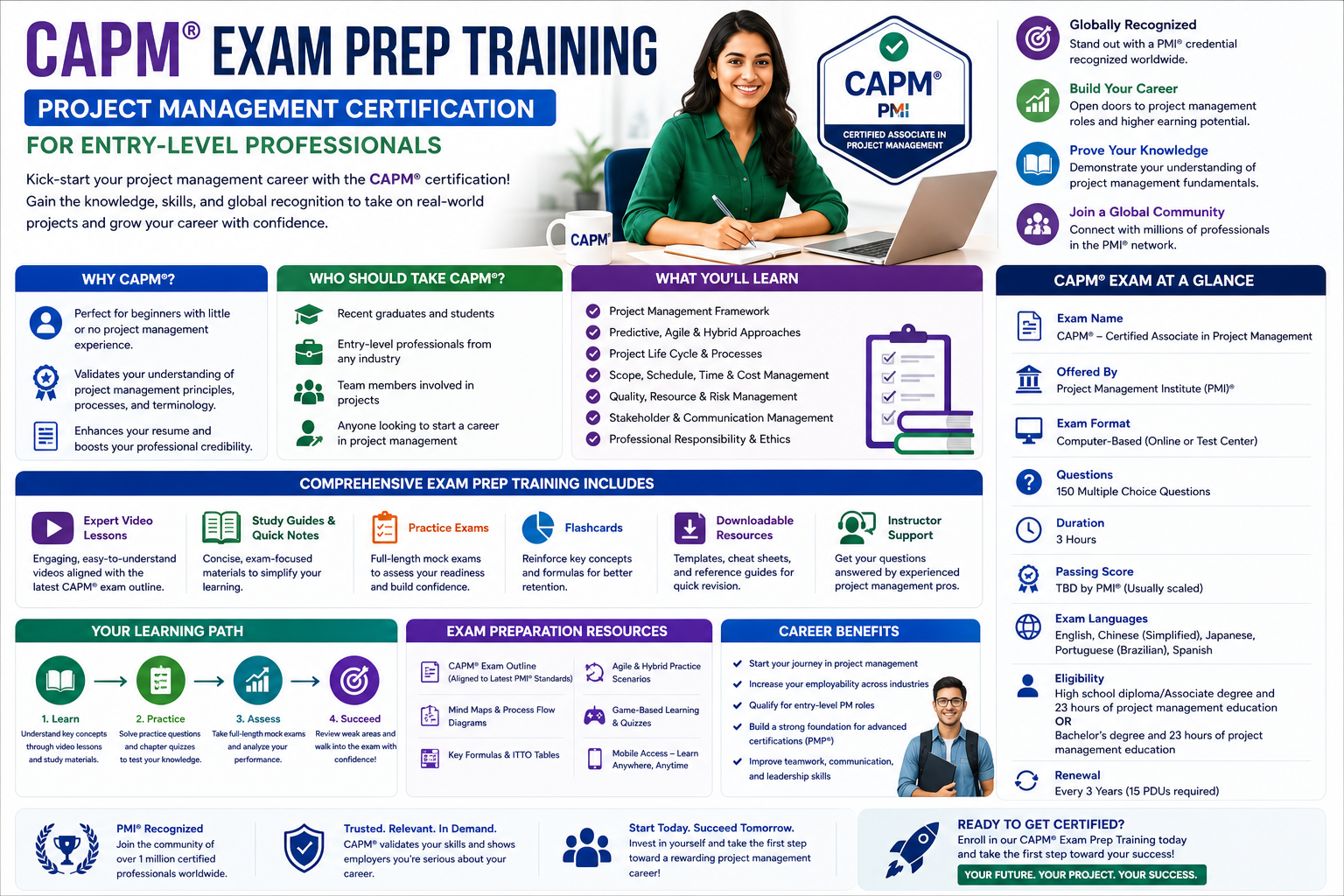
The Certified Associate in Project Management (CAPM)® is widely recognized as an entry-level certification designed to introduce individuals to these structured practices. It is intended for those who are new to project management or those who want to strengthen their understanding of standardized project processes. Unlike advanced certifications that assume significant professional experience, CAPM focuses on foundational knowledge, making it accessible to learners who are still building their careers.
Project management as a discipline is not limited to any single industry. It is applied in construction, information technology, healthcare, finance, education, manufacturing, and many other fields. This universality is one of the reasons why structured learning in project management has become so valuable. Organizations increasingly rely on professionals who can manage complexity, coordinate teams, and deliver consistent results. Understanding the fundamentals of project management provides a strong starting point for anyone interested in contributing to these efforts.
Why Entry-Level Project Management Knowledge Matters
Beginning a journey in project management requires more than enthusiasm. It requires an understanding of structured thinking and systematic execution. Entry-level knowledge helps individuals grasp how projects are initiated, planned, executed, monitored, and completed. Without this foundational understanding, it becomes difficult to interpret how different activities connect or how decisions impact overall outcomes.
One of the key reasons entry-level knowledge is important is that it introduces a common language used in professional environments. Terms such as scope, deliverables, milestones, dependencies, and risk are frequently used in project discussions. Without familiarity with these concepts, communication gaps can arise, leading to misunderstandings and inefficiencies. CAPM-level understanding helps bridge this gap by ensuring individuals can follow discussions and contribute meaningfully.
Another important aspect is that project environments are rarely static. Requirements evolve, priorities shift, and unforeseen challenges emerge. Entry-level project management training helps individuals develop a mindset that is adaptable yet structured. It teaches the importance of planning while also recognizing the need for flexibility. This balance is crucial for managing real-world projects effectively.
Additionally, organizations benefit when team members have a shared understanding of project fundamentals. It creates alignment, reduces confusion, and improves collaboration. Even if an individual is not in a formal project manager role, having CAPM-level knowledge allows them to participate more effectively in project-based work environments.
Overview of the Project Lifecycle
The project lifecycle is a fundamental concept in project management. It describes the stages a project goes through from its initial idea to its completion. While different methodologies may describe the phases slightly differently, the general structure remains consistent: initiation, planning, execution, monitoring and controlling, and closing.
The initiation phase is where a project is formally defined. This stage involves identifying the purpose of the project, understanding its objectives, and determining whether it is feasible. It is also where stakeholders are identified and high-level expectations are established. A strong initiation phase sets the foundation for everything that follows, ensuring that the project has clear direction from the beginning.
The planning phase is one of the most detailed stages of the lifecycle. It involves breaking down the project into manageable components, defining scope, estimating resources, and creating schedules. Planning also includes identifying risks and preparing strategies to address them. This phase is critical because it establishes the roadmap that guides the entire project.
Execution is the stage where planned activities are carried out. Teams perform the work defined in the planning phase, and deliverables begin to take shape. This phase requires coordination, communication, and leadership to ensure that work progresses smoothly.
Monitoring and controlling occur alongside execution. This involves tracking progress, comparing it against the plan, and making adjustments when necessary. It ensures that the project remains aligned with its objectives and that any deviations are addressed promptly.
Finally, the closing phase marks the completion of the project. Deliverables are finalized, outcomes are reviewed, and lessons learned are documented. This stage ensures that the project is formally concluded and that valuable insights are retained for future work.
Fundamentals of Project Initiation
Project initiation is the stage where ideas begin to take form as structured efforts. It is often driven by a need, opportunity, or problem that requires a solution. During this stage, the purpose of the project is defined in broad terms, and its alignment with organizational goals is assessed.
One of the key activities in initiation is identifying stakeholders. Stakeholders are individuals or groups who have an interest in the project’s outcome. They may include clients, team members, managers, or external parties. Understanding who the stakeholders are and what they expect is crucial for ensuring alignment and avoiding conflicts later in the project.
Another important aspect of initiation is defining the high-level scope. Scope refers to what the project will and will not include. At this stage, scope is not highly detailed but provides a general understanding of boundaries. This helps prevent ambiguity and ensures that expectations are realistic from the beginning.
Feasibility analysis is also an important part of initiation. This involves assessing whether the project is practical and achievable given available resources, time constraints, and technical limitations. It helps decision-makers determine whether the project should proceed or be adjusted before significant effort is invested.
Initiation also sets the stage for authorization. Before a project moves forward, it typically requires approval from relevant authorities or decision-makers. This ensures that resources are allocated appropriately and that the project aligns with broader strategic goals.
Understanding Planning in Project Management
Planning is one of the most critical stages in the project lifecycle because it transforms ideas into actionable steps. Without proper planning, even well-intentioned projects can become disorganized and inefficient. Planning provides structure, clarity, and direction.
A major component of planning is defining the scope in detail. This involves identifying all the work required to complete the project successfully. Scope definition helps prevent unnecessary work and ensures that the project remains focused on its objectives. It also plays a key role in preventing scope creep, which occurs when additional tasks are added without proper evaluation.
Schedule planning is another essential element. It involves determining the sequence of activities, estimating how long each task will take, and organizing them into a timeline. This helps ensure that the project progresses in a logical and timely manner. Scheduling also helps identify dependencies, where certain tasks must be completed before others can begin.
Resource planning is equally important. This involves identifying the people, tools, and materials required to complete the project. Proper resource allocation ensures that work is distributed effectively and that no part of the project is under-resourced.
Cost planning is also part of the process. It involves estimating the financial resources needed for the project and ensuring that spending remains within acceptable limits. While entry-level understanding may not focus heavily on financial complexity, awareness of budgeting principles is essential.
Risk planning is another critical area. Every project carries uncertainty, and risk planning involves identifying potential issues before they occur. This allows teams to prepare responses in advance, reducing the impact of unexpected events.
Communication and Stakeholder Awareness in Projects
Effective communication is one of the most important skills in project management. Projects involve multiple people with different responsibilities, perspectives, and expectations. Without clear communication, misunderstandings can arise, leading to delays or errors.
Communication in project environments is not limited to formal meetings or reports. It includes informal discussions, written updates, progress tracking, and feedback loops. The goal is to ensure that everyone involved in the project has access to the information they need at the right time.
Stakeholder awareness is closely connected to communication. Different stakeholders have different levels of interest and influence over the project. Some may be directly involved in day-to-day activities, while others may only require periodic updates. Understanding these differences helps tailor communication effectively.
Another important aspect of communication is clarity. Information must be conveyed in a way that is easy to understand and free from unnecessary complexity. This reduces the risk of misinterpretation and ensures alignment among team members.
Active listening is also a critical part of communication. It involves paying attention to feedback, concerns, and suggestions from others. In project environments, this helps identify issues early and fosters a collaborative atmosphere.
Core Competencies for Project Management Beginners
Developing competence in project management requires more than theoretical understanding. It involves building practical skills that can be applied in real situations. One of the most important competencies is organization. Projects involve multiple tasks, deadlines, and responsibilities, and being organized helps ensure that nothing is overlooked.
Time management is another essential skill. Projects operate within fixed schedules, and managing time effectively ensures that tasks are completed as planned. This includes prioritizing activities, setting realistic deadlines, and avoiding unnecessary delays.
Problem-solving is also a key competency. Projects often encounter challenges that require quick thinking and practical solutions. Being able to analyze situations and identify effective responses is an important part of project success.
Collaboration is equally important. Projects are rarely completed by individuals working alone. They involve teams with different skills and responsibilities. Being able to work effectively with others, share information, and support collective goals is essential.
Attention to detail also plays a significant role. Small errors can have large impacts in project environments, so being careful and thorough is important. This helps ensure accuracy in planning, execution, and reporting.
Common Challenges Faced by Beginners in Project Environments
Individuals new to project management often face a range of challenges as they adapt to structured work environments. One common challenge is understanding complexity. Projects often involve interconnected tasks, and it can be difficult to see how individual activities contribute to the overall goal.
Another challenge is managing uncertainty. Projects rarely go exactly as planned, and unexpected changes can create confusion. Learning to remain adaptable while maintaining structure is a skill that develops over time.
Communication difficulties are also common. Beginners may struggle to express ideas clearly or interpret instructions accurately. This can lead to misunderstandings that affect project progress. Over time, exposure to different communication styles helps improve clarity and confidence.
Time pressure is another frequent challenge. Projects often operate under strict deadlines, and balancing multiple tasks can feel overwhelming. Developing prioritization skills helps manage this pressure more effectively.
Finally, understanding documentation and structured processes can be challenging at first. Project management relies heavily on records, plans, and formal procedures. Learning how to navigate and use these effectively is an important part of early development in the field.
Strengthening the Planning Process in Project Environments
Planning in project management is far more than a preparatory step; it is a continuous intellectual process that shapes how work will be executed and evaluated. While the earlier phase of understanding planning introduces its importance, a deeper look reveals how detailed and interconnected this stage truly is. Planning is where abstract goals are translated into structured actions, and where uncertainty is reduced through deliberate design.
A well-developed project plan acts as a guiding system that influences every decision made during execution. It is not a static document but a dynamic reference that evolves as the project progresses. Effective planning requires anticipating not only what needs to be done, but also how different tasks interact, what resources will be required at each stage, and what constraints might affect progress.
One of the most critical aspects of advanced planning is decomposition of work. Large objectives are broken down into smaller, manageable components so that each task can be assigned, tracked, and completed independently. This breakdown creates clarity and allows teams to focus on specific deliverables without losing sight of the broader objective.
Sequencing is another essential part of planning. Tasks cannot always be completed simultaneously; many depend on the completion of others. Understanding these relationships helps establish a logical flow of work. Proper sequencing reduces delays and prevents bottlenecks that could disrupt the entire project timeline.
Estimation also becomes more refined during detailed planning. Time, effort, and resources must be predicted with reasonable accuracy. While estimates are never perfect, structured approaches help reduce uncertainty. Estimation is not only about predicting duration but also about understanding variability and building buffers where necessary.
Planning also involves aligning expectations among stakeholders. Different individuals may have different interpretations of success, and planning helps unify these perspectives into a shared understanding. This alignment reduces conflict and ensures that all participants are working toward the same outcome.
Deepening Understanding of Scope and Its Boundaries
Scope is one of the most fundamental concepts in project management because it defines the boundaries of what the project will achieve. Without a clear scope, projects can expand uncontrollably, leading to inefficiency, confusion, and resource strain.
Defining scope requires identifying both inclusions and exclusions. Inclusions specify what is part of the project deliverables, while exclusions clarify what is not included. This distinction is essential because ambiguity in scope often leads to misunderstandings later in the project lifecycle.
Scope management also involves continuous monitoring. Even after initial definition, scope can evolve due to stakeholder requests, environmental changes, or new insights. Managing these changes requires a structured approach to evaluate whether proposed additions align with project objectives and available resources.
Another important aspect of scope is its relationship with quality and cost. Expanding scope often increases both complexity and expense. Therefore, decisions about scope must consider trade-offs between ambition and feasibility. A well-managed scope ensures that project goals remain realistic and achievable.
Scope definition also helps in setting expectations for deliverables. It ensures that all stakeholders understand what will be produced at the end of the project. This reduces the likelihood of dissatisfaction and ensures that outcomes are aligned with initial agreements.
The Role of Scheduling in Project Success
Scheduling is one of the most visible elements of project management because it determines when work will be completed. A schedule is not simply a timeline; it is a structured representation of how tasks interact over time.
Creating a schedule involves identifying all activities required to complete the project and placing them in a logical sequence. Each task is assigned a start and end point, and dependencies between tasks are mapped to ensure proper flow. This helps prevent situations where work is delayed because prerequisites have not been completed.
Time estimation plays a crucial role in scheduling. While it is difficult to predict exact durations, structured estimation techniques help create realistic timelines. These estimates often consider factors such as task complexity, resource availability, and potential risks.
Scheduling also involves identifying milestones. Milestones are significant points in the project that indicate progress toward completion. They help track whether the project is moving according to plan and provide opportunities for evaluation and adjustment.
Another important aspect of scheduling is resource leveling. This ensures that workloads are distributed evenly and that no team member or resource is overwhelmed. Proper resource balancing improves efficiency and reduces burnout.
Schedules are not fixed; they must be adjusted when changes occur. Flexibility in scheduling is essential because real-world conditions often differ from initial assumptions. Effective project environments allow for controlled adjustments while maintaining overall structure.
Cost Awareness and Resource Allocation in Projects
Cost management is a critical dimension of project management that ensures financial resources are used efficiently. Every project operates within some form of budget constraint, and managing costs effectively helps ensure that objectives are achieved without overspending.
Cost estimation begins early in the project lifecycle. It involves predicting how much money will be required for resources, labor, equipment, and other expenses. While early estimates may be broad, they become more refined as planning progresses.
Resource allocation is closely connected to cost management. Resources include not only financial assets but also human effort, materials, and tools. Assigning these resources efficiently ensures that the project remains productive without unnecessary waste.
Monitoring costs during execution is equally important. Even well-planned projects can experience deviations due to unexpected challenges or changes in scope. Tracking expenses helps identify these deviations early so corrective actions can be taken.
Cost control also involves evaluating trade-offs. Sometimes decisions must be made between quality, time, and cost. Increasing quality may require additional resources, while reducing cost may impact speed or output. Understanding these relationships is essential for balanced decision-making.
Effective cost management ensures that projects remain financially viable while still meeting their objectives. It requires discipline, monitoring, and the ability to make informed adjustments when necessary.
Risk Awareness and Uncertainty Management
Risk is an unavoidable part of any project. It refers to uncertain events that can positively or negatively affect project outcomes. Understanding risk is essential for maintaining control in unpredictable environments.
Risk identification is the first step in managing uncertainty. It involves examining the project environment to determine what could potentially go wrong or right. Risks may arise from technical challenges, resource limitations, external dependencies, or environmental factors.
Once risks are identified, they must be analyzed to determine their likelihood and potential impact. Not all risks are equally important; some may have minimal effect, while others could significantly disrupt the project. Prioritizing risks helps focus attention on the most critical areas.
Risk response planning involves deciding how to handle identified risks. Some risks may be avoided, others mitigated, and some accepted if their impact is minimal. Each response strategy is chosen based on the nature of the risk and its potential consequences.
Risk monitoring continues throughout the project lifecycle. New risks may emerge, and existing risks may change in severity. Continuous monitoring ensures that the project remains prepared for uncertainty.
Risk management is not about eliminating uncertainty but about controlling its effects. It helps create resilience within the project structure so that unexpected events do not derail progress.
Communication Structures in Professional Project Environments
Communication in project management is a structured process that ensures information flows effectively between all participants. It is not simply about exchanging messages but about ensuring clarity, accuracy, and relevance.
Different communication channels serve different purposes. Formal communication includes reports, documentation, and structured meetings. Informal communication includes discussions, quick updates, and collaborative interactions. Both types are essential for maintaining project flow.
One of the key challenges in communication is ensuring consistency. Information must be aligned across all channels to avoid confusion. Inconsistent messaging can lead to misunderstandings and incorrect assumptions.
Communication planning is an important part of project structure. It defines who needs what information, when they need it, and how it should be delivered. This prevents information overload and ensures that stakeholders receive relevant updates.
Another important aspect is feedback integration. Communication should not be one-way; it must allow for input from different participants. Feedback helps identify issues early and improves decision-making.
Clarity remains the most important principle in communication. Complex ideas must be expressed in a way that is easy to understand, reducing the risk of misinterpretation.
Stakeholder Influence and Engagement Dynamics
Stakeholders play a central role in project environments because they influence decisions and outcomes. Understanding stakeholder dynamics is essential for maintaining alignment throughout the project lifecycle.
Stakeholders vary in their level of interest and influence. Some have direct decision-making power, while others are impacted by the project results but have limited control over its execution. Recognizing these differences helps prioritize engagement efforts.
Stakeholder expectations must be carefully managed. Different stakeholders may have different goals, and aligning these expectations requires clear communication and negotiation. Without proper management, conflicting expectations can create tension.
Engagement involves maintaining regular interaction with stakeholders. This ensures that they remain informed and involved in key decisions. Engagement also builds trust, which is essential for smooth project execution.
Stakeholder feedback is valuable because it provides insights that may not be visible to the project team. Incorporating feedback helps improve outcomes and ensures that deliverables meet real-world needs.
Managing stakeholders is an ongoing process that continues throughout the project lifecycle. It requires attention, communication, and adaptability.
Introduction to Project Methodologies and Structured Approaches
Project management methodologies provide structured approaches for managing work. They define how tasks are organized, executed, and monitored. Different methodologies offer different ways of handling complexity and change.
Traditional approaches often follow a sequential structure where each phase must be completed before the next begins. This approach is useful for projects with stable requirements and predictable outcomes.
Adaptive approaches, on the other hand, allow for flexibility and iterative development. Work is completed in cycles, and feedback is incorporated continuously. This approach is useful for projects where requirements may change over time.
Hybrid approaches combine elements of both structured and flexible methodologies. They allow teams to maintain control while also adapting to change when necessary.
Understanding methodologies helps project professionals choose the most appropriate approach based on project characteristics. It also helps improve efficiency and adaptability in different environments.
Quality Considerations in Project Execution
Quality in project management refers to how well deliverables meet defined requirements and expectations. It is not only about final output but also about the processes used to achieve that output.
Quality planning involves defining standards that the project must meet. These standards help ensure consistency and reliability in deliverables. Without clear quality expectations, outcomes may vary and fail to meet stakeholder needs.
Quality assurance focuses on ensuring that processes are followed correctly. It involves monitoring activities to confirm that work is being performed according to established guidelines.
Quality control involves evaluating deliverables to ensure they meet required standards. This may include testing, reviews, and inspections.
Maintaining quality requires continuous attention throughout the project lifecycle. It cannot be achieved at the end alone; it must be built into every stage of execution.
Integration of Project Elements into a Unified System
Project management is not a collection of separate activities but an integrated system where all elements interact. Scope, time, cost, risk, communication, and quality are interconnected, and changes in one area often affect others.
Integration management ensures that these elements work together harmoniously. It involves coordinating different aspects of the project to maintain balance and alignment with objectives.
Decision-making plays a central role in integration. Project managers must evaluate trade-offs and make adjustments that consider multiple factors simultaneously.
Integration also involves maintaining consistency across documentation, communication, and execution. This ensures that all parts of the project are aligned and working toward the same goals.
A well-integrated project environment reduces confusion, improves efficiency, and increases the likelihood of successful outcomes.
Executing Projects and Turning Plans into Action
Execution is the stage where project plans move from documentation into real-world activity. It is the phase where ideas, schedules, and strategies are translated into tangible progress. While planning establishes direction, execution is where that direction is tested against reality. This stage is often the most resource-intensive because it involves coordinating people, managing tasks, and ensuring that deliverables are produced according to expectations.
At its core, execution is about coordination. Multiple teams or individuals may be working on different components of the same project, and their efforts must remain aligned. Without coordination, even a well-designed plan can fail due to misalignment between tasks or teams. Execution requires consistent communication, clear role definitions, and active oversight to ensure that all parts of the project are progressing together.
Another important aspect of execution is task management. Tasks defined during planning are now assigned to individuals or groups, and responsibility becomes more concrete. Each task has a purpose within the larger structure of the project, and understanding this connection helps maintain motivation and focus among team members.
Execution also involves adapting to real-world conditions. No project unfolds exactly as planned. Unexpected delays, resource limitations, or changes in requirements may occur. The ability to adjust while maintaining overall direction is essential. This does not mean abandoning the plan, but rather refining it based on new information.
Progress tracking is a continuous activity during execution. It ensures that work is advancing as expected and helps identify early signs of deviation. Without tracking, problems may go unnoticed until they become significant obstacles. Monitoring progress allows for timely intervention and correction.
Leadership and Team Coordination in Project Work
Leadership in project environments is not limited to authority; it is about guiding teams toward shared goals. Effective leadership ensures that individuals understand their responsibilities and feel supported in completing their tasks.
One of the key responsibilities of leadership is creating clarity. Team members must understand what is expected of them, how their work contributes to the project, and what standards they are expected to meet. Without clarity, confusion can lead to inefficiency and errors.
Leadership also involves motivation. Projects often require sustained effort over long periods, and maintaining engagement is essential. Motivation does not always come from external rewards; it can also come from understanding purpose, receiving feedback, and feeling valued within the team.
Coordination is closely linked to leadership. It involves ensuring that different parts of the team work together effectively. This includes managing dependencies between tasks and resolving conflicts that may arise between team members or workstreams.
Decision-making is another important leadership function. Leaders must evaluate information, consider trade-offs, and choose the best course of action for the project. These decisions often need to be made quickly, especially when unexpected challenges arise.
Leadership in project environments is also adaptive. Different projects and teams may require different leadership styles. Some situations require direct guidance, while others benefit from collaborative decision-making. Understanding when to adjust leadership approach is an important skill.
Monitoring Progress and Maintaining Control
Monitoring is the process of continuously observing project performance to ensure it aligns with the plan. It acts as a control mechanism that keeps the project on track and helps identify issues early.
One of the primary functions of monitoring is comparing actual performance against planned performance. This includes evaluating whether tasks are being completed on time, within budget, and according to quality standards. Any deviations are analyzed to determine their cause and impact.
Monitoring also involves collecting data. This data may include task completion rates, resource usage, and progress reports. Accurate data collection is essential because decisions based on incomplete or incorrect information can lead to further problems.
Another important aspect is trend analysis. Instead of looking at isolated data points, monitoring examines patterns over time. This helps identify whether the project is improving, stagnating, or declining in performance.
Control mechanisms are used alongside monitoring to take corrective action when needed. If a task is delayed, resources may be reallocated. If costs are increasing, adjustments may be made to reduce expenditure. These actions help maintain alignment with project objectives.
Monitoring is not only about identifying problems but also about recognizing success. Positive performance indicators help confirm that the project is on the right track and reinforce effective practices.
Managing Change in Project Environments
Change is a natural part of any project. Requirements evolve, stakeholders adjust expectations, and external conditions shift over time. Managing change effectively is essential for maintaining project stability.
Change management begins with identification. Any proposed modification to scope, schedule, or resources must be recognized and documented. This ensures that changes are not implemented informally, which could disrupt project structure.
Once identified, changes must be evaluated. This involves assessing their impact on different aspects of the project, including time, cost, quality, and risk. Some changes may be minor, while others can significantly alter the direction of the project.
Approval is another critical step in change management. Not all changes should be implemented automatically. They often require review by decision-makers to ensure alignment with project goals and constraints.
Once approved, changes must be integrated into the project plan. This may involve updating schedules, reallocating resources, or revising scope definitions. Proper integration ensures that the project remains coherent.
Change control is an ongoing process. It ensures that modifications are tracked and managed systematically rather than being applied inconsistently. Without structured change management, projects can become unstable and difficult to control.
Quality Assurance During Execution
Quality assurance ensures that project processes are followed correctly so that outputs meet defined standards. It focuses on preventing errors rather than correcting them after they occur.
One of the main principles of quality assurance is consistency. Processes must be applied uniformly across the project to ensure predictable outcomes. Inconsistent practices can lead to variations in quality and reduce reliability.
Quality assurance also involves audits and reviews. These activities evaluate whether processes are being followed correctly and identify areas for improvement. The goal is not only to detect issues but also to strengthen overall project performance.
Training and guidance are often part of quality assurance. Team members must understand the standards they are expected to follow. Without proper understanding, even well-designed processes may not be implemented effectively.
Another important aspect is continuous improvement. Quality assurance is not static; it evolves based on feedback and performance analysis. Lessons learned from ongoing work are used to refine processes over time.
Quality assurance helps create confidence in project outcomes. It ensures that deliverables are not only completed but completed in a reliable and consistent manner.
Quality Control and Output Evaluation
While quality assurance focuses on processes, quality control focuses on outputs. It ensures that deliverables meet the required standards before they are finalized or delivered to stakeholders.
Quality control involves inspection and testing. Deliverables are examined to verify that they meet predefined criteria. This may include checking for accuracy, functionality, or completeness.
Defect identification is a key part of quality control. When issues are found, they are documented and addressed. This helps ensure that final outputs are reliable and meet expectations.
Corrective actions are often taken when quality issues are identified. These actions may involve rework, adjustments, or improvements to processes. The goal is to ensure that final deliverables meet required standards.
Quality control also provides feedback into the project system. Information gathered during evaluation helps improve future processes and prevent similar issues from occurring again.
Together, quality assurance and quality control create a balanced system that supports both process integrity and output reliability.
Communication During Execution Phase
Communication becomes even more important during execution because it ensures that all participants remain aligned while work is actively being performed. Information must flow continuously to support coordination and decision-making.
One key aspect of communication during execution is progress reporting. Team members provide updates on their tasks, allowing leaders to understand how the project is advancing. These updates help identify delays or issues early.
Another important aspect is issue communication. Problems must be reported quickly so that they can be addressed before escalating. Delayed communication can result in larger disruptions.
Meetings are often used during execution to synchronize efforts. These sessions provide opportunities to discuss progress, resolve challenges, and plan next steps. However, they must be structured effectively to avoid inefficiency.
Communication also supports collaboration. Team members often rely on each other’s input to complete their tasks. Clear and timely communication ensures that dependencies are managed smoothly.
Transparency is essential in execution communication. Honest reporting of progress and challenges helps build trust and ensures that decisions are based on accurate information.
Risk Response and Adaptive Management
Risk does not disappear once execution begins; instead, it becomes more visible. Risk response during execution involves actively managing uncertainties as they arise.
One approach to risk response is mitigation, which involves reducing the likelihood or impact of a risk. This may include adjusting processes or introducing safeguards.
Another approach is contingency planning. This involves preparing alternative actions in case a risk becomes reality. Contingency plans help ensure that the project can continue even when unexpected events occur.
Some risks are accepted when their impact is minimal or when mitigation is not practical. In such cases, monitoring becomes important to ensure that the risk does not escalate.
Adaptive management is closely linked to risk response. It involves adjusting plans and actions based on changing conditions. This flexibility helps maintain stability in uncertain environments.
Effective risk response ensures that challenges do not derail the project and that teams remain prepared for uncertainty.
Resource Management in Active Projects
Resource management during execution focuses on ensuring that people, tools, and materials are used efficiently. It involves continuous adjustment based on project needs.
Human resources must be assigned to tasks based on skill and availability. Proper allocation ensures that work is completed efficiently and that team members are not overloaded.
Material resources must also be monitored. Equipment, software, and supplies must be available when needed. Delays in resource availability can slow down project progress.
Time is another critical resource. Managing time effectively ensures that tasks are completed according to schedule. This requires prioritization and coordination.
Resource conflicts may arise when multiple tasks require the same resources simultaneously. Resolving these conflicts requires careful planning and prioritization.
Effective resource management ensures that the project operates smoothly without unnecessary delays or inefficiencies.
Integration of Execution Activities into Project Flow
Execution is not isolated; it is deeply connected to all other phases of project management. Planning guides execution, monitoring supports it, and change management adjusts it.
Integration during execution ensures that all activities remain aligned with overall project objectives. Without integration, different parts of the project may drift apart, leading to inconsistency.
Decision-making plays a central role in integration. Leaders must continuously evaluate information and ensure that actions align with broader goals.
Coordination between teams is also essential for integration. Different workstreams must remain synchronized to avoid delays or duplication of effort.
Integration ensures that execution remains structured, controlled, and aligned with project intent even in dynamic conditions.
Transitioning Toward Project Completion Awareness
As execution progresses, attention gradually shifts toward completion. Deliverables begin to take shape, and focus moves toward finalizing outcomes. Even though closure is a separate phase, awareness of completion begins during late execution.
Final deliverables must be refined, reviewed, and validated. This ensures that they meet quality standards and stakeholder expectations.
Documentation becomes increasingly important as the project nears completion. Records of work, decisions, and changes must be organized for final review.
Knowledge transfer may also begin during this stage. Lessons learned and operational details are prepared for future reference.
Execution gradually transitions into a more reflective and evaluative phase as the project moves toward its conclusion.
Conclusion
Project management, at its core, is a structured way of turning objectives into outcomes through careful planning, disciplined execution, and continuous coordination. Across the different stages of a project, every activity—whether defining scope, building schedules, managing resources, or handling risks—contributes to a larger system designed to deliver value in a controlled and predictable manner. The CAPM-level understanding of these principles provides a strong foundation for anyone entering this field, as it builds both awareness and practical thinking skills needed in real-world environments.
One of the most important insights from project management is that success is not determined by a single factor. Instead, it is the result of how well different elements work together. Communication ensures alignment, planning provides direction, execution brings ideas to life, and monitoring keeps everything on track. When these components are balanced effectively, projects are far more likely to achieve their intended outcomes.
Another key takeaway is the importance of adaptability. No project unfolds exactly as expected, and the ability to respond to change is essential. Whether it involves adjusting schedules, managing risks, or refining scope, flexibility within a structured framework allows teams to maintain progress even in uncertain conditions.
Equally important is the human element. Project management is not just about processes and tools; it is about people working together toward shared goals. Leadership, collaboration, and communication all play a central role in ensuring that teams remain coordinated and motivated throughout the project lifecycle.
Developing a strong foundation in project management principles prepares individuals to contribute effectively in a wide range of professional environments. It encourages structured thinking, improves problem-solving abilities, and builds confidence in handling complex tasks. Ultimately, project management is about creating order within complexity and guiding efforts toward meaningful, successful outcomes.