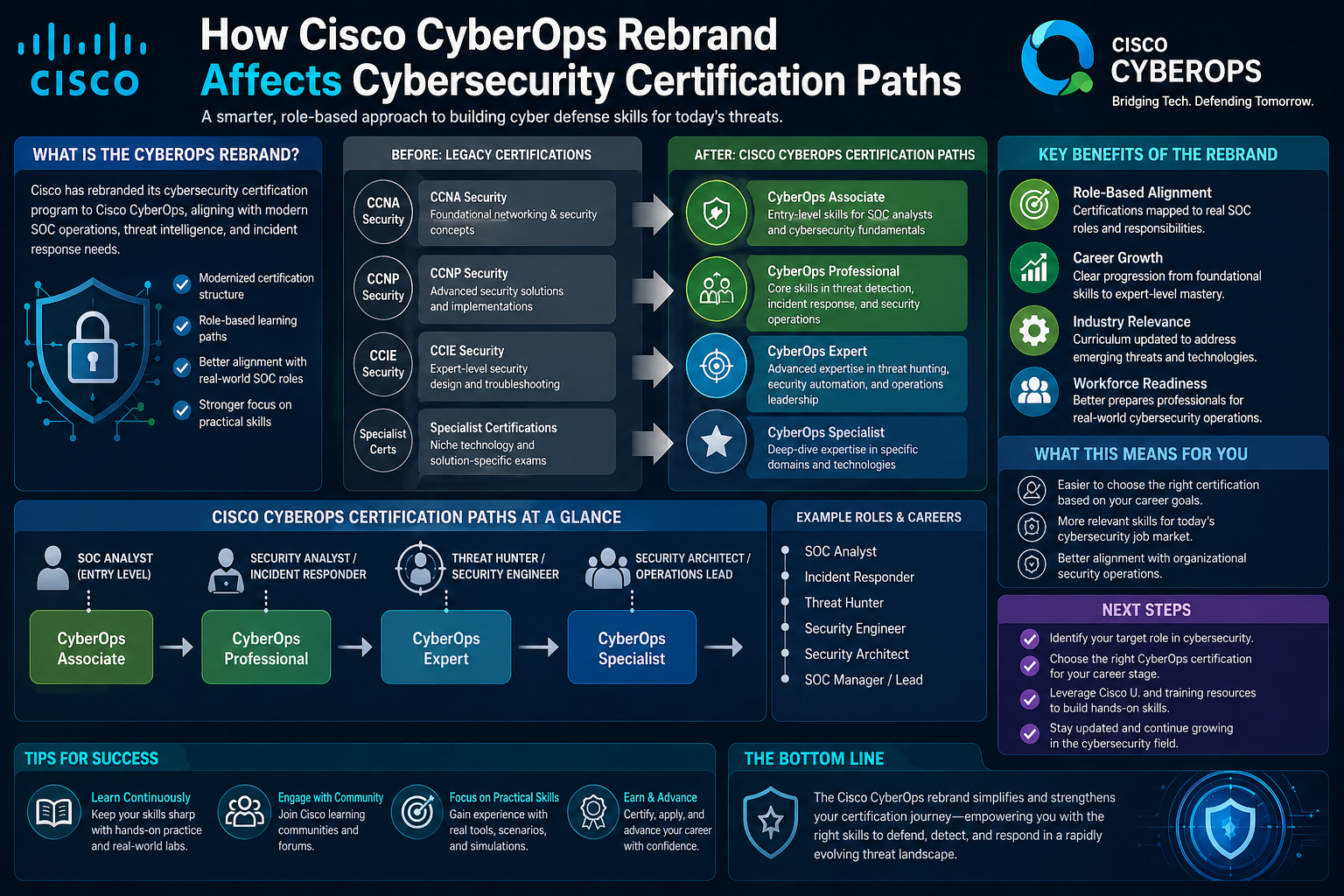
Cisco’s CyberOps certification track has entered a significant transformation in 2026, marking one of the most notable updates in its cybersecurity training ecosystem in recent years. What was previously known as a focused pathway for Security Operations Center (SOC) professionals has now evolved into a broader cybersecurity certification framework that reflects the changing demands of the global security industry. This change is not just cosmetic; it represents a deeper shift in how cybersecurity roles are defined, how professionals are trained, and what skills are expected in modern security environments.
The rebrand aligns with a growing industry trend where cybersecurity is no longer limited to manual monitoring and alert handling. Instead, it is increasingly driven by automation, machine learning, and AI-assisted decision-making systems. Cisco’s restructuring of CyberOps into a more comprehensive cybersecurity certification pathway signals a response to these technological and workforce changes.
Evolution of CyberOps Into a Broader Cybersecurity Identity
For several years, CyberOps certifications were primarily associated with SOC analysts and professionals responsible for monitoring, detecting, and responding to security incidents. The focus was heavily centered on operational tasks such as log analysis, threat detection, and incident response workflows.
In 2026, this identity has expanded. The CyberOps track has been repositioned under a broader cybersecurity umbrella, reflecting the fact that modern security operations now require more than traditional monitoring skills. Today’s cybersecurity professionals are expected to understand automated threat detection systems, AI-driven analytics, and integrated security platforms that combine multiple data sources for faster decision-making.
This shift acknowledges that cybersecurity roles are no longer isolated to SOC environments. Instead, they extend across cloud infrastructure, enterprise networks, hybrid environments, and even AI-managed security ecosystems. As a result, the certification structure has been updated to prepare candidates for a more interconnected and technologically advanced security landscape.
The Influence of Artificial Intelligence on Security Operations
One of the most important drivers behind the CyberOps rebrand is the increasing role of artificial intelligence in cybersecurity operations. AI systems are now widely used to process large volumes of security data, detect anomalies, and prioritize threats in real time. This has significantly reduced the reliance on purely manual analysis.
Security teams today often work alongside AI-powered tools that filter alerts, classify incidents, and even suggest potential response actions. While this improves efficiency, it also changes the skill requirements for cybersecurity professionals. Instead of manually reviewing every log entry, professionals are now expected to interpret AI-generated insights and validate automated decisions.
The updated certification framework reflects this shift by incorporating AI-related competencies into its learning objectives. These include understanding how AI models contribute to threat detection, how predictive analytics can identify potential attacks before they occur, and how automated systems support incident response workflows.
This does not mean that traditional cybersecurity skills have become obsolete. On the contrary, foundational knowledge remains essential. However, the ability to work effectively with AI-driven systems has become equally important.
Changing Structure of Cybersecurity Roles in Modern SOC Environments
The structure of Security Operations Centers has changed significantly over the past few years. Traditionally, SOC analysts were responsible for manually monitoring dashboards, reviewing alerts, and escalating incidents based on predefined rules. This model required large teams to handle repetitive tasks.
With the introduction of AI-based security tools, many of these repetitive functions are now automated. As a result, the role of SOC professionals is shifting from manual execution to analytical oversight. Instead of spending time sorting through large volumes of alerts, professionals now focus on validating high-priority threats and making strategic decisions based on AI recommendations.
This change has also influenced job market trends. Entry-level roles that primarily involve repetitive monitoring tasks have seen a decline, while more advanced roles requiring analytical thinking and threat intelligence skills have increased. Positions such as threat hunters, incident response specialists, and security engineers are becoming more prominent.
Cisco’s updated certification structure reflects this evolution by preparing candidates for hybrid roles that combine human judgment with machine-driven analysis. This shift ensures that professionals are not just operators of security tools but also interpreters and decision-makers in AI-assisted environments.
Rebranding Strategy and Certification Name Transition
The CyberOps rebrand introduces a new naming structure that aligns more closely with Cisco’s broader certification ecosystem. The previous CyberOps Associate and CyberOps Professional certifications have been repositioned under the cybersecurity designation, reflecting their expanded scope.
This transition is not limited to terminology. It represents a strategic effort to unify cybersecurity certifications under a more recognizable and standardized framework. By aligning cybersecurity certifications with established naming conventions, the structure becomes more intuitive for both employers and professionals navigating certification paths.
The rebranding process has been implemented in phases. The initial phase introduced the updated cybersecurity naming structure, while a subsequent phase integrates these certifications into Cisco’s wider certification hierarchy. This approach ensures a smoother transition for current certification holders and reduces confusion during the restructuring period.
Despite these changes, the core certification codes and exam frameworks remain largely consistent. However, updated versions of the exams introduce new content areas that reflect modern security practices, particularly those involving AI and automation.
Expansion of Exam Content and Skill Requirements
The updated certification content places a stronger emphasis on practical, real-world cybersecurity scenarios. While foundational topics such as network security, intrusion detection, and incident response remain essential, new domains have been added to reflect current industry demands.
One of the most notable additions is the integration of AI-driven security concepts. Candidates are now expected to understand how AI tools assist in threat detection and how machine learning models improve security analytics. This includes interpreting AI-generated insights and using them to support decision-making in security operations.
Another key area of focus is predictive threat intelligence. Instead of reacting to incidents after they occur, cybersecurity professionals are increasingly expected to anticipate potential threats based on behavioral patterns and data analysis. This proactive approach is becoming a core part of modern security strategies.
Incident response has also evolved. Rather than relying solely on predefined response procedures, professionals must now consider AI-assisted recommendations when dealing with complex security events. This includes evaluating automated suggestions and determining the most appropriate course of action in real time.
These changes highlight a broader shift in cybersecurity education, where theoretical knowledge is combined with applied, scenario-based learning.
Industry Trends Driving Certification Transformation
The transformation of Cisco’s CyberOps certification is closely tied to broader industry trends. One of the most significant trends is the increasing automation of cybersecurity operations. Many organizations are adopting AI-driven platforms to handle routine security tasks, which reduces the need for manual intervention in basic processes.
At the same time, cyber threats are becoming more sophisticated. Attackers are using advanced techniques that require equally advanced defensive strategies. This has led to a growing demand for professionals who can work alongside intelligent systems rather than rely solely on manual processes.
Another important trend is the shift toward integrated security ecosystems. Modern organizations use multiple security tools that are interconnected through centralized platforms. This requires professionals to understand how different systems interact and how data flows across security layers.
The CyberOps rebrand reflects these changes by emphasizing adaptability, analytical thinking, and cross-platform understanding. Instead of focusing narrowly on one aspect of cybersecurity, the updated certification framework encourages a more holistic understanding of security operations.
Impact on Early-Career Cybersecurity Professionals
For individuals entering the cybersecurity field, the rebrand introduces both opportunities and adjustments. On the one hand, the integration of AI-related content may seem challenging for beginners. On the other hand, it provides exposure to technologies that are increasingly in demand.
Early-career professionals are now expected to develop a combination of foundational security knowledge and familiarity with modern tools. This includes understanding how automated systems support security workflows and how to interpret data produced by these systems.
The evolving certification structure also provides clearer career progression pathways. With cybersecurity roles becoming more specialized, professionals can move from entry-level operational roles into more advanced analytical and strategic positions over time.
This progression reflects the industry’s shift from task-based roles to skill-based roles, where the ability to interpret and respond to complex security environments is more valuable than simply following predefined procedures.
Alignment With Future Cybersecurity Work Environments
The CyberOps rebrand is not just a response to current industry changes but also an anticipation of future cybersecurity environments. As organizations continue to adopt cloud computing, distributed systems, and AI-driven infrastructure, the complexity of security operations will continue to increase.
Future cybersecurity teams are expected to operate in environments where human decision-making is closely integrated with machine intelligence. This means professionals will need to understand not only how to use security tools but also how those tools make decisions.
The updated certification framework is designed to prepare candidates for this hybrid environment. It emphasizes adaptability, continuous learning, and the ability to work with evolving technologies.
As cybersecurity continues to evolve, certifications like these play an important role in shaping how professionals are trained and how organizations define security roles.
Rebuilding Modern SOC Workflows Around AI-Driven Security Operations
The restructuring of Cisco’s CyberOps track reflects a deeper transformation happening inside Security Operations Centers, where traditional linear workflows are being replaced by adaptive, intelligence-driven systems. In earlier SOC models, workflows followed a predictable sequence: alerts were generated, analysts reviewed logs, incidents were escalated, and responses were executed manually. This structure worked in environments where threats were relatively slower and data volumes were manageable.
In modern cybersecurity environments, that model is no longer efficient. The volume of telemetry data generated by cloud systems, endpoints, applications, and network devices has grown exponentially. As a result, SOC workflows are now built around automation pipelines that continuously process, filter, and prioritize security events before they ever reach a human analyst.
AI systems play a central role in this transformation. Instead of simply generating alerts, they now categorize threats based on behavioral patterns, historical attack data, and predictive modeling. This allows SOC teams to focus on validated incidents rather than raw noise. The workflow has shifted from “detect and respond” to “predict, validate, and optimize response.”
This change directly influences how cybersecurity professionals are trained under updated certification frameworks. Understanding workflow design is no longer optional—it is a core competency. Professionals must understand how data flows through security systems, how AI engines classify events, and how decisions are escalated within automated pipelines.
The Rise of Intelligence-Centered SOC Architectures
SOC architecture is no longer just a collection of monitoring tools and dashboards. It has evolved into an intelligence-centered ecosystem where multiple layers of automation and analytics operate together. At the foundation are data ingestion systems that collect logs, network traffic, endpoint telemetry, and cloud activity data. These inputs are then normalized and processed through analytics engines.
AI-driven correlation engines identify patterns across these datasets, linking seemingly unrelated events into coherent attack narratives. This is a major shift from traditional rule-based correlation, where predefined signatures were required to detect threats. Modern systems learn continuously, adapting to new attack techniques without requiring manual rule updates.
Above this layer, orchestration systems coordinate response actions. These systems can automatically isolate compromised devices, block malicious IP addresses, or trigger authentication resets depending on the severity of the detected threat. Human analysts are involved primarily in validation, exception handling, and strategic decision-making.
This architecture reduces response times significantly while increasing accuracy. However, it also requires professionals to understand not only security principles but also system design principles. Cybersecurity is no longer isolated from data engineering, automation, and system architecture—it is deeply interconnected with them.
Changing Nature of Threat Intelligence in Automated Environments
Threat intelligence has also undergone a major transformation. In earlier models, threat intelligence consisted of manually curated reports describing known attack vectors, malware signatures, and adversary behaviors. Analysts would consume this information and apply it to their environments.
In AI-enabled security ecosystems, threat intelligence is now dynamic and continuously updated. Machine learning models analyze global attack data, identify emerging patterns, and generate predictive insights. These insights are integrated directly into security platforms, allowing organizations to respond to threats before they are fully manifested.
Instead of static reports, threat intelligence has become a live data stream. This means cybersecurity professionals must learn how to interpret constantly evolving intelligence feeds rather than relying on periodic updates. The ability to contextualize AI-generated threat data has become an essential skill.
Cisco’s updated certification framework reflects this shift by emphasizing applied intelligence interpretation. Candidates are expected to understand how threat data is collected, how it is analyzed by AI systems, and how it influences automated defensive actions. This requires both analytical thinking and technical awareness of machine learning principles in cybersecurity contexts.
Evolution of Incident Response in AI-Assisted Security Models
Incident response has traditionally been a structured process involving identification, containment, eradication, and recovery. While these phases remain relevant, their execution has changed significantly in modern environments.
AI systems now assist in identifying incidents almost immediately after anomalies are detected. In some cases, incidents are classified and prioritized automatically based on severity scoring models. This reduces the time between detection and response initiation.
Containment strategies are also increasingly automated. For example, compromised endpoints can be isolated from the network without human intervention. Suspicious user sessions can be terminated automatically based on behavioral deviations. These automated actions reduce damage but require careful oversight to avoid false positives disrupting legitimate operations.
Cybersecurity professionals are now expected to oversee these automated response mechanisms rather than execute every step manually. This introduces a new layer of responsibility: validating machine-driven decisions and ensuring that automated actions align with organizational policies.
The updated certification structure incorporates these expectations by introducing scenario-based learning that focuses on decision validation, escalation logic, and AI-assisted incident workflows.
Security Data Pipelines and the Importance of Structured Telemetry
One of the most critical components of modern cybersecurity operations is the security data pipeline. These pipelines are responsible for collecting, processing, and analyzing massive volumes of data generated by enterprise systems.
Data enters the pipeline from multiple sources, including firewalls, intrusion detection systems, cloud platforms, and endpoint protection tools. This raw data is then normalized into structured formats that can be analyzed efficiently by security tools.
AI systems operate on this structured data to identify anomalies and generate insights. Without proper data structuring, even the most advanced AI models cannot function effectively. This makes data engineering principles increasingly relevant in cybersecurity roles.
Professionals preparing for modern cybersecurity certifications are expected to understand how data flows through these pipelines, how it is transformed at each stage, and how it contributes to threat detection outcomes. This represents a significant expansion of traditional cybersecurity knowledge, which previously focused more on network protocols and system security.
The Shift From Reactive Monitoring to Proactive Detection Engineering
Cybersecurity has traditionally been reactive, with analysts responding to alerts after they are triggered. However, modern security operations are shifting toward proactive detection engineering.
Detection engineering involves designing systems that can identify threats before they fully materialize. Instead of waiting for attack signatures, security teams develop behavioral models that detect deviations from normal activity.
AI plays a central role in this approach by continuously learning what constitutes normal behavior within an environment. When deviations occur, alerts are generated based on probability scoring rather than fixed thresholds.
This approach significantly improves detection accuracy but requires professionals to understand how detection logic is constructed. It also requires familiarity with tuning detection systems to reduce false positives while maintaining sensitivity to real threats.
Cisco’s updated cybersecurity certification content reflects this shift by emphasizing analytical reasoning over manual alert handling. Candidates are expected to understand how detection systems evolve and how to optimize them in dynamic environments.
Cloud-Centric Security Operations and Distributed Environments
The migration of enterprise systems to cloud environments has added another layer of complexity to cybersecurity operations. Unlike traditional on-premises systems, cloud environments are highly distributed and dynamic, with resources scaling up and down based on demand.
This creates challenges for visibility and monitoring. Security teams must track activity across multiple platforms, services, and regions simultaneously. AI-driven tools help manage this complexity by aggregating data across environments and providing unified visibility.
However, professionals still need to understand the underlying architecture of cloud systems. This includes identity management, access control mechanisms, and network segmentation strategies used in distributed environments.
CyberOps updates reflect this reality by incorporating cloud security concepts into broader cybersecurity workflows. This ensures that professionals are prepared to handle hybrid environments where on-premises and cloud systems operate together.
Changing Expectations for Entry-Level and Mid-Level Security Roles
The restructuring of cybersecurity certifications also influences how employers define entry-level and mid-level roles. Entry-level positions are no longer limited to basic monitoring tasks. Instead, they require familiarity with automated systems, AI-assisted dashboards, and integrated security platforms.
Mid-level roles now emphasize analytical thinking, threat interpretation, and incident validation. Professionals are expected to understand how AI systems make decisions and how to intervene when necessary.
This shift has raised the baseline skill requirements across the industry. While this may appear challenging for newcomers, it also creates clearer career progression paths. Individuals who develop hybrid skills—combining technical knowledge with analytical reasoning—are more likely to advance into specialized roles.
These changes are reflected in updated certification expectations, which focus on preparing candidates for real-world responsibilities rather than isolated technical tasks.
Security Metrics and Performance Measurement in Modern SOCs
Another important development in cybersecurity operations is the increased emphasis on metrics and performance measurement. SOC teams are now evaluated not only based on their ability to respond to incidents but also on their efficiency, accuracy, and automation effectiveness.
Key metrics include mean time to detect (MTTD), mean time to respond (MTTR), false positive rates, and detection coverage. AI systems contribute to improving these metrics by reducing noise and accelerating analysis.
However, interpreting these metrics requires human oversight. Professionals must understand what these numbers represent, how they are calculated, and how they influence security strategy decisions.
Certification updates reflect this by encouraging a data-driven approach to cybersecurity operations. Candidates are expected to understand how performance metrics relate to operational efficiency and security effectiveness.
Integration of Automation Tools Across Security Ecosystems
Automation tools have become a central part of cybersecurity ecosystems. These tools handle repetitive tasks such as log analysis, alert filtering, and initial incident triage. They also enable orchestration of complex response workflows across multiple systems.
The integration of automation reduces manual workload but increases the importance of system configuration and oversight. Misconfigured automation can lead to incorrect responses or missed threats.
Cybersecurity professionals must therefore understand how automation logic is built, how it interacts with security tools, and how it can be adjusted to align with organizational needs.
This represents a shift from operational execution to system management, where professionals are responsible for ensuring that automated systems function correctly and efficiently.
Expanding Role of Identity and Access Management in Security Operations
Identity and access management has become a critical component of modern cybersecurity operations. As organizations adopt cloud services and remote work models, controlling access to systems has become more complex.
AI systems now analyze user behavior to detect anomalies in authentication patterns. For example, unusual login locations or access attempts at abnormal times can trigger security alerts.
Cybersecurity professionals must understand how identity systems integrate with broader security operations. This includes authentication protocols, access control policies, and behavioral monitoring systems.
The updated certification framework incorporates these concepts into broader security workflows, ensuring that professionals can manage identity-related risks effectively in dynamic environments.
Preparing for Adaptive Cybersecurity Work Environments
The overall direction of cybersecurity evolution points toward adaptive environments where systems continuously adjust based on threat intelligence, behavioral data, and operational requirements.
In these environments, cybersecurity professionals must be adaptable as well. Static knowledge is no longer sufficient; continuous learning and system awareness are essential.
The CyberOps rebrand reflects this shift by emphasizing flexibility, analytical capability, and integration with AI systems. Instead of focusing solely on technical execution, professionals are expected to understand how security ecosystems evolve and how to operate within them effectively.
Advanced Cybersecurity Skill Shifts Driven by AI Integration
The cybersecurity landscape in 2026 is being reshaped by a fundamental shift in skill expectations. Traditional security roles were built around static technical competencies such as firewall configuration, signature-based detection, and manual log analysis. While these skills remain important, they are no longer sufficient on their own in modern environments.
The integration of artificial intelligence into security operations has introduced a new layer of expectations. Cybersecurity professionals are now required to understand how AI models influence detection outcomes, how automated systems prioritize threats, and how machine-generated insights should be interpreted in real-world scenarios. This shift is not just about using new tools; it is about adapting to a new way of thinking about security.
Instead of focusing purely on reactive defense, professionals are expected to engage in predictive and adaptive security strategies. This includes identifying potential attack patterns before they fully emerge and understanding how automated systems evolve based on new data inputs.
The CyberOps restructuring reflects this transition by embedding AI awareness into core cybersecurity competencies. This ensures that professionals are not only technically capable but also strategically aware of how automation is transforming the field.
Human Decision-Making in AI-Augmented Security Environments
Even though AI plays a major role in modern cybersecurity operations, human decision-making remains essential. AI systems are powerful at processing large volumes of data and identifying patterns, but they lack contextual awareness, ethical reasoning, and organizational understanding.
This creates a hybrid model where humans and machines work together. AI systems generate insights, prioritize alerts, and suggest responses, while human professionals validate those outputs and make final decisions. This balance ensures both efficiency and accuracy in security operations.
However, this also introduces new challenges. Cybersecurity professionals must learn how to evaluate AI-generated recommendations critically. Not every automated suggestion is correct, and blind trust in machine outputs can lead to security gaps or operational disruptions.
Decision-making in this environment requires a combination of technical knowledge and analytical judgment. Professionals must understand how AI systems reach conclusions, what data they rely on, and where potential biases or limitations may exist.
The updated certification structure emphasizes this balance by introducing scenarios that require candidates to evaluate automated decisions and determine appropriate responses based on contextual factors.
Expansion of Behavioral Analytics in Threat Detection
Behavioral analytics has become one of the most important components of modern cybersecurity systems. Instead of relying solely on known threat signatures, security tools now analyze patterns of behavior to identify anomalies.
This includes monitoring user activity, network traffic patterns, application usage, and system interactions. AI models establish a baseline of normal behavior and then detect deviations that may indicate malicious activity.
For example, a user logging in from an unusual geographic location, accessing sensitive files at odd hours, or transferring large volumes of data may trigger behavioral alerts. These alerts are then analyzed further to determine whether they represent legitimate activity or potential threats.
Cybersecurity professionals must understand how these behavioral models function and how they are tuned. False positives remain a significant challenge, and professionals play a key role in refining detection accuracy.
This approach represents a major shift from static rule-based detection to dynamic, behavior-driven security analysis. It also requires professionals to think in terms of patterns rather than isolated events.
The Role of Machine Learning in Modern Security Analytics
Machine learning has become a foundational technology in cybersecurity analytics. It enables systems to learn from historical data, identify patterns, and improve detection accuracy over time without explicit programming.
In security operations, machine learning is used for anomaly detection, malware classification, phishing detection, and threat prioritization. These models continuously evolve as they are exposed to new data, making them highly adaptive to changing threat landscapes.
However, machine learning systems are not perfect. They require large volumes of high-quality data to function effectively, and they can sometimes produce inaccurate results if the training data is biased or incomplete.
Cybersecurity professionals must therefore understand not only how to use machine learning tools but also how they work internally. This includes knowledge of training processes, feature selection, and model evaluation techniques.
The updated certification framework reflects this requirement by introducing AI literacy as a core competency. Professionals are expected to understand the principles behind machine learning systems and how they influence security operations.
Redefining Incident Investigation Through Automation and AI
Incident investigation has evolved significantly due to automation. In traditional environments, investigations involved manually reviewing logs, tracing attack paths, and reconstructing events step by step. This process was time-consuming and required deep technical expertise.
Modern systems automate much of this process. AI tools can now reconstruct attack timelines, correlate events across multiple systems, and identify root causes with minimal human intervention. This significantly reduces investigation time and improves accuracy.
However, human analysts still play a critical role in validating findings and interpreting results. AI-generated investigations must be reviewed to ensure they align with real-world context and organizational policies.
This shift has changed the focus of cybersecurity professionals from manual investigation to analytical validation. Instead of spending hours gathering data, professionals now focus on interpreting results and making informed decisions based on AI-generated insights.
The updated CyberOps framework incorporates these expectations by emphasizing investigative reasoning and validation skills over manual data collection.
Security Orchestration and Automated Response Systems
Security orchestration, automation, and response (SOAR) systems have become essential components of modern cybersecurity infrastructure. These systems integrate multiple security tools and automate response workflows across platforms.
When a threat is detected, SOAR systems can automatically trigger predefined actions such as isolating endpoints, blocking malicious traffic, or notifying security teams. This reduces response time and minimizes the impact of attacks.
However, automation must be carefully managed. Poorly configured response workflows can lead to unintended consequences, such as blocking legitimate users or disrupting business operations.
Cybersecurity professionals must therefore understand how orchestration systems are configured and how response playbooks are designed. This includes knowledge of workflow logic, decision trees, and integration points between different security tools.
The CyberOps rebrand reflects this shift by emphasizing operational design skills alongside traditional security knowledge.
Cloud Security Complexity and Distributed Threat Environments
Cloud computing has introduced new complexities into cybersecurity operations. Unlike traditional environments where systems are centralized, cloud environments are distributed across multiple regions, services, and providers.
This distribution creates challenges in visibility, control, and monitoring. Security teams must track activity across multiple layers, including infrastructure, applications, and identity systems.
AI tools help manage this complexity by aggregating data from different sources and providing unified visibility. However, professionals must still understand how cloud systems are structured and how security controls are implemented within them.
This includes knowledge of identity management systems, network segmentation, encryption mechanisms, and access control policies in cloud environments.
Cybersecurity certifications now reflect this reality by integrating cloud security concepts into broader security operations training.
Identity-Centric Security Models in Modern Enterprises
Identity has become the new security perimeter in modern enterprises. With remote work and cloud adoption, traditional network boundaries have become less relevant. Instead, identity-based security models are now used to control access to systems and data.
These models rely on continuous authentication and behavioral verification. AI systems analyze user behavior to detect anomalies and enforce access policies dynamically.
For example, a user may be granted access based on normal behavior patterns but denied access if their activity deviates from expected behavior. This approach improves security but requires continuous monitoring and analysis.
Cybersecurity professionals must understand how identity systems integrate with broader security frameworks. This includes authentication protocols, multi-factor authentication systems, and privilege management strategies.
The updated CyberOps framework incorporates identity-centric security as a core component of modern cybersecurity operations.
Expanding Importance of Data Governance in Security Operations
Data governance has become increasingly important in cybersecurity environments. As organizations collect and process large volumes of data, ensuring proper data management, classification, and protection is essential.
Security teams must understand how data flows through systems, where it is stored, and how it is protected. This includes knowledge of data lifecycle management and regulatory compliance requirements.
AI systems also rely on well-governed data to function effectively. Poor data quality can lead to inaccurate detection results and unreliable security insights.
Cybersecurity professionals must therefore understand the relationship between data governance and security effectiveness. This includes ensuring that security tools operate on accurate, consistent, and properly classified data sets.
The Rise of Autonomous Security Systems
Autonomous security systems represent the next stage in cybersecurity evolution. These systems are capable of detecting, analyzing, and responding to threats with minimal human intervention.
They combine AI, machine learning, and automation to create self-operating security environments. While full autonomy is not yet widespread, many organizations are moving toward semi-autonomous models.
In these environments, humans oversee system behavior rather than manually executing tasks. This requires a shift in mindset from operational control to system supervision.
Cybersecurity professionals must understand how autonomous systems make decisions and how to intervene when necessary. This includes knowledge of system feedback loops, decision thresholds, and escalation mechanisms.
Evolving Career Structures in Cybersecurity Domains
The restructuring of cybersecurity certifications also reflects changes in career structures. Traditional linear career paths are being replaced by more flexible, skill-based progression models.
Professionals can now move between roles such as SOC analyst, threat hunter, security engineer, and incident responder based on skill specialization rather than fixed job titles.
This flexibility is driven by the increasing overlap between different cybersecurity domains. AI and automation have blurred the boundaries between roles, creating a more integrated skill ecosystem.
As a result, professionals are expected to develop a broader range of competencies while also specializing in specific areas of interest.
Continuous Learning as a Core Requirement in Cybersecurity Careers
Cybersecurity is no longer a field where static knowledge is sufficient for long-term success. The rapid evolution of threats, technologies, and tools requires continuous learning.
Professionals must regularly update their skills to keep pace with changes in AI, cloud computing, and security automation. This includes understanding new attack techniques, updated defense mechanisms, and emerging industry practices.
Certification frameworks now reflect this reality by emphasizing adaptive learning rather than fixed knowledge sets. Professionals are expected to evolve alongside the industry rather than rely on outdated skill sets.
This shift ensures that cybersecurity teams remain effective in rapidly changing environments where threats and technologies evolve continuously.
Emerging Threat Landscape and Adaptive Defense Strategies
As cybersecurity systems become more advanced, the threat landscape is also evolving at a similar pace. In 2026, attackers are no longer relying on simple malware or predictable intrusion methods. Instead, they are using highly adaptive techniques powered by automation, AI-assisted reconnaissance, and multi-stage attack chains that are designed to bypass traditional defenses.
One of the most significant changes is the rise of intelligent phishing campaigns. These attacks are no longer generic or easy to detect. Instead, they are dynamically generated using data gathered from social media, public records, and organizational leaks. AI tools on the attacker’s side can craft highly personalized messages that closely mimic legitimate communication patterns, making detection significantly more difficult for traditional filters.
Another growing concern is the use of automated vulnerability discovery. Attackers are increasingly deploying tools that continuously scan networks, cloud environments, and APIs for weaknesses. These tools operate at a scale that human defenders cannot match manually, which puts pressure on organizations to adopt equally automated defensive mechanisms.
In response, cybersecurity defense strategies are becoming more adaptive. Security systems now rely heavily on real-time learning models that adjust detection rules based on incoming threat data. Instead of static defense layers, organizations are building dynamic security postures that evolve continuously as new threats emerge.
This environment requires cybersecurity professionals to understand not just how attacks happen, but how they evolve. The ability to anticipate attacker behavior and adjust defense strategies accordingly is becoming a critical skill in modern security operations.
Ethical Considerations in AI-Driven Cybersecurity Systems
As artificial intelligence becomes more deeply embedded in cybersecurity operations, ethical considerations are becoming increasingly important. AI systems are responsible for analyzing sensitive data, making security recommendations, and in some cases, initiating automated responses that can affect users and systems.
One of the key ethical challenges is transparency. Many AI models operate as complex systems that are difficult to interpret, even for experienced professionals. This raises concerns about accountability when automated decisions lead to unintended consequences, such as blocking legitimate users or misclassifying threats.
Another concern is bias in AI training data. If security models are trained on incomplete or skewed datasets, they may produce inaccurate or unfair outcomes. This can lead to disproportionate targeting of certain behaviors or environments, reducing overall system reliability.
Cybersecurity professionals are increasingly expected to understand these ethical implications and ensure that AI systems are deployed responsibly. This includes validating model outputs, monitoring system behavior, and ensuring that automated decisions align with organizational policies and regulatory requirements.
Ethical cybersecurity practice is becoming a core part of professional identity, especially as AI systems take on a larger role in decision-making processes.
Workforce Transformation and the Rise of Hybrid Security Professionals
The cybersecurity workforce is undergoing a structural transformation driven by automation and AI integration. Traditional role boundaries are becoming less rigid, and professionals are increasingly expected to develop hybrid skill sets that combine technical expertise with analytical and strategic thinking.
This shift is creating a new category of cybersecurity professionals who are not limited to operational tasks but are also involved in system design, AI oversight, and strategic threat analysis. These hybrid professionals act as intermediaries between automated systems and organizational decision-makers.
In practical terms, this means that job roles are becoming more fluid. A single professional may now be involved in threat detection, incident validation, and security system tuning within the same operational cycle. This level of versatility requires continuous learning and adaptability.
Organizations are also restructuring their security teams to reflect this change. Instead of large teams focused on repetitive monitoring tasks, modern SOC environments are becoming smaller, more specialized, and more automation-driven. Human expertise is being concentrated in higher-value areas where judgment and experience are essential.
This transformation highlights the growing importance of certifications that reflect real-world, integrated skill sets. Cybersecurity education is no longer just about mastering tools; it is about understanding how entire security ecosystems function and evolve together.
Conclusion
The 2026 restructuring of Cisco’s CyberOps certification marks a clear turning point in how cybersecurity skills are defined, taught, and applied in real-world environments. Rather than remaining a narrow SOC-focused pathway, the certification has expanded into a broader cybersecurity framework that reflects the increasing complexity of modern digital infrastructure. This shift acknowledges that cybersecurity is no longer limited to manual monitoring or isolated incident response tasks, but is now deeply integrated with automation, artificial intelligence, and cloud-driven systems. It also signals a more mature approach to aligning certification pathways with actual industry workflows and evolving enterprise security needs.
Across industries, security operations are becoming faster, more data-driven, and more dependent on machine-assisted decision-making. As a result, professionals entering or advancing in the field are expected to go beyond traditional defensive skills. They must now understand how AI systems analyze threats, how behavioral analytics shape detection, and how automated workflows influence incident response. This does not reduce the importance of human expertise; instead, it elevates it. Human judgment remains essential for validating outcomes, interpreting context, and ensuring that automated actions align with organizational priorities. In many cases, it is this human oversight that determines whether automation strengthens or weakens overall security posture.
The restructured certification path also highlights a broader shift in career expectations. Cybersecurity roles are becoming more hybrid in nature, combining technical knowledge with analytical reasoning and system-level awareness. Professionals who can bridge the gap between human decision-making and machine intelligence are increasingly valuable in modern security environments. At the same time, the growing adoption of cloud systems and distributed architectures means that cybersecurity expertise must now extend across multiple platforms and technologies, often simultaneously.
Ultimately, the CyberOps transformation reflects the direction of the entire industry. Security is becoming more predictive, automated, and intelligence-driven, while still relying on skilled professionals to guide and oversee these systems. For those building careers in cybersecurity, this evolution represents not just a certification update but a broader shift toward a more adaptive, integrated, and forward-looking profession that rewards continuous learning and cross-domain expertise.