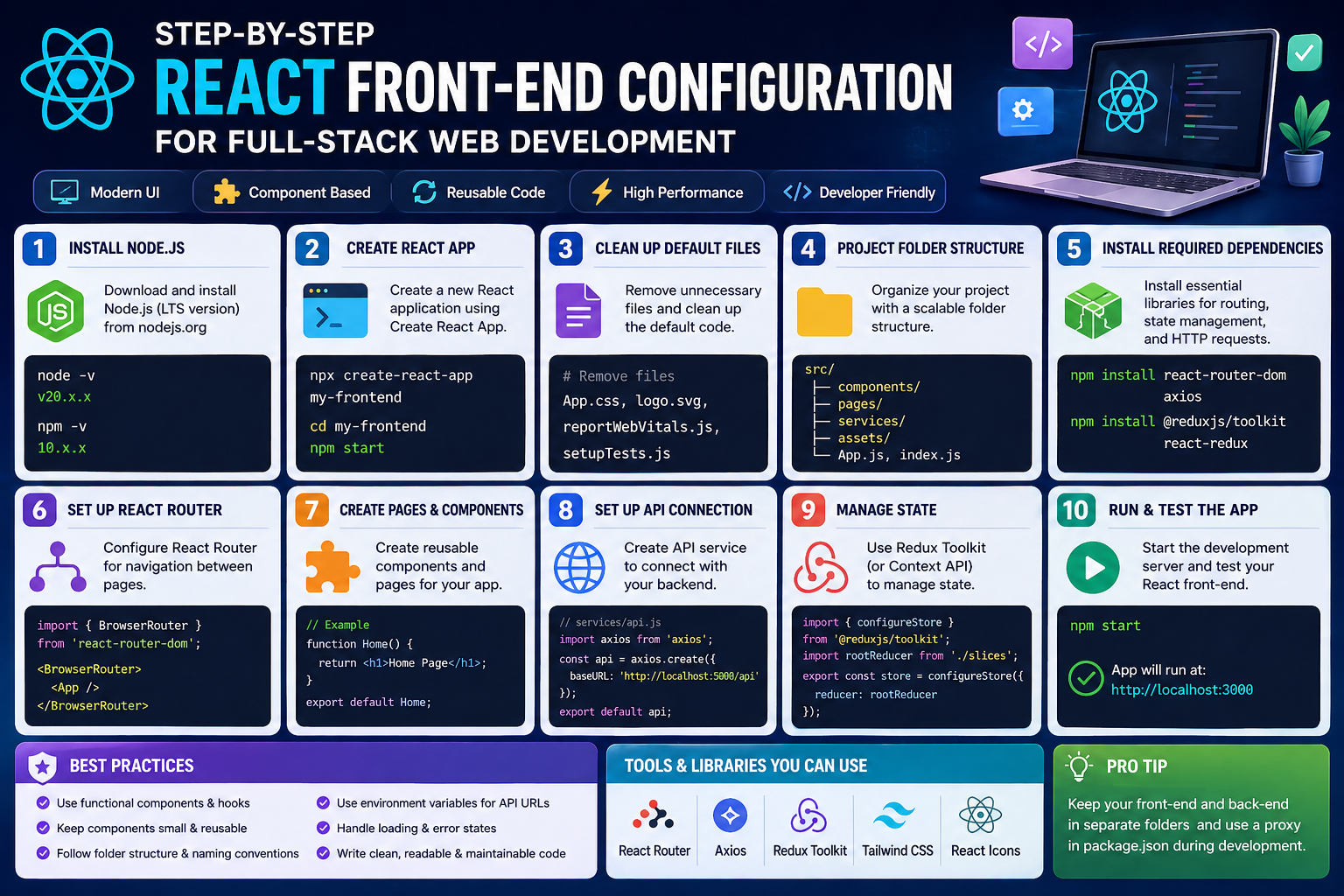
Building a modern web application often involves separating responsibilities between the front-end and the back-end. In this structure, React plays the role of the front-end library responsible for everything the user sees and interacts with in the browser. Before diving into setup steps, it is important to understand what role React actually plays in a full-stack environment.
In a full-stack application, the front-end is responsible for presenting data, handling user interactions, and maintaining a responsive interface. React is particularly well-suited for this because it breaks the user interface into reusable components. Each component manages its own logic and presentation, making it easier to scale applications as they grow in complexity.
When React is paired with a back-end system, such as an API-based server, the front-end becomes a consumer of data rather than a direct data manager. This separation allows developers to focus on building a smooth user experience while relying on a dedicated server layer for business logic, authentication, and database operations.
Understanding this separation is essential before starting a React project because it influences how you structure your application from the beginning. Instead of thinking in terms of static pages, you begin thinking in terms of dynamic components that update based on data received from external sources.
Preparing Your Development Environment
Before creating a React front-end, the development environment must be properly prepared. This step ensures that all necessary tools are available and compatible with modern React workflows.
A key requirement is a JavaScript runtime environment that allows your computer to execute JavaScript outside the browser. This runtime is essential because React development relies on various build tools and package managers that operate through it.
Alongside the runtime, a package management system is required. This system is responsible for installing and managing third-party libraries, including React itself and supporting tools. Without it, building modern web applications would require manually handling dependencies, which would be inefficient and error-prone.
It is also important to ensure that your system is ready for version management. Different projects may require different versions of runtime tools or dependencies, and switching between them is a common part of professional development. Preparing for this early helps prevent compatibility issues later.
A code editor is another essential part of the environment. While many editors are available, the most useful ones for React development typically include features such as syntax highlighting, integrated terminals, debugging tools, and support for extensions that enhance productivity.
Once the environment is prepared, the system is ready to support the creation of a React application and the workflows that come with full-stack development.
Creating a New React Application
The first step in building a React front-end is generating a new project structure. Instead of manually creating folders and configuring files, modern tooling allows developers to generate a ready-to-use application scaffold.
This scaffold includes everything needed to start development, such as configuration files, default dependencies, and a predefined project structure. The goal is to eliminate repetitive setup tasks so developers can focus directly on building features.
When initiating a new React application, the system automatically installs required libraries and configures the development environment. This includes setting up a local development server, preparing build scripts, and establishing a basic component structure.
Once the process completes, a new project folder is created. This folder acts as the root of your application and contains all source files, configuration settings, and dependency references. Inside this structure, there are specific directories dedicated to components, assets, and application logic.
At this stage, the application is already functional in its most basic form. Even without modifications, it can be launched in a browser to display a default interface. This allows developers to immediately verify that the setup process was successful.
Understanding the Default Project Structure
After creating a React application, one of the most important steps is understanding the generated project structure. This structure is designed to support scalability and maintainability, even for large applications.
At the top level, the project contains configuration files that control how the application behaves during development and production. These files define how the application is built, how dependencies are managed, and how the development server operates.
The source directory is where most development work takes place. This is where components, styles, and application logic are stored. Within this directory, the main entry point of the application is located. This entry point is responsible for rendering the entire application into the browser.
Another important part of the structure is the public directory. This section contains static assets that are not processed by the build system. These include images, icons, and the main HTML file that serves as the container for the React application.
Understanding this structure early is important because it helps developers organize their code effectively. As applications grow, maintaining a clear structure prevents confusion and makes it easier to locate and modify specific parts of the project.
Running the Development Environment
Once the project structure is in place, the next step is launching the development environment. This environment allows developers to see changes in real time as they modify the application.
When the development server is started, it compiles the application and serves it through a local address in the browser. This process continuously watches for changes in the source files. Whenever a file is updated, the system automatically refreshes the application to reflect those changes.
This live update system is one of the most powerful features of modern front-end development. It removes the need to manually rebuild or reload the application after every change, significantly speeding up the development process.
During this stage, developers typically open the application in a browser to observe its behavior. Even though the default interface may be simple, it confirms that the system is functioning correctly and ready for further development.
Understanding Components and Reusability
React is built around the concept of components, which are independent, reusable pieces of the user interface. Each component represents a part of the application, such as a header, button, form, or entire page section.
Components can be thought of as building blocks. Instead of creating entire pages at once, developers build small, manageable pieces that can be combined in different ways. This approach makes applications easier to maintain and scale.
One of the key advantages of components is reusability. Once a component is created, it can be used multiple times throughout the application without rewriting its logic. This reduces duplication and ensures consistency across the user interface.
Components also help separate concerns within an application. Each component handles its own behavior and presentation, which makes debugging and updating features much simpler. When something needs to change, developers can focus on a single component instead of searching through a large codebase.
Connecting Front-End with Full-Stack Architecture
In a full-stack application, the front-end does not operate in isolation. Instead, it communicates with a back-end system to retrieve and send data. This communication is typically handled through network requests.
When React is used as the front-end layer, it acts as an interface between the user and the server. The back-end handles tasks such as authentication, database management, and business logic, while React focuses on presenting the results in a user-friendly way.
This separation allows each part of the application to evolve independently. The back-end can be optimized for performance and security, while the front-end can focus on user experience and design.
Understanding how these two layers interact is essential before building complex applications. It helps developers design systems that are efficient, scalable, and easier to maintain over time.
Managing State in a React Front-End
State refers to the dynamic data that changes during the lifetime of an application. This includes user input, server responses, and interface changes.
In React, state management is a core concept because it determines how the interface responds to user actions and external data. When state changes, React automatically updates the relevant parts of the user interface.
Managing state effectively is crucial for building responsive applications. Poor state management can lead to inconsistent behavior, performance issues, and difficulty in debugging.
As applications grow, the state becomes more complex. Developers must decide where to store data, how to share it between components, and how to ensure that updates remain predictable. These decisions have a significant impact on the overall architecture of the application.
Building a Foundation for Future Features
At this stage of development, the React front-end is fully prepared for expansion. The basic structure is in place, the development environment is running, and the core concepts of components and state are understood.
This foundation is essential because it supports all future features that will be added to the application. Whether integrating user authentication, connecting to databases, or building interactive dashboards, the initial setup determines how smoothly these features can be implemented.
A well-structured React front-end makes it easier to scale the application without major refactoring. It also helps teams collaborate more effectively, as each part of the application is clearly organized and easy to understand.
With this foundation in place, the next stage of development typically involves integrating backend services, expanding component structures, and building more advanced user interactions.
Structuring a Scalable React Front-End Architecture
As a React application grows beyond its initial setup, structure becomes one of the most important factors in maintaining long-term stability. A small project can survive with a simple layout, but a full-stack application requires a more deliberate architectural approach to avoid confusion and duplication.
A scalable React architecture is designed around the separation of concerns. This means dividing the application into clearly defined areas such as presentation logic, data handling, reusable utilities, and feature-specific modules. Instead of placing everything in a single folder or loosely organized structure, each part of the application is grouped based on responsibility.
In larger applications, features often become self-contained units. Each feature may include its own components, internal logic, and styling rules. This approach reduces dependencies between unrelated parts of the system and makes it easier to modify or replace individual features without affecting the entire application.
Another important aspect of structure is predictability. When a developer joins a project or returns after a break, they should be able to quickly locate where specific functionality resides. A predictable architecture eliminates guesswork and improves collaboration across teams.
Designing a Clear Data Flow Between Components
One of the most important concepts in React development is understanding how data moves through an application. Unlike traditional applications, where data might be shared globally without restriction, React encourages a controlled flow of information.
Data typically flows in one direction, starting from a parent component and moving down to child components. This predictable flow ensures that changes in data can be tracked easily and that the user interface remains consistent.
When a child component needs to communicate back to a parent, it does so through structured interactions rather than direct modification. This keeps the system organized and prevents unexpected side effects.
As applications grow, managing data flow becomes more complex. Developers must decide which components should own specific pieces of data and how that data should be shared across different parts of the interface. Proper planning at this stage helps avoid performance issues and reduces unnecessary re-rendering.
Introducing Navigation and Multi-View Interfaces
Most full-stack applications are not single-page experiences in the traditional sense, even if they technically operate as single-page applications. Users expect multiple views such as dashboards, profiles, settings pages, and detail screens.
To support this, React applications use a navigation system that allows switching between different views without reloading the entire page. This creates a smooth user experience that feels fast and responsive.
Each view in the application is typically mapped to a specific route. These routes determine what the user sees based on the URL structure. When a route changes, the application dynamically renders the appropriate components without refreshing the browser.
Designing navigation requires careful planning. Developers must decide how users move through the application, which views are accessible at different stages, and how to handle invalid or unexpected routes.
In more complex applications, navigation may also include nested structures. This allows certain sections of the application to have their own internal navigation system, such as dashboards with multiple subsections.
Managing Application State Beyond Basic Usage
As applications become more complex, basic state handling is no longer sufficient. Data may need to be shared across multiple unrelated components, persist across sessions, or reflect real-time updates from a server.
In these scenarios, state management becomes more structured. Instead of relying solely on individual component states, developers introduce centralized approaches that allow different parts of the application to access and update shared data.
This centralized approach ensures consistency. When one part of the application updates a piece of data, all other parts that depend on that data automatically reflect the change. This prevents mismatches and reduces the likelihood of bugs caused by outdated information.
However, centralized state management also introduces complexity. Developers must carefully design how data is stored, how it is updated, and how changes propagate throughout the system. Poorly designed state structures can lead to unnecessary updates and performance issues.
Connecting React to External Data Sources
In a full-stack application, the front-end rarely operates with static data. Instead, it interacts with external services that provide dynamic information. These services may include databases, authentication systems, or third-party APIs.
React applications communicate with these services through structured requests. When a user acts, such as submitting a form or opening a page, the front-end may request data from the server. The server then responds with the necessary information, which is displayed in the interface.
This interaction introduces several important considerations. One of the most critical is timing. Since data is not always available immediately, the interface must be designed to handle loading states and temporary delays.
Another consideration is data consistency. The application must ensure that the information displayed to the user accurately reflects the current state of the server. This requires careful synchronization between front-end and back-end systems.
Security is also an important factor. Sensitive data should never be exposed directly in the front-end. Instead, secure communication patterns are used to protect user information and prevent unauthorized access.
Handling User Input and Interactive Forms
User interaction is a core part of any front-end application. Forms are one of the most common ways users interact with a system, whether they are logging in, submitting data, or configuring settings.
In React, form handling is typically managed through controlled inputs. This means that the application maintains full control over the form data, rather than relying on the browser to manage it internally.
This approach allows for greater flexibility. The application can validate input in real time, provide instant feedback to users, and ensure that submitted data meets required standards before being sent to the server.
Form handling also involves managing different states, such as empty fields, partially completed inputs, and submission errors. Each of these states must be clearly reflected in the user interface to ensure a smooth experience.
As applications grow, form complexity increases. Some forms may span multiple steps, require conditional inputs, or interact with external services during completion. Managing these complexities requires careful structuring of form logic and state.
Implementing Component Communication Patterns
In a React application, components rarely exist in isolation. They often need to share information or trigger actions in other parts of the interface. This requires well-defined communication patterns.
The simplest form of communication occurs between parent and child components. However, as applications grow, communication often needs to occur between components that are not directly related.
To handle this, developers use structured patterns that allow data to flow efficiently across the application. These patterns ensure that components remain reusable and independent while still being able to interact when necessary.
One important principle is avoiding unnecessary coupling between components. When components become too dependent on each other, changes in one area can unintentionally affect others. Keeping communication structured helps prevent this issue.
Managing Styling and Visual Consistency
User interface design is a critical part of any front-end application. While functionality determines what an application does, styling determines how users perceive and interact with it.
React applications can use various approaches to manage styling. The key goal is to maintain consistency across the entire interface while allowing flexibility for individual components.
Styling decisions often involve balancing global design rules with component-specific styles. Global rules ensure consistency in typography, spacing, and color schemes, while component-level styles allow for unique visual behavior.
As applications grow, maintaining consistency becomes more challenging. Without a clear styling strategy, interfaces can become fragmented and difficult to maintain. A structured approach ensures that design remains unified across all parts of the application.
Optimizing Performance in a Growing Application
Performance becomes increasingly important as a React application scales. While small applications may not experience noticeable delays, larger applications can suffer from slow rendering, excessive updates, or inefficient data handling.
One of the key aspects of performance optimization is reducing unnecessary updates. When components re-render more often than needed, the application can become less responsive. Identifying and minimizing these re-renders is an important part of optimization.
Another factor is how data is managed and passed through the application. Large or frequently changing data sets can impact performance if not handled carefully. Structuring data efficiently helps reduce overhead and improve responsiveness.
Loading strategies also play a role in performance. Instead of loading all data at once, applications can load information gradually as needed. This improves initial load times and creates a smoother user experience.
Preparing the Application for Backend Integration
Before a React front-end can fully function as part of a full-stack system, it must be prepared to integrate with backend services. This preparation involves ensuring that the front-end is capable of handling dynamic data, asynchronous operations, and structured communication patterns.
One important consideration is how the front-end handles different states of data availability. Since backend responses are not instantaneous, the interface must account for loading periods and potential delays.
Another consideration is error handling. Network requests can fail for various reasons, and the application must be designed to respond gracefully. This includes displaying meaningful feedback to the user and ensuring that the interface remains stable.
Data formatting is also important. The structure of data received from the backend must align with the expectations of the front-end components. Any mismatch can lead to rendering issues or unexpected behavior.
Organizing Reusable Logic and Utilities
As development progresses, many parts of an application begin to share common logic. This might include data formatting, validation rules, or utility functions that are used across multiple components.
Instead of duplicating this logic in different places, it is organized into reusable modules. These modules act as centralized resources that can be accessed whenever needed.
This approach improves maintainability and reduces redundancy. When changes are required, they can be made in a single location rather than across multiple files.
Reusable logic also helps maintain consistency. When the same function is used throughout the application, it ensures that behavior remains predictable and uniform.
Preparing for Testing and Reliability
As applications become more complex, ensuring reliability becomes increasingly important. Testing helps verify that components behave as expected under different conditions.
React applications can be tested at different levels, including individual components, integrated systems, and full user flows. Each level of testing provides different insights into the stability of the application.
Component-level testing focuses on isolated behavior, ensuring that individual parts of the interface function correctly. Integration testing examines how different parts of the application work together. End-to-end testing simulates real user interactions.
Testing is not only about finding errors but also about ensuring long-term stability. As the application evolves, tests help prevent regressions and maintain consistent behavior across updates.
Integrating a React Front-End with Full-Stack Backend Systems
At this stage of development, a React front-end is no longer just a standalone interface. It becomes part of a larger ecosystem where it communicates with backend services to deliver dynamic, data-driven functionality. This integration is what transforms a simple React project into a full-stack application.
The connection between front-end and back-end is typically established through structured communication patterns. The front-end sends requests for data, and the back-end responds with structured information that the user interface can display. This exchange happens continuously as users interact with the application.
In a full-stack environment, the backend is responsible for handling business logic, managing databases, and enforcing security rules. The React front-end focuses on presentation and user interaction. This separation allows each side of the system to specialize in its own responsibilities, resulting in a more efficient architecture.
Understanding how these two layers interact is essential for building scalable applications. Without proper integration design, applications can become slow, inconsistent, or difficult to maintain.
Handling Asynchronous Data in React Applications
One of the most important challenges in full-stack React development is managing asynchronous data. Since data is often retrieved from external servers, it does not arrive instantly. This introduces delays that must be carefully managed within the user interface.
React applications must account for different states of data retrieval. These states include loading, success, and failure conditions. Each state must be reflected in the interface to ensure users understand what is happening behind the scenes.
When data is being fetched, the application typically displays a temporary interface indicating that content is loading. Once the data arrives, the interface updates automatically to display the final result. If an error occurs, the application must handle it gracefully and inform the user.
Asynchronous handling also impacts how components are structured. Developers must ensure that components do not attempt to render incomplete or unavailable data. Proper handling of these situations prevents crashes and improves overall stability.
Structuring API Communication Patterns
In full-stack applications, communication between the front-end and back-end is usually handled through structured APIs. These APIs define how data is requested, what format it should follow, and how responses are delivered.
React applications interact with these APIs by sending requests based on user actions or lifecycle events. For example, when a page loads, the application may request data required to render the initial view. When a user submits a form, the application may send new data to the server for processing.
A well-structured communication system ensures consistency across the application. Each request follows predictable rules, and responses are formatted in a way that the front-end can easily interpret.
This structure also improves maintainability. When the API is clearly defined, changes can be made on either side of the system with minimal disruption, as long as the communication contract remains consistent.
Managing Authentication in React Front-End Systems
Authentication is a core feature of most full-stack applications. It ensures that users are properly identified and that access to certain features is controlled.
In a React front-end, authentication typically involves interacting with backend services that validate user credentials. Once a user is authenticated, the system provides a form of verification that allows access to protected parts of the application.
This verification is often stored temporarily within the application so that users do not need to re-authenticate on every action. However, this information must be handled carefully to maintain security and prevent unauthorized access.
Different parts of the application may have different access levels. Some views may be public, while others require authentication. React must be able to dynamically adjust what is displayed based on the user’s authentication status.
Proper authentication handling also involves managing session expiration, token refresh mechanisms, and secure storage practices. These elements ensure that user sessions remain both functional and secure.
Protecting Routes and Conditional Access in React
In full-stack applications, not all routes are accessible to every user. Some pages may contain sensitive information or administrative functionality that should only be available under specific conditions.
React applications handle this through conditional rendering of routes. Before displaying a page, the system checks whether the user meets the required conditions. If not, the user may be redirected or shown an alternative interface.
This approach ensures that unauthorized users cannot access restricted areas of the application. It also improves user experience by guiding users toward appropriate actions based on their status.
Route protection is closely tied to authentication systems. Together, they form the foundation of secure front-end behavior in full-stack applications.
Managing Real-Time Data Updates
Modern applications increasingly rely on real-time data updates. This means that information changes dynamically without requiring the user to refresh the page.
React can handle real-time updates through various communication methods that continuously send data between the server and the front-end. When new information arrives, the interface updates immediately to reflect the change.
This is particularly important for applications such as dashboards, messaging systems, and collaborative tools. In these environments, delays in data updates can significantly impact user experience.
Handling real-time data requires careful state management. The application must be able to process frequent updates without becoming unstable or unresponsive. Efficient rendering strategies help ensure that only necessary parts of the interface are updated.
Optimizing Component Rendering Behavior
As React applications grow, performance becomes closely tied to how components render and update. Every time state or props change, React determines which components need to be updated. If this process is not optimized, unnecessary rendering can slow down the application.
Efficient rendering involves minimizing unnecessary updates. Components should only re-render when their data has actually changed. This reduces computational overhead and improves responsiveness.
Another important factor is component structure. Large components that handle too many responsibilities can become inefficient. Breaking them into smaller, focused components allows React to manage updates more effectively.
Memoization techniques are also used to improve rendering performance. These techniques allow components to remember previous results and avoid recalculating values unnecessarily.
Managing Large-Scale State Complexity
In large applications, state management becomes significantly more complex. Data is no longer limited to small, isolated components but instead spans across multiple sections of the application.
To manage this complexity, developers design structured state systems that organize data logically. These systems ensure that data remains consistent and accessible across the application.
One of the key challenges is avoiding conflicts between different parts of the state. When multiple components attempt to modify the same data, careful coordination is required to prevent inconsistencies.
Another challenge is maintaining performance while managing large amounts of state. Efficient data structures and update patterns help ensure that the application remains responsive even as complexity increases.
Organizing Front-End Code for Maintainability
As applications grow, maintaining clean and organized code becomes essential. Without proper organization, even simple changes can become difficult to implement.
Code organization in React involves grouping related functionality. Components, styles, utilities, and data handling logic are separated into logical sections. This makes the codebase easier to navigate and understand.
Consistency is also important. When similar patterns are used throughout the application, developers can quickly understand how different parts of the system work.
Maintaining a structured codebase also improves collaboration. When multiple developers work on the same project, clear organization reduces confusion and prevents conflicts.
Handling Error States and System Failures
No application is completely free from errors. Network failures, incorrect user input, or unexpected server responses can all cause issues in a React front-end.
Handling these errors gracefully is an important part of application design. Instead of allowing the application to crash or behave unpredictably, developers implement fallback mechanisms that maintain stability.
Error states are often displayed to the user in a clear and informative way. This helps users understand what went wrong and how they might resolve the issue.
From a system perspective, error handling also involves logging and monitoring. These tools help developers identify issues and improve the application over time.
Improving User Experience Through Interface Responsiveness
User experience is heavily influenced by how responsive an application feels. Even if an application performs complex operations, it must still feel smooth and immediate to the user.
Responsiveness is achieved through efficient rendering, optimized data handling, and thoughtful interface design. When users interact with the application, feedback should be immediate and intuitive.
This includes visual indicators such as loading states, transitions, and dynamic updates. These elements help users understand how the system is responding to their actions.
A responsive interface also reduces user frustration. When the application behaves predictably and quickly, users are more likely to engage with it effectively.
Preparing React Applications for Deployment Environments
Once development is complete, the application must be prepared for deployment. This involves transforming the development version into an optimized production version.
During this process, unnecessary code is removed, files are compressed, and performance optimizations are applied. The goal is to ensure that the application runs efficiently in real-world environments.
Deployment preparation also includes configuring environment-specific settings. These settings determine how the application interacts with backend services, handles errors, and manages performance in production.
Proper preparation ensures that the application behaves consistently across different environments and provides a stable experience for end users.
Managing Scalability in Full-Stack React Applications
Scalability refers to the ability of an application to handle increased usage, data volume, and complexity without degrading performance.
In React front-end systems, scalability is achieved through modular design, efficient state management, and optimized rendering strategies. Applications must be able to grow without requiring complete structural changes.
Backend integration also plays a role in scalability. As the number of users increases, the system must be able to handle more requests and deliver data efficiently.
Planning for scalability early in development helps prevent major restructuring later. It ensures that the application can evolve smoothly as requirements change.
Evolving the Front-End Beyond Initial Implementation
A React front-end is never truly finished. It continues to evolve as new features are added, requirements change, and user expectations grow.
This evolution involves continuous refinement of components, improvement of performance, and expansion of functionality. Over time, the application becomes more robust and feature-rich.
As new technologies and patterns emerge, React applications can be updated to incorporate modern practices. This ensures that the application remains relevant and efficient in a changing development landscape.
The ability to adapt is one of the key strengths of React-based systems. With a well-structured foundation, applications can continue to grow and improve without losing stability or performance.
Advanced Performance Profiling and Debugging Strategies
As React applications become more complex, understanding performance at a deeper level becomes essential. Beyond basic optimization techniques, developers often rely on profiling tools that reveal how components behave during rendering. These tools provide insights into which components re-render frequently, how long rendering takes, and which updates may be unnecessary.
Profiling helps identify hidden inefficiencies that are not immediately visible during development. For example, a component might appear simple but still trigger expensive recalculations due to changes in the parent state. By analyzing render timelines, developers can pinpoint bottlenecks and refine component behavior accordingly.
Debugging in large applications also requires a structured approach. Instead of relying on isolated console outputs, developers examine application state transitions, component hierarchies, and data flow patterns. This broader perspective makes it easier to understand why certain issues occur and how they propagate through the system.
Performance profiling is not a one-time task but an ongoing process. As new features are added, previously optimized sections may need reevaluation to ensure the application continues to perform efficiently under increased complexity.
Code Splitting and Lazy Loading for Efficient Delivery
In larger React applications, loading the entire codebase at once can negatively impact initial load times. To address this, applications often use code splitting, which breaks the application into smaller chunks that are loaded only when needed.
This approach ensures that users only download the parts of the application relevant to their current interaction. For example, a dashboard page and a settings page do not need to be loaded simultaneously if the user only accesses one of them.
Lazy loading complements this strategy by deferring the loading of specific components until they are actually required. This reduces the initial bundle size and improves perceived performance, especially on slower networks.
By combining code splitting and lazy loading, applications become more efficient in how they deliver resources. This approach also improves scalability, as new features can be added without significantly increasing the initial load burden.
Proper implementation requires careful planning of application routes and component boundaries. When structured correctly, these techniques create a smoother and more responsive user experience.
Enhancing Front-End Caching and Data Efficiency
Efficient data handling is crucial in full-stack React applications, especially when dealing with repeated requests or large datasets. Caching strategies help reduce unnecessary network calls and improve overall responsiveness.
Caching can occur at multiple levels, including browser caching, application-level caching, and server-side caching. Each layer contributes to reducing redundant data fetching and improving load times.
In the front-end, caching ensures that previously retrieved data can be reused instead of requesting it again from the server. This is particularly useful for data that does not change frequently, such as configuration settings or static content.
However, caching must be managed carefully to avoid displaying outdated information. Developers need to define clear rules for when cached data should be refreshed or invalidated.
Efficient data handling also involves minimizing payload sizes and structuring responses in a way that aligns with front-end requirements. This reduces processing overhead and improves rendering speed.
Accessibility and Inclusive Interface Design in React
Modern front-end development places increasing importance on accessibility, ensuring that applications are usable by people with diverse abilities and assistive technologies.
In React applications, accessibility involves designing components that can be navigated using keyboards, screen readers, and other assistive tools. This requires careful attention to structure, labeling, and interaction patterns.
Proper semantic structure helps assistive technologies interpret the interface correctly. Interactive elements must be clearly defined so that users can understand their purpose and functionality without relying solely on visual cues.
Color contrast, font sizing, and focus indicators also play a significant role in accessibility. These elements ensure that the interface remains usable under different viewing conditions and for users with visual impairments.
Accessibility is not an optional enhancement but a core aspect of modern application design. When implemented correctly, it improves usability for all users, not just those relying on assistive technologies.
Continuous Integration and Delivery in Front-End Workflows
As React applications evolve, maintaining consistent quality across updates becomes increasingly important. Continuous integration and delivery practices help automate testing, building, and deployment processes.
In a structured workflow, every code change is automatically tested and validated before being merged into the main codebase. This reduces the likelihood of introducing bugs or breaking existing functionality.
Once changes pass validation, they can be automatically prepared for deployment. This ensures that updates are delivered quickly and reliably without requiring manual intervention for every release.
Automated workflows also improve collaboration among development teams. Since changes are continuously integrated, conflicts are detected early, and issues are resolved before they escalate.
This approach creates a stable development environment where updates can be released frequently without compromising application reliability.
Conclusion
Building a React front-end for a full-stack application is not just about writing components or running setup commands; it is about understanding how modern web systems are structured and how different layers work together to deliver a seamless user experience. From the initial project setup to advanced integration with backend services, each stage plays a critical role in shaping the final application.
A strong React foundation begins with a clear understanding of component-based architecture, where the interface is broken into reusable and independent pieces. This approach makes development more organized and allows applications to scale without becoming difficult to manage. As the application grows, concepts such as state management, routing, and data flow become increasingly important in maintaining consistency and performance across the interface.
Equally important is the relationship between the front-end and back-end. In a full-stack system, React acts as the presentation layer while relying on backend services for data processing, authentication, and storage. This separation of responsibilities allows developers to build more efficient and maintainable applications, where each part of the system focuses on its own strengths.
As applications become more advanced, additional considerations such as asynchronous data handling, error management, and performance optimization play a major role. These elements ensure that the application remains responsive, reliable, and user-friendly even under complex conditions. Proper structuring and thoughtful architecture decisions help prevent issues that typically arise in large-scale systems.
Ultimately, mastering React in a full-stack environment is a continuous process. It involves not only learning how to build features but also understanding how to design systems that can evolve. Developers who focus on clean structure, efficient communication between layers, and scalable design principles are better equipped to build applications that are both powerful and sustainable in the long run.