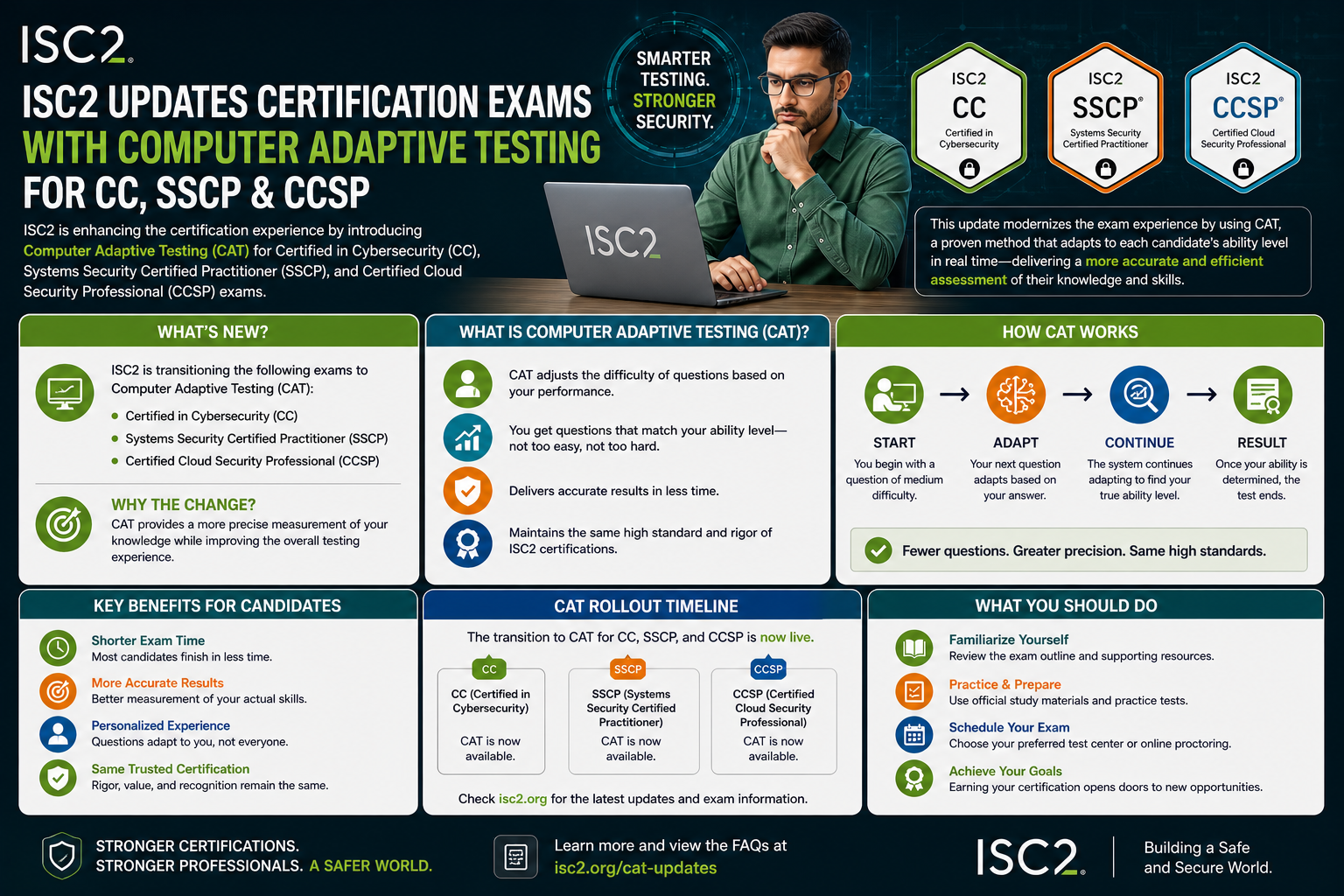
In recent years, certification exams in the cybersecurity field have been evolving to better reflect how professionals are assessed in real-world environments. One of the most significant developments in this direction is the introduction of Computer Adaptive Testing (CAT) for several major ISC2 certifications, including Certified in Cybersecurity (CC), Systems Security Certified Practitioner (SSCP), and Certified Cloud Security Professional (CCSP). This change marks a departure from the traditional fixed-question exam structure that candidates have been accustomed to for many years.
The CAT format represents a shift not only in delivery but also in philosophy. Instead of presenting every candidate with an identical set of questions, the exam dynamically adjusts its difficulty level based on the individual’s responses. This means the assessment becomes more personalized, continuously measuring performance in real time and selecting questions that better reflect the candidate’s ability level. As a result, the exam is no longer just a static test but an evolving evaluation process.
This transition also aligns these certifications more closely with the Certified Information Systems Security Professional (CISSP) exam, which already adopted the adaptive model earlier. By expanding this format across multiple certification levels, ISC2 is creating a more consistent testing experience across its credential ecosystem.
The Core Idea Behind Computer Adaptive Testing
At the heart of CAT lies a simple but powerful concept: the exam adapts to the test-taker rather than forcing every test-taker to adapt to the same exam. The system begins by presenting questions of moderate difficulty. Based on whether the candidate answers correctly or incorrectly, the algorithm recalibrates the estimated skill level and selects the next question accordingly.
If a candidate answers correctly, the system may present a more challenging question next. If the response is incorrect, the system may adjust by offering a slightly easier question. This process continues throughout the exam, allowing the system to converge on an accurate estimate of the candidate’s true proficiency level.
This adaptive mechanism is built on statistical modeling, where each question contributes to a progressively refined understanding of the test-taker’s ability. Unlike traditional exams, where performance is measured by total correct answers out of a fixed set, CAT focuses on precision. It seeks to determine not just how many questions a candidate gets right, but how difficult those questions are in relation to their ability.
This approach reduces randomness and improves measurement accuracy, ensuring that the final result reflects a more reliable assessment of competence.
Why ISC2 Introduced Adaptive Testing Across Multiple Certifications
The decision to extend CAT to CC, SSCP, and CCSP is part of a broader effort to modernize certification assessment standards. Cybersecurity is a rapidly evolving field, and certification bodies must ensure that their evaluation methods keep pace with industry expectations.
One of the key motivations behind this transition is improved measurement precision. Traditional fixed-question exams can sometimes fail to differentiate effectively between candidates who are borderline pass or fail. CAT reduces this ambiguity by continuously refining the difficulty level until the system reaches a high level of confidence in the candidate’s ability estimate.
Another reason for the shift is exam efficiency. Since the test adapts in real time, candidates do not necessarily need to answer a full fixed set of questions. The exam can conclude earlier if the system determines that it has enough information to make a decision. This creates a more streamlined testing experience without compromising evaluation quality.
Security is also a major factor. Adaptive testing reduces the risk of question exposure because no two candidates receive the same sequence of questions. This makes it significantly harder to share or reconstruct exam content, helping preserve the integrity of the certification process.
Finally, consistency across certifications is another driving force. With CISSP already using CAT, extending the same model to CC, SSCP, and CCSP creates a unified testing framework across different levels of expertise, from entry-level to advanced professional credentials.
Structural Changes in the Exam Experience
While the content domains of CC, SSCP, and CCSP remain unchanged, the structure of how candidates interact with the exam has been significantly modified. One of the most noticeable differences is the variable number of questions. Instead of a fixed count, each exam now operates within a defined range.
For CC and SSCP, the exam typically includes between 100 and 125 questions, while CCSP ranges from 100 to 150 questions. The actual number each candidate sees depends entirely on their performance during the test. Similarly, time limits are structured to accommodate this adaptive format, ensuring candidates have sufficient opportunity to demonstrate their knowledge without unnecessary pressure.
Another structural change is the inability to skip or return to previous questions. In a CAT environment, each response is final. Once a question is answered, the system immediately moves forward, incorporating that response into the ongoing evaluation model. This design ensures that each answer directly contributes to the next stage of difficulty calibration.
This requires a more focused approach to decision-making during the exam. Candidates must rely on their knowledge and judgment in the moment, rather than revisiting and reconsidering earlier responses.
The Psychological Shift for Candidates
Beyond technical adjustments, the introduction of CAT also brings a psychological shift in how candidates experience the exam. Traditional testing formats allow individuals to pace themselves in a predictable way, often reviewing answers or allocating time based on a known number of questions.
With CAT, this predictability is replaced by variability. Since the number of questions is not fixed and difficulty levels change dynamically, candidates may find themselves facing a mix of relatively easy and unexpectedly challenging questions in succession. This can create uncertainty about performance during the exam itself.
However, this uncertainty is intentional. The system is designed to evaluate consistency and competence across varying levels of difficulty rather than relying on a uniform question set. Candidates who remain calm and focused are more likely to perform effectively, as the system rewards stable performance patterns rather than isolated correct answers.
The adaptive nature of the exam also means that encountering difficult questions does not necessarily indicate poor performance. In many cases, it may indicate that the system is accurately identifying higher proficiency levels and adjusting accordingly.
Maintaining Alignment with Existing Study Domains
Despite the introduction of CAT, the foundational structure of what candidates need to study has not changed. The exam domains for CC, SSCP, and CCSP remain consistent with previous versions. This ensures continuity in preparation materials and study approaches.
Candidates are still expected to master core cybersecurity principles, including risk management, access control, network security, cloud security concepts, and operational security practices depending on the certification level. The shift lies entirely in how knowledge is assessed, not in what knowledge is required.
This continuity is important because it prevents disruption in learning pathways. Professionals preparing for these certifications can continue using established study plans without needing to overhaul their entire preparation strategy. Instead, they can focus on adapting their test-taking mindset to align with the adaptive format.
The emphasis now shifts toward deeper comprehension rather than memorization. Since the exam dynamically adjusts to performance, surface-level familiarity with concepts is less effective than a solid understanding of underlying principles.
How Adaptive Questioning Influences Difficulty Progression
One of the defining features of CAT is how it manages difficulty progression. Unlike traditional exams, where difficulty is distributed across a fixed set of questions, CAT continuously evaluates performance and adjusts in real time.
If a candidate demonstrates strong understanding early in the exam, the system introduces more complex scenarios to better gauge the upper limits of their knowledge. Conversely, if a candidate struggles, the system may present less complex questions to ensure accurate measurement at a lower performance range.
This creates a tailored difficulty curve for each individual. The result is an exam that feels unique to every candidate, even though it is drawn from a shared question pool. The algorithm’s goal is not to challenge candidates arbitrarily but to identify the point at which their performance stabilizes with statistical confidence.
This adaptive progression also reduces unnecessary fatigue. Candidates are less likely to encounter long sequences of questions that are either too easy or too difficult, which helps maintain engagement and focus throughout the exam duration.
The Role of Time Management in an Adaptive Environment
Time management takes on a different meaning in a CAT-based exam. Since the number of questions is variable and the exam may end early depending on performance, candidates cannot rely on a fixed pacing strategy.
Instead, time must be managed at the level of individual questions rather than the entire exam. Each question becomes a self-contained decision point, requiring careful attention and analysis. Spending too much time on a single question can reduce overall efficiency, especially since there is no opportunity to return to it later.
At the same time, rushing through questions can negatively affect the adaptive scoring model, as each response directly influences the next question’s difficulty level. This creates a delicate balance between speed and accuracy.
Candidates who adapt well to this structure tend to focus on clarity of understanding rather than attempting to optimize for time across the entire exam. This approach aligns more closely with real-world decision-making scenarios in cybersecurity roles, where timely but accurate responses are often required under pressure.
Early Impact on Certification Experience
As CC, SSCP, and CCSP transition into the CAT format, early feedback and observations suggest a noticeable shift in candidate experience. Many find the exam more fluid and less predictable, while others appreciate the reduced length in cases where strong performance leads to earlier completion.
The adaptive model also changes how candidates interpret difficulty. Instead of viewing the exam as a linear progression from easy to hard, it becomes a dynamic interaction between performance and assessment. This requires a more flexible mindset, where candidates focus less on anticipating question order and more on applying knowledge consistently.
Over time, this approach is expected to become the standard across cybersecurity certifications, reinforcing a more modern and responsive evaluation system that better aligns with evolving professional demands.
The broader implications of this shift continue to unfold as more candidates engage with the updated format, and as the adaptive model becomes more deeply integrated into certification frameworks across the industry.
The Psychometric Foundation Behind Computer Adaptive Testing in ISC2 Exams
The introduction of Computer Adaptive Testing in ISC2 certifications is not simply a change in exam delivery format; it is built on a deeply scientific foundation rooted in psychometrics, the discipline that studies measurement of knowledge, skills, and abilities. At the core of CAT lies a statistical framework that allows the system to estimate a candidate’s proficiency in real time based on their responses.
One of the most important models used in adaptive testing environments is Item Response Theory (IRT). This model assumes that every question in the exam has a measurable difficulty level, and every candidate has a measurable ability level. The interaction between these two variables determines the probability of a correct response. Instead of treating all questions equally, the system assigns weight based on how challenging each item is.
In practice, this means that answering a difficult question correctly provides more information about a candidate’s ability than answering an easy question correctly. Similarly, failing a very easy question provides strong signals about lower proficiency levels. The CAT engine continuously uses this feedback loop to refine its estimation of the candidate’s skill.
As the exam progresses, the system reduces uncertainty in its ability estimate. Once the statistical confidence reaches a predefined threshold, the exam ends. This approach ensures that no candidate is over-tested or under-tested. The goal is not to reach a fixed number of questions but to reach a stable and reliable measurement.
This scientific foundation is what differentiates CAT from traditional linear exams, where scoring is often based on a simple percentage of correct answers. Instead, CAT focuses on probability-based estimation, which provides a more nuanced and accurate representation of real-world competence.
Question Bank Design and Calibration in Adaptive Environments
Behind every Computer Adaptive Testing system lies a carefully constructed and highly calibrated question bank. In ISC2 exams such as CC, SSCP, and CCSP, each question is not only written to test knowledge but also assigned specific psychometric properties that allow the adaptive engine to function effectively.
Each item in the question bank undergoes rigorous analysis before being deployed. This includes evaluating its difficulty level, discrimination index, and statistical reliability. Difficulty refers to how challenging the question is for the average candidate. Discrimination measures how effectively the question differentiates between high-performing and low-performing candidates. Reliability ensures that the question produces consistent results across different testing scenarios.
Once calibrated, these questions are stored in a structured item pool. The adaptive engine draws from this pool dynamically during the exam. However, not all questions are used equally. The system ensures that each candidate receives a unique sequence of items tailored to their performance trajectory.
To maintain fairness and consistency, ISC2 continuously updates and recalibrates its question pool. New questions are introduced, outdated items are retired, and statistical models are refined based on real exam data. This ongoing maintenance ensures that the adaptive system remains accurate and aligned with evolving cybersecurity knowledge domains.
The complexity of this design is often invisible to candidates, but it plays a critical role in ensuring that every exam session produces valid and defensible results.
How the Adaptive Engine Determines When to End the Exam
One of the most distinctive features of Computer Adaptive Testing is that the exam does not have a fixed length. Instead, the system determines when it has collected enough information to make a confident decision about the candidate’s ability level.
This process is governed by statistical stopping rules. As each question is answered, the system updates its estimate of the candidate’s ability and calculates the level of uncertainty associated with that estimate. Early in the exam, uncertainty is high because there is limited data. As more questions are answered, uncertainty decreases.
Once the system determines that the confidence interval around the ability estimate is sufficiently narrow, the exam is terminated. This means the system is confident that additional questions would not significantly change the final outcome.
This mechanism ensures efficiency without sacrificing accuracy. Strong candidates may reach this confidence threshold earlier, resulting in shorter exams. Candidates with more variable performance may require more questions to reach the same level of certainty.
It is important to understand that exam length is not an indicator of success or failure. A shorter exam does not automatically mean high performance, and a longer exam does not necessarily indicate difficulty. It simply reflects how quickly the system was able to stabilize its measurement.
This dynamic stopping mechanism is one of the key innovations that distinguishes adaptive testing from traditional fixed-length exams.
Security Enhancements Through Adaptive Delivery Systems
Cybersecurity certifications require a high level of integrity in exam delivery, and Computer Adaptive Testing introduces several security enhancements that strengthen exam protection.
One of the most significant advantages is reduced predictability. In linear exams, all candidates receive the same set of questions in a fixed order, which increases the risk of content memorization and sharing. In contrast, CAT ensures that each candidate receives a unique sequence of questions based on their performance path.
Even if two candidates start with similar questions, their paths diverge quickly as the system adapts. This makes it extremely difficult to reconstruct a complete exam or share meaningful question sequences after the test.
Additionally, the dynamic nature of question selection reduces the value of external question dumps or memorized answer sets. Since candidates do not know which questions they will receive, preparation must focus on understanding concepts rather than memorizing patterns.
The system also incorporates secure item exposure controls. This ensures that no single question is overused, preserving the integrity of the question bank. Items that are statistically overexposed may be temporarily removed or replaced to maintain balance.
From an operational standpoint, adaptive testing platforms also employ advanced encryption and monitoring systems to ensure that exam data remains secure throughout the delivery process. This is particularly important for globally administered certifications like those offered by ISC2.
Cognitive Experience and Cognitive Load in Adaptive Exams
The shift to Computer Adaptive Testing also changes the cognitive experience of candidates in subtle but important ways. In traditional exams, candidates often experience a predictable rhythm: a mix of easy, moderate, and difficult questions arranged in a fixed sequence. This allows for mental pacing strategies based on anticipated structure.
In CAT, however, the cognitive load becomes more dynamic. Since each question is selected based on previous responses, candidates may experience fluctuations in difficulty that feel less predictable. This requires a different kind of mental flexibility.
Instead of mentally categorizing sections of the exam, candidates must focus on each question independently. This reduces the effectiveness of long-term pacing strategies and increases the importance of moment-to-moment decision-making.
Interestingly, this design can also reduce cognitive fatigue in some cases. Because the system avoids presenting long sequences of irrelevant difficulty levels, candidates are less likely to spend extended periods on questions that are far outside their ability range. This can create a more balanced cognitive experience overall.
However, the unpredictability also requires stronger emotional regulation. Candidates must remain focused even when encountering unexpectedly difficult questions, understanding that such questions are part of the system’s calibration process rather than indicators of failure.
Misconceptions and Misinterpretations About CAT Performance
With the introduction of Computer Adaptive Testing, several misconceptions often arise among candidates unfamiliar with the model. One common misunderstanding is that the difficulty of a question directly reflects whether the candidate is performing well or poorly.
In reality, the appearance of difficult questions is not a signal of failure. Instead, it often indicates that the system has identified the candidate as potentially high-performing and is testing the upper boundaries of their ability. Conversely, easier questions do not necessarily indicate poor performance but may reflect calibration toward a lower estimated ability range.
Another misconception is that guessing has no value in adaptive exams. While guessing is generally discouraged, the system still interprets responses probabilistically. A correct answer contributes positively to ability estimation, regardless of certainty, while incorrect answers adjust the model accordingly.
There is also confusion about exam length. Some candidates assume that reaching the maximum number of questions means failure, while early termination guarantees success. Both assumptions are incorrect. The system is designed to stop when sufficient confidence is reached, regardless of outcome.
Understanding these misconceptions is important for reducing anxiety and ensuring that candidates approach the exam with the correct expectations.
Fairness, Bias Control, and Global Standardization
Fairness is a central concern in any high-stakes certification exam, and Computer Adaptive Testing introduces both advantages and challenges in this area. On one hand, CAT improves fairness by tailoring question difficulty to individual performance levels, reducing the likelihood of candidates being disadvantaged by randomly assigned question sets.
On the other hand, ensuring fairness requires careful calibration of the underlying item bank. Each question must be tested across diverse candidate populations to ensure it does not introduce unintended bias. This includes evaluating performance across different geographic regions, educational backgrounds, and professional experiences.
ISC2’s implementation of adaptive testing includes continuous statistical monitoring to detect and correct any irregularities in question performance. If a question behaves differently across demographic groups, it may be reviewed or removed.
Global standardization is another important aspect. Since ISC2 certifications are recognized internationally, the adaptive system must ensure consistent measurement regardless of where the exam is taken. This requires robust data modeling and ongoing validation to ensure that results are comparable across all regions.
The combination of adaptive delivery and rigorous psychometric oversight helps maintain the credibility and global recognition of these certifications.
Candidate Behavior Adaptation in Real Time
One of the most interesting aspects of Computer Adaptive Testing is how it influences candidate behavior during the exam itself. Because each response directly influences the next question, candidates often become more deliberate in their decision-making.
Unlike linear exams, where a single difficult question may not significantly affect the overall experience, in CAT every answer contributes to the evolving assessment model. This encourages candidates to treat each question with consistent attention.
Over time, candidates may begin to notice patterns in how the exam responds to their performance. However, these patterns are not designed to be predictable. Instead, they reflect statistical adjustments rather than fixed sequences.
Some candidates naturally adapt to this environment by slowing down slightly and focusing on accuracy rather than speed. Others may initially struggle with the lack of predictability but adjust as they become more familiar with the format.
This behavioral adaptation is an important part of the CAT experience and reflects the system’s emphasis on consistent cognitive performance rather than memorized test strategies.
Operational Complexity Behind Adaptive Exam Delivery
From an operational perspective, delivering Computer Adaptive Testing at scale involves significant technical and logistical complexity. The system must be capable of processing responses in real time, updating ability estimates instantly, and selecting the next question without delay.
This requires a highly optimized backend infrastructure capable of handling large volumes of simultaneous test-takers across different regions. Latency must be minimized to ensure a seamless exam experience, as even small delays in question delivery could disrupt the adaptive flow.
Additionally, the system must maintain strict synchronization between question selection algorithms and security protocols. Each response must be securely transmitted, evaluated, and integrated into the adaptive model without exposing sensitive item data.
Quality assurance processes also play a critical role. Before deployment, adaptive systems undergo extensive simulation testing using modeled candidate responses to ensure stability and accuracy under different conditions.
This operational complexity is one of the reasons why adaptive testing is typically introduced gradually across certification programs rather than all at once.
The evolution of ISC2’s certification delivery model reflects a broader shift in how professional competence is measured, emphasizing precision, adaptability, and statistical rigor in modern assessment systems.
Real-World Impact of Computer Adaptive Testing on Cybersecurity Certification Standards
The introduction of Computer Adaptive Testing (CAT) across ISC2 certifications such as Certified in Cybersecurity (CC), Systems Security Certified Practitioner (SSCP), and Certified Cloud Security Professional (CCSP) represents more than a technical upgrade in exam delivery. It signals a broader shift in how professional competence in cybersecurity is measured, validated, and interpreted in real-world industry contexts.
In traditional certification models, the emphasis was primarily on standardized testing conditions, where every candidate was evaluated using the same fixed set of questions. While this approach offered consistency, it did not always reflect the variability of real-world cybersecurity environments, where professionals must adapt dynamically to changing threats, systems, and operational demands.
Computer Adaptive Testing introduces a closer alignment between assessment methodology and real-world decision-making. In cybersecurity operations, professionals rarely encounter identical scenarios or predictable sequences of problems. Instead, they face evolving challenges that require continuous reassessment of risk, priority, and response strategy. CAT mirrors this dynamic by adjusting the difficulty and focus of questions based on ongoing performance.
This alignment between exam structure and real-world cognitive demands is one of the reasons ISC2 has expanded adaptive testing across multiple certification levels. It is not simply about making exams more efficient; it is about ensuring that the evaluation process reflects the adaptive thinking required in modern cybersecurity roles.
Strengthening Skill Validation Across Different Career Levels
One of the most significant outcomes of implementing Computer Adaptive Testing across CC, SSCP, and CCSP is the improved granularity in skill validation. Each certification represents a different stage in a cybersecurity career, from foundational awareness to advanced cloud security expertise. CAT allows ISC2 to more precisely measure where a candidate falls within this spectrum.
For entry-level candidates pursuing Certified in Cybersecurity, the adaptive system focuses on establishing baseline understanding of core concepts such as security principles, access control, and risk awareness. The system gradually adjusts question difficulty to determine whether the candidate has achieved foundational readiness for cybersecurity roles.
For SSCP candidates, who are expected to demonstrate hands-on operational security skills, the adaptive mechanism evaluates applied knowledge in areas such as network security, incident response, and system monitoring. The system is able to distinguish between theoretical understanding and practical comprehension by adjusting question complexity in real time.
For CCSP candidates, the adaptive model operates at a more advanced level, assessing cloud architecture, governance, and enterprise security design principles. Here, CAT helps differentiate between candidates who understand conceptual frameworks and those who can apply them in complex, real-world cloud environments.
This layered evaluation approach ensures that each certification accurately reflects the intended level of expertise, reducing ambiguity in skill classification.
The Shift in Exam Strategy and Candidate Preparation Mindset
The transition to Computer Adaptive Testing also requires a fundamental shift in how candidates approach exam preparation. In traditional linear exams, preparation often includes practicing with full-length mock tests, memorizing question patterns, and developing pacing strategies based on a known number of questions.
With CAT, these strategies become less effective because the exam structure is not fixed. Instead, preparation must focus on conceptual mastery and adaptability. Candidates must develop a deep understanding of cybersecurity principles rather than relying on pattern recognition or memorized question formats.
This shift encourages a more analytical learning approach. Instead of asking “what will the next question look like,” candidates must focus on “how do I apply this concept in different scenarios.” This mirrors real cybersecurity work, where professionals must apply knowledge flexibly rather than rely on predefined solutions.
Another important change is the need for consistent performance under uncertainty. Since candidates cannot predict question order or difficulty progression, preparation must include exposure to varied question types and difficulty levels. This helps reduce cognitive shock during the actual exam experience.
Over time, candidates who adapt to this preparation style tend to develop stronger problem-solving skills, improved conceptual clarity, and greater confidence in handling unfamiliar scenarios.
How CAT Changes the Interpretation of Passing and Failing
In traditional exams, passing and failing are often perceived as outcomes based on a simple score threshold. However, in Computer Adaptive Testing, the interpretation of results is more nuanced. The system does not merely count correct answers; it estimates a candidate’s ability level with statistical confidence.
This means that two candidates with similar raw performance may receive different outcomes depending on how their responses align with question difficulty. A candidate who answers fewer but more difficult questions correctly may demonstrate a higher ability level than a candidate who answers more easy questions correctly.
The adaptive model also reduces the influence of chance. In fixed exams, guessing can sometimes significantly impact results, especially if the question distribution is uneven. In CAT, the continuous recalibration process minimizes the effect of random guessing by evaluating performance across multiple difficulty levels.
As a result, passing or failing becomes a reflection of consistent ability rather than isolated performance moments. This provides a more stable and defensible measurement of professional competence.
However, this also means that candidates may not always receive intuitive feedback based on their perception of performance. It is possible to feel uncertain during the exam while still achieving a passing result, or to feel confident while narrowly missing the required ability threshold. This disconnect between perception and outcome is a natural consequence of probabilistic measurement systems.
The Role of Uncertainty Reduction in Exam Termination
A defining feature of Computer Adaptive Testing is its focus on uncertainty reduction. Unlike traditional exams, where all candidates answer a fixed number of questions regardless of performance, CAT dynamically determines when enough information has been collected to make a reliable decision.
At the start of the exam, the system has minimal information about the candidate’s ability level. Each response significantly influences the model’s estimate. As the exam progresses, the system becomes more confident in its assessment and the rate of change in ability estimation decreases.
When the level of uncertainty falls below a predefined threshold, the exam terminates. This means the system has reached a stable estimate of the candidate’s ability that is unlikely to change with additional questions.
This approach is efficient because it avoids unnecessary testing once sufficient evidence has been gathered. It also ensures fairness by standardizing confidence levels across all candidates, regardless of how many questions they answer.
Importantly, this mechanism is independent of time perception. A candidate may finish early due to rapid convergence, or continue for the full duration if their responses require more calibration. Both outcomes are valid and reflect the adaptive nature of the system.
Implications for Global Cybersecurity Workforce Standards
The adoption of Computer Adaptive Testing across ISC2 certifications has broader implications for global cybersecurity workforce development. As these certifications are widely recognized across industries and countries, changes in assessment methodology influence how employers interpret certification validity.
One of the key benefits of CAT is improved consistency in candidate evaluation. Since the system dynamically adjusts difficulty based on individual performance, it reduces variability in exam difficulty across different test sessions. This ensures that a certification earned in one region or time period is comparable in rigor to another.
This consistency is particularly important in cybersecurity, where professionals often work in global teams and must meet standardized competency expectations. Employers can have greater confidence that certified individuals have been evaluated using a stable and statistically reliable method.
Additionally, CAT helps align certification outcomes more closely with actual job performance. Because the exam focuses on adaptive problem-solving rather than static memorization, it better reflects the skills required in operational environments.
This contributes to stronger trust in certification programs as indicators of real-world readiness.
Psychological Adaptation and Candidate Resilience
The introduction of adaptive testing also influences psychological resilience during exam conditions. Unlike traditional exams, where candidates can anticipate structure and pace, CAT introduces variability that requires sustained mental flexibility.
Candidates must learn to manage uncertainty without becoming distracted by it. This includes maintaining focus when encountering unexpectedly difficult questions and avoiding overinterpretation of question difficulty as a performance indicator.
Over time, candidates who become familiar with adaptive environments tend to develop stronger emotional regulation skills. They learn to treat each question as an independent evaluation point rather than part of a predictable sequence.
This mindset is valuable beyond the exam itself. In cybersecurity roles, professionals frequently operate in environments where information is incomplete, threats evolve rapidly, and decisions must be made under uncertainty. The cognitive resilience developed during CAT-based exams can therefore translate into professional advantages.
However, this adaptation process may initially feel challenging for candidates accustomed to linear testing formats. The lack of visible structure can create uncertainty, but with familiarity, most candidates adjust their expectations and develop new strategies for engagement.
Data-Driven Evolution of Certification Exams
One of the less visible but highly significant aspects of Computer Adaptive Testing is its ability to continuously improve through data analysis. Every exam session generates large amounts of performance data, which can be used to refine question calibration, adjust difficulty scaling, and improve statistical models.
This creates a feedback loop where the exam system becomes increasingly accurate over time. Questions that do not perform as expected can be revised or removed, while well-performing items can be retained and reused in controlled proportions.
This data-driven approach also helps identify trends in candidate performance. For example, if a large number of candidates consistently struggle with a particular domain, it may indicate a need for clarification in training materials or exam objectives.
However, the adaptive system itself remains stable in structure. While underlying models may be refined, the core principles of real-time difficulty adjustment and uncertainty reduction remain consistent.
This continuous improvement cycle ensures that certification exams remain relevant in a rapidly changing cybersecurity landscape.
Long-Term Influence on Certification Design Philosophy
The expansion of Computer Adaptive Testing across ISC2 certifications reflects a broader shift in certification design philosophy. Instead of viewing exams as static evaluations, they are increasingly being treated as dynamic measurement systems that evolve with candidate performance.
This represents a move toward precision-based assessment, where the goal is not simply to determine whether a candidate passes or fails, but to accurately locate their ability within a defined competency spectrum.
In the long term, this approach may influence other certification bodies to adopt similar models, particularly in technical fields where skill levels vary widely and continuous adaptation is essential.
It also reinforces the idea that certification is not just about knowledge recall but about applied understanding, decision-making ability, and cognitive flexibility under changing conditions.
As Computer Adaptive Testing becomes more widely adopted, it is likely to shape the future of professional certification standards across multiple industries, establishing a new benchmark for how expertise is measured and validated in complex technical domains.
As Computer Adaptive Testing becomes more established across ISC2 certifications, its influence is also reshaping how organizations think about workforce readiness and continuous professional development. Instead of relying solely on static exam results as a one-time indicator of competence, employers are beginning to recognize that adaptive assessments provide a more nuanced view of a candidate’s ability to handle real operational complexity.
This shift is particularly important in cybersecurity, where threats evolve constantly and professionals must make decisions under pressure with incomplete information. The adaptive exam model indirectly reinforces these expectations by measuring not just correctness, but consistency of performance across varying difficulty levels. Over time, this helps create a more resilient certification framework that better aligns with real-world job demands.
At the same time, ISC2’s move toward CAT also reflects a broader industry trend toward data-driven evaluation systems. As more certification bodies adopt similar models, the standard for professional assessment is gradually moving away from rigid testing structures toward more intelligent, responsive systems that better capture human capability in dynamic environments.
Ultimately, this evolution strengthens the credibility of certifications like CC, SSCP, and CCSP, ensuring they remain relevant benchmarks in an increasingly complex and fast-changing cybersecurity landscape.
Conclusion
The introduction of Computer Adaptive Testing (CAT) across ISC2 certifications such as Certified in Cybersecurity (CC), Systems Security Certified Practitioner (SSCP), and Certified Cloud Security Professional (CCSP) represents a significant transformation in how professional cybersecurity competence is assessed. Rather than relying on traditional fixed-question exam formats, ISC2 has adopted a more intelligent and responsive system that adjusts in real time to a candidate’s performance. This shift reflects a broader movement in the certification industry toward more precise, data-driven evaluation methods.
At its core, CAT is designed to measure ability more accurately by dynamically selecting questions based on previous responses. This ensures that each candidate is evaluated in a way that better reflects their actual skill level, rather than being compared against a static and uniform set of questions. The result is a more efficient and statistically reliable assessment process that reduces uncertainty while improving fairness.
For candidates, this change introduces a new way of thinking about exam preparation and performance. Success is no longer tied to memorizing patterns or preparing for a predictable structure. Instead, it depends on deep conceptual understanding, consistent reasoning, and the ability to apply knowledge across varying levels of difficulty. This aligns more closely with real-world cybersecurity roles, where professionals must respond to unpredictable challenges and evolving threats.
From an industry perspective, the adoption of CAT strengthens the credibility of ISC2 certifications by ensuring that they remain relevant in a rapidly changing technological landscape. Employers benefit from more accurate assessments of candidate capability, while professionals gain certifications that better reflect their practical readiness for complex environments.
Additionally, the adaptive model enhances exam security, reduces content exposure, and ensures global consistency in evaluation standards. These improvements contribute to a more robust certification ecosystem that can scale effectively across diverse regions and candidate populations.
Ultimately, the move toward Computer Adaptive Testing marks an important step in the evolution of cybersecurity education and certification. It demonstrates a commitment to precision, fairness, and continuous improvement in professional assessment. As this model continues to mature and expand, it is likely to influence not only ISC2 programs but also the broader landscape of technical certifications worldwide, setting new expectations for how expertise is measured and validated in the digital age, while strengthening global trust, consistency, and industry relevance across rapidly evolving technological environments.