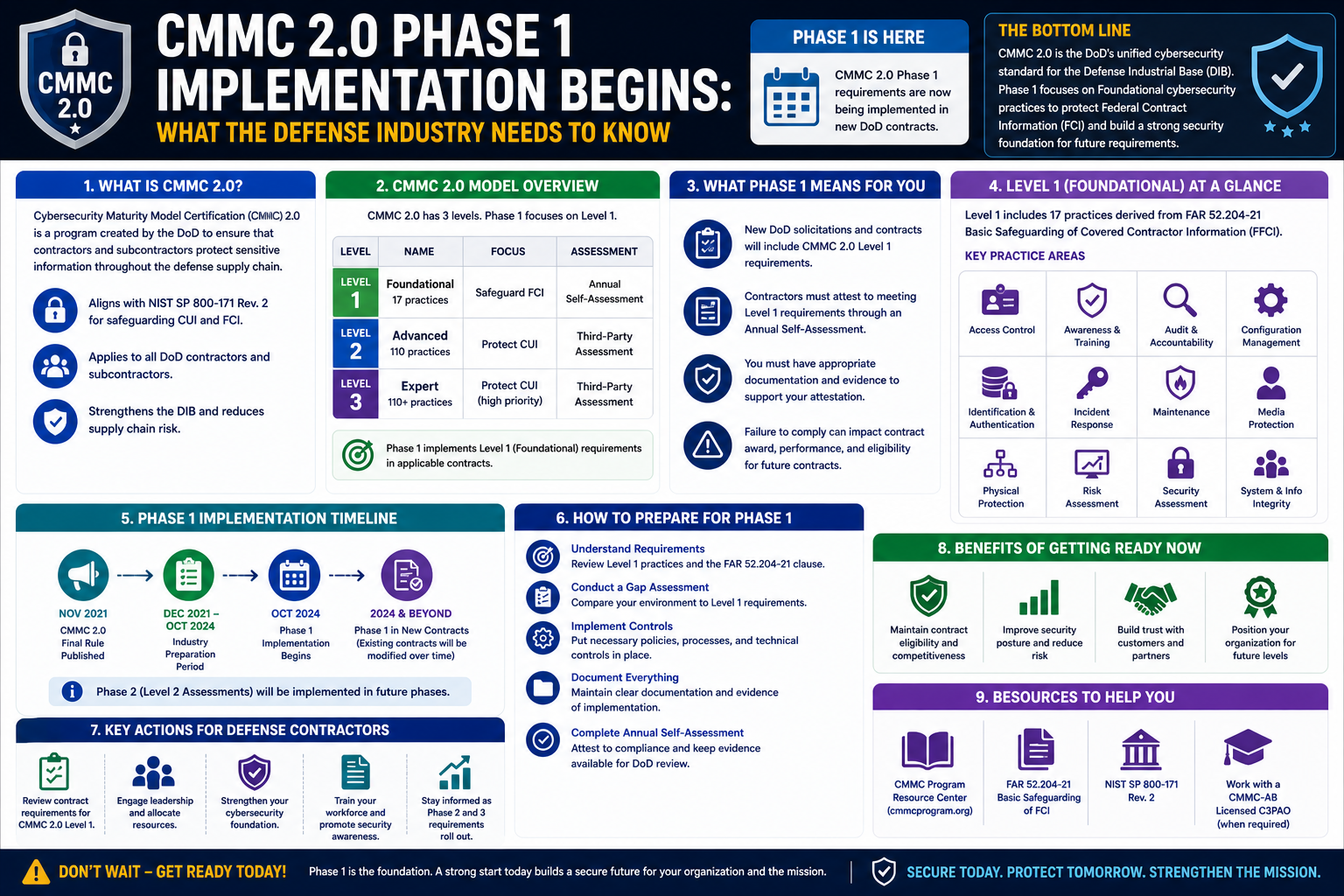
The rollout of Phase 1 of CMMC 2.0 represents a major shift in how the Department of Defense approaches cybersecurity across its vast network of contractors. At its core, this update is designed to strengthen the protection of Federal Contract Information (FCI) and Controlled Unclassified Information (CUI), two categories of data that are critical to national security operations but do not fall under classified status.
For years, defense contractors have been required to follow a range of cybersecurity standards, often relying on self-attestation or fragmented compliance frameworks. With CMMC 2.0 Phase 1 now active, the expectations are becoming more structured, more enforceable, and more consistent across the entire defense industrial base. This change is not simply administrative; it signals a shift toward measurable cybersecurity accountability.
The defense supply chain includes thousands of organizations of varying sizes, from large prime contractors managing complex defense systems to small subcontractors providing specialized components or services. Each of these entities may handle sensitive data at different points in the contracting process. Phase 1 ensures that even the smallest contributors are held to a baseline standard of cybersecurity hygiene, reducing the likelihood of weak links in the broader ecosystem.
Unlike previous approaches that often allowed flexibility without verification, CMMC 2.0 introduces a more formalized assessment structure. Phase 1 begins the enforcement of these expectations by integrating requirements directly into new DoD contracts. This means compliance is no longer a separate consideration but a contractual obligation tied to eligibility for defense work.
Understanding the Structure of CMMC 2.0 and Its Three Levels
CMMC 2.0 is built around a three-tiered model that aligns cybersecurity requirements with the sensitivity of the information being handled. Each level represents a progressively stronger set of security controls and verification methods.
At the foundational level, Level 1 focuses on protecting Federal Contract Information. This category includes information provided by or generated for the government that is not intended for public release. Organizations operating at this level are required to implement a set of basic safeguarding practices designed to reduce common cybersecurity risks. These practices emphasize fundamental protections such as access control, identity verification, and secure handling of sensitive data. The expectation is that these organizations will perform annual self-assessments to confirm compliance.
Level 2 is significantly more rigorous, as it applies to organizations handling Controlled Unclassified Information. CUI is more sensitive than FCI and often relates to technical specifications, operational details, or information that could be exploited if exposed. Level 2 requirements align closely with the security controls defined in NIST SP 800-171, a widely recognized cybersecurity standard for protecting sensitive government-related information in non-federal systems.
Depending on the nature of the contract and the type of information involved, organizations at Level 2 may be required to complete either a self-assessment or a third-party assessment conducted by an accredited organization. The determination is made by the Department of Defense based on risk considerations and the criticality of the information being handled. This dual-path approach reflects an attempt to balance scalability with assurance, ensuring that higher-risk environments receive more rigorous oversight.
Level 3 represents the highest tier within CMMC 2.0. It is intended for organizations working on the most sensitive national security programs. The requirements at this level are derived from NIST SP 800-172, which expands upon the protections found in lower tiers by introducing enhanced safeguards designed to defend against advanced persistent threats. These threats often involve sophisticated adversaries capable of sustained and targeted cyberattacks.
Organizations operating at Level 3 are subject to government-led assessments every three years. Unlike the lower levels, self-assessment is not an option. However, the full set of requirements for Level 3 is still being finalized, meaning this tier continues to evolve as the program matures and as threat landscapes change.
Key Differences Between CMMC 2.0 and Earlier Compliance Models
The transition from earlier versions of the Cybersecurity Maturity Model Certification framework to CMMC 2.0 reflects a broader effort to simplify compliance while improving effectiveness. One of the most significant changes is the removal of the multi-layered maturity processes that previously defined the original framework. Those earlier models included more complex scoring systems and maturity benchmarks that were often viewed as difficult to interpret and implement consistently.
CMMC 2.0 replaces that complexity with a more streamlined structure focused on alignment with established federal cybersecurity standards. By grounding Level 2 requirements in NIST SP 800-171, the framework reduces ambiguity and creates a more direct path for organizations already familiar with federal security guidelines.
Another notable change is the refinement of assessment requirements. Instead of a universal third-party certification requirement across multiple levels, CMMC 2.0 introduces a risk-based model. This allows the Department of Defense to determine when external validation is necessary and when self-assessment is sufficient. This approach is intended to reduce administrative burden while maintaining security integrity where it matters most.
In addition, CMMC 2.0 introduces the possibility of limited waivers in certain urgent contracting situations. These waivers are not designed to bypass security requirements entirely but rather to provide flexibility in scenarios where delays could negatively impact mission-critical operations. Such exceptions are expected to be rare and tightly controlled, ensuring they do not undermine the overall framework.
The shift also reflects lessons learned from earlier implementation challenges. Many contractors found the original model to be resource-intensive, particularly for smaller organizations with limited cybersecurity staff. By simplifying requirements and clarifying expectations, CMMC 2.0 aims to make compliance more achievable without compromising national security objectives.
How Phase 1 Changes the Defense Contracting Environment
With Phase 1 now in effect, cybersecurity requirements are no longer theoretical expectations but active conditions within new Department of Defense contracts. This means that organizations seeking to win or maintain defense contracts must demonstrate compliance as part of their contractual obligations.
One of the most immediate impacts of Phase 1 is the requirement for organizations handling Federal Contract Information to perform structured self-assessments. These assessments must evaluate whether the organization is meeting the baseline security practices defined for Level 1. The results are then submitted to the Supplier Performance Risk System, which serves as a centralized repository for contractor compliance data.
For organizations handling Controlled Unclassified Information, the requirements become more complex. Depending on the nature of the contract, some organizations may be required to undergo third-party assessments, while others may continue with self-assessments under specific conditions. This variability introduces a need for careful contract analysis, as organizations must understand which level of compliance applies to each engagement.
Subcontractors are equally affected by these changes. In many cases, subcontractors handle sensitive data indirectly through their relationships with prime contractors. Phase 1 ensures that these downstream entities are not overlooked in the compliance process. Any organization that touches FCI or CUI is expected to meet the appropriate security requirements, regardless of its position in the supply chain.
This expanded scope significantly increases the importance of cybersecurity visibility across all tiers of defense contracting. It also encourages stronger communication between prime contractors and subcontractors, as compliance responsibilities must be clearly understood and coordinated.
Phase 1 does not yet introduce full enforcement of Level 3 requirements, nor does it mandate widespread third-party assessments for all Level 2 organizations. Instead, it lays the foundation for a phased rollout that will gradually increase rigor over time. This incremental approach is designed to allow organizations to adapt without disrupting ongoing defense operations.
Operational Implications for Contractors and Subcontractors
The introduction of Phase 1 requirements has practical implications for how defense contractors manage their cybersecurity programs. Organizations must now ensure that their internal policies align with CMMC 2.0 expectations, particularly in areas such as access control, system monitoring, and incident response.
One of the key operational challenges is maintaining consistent documentation. Compliance is not only about implementing security controls but also about demonstrating that those controls are active and effective. This requires organizations to maintain accurate records of policies, procedures, and technical configurations.
Another important consideration is workforce awareness. Employees at all levels must understand their role in maintaining cybersecurity standards. This includes recognizing potential threats, following secure data handling practices, and reporting suspicious activity. Human error remains one of the most common causes of security breaches, making training and awareness a critical component of compliance.
Technology infrastructure also plays a central role. Many organizations will need to evaluate whether their existing systems meet the required security standards or whether upgrades are necessary. This may involve implementing stronger authentication mechanisms, improving encryption practices, or enhancing network segmentation.
For smaller contractors, these requirements can present resource challenges. Unlike larger organizations with dedicated cybersecurity teams, smaller entities may need to rely on external expertise or phased implementation strategies. However, the framework is designed to accommodate different organizational sizes by allowing self-assessment options at certain levels.
Supply chain coordination becomes increasingly important under Phase 1. Prime contractors are responsible for ensuring that their subcontractors meet appropriate security standards, which often requires formal communication channels and contractual updates. This creates a cascading effect throughout the defense ecosystem, where compliance expectations flow from top-tier contractors down to the smallest vendors.
Early Steps Toward Long-Term Cybersecurity Standardization
Phase 1 of CMMC 2.0 represents the beginning of a broader transformation in how cybersecurity is managed across the defense industrial base. While the immediate changes focus on assessment requirements and contractual integration, the long-term vision is centered on standardization and resilience.
By aligning cybersecurity expectations with recognized federal standards and embedding them directly into contract requirements, the Department of Defense is moving toward a more unified compliance model. This reduces variability in how security is implemented across different organizations and creates a more predictable baseline for protecting sensitive information.
As the rollout continues, organizations will likely see further refinements in assessment processes, clarification of Level 3 requirements, and increased integration of cybersecurity metrics into contract performance evaluations. These developments will gradually shape a more mature compliance environment where cybersecurity is treated as an ongoing operational responsibility rather than a periodic requirement.
The introduction of Phase 1 also signals a cultural shift within the defense contracting community. Cybersecurity is increasingly viewed not as a separate technical function but as a core component of business operations. Organizations that adapt early are likely to be better positioned to navigate future requirements and maintain eligibility for defense contracts as the framework evolves.
Operationalizing CMMC 2.0 Phase 1 Across Defense Contract Environments
With Phase 1 of CMMC 2.0 now embedded into active Department of Defense contracting requirements, organizations are no longer dealing with abstract policy discussions. Instead, they must translate cybersecurity expectations into day-to-day operational behavior. This shift requires a structured approach to security implementation, documentation, and verification across all systems that process, store, or transmit Federal Contract Information and Controlled Unclassified Information.
At an operational level, compliance is no longer defined by intention or policy statements alone. It is defined by evidence. Every safeguard must be demonstrable, every process must be repeatable, and every control must be traceable to a specific requirement within the CMMC framework. This changes how organizations manage cybersecurity from a reactive function to a continuously monitored discipline.
Organizations that previously treated cybersecurity as an IT responsibility are now required to elevate it into a cross-functional governance model. Leadership, legal teams, IT departments, and procurement units all play a role in ensuring that compliance expectations are consistently met and properly documented.
Translating CMMC 2.0 Requirements into Internal Security Controls
One of the most significant challenges organizations face under Phase 1 is translating high-level regulatory language into practical internal controls. While CMMC 2.0 aligns with established standards such as NIST SP 800-171, the actual implementation requires careful interpretation within each organization’s operational environment.
Security controls must be embedded into daily workflows rather than treated as standalone tasks. For example, access control policies must not only exist on paper but must also be enforced through technical mechanisms such as role-based access systems, multi-factor authentication, and periodic permission reviews.
Similarly, data protection requirements extend beyond encryption policies. Organizations must ensure that sensitive information is encrypted both in transit and at rest, and that encryption keys are managed securely. This includes defining clear ownership of cryptographic assets and ensuring that access to encryption mechanisms is tightly controlled.
Logging and monitoring requirements also demand operational integration. Security logs must be generated consistently across systems, stored securely, and reviewed regularly to detect anomalies. This requires coordination between system administrators and security personnel to ensure that logs are not only collected but also actively analyzed.
The key challenge is ensuring that each control is both implemented and verifiable. Without verifiable evidence, compliance cannot be demonstrated during assessments or audits.
The Role of Self-Assessments in Phase 1 Compliance Validation
Self-assessments play a central role in Phase 1 of CMMC 2.0, particularly for organizations operating at Level 1 and certain Level 2 scenarios. These assessments require organizations to evaluate their own adherence to required cybersecurity practices and submit the results to the Supplier Performance Risk System.
Unlike informal internal reviews, these self-assessments carry contractual weight. The information submitted is used by the Department of Defense to evaluate contractor eligibility and risk exposure. As a result, accuracy and completeness are critical.
Organizations must systematically review each required practice and determine whether it is fully implemented, partially implemented, or not implemented at all. This process often reveals discrepancies between perceived compliance and actual security posture.
A major challenge in self-assessment lies in objectivity. Internal teams may unintentionally overestimate compliance due to familiarity with systems or assumptions about existing controls. To mitigate this risk, organizations often establish internal validation processes that involve cross-functional review and independent verification of security controls.
The submission to the Supplier Performance Risk System becomes a formal record of compliance status. Any inaccuracies or misrepresentations can have serious implications, including contract penalties or loss of eligibility for future work.
Understanding the Supplier Performance Risk System and Its Function
The Supplier Performance Risk System serves as a centralized repository for contractor cybersecurity compliance data. Under Phase 1, it becomes a critical component of the defense contracting ecosystem, providing visibility into the cybersecurity posture of participating organizations.
Information submitted to this system is used by contracting officers to evaluate risk when awarding or managing contracts. This creates a direct link between cybersecurity performance and business opportunity within the defense sector.
Organizations are expected to ensure that the data they submit is current and reflects their actual security posture. This includes updating assessments when significant changes occur within their IT environment or organizational structure.
The system also supports traceability across the supply chain. Prime contractors can be evaluated not only on their own compliance but also on the compliance status of their subcontractors. This creates a layered accountability structure that extends cybersecurity responsibility throughout the contracting hierarchy.
Because of its central role, the Supplier Performance Risk System effectively becomes a compliance visibility engine. It transforms cybersecurity from an internal concern into a shared data point that influences contracting decisions.
Mapping CMMC Controls to NIST SP 800-171 Requirements
A critical aspect of Phase 1 implementation involves aligning organizational controls with the requirements outlined in NIST SP 800-171. This framework serves as the foundation for Level 2 compliance and defines the security expectations for protecting Controlled Unclassified Information.
The mapping process involves identifying each control requirement and determining how it is implemented within the organization’s environment. This includes technical controls, administrative policies, and physical safeguards.
Access control requirements, for example, must be mapped to identity management systems, authentication mechanisms, and user provisioning processes. Audit and accountability controls must be linked to logging infrastructure and monitoring tools. Configuration management controls must align with system change management procedures.
One of the challenges in this mapping process is ensuring completeness. Organizations must account for all applicable requirements and avoid gaps where controls are assumed but not formally implemented.
This mapping exercise also forms the basis for documentation required during assessments. Without a clear mapping between requirements and implemented controls, organizations may struggle to demonstrate compliance effectively.
System Security Plans and Their Role in Demonstrating Compliance
System Security Plans are a foundational element of CMMC 2.0 compliance documentation. These plans provide a detailed description of how security requirements are implemented within an organization’s systems.
A System Security Plan typically includes information about system boundaries, data flows, security controls, and operational procedures. It serves as a comprehensive reference document that assessors use to evaluate compliance.
Under Phase 1, maintaining an accurate and up-to-date System Security Plan becomes essential. Any changes to systems, processes, or security controls must be reflected in the document to ensure ongoing accuracy.
The effectiveness of a System Security Plan depends on its level of detail. High-level descriptions are not sufficient; the document must clearly explain how each control is implemented and maintained in practice.
Organizations often struggle with maintaining consistency between their actual systems and their documented security plans. This gap can lead to compliance issues during assessments, even if the underlying controls are technically in place.
Plans of Action and Milestones as a Structured Improvement Mechanism
Plans of Action and Milestones are used to track and manage gaps in compliance. When an organization identifies a deficiency in meeting a required control, it is documented along with a remediation plan and timeline.
This structured approach allows organizations to demonstrate awareness of gaps while actively working toward resolution. It also provides transparency into the organization’s security improvement efforts.
Each entry typically includes a description of the issue, the planned corrective action, responsible parties, and expected completion dates. This ensures accountability and provides a clear roadmap for achieving compliance.
Under Phase 1, Plans of Action and Milestones become particularly important for organizations that are transitioning toward full compliance. They allow for controlled progression rather than immediate perfection, provided that risks are properly managed.
However, not all deficiencies may be acceptable for continued contract eligibility. Certain critical gaps may disqualify an organization from meeting minimum requirements, even if a remediation plan is in place.
Managing Federal Contract Information and Controlled Unclassified Information
A key distinction within CMMC 2.0 compliance is the handling of Federal Contract Information versus Controlled Unclassified Information. Each category requires different levels of protection, and organizations must clearly understand which type of data they are processing.
Federal Contract Information generally requires baseline security practices that focus on preventing unauthorized access and ensuring basic data protection. This includes secure storage, controlled access, and protection against accidental disclosure.
Controlled Unclassified Information requires significantly stronger safeguards. This includes enhanced access controls, encryption requirements, monitoring mechanisms, and stricter handling procedures.
Organizations must implement clear data classification practices to ensure that information is properly identified and protected according to its sensitivity level. Misclassification can lead to either under-protection or unnecessary over-protection, both of which create operational inefficiencies or compliance risks.
Data flow mapping is often used to track how information moves through systems and between organizations. This helps ensure that appropriate controls are applied at each stage of data handling.
Security Documentation and Evidence Collection Requirements
Documentation plays a critical role in CMMC 2.0 compliance. Organizations are required to maintain evidence that demonstrates the implementation and effectiveness of security controls.
This evidence may include configuration settings, access control logs, policy documents, audit reports, and system screenshots. The goal is to provide verifiable proof that security practices are not only defined but actively enforced.
Evidence collection must be continuous rather than reactive. Organizations that attempt to assemble documentation only during assessment periods often struggle to provide complete and accurate records.
A structured documentation approach ensures that evidence is organized, accessible, and aligned with specific control requirements. This reduces the effort required during assessments and improves overall compliance readiness.
Consistency between documentation and actual system behavior is essential. Discrepancies between the two can raise concerns during evaluations and lead to additional scrutiny.
Common Implementation Challenges in Phase 1 Environments
Organizations implementing Phase 1 requirements often encounter several recurring challenges. One of the most common is inconsistent interpretation of control requirements. Without clear internal standards, different teams may implement controls in varying ways, leading to gaps in compliance.
Another challenge involves legacy systems that were not designed with modern cybersecurity standards in mind. Integrating these systems into a compliant environment often requires additional security layers or compensating controls.
Resource constraints also play a significant role, particularly for smaller contractors. Implementing comprehensive security programs requires time, expertise, and financial investment, which may not be readily available in all organizations.
Maintaining ongoing compliance is another difficulty. Security is not a static condition, and systems evolve over time. Without continuous monitoring and review, compliant systems can gradually drift into non-compliant states.
Coordination across subcontractors introduces additional complexity. Ensuring that all parties within the supply chain adhere to consistent security standards requires strong communication and contractual alignment.
These challenges highlight the importance of structured governance and ongoing oversight in maintaining compliance under Phase 1 requirements.
Scaling CMMC 2.0 Phase 1 Across the Defense Supply Chain Ecosystem
As Phase 1 of CMMC 2.0 becomes embedded into Department of Defense contracting practices, its influence extends far beyond individual organizations. The real transformation is occurring across the entire defense supply chain, where cybersecurity expectations are now shaping how contracts are structured, how partnerships are formed, and how risk is distributed among interconnected entities.
The defense industrial base operates as a highly interdependent network. Prime contractors rely on subcontractors, who in turn may depend on smaller vendors and service providers. Each link in this chain can handle sensitive information at some stage of contract execution. Phase 1 introduces a standardized baseline that ensures cybersecurity is consistently enforced across all tiers, rather than being concentrated only at the top.
This shift fundamentally changes the traditional outsourcing model. Cybersecurity is no longer an isolated responsibility delegated to IT departments or external consultants. Instead, it becomes a shared obligation embedded into every contractual relationship. Organizations must now evaluate not only their own compliance posture but also the readiness of their partners.
This interconnected compliance environment creates a cascading effect. If one organization in the supply chain fails to meet requirements, it can affect the eligibility of upstream contractors. As a result, cybersecurity due diligence becomes a critical part of vendor selection and contract management processes.
The Expanding Role of Prime Contractors in Compliance Oversight
Prime contractors play a central role in enforcing CMMC 2.0 Phase 1 requirements throughout the supply chain. Because they hold direct contractual relationships with the Department of Defense, they are ultimately accountable for ensuring that all subcontractors meet applicable cybersecurity standards.
This responsibility requires prime contractors to implement structured oversight mechanisms. These may include formal cybersecurity requirements in subcontract agreements, periodic compliance reviews, and verification of assessment submissions.
In practice, this means prime contractors must maintain visibility into the cybersecurity posture of their entire vendor ecosystem. This is not limited to high-level assurances but often requires detailed documentation of subcontractor compliance activities.
Many prime contractors are developing internal supplier risk management frameworks to address this need. These frameworks categorize vendors based on the sensitivity of data they handle and the criticality of their role in contract execution. Higher-risk vendors are subject to more frequent reviews and stricter compliance verification processes.
This increased oversight responsibility also requires investment in internal expertise. Prime contractors must ensure that their teams understand CMMC 2.0 requirements in sufficient detail to evaluate subcontractor compliance effectively.
Subcontractor Readiness and the Compliance Ripple Effect
Subcontractors face a unique set of challenges under Phase 1 implementation. While they may not always have direct visibility into Department of Defense requirements, they are still required to comply if they handle Federal Contract Information or Controlled Unclassified Information.
This creates a ripple effect where compliance expectations cascade down through multiple layers of contracting relationships. Even small organizations that previously operated outside formal cybersecurity frameworks are now required to implement structured security controls.
For many subcontractors, the most significant challenge is awareness. Some organizations may not initially realize that the data they handle falls under CMMC 2.0 scope. Others may underestimate the level of security required for compliance.
Once requirements are identified, subcontractors must often make significant adjustments to their security practices. This may include implementing access controls, improving authentication mechanisms, or formalizing data handling procedures.
The financial and operational impact of these changes can be substantial, particularly for small and medium-sized businesses. However, compliance is increasingly becoming a prerequisite for participation in defense contracting opportunities.
Subcontractors that fail to meet requirements risk being excluded from supply chains, even if they provide otherwise critical services or capabilities. This creates strong incentives for early adoption of compliance practices.
Cybersecurity Governance as a Strategic Business Function
CMMC 2.0 Phase 1 is driving a broader shift in how organizations view cybersecurity governance. Rather than treating it as a technical function, many organizations are integrating cybersecurity into strategic business planning.
This shift reflects the growing recognition that cybersecurity risk is directly linked to business continuity and contract eligibility. A failure to meet compliance requirements can result in loss of revenue, reputational damage, or exclusion from future opportunities.
As a result, executive leadership is becoming more actively involved in cybersecurity decision-making. Boards and senior management teams are increasingly required to oversee compliance initiatives and ensure adequate resource allocation.
Governance structures are also evolving to support this shift. Many organizations are establishing dedicated compliance committees or expanding the role of existing risk management teams to include cybersecurity oversight.
These governance bodies are responsible for ensuring that cybersecurity policies align with contractual obligations and regulatory expectations. They also play a key role in monitoring compliance progress and addressing identified gaps.
By embedding cybersecurity into governance structures, organizations create a more sustainable approach to compliance that extends beyond technical implementation.
Risk-Based Decision Making in CMMC 2.0 Phase 1
A defining characteristic of CMMC 2.0 Phase 1 is its emphasis on risk-based decision making. Rather than applying identical requirements across all organizations, the framework adjusts expectations based on the sensitivity of information and the level of risk involved.
This approach allows the Department of Defense to allocate oversight resources more effectively. High-risk environments receive more rigorous evaluation, while lower-risk scenarios may rely on self-assessment.
For organizations, this means compliance strategies must be aligned with their specific risk profile. Understanding the type of data being handled and the potential impact of a security breach becomes essential for determining compliance obligations.
Risk-based decision making also influences internal security investments. Organizations must prioritize controls that address the most significant risks to their operations and contractual obligations.
This often leads to a more targeted approach to cybersecurity, where resources are allocated based on risk severity rather than uniform implementation across all systems.
However, this approach also requires strong risk assessment capabilities. Organizations must be able to accurately identify, evaluate, and prioritize cybersecurity risks within their environment.
Continuous Monitoring and the Shift Away from Static Compliance
One of the most important operational shifts introduced by Phase 1 is the move away from static compliance models toward continuous monitoring. Compliance is no longer viewed as a point-in-time achievement but as an ongoing state that must be maintained.
Systems, processes, and personnel change over time, and these changes can affect compliance status. Without continuous monitoring, organizations risk falling out of compliance without immediate awareness.
Continuous monitoring involves ongoing assessment of security controls, regular review of system configurations, and real-time detection of anomalies. It also includes periodic validation of documentation to ensure accuracy.
This approach requires integration between cybersecurity tools and operational processes. Automated monitoring systems are often used to track compliance indicators and alert teams to potential issues.
However, technology alone is not sufficient. Human oversight remains essential for interpreting monitoring data and making informed decisions about remediation actions.
Continuous monitoring also supports faster response to security incidents. By maintaining visibility into system behavior, organizations can detect and address issues before they escalate into significant breaches.
Audit Readiness and Evidence Management Practices
Audit readiness is becoming a core operational requirement under Phase 1. Organizations must be prepared to demonstrate compliance at any time, not just during scheduled assessments.
This requires disciplined evidence management practices. Evidence must be collected, organized, and maintained in a way that allows for rapid retrieval during evaluations.
Effective evidence management involves categorizing documentation based on specific control requirements. This ensures that each requirement can be supported by relevant and up-to-date evidence.
Organizations must also ensure that evidence remains current. Outdated documentation can create discrepancies during assessments and undermine confidence in compliance status.
Version control plays an important role in maintaining evidence integrity. As systems and policies evolve, updated documentation must replace or supplement previous records while preserving historical context.
Audit readiness also extends to personnel awareness. Employees may be required to explain or demonstrate security practices during assessments, making training and preparedness essential components of compliance.
Supply Chain Transparency and Information Flow Management
CMMC 2.0 Phase 1 places increased emphasis on transparency across the supply chain. Organizations must have clear visibility into how information flows between systems, partners, and subcontractors.
This requires detailed mapping of data flows to identify where sensitive information is stored, processed, or transmitted. Understanding these pathways is essential for applying appropriate security controls.
Information flow management also helps identify potential vulnerabilities within the supply chain. If sensitive data passes through multiple organizations, each transfer point represents a potential risk.
To address this, organizations must implement controls that protect data throughout its entire lifecycle. This includes securing data at rest, in transit, and during processing.
Transparency also supports accountability. When organizations understand how data moves through their ecosystem, they are better able to assign responsibility for security at each stage.
This level of visibility is increasingly important as supply chains become more complex and distributed. Cloud environments, outsourced services, and remote operations all contribute to expanded data movement across organizational boundaries.
Technology Modernization Driven by Compliance Requirements
Phase 1 of CMMC 2.0 is also accelerating technology modernization across the defense contracting sector. Many organizations are discovering that legacy systems are not capable of meeting current cybersecurity requirements.
This is particularly true for systems that lack modern authentication mechanisms, encryption capabilities, or centralized logging functionality. In such cases, organizations must either upgrade systems or implement compensating controls.
Cloud adoption is one of the most common modernization strategies. Cloud platforms often provide built-in security features that align with compliance requirements, making them attractive options for organizations seeking to improve their security posture.
However, cloud adoption introduces its own set of challenges, including configuration management, access control complexity, and shared responsibility models. Organizations must carefully evaluate how security responsibilities are distributed between service providers and internal teams.
Modernization efforts also extend to identity and access management systems. Strong authentication, centralized identity control, and role-based access are increasingly becoming standard requirements.
Network architecture is another area undergoing transformation. Segmentation, zero-trust principles, and enhanced monitoring are becoming more widely adopted as organizations align with CMMC 2.0 expectations.
Organizational Culture and the Human Element of Compliance
While technical controls are essential, the success of CMMC 2.0 Phase 1 ultimately depends on organizational culture. Employees at all levels must understand their role in maintaining cybersecurity standards.
Human behavior remains one of the most significant factors in cybersecurity risk. Phishing attacks, accidental data exposure, and improper handling of sensitive information are common causes of security incidents.
To address this, organizations must foster a culture of security awareness. This includes regular training, clear communication of policies, and reinforcement of best practices in daily operations.
Leadership involvement is critical in shaping this culture. When executives prioritize cybersecurity, it signals its importance throughout the organization.
Accountability also plays a key role. Employees must understand that cybersecurity is part of their job responsibilities, not an optional or secondary concern.
Over time, this cultural shift contributes to stronger compliance outcomes and more resilient security practices across the organization.
Evolving Expectations as Phase 1 Progresses
As Phase 1 continues to unfold, expectations are likely to evolve based on implementation feedback and emerging security challenges. The Department of Defense may refine assessment procedures, adjust risk criteria, and expand enforcement mechanisms.
Organizations should anticipate gradual increases in compliance rigor as the framework matures. Early adoption of strong security practices will likely provide a competitive advantage as requirements become more stringent.
The long-term trajectory of CMMC 2.0 suggests a move toward deeper integration of cybersecurity into all aspects of defense contracting. Rather than functioning as a separate compliance program, it is becoming a foundational element of contract eligibility and performance evaluation.
This evolution reinforces the importance of proactive engagement with cybersecurity requirements. Organizations that treat compliance as an ongoing strategic priority will be better positioned to adapt to future changes in the defense contracting environment.
Conclusion
The implementation of CMMC 2.0 Phase 1 marks a significant turning point in the Department of Defense’s approach to cybersecurity across its contractor ecosystem. What was once a loosely coordinated set of security expectations has now become a structured, enforceable framework that directly influences contract eligibility and operational responsibility. This shift reflects a broader recognition that cybersecurity is no longer a supporting function within defense operations but a foundational requirement for protecting national security interests.
At its core, CMMC 2.0 Phase 1 is about establishing consistency. By standardizing expectations for how Federal Contract Information and Controlled Unclassified Information are handled, the framework reduces ambiguity and ensures that organizations across the defense supply chain are operating under a shared baseline of security practices. This consistency is especially important in an environment where thousands of contractors and subcontractors interact with sensitive data in different capacities and across varying levels of technical maturity.
The introduction of structured self-assessments and third-party evaluations also represents a shift toward accountability and transparency. Organizations are now required to actively demonstrate their security posture rather than simply assert it. This emphasis on evidence-based compliance ensures that cybersecurity controls are not only defined on paper but are actively implemented, maintained, and verifiable in real-world environments.
Equally important is the ripple effect across the supply chain. Prime contractors and subcontractors are now interconnected in a shared compliance ecosystem, where the security posture of one organization can influence the eligibility of others. This interconnectedness encourages greater collaboration, improved communication, and stronger oversight across all levels of contracting relationships. It also reinforces the idea that cybersecurity is a collective responsibility rather than an isolated function.
However, the transition to this new model is not without challenges. Many organizations face difficulties in interpreting requirements, modernizing legacy systems, and allocating sufficient resources to meet compliance expectations. Smaller contractors, in particular, may struggle with the financial and operational demands of implementing comprehensive security controls. Despite these challenges, the phased nature of the rollout provides organizations with time to adapt and gradually strengthen their cybersecurity posture.
Another key implication of Phase 1 is the growing importance of governance and leadership involvement in cybersecurity decision-making. Compliance is no longer solely the responsibility of technical teams; it requires active engagement from executive leadership, procurement teams, legal departments, and operational managers. This broader involvement ensures that cybersecurity is integrated into strategic planning and organizational priorities rather than treated as a standalone technical requirement.
The emphasis on continuous monitoring and ongoing compliance further highlights the evolving nature of cybersecurity within the defense contracting environment. Organizations are expected to maintain compliance over time, not just achieve it during assessments. This requires sustained attention to system changes, policy updates, and emerging threats. As a result, cybersecurity becomes a dynamic and ongoing discipline that evolves alongside organizational operations.
Ultimately, CMMC 2.0 Phase 1 signals a fundamental shift in how cybersecurity is perceived and enforced within the defense industrial base. It establishes a clear expectation that protecting sensitive information is not optional but essential. By embedding cybersecurity into the fabric of contracting relationships, the Department of Defense is creating a more resilient, transparent, and accountable supply chain capable of meeting the challenges of an increasingly complex digital threat landscape.