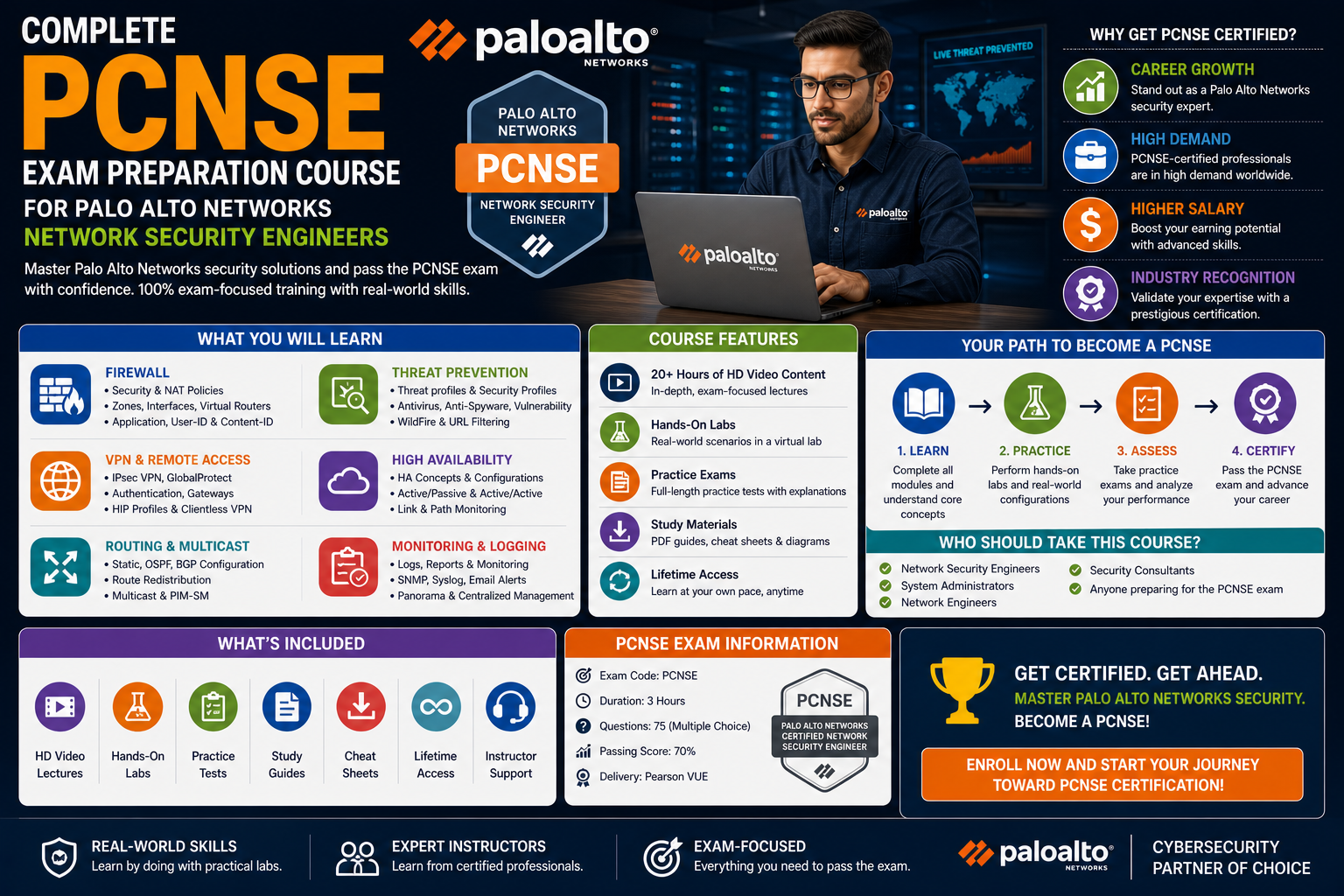
Network security has become one of the most critical pillars of modern IT infrastructure. As organizations expand across cloud platforms, hybrid environments, and remote work models, the responsibility of securing data and controlling access has grown significantly. A network security engineer operates at the center of this responsibility, ensuring that digital assets remain protected while maintaining smooth and reliable connectivity across systems.
The role is not limited to simply installing firewalls or monitoring alerts. It involves designing security architectures, understanding traffic behavior, identifying potential risks, and continuously adapting to evolving threats. Attackers are constantly developing new techniques to bypass traditional defenses, which means security engineers must think proactively rather than reactively.
In environments built around advanced security platforms like Palo Alto Networks, engineers are expected to manage both hardware and software components while maintaining visibility across the entire network. This includes configuration of firewalls, enforcement of security policies, monitoring of logs, and rapid troubleshooting when issues arise.
A strong understanding of network protocols, application behavior, and security principles is essential. Engineers must also be comfortable working with centralized management tools and distributed security systems that span multiple locations or cloud environments.
Introduction to Palo Alto Networks Security Ecosystem
The Palo Alto Networks ecosystem is designed to provide comprehensive protection against modern cyber threats by combining advanced firewall technology, centralized management, and intelligent traffic inspection. At its core, it focuses on identifying applications rather than just ports and protocols, which represents a major shift in traditional network security approaches.
Unlike legacy firewalls that rely heavily on static rules, this platform emphasizes application awareness and user identity. This allows security policies to be more precise and adaptive. Instead of simply blocking or allowing traffic based on IP addresses, decisions are made based on what the application is doing, who is using it, and whether the behavior aligns with organizational policy.
The ecosystem typically includes next-generation firewalls, centralized management systems, and cloud-based security services. These components work together to provide visibility, control, and automated response capabilities across the entire network infrastructure.
Security engineers working in this environment must understand how these components interact. Firewalls handle traffic inspection and enforcement, while centralized management systems coordinate policies across multiple devices. Logging and monitoring tools provide insight into network behavior, enabling engineers to detect anomalies and respond to threats efficiently.
Core Architecture of Palo Alto Firewalls
At the heart of the system lies the next-generation firewall architecture, which is built to process traffic in a highly efficient and intelligent manner. The architecture is designed around multiple processing stages that inspect traffic in real time without compromising performance.
When traffic enters the firewall, it is first classified based on application signatures. This means the system identifies whether the traffic is web browsing, file sharing, streaming, or any other application type. Once identified, the firewall applies security policies based on predefined rules that consider application, user identity, and content.
After classification, traffic undergoes security inspection, which includes threat detection, malware analysis, and data filtering. This layered approach ensures that malicious activity is identified at multiple levels rather than relying on a single checkpoint.
The firewall architecture also separates control functions from data processing functions. This separation allows for more efficient handling of traffic while maintaining strong security enforcement. Control functions manage configuration, logging, and policy decisions, while data processing handles the actual inspection and forwarding of packets.
Understanding this architecture is essential for security engineers because it directly impacts how policies are designed and how troubleshooting is performed when issues occur.
Deployment Models and Hardware Considerations
Palo Alto security platforms can be deployed in various environments depending on organizational needs. These include physical appliances, virtualized environments, and cloud-based deployments. Each model offers different advantages and requires different configuration approaches.
Physical appliances are typically used in traditional data centers where dedicated hardware provides consistent performance and reliability. These devices are designed to handle high traffic volumes and are often deployed at network perimeters.
Virtualized firewalls operate within hypervisor environments and are commonly used in private cloud infrastructures. They provide flexibility and scalability, allowing organizations to quickly adjust resources based on demand.
Cloud-based deployments extend security controls into public cloud environments. This is especially important for organizations using multi-cloud strategies, where workloads are distributed across different providers.
Regardless of the deployment model, the underlying security principles remain consistent. Engineers must ensure that policies are properly applied, traffic is correctly inspected, and security logs are continuously monitored.
Hardware considerations also play an important role in performance. Factors such as throughput capacity, interface configuration, and resource allocation directly affect how efficiently the firewall operates. Proper planning is required to ensure that devices can handle expected traffic loads without degradation in performance.
Security Zones and Traffic Segmentation
One of the fundamental concepts in Palo Alto Networks security design is the use of security zones. A security zone represents a logical grouping of network interfaces that share similar security requirements. Traffic between zones is controlled using security policies, while traffic within the same zone may follow different inspection rules depending on configuration.
Zones help simplify security management by allowing engineers to define broad trust boundaries. For example, internal networks, external networks, and demilitarized zones can each be assigned to separate security zones. This makes it easier to enforce consistent policies and monitor traffic flows.
Traffic segmentation through zones also improves visibility. Engineers can quickly identify where traffic is coming from and where it is going, which is essential for troubleshooting and threat detection. By controlling traffic between zones, organizations can reduce the risk of lateral movement by attackers within the network.
Proper zone design is a critical part of network architecture. Poorly defined zones can lead to security gaps or overly complex configurations that are difficult to manage. Engineers must carefully analyze network structure and business requirements before defining zone boundaries.
Security Policy Structure and Traffic Control
Security policies are the core mechanism used to control traffic flow within a Palo Alto environment. These policies define what traffic is allowed, what is denied, and under what conditions specific actions should be taken.
Each policy typically includes multiple components such as source and destination zones, source and destination addresses, users, applications, services, and security profiles. This multi-dimensional approach allows for highly granular control over network traffic.
Unlike traditional firewall rules that rely primarily on IP addresses and ports, modern security policies focus on application behavior and user context. This allows for more accurate decision-making and reduces the risk of unnecessary access restrictions.
Policies are evaluated in a top-down order, meaning that the first matching rule is applied. This makes rule ordering extremely important. Incorrect ordering can lead to unintended access or blocked traffic.
Security engineers must carefully design and maintain these policies to ensure they align with organizational security requirements. Over time, policies may need to be adjusted as new applications are introduced or as business needs change.
Network Address Translation and Traffic Mapping
Network Address Translation plays a key role in managing how traffic flows between internal and external networks. It allows private IP addresses to be translated into public addresses, enabling secure communication with external systems.
In advanced security environments, NAT policies are tightly integrated with security policies. This ensures that traffic translation and security enforcement work together seamlessly.
Different types of translation methods may be used depending on the scenario, including static translation, dynamic translation, and port-based translation. Each method serves a specific purpose and must be selected based on network design requirements.
Proper configuration of NAT is essential for ensuring connectivity while maintaining security. Incorrect NAT rules can result in traffic failures, routing issues, or unintended exposure of internal systems.
Routing Fundamentals in Secure Network Design
Routing determines how data moves across networks and between different security zones. In Palo Alto environments, routing can be handled dynamically or statically depending on the complexity of the network.
Static routing involves manually defining paths for traffic, while dynamic routing uses protocols to automatically determine the best path based on network conditions. Both methods are commonly used in enterprise environments.
Security engineers must ensure that routing configurations align with security policies. Misaligned routing can bypass security controls or create unintended traffic paths.
Routing also plays a critical role in redundancy and failover scenarios. Proper routing design ensures that traffic continues to flow even when parts of the network experience failures.
Introduction to High Availability Concepts
High availability is a key design principle in modern security infrastructure. It ensures that network security services remain operational even in the event of hardware or software failures.
In a high availability setup, multiple devices work together to provide continuous service. If one device fails, another immediately takes over without disrupting network traffic.
This requires synchronization of configurations, session states, and policies between devices. Engineers must ensure that both primary and backup systems are properly aligned to avoid inconsistencies.
High availability configurations can be active-passive or active-active depending on performance and redundancy requirements. Each approach has its own advantages and design considerations.
Centralized Management and Visibility Concepts
As networks grow in size and complexity, centralized management becomes essential. Instead of configuring each security device individually, engineers use centralized platforms to manage policies, monitor traffic, and analyze security events.
Centralized management improves consistency and reduces configuration errors. It also provides a unified view of network activity, making it easier to detect threats and respond quickly.
Visibility is a key benefit of centralized systems. Engineers can see detailed information about applications, users, and traffic patterns across the entire network. This level of insight is critical for maintaining strong security posture in dynamic environments.
Log aggregation and analysis further enhance visibility by providing historical data that can be used for troubleshooting and security investigations.
Traffic Inspection and Application Awareness
One of the most powerful aspects of modern network security platforms is application-aware traffic inspection. Instead of relying solely on port numbers, the system identifies applications based on behavior and signatures.
This allows for more precise control over network activity. For example, engineers can allow specific applications while blocking others that use the same port.
Application awareness also helps detect hidden or disguised traffic that may be used for malicious purposes. By analyzing traffic behavior, the system can identify threats that would otherwise go unnoticed.
This level of inspection requires deep packet analysis and continuous updates to application signatures. Engineers must ensure that systems remain updated to maintain accurate detection capabilities.
Introduction to Threat Prevention Principles
Threat prevention is an essential component of any security architecture. It involves detecting and blocking malicious activity before it can impact systems or data.
This includes protection against malware, intrusion attempts, and suspicious network behavior. Security platforms use a combination of signature-based detection, behavioral analysis, and machine learning techniques to identify threats.
Engineers must configure appropriate security profiles to ensure that traffic is properly inspected. These profiles define how different types of threats are handled, including whether they are blocked, logged, or monitored.
Effective threat prevention requires continuous monitoring and adjustment. As new threats emerge, security configurations must evolve to remain effective.
Expanding Operational Control Through Centralized Firewall Management
As network environments scale beyond a single location, managing security policies on individual devices becomes increasingly complex. Enterprises often operate dozens or even hundreds of firewalls distributed across data centers, branch offices, and cloud environments. In such situations, maintaining consistency in configuration and policy enforcement is a major challenge.
Centralized management systems address this challenge by providing a unified interface for configuring, monitoring, and maintaining multiple security devices. Instead of logging into each firewall individually, security engineers can manage all policies from a single control point.
This approach significantly reduces configuration errors, improves operational efficiency, and ensures that security policies remain consistent across the entire infrastructure. It also allows engineers to deploy changes at scale without manually updating each device.
In addition to policy management, centralized systems also provide visibility into device health, traffic patterns, and security events. This aggregated view is essential for understanding the overall security posture of an organization.
Understanding Panorama-Based Security Management
In enterprise-grade Palo Alto environments, centralized management is often achieved through a dedicated management platform designed specifically for firewall orchestration. This platform allows administrators to define shared policies, push configurations to multiple devices, and monitor logs in real time.
One of the key advantages of this approach is the ability to create hierarchical policy structures. Policies can be defined at a global level and then inherited by individual devices or groups of devices. This ensures consistency while still allowing for localized customization where necessary.
Device groups play an important role in organizing firewalls based on function, location, or business unit. Templates are used to standardize configuration settings such as interfaces, zones, and network parameters.
This separation between policy and device configuration allows for cleaner management and reduces the risk of configuration drift over time.
Logging Architecture and Security Event Visibility
Logging is one of the most critical components of any security infrastructure. Without detailed logs, it becomes extremely difficult to understand network behavior, investigate incidents, or identify threats.
In Palo Alto environments, logs are generated for a wide range of events including traffic flow, threat detection, system activity, and user behavior. These logs provide deep visibility into what is happening across the network at any given time.
Traffic logs show information about allowed and denied connections, including source and destination details. Threat logs provide insight into malicious activity such as malware, exploits, and intrusion attempts. System logs capture device-level events such as configuration changes and system errors.
Security engineers rely heavily on these logs for troubleshooting and forensic analysis. By correlating data across multiple log types, it becomes possible to reconstruct events and understand how security incidents unfold.
Centralized logging also enables long-term data retention, which is essential for compliance and historical analysis.
Log Forwarding and External Integration
In larger environments, logs are often forwarded to external systems for further analysis and storage. This may include security information and event management platforms or cloud-based analytics systems.
Log forwarding allows organizations to correlate firewall data with information from other security tools, creating a more complete picture of network activity. This integration is essential for advanced threat detection and incident response.
Engineers must ensure that log forwarding is properly configured to avoid data loss or duplication. Bandwidth considerations are also important, especially in high-traffic environments where large volumes of log data are generated.
Troubleshooting Methodologies in Security Environments
Troubleshooting network security issues requires a structured approach. When connectivity problems or security anomalies occur, engineers must systematically analyze logs, policies, and network configurations.
The first step is typically to identify whether traffic is being allowed or denied by security policies. If traffic is blocked, the next step is to determine which rule is responsible and why it is being triggered.
If traffic is allowed but still not reaching its destination, routing or NAT configurations may be the cause. In such cases, engineers must trace the packet path through the network to identify where it is being dropped or altered.
Advanced troubleshooting often involves analyzing session tables, inspecting packet flows, and reviewing system logs. This requires a deep understanding of how traffic moves through the firewall and how different components interact.
Consistency in troubleshooting methodology is essential for quickly identifying and resolving issues.
GlobalProtect and Secure Remote Access Architecture
Modern organizations increasingly rely on remote workforces, which makes secure remote access a critical requirement. Remote users need to connect to internal resources without exposing the network to unnecessary risk.
A secure remote access solution provides encrypted connectivity between remote endpoints and the internal network. It ensures that data remains protected even when transmitted over public networks.
This system typically includes a client application installed on user devices, which establishes a secure tunnel to the firewall or security gateway. Once connected, users are subject to the same security policies as internal users.
Authentication mechanisms play a key role in ensuring that only authorized users can access the network. Multi-factor authentication is often used to enhance security.
Engineers must carefully configure access policies to ensure that remote users only have access to the resources they need. Overly permissive configurations can introduce security risks, while overly restrictive settings can impact productivity.
Managing Authentication and Identity-Based Policies
User identity is a fundamental component of modern network security. Instead of relying solely on IP addresses, security policies can be based on user identity and group membership.
This allows organizations to enforce granular access controls based on roles and responsibilities. For example, employees in different departments may have access to different applications or resources.
Authentication systems integrate with directory services to validate user credentials and retrieve group information. This data is then used by the firewall to enforce identity-based policies.
Identity-based security provides greater flexibility and control compared to traditional network-based rules. It also improves visibility into user activity across the network.
Digital Certificates and Secure Communication
Digital certificates play an essential role in establishing trust and securing communications within network environments. They are used to verify the identity of devices and encrypt data transmitted between systems.
In security platforms, certificates are commonly used for administrative access, secure tunnels, and encrypted traffic inspection. Proper certificate management is essential for maintaining trust and preventing security warnings or failures.
Certificates are issued by trusted authorities and must be properly installed and maintained on all relevant systems. Expired or misconfigured certificates can lead to connectivity issues or security vulnerabilities.
Engineers must also understand certificate chains and validation processes to ensure that secure connections are properly established.
Decryption Strategies and Encrypted Traffic Inspection
A significant portion of modern network traffic is encrypted. While encryption protects data privacy, it also creates challenges for security inspection, as malicious activity can be hidden within encrypted streams.
Decryption strategies allow security systems to inspect encrypted traffic while maintaining privacy and compliance requirements. This is achieved by temporarily decrypting traffic, inspecting it for threats, and then re-encrypting it before forwarding.
Different types of decryption may be applied depending on the direction and nature of traffic. Outbound traffic from internal users may be handled differently than inbound traffic from external sources.
Engineers must carefully balance security needs with privacy considerations when implementing decryption policies. Not all traffic should be decrypted, and exceptions must be defined for sensitive applications.
Proper configuration ensures that security visibility is maintained without violating privacy requirements or regulatory constraints.
Application Groups, Filters, and Policy Optimization
Managing security policies becomes increasingly complex as the number of applications in a network grows. To simplify this, applications can be grouped and filtered based on behavior, function, or risk level.
Application groups allow engineers to apply policies to multiple applications at once. Filters provide dynamic grouping based on predefined criteria such as category or risk score.
This approach reduces the number of individual rules required and makes policy management more efficient. It also improves readability and maintainability of security configurations.
Optimizing application policies involves balancing security strictness with operational flexibility. Overly complex rules can slow down processing, while overly broad rules can weaken security.
High Availability Synchronization and Failover Behavior
In high availability environments, synchronization between devices is essential for maintaining consistent security enforcement. Configuration settings, session information, and routing tables must be kept in sync across all devices in the cluster.
Failover mechanisms ensure that if one device becomes unavailable, another device can immediately take over without disrupting network traffic. This transition must be seamless to avoid service interruptions.
Engineers must regularly test failover scenarios to ensure that redundancy mechanisms function correctly. Misconfigured synchronization can lead to data inconsistencies or traffic loss during failover events.
Monitoring tools are used to track the health and status of all devices in the high availability setup.
Advanced Routing Behavior in Security Appliances
Routing in security appliances involves more than simply directing traffic between networks. It also interacts closely with security policies and zone definitions.
Dynamic routing protocols allow devices to automatically adapt to changes in network topology. This is particularly important in large or complex environments where manual routing configuration would be impractical.
Engineers must ensure that routing decisions align with security requirements. Improper routing can bypass security controls or create unintended access paths.
Routing stability is also important for maintaining consistent network performance and avoiding packet loss or delays.
Quality of Service and Traffic Prioritization
Not all network traffic has the same level of importance. Some applications require low latency and high bandwidth, while others can tolerate delays.
Quality of service mechanisms allow engineers to prioritize traffic based on application type, user identity, or business importance. This ensures that critical services receive the necessary resources even during periods of high network load.
Traffic shaping and bandwidth allocation are commonly used techniques for implementing quality of service policies.
Proper configuration helps maintain performance consistency across the network and prevents congestion from affecting critical applications.
Monitoring Security Performance and System Health
Continuous monitoring is essential for maintaining the health and performance of security systems. Engineers must track system metrics such as CPU usage, memory consumption, and session capacity.
Monitoring tools provide real-time visibility into device performance and help identify potential issues before they impact network operations.
Historical data analysis also plays an important role in capacity planning and performance optimization.
By continuously monitoring system health, engineers can ensure that security infrastructure remains stable and responsive under varying network conditions.
Evolving Threat Landscape and Modern Security Inspection Philosophy
Modern network security is shaped by an increasingly complex and adaptive threat landscape. Attackers no longer rely on simple exploit techniques or predictable intrusion patterns. Instead, they use multi-stage attacks, encrypted channels, and application-level deception to bypass traditional defenses. This shift has fundamentally changed how security platforms are designed and operated.
Security inspection is no longer focused solely on blocking known malicious IP addresses or scanning for basic signatures. Instead, it revolves around understanding behavior, identifying intent, and correlating activity across multiple layers of the network. This includes application behavior, user identity, device posture, and traffic context.
In advanced security environments, every packet is evaluated not just for what it is, but for what it is trying to do. This philosophy enables deeper inspection and more accurate threat detection. It also reduces false positives, which are common in older security models that rely heavily on static rules.
Security engineers must therefore develop a mindset that goes beyond traditional perimeter defense. They must think in terms of dynamic threat behavior, lateral movement within networks, and hidden communication channels that may be embedded within legitimate traffic.
Deep Application Intelligence and Context-Aware Policy Enforcement
One of the most powerful aspects of modern firewall architecture is its ability to identify applications regardless of port, protocol, or encryption method. This capability is based on deep application intelligence that analyzes traffic patterns, payload structures, and behavioral signatures.
Unlike traditional systems that depend on fixed port numbers, application intelligence allows the firewall to recognize applications even when they attempt to disguise themselves. For example, an application may attempt to use standard web ports to bypass restrictions, but behavioral analysis can still identify its true nature.
This level of inspection enables context-aware policy enforcement. Instead of writing rules based on IP addresses or ports, engineers can define policies based on application type, user identity, and risk level.
Context awareness also extends to session behavior. The system continuously evaluates whether an active session behaves consistently with expected application patterns. If anomalies are detected, the session can be blocked or flagged for further inspection.
This approach significantly improves security accuracy and reduces reliance on outdated rule-based filtering methods.
URL Filtering and Web Traffic Control Mechanisms
Web traffic remains one of the most common vectors for security threats. Malicious websites, phishing pages, and infected downloads are frequently used to compromise systems. To address this, advanced security platforms implement URL filtering mechanisms that categorize and control access to web content.
URL filtering works by classifying websites into predefined categories such as business, social media, malicious, or unknown. Security policies can then allow or block access based on these categories.
This approach allows organizations to enforce acceptable use policies while also reducing exposure to harmful content. For example, access to known malicious sites can be blocked entirely, while access to high-risk categories can be restricted or monitored.
URL filtering databases are continuously updated to reflect changes in web content and emerging threats. This ensures that newly discovered malicious sites are quickly identified and controlled.
Engineers must carefully tune URL filtering policies to balance security and usability. Overly strict policies may disrupt legitimate business activity, while overly permissive policies may increase risk exposure.
Advanced Threat Prevention and Intrusion Detection Capabilities
Threat prevention systems are designed to identify and block a wide range of malicious activities, including exploits, malware delivery, and command-and-control communication. These systems operate using multiple detection techniques to ensure comprehensive protection.
Signature-based detection remains one component of threat prevention, where known attack patterns are identified using predefined signatures. However, modern systems also rely heavily on behavioral analysis, which identifies suspicious activity based on deviations from normal network behavior.
Intrusion detection capabilities allow the system to inspect traffic for exploit attempts targeting known vulnerabilities. When such activity is detected, the system can block the session, reset the connection, or alert administrators.
Threat prevention is not limited to inbound traffic. Outbound traffic is equally important, as compromised systems often attempt to communicate with external command servers. Detecting and blocking this communication is a critical part of containment strategies.
Security engineers must ensure that threat prevention profiles are properly configured and applied to relevant policies. This ensures consistent protection across all network traffic.
Malware Detection and File-Based Security Inspection
Malware remains one of the most persistent and damaging types of cyber threats. It often enters networks through email attachments, web downloads, or compromised applications.
Advanced security systems inspect files as they pass through the network, analyzing them for malicious code or suspicious behavior. This inspection can occur in real time or through delayed analysis depending on system configuration.
File-based inspection supports multiple file types, including executables, documents, and compressed archives. Each file is analyzed using a combination of signature matching and behavioral analysis.
Suspicious files can be blocked, quarantined, or forwarded for deeper analysis depending on policy configuration.
Engineers must carefully define file inspection rules to ensure that legitimate business files are not unnecessarily blocked while still maintaining strong protection against malware.
Cloud-Based Sandboxing and Dynamic Threat Analysis
Some threats cannot be detected using static analysis alone. To address this, advanced systems use sandboxing techniques that execute files in a controlled environment to observe their behavior.
In a sandbox environment, files are isolated from production systems and allowed to run in a simulated environment. Their behavior is closely monitored to detect malicious activity such as unauthorized file modification, registry changes, or network communication attempts.
This dynamic analysis provides deeper insight into unknown or suspicious files. If malicious behavior is detected, signatures can be generated and distributed to protect other systems.
Sandboxing is particularly effective against zero-day threats, which are previously unknown vulnerabilities that have no existing signatures.
Engineers must ensure that sandboxing policies are properly integrated into the overall security framework to maximize detection capabilities.
DNS Security and Command-and-Control Detection
Domain Name System traffic plays a critical role in network communication, but it is also frequently exploited by attackers for command-and-control operations and data exfiltration.
DNS security mechanisms analyze domain queries to detect suspicious patterns such as newly registered domains, algorithmically generated domains, or known malicious domains.
By inspecting DNS traffic, security systems can identify early indicators of compromise before malicious payloads are fully deployed.
Command-and-control detection focuses on identifying communication between compromised systems and external servers controlled by attackers. These communications often use encrypted or obfuscated channels to avoid detection.
Blocking or disrupting these channels is essential for preventing attackers from maintaining control over compromised systems.
Advanced Encryption Handling and Secure Traffic Inspection
Encryption is widely used to protect data privacy, but it also creates challenges for security inspection. Many modern attacks are hidden within encrypted traffic, making them difficult to detect using traditional methods.
To address this, advanced security systems use controlled decryption techniques to inspect encrypted traffic while maintaining privacy and compliance requirements.
Outbound encrypted traffic from internal users can be temporarily decrypted, inspected for threats, and then re-encrypted before being forwarded. This ensures that malicious content is not hidden within secure channels.
Inbound encrypted traffic may also be inspected depending on policy configuration and trust boundaries.
Engineers must carefully define which traffic should be decrypted, as not all data is suitable for inspection. Sensitive applications may require exclusion from decryption policies to maintain privacy and regulatory compliance.
Network Segmentation and Zero Trust Implementation Principles
Network segmentation is a critical strategy for limiting the spread of threats within an environment. By dividing the network into smaller, isolated segments, organizations can reduce the impact of security breaches.
Each segment operates under its own security policies and access controls. Communication between segments is tightly controlled and monitored.
This approach aligns closely with zero trust principles, which assume that no part of the network should be inherently trusted. Every access request must be verified, regardless of origin.
Zero trust implementation involves continuous verification of users, devices, and traffic behavior. Access is granted based on strict policy evaluation rather than static network location.
Engineers must design segmentation carefully to avoid excessive complexity while still maintaining strong isolation between critical systems.
Advanced Routing Integration in Security-Driven Networks
Routing plays a vital role in determining how traffic flows through secure environments. In advanced deployments, routing decisions are tightly integrated with security policies to ensure that traffic follows controlled and predictable paths.
Dynamic routing protocols such as OSPF and BGP are commonly used to manage large-scale network connectivity. These protocols automatically adjust routing paths based on network conditions.
Security devices must participate in routing decisions while still enforcing security controls. This requires careful coordination between routing configurations and policy enforcement mechanisms.
Misaligned routing can create security gaps or allow traffic to bypass inspection points. Engineers must therefore ensure that routing and security configurations are fully aligned.
High-Scale NAT Architectures and Traffic Translation Strategies
Network Address Translation is essential for managing communication between private and public networks. In large-scale environments, NAT configurations can become highly complex due to multiple layers of translation and overlapping address spaces.
Advanced NAT strategies include dynamic translation, static mapping, and port-based translation. These methods are used depending on traffic direction and application requirements.
One important concept is traffic symmetry, which ensures that return traffic follows the same translation path as outbound traffic. Without proper symmetry, sessions may fail or become unstable.
Some environments also require specialized NAT configurations for internal-to-internal communication scenarios where address translation is still necessary.
Engineers must carefully design NAT rules to avoid conflicts and ensure consistent connectivity across all network segments.
SD-WAN Integration and Intelligent Traffic Routing
Software-defined wide area networking introduces intelligent traffic routing across distributed network locations. It allows organizations to optimize connectivity between branch offices, data centers, and cloud environments.
Traffic can be dynamically routed based on performance metrics such as latency, jitter, and packet loss. This ensures that applications receive optimal network conditions at all times.
Security policies are fully integrated into SD-WAN environments, ensuring that traffic is inspected and controlled regardless of its path.
Engineers must define routing policies that balance performance optimization with security enforcement.
Cloud and Hybrid Environment Security Enforcement
Modern organizations increasingly operate across hybrid environments that include on-premises infrastructure and cloud-based resources. This introduces new challenges in maintaining consistent security enforcement.
Security policies must extend across all environments to ensure unified protection. This includes visibility into cloud workloads, virtual networks, and remote resources.
Consistency in policy enforcement is critical to prevent gaps that could be exploited by attackers moving between environments.
Engineers must also consider scalability and elasticity, as cloud environments can dynamically change based on workload demand.
Automation and Policy Lifecycle Optimization
As network environments grow, manual policy management becomes increasingly inefficient. Automation plays a key role in maintaining consistency and reducing operational overhead.
Automated systems can assist in policy deployment, rule optimization, and configuration validation. This helps reduce human error and improves response times.
Policy lifecycle management involves continuously reviewing and updating security rules to ensure they remain relevant and effective.
Unused or redundant rules must be identified and removed to maintain system efficiency.
Incident Response and Security Event Correlation
When security incidents occur, rapid response is essential. Incident response involves identifying the source of the issue, containing the threat, and restoring normal operations.
Security event correlation plays a key role in this process by linking related events across different logs and systems. This helps engineers understand the full scope of an attack.
By correlating data from multiple sources, it becomes possible to reconstruct attack sequences and identify compromised systems.
Engineers must follow structured response procedures to ensure that incidents are handled efficiently and effectively.
Performance Scaling and Resource Optimization in Security Systems
Performance scaling and resource optimization in security systems also require a deep understanding of how workloads evolve over time. Traffic patterns are rarely static, as they fluctuate based on business activity, user demand, and application usage. Engineers must therefore design systems that can adapt dynamically to these changes without sacrificing security or stability. Capacity planning becomes essential, ensuring that infrastructure can handle peak loads without degradation in service.
In addition, efficient memory management and CPU utilization play a major role in maintaining consistent performance under stress. Improperly tuned systems may experience latency, packet loss, or delayed threat inspection, which can weaken overall protection. Engineers often rely on performance analytics to fine-tune configurations and identify inefficient rule sets or redundant processes. By continuously optimizing system resources and aligning them with real-world traffic demands, organizations can maintain both high security standards and reliable network performance under all operating conditions.
Conclusion
Palo Alto Networks security engineering represents a shift from traditional perimeter-based defense toward a more intelligent, adaptive, and context-driven approach to cybersecurity. Across modern enterprise environments, the role of the security engineer has evolved into one that requires not only technical configuration skills but also a deep understanding of application behavior, user identity, and dynamic threat landscapes.
At the core of this evolution is the idea that security cannot rely on static rules alone. Instead, it must continuously analyze traffic in real time, understand intent, and apply policies that reflect both business needs and security priorities. This is what makes next-generation firewall architecture fundamentally different from legacy systems. It does not simply allow or block traffic based on ports; it evaluates what the traffic actually represents and how it behaves within the network.
Another key aspect of modern security engineering is visibility. Without clear insight into network activity, applications, and user behavior, effective protection becomes impossible. Centralized management and logging systems provide this visibility by consolidating data across multiple devices and environments. This allows engineers to detect anomalies, investigate incidents, and maintain a strong security posture across complex infrastructures.
Equally important is the ability to adapt to encrypted and distributed environments. As encryption becomes standard across most applications, security systems must evolve to inspect traffic intelligently without compromising privacy or performance. This requires careful policy design, selective decryption strategies, and continuous tuning to balance protection with operational requirements.
High availability, scalability, and automation also play essential roles in ensuring that security systems remain reliable under pressure. Modern networks are dynamic, and security infrastructure must be capable of handling changes in traffic patterns, workload demands, and deployment models without disruption.
Ultimately, effective network security engineering is about maintaining control in an environment that is constantly changing. It requires a combination of technical expertise, analytical thinking, and strategic design. Engineers must not only respond to threats but anticipate them, building systems that are resilient, adaptable, and intelligent.
As organizations continue to expand across cloud platforms, remote work environments, and globally distributed networks, the importance of advanced security engineering will only increase. Mastery of these principles ensures that infrastructure remains protected, performance remains stable, and threats are continuously mitigated in an ever-evolving digital landscape.