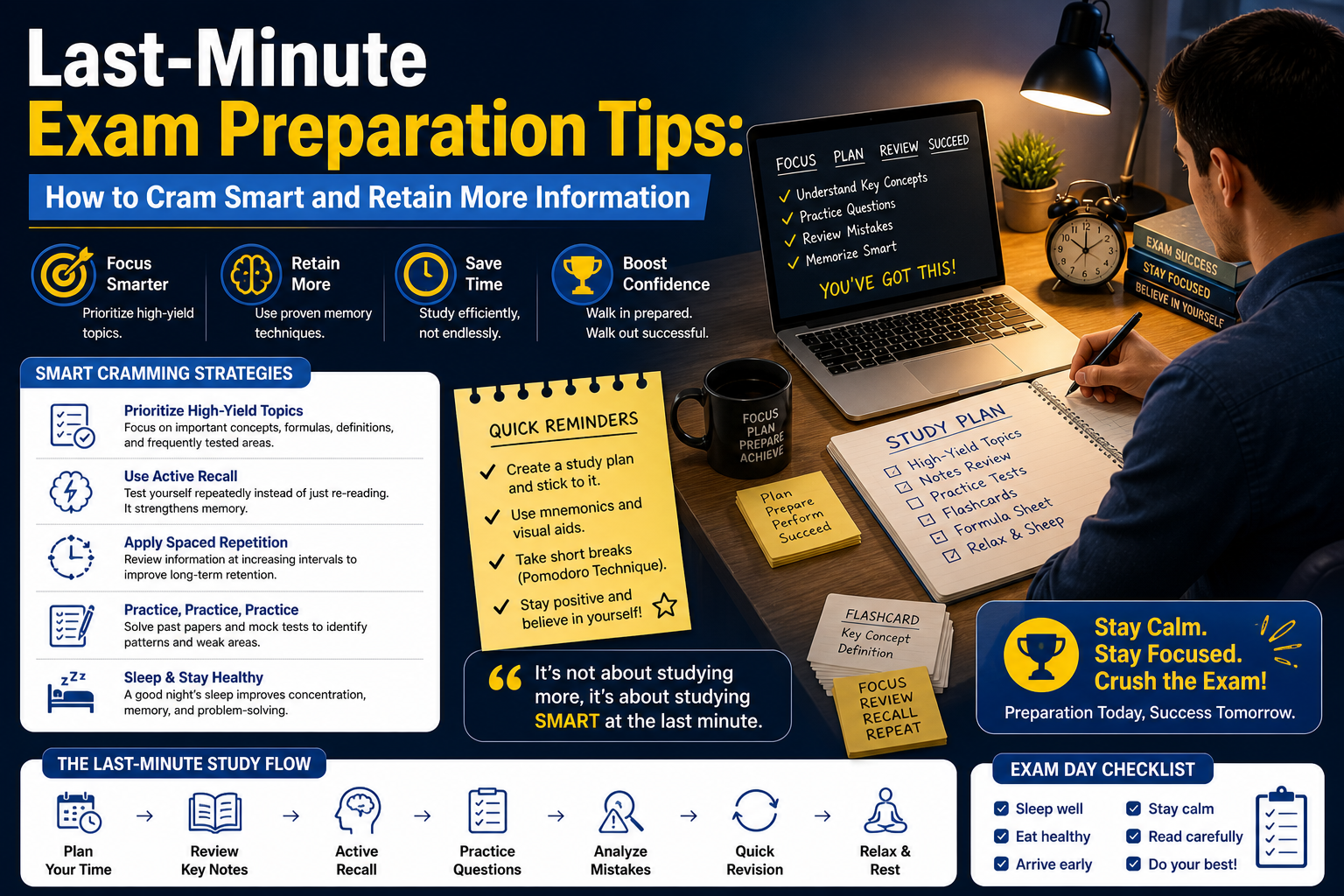
Most people don’t plan to cram. It usually happens when study schedules fall apart, deadlines sneak up faster than expected, or life simply gets in the way. In technical fields like IT certifications, the amount of material involved can be overwhelming, and it’s easy to underestimate how long it actually takes to fully understand complex topics. Concepts such as networking models, virtualization, cloud infrastructure, security principles, or system administration are not just definitions to memorize—they require comprehension, repetition, and practical thinking.
Despite this, cramming often becomes the fallback option. It feels like a rescue plan, a way to compress weeks of preparation into a single intense session. The problem is that the brain does not naturally absorb dense technical knowledge under pressure in short bursts. Instead, it tends to prioritize survival mode—stress, urgency, and fragmented recall rather than structured understanding.
Still, last-minute studying happens, and when it does, the goal shifts. It is no longer about mastering everything perfectly but about maximizing clarity in the limited time available. That shift in mindset is crucial because it prevents wasted effort on unrealistic expectations.
The Cognitive Limits of Short-Term Learning
Human memory is not designed to efficiently store large volumes of unfamiliar technical information in a single sitting. When new material is introduced, the brain needs time to process it, connect it to existing knowledge, and reinforce it through repetition. Without that reinforcement, information tends to fade quickly.
During a cram session, the brain is overloaded with input. It tries to hold subnetting rules, protocol behaviors, configuration steps, and troubleshooting logic all at once. This creates interference, where similar ideas compete for attention and reduce overall retention.
Stress also plays a role. When pressure increases, the brain shifts toward short-term survival responses rather than deep learning. This can make simple recall harder, even for topics that were previously understood. That is why someone might recognize a concept while studying but fail to retrieve it during an exam.
Understanding these limits is not meant to discourage last-minute preparation. Instead, it helps shape a more realistic approach so that effort is directed toward what can actually be achieved in a short window of time.
Shifting the Goal: From Mastery to Maximum Retention
When time is limited, the objective changes from “learn everything” to “strengthen what matters most.” This is an important mental adjustment. Instead of trying to cover every topic equally, it becomes more effective to identify high-impact areas and focus energy there.
In IT certification exams, not all topics carry equal weight. Some concepts appear frequently in scenarios, troubleshooting questions, or performance-based tasks. Others may be more peripheral or highly specialized. Recognizing this difference allows for more efficient use of time.
Cramming, when unavoidable, should focus on reinforcing familiarity rather than building understanding from scratch. If a topic is completely unknown, it is often more efficient to gain a basic conceptual overview rather than attempt deep mastery. On the other hand, partially understood topics are where improvement is most achievable in a short period.
This shift in expectation reduces frustration. Instead of feeling like everything must be learned perfectly, the focus becomes strengthening weak connections and stabilizing existing knowledge.
Creating the Right Mental Conditions for Focused Study
Environment plays a major role in how effectively information is processed during short study sessions. Distractions significantly reduce the brain’s ability to retain technical material. Even small interruptions—notifications, conversations, background noise, or multitasking—can break concentration and force the mind to restart its learning process repeatedly.
A focused environment does not need to be elaborate. What matters most is consistency and control. A space where interruptions are minimized allows the brain to settle into a rhythm of concentration. This rhythm is essential during cramming because time is already limited, and every minute of focused attention counts.
Comfort also plays a role, but not in the sense of relaxation. The goal is to create a setting where the body is comfortable enough to stay still, while the mind remains alert. Poor lighting, excessive noise, or physical discomfort can all contribute to fatigue, which reduces cognitive performance.
Even temperature and posture can influence concentration. When the body is too relaxed, drowsiness increases. When it is too tense, stress levels rise. Finding a balance helps maintain steady focus during long study stretches.
Structuring Time When Everything Feels Urgent
One of the biggest challenges in last-minute preparation is time distortion. When panic sets in, it can feel like there is too much to do and not enough time to organize it. This often leads to inefficient studying, where attention jumps randomly between topics without structure.
A more effective approach is to divide time into manageable segments. Short, focused intervals of study followed by brief breaks help maintain mental freshness. The brain performs better when it is allowed to reset periodically rather than pushed continuously without pause.
During focused intervals, attention should be fully directed at one topic or concept at a time. Switching between unrelated subjects too quickly reduces retention and increases confusion. Even within limited time, depth of focus is more valuable than breadth without understanding.
Breaks are not wasted time. They allow the brain to process what has just been studied. Without this processing period, information tends to remain temporarily stored and is more likely to be forgotten quickly.
Identifying What Actually Needs Attention
In a rushed study situation, not all material deserves equal focus. One of the most effective strategies is quickly identifying areas of weakness. This is where many learners waste time—they revisit material they already understand because it feels comfortable, rather than confronting topics they struggle with.
Weak areas are where improvement is most possible in a short time. Even small gains in understanding difficult concepts can have a significant impact on overall performance. For example, improving clarity on a single networking concept may help answer multiple exam questions correctly.
Self-assessment plays a key role here. Without it, it is easy to assume understanding where there is actually confusion. Reviewing notes, recalling definitions, or attempting practice scenarios can quickly reveal gaps in knowledge.
Once weak areas are identified, they should become the primary focus. Strong areas require only light reinforcement to maintain confidence.
The Importance of Conceptual Understanding Over Memorization
Technical exams often test understanding rather than pure memorization. While certain details must be remembered, such as terminology or standard values, most questions are designed to assess how concepts are applied in real situations.
Cramming tends to encourage memorization because it feels faster. However, memorized information is fragile under pressure. If a question is phrased differently from what was studied, recall can fail.
Conceptual understanding, even if incomplete, is more flexible. It allows the brain to reason through unfamiliar scenarios by applying known principles. This is especially important in IT-related fields where problem-solving is a core skill.
Even in short study sessions, trying to understand “why” something works is more valuable than repeating “what” it is. This small shift improves long-term retention and increases adaptability during the exam itself.
Managing Mental Pressure During Intensive Study
Stress is almost unavoidable during last-minute preparation. The awareness of limited time can create anxiety, which in turn reduces concentration. This creates a cycle where stress leads to poor focus, and poor focus increases stress.
Breaking this cycle requires conscious control of attention. Instead of focusing on the total remaining material, attention should be directed only to the current task. Thinking about everything at once overwhelms the mind, while focusing on one small segment at a time makes progress manageable.
It is also important to recognize that some level of uncertainty is normal. No cram session can cover everything perfectly, and expecting complete mastery only increases pressure unnecessarily.
Short mental resets can help maintain clarity. Even brief pauses where the mind disengages from studying can reduce tension and improve focus when returning to material.
How Memory Responds to Repetition Under Time Pressure
Repetition remains one of the most effective ways to reinforce learning, even during short study periods. However, the nature of repetition matters. Simply rereading material without engagement has limited effect.
Active recall is more effective. This involves attempting to retrieve information without looking at notes. Even if the recall is incomplete, the effort strengthens memory pathways and improves retention.
Repetition also benefits from variation. Reviewing the same concept in slightly different ways helps the brain build multiple associations. This makes recall more flexible during the exam.
However, repetition must be balanced. Excessive focus on a single topic can waste valuable time, especially if that topic is already understood. Strategic repetition focuses on weak or moderately understood areas rather than revisiting everything equally.
Recognizing the Trade-Offs of Last-Minute Study
Cramming is inherently a compromise. It sacrifices depth for speed, and stability for urgency. While it can help reinforce certain concepts quickly, it cannot replace structured, long-term learning.
Understanding this trade-off helps set realistic expectations. The goal is not perfection but damage control—strengthening enough knowledge to improve performance under constraints.
By acknowledging these limitations, it becomes easier to focus on what is achievable rather than what is ideal.
Building a Rapid but Structured Study Plan Under Pressure
When time is short, the absence of structure becomes one of the biggest threats to productivity. Without a plan, studying turns into random movement between topics, which creates a false sense of activity but produces weak retention. A rapid study plan is not about perfection; it is about direction.
The first step is identifying what remains to be covered versus what is already familiar. This does not require deep analysis—just a quick mental or written scan of major exam domains. Once the broad areas are visible, they can be divided into priority tiers based on confidence level and importance.
High-priority areas are those that are both heavily weighted in exams and poorly understood. Medium-priority areas are partially understood topics that need reinforcement. Low-priority areas are those already well understood and only require brief review.
A structured plan under time pressure should not attempt to treat all topics equally. Instead, it should intentionally bias attention toward weak zones while maintaining minimal reinforcement of strong ones. This prevents unnecessary time loss on material that is already stable.
Even a rough structure significantly improves efficiency. It reduces decision fatigue, which is the mental exhaustion caused by constantly deciding what to study next.
Prioritization as a Survival Skill in Cram Sessions
Prioritization becomes the core skill in last-minute preparation. Without it, learners tend to fall into comfort-based studying—revisiting familiar topics because they feel easier rather than confronting difficult ones that actually need attention.
A useful way to prioritize is to ask three questions about each topic:
Which topics appear most frequently in exams?
Which topics cause the most confusion?
Which topics can be improved quickly with short effort?
Topics that satisfy all three conditions deserve immediate focus. These are often high-yield areas where even small improvements can significantly affect performance.
In technical exams, certain concepts consistently carry more weight. Networking fundamentals, security principles, system troubleshooting logic, and cloud architecture patterns often appear repeatedly in different forms. These are not always the most complex topics, but they are frequently tested.
At the same time, overly specialized or niche areas may appear less frequently and can be deprioritized if time is extremely limited. This does not mean ignoring them completely, but rather reducing the depth of focus.
Prioritization also requires emotional discipline. It is easy to spend too much time on topics that feel interesting rather than those that are necessary. Effective cramming requires resisting that temptation.
Active Recall as the Fastest Way to Strengthen Memory
One of the most effective techniques in short-term study is active recall. This method involves attempting to retrieve information from memory without looking at notes or references.
Unlike passive reading, active recall forces the brain to work harder. This effort strengthens neural connections and improves the ability to retrieve information under pressure. Even when recall is incomplete, the attempt itself is valuable because it highlights gaps in knowledge.
For example, instead of rereading a definition of a protocol, a more effective approach is to close the notes and try to explain it out loud. If parts are forgotten, they can then be checked and corrected.
This process creates stronger memory encoding than repeated reading. It also simulates exam conditions, where information must be retrieved without assistance.
Active recall is especially useful for technical terminology, configuration steps, and conceptual explanations. It transforms studying from recognition-based learning into retrieval-based learning, which is more aligned with exam requirements.
Using Practice Questions as Diagnostic Tools, Not Just Testing Tools
Practice questions are often used incorrectly during cramming. Many learners treat them as final assessments rather than learning tools. In a time-limited situation, their real value lies in identifying weaknesses quickly.
When a question is answered incorrectly, it reveals more than just a gap in knowledge. It highlights misunderstandings in reasoning, gaps in terminology, or weaknesses in applying concepts.
Even correctly answered questions can be informative if they were answered with uncertainty. Confidence level matters as much as accuracy.
The key is to analyze mistakes immediately. Instead of simply moving on, it is more effective to briefly identify why the mistake happened. Was it due to forgetting a detail, misinterpreting the question, or confusion between similar concepts?
This reflection helps prevent repeated errors. In a cram session, avoiding repetition of mistakes is more valuable than learning entirely new material.
Practice questions also help simulate exam pressure. This is important because stress affects recall. By repeatedly exposing the brain to question-based formats, familiarity increases and anxiety decreases slightly over time.
Handling Complex Technical Topics Without Getting Overwhelmed
Certain IT concepts naturally feel dense and intimidating during last-minute study. Topics such as subnetting, cloud architecture, routing behavior, or security policies often require layered understanding.
When time is limited, the goal is not to master every detail but to understand structure and logic.
For example, instead of memorizing every possible variation of a concept, it is more efficient to understand the underlying pattern. Many technical systems follow predictable rules. Recognizing these patterns allows for logical reasoning even when specific details are forgotten.
Breaking complex topics into smaller components also reduces cognitive overload. A large concept becomes easier to understand when divided into functional parts.
Instead of viewing a system as a single overwhelming subject, it can be separated into input, process, and output components. This approach simplifies understanding and improves recall.
Another useful method is focusing on relationships rather than isolated facts. Understanding how components interact often provides more value than memorizing individual definitions.
Rapid Note Condensation for Maximum Retention
During cramming, large amounts of notes become difficult to manage. Long explanations and detailed documentation are not efficient for last-minute review. Instead, condensing information into minimal form becomes essential.
Condensation does not mean removing meaning. It means reducing content to its core ideas. Each concept should be represented in the simplest possible form that still preserves understanding.
This process forces deeper engagement with the material. To simplify a concept, one must first understand it clearly. This alone improves retention.
Condensed notes also reduce cognitive load during review. Instead of reading long paragraphs, the brain processes short, focused points more efficiently.
However, condensation should not eliminate context entirely. Without context, isolated facts become harder to apply in exam scenarios. The goal is balance—short enough to review quickly but detailed enough to retain meaning.
Managing Cognitive Load During Intensive Study Sessions
Cognitive load refers to the amount of mental effort being used in working memory. During cram sessions, cognitive load is often extremely high due to the volume of information being processed.
When cognitive load exceeds capacity, comprehension drops sharply. This leads to confusion, fatigue, and reduced retention.
Managing cognitive load requires simplifying input. Studying one concept at a time is more effective than switching between multiple unrelated topics rapidly.
Grouping related concepts together can also help. When information is organized logically, the brain processes it more efficiently.
Another important factor is pacing. Continuous intense focus without breaks leads to mental saturation. Short pauses allow the brain to consolidate information and reduce overload.
Reducing unnecessary complexity is also important. Not every detail needs to be processed deeply during a cram session. Focusing on essential ideas improves clarity and prevents overload.
Understanding Exam Patterns to Guide Focused Preparation
Even in limited time, familiarity with exam structure can improve efficiency. Different certification exams tend to follow predictable patterns in question style and topic distribution.
Some questions test definitions, others test scenario-based problem solving, and some test troubleshooting logic. Recognizing these patterns helps guide preparation toward relevant skills.
Scenario-based questions often require application rather than memorization. These questions typically present a situation and ask for the best solution. Understanding how to analyze such scenarios quickly can improve performance even without full topic mastery.
Pattern recognition also helps reduce uncertainty. When learners understand how questions are structured, they are less likely to be surprised during the exam.
This familiarity reduces anxiety and improves decision-making speed.
Mental Rehearsal as a Reinforcement Technique
Mental rehearsal involves imagining the process of recalling and applying knowledge without physically studying it. This technique strengthens neural pathways associated with memory retrieval.
By mentally walking through concepts, steps, or scenarios, the brain reinforces its ability to access information under pressure.
For example, mentally simulating troubleshooting steps or configuration processes can improve recall speed during the exam.
This technique is especially useful when physical studying becomes exhausting. It allows continued engagement with material without additional cognitive strain.
Mental rehearsal also prepares the brain for exam conditions. By imagining the structure of questions and responses, familiarity increases, which can reduce stress during actual testing.
Balancing Speed and Accuracy in Short-Term Learning
One of the challenges of cramming is balancing speed with correctness. Studying too quickly can lead to shallow understanding, while studying too slowly wastes limited time.
The key is to aim for functional understanding rather than perfection. Functional understanding means being able to recognize concepts, explain them briefly, and apply them in basic scenarios.
Accuracy improves naturally when understanding is stable. However, perfection is rarely achievable in short timeframes.
Accepting this balance helps reduce frustration and allows for more efficient progress.
Avoiding Common Inefficiencies During Cram Sessions
Certain behaviors consistently reduce the effectiveness of last-minute studying. One of the most common is repeatedly reading the same material without engaging with it actively. This creates an illusion of learning without real retention.
Another inefficiency is switching topics too frequently. Constant switching prevents deep focus and reduces memory consolidation.
Overloading with too much new information is also counterproductive. Introducing unfamiliar concepts too late in the process often leads to confusion rather than clarity.
Finally, excessive perfectionism slows progress. Trying to fully master every detail is unrealistic under time pressure and leads to unnecessary stress.
Strengthening Confidence Through Controlled Review
Confidence plays an important role in performance. Even when knowledge is incomplete, a structured review process can help stabilize understanding.
Controlled review involves revisiting key concepts in a focused, intentional way rather than randomly scanning material.
This reinforces familiarity and reduces uncertainty. Familiarity does not guarantee perfect recall, but it improves the ability to reason through questions during the exam.
Confidence built through structured review is more reliable than confidence based on last-minute guessing or memorization spikes.
Reinforcing Learning Through Short Repetition Cycles
Short repetition cycles involve reviewing the same material multiple times in decreasing detail. The first pass focuses on understanding, the second on recall, and subsequent passes on reinforcement.
This layered repetition strengthens memory without requiring long study sessions.
Each cycle improves clarity and reduces forgetting. Even in limited time, repetition remains one of the most effective tools for retention when applied strategically.
However, repetition must remain focused. Repeating low-value material does not improve outcomes. Prioritization should guide what gets repeated.
Preparing the Mind for Performance Under Pressure
Exam performance is not determined solely by knowledge. Mental readiness plays a significant role. Stress, fatigue, and uncertainty can all affect recall.
Preparing the mind involves building familiarity with pressure conditions. This includes practicing recall under time constraints and simulating decision-making under limited information.
The goal is not to eliminate pressure but to become more comfortable operating within it.
Turning Limited Time Into Strategic Performance Windows
When an exam is approaching and preparation time is almost exhausted, the focus naturally shifts from learning new material to optimizing what already exists in memory. At this stage, every minute becomes a performance window rather than a learning window. That distinction matters more than it seems, because it changes how the brain is directed.
Instead of asking “What can I still learn?” the more useful question becomes “What can I reliably retrieve under pressure?” This reframing reduces wasted effort and aligns the mind with exam conditions. In technical certifications, especially IT-related ones, success often depends less on exposure to material and more on how efficiently knowledge can be accessed and applied.
Performance optimization is not about intensity alone. It is about clarity, focus, and deliberate selection of mental effort. Trying to force large volumes of new information at the last minute tends to reduce overall performance rather than improve it. At this stage, refinement matters more than expansion.
The brain operates more efficiently when it is not overwhelmed by constant novelty. Familiarity becomes an advantage. Even partial recognition of concepts can be leveraged to answer questions correctly if recall pathways are strengthened through structured review.
Strengthening Retrieval Paths Instead of Adding New Information
One of the most important shifts in final-stage preparation is focusing on retrieval strength rather than knowledge acquisition. Retrieval strength refers to how easily information can be accessed when needed, especially under pressure.
In a cram scenario, adding new information often weakens retrieval strength because it competes with existing knowledge. The brain has limited capacity for short-term consolidation, and introducing too many new ideas creates interference.
Instead, reinforcing existing knowledge improves stability. This can be done through repeated recall attempts, short reviews, and mentally reconstructing concepts without external references.
For example, instead of reading a full explanation of a protocol or system again, it is more effective to close notes and attempt to explain it from memory. Even if the explanation is incomplete, the act of retrieval strengthens neural pathways.
This approach transforms memory from passive recognition into active access. Active access is what exams require.
Managing Mental Fatigue During High-Pressure Study Sessions
Mental fatigue is one of the most underestimated challenges during last-minute preparation. Unlike physical fatigue, it is not always immediately noticeable. Instead, it appears as reduced concentration, slower recall, and increased frustration.
As cognitive resources become depleted, the brain struggles to maintain focus on complex material. This is especially noticeable in technical subjects that require logical reasoning.
Pushing through fatigue without adjustment often leads to diminishing returns. More time spent studying does not necessarily translate into better retention when the mind is exhausted.
To manage fatigue effectively, study intensity must be balanced with recovery intervals. Short breaks allow the brain to reset attention and reduce overload. These breaks are not distractions; they are part of the learning cycle.
Another important factor is variation in study activity. Repeating the same type of cognitive task for too long increases fatigue. Alternating between reading, recall, and review helps maintain engagement and reduces mental strain.
Fatigue management is not about avoiding effort. It is about sustaining effort long enough for it to remain effective.
The Role of Confidence in Exam Performance
Confidence is not just an emotional state during exams; it directly affects cognitive performance. When confidence is low, hesitation increases, and retrieval becomes slower. When confidence is stable, decision-making becomes more efficient.
However, confidence in cramming situations must be grounded in familiarity rather than certainty. Complete certainty is rarely achievable in short preparation windows. Instead, familiarity with patterns, concepts, and question types provides a stable base for confidence.
Even partial understanding can support confident reasoning. For example, recognizing key terms or identifying familiar structures in a question can guide the mind toward the correct answer even if full details are not recalled.
Overconfidence, however, can be dangerous. It may lead to skipping review of weak areas or rushing through questions without proper analysis. Balanced confidence—based on realistic self-assessment—is the most effective state during exams.
Improving Decision-Making Speed Under Exam Conditions
Exams, especially technical ones, often require quick decision-making under uncertainty. Time pressure forces candidates to choose answers based on partial knowledge, reasoning, and elimination strategies.
In cramming situations, decision-making speed becomes even more important because deep familiarity may be limited. The brain must rely on pattern recognition and logical deduction rather than complete recall.
One effective way to improve decision-making speed is repeated exposure to question formats. When the brain becomes familiar with how questions are structured, it processes them more efficiently.
Another important factor is reducing hesitation. Overthinking can consume valuable time and lead to confusion. While careful analysis is important, excessive doubt slows performance.
A useful approach is to first eliminate clearly incorrect options and then focus on comparing remaining choices. This reduces cognitive load and improves clarity.
Decision-making under pressure improves when the brain is trained to act with incomplete information rather than waiting for perfect recall.
Reinforcing Core Concepts Through Mental Structuring
In the final phase of preparation, mental structuring becomes more valuable than detailed review. Mental structuring refers to organizing knowledge in a simplified internal framework that can be easily accessed.
Instead of remembering isolated facts, the brain benefits from grouping related ideas together. For example, networking concepts can be mentally organized into layers, functions, and interactions rather than separate definitions.
This structured mental map allows for faster recall during the exam. When a question appears, the brain can quickly navigate the internal structure to find relevant information.
Even in limited time, creating these mental frameworks improves performance significantly. It reduces confusion and strengthens logical connections between ideas.
Structured thinking is especially important in scenario-based questions, where multiple concepts must be combined to reach a solution.
Handling Uncertainty Without Losing Focus
Uncertainty is unavoidable during last-minute preparation. There will always be topics that feel incomplete or unclear. The key is learning how to function despite that uncertainty.
Focusing too much on unknown areas can create anxiety and reduce performance across all topics. Instead, it is more effective to stabilize known areas and strengthen partially known ones.
Uncertainty should be acknowledged but not allowed to dominate attention. The brain performs best when it operates with clarity on current tasks rather than worrying about gaps.
One effective strategy is narrowing focus to immediate goals. Instead of thinking about overall readiness, attention is directed toward the current topic or question.
This reduces cognitive overload and improves efficiency.
The Importance of Logical Reasoning in Technical Exams
Technical exams often test reasoning as much as memorization. Even when specific details are forgotten, logical thinking can lead to correct answers.
Logical reasoning involves understanding how systems behave under certain conditions. This includes predicting outcomes, analyzing scenarios, and identifying patterns.
In cramming situations, strengthening reasoning ability is often more effective than trying to memorize missing details.
For example, if a question involves troubleshooting, understanding cause-and-effect relationships can help narrow down possible solutions even without exact recall.
Reasoning also helps in eliminating incorrect options, increasing the probability of selecting the correct answer.
This approach reduces dependence on memorization and increases adaptability.
Final Reinforcement Through Targeted Review Cycles
In the final hours before an exam, review cycles should become highly targeted. Instead of broad study sessions, short focused reviews of key concepts are more effective.
Each cycle should focus on reinforcing weak areas first, followed by quick reinforcement of strong areas. The goal is not to learn new material but to stabilize existing knowledge.
Repeated exposure to key ideas strengthens familiarity and improves recall speed. However, repetition should remain intentional rather than mechanical.
Each review cycle should add clarity rather than confusion. If a concept becomes more confusing with repeated exposure, it may be better to move on rather than force understanding under time pressure.
Managing Emotional Pressure Before and During the Exam
Emotional pressure can significantly impact performance. Anxiety before or during an exam can interfere with recall and decision-making.
Managing this pressure involves maintaining steady focus on the present moment rather than future outcomes. Thinking too much about results increases stress and reduces cognitive efficiency.
A more effective approach is focusing on individual questions as they come. This keeps attention grounded and prevents overwhelm.
Emotional control does not mean eliminating stress completely. It means preventing stress from interfering with performance.
Breathing control, short mental pauses, and structured thinking can all help stabilize emotional responses during exams.
Maximizing Recall Efficiency in the Final Moments
In the final stage of preparation, recall efficiency becomes the most important factor. The ability to quickly access relevant information determines performance more than total knowledge volume.
Recall efficiency improves through repetition, structured review, and active engagement with material.
The brain responds better to familiar patterns than to newly introduced information. This is why last-minute cramming should focus on strengthening what is already partially known.
Efficient recall also depends on mental organization. Disorganized information is harder to retrieve under pressure. Structured mental frameworks improve access speed.
Balancing Speed, Accuracy, and Stability Under Pressure
During exams, three factors compete for attention: speed, accuracy, and stability. Speed ensures all questions are attempted. Accuracy ensures correct answers. Stability ensures consistent performance under pressure.
Cramming tends to prioritize speed, but without stability and accuracy, results suffer.
The most effective approach is balancing all three by focusing on clarity in decision-making, avoiding unnecessary hesitation, and relying on structured reasoning.
Even when knowledge is incomplete, stable thinking improves outcomes significantly.
Mental Conditioning for Exam Readiness
In the final hours, mental conditioning becomes more important than additional study. The goal is to prepare the mind for performance rather than continue heavy learning.
This involves reinforcing confidence, reducing anxiety, and maintaining focus on key concepts.
The brain performs best when it is calm, familiar with material, and not overloaded. Mental readiness allows existing knowledge to be used effectively.
At this stage, preparation shifts entirely toward execution rather than learning.
Building Consistency in Recall Under Time Pressure
As exam time approaches, one of the most valuable abilities is not just knowing information, but being able to retrieve it consistently under pressure. Consistency in recall means that knowledge does not appear only when conditions are ideal, but remains accessible even when stress, time pressure, or uncertainty are present.
This consistency is developed through repeated exposure to retrieval conditions that resemble exam environments. Even without formal practice tests, simply attempting to recall information without support builds familiarity with pressure-based thinking. The brain gradually learns that retrieval is expected even when conditions are not perfect.
In technical exams, inconsistency is often more damaging than lack of knowledge. A concept that is understood but not reliably recalled can lead to missed questions. Strengthening consistency reduces this risk and stabilizes performance.
One effective way to reinforce consistency is to revisit key topics multiple times in short intervals rather than long sessions. Each revisit strengthens retrieval pathways and reduces dependency on recognition-based memory.
Reducing Cognitive Friction During Problem Solving
Cognitive friction refers to the mental resistance experienced when trying to process or apply information. In exams, this often appears as hesitation, confusion, or slow decision-making.
High cognitive friction occurs when information is poorly organized, partially understood, or not reinforced. During cramming, reducing this friction becomes essential because time is limited and decisions must be made quickly.
One way to reduce cognitive friction is by simplifying internal explanations of concepts. Instead of complex descriptions, the brain benefits from short, structured interpretations that are easy to recall. These simplified mental models act as shortcuts during problem-solving.
Another method is recognizing familiar patterns within questions. When the brain identifies a known structure, it reduces processing effort and speeds up response time. This is particularly useful in scenario-based IT questions where similar patterns often repeat with slight variations.
Reducing friction does not mean oversimplifying knowledge. It means optimizing how that knowledge is accessed under pressure.
Strengthening Pattern Recognition for Technical Scenarios
Pattern recognition is one of the most powerful cognitive tools in technical exams. Many questions are not entirely new; they are variations of familiar structures. Recognizing these patterns allows the brain to respond quickly and accurately even when details are incomplete.
For example, troubleshooting questions often follow logical sequences: identifying symptoms, isolating causes, and selecting solutions. Network configuration questions may follow predictable structures involving inputs, outputs, and dependencies.
During last-minute preparation, actively focusing on these patterns improves adaptability. Instead of memorizing every possible scenario, the brain learns to identify the underlying structure of problems.
This skill becomes especially valuable when time is limited, because it reduces reliance on full recall and increases reliance on reasoning.
Pattern recognition also improves confidence. When a question feels familiar in structure, even if content varies, decision-making becomes more stable.
Strengthening Attention Control During High-Stress Moments
Attention control refers to the ability to maintain focus on relevant information while ignoring distractions. In exam environments, distractions may not always be external; they are often internal, such as anxiety, doubt, or overthinking.
When attention is unstable, even simple questions can feel difficult. The mind jumps between possibilities instead of focusing on one structured thought process.
Strengthening attention control during final preparation helps stabilize performance. This involves training the mind to stay focused on one concept or question at a time without shifting prematurely.
One effective approach is narrowing mental scope. Instead of thinking about the entire exam, focus only on the current question. This reduces cognitive overload and improves clarity.
Attention control also improves through deliberate pacing. Rushing increases mistakes, while overly slow thinking reduces time efficiency. A balanced rhythm helps maintain both accuracy and speed.
Conclusion
Last-minute exam preparation is rarely an ideal situation, especially in technical fields where understanding matters more than memorization. Yet it remains a reality for many learners who find themselves facing an approaching exam with more material left than time available. In those moments, the goal is not to replace proper study but to make the most effective use of the time that remains.
Cramming, when it happens, should not be treated as a substitute for real learning. It is a compressed form of prioritization, where decisions about what to focus on matter more than the volume of content covered. The most effective approach is to shift attention away from trying to learn everything and instead focus on reinforcing what is already partially understood. This allows the brain to strengthen existing memory pathways rather than struggle with entirely new concepts under pressure.
Another important takeaway is that structure matters even in urgency. Without structure, last-minute study becomes chaotic, leading to wasted effort and increased stress. Even simple organization—such as grouping weak topics, using short study cycles, and focusing on high-impact concepts—can significantly improve retention. Structure reduces mental overload and helps maintain direction when time is limited.
Equally important is the role of focus and environment. Distractions, fatigue, and fragmented attention are some of the biggest obstacles during short study sessions. Creating conditions that support concentration, even in a simple way, can make a noticeable difference in how much information is actually absorbed. When attention is stable, even short periods of study become more productive.
It is also clear that understanding concepts is more valuable than memorizing isolated facts. Technical exams often test application and reasoning rather than direct recall. This means that even partial understanding, when applied logically, can lead to correct answers. Strengthening conceptual clarity, even briefly, is more beneficial than trying to memorize large amounts of disconnected information.
Perhaps most importantly, managing mental state plays a central role in performance. Stress, anxiety, and pressure can interfere with recall and decision-making. A calm and focused mindset, even in imperfect preparation conditions, allows knowledge to surface more effectively. Confidence built from familiarity, rather than certainty, supports better performance under uncertainty.
Ultimately, last-minute preparation is about balance. It is a combination of prioritization, structured review, controlled focus, and mental stability. While it cannot replace consistent long-term study, it can still improve outcomes when used wisely. The key is not to aim for perfection, but to aim for clarity, stability, and the best possible use of limited time.