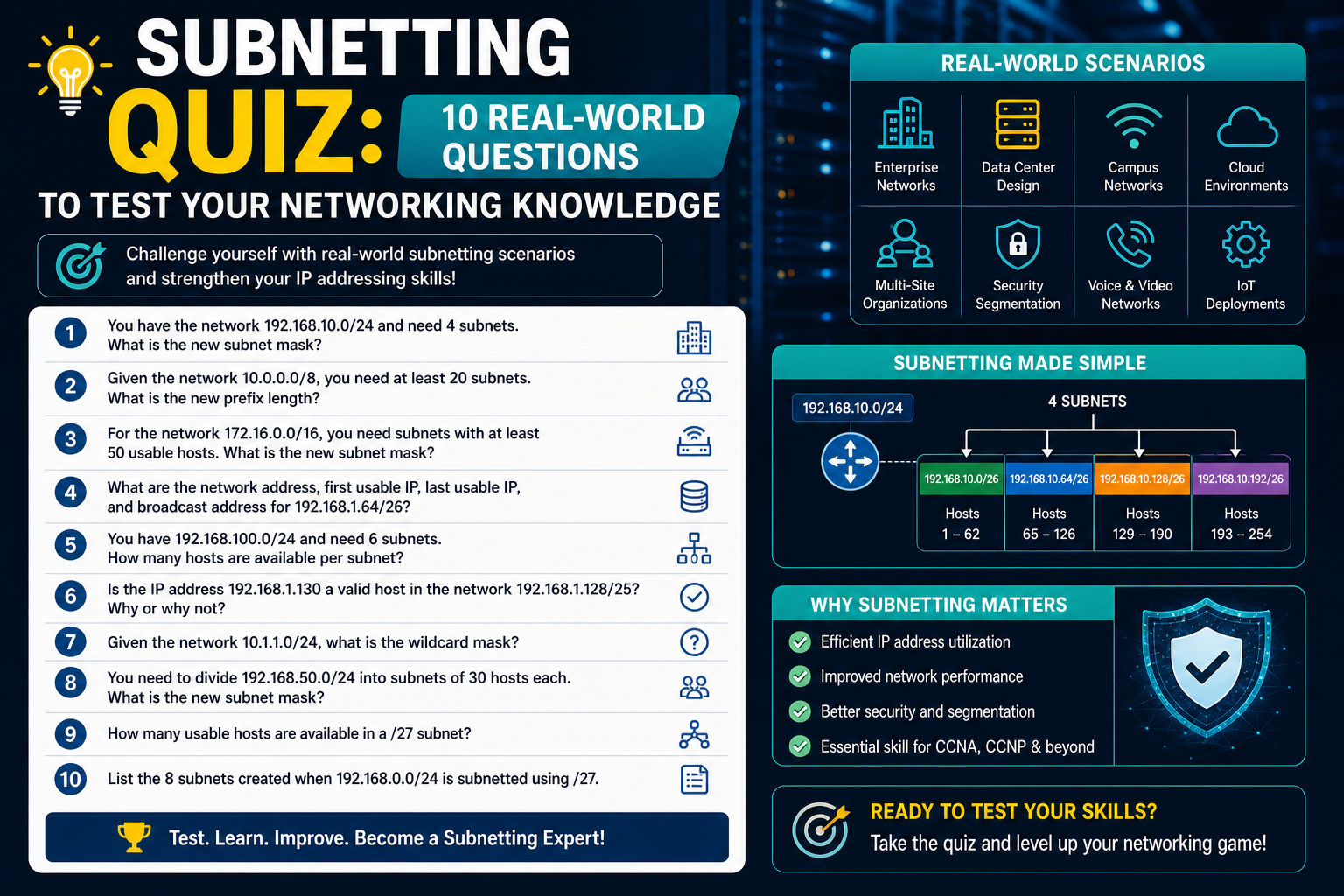
Subnetting is one of the most important foundational concepts in computer networking, especially for anyone working toward certifications like CCENT, CCNA, or Network+. While many networking topics evolve over time as technologies change, subnetting remains consistently relevant because it is directly tied to how IP networks are structured, managed, and scaled.
At its core, subnetting is about dividing a larger network into smaller, more manageable sections. These smaller sections are called subnets. This division is not just an academic exercise; it solves very real problems in networking environments. Without subnetting, large networks would become inefficient, difficult to manage, and prone to performance issues due to excessive broadcast traffic.
To understand subnetting properly, it helps to think of an IP network as a large neighborhood. Without subdivisions, every house would be part of one massive block, making organization difficult. Subnetting introduces structured divisions within that neighborhood, allowing better control over traffic flow, security boundaries, and resource allocation.
One of the most important ideas in subnetting is that IP addresses are not just random numbers. They are structured into two main parts: the network portion and the host portion. The network portion identifies the specific network a device belongs to, while the host portion identifies the individual device within that network. Subnetting is essentially the process of manipulating how these two parts are divided.
When subnetting is performed, bits from the host portion are borrowed to create additional networks. This is why subnetting increases the number of available networks but reduces the number of hosts per network. This trade-off is central to understanding how efficient IP addressing is achieved in real-world environments.
Another reason subnetting is important is that it allows organizations to use IP address space more efficiently. Without subnetting, large blocks of IP addresses would be wasted because networks would either be too large or too small for specific needs. Subnetting allows networks to be sized appropriately based on actual requirements rather than fixed class-based boundaries.
In modern networking, subnetting also plays a key role in segmentation and security. By dividing a network into smaller subnets, administrators can isolate departments, control traffic flow between systems, and reduce the risk of network-wide issues. For example, a company might place finance systems in one subnet and guest users in another, ensuring that traffic between them is controlled and monitored.
Subnetting also improves performance. When a network is divided into smaller subnets, broadcast traffic is limited to each subnet rather than flooding the entire network. This reduces unnecessary load on devices and improves overall efficiency.
Understanding subnetting requires comfort with binary numbers because IP addresses and subnet masks are ultimately represented in binary form. While most people work with decimal notation, the actual calculations happen at the binary level. Each IP address is made up of 32 bits, divided into four groups called octets. Each octet contains 8 bits, and these bits determine the numerical value of that section of the address.
This binary structure is what allows subnetting to function. By changing bits in the subnet mask, we effectively redefine how much of the IP address belongs to the network and how much belongs to the host. This flexibility is what makes subnetting so powerful.
Subnet masks are closely tied to this concept. A subnet mask is used to separate the network portion from the host portion of an IP address. It does this by using a series of binary ones and zeros. The ones represent the network portion, while the zeros represent the host portion. When applied to an IP address, the subnet mask reveals which network the address belongs to and which part can be used for device identification.
Without subnet masks, IP addresses would be meaningless in terms of network structure. The subnet mask is what gives context to the IP address. It tells devices how to interpret the address and how to route traffic appropriately.
Subnetting also introduces the concept of flexibility in network design. Instead of being restricted to fixed network sizes, administrators can create networks that are tailored to specific needs. For example, a small department might only need a few IP addresses, while a data center might require thousands. Subnetting allows both scenarios to exist within the same address space.
Understanding subnetting is not just about memorizing rules; it is about developing an intuitive sense of how networks are structured. Once this understanding is developed, subnetting becomes less about calculation and more about logic and pattern recognition.
Binary Fundamentals Behind IP Addressing
To fully understand subnetting, it is necessary to have a strong grasp of binary numbers. While humans naturally work in base-10 (decimal), computers operate in base-2 (binary). This means every IP address is ultimately represented as a series of 0s and 1s.
Each octet in an IP address consists of 8 bits. Each bit represents a power of 2, starting from the right. The rightmost bit represents 1, the next represents 2, then 4, 8, 16, 32, 64, and finally 128 on the leftmost side of the octet. By combining these values, any number between 0 and 255 can be represented in a single octet.
For example, the decimal number 41 is represented in binary by turning on the bits that add up to 41. This includes the values 32, 8, and 1. When combined, they produce the correct binary representation. This kind of binary breakdown is essential when working with subnetting because it directly affects how network boundaries are defined.
Subnetting relies heavily on understanding how bits can be manipulated. When we borrow bits from the host portion of an IP address, we are effectively changing the structure of the network. Each borrowed bit doubles the number of possible subnets but halves the number of available hosts per subnet.
This relationship between bits, networks, and hosts is one of the most important concepts in networking. It explains why subnetting always involves trade-offs. More networks mean fewer hosts, and more hosts mean fewer networks.
Binary also plays a key role in understanding subnet masks. A subnet mask is a 32-bit number where continuous ones represent the network portion and continuous zeros represent the host portion. The transition point between ones and zeros determines the size of the network.
For example, a subnet mask with 24 ones followed by 8 zeros means that the first 24 bits of the IP address represent the network, while the last 8 bits represent hosts. This is commonly seen in many standard networks.
Understanding binary is also essential for calculating network ranges. By analyzing the binary structure of an IP address and its subnet mask, it becomes possible to determine the network address, broadcast address, and usable host range.
The network address is always the first address in a subnet, where all host bits are set to zero. The broadcast address is always the last address in a subnet, where all host bits are set to one. These two addresses cannot be assigned to devices, leaving only the addresses in between as usable host addresses.
Binary manipulation is also the reason subnetting can be scaled so efficiently. Instead of manually assigning IP addresses, subnetting allows entire ranges to be defined mathematically. This reduces errors and improves consistency across large networks.
The Role of Subnet Masks in Network Structure
Subnet masks are one of the most critical components in IP networking. They define how an IP address should be interpreted and determine which portion of the address belongs to the network and which belongs to the host.
Every IP address must be paired with a subnet mask. Without it, a device would not know how to route traffic correctly. The subnet mask acts as a guide that tells devices how to interpret the structure of the IP address.
A subnet mask is always the same length as an IP address, meaning it consists of 32 bits. These bits are divided into two sections: the network portion and the host portion. The network portion is represented by binary ones, while the host portion is represented by binary zeros.
When a device receives an IP address and subnet mask, it performs a logical comparison to determine whether another device is on the same network or a different one. If both devices share the same network portion, communication can occur directly. If not, traffic must be routed through a gateway.
This process is fundamental to how networks operate. It allows devices to make decisions locally without needing centralized control for every communication attempt.
Subnet masks also define network size. A shorter subnet mask (fewer network bits) results in a larger network with more hosts. A longer subnet mask (more network bits) results in a smaller network with fewer hosts. This flexibility allows networks to be designed according to specific needs.
Historically, IP addressing used fixed classes, such as Class A, Class B, and Class C. Each class had a default subnet mask. However, this system was inefficient because it did not allow fine-grained control over network sizes. Subnetting solved this problem by allowing variable-length subnet masks.
Variable-length subnet masking enables networks to be divided in a more flexible way. Instead of being restricted to fixed sizes, administrators can choose exactly how many bits to allocate to the network portion. This leads to better utilization of IP address space.
Subnet masks also play a role in routing. Routers use subnet masks to determine where to send packets. By comparing destination IP addresses with known subnet masks, routers can make efficient forwarding decisions.
This is especially important in large networks where thousands of routes may exist. Without subnet masks, routing would be far less efficient and scalable.
Subnet masks also help reduce network congestion. By dividing networks into smaller segments, broadcast traffic is limited to each subnet. This prevents unnecessary traffic from affecting the entire network.
In practical terms, subnet masks are essential for designing stable and scalable networks. They provide structure, control, and efficiency, all of which are necessary for modern networking environments.
How Subnetting Shapes Real-World Network Design
Subnetting is not just a theoretical concept; it is a practical tool used in almost every network environment. From small office networks to large enterprise infrastructures, subnetting plays a critical role in organizing and managing IP address space.
One of the main uses of subnetting in real-world design is segmentation. Networks are often divided based on departments, functions, or security requirements. For example, a company might create separate subnets for human resources, engineering, and guest access. This separation helps control traffic flow and improve security.
Subnetting also supports scalability. As organizations grow, their networks must expand without becoming chaotic. Subnetting allows new sections of the network to be added without disrupting existing structures. This makes it easier to manage growth over time.
Another important aspect of subnetting in real-world environments is troubleshooting. When networks are divided into subnets, it becomes easier to identify where problems are occurring. Instead of searching through a large flat network, administrators can focus on specific segments.
Subnetting also improves performance by reducing broadcast traffic. In large networks, broadcast messages can consume significant bandwidth. By dividing the network into smaller subnets, broadcasts are contained within each segment, improving overall efficiency.
Security is another major benefit of subnetting. By isolating different parts of a network, administrators can apply security policies more effectively. Sensitive systems can be placed in restricted subnets, while less critical systems can be placed elsewhere.
Subnetting also plays a key role in routing efficiency. Routers use subnet information to make decisions about where to send traffic. Proper subnet design can reduce routing complexity and improve overall network performance.
In modern networks, subnetting is often combined with other technologies such as VLANs and routing protocols. This combination allows for highly flexible and efficient network architectures that can adapt to changing requirements.
Subnetting also supports cloud and virtual environments. As infrastructure becomes more dynamic, subnetting provides the logical structure needed to manage virtual networks effectively.
Ultimately, subnetting remains one of the most essential skills in networking because it forms the foundation of how IP networks are designed, structured, and maintained.
Classful Addressing and the Shift Toward Modern Subnetting
Before subnetting became flexible and widely used in modern networks, IP addressing followed a strict system known as classful addressing. This system divided IP addresses into fixed categories based on their leading bits and decimal ranges. These categories were Class A, Class B, and Class C, with additional classes reserved for special purposes.
Each class came with a default subnet mask, which determined how many bits were used for the network portion and how many were left for hosts. Class A networks used a very small portion of bits for the network and a very large portion for hosts, making them suitable for extremely large organizations. Class B networks offered a balanced split, while Class C networks provided a large number of smaller networks.
At first glance, this system seemed organized, but it quickly became inefficient in practice. Organizations were forced to choose from predefined network sizes that often did not match their actual needs. For example, a company that needed 500 IP addresses might be assigned a Class B network that provided far more addresses than required, leading to waste.
This inefficiency led to the development of subnetting and eventually classless addressing. Subnetting allowed administrators to take these large classful networks and divide them into smaller, more appropriate segments. Over time, the industry moved toward classless inter-domain routing, which removed strict class boundaries altogether.
The shift from classful to classless addressing fundamentally changed how networks are designed. Instead of being constrained by fixed network sizes, administrators could now define networks based on actual requirements. This flexibility is one of the main reasons modern networking is far more scalable and efficient than early IP systems.
Subnetting became the tool that made this flexibility possible. By borrowing bits from the host portion of an address, administrators could create networks of almost any size. This eliminated the waste associated with classful addressing and allowed IP space to be used more efficiently.
Even though classful addressing is no longer used in modern routing decisions, its concepts are still important for understanding subnetting. Many foundational ideas, such as network classes and default masks, help learners understand how IP addressing evolved.
CIDR and the Introduction of Flexible Network Boundaries
One of the most important developments in modern networking is classless inter-domain routing, commonly known as CIDR. CIDR replaced the rigid class-based system with a more flexible approach to IP addressing and routing.
Instead of relying on predefined classes, CIDR uses prefix notation to represent the network portion of an IP address. This notation specifies how many bits are used for the network, allowing for precise control over network size.
For example, instead of saying an IP address belongs to a Class C network, CIDR allows it to be expressed as having a specific number of network bits. This makes it possible to create networks of any size, rather than being limited to fixed categories.
CIDR also plays a major role in route aggregation, which helps reduce the size of routing tables on the internet. By combining multiple smaller networks into a single larger route, routers can operate more efficiently and process fewer entries.
This aggregation is possible because CIDR allows network boundaries to be defined based on binary prefixes rather than class rules. When multiple networks share a common prefix, they can be summarized into a single route.
Subnetting and CIDR work closely together. While subnetting is used to divide networks into smaller segments, CIDR is used to define and summarize those segments efficiently. Together, they form the backbone of modern IP addressing.
CIDR also enables more precise allocation of IP addresses. Instead of assigning large blocks that may be partially unused, network administrators can allocate exactly the number of addresses required. This reduces waste and improves overall address utilization.
In large-scale networks, such as those used by internet service providers, CIDR is essential. Without it, routing tables would grow too large, and IP address space would be used inefficiently.
Variable-Length Subnet Masking and Network Flexibility
Variable-length subnet masking is one of the most powerful extensions of subnetting. It allows different subnets within the same network to have different sizes. This flexibility is crucial in real-world environments where different departments or systems have different address requirements.
Instead of dividing a network into equal parts, variable-length subnet masking allows it to be divided based on actual needs. For example, a network segment for servers might require hundreds of IP addresses, while a segment for printers might only require a handful.
This approach eliminates the waste associated with fixed-size subnetting. Each subnet can be tailored to the specific number of hosts it needs to support.
Variable-length subnet masking also improves hierarchical network design. Large networks can be broken down into smaller and smaller subnets in a structured way. This hierarchy makes networks easier to manage and scale.
One of the key benefits of this approach is that it allows efficient use of address space. Instead of reserving large blocks of unused addresses, administrators can allocate smaller, more precise blocks.
Another advantage is improved routing efficiency. Because subnets can be summarized more effectively, routing tables remain smaller and more manageable.
Variable-length subnet masking also supports better fault isolation. If one subnet experiences issues, it is less likely to impact other subnets because they are independently defined and structured.
Calculating Subnets and Understanding Network Boundaries
Subnetting requires the ability to determine key network values, including network address, broadcast address, and usable host range. These values are derived from the relationship between an IP address and its subnet mask.
The network address is the first address in a subnet. It is calculated by setting all host bits to zero. This address identifies the subnet itself and cannot be assigned to a device.
The broadcast address is the last address in a subnet. It is calculated by setting all host bits to one. This address is used to send messages to all devices within the subnet simultaneously.
Between these two addresses lies the usable host range. These addresses can be assigned to devices such as computers, servers, and printers.
Understanding how to determine these values is essential for network design and troubleshooting. It allows administrators to verify whether devices are correctly assigned and whether networks are properly segmented.
Subnet boundaries are determined by the subnet mask. The position where network bits end and host bits begin defines the size of each subnet. Changing this boundary changes the number of available subnets and hosts.
When more bits are borrowed from the host portion, the number of subnets increases, but each subnet becomes smaller. When fewer bits are borrowed, the number of subnets decreases, but each subnet can support more hosts.
This relationship is fundamental to subnetting and must be understood intuitively. It allows network designers to balance scalability and efficiency.
Host Calculation and Subnet Size Relationships
One of the most important aspects of subnetting is understanding how many hosts a subnet can support. This is determined by the number of bits allocated to the host portion of the IP address.
Each host bit represents a binary choice, either zero or one. The total number of possible combinations is calculated using powers of two. However, two addresses in each subnet are reserved: the network address and the broadcast address.
This means that the usable host count is always two less than the total number of possible combinations.
As the number of host bits decreases, the number of available hosts decreases exponentially. This is why subnet design must be carefully planned to avoid wasting address space or running out of capacity.
In large networks, choosing the correct subnet size is critical. If a subnet is too small, it may not support all required devices. If it is too large, valuable address space may be wasted.
Subnet size planning requires a balance between current needs and future growth. Network designers often allocate slightly more space than currently needed to allow for expansion.
Understanding this relationship helps prevent common network design mistakes. It also ensures that networks remain scalable and efficient over time.
Efficient Subnet Design in Real Environments
In real-world networking, subnet design is a strategic process. It involves analyzing organizational needs and translating them into logical network segments.
One of the first steps in subnet design is identifying how many departments or systems require separate networks. Each of these segments may have different size requirements based on usage patterns.
Once requirements are identified, subnet sizes are assigned accordingly. Larger segments are given more host capacity, while smaller segments are assigned smaller subnets.
This approach ensures that resources are allocated efficiently. It also improves performance by reducing unnecessary traffic between unrelated systems.
Subnet design also considers future growth. Networks are rarely static, and planning for expansion is essential. Proper subnetting allows additional devices or departments to be added without major restructuring.
Another important factor is routing efficiency. Well-designed subnets allow routers to make faster and simpler decisions. This reduces latency and improves overall network performance.
Security considerations also influence subnet design. Sensitive systems are often placed in isolated subnets to reduce exposure and improve control over traffic flow.
Subnet design is both a technical and strategic task. It requires understanding both the mathematical principles of subnetting and the practical requirements of real networks.
The Importance of Prefix Length in Modern Networks
Prefix length is a key concept in modern IP addressing. It represents the number of bits used for the network portion of an address. This value determines the size of the subnet and is central to CIDR notation.
A shorter prefix length means a larger network, while a longer prefix length means a smaller network. This simple relationship allows precise control over network sizing.
Prefix length also plays a major role in routing decisions. Routers use prefix length to determine the most specific route for a given destination. More specific routes are preferred over less specific ones.
This hierarchy of specificity allows multiple overlapping routes to exist without conflict. It also enables efficient route aggregation and distribution.
In large networks, prefix length is used to structure hierarchical addressing schemes. This allows networks to be divided into regions, subregions, and individual segments in a logical way.
Prefix length also simplifies communication between systems. Instead of relying on complex class-based rules, devices use simple numerical values to determine network boundaries.
Understanding prefix length is essential for working with modern networking technologies. It is the foundation of both subnetting and routing in contemporary IP systems.
Advanced Subnetting Techniques in Modern Networks
As networking environments become larger and more complex, subnetting moves beyond basic address division into more advanced techniques that focus on efficiency, scalability, and structured design. At this level, subnetting is no longer just about borrowing bits from a host portion—it becomes a planning discipline that shapes how entire infrastructures operate.
Advanced subnetting involves thinking in terms of hierarchy. Instead of viewing a network as a single flat space, it is divided into multiple layers, each serving a different purpose. These layers might represent geographic regions, departments, service types, or security zones. Each layer contains smaller subnet structures designed to optimize traffic flow and resource allocation.
One of the key ideas in advanced subnetting is predictability. Large networks must be designed so that addressing schemes can be easily understood and expanded. This means subnet boundaries are often chosen based on binary alignment, ensuring that network blocks fit neatly into the underlying structure of IP addressing.
This alignment reduces complexity in routing and makes troubleshooting significantly easier. When subnet ranges follow clean binary divisions, it becomes much simpler to identify where a particular IP address belongs within a larger system.
Advanced subnetting also emphasizes planning for future growth. Instead of allocating just enough addresses for current needs, network designers often reserve additional space within each subnet. This prevents frequent restructuring, which can be disruptive and time-consuming.
Another important aspect is consistency. When subnet sizes follow consistent patterns, it becomes easier to manage configurations across routers, switches, and security devices. Consistency reduces errors and improves operational efficiency across the entire network.
Variable-Length Subnet Masking in Complex Environments
Variable-length subnet masking becomes significantly more powerful in large-scale networks where different segments have different requirements. In simple environments, subnet sizes may be uniform, but in enterprise or service provider networks, this approach quickly becomes inefficient.
With variable-length subnet masking, each subnet can be tailored precisely to the number of hosts it needs. This prevents waste of IP address space and allows for highly optimized network design.
For example, a data center might require large subnets to accommodate servers, virtual machines, and storage systems, while administrative networks might only require small subnets for a limited number of devices. Using fixed-size subnetting would either waste addresses or restrict scalability.
Variable-length subnet masking solves this problem by allowing different subnet sizes to coexist within the same addressing space. This flexibility makes it possible to design networks that are both efficient and adaptable.
One of the key challenges in using variable-length subnet masking is maintaining order. Without careful planning, subnet allocations can become fragmented, making routing more complex. To avoid this, subnet ranges are often assigned in a hierarchical manner, starting with the largest requirements and working down to smaller ones.
This approach ensures that larger subnets are placed in contiguous blocks, allowing them to be summarized later if needed. Smaller subnets are then placed in remaining space, maintaining overall structure and efficiency.
Variable-length subnet masking also plays a critical role in route summarization. When subnets are aligned properly, they can be grouped together into a single route entry. This reduces the size of routing tables and improves network performance.
Route Summarization and Supernetting Concepts
Route summarization, sometimes referred to as supernetting, is the process of combining multiple smaller network routes into a single larger route. This technique is essential for reducing the complexity of routing tables in large networks.
Instead of advertising multiple individual subnets, a router can advertise a single summarized route that represents all of them. This reduces processing overhead and improves routing efficiency.
Route summarization works best when subnets are contiguous and follow binary alignment. When networks are assigned in structured blocks, it becomes easier to identify common prefixes that can be aggregated.
For example, if multiple adjacent subnets share the same starting binary pattern, they can be combined into a single larger network block. This reduces the number of routing entries required to represent them.
Supernetting is particularly important in internet-scale routing. Without it, global routing tables would grow excessively large, making it difficult for routers to process traffic efficiently.
By summarizing routes, network administrators can significantly reduce the amount of information that must be stored and processed. This leads to faster convergence times and more stable routing behavior.
However, route summarization must be done carefully. Improper aggregation can lead to routing inefficiencies or even incorrect traffic delivery. This is why structured subnet planning is essential when designing large networks.
Special Subnet Cases and Efficient Address Usage
In modern networking, not all subnet rules are strictly conventional. Certain special cases have been introduced to improve address efficiency, particularly in environments where IP space is limited.
One such case is the use of very small subnets for point-to-point connections. Traditionally, subnetting reserved two addresses for network and broadcast, leaving limited usable addresses. However, in point-to-point links, only two devices are involved, making traditional subnet sizes inefficient.
To address this, special subnet sizes such as very small network blocks are used to optimize address usage. These allow point-to-point connections to operate without wasting large portions of IP space.
Another special case involves host-specific addressing. In some scenarios, a single IP address may represent a specific device or service rather than an entire subnet. This is often used in routing or security configurations.
These special cases demonstrate how subnetting continues to evolve to meet real-world demands. Instead of being a rigid system, it has become highly adaptable to different network requirements.
Efficient address usage is especially important in environments where IP space is limited. Even though IPv4 provides a large number of addresses, global demand has made efficient allocation essential.
Subnetting techniques that minimize waste help extend the usable life of IPv4 addressing while also improving network organization.
Subnetting in High-Performance Network Design
In high-performance networks, subnetting is used not only for organization but also for optimizing traffic flow and reducing latency. Proper subnet design can significantly improve network responsiveness.
One of the key performance benefits of subnetting is broadcast control. In large networks without segmentation, broadcast traffic can consume significant bandwidth. By dividing networks into smaller subnets, broadcast domains are reduced, limiting unnecessary traffic.
This improves overall network efficiency and reduces load on devices. Each subnet handles its own broadcast traffic independently, preventing congestion from spreading across the entire network.
Subnetting also improves routing efficiency. When networks are properly segmented, routers can make faster decisions because routing tables are more structured and manageable.
Smaller, well-defined subnets reduce the complexity of routing decisions. This leads to faster packet forwarding and improved overall performance.
Another performance advantage is fault isolation. If a network issue occurs within a subnet, it is less likely to impact other parts of the network. This containment improves reliability and reduces downtime.
In large-scale environments such as data centers, subnetting is used to separate different types of traffic, such as storage, management, and application traffic. This separation ensures that high-priority traffic is not affected by lower-priority activities.
Troubleshooting Subnetting-Related Network Issues
Subnetting plays a major role in troubleshooting network problems. Many connectivity issues arise from incorrect subnet configuration or misunderstanding of network boundaries.
One common issue is incorrect subnet mask configuration. If a device is assigned the wrong subnet mask, it may incorrectly determine whether another device is on the same network. This can lead to communication failures even when IP addresses appear correct.
Another issue is overlapping subnets. When two subnets share overlapping address ranges, routing confusion can occur. This often leads to inconsistent or failed connectivity.
Misconfigured gateways are also a common problem. If a device does not know the correct route to reach other networks, it may attempt to send traffic locally, resulting in failures.
Understanding subnet boundaries is essential for diagnosing these issues. By analyzing IP addresses and subnet masks, administrators can determine whether devices are correctly placed within their intended networks.
Another troubleshooting challenge involves broadcast traffic. Excessive broadcasts may indicate poorly designed subnet boundaries or overly large broadcast domains.
Effective troubleshooting requires a strong understanding of how subnetting defines network behavior. Without this understanding, identifying the root cause of issues becomes significantly more difficult.
Subnetting in Security and Network Segmentation
Subnetting plays a critical role in network security by enabling segmentation. Network segmentation involves dividing a network into isolated sections to control traffic flow and improve security.
By placing sensitive systems in separate subnets, administrators can restrict access and reduce exposure to potential threats. This isolation limits the impact of security breaches and prevents lateral movement within the network.
Subnetting also supports the implementation of access control policies. Firewalls and routers can enforce rules based on subnet boundaries, allowing or denying traffic between different segments.
This level of control is essential in environments that handle sensitive data or require strict compliance with security standards.
Subnetting also helps reduce attack surfaces. By limiting the visibility of devices within a network, it becomes more difficult for unauthorized users to discover or access critical systems.
In addition, subnetting supports monitoring and logging. Traffic within and between subnets can be analyzed separately, making it easier to detect unusual behavior or potential threats.
Common Subnetting Mistakes in Practice
Despite its importance, subnetting is often a source of mistakes, especially for those new to networking. One common mistake is misunderstanding binary relationships, which leads to incorrect calculations of network and host ranges.
Another frequent error is misidentifying subnet boundaries. This can result in overlapping networks or incorrect IP assignments.
Some learners also struggle with host calculations, forgetting that two addresses in each subnet are reserved. This leads to overestimating the number of usable addresses.
Improper planning is another issue. Without careful design, subnet structures can become fragmented and inefficient, making future expansion difficult.
Inconsistent addressing schemes can also create confusion in large networks. When subnet sizes vary without structure, troubleshooting and management become more complex.
Avoiding these mistakes requires practice and a strong conceptual understanding of how subnetting works at both the binary and logical levels.
Subnetting in Large-Scale Hierarchical Networks
Large-scale networks often use hierarchical designs to manage complexity. In such designs, subnetting is used at multiple levels to create a structured and scalable architecture.
At the top level, large network blocks are divided into major regions. These regions are then further subdivided into smaller subnets based on functional or geographic requirements.
This hierarchy allows networks to scale efficiently while maintaining structure. Each level of the hierarchy can be managed independently, reducing complexity.
Hierarchical subnetting also improves routing efficiency. Because address blocks are structured logically, routes can be summarized at each level of the hierarchy.
This reduces the size of routing tables and improves network performance.
In addition, hierarchical subnetting improves fault isolation. Issues in one part of the network are less likely to impact other sections because each level operates independently.
This layered approach is essential in enterprise and service provider networks where scalability and reliability are critical requirements.
Mental Strategies for Subnetting Calculations
Subnetting often involves quick mental calculations, especially in exam or real-world troubleshooting scenarios. Developing mental strategies can significantly improve speed and accuracy.
One useful approach is recognizing binary patterns. Instead of converting entire addresses manually, it is often faster to identify key bit positions and understand their impact on network size.
Another strategy is memorizing common subnet boundaries. Many subnet sizes follow predictable patterns based on powers of two, making them easier to recognize.
Understanding the relationship between prefix length and host capacity also helps simplify calculations. Once this relationship becomes intuitive, determining subnet sizes becomes much faster.
Practicing with different subnet scenarios helps build familiarity with these patterns. Over time, subnetting becomes less about calculation and more about recognition.
Strong mental strategies are especially valuable in time-sensitive environments, where quick decision-making is required.
Evolving Role of Subnetting in Modern Infrastructure
Subnetting continues to play a vital role in modern networking infrastructure. Even as technologies evolve, the fundamental principles of IP addressing remain unchanged.
Modern networks increasingly rely on automation and virtualization, but subnetting still provides the logical foundation for network structure. Virtual networks, cloud environments, and containerized systems all depend on subnetting principles.
As networks become more dynamic, subnetting provides the stability needed to maintain order. It ensures that even highly flexible environments remain organized and manageable.
Subnetting also continues to support scalability. As systems grow in complexity, subnetting allows them to expand without losing structure or efficiency.
Its role in performance, security, and organization ensures that subnetting remains a core concept in networking for the foreseeable future.
Conclusion
Subnetting remains one of the most essential building blocks of modern networking, shaping how IP addresses are organized, allocated, and managed across both small and large environments. From the earliest classful addressing systems to today’s highly flexible classless designs, subnetting has evolved into a powerful method for creating structure within complex networks.
At its core, subnetting is about control and efficiency. It allows network administrators to divide large address spaces into smaller, more meaningful segments that align with real-world requirements. This division improves not only organization but also performance, security, and scalability. Without subnetting, networks would quickly become unmanageable, with excessive broadcast traffic, wasted IP addresses, and limited flexibility for growth.
Understanding subnetting also strengthens a deeper comprehension of how IP addressing works at the binary level. The relationship between network bits and host bits defines everything from subnet size to usable address ranges. Once this relationship becomes intuitive, subnetting transforms from a mathematical challenge into a logical process that supports intelligent network design.
In practical environments, subnetting is not just a theoretical skill—it is actively used in routing decisions, network segmentation, troubleshooting, and infrastructure planning. It helps isolate systems for security, optimize traffic flow for performance, and structure networks in a way that supports long-term expansion.
As networks continue to grow in complexity with cloud computing, virtualization, and distributed systems, subnetting remains just as relevant as ever. It provides the foundation upon which modern IP networks are built and ensures that even the most advanced systems maintain clarity and order.
Mastering subnetting ultimately means gaining the ability to think like a network architect—understanding not just how addresses are assigned, but how entire systems are structured and optimized for real-world demands.