Modern cybersecurity is no longer a simple matter of locking down a network perimeter and assuming everything inside is safe. The digital world has expanded into cloud platforms, mobile applications, remote work environments, and interconnected services that stretch across continents. As a result, the idea of a single defensive boundary has gradually disappeared, replaced by a dynamic and constantly shifting battlefield.
In earlier computing environments, organizations primarily focused on protecting a clearly defined network edge. Anything outside the corporate network was considered untrusted, while anything inside was assumed to be relatively safe. This model worked when systems were centralized and users were physically located within office buildings. However, that structure no longer reflects reality.
Today, data flows through multiple channels simultaneously. Employees connect from home networks, public Wi-Fi, and mobile devices. Applications communicate with external APIs, third-party services, and cloud-based infrastructure. Even internal systems often rely on distributed architecture, where data is processed across multiple environments rather than a single controlled location. This interconnectedness has fundamentally changed how threats operate and how defenses must respond.
Attackers have adapted quickly to this shift. Instead of targeting a single entry point, they now exploit weak links anywhere in the system. A compromised email account, an insecure API, or a misconfigured cloud service can serve as an entryway into critical infrastructure. The battlefield is no longer at the gate—it exists everywhere digital interaction occurs.
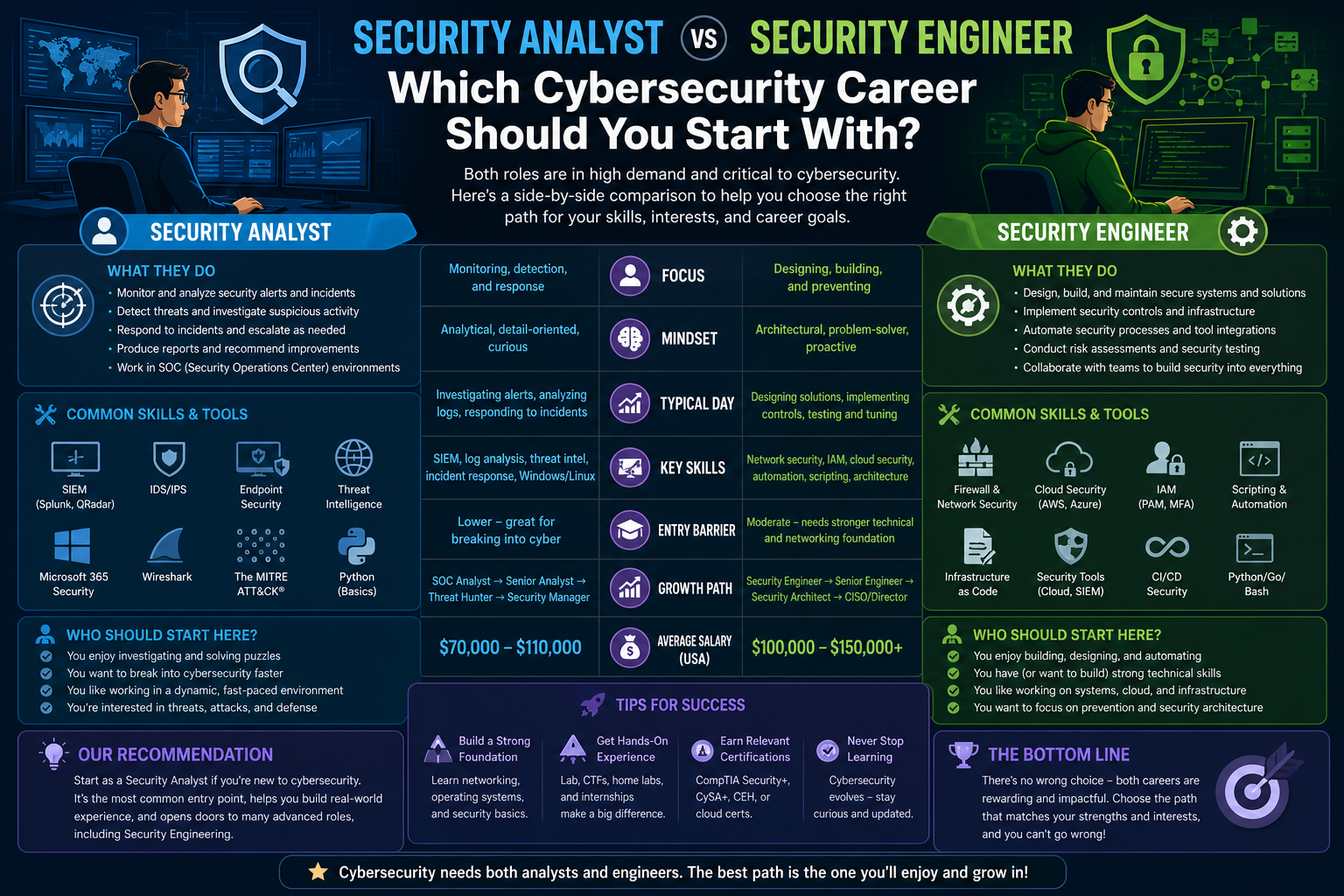
This complexity has forced organizations to rethink how cybersecurity teams are structured. Rather than relying on a single defensive layer, modern security requires specialized roles that operate at different points within the system. Among the most important of these roles are security engineers and security analysts, each contributing to the defense strategy in distinct but interconnected ways.
Security engineers operate closer to the creation and reinforcement of systems. They design, build, and strengthen the technologies that protect infrastructure. Security analysts, on the other hand, focus on observation, monitoring, and interpretation of system behavior. They examine activity across networks and applications to detect anomalies, suspicious behavior, and potential breaches.
Understanding how these roles function begins with understanding the environment they operate in. Organizations today function like layered defense ecosystems, where protection is distributed across multiple levels rather than concentrated in one place. This layered approach ensures that even if one control fails, others remain in place to reduce risk and limit damage.
Modern Enterprise Defense Architecture
The structure of enterprise cybersecurity can be compared to a multi-layered defense system. Instead of a single wall protecting valuable assets, organizations deploy multiple protective layers that work together. Each layer serves a specific purpose, such as preventing unauthorized access, detecting unusual activity, or responding to incidents when they occur.
At the outermost level, there are systems designed to filter incoming traffic and block known threats. Firewalls, intrusion prevention systems, and secure gateways form the first barrier between external networks and internal systems. However, this outer layer is no longer sufficient on its own because threats can originate from within trusted environments or bypass traditional controls entirely.
Inside the perimeter, security becomes more complex. Applications communicate with databases, cloud services exchange information with on-premises systems, and users interact with multiple platforms simultaneously. Each of these interactions introduces potential vulnerabilities. Misconfigurations, weak authentication mechanisms, and insecure code can all create opportunities for exploitation.
To manage this complexity, organizations rely on layered defense strategies that extend beyond the traditional perimeter. These layers include identity management systems, endpoint protection, behavioral monitoring tools, encryption mechanisms, and continuous auditing processes. Each layer contributes to reducing exposure and increasing visibility across the entire system.
Within this architecture, security engineers are responsible for building and maintaining many of these defensive components. They ensure that systems are designed with security in mind from the beginning rather than added as an afterthought. Their work influences how data is stored, how applications communicate, and how users access resources.
Security analysts operate within this architecture by continuously observing how these systems behave in real time. They interpret the signals generated by security tools, identify irregular patterns, and determine whether those patterns represent actual threats. Their role is not to build the defenses but to evaluate how effectively those defenses are performing under real-world conditions.
This division of responsibility allows organizations to maintain a balance between proactive design and reactive monitoring. While engineers focus on strengthening systems before attacks occur, analysts focus on detecting and responding to issues as they arise. Together, they create a continuous feedback loop that improves overall security posture.
The Security Operations Center as the Command Environment
At the heart of modern cybersecurity operations is a centralized environment known as the Security Operations Center. This is where security analysts primarily operate, monitoring systems and coordinating responses to potential threats. The SOC functions as the nerve center of enterprise defense, bringing together data from multiple sources into a unified view.
Inside this environment, analysts observe activity from across the organization’s digital ecosystem. Logs from servers, alerts from firewalls, notifications from endpoint protection systems, and data from cloud platforms are all collected and analyzed. This constant stream of information allows analysts to detect patterns that might indicate malicious activity or system misbehavior.
The SOC is not simply a physical space filled with screens. It represents a structured process for managing security events. Information flows continuously into centralized systems where it is normalized, correlated, and evaluated. Analysts then interpret this data to determine whether an incident is occurring, has occurred, or is likely to occur in the future.
One of the key challenges within the SOC is distinguishing between normal behavior and suspicious activity. Modern systems generate enormous volumes of data, much of which is benign. Users log in, applications exchange data, and systems perform routine maintenance tasks. Within this normal activity, however, subtle anomalies can indicate potential threats.
Security analysts must develop the ability to recognize these anomalies. This involves understanding baseline behavior for systems and users, then identifying deviations from those patterns. A single unusual login attempt may not indicate a breach, but a series of coordinated anomalies across multiple systems might signal a more serious issue.
The SOC also plays a critical role in incident response. When a potential threat is identified, analysts work to investigate its origin, scope, and impact. They determine whether the activity is malicious, accidental, or false positive. Depending on the outcome, they may escalate the issue, contain the threat, or document it for future analysis.
While analysts focus on monitoring and investigation, their work depends heavily on the systems built by security engineers. Without properly configured logging, detection rules, and monitoring tools, analysts would lack the visibility needed to identify threats effectively. This interdependence highlights the importance of coordination between both roles.
Security Engineer Role and Technical Foundation
Security engineers are responsible for designing and implementing the systems that protect organizational infrastructure. Their work is deeply technical and involves integrating security principles into the architecture of applications, networks, and cloud environments. Rather than simply reacting to threats, they focus on preventing vulnerabilities from existing in the first place.
A security engineer’s role often begins during the design phase of a system. When new applications or infrastructure components are being developed, engineers evaluate potential security risks and recommend controls to mitigate them. This may include encryption strategies, authentication mechanisms, access controls, and secure communication protocols.
Their responsibilities extend across a wide range of technologies. Modern environments include operating systems such as Windows and Linux, cloud platforms that host critical workloads, and a variety of development frameworks used to build applications. Engineers must understand how these components interact and where security weaknesses may arise.
In addition to system architecture, security engineers often work with automation and scripting tools to improve efficiency. By automating repetitive tasks such as configuration checks, vulnerability scanning, and patch management, they reduce the likelihood of human error while increasing consistency across systems.
Another important aspect of their role involves testing and validation. Security engineers frequently simulate attack scenarios to identify weaknesses in systems before malicious actors can exploit them. This process helps organizations strengthen defenses and refine security policies over time.
Their work is not limited to technical implementation. Security engineers must also consider regulatory and compliance requirements. Many industries are governed by strict standards that dictate how data must be protected. Engineers ensure that systems adhere to these requirements by incorporating appropriate controls and documentation practices.
Engineer Technical Environment and Tools
The technical environment of a security engineer is highly diverse and constantly evolving. It spans across cloud platforms, on-premises infrastructure, and hybrid environments that combine both. Engineers must be comfortable navigating this complexity while maintaining a strong focus on security principles.
Cloud environments play a significant role in modern infrastructure. Services such as compute instances, storage systems, and managed databases are commonly deployed across platforms. Security engineers are responsible for configuring these services securely, ensuring that access controls are properly defined and data is protected both in transit and at rest.
Operating systems remain a foundational element of their work. Understanding how Linux and Windows systems operate allows engineers to secure endpoints, manage permissions, and detect vulnerabilities at the system level. Each operating system has its own security model, requiring specialized knowledge to configure and maintain effectively.
Networking is another critical area of focus. Engineers must understand how data moves across networks, including concepts such as routing, segmentation, and protocol behavior. Misconfigurations at the network level can expose systems to significant risk, making this knowledge essential for effective defense design.
Security engineers also interact with a wide range of security tools. These tools assist in identifying vulnerabilities, testing system resilience, and analyzing potential threats. They may use penetration testing frameworks to simulate attacks or vulnerability scanners to identify weaknesses in applications and infrastructure.
Scripting and programming skills further enhance their ability to automate tasks and customize security solutions. Languages such as Python are commonly used to develop security scripts, analyze data, and integrate different tools into cohesive workflows. This ability to programmatically control security processes increases efficiency and scalability.
Within this environment, engineers continuously evaluate new technologies and attack methods. The cybersecurity landscape evolves rapidly, and staying ahead requires constant learning and adaptation. This ongoing development ensures that security measures remain effective against emerging threats.
Security Analyst Role and Observational Focus
Security analysts operate primarily in a monitoring and investigative capacity. Their role centers on observing system activity, analyzing security data, and identifying potential threats. Unlike engineers, who focus on building systems, analysts focus on understanding how those systems behave in real time.
Their work begins with continuous monitoring of security events generated across the organization. These events may include login attempts, file access patterns, network traffic anomalies, and system alerts. By reviewing this information, analysts gain visibility into what is happening across the digital environment.
A key aspect of their role is identifying unusual behavior. This requires understanding normal system activity so that deviations can be recognized. For example, a user accessing files at an unusual time or from an unexpected location may indicate suspicious behavior that requires further investigation.
Security analysts also play a major role in vulnerability management. They review scanning results, prioritize risks, and provide recommendations for remediation. This helps organizations address weaknesses before they can be exploited by attackers.
In many cases, analysts work closely with incident response teams. When a potential security incident is detected, they help investigate its origin and determine its impact. This involves analyzing logs, tracing activity across systems, and correlating data from multiple sources to build a clear picture of events.
Their responsibilities require a strong understanding of both technical systems and attack methodologies. Analysts must be familiar with how attackers operate, including common techniques used to bypass security controls. This knowledge allows them to recognize threats more effectively and respond appropriately.
The role of a security analyst is often considered an entry point into cybersecurity, but it is far from simple or limited. It requires strong analytical skills, attention to detail, and the ability to interpret complex data under pressure. Over time, analysts develop deeper expertise that can lead to more advanced roles within the field.
Analyst Monitoring Systems and Data Interpretation
Within the SOC environment, security analysts rely heavily on monitoring systems that collect and organize security data. These systems aggregate information from across the organization, providing a centralized view of activity that would otherwise be difficult to interpret.
One of the primary challenges in this environment is dealing with large volumes of data. Every system interaction generates logs, and these logs accumulate rapidly. Analysts must filter through this information to identify meaningful signals while ignoring irrelevant noise.
To manage this complexity, analysts use correlation techniques to connect related events. A single event may not indicate a threat, but multiple related events occurring in sequence may reveal a pattern of malicious behavior. By connecting these dots, analysts can uncover incidents that would otherwise go unnoticed.
Another important aspect of their work involves validating alerts. Security tools often generate automated alerts when suspicious activity is detected. However, not all alerts represent real threats. Analysts must evaluate each alert to determine its validity and severity.
This validation process requires careful examination of context. Analysts consider factors such as user behavior, system configuration, and historical activity before making conclusions. This ensures that responses are accurate and appropriate to the situation.
In addition to monitoring and validation, analysts contribute to improving detection systems. By analyzing past incidents and identifying gaps in coverage, they help refine rules and detection logic. This continuous improvement process strengthens the organization’s overall security posture.
The work of a security analyst is both analytical and investigative, requiring constant attention to detail and a deep understanding of system behavior. It complements the engineering function by providing real-world feedback on how security controls perform under actual conditions.
Threat Intelligence and the Expanding Role of Security Analysts
As cybersecurity environments have become more complex, the role of a security analyst has expanded far beyond simple log review. Analysts now operate in a landscape where threat intelligence plays a central role in decision-making. Instead of reacting only to alerts generated within internal systems, analysts increasingly incorporate external intelligence about global threats, attacker behaviors, and emerging vulnerabilities.
Threat intelligence refers to structured information about potential or active cyber threats. This includes indicators such as malicious IP addresses, phishing domains, malware signatures, and attacker techniques. Analysts use this information to enrich internal data, allowing them to detect threats that may not yet have triggered internal alerts.
In modern environments, security analysts must understand how to contextualize this intelligence. A suspicious login attempt may seem minor on its own, but when combined with known attacker infrastructure or patterns associated with a specific threat group, its significance increases dramatically. This ability to correlate internal activity with external intelligence is a defining aspect of advanced analysis work.
Threat intelligence also helps analysts prioritize incidents. Not all alerts carry equal risk. A login attempt from a known benign source is treated differently from activity linked to a known advanced persistent threat. By integrating intelligence into their workflows, analysts can focus attention on the most critical risks first.
This evolution has transformed the analyst role from reactive monitoring to proactive investigation. Analysts are no longer simply responding to what systems report; they are actively shaping how threats are identified and understood within the organization.
Security Information and Event Analysis Workflows
One of the most important operational frameworks used by security analysts is the structured analysis of security information and events. In modern enterprises, this process is highly systematic and depends on centralized data collection platforms that aggregate logs from across the entire infrastructure.
These systems collect data from servers, applications, network devices, cloud platforms, and endpoint security tools. Each data source contributes a different perspective on system activity. When combined, they create a comprehensive view of what is happening across the environment.
Analysts begin by reviewing aggregated alerts and identifying those that require deeper investigation. This filtering process is essential because the volume of data generated in modern systems is enormous. Without prioritization, meaningful signals would be lost in noise.
Once an alert is identified, analysts begin the investigation process. This involves examining related logs, identifying affected systems, and tracing the sequence of events that led to the alert. The goal is to reconstruct a timeline of activity to determine whether a security incident has occurred.
During this process, analysts often move between multiple data sources. For example, a network alert may lead them to review endpoint logs, authentication records, and application activity. This cross-referencing is critical for understanding the full scope of an event.
Another important aspect of this workflow is correlation. Individual events may appear harmless in isolation, but when combined, they may reveal malicious intent. Analysts use correlation rules and behavioral patterns to identify these hidden relationships.
Over time, this process becomes increasingly refined. Analysts learn to recognize subtle indicators of compromise, such as unusual data transfers, abnormal authentication patterns, or unexpected system behavior. These indicators often provide early warning signs of more serious threats.
Incident Detection and Response Lifecycle
When a potential security incident is identified, analysts follow a structured lifecycle to manage and resolve the issue. This lifecycle is designed to ensure that threats are handled efficiently while minimizing damage to systems and data.
The first stage involves detection. This occurs when a system alert is triggered or when an analyst identifies suspicious activity during routine monitoring. Detection is not always straightforward, as many legitimate activities can resemble malicious behavior.
Once an incident is detected, analysts move into the validation phase. During this stage, they determine whether the activity is truly malicious or simply a false positive. This requires careful analysis of context, including user behavior, system configuration, and historical patterns.
If the incident is confirmed, analysts proceed to containment. This step involves limiting the spread or impact of the threat. Depending on the severity, containment actions may include isolating affected systems, disabling user accounts, or blocking network traffic associated with the attack.
After containment, the investigation phase begins in greater depth. Analysts work to understand how the incident occurred, what systems were affected, and whether any data was compromised. This requires detailed forensic analysis of logs, system snapshots, and network activity.
Eradication follows investigation. During this stage, the root cause of the incident is removed from the environment. This may involve deleting malicious files, closing vulnerabilities, or correcting misconfigurations that allowed the attack to succeed.
Finally, recovery ensures that systems are restored to normal operation. This may involve restoring data from backups, reconfiguring systems, or validating that security controls are functioning correctly. Even after recovery, analysts continue to monitor systems for signs of residual threats.
Throughout this entire lifecycle, communication is essential. Analysts must coordinate with engineers, system administrators, and management teams to ensure that appropriate actions are taken. This collaboration ensures that incidents are resolved effectively and that similar issues are prevented in the future.
Deep Dive into Security Engineering Design Principles
While analysts focus on observing and interpreting system behavior, security engineers focus on building systems that reduce risk from the ground up. Their work is guided by foundational design principles that ensure security is embedded into every layer of infrastructure.
One of the most important principles is least privilege. This concept ensures that users and systems are granted only the minimum level of access required to perform their functions. By limiting access, organizations reduce the potential impact of compromised accounts or systems.
Another key principle is defense in depth. Instead of relying on a single security control, engineers design multiple layers of protection. If one layer fails, others remain in place to prevent or detect malicious activity. This layered approach is essential in modern environments where threats can originate from multiple sources.
Security engineers also focus heavily on secure architecture design. This involves structuring systems in a way that minimizes exposure to risk. For example, sensitive data may be isolated in secure environments, while public-facing systems are separated from internal networks.
Encryption plays a critical role in engineering design. Data must be protected both in transit and at rest. Engineers implement encryption protocols to ensure that even if data is intercepted, it cannot be easily read or modified by unauthorized parties.
Authentication and identity management are also central to engineering work. Engineers design systems that verify user identities using secure methods such as multi-factor authentication. This helps prevent unauthorized access even if credentials are compromised.
Another important aspect of engineering design is resilience. Systems must be able to withstand failures, attacks, and unexpected conditions without losing critical functionality. Engineers achieve this through redundancy, failover mechanisms, and load balancing strategies.
These principles work together to create systems that are not only secure but also reliable and scalable. Security engineers continuously evaluate and refine these designs as new threats and technologies emerge.
Engineering Involvement in Cloud and Hybrid Environments
The shift toward cloud computing has significantly changed the responsibilities of security engineers. In traditional environments, engineers focused primarily on on-premises infrastructure. Today, they must manage security across distributed environments that include cloud platforms, local systems, and hybrid architectures.
Cloud environments introduce new challenges because infrastructure is no longer fully controlled by a single organization. Instead, responsibility is shared between cloud providers and customers. This shared responsibility model requires engineers to clearly understand which security controls they are responsible for implementing.
Security engineers must configure cloud resources securely from the moment they are deployed. This includes setting access permissions, managing identity and access policies, and ensuring that data storage systems are properly protected.
Misconfigurations in cloud environments are a common source of security incidents. A single incorrectly configured storage bucket or overly permissive access policy can expose sensitive data to the public. Engineers must therefore continuously audit and validate cloud configurations.
Hybrid environments add another layer of complexity. In these setups, some systems run on-premises while others operate in the cloud. Engineers must ensure that communication between these environments is secure and properly monitored.
This often involves implementing secure communication channels, consistent identity management systems, and unified security policies across all platforms. Without this consistency, gaps can emerge that attackers may exploit.
Automation plays a critical role in cloud security engineering. Engineers use automated tools to enforce security policies, detect misconfigurations, and respond to threats in real time. This reduces the likelihood of human error and improves response speed.
Analyst and Engineer Collaboration in Practice
Although security analysts and engineers have distinct responsibilities, their work is deeply interconnected. Effective cybersecurity depends on continuous collaboration between these roles, ensuring that insights from one side inform actions on the other.
Analysts provide engineers with real-world feedback about how systems behave under normal and abnormal conditions. When analysts detect recurring issues or patterns of false positives, they share this information so engineers can refine system configurations.
Similarly, engineers rely on analysts to validate the effectiveness of security controls. If a new detection rule is implemented, analysts observe how it performs in real-world conditions and determine whether adjustments are needed.
During security incidents, collaboration becomes even more critical. Analysts identify and investigate threats, while engineers implement technical changes to contain and remediate issues. This coordinated effort ensures that incidents are resolved efficiently.
Communication between these roles often occurs through structured reporting systems. Analysts document findings, while engineers track system changes and updates. This shared documentation helps maintain clarity and accountability across the security organization.
Over time, this collaboration leads to continuous improvement. Systems become more resilient, detection capabilities become more accurate, and response processes become more efficient. The relationship between analysts and engineers forms the backbone of modern cybersecurity operations.
Evolution of Skills Across Analyst and Engineer Roles
The skill sets required for security analysts and engineers evolve significantly as professionals gain experience. Entry-level analysts typically begin with foundational knowledge of networking, operating systems, and basic security concepts. Over time, they develop deeper analytical abilities and gain experience with complex investigation techniques.
As analysts progress, they often move into more advanced roles involving threat hunting, incident response leadership, and security strategy development. These roles require a deeper understanding of attacker behavior and system architecture.
Security engineers also follow a progression path, beginning with basic system administration and security configuration tasks. As they gain experience, they take on more complex responsibilities such as designing secure architectures, implementing automation frameworks, and managing large-scale security infrastructure.
Advanced engineers often specialize in areas such as cloud security, application security, or infrastructure protection. These specializations require deep technical knowledge and the ability to design systems that operate securely at scale.
Both roles require continuous learning due to the rapidly evolving nature of cybersecurity. New threats, technologies, and methodologies emerge regularly, requiring professionals to adapt their skills accordingly.
Despite their differences, both analysts and engineers share a common goal: protecting organizational systems and data from unauthorized access and malicious activity. Their collaboration ensures that security is both proactive and responsive, addressing threats from multiple angles simultaneously.
Advanced Threat Landscapes and the Changing Nature of Cyber Risk
As organizations expand their digital footprint, the nature of cyber threats has become more sophisticated, persistent, and adaptive. Attackers no longer rely on simple exploits or isolated weaknesses. Instead, they design multi-stage campaigns that evolve over time, often combining technical exploitation with social engineering and strategic reconnaissance.
Modern threats are rarely random. Many are targeted, meaning attackers deliberately select organizations based on value, access potential, or strategic importance. These attacks often begin with subtle reconnaissance, where adversaries gather information about systems, employees, and infrastructure before attempting any direct intrusion.
This shift has placed greater responsibility on both security analysts and security engineers. Analysts must now recognize early-stage indicators of long-term attack campaigns, while engineers must design systems capable of resisting not just immediate threats but sustained infiltration attempts.
One of the most significant changes in the threat landscape is the rise of stealth-oriented attacks. Instead of causing immediate disruption, attackers often attempt to remain undetected for long periods. During this time, they move laterally through systems, escalate privileges, and quietly gather sensitive data.
This behavior demands a more nuanced approach to detection. Security analysts cannot rely solely on obvious alerts or known signatures. Instead, they must identify subtle anomalies in behavior patterns, network flows, and user activity. Even minor deviations from baseline behavior can become critical clues when viewed in context.
At the same time, security engineers must assume that perimeter defenses will eventually be bypassed. This assumption leads to architectures that prioritize segmentation, isolation, and continuous validation of trust rather than static defensive boundaries.
The evolving threat landscape also includes increased automation on the attacker side. Cybercriminal groups now use automated tools to scan for vulnerabilities across large portions of the internet. This means that any exposed weakness, even briefly, can be quickly discovered and exploited.
In response, organizations must adopt equally adaptive defensive strategies. Security is no longer a static state but a continuous process of monitoring, adjustment, and reinforcement.
The Rise of Behavioral Security Analysis
Traditional security monitoring relied heavily on known indicators such as signatures, rules, and predefined patterns. While these methods remain important, they are no longer sufficient to detect modern threats that intentionally avoid predictable behavior.
Behavioral security analysis has emerged as a critical evolution in this space. Instead of focusing solely on known threats, analysts now study how systems and users behave under normal conditions and then identify deviations from those patterns.
This approach allows analysts to detect previously unknown or emerging threats. For example, if a user typically accesses systems during business hours from a specific location, a sudden login from a different region at an unusual time may indicate compromise.
Behavioral analysis also applies to system activity. Applications, servers, and network devices all exhibit predictable patterns of behavior. When those patterns change unexpectedly, it may signal an underlying issue such as misconfiguration, intrusion, or malware activity.
However, behavioral analysis introduces new challenges. Not all deviations indicate malicious activity. Systems evolve, users change roles, and legitimate business operations often create unusual patterns. Analysts must carefully distinguish between harmless anomalies and genuine threats.
This requires a combination of technical knowledge, contextual awareness, and experience. Analysts must understand not only what is happening but also why it might be happening. This interpretive aspect makes the role both complex and intellectually demanding.
Security engineers support this process by designing systems that generate meaningful telemetry. Without proper logging, instrumentation, and visibility, behavioral analysis would not be possible. Engineers ensure that systems provide the right level of detail for analysts to interpret effectively.
Engineering Security into Modern Software Development
One of the most significant shifts in cybersecurity has been the integration of security practices into software development itself. Instead of treating security as a separate phase after development, organizations now embed security throughout the entire software lifecycle.
Security engineers play a central role in this transformation. They work closely with development teams to ensure that applications are designed with security principles from the beginning. This includes reviewing code architectures, identifying potential vulnerabilities, and recommending secure design patterns.
Modern applications are often built using complex frameworks that rely on multiple external components. Each of these components introduces potential risk. Engineers must evaluate dependencies, ensure proper configuration, and monitor for known vulnerabilities in third-party libraries.
Secure coding practices are another critical aspect of engineering involvement. Developers must be aware of common vulnerabilities such as injection flaws, insecure authentication mechanisms, and improper error handling. Security engineers help define guidelines that reduce the likelihood of these issues occurring.
Testing is also deeply integrated into the development process. Security engineers support automated testing frameworks that evaluate applications for vulnerabilities before they are deployed. This includes static analysis, dynamic testing, and simulated attack scenarios.
By embedding security into development workflows, organizations reduce the number of vulnerabilities that reach production environments. This shift has significantly changed the role of security engineers, making them an integral part of the software creation process rather than external reviewers.
Security analysts benefit from this approach as well. When applications are built securely from the start, the number of incidents they must investigate is reduced. However, they still play a critical role in identifying misconfigurations, runtime issues, and unexpected behaviors that emerge after deployment.
Cloud-Native Security Challenges and Responsibilities
The widespread adoption of cloud computing has introduced new security challenges that differ significantly from traditional infrastructure models. Cloud environments are highly dynamic, scalable, and distributed, which makes them both powerful and complex to secure.
One of the key challenges in cloud security is visibility. In traditional environments, systems are physically or logically contained within a defined network. In cloud environments, resources are constantly being created, modified, and destroyed across multiple regions and services.
Security engineers must ensure that security controls are consistently applied across all cloud resources. This includes identity management, access control, network segmentation, and data protection policies. Any inconsistency can create vulnerabilities that attackers may exploit.
Another challenge is configuration management. Cloud platforms offer a wide range of services, each with its own configuration options. Misconfigurations are one of the most common causes of security incidents in cloud environments.
Engineers must therefore implement strict configuration standards and automated validation processes. These systems continuously check for deviations from expected security settings and alert teams when issues are detected.
Security analysts, on the other hand, must interpret cloud-specific telemetry. This includes monitoring access logs, reviewing API activity, and analyzing resource changes. Cloud environments generate vast amounts of data, making it essential for analysts to focus on meaningful signals rather than raw information.
The dynamic nature of cloud infrastructure also requires a shift in mindset. Security is no longer about protecting fixed assets but about securing constantly changing environments. This requires continuous monitoring, automation, and adaptive defense strategies.
The Emergence of DevSecOps Culture
As cybersecurity has matured, organizations have increasingly adopted collaborative approaches that integrate development, security, and operations into a unified workflow. This cultural shift is often referred to as DevSecOps.
In this model, security is not a separate function but a shared responsibility across all teams. Security engineers act as facilitators, helping developers integrate security practices into their workflows. Security analysts contribute by providing feedback on real-world incidents and vulnerabilities.
DevSecOps emphasizes automation and continuous integration. Security checks are embedded directly into development pipelines, allowing vulnerabilities to be detected early in the development process. This reduces the cost and impact of fixing issues later in production.
Security engineers play a key role in designing and maintaining these automated systems. They define security policies, create validation rules, and ensure that security checks do not disrupt development workflows.
Security analysts contribute by analyzing production incidents and feeding insights back into the development process. This creates a continuous feedback loop where lessons learned from real-world events improve future software development.
This collaborative approach reduces silos between teams and improves overall security posture. It also ensures that security considerations are integrated into every stage of system development and operation.
Career Progression and Specialization Paths
Both security analyst and security engineer roles offer diverse career progression opportunities. As professionals gain experience, they often move into more specialized or leadership-oriented positions.
Security analysts may advance into roles such as threat intelligence specialists, incident response leaders, or security operations managers. These positions require deeper analytical skills and the ability to coordinate responses across multiple teams.
Some analysts transition into threat hunting roles, where they proactively search for hidden threats within systems rather than waiting for alerts. This requires a deep understanding of attacker behavior and system anomalies.
Security engineers often progress into architectural roles, where they design large-scale security systems and define enterprise-wide security strategies. These positions require a combination of technical expertise and strategic thinking.
Other engineers may specialize in areas such as cloud security, application security, or infrastructure protection. These specializations allow them to focus on specific domains while developing deep expertise in those areas.
Leadership roles are also common for both paths. Senior professionals may become security directors or chief information security officers, responsible for overseeing entire security programs and aligning them with business objectives.
Despite their different focuses, both career paths require continuous learning. The cybersecurity field evolves rapidly, and professionals must stay updated on new technologies, threats, and defensive strategies.
Future Directions in Cybersecurity Roles
The distinction between security analysts and security engineers is gradually becoming more fluid as technology evolves. Automation, artificial intelligence, and advanced analytics are reshaping how security tasks are performed.
Many routine tasks traditionally handled by analysts, such as log filtering and basic alert triage, are increasingly being automated. This allows analysts to focus more on complex investigations and strategic threat analysis.
Similarly, security engineers are increasingly relying on automation to manage large-scale infrastructure. Infrastructure-as-code, automated policy enforcement, and continuous compliance monitoring are becoming standard practices.
Artificial intelligence is also beginning to influence both roles. Machine learning models can identify patterns in data that may be difficult for humans to detect. However, human expertise remains essential for interpreting results and making final decisions.
As these technologies evolve, both analysts and engineers will need to adapt their skill sets. Analysts will focus more on interpretation, investigation, and strategy, while engineers will focus on architecture, automation, and system design.
Despite technological advances, the core principle remains unchanged: cybersecurity is fundamentally about understanding systems, anticipating threats, and designing defenses that can adapt to an ever-changing environment.
Conclusion
The distinction between security analysts and security engineers reflects two complementary approaches to the same mission: protecting digital environments from increasingly sophisticated threats. While both roles operate within the broader field of cybersecurity, they focus on different stages of the defense lifecycle and require different skill sets to be effective.
Security engineers concentrate on building and strengthening the systems that form the foundation of organizational security. Their work involves designing secure architectures, implementing protective controls, and ensuring that infrastructure is resilient against attacks. They operate at a structural level, embedding security into applications, networks, and cloud environments before threats can take advantage of weaknesses.
Security analysts, in contrast, focus on visibility and interpretation. They monitor systems in real time, analyze security data, and investigate suspicious activity. Their role is essential for identifying threats that bypass preventative controls and ensuring that incidents are detected and addressed quickly. They provide the observational intelligence that helps organizations understand what is happening within their environments.
Although their responsibilities differ, these roles are deeply interconnected. Engineers rely on analysts to provide feedback on how systems behave in real-world conditions, while analysts depend on engineers to build the tools and frameworks that make detection possible. Together, they form a continuous loop of prevention, detection, and improvement.
As cybersecurity continues to evolve, the boundaries between these roles may shift, but their importance will only increase. Organizations will continue to depend on engineers to design secure systems and on analysts to interpret and respond to emerging threats. Understanding the relationship between these two roles provides a clear perspective on how modern cybersecurity teams function as a unified defense system rather than isolated positions.