In modern networking careers, Cisco’s entry-level certification path is often treated as a reference point for how structured networking education can be delivered. The CCNA credential, in particular, has become widely associated with foundational networking knowledge. It is designed around core concepts that every network professional is expected to understand, regardless of the vendor environment they eventually work in.
At its core, the CCNA framework focuses on how data moves across networks, how devices communicate, and how infrastructure is built to support connectivity at scale. It introduces learners to routing and switching concepts, IP addressing, subnetting, VLANs, and basic network security principles. These are not just Cisco-specific ideas; they represent the fundamental language of networking itself.
What makes CCNA particularly influential is the way it structures this knowledge into a progressive learning path. Instead of treating networking as a collection of disconnected topics, it builds a mental model of how networks behave. A learner starts with simple local area network concepts and gradually moves toward more complex ideas like dynamic routing protocols and wide area network connectivity. This layered approach has contributed to its reputation as a standard starting point for many IT professionals.
Because Cisco has historically held a dominant position in enterprise networking infrastructure, CCNA naturally aligns with real-world deployments found in many organizations. This alignment means that professionals trained in this ecosystem often encounter familiar configurations and concepts when they step into enterprise environments. As a result, CCNA is frequently seen not just as a certification, but as a bridge between theoretical learning and practical implementation.
However, despite its widespread recognition, CCNA represents only one interpretation of networking principles. The industry is not built on a single vendor’s philosophy. Networking as a discipline is broader than any one certification path, and this becomes important when comparing it with alternative ecosystems like Juniper Networks.
Understanding Juniper Networks in the Networking Landscape
Juniper Networks emerged as a significant force in the networking industry by focusing heavily on performance-oriented infrastructure and service provider environments. While Cisco established dominance across a wide range of enterprise solutions, Juniper carved out its identity by prioritizing high-speed routing, efficiency, and architectural simplicity.
From the perspective of industry positioning, Juniper is often viewed as a strong alternative ecosystem rather than a direct replacement for Cisco. Its technologies are widely deployed in environments where performance, scalability, and predictable behavior under heavy network loads are critical. This includes service provider backbones, large-scale data routing environments, and high-performance enterprise networks.
One of the defining characteristics of Juniper’s approach is its emphasis on clean separation between control and forwarding functions within networking devices. This architectural choice influences how its systems behave under stress and how they are maintained over time. Instead of layering complexity on top of legacy systems, Juniper’s design philosophy tends to prioritize consistency and operational clarity.
Juniper’s presence in the networking world is also reinforced by its certification ecosystem. While Cisco certifications are often associated with broad enterprise networking roles, Juniper certifications are typically aligned with environments where performance optimization and routing efficiency are key concerns. This difference in focus contributes to the perception that Juniper represents a more specialized skill set.
It is also important to understand that Juniper’s relevance is not defined by scale alone. Instead, it is defined by strategic adoption. Many large-scale networks incorporate Juniper hardware and software precisely because of its strengths in routing efficiency and system stability. This creates a professional niche where expertise in Juniper technologies can become particularly valuable.
Market Position and Historical Competition
The relationship between Cisco and Juniper has often been described in terms of competition, but it is more accurate to view it as coexistence within different segments of the networking industry. Cisco has historically maintained a broad market presence across enterprise networking, small business infrastructure, and large-scale deployments. Juniper, on the other hand, has concentrated more heavily on high-performance routing and service provider environments.
During the early expansion of internet infrastructure, Cisco became synonymous with networking equipment due to its widespread adoption and extensive product portfolio. It built a reputation for reliability and scalability across diverse environments. This dominance allowed Cisco to establish a strong foothold in enterprise networking, where standardization and vendor consistency are often important.
Juniper entered the landscape with a more focused approach. Instead of competing across every segment, it targeted areas where performance and efficiency were critical differentiators. This strategy allowed Juniper to gain traction in environments that demanded high throughput and minimal latency, particularly in backbone routing infrastructure used by large service providers.
Over time, both companies expanded their reach, but their core identities remained distinct. Cisco continued to evolve its enterprise networking solutions, incorporating broader technologies such as security, collaboration, and cloud integration. Juniper continued refining its expertise in routing, switching, and network optimization, while also expanding into automation and software-defined networking.
This divergence in strategy has created an environment where professionals often encounter both technologies in real-world scenarios. Large organizations may deploy Cisco in enterprise campus networks while using Juniper in core routing or service provider connections. This hybrid adoption reflects the reality that networking is not a single-vendor ecosystem, but a multi-layered infrastructure composed of different strengths.
Understanding this historical and strategic context is important because it explains why professionals might choose to learn beyond a single certification path. Exposure to multiple networking philosophies allows engineers to adapt more effectively to different infrastructure environments.
Architectural Philosophies: IOS vs Junos
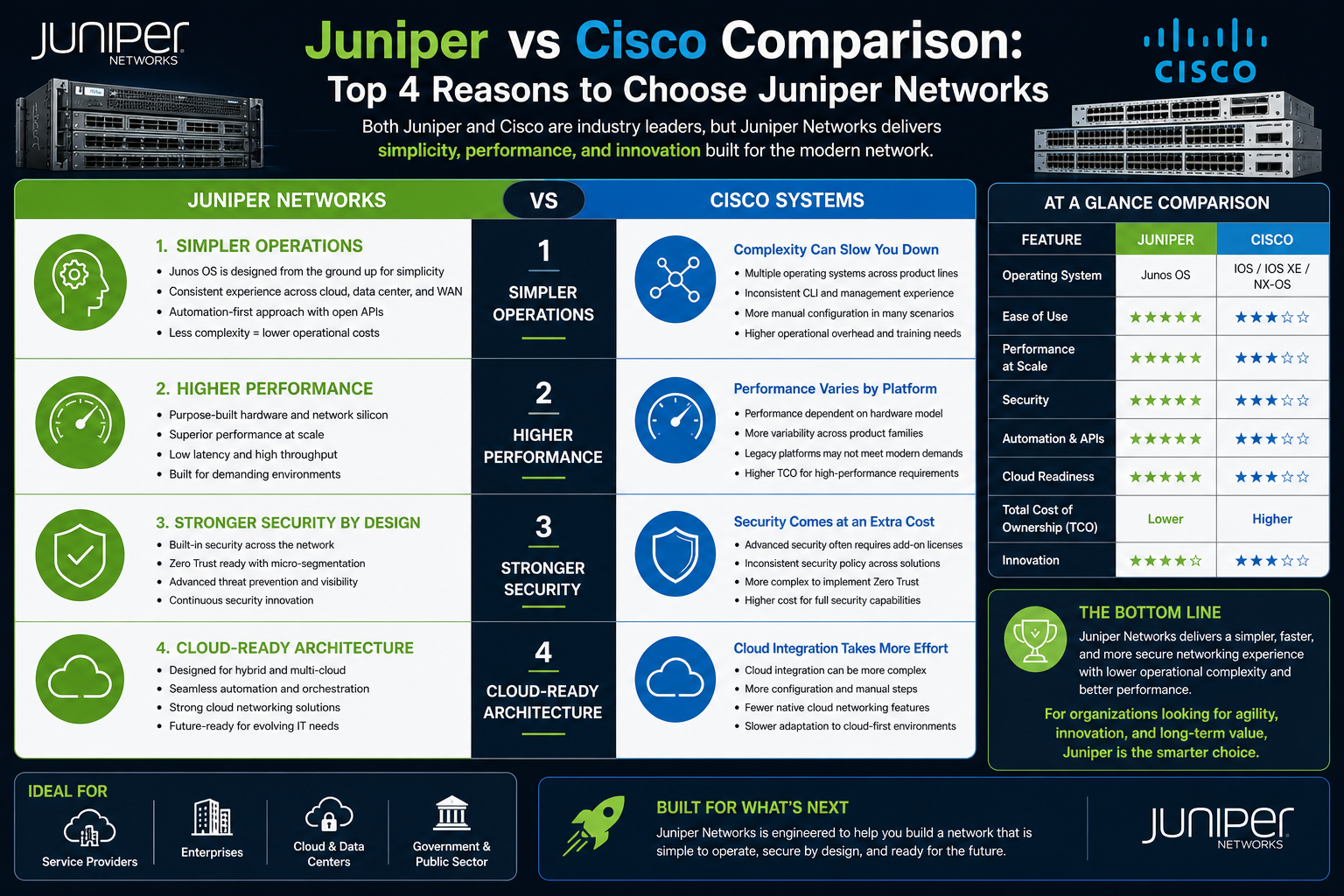
One of the most significant differences between Cisco and Juniper lies in the design of their operating systems. Cisco’s IOS and Juniper’s Junos OS represent two distinct approaches to network device management, configuration, and stability.
Cisco IOS has evolved over many years, adapting to changing networking demands while maintaining backward compatibility. This long evolution has resulted in a system that is highly flexible but also complex. IOS is known for its wide range of features and configurations, which allow it to support diverse networking scenarios. However, this flexibility can also introduce complexity, especially when managing large-scale environments with multiple feature sets enabled simultaneously.
Junos OS, in contrast, was designed with a more structured approach from the beginning. Built on a modular architecture, Junos separates system functions into distinct processes. This design ensures that individual components can operate independently, reducing the risk that a failure in one area will impact the entire system. This separation of functions contributes to operational stability, especially in high-availability environments.
A key difference between the two systems lies in their configuration philosophy. Cisco IOS often relies on incremental configuration changes, where administrators modify settings step by step. Junos OS, however, encourages a more structured configuration model, where changes are reviewed and committed in a controlled manner. This approach reduces configuration errors and improves predictability in network behavior.
Another important distinction is how each operating system handles system processes. In Cisco IOS environments, multiple functions may run within a more tightly coupled framework. In Junos OS, processes are more isolated, which allows for greater fault tolerance. If a single process encounters an issue, it does not necessarily compromise the entire system.
These architectural differences influence how network engineers interact with devices on a daily basis. In IOS environments, troubleshooting often involves navigating a wide range of command structures and configuration contexts. In Junos environments, the structure tends to be more consistent, with a focus on logical separation between configuration, operational monitoring, and system management.
Both systems are powerful in their own right, but they reflect different design philosophies. IOS emphasizes breadth and adaptability, while Junos emphasizes structure and stability. Understanding both approaches provides a deeper appreciation of how network systems can be designed to solve similar problems in different ways.
Hardware Design Differences and Performance Impact
Beyond operating systems, Cisco and Juniper also differ in how they approach hardware design. These differences are particularly evident in high-performance networking environments, where throughput and latency play a critical role.
Juniper has historically emphasized the use of specialized hardware components designed to accelerate packet processing. This includes the use of application-specific integrated circuits, which allow certain networking functions to be handled directly at the hardware level. By offloading tasks from general-purpose processing systems, these devices can achieve faster data forwarding and more consistent performance under load.
This hardware-centric approach is especially valuable in environments where large volumes of data must be processed quickly and reliably. Service provider networks, for example, require consistent performance even during peak traffic conditions. Juniper’s design philosophy aligns closely with these requirements by prioritizing efficient packet handling at the hardware level.
Cisco also utilizes advanced hardware technologies across its product range, but its approach is often more diversified due to its broader market focus. Cisco devices are designed to support a wide range of use cases, from small business networking to large enterprise deployments. This versatility requires a balance between performance optimization and feature richness.
As a result, Cisco hardware often integrates multiple layers of functionality to support different networking scenarios. While this makes it highly adaptable, it can also introduce complexity in terms of configuration and performance tuning.
Juniper’s more focused hardware strategy allows it to optimize deeply for specific use cases, particularly in routing-intensive environments. This specialization contributes to its reputation for high performance in core network infrastructures.
The differences in hardware philosophy also influence how networks are designed and scaled. In Cisco-heavy environments, scalability is often achieved through modular expansion and feature integration. In Juniper environments, scalability is frequently achieved through high-performance core systems designed to handle large volumes of traffic efficiently from the outset.
These contrasting approaches reflect broader differences in how each company views network architecture. One prioritizes flexibility and broad applicability, while the other prioritizes performance and specialization.
Why Professionals Consider a Second Ecosystem
In real-world networking careers, professionals rarely operate within a single vendor ecosystem throughout their entire experience. Networks are often composed of multiple technologies, and engineers are expected to adapt to different environments depending on organizational needs.
For individuals who begin with Cisco-based training, exposure to Juniper systems can provide a valuable expansion of perspective. It introduces alternative ways of thinking about network design, configuration management, and system architecture. This broader understanding can improve problem-solving skills and adaptability in complex environments.
One of the key reasons professionals explore Juniper after Cisco training is the difference in operational philosophy. While Cisco environments often emphasize procedural configuration and extensive feature sets, Juniper environments emphasize structured workflows and system consistency. This contrast helps engineers develop a more flexible mindset when approaching network challenges.
Another important factor is the nature of enterprise infrastructure itself. Many organizations operate hybrid networks where multiple vendors coexist. In such environments, engineers who understand more than one ecosystem are better equipped to troubleshoot issues that span different systems. This cross-compatibility becomes increasingly valuable as networks grow in complexity.
Additionally, exposure to different operating systems and hardware architectures helps professionals develop a deeper understanding of underlying networking principles. Instead of relying on vendor-specific commands or configurations, they begin to recognize patterns in how networks behave regardless of platform.
This broader perspective is particularly relevant in modern networking environments where automation, virtualization, and software-defined infrastructure are becoming more prominent. In these contexts, understanding the logic behind network behavior is often more important than memorizing specific command sets.
Juniper, with its structured operating system and performance-oriented design, offers a different lens through which to view networking. For professionals who are already familiar with Cisco environments, this alternative perspective can provide new insights into efficiency, scalability, and system design principles.
As networking continues to evolve, the ability to navigate multiple ecosystems is becoming less of an advantage and more of a necessity. The differences between Cisco and Juniper are not just technical; they represent different approaches to solving the same fundamental challenges in connectivity, performance, and reliability.
Operational Workflows in Junos OS and Cisco IOS Environments
In day-to-day network administration, the experience of working with Cisco IOS compared to Juniper’s Junos OS is shaped not only by syntax or commands but by the underlying philosophy of system interaction. Both environments are designed to configure, monitor, and maintain network infrastructure, yet they guide engineers through very different operational workflows.
In Cisco IOS-based systems, configuration is often performed in a more immediate and incremental manner. Administrators enter configuration modes, apply changes directly, and observe the effects in real time. This approach provides flexibility and speed, particularly in environments where rapid adjustments are necessary. However, it also requires careful attention to detail, since changes are typically active as soon as they are applied.
Juniper’s Junos OS takes a more structured and transactional approach. Instead of immediately applying changes, configurations are prepared in a candidate state before being committed. This allows engineers to review, validate, and compare changes before they affect the running system. The result is a more controlled operational environment where configuration errors can be reduced through deliberate verification.
This difference in workflow has practical implications for network stability. In large-scale environments, especially those supporting critical services, the ability to stage and review changes before deployment can significantly reduce downtime and configuration-related outages. Junos OS, by design, encourages this disciplined approach, which aligns with environments that prioritize predictability and consistency.
Cisco IOS, on the other hand, is often favored in environments where flexibility and rapid troubleshooting are essential. Its immediate configuration model allows engineers to respond quickly to network events, making it particularly effective in dynamic or smaller-scale environments where iterative changes are common.
The Shift Toward Network Automation
One of the most significant transformations in modern networking is the shift toward automation. Traditional network management relied heavily on manual configuration, where engineers logged into devices individually to make changes. As networks grew in size and complexity, this approach became increasingly inefficient and prone to human error.
Both Cisco and Juniper have responded to this shift by integrating automation capabilities into their platforms, but their approaches reflect their broader design philosophies.
Juniper has historically placed strong emphasis on automation-friendly architecture. Junos OS was designed with structured configuration models that are easier to parse, validate, and automate. This structure allows external systems and scripts to interact with network configurations in a predictable way. As a result, automation tools can more easily interpret configuration states and apply changes consistently across large environments.
Cisco has also made significant advancements in automation, particularly through programmable interfaces and software-defined networking initiatives. However, because Cisco’s ecosystem evolved over a longer period and across a wider range of products, its automation landscape is more diverse. Engineers often encounter multiple tools and interfaces depending on the specific platform or device family they are working with.
The rise of network automation has shifted the focus of networking careers from manual configuration toward software-driven infrastructure management. Engineers are now expected to understand not only how to configure devices but also how to integrate them into automated workflows. This includes the use of APIs, scripting languages, and orchestration systems.
In this context, both Cisco and Juniper environments are evolving toward a shared goal: reducing manual intervention and increasing consistency across network operations. However, the path each vendor takes reflects its underlying philosophy—Cisco through broad ecosystem integration, and Juniper through structured system design.
Enterprise Networking Versus Service Provider Infrastructure
A key distinction between Cisco and Juniper lies in the environments where their technologies are most commonly deployed. While both vendors are present in enterprise and service provider networks, their strengths have historically aligned with different segments.
Cisco has maintained a strong presence in enterprise networking, particularly in campus networks, branch offices, and data center environments. Its broad product portfolio supports a wide range of use cases, from small business connectivity to large-scale enterprise infrastructure. This versatility has made Cisco a default choice in many corporate environments where standardization and vendor support are critical.
Juniper, by contrast, has traditionally been more prominent in service provider networks and high-performance routing environments. Internet service providers, telecommunications companies, and large-scale backbone operators often require infrastructure capable of handling massive traffic volumes with minimal latency. Juniper’s focus on routing efficiency and hardware optimization has made it particularly well-suited to these environments.
In enterprise settings, Juniper is often deployed in specific roles rather than across entire infrastructures. It may be used in core routing, high-performance switching, or security-focused segments of the network. This selective adoption reflects its strength in specialized use cases rather than general-purpose networking.
Service provider environments, however, tend to align more closely with Juniper’s architectural strengths. These networks require consistent performance under heavy load, predictable routing behavior, and high availability. Juniper’s emphasis on streamlined processing and modular system design supports these requirements effectively.
Cisco also plays a significant role in service provider networks, particularly in access and aggregation layers. Its wide range of solutions allows it to address multiple layers of network architecture within a single vendor ecosystem. This flexibility is one of Cisco’s key advantages in large, heterogeneous environments.
The coexistence of both vendors in many networks highlights the reality that modern infrastructure is rarely homogeneous. Instead, it is composed of multiple layers, each optimized for different performance and operational requirements.
Routing and Switching Philosophies in Practice
At the core of both Cisco and Juniper technologies lies the fundamental task of routing and switching. However, the way each vendor approaches these functions reflects distinct engineering philosophies.
Cisco’s approach to routing and switching is characterized by flexibility and feature richness. Its devices support a wide range of protocols, configurations, and customization options. This allows network engineers to tailor systems to specific requirements, whether in enterprise campus networks or large data centers.
Juniper’s approach emphasizes efficiency and consistency. Routing decisions are designed to be highly predictable, with a focus on minimizing overhead and maximizing throughput. This is achieved through a combination of hardware acceleration and streamlined software processes.
In practical terms, these differences influence how networks are designed and operated. Cisco environments often allow for extensive customization of routing policies, switching behaviors, and network segmentation strategies. This flexibility can be advantageous in complex enterprise environments where diverse requirements must be met.
Juniper environments, on the other hand, tend to favor standardized configurations and predictable behavior. This reduces complexity and makes large-scale network operations easier to manage. In environments where consistency is more important than customization, this approach can significantly reduce operational overhead.
Switching architectures also reflect these differences. Cisco switching platforms are designed to support a wide range of features, including advanced VLAN configurations, spanning tree variations, and integration with broader enterprise services. Juniper switching platforms focus more on performance and stability, often prioritizing streamlined forwarding behavior over extensive feature sets.
Both approaches are valid, but they serve different operational priorities. Cisco’s flexibility supports diverse enterprise needs, while Juniper’s efficiency supports high-performance, large-scale environments.
Security Integration and Network Protection Strategies
Network security has become an integral part of infrastructure design, and both Cisco and Juniper have developed comprehensive security solutions to address evolving threats. However, their approaches to security integration reflect their broader architectural philosophies.
Cisco integrates security across a wide range of its products and platforms. Security features are often embedded directly into networking devices, allowing for integrated threat detection, access control, and policy enforcement. This approach aligns with Cisco’s broader ecosystem strategy, where multiple services are combined within a unified infrastructure.
Juniper approaches security with a strong emphasis on performance and segmentation. Its security solutions are often tightly integrated with routing and switching infrastructure, enabling efficient enforcement of security policies without compromising network performance. This is particularly important in high-throughput environments where security cannot become a bottleneck.
Firewall technologies, intrusion prevention systems, and secure routing protocols are common components in both ecosystems. However, Juniper’s implementations are often optimized for environments where traffic volume is extremely high and latency must be minimized.
Cisco’s security ecosystem is broader, encompassing endpoint security, cloud security, and identity management in addition to network-level protection. This makes it well-suited for organizations seeking unified security across multiple layers of infrastructure.
Juniper’s security approach is more focused on network-level protection, particularly in environments where routing and forwarding performance are critical. This specialization allows it to maintain high levels of security without sacrificing throughput.
As cybersecurity threats continue to evolve, both vendors are increasingly integrating advanced analytics, automation, and artificial intelligence into their security frameworks. This reflects a broader industry trend toward proactive rather than reactive security management.
Evolution of Software-Defined Networking Approaches
Software-defined networking represents a major shift in how networks are designed, controlled, and managed. Instead of relying solely on device-level configuration, SDN introduces centralized control mechanisms that abstract network behavior from underlying hardware.
Cisco and Juniper have both developed SDN strategies, but their implementations differ in structure and emphasis.
Cisco’s SDN approach includes architectures such as application-centric infrastructure, which focuses on policy-driven network management. This model emphasizes centralized control and automation across enterprise environments. Cisco’s broad ecosystem allows it to integrate SDN capabilities across multiple product lines, including data centers, campus networks, and cloud environments.
Juniper’s SDN strategy has historically focused on programmability and openness. Its acquisition of technologies that support virtualized networking has enabled it to build platforms that emphasize flexibility and integration with open standards. This aligns with Juniper’s broader philosophy of structured and efficient network design.
In practical terms, SDN allows networks to be managed more dynamically, reducing the need for manual configuration at individual device levels. Policies can be defined centrally and applied consistently across entire infrastructures. This improves scalability and reduces operational complexity.
Cisco’s SDN solutions tend to emphasize integration within its broader ecosystem, providing a unified management experience across multiple network layers. Juniper’s SDN solutions emphasize interoperability and programmability, allowing integration with external systems and custom automation frameworks.
Both approaches reflect different interpretations of how network abstraction should be achieved. Cisco focuses on ecosystem integration, while Juniper focuses on modularity and openness.
Troubleshooting Methodologies Across Platforms
Troubleshooting is one of the most critical skills in network engineering, and the experience of diagnosing issues differs between Cisco and Juniper environments.
In Cisco IOS environments, troubleshooting often involves navigating multiple command contexts and interpreting a wide range of outputs. The flexibility of the system means that issues can arise from many different configuration layers, requiring a broad understanding of device behavior.
Engineers working in Cisco environments typically rely on a combination of real-time diagnostics, interface monitoring, and protocol analysis. Because of the system’s flexibility, troubleshooting can sometimes require examining multiple configuration layers to identify the root cause of an issue.
Juniper’s Junos OS, with its structured design, often provides a more consistent troubleshooting experience. Operational commands are organized in a predictable hierarchy, and system outputs are designed to be uniform across different platforms. This consistency can make it easier to isolate issues, particularly in large-scale environments.
The separation of system processes in Junos OS also contributes to more targeted troubleshooting. Since functions are modular, engineers can focus on specific components without needing to analyze the entire system at once.
In both environments, troubleshooting requires a deep understanding of networking principles, but the tools and workflows differ. Cisco environments often require adaptability across diverse configurations, while Juniper environments emphasize structured analysis and systematic investigation.
Network Design Thinking and Scalability Considerations
Network design is not only about connecting devices but also about anticipating growth, managing complexity, and ensuring long-term stability. Cisco and Juniper approaches to scalability reflect different design philosophies.
Cisco networks are often designed with modular expansion in mind. This allows organizations to grow incrementally, adding new devices and services as needed. The flexibility of Cisco’s ecosystem supports a wide range of deployment models, making it suitable for organizations with evolving requirements.
Juniper networks tend to emphasize high-performance core design, where scalability is achieved through efficient handling of large traffic volumes at key points in the network. This approach reduces the need for excessive layering and can simplify core infrastructure design.
In large-scale environments, these differences become particularly important. Cisco’s modular approach allows for granular expansion across different network segments. Juniper’s approach focuses on optimizing core performance to handle large-scale traffic efficiently.
Both strategies are effective, but they reflect different priorities. One prioritizes flexibility and incremental growth, while the other prioritizes performance and structural efficiency.
As networks continue to evolve toward cloud integration, virtualization, and automation, these design philosophies continue to influence how infrastructure is built and managed across industries.
Enterprise Network Architecture in Hybrid Cisco and Juniper Environments
Modern enterprise networks rarely exist in a single-vendor vacuum. Instead, they are typically hybrid environments where Cisco and Juniper technologies coexist, often serving different layers of the infrastructure stack. Understanding how these systems interact in real-world deployments is essential for grasping the broader relevance of both ecosystems.
In many organizations, Cisco is commonly used in campus environments, branch connectivity, and access layer switching. These are areas where flexibility, ease of deployment, and feature-rich configurations are important. Cisco’s broad product range allows enterprises to standardize across multiple departments while maintaining consistent operational practices.
Juniper, on the other hand, is frequently deployed in core routing layers, data center interconnects, and service provider-facing infrastructure. These are environments where stability under heavy load and predictable performance are more critical than extensive feature variability. Juniper’s architecture is well-suited for handling large volumes of traffic with minimal latency variation.
In hybrid environments, the interaction between Cisco and Juniper systems requires careful planning around routing protocols, interface compatibility, and operational consistency. While both vendors support standard networking protocols such as OSPF, BGP, and MPLS, subtle differences in implementation can influence network behavior.
This coexistence highlights an important reality in networking careers: engineers are often expected to understand multiple systems simultaneously. The ability to operate across vendor boundaries is increasingly valuable as organizations adopt multi-vendor strategies to avoid dependency on a single ecosystem.
Performance Engineering and High-Throughput Networking
Performance engineering is a key differentiator between Cisco and Juniper in large-scale environments. While both vendors design systems capable of high throughput, their optimization strategies differ significantly.
Juniper has traditionally focused on optimizing packet forwarding efficiency through hardware acceleration and streamlined software processing. This approach reduces the burden on general-purpose CPUs and allows specialized components to handle data-intensive tasks. As a result, Juniper systems are often associated with consistent performance under sustained load conditions.
This design philosophy is particularly important in service provider environments, where networks must handle continuous traffic flows across global backbones. In such scenarios, even small inefficiencies can scale into significant performance issues. Juniper’s emphasis on deterministic performance helps mitigate these risks.
Cisco also provides high-performance networking solutions, but its broader product strategy means that performance optimization is often balanced against feature flexibility. Cisco devices are designed to support a wide range of use cases, which sometimes introduces additional processing layers to accommodate diverse functionality.
In enterprise environments, this trade-off is often acceptable because flexibility and feature integration are more important than absolute performance optimization. In service provider environments, however, the balance shifts toward throughput efficiency and latency reduction.
Performance engineering also extends to traffic shaping, quality of service management, and congestion control mechanisms. Both Cisco and Juniper provide robust QoS frameworks, but their configuration approaches differ in complexity and granularity.
Juniper’s approach tends to emphasize structured policy enforcement, where traffic classes are defined clearly and applied consistently. Cisco’s approach offers more granular control options, allowing engineers to fine-tune behavior across multiple network layers.
Automation at Scale and Intent-Based Networking
As networks continue to grow in complexity, automation has become a central requirement rather than an optional enhancement. This shift has given rise to the concept of intent-based networking, where administrators define desired outcomes rather than individual configuration steps.
Cisco has heavily invested in intent-based networking frameworks that integrate analytics, automation, and policy enforcement. These systems are designed to translate high-level business intent into network configurations automatically. This reduces manual intervention and helps ensure consistency across large-scale environments.
Juniper’s automation strategy aligns closely with its structured system design. Junos OS is inherently more machine-readable and predictable, which makes it well-suited for integration with automation tools. Configuration consistency and modular system design allow external systems to interact with Juniper devices in a more deterministic manner.
At scale, automation reduces the risk of human error, accelerates deployment cycles, and improves operational efficiency. In environments with thousands of network devices, manual configuration becomes impractical, making automation essential.
Cisco’s automation ecosystem is deeply integrated into its broader platform strategy, offering centralized management tools that span multiple network domains. Juniper’s approach emphasizes openness and programmability, allowing engineers to build custom automation workflows tailored to specific operational needs.
Both approaches reflect a broader industry trend toward abstraction, where network complexity is hidden behind automated systems that manage configuration, monitoring, and optimization tasks.
Cloud Integration and Virtualized Infrastructure
The rise of cloud computing has fundamentally changed how networks are designed and operated. Traditional on-premises infrastructure is increasingly integrated with public and private cloud environments, creating hybrid architectures that span multiple platforms.
Cisco has developed extensive cloud integration capabilities that support hybrid cloud environments, multi-cloud connectivity, and unified network management across distributed systems. Its solutions are designed to provide consistent networking experiences across both physical and virtual infrastructure.
Juniper also supports cloud integration through its focus on virtualization and software-defined networking. Its technologies are often used in cloud service provider environments where scalability and programmability are essential. Juniper’s emphasis on open architectures allows for flexible integration with cloud orchestration platforms.
In virtualized environments, network functions are increasingly decoupled from physical hardware. This allows routing, switching, and security services to be deployed as software instances that can scale dynamically based on demand.
Cisco and Juniper both support network function virtualization, but their implementations reflect different design philosophies. Cisco’s approach integrates virtualization into its broader ecosystem of enterprise solutions, while Juniper’s approach emphasizes modular deployment and interoperability.
Cloud-native networking also introduces new challenges related to latency, security, and orchestration. Networks must now support dynamic workloads that can move across geographic regions and infrastructure types. This requires highly adaptive networking systems capable of responding in real time to changing conditions.
Career Path Diversification in Networking Roles
From a professional development perspective, understanding both Cisco and Juniper ecosystems can significantly broaden career opportunities in networking. While many professionals begin with a single vendor certification path, exposure to multiple systems often leads to more advanced roles in enterprise architecture, network design, and infrastructure engineering.
Cisco-based career paths often lead into roles such as network administration, enterprise network engineering, and systems integration. These roles focus on maintaining and optimizing large-scale enterprise networks across diverse organizational environments.
Juniper expertise is often associated with roles in service provider networks, high-performance routing environments, and infrastructure design for large-scale systems. These roles require a deep understanding of routing efficiency, scalability, and performance optimization.
Professionals who understand both ecosystems are often better positioned for senior roles that require cross-platform expertise. These roles include network architect positions, infrastructure consultants, and systems engineers responsible for designing hybrid environments.
Career diversification is also influenced by the increasing demand for automation and cloud integration skills. Modern networking roles often require knowledge of scripting, orchestration, and API-based configuration management in addition to traditional networking principles.
As organizations adopt more complex infrastructures, the ability to navigate multiple vendor environments becomes a key differentiator in career progression.
Troubleshooting Complexity in Large-Scale Networks
As networks grow in size and complexity, troubleshooting becomes one of the most challenging aspects of network engineering. Issues may arise at multiple layers, including physical connectivity, routing behavior, application performance, and security enforcement.
In Cisco environments, troubleshooting often involves analyzing a wide range of outputs across different system layers. Engineers may need to examine interface statistics, routing tables, and protocol states to identify the root cause of an issue. The flexibility of Cisco systems means that problems can manifest in various ways depending on configuration complexity.
Juniper’s structured operating system provides a more consistent troubleshooting experience in many cases. Because system processes are modular and outputs are standardized, engineers can more easily isolate specific components when diagnosing issues.
However, both environments require a deep understanding of networking fundamentals. Troubleshooting is not just about using commands but about interpreting system behavior and understanding how different layers of the network interact.
In large-scale environments, troubleshooting also involves collaboration between teams. Network engineers, system administrators, and security professionals often work together to identify and resolve issues. This makes communication and documentation skills just as important as technical expertise.
Security Evolution in Modern Network Design
Network security has evolved from a perimeter-based concept to a distributed model integrated across all layers of infrastructure. Both Cisco and Juniper have adapted their security strategies to reflect this shift.
Cisco integrates security across its ecosystem, offering solutions that span endpoint protection, network access control, cloud security, and threat intelligence. This integrated approach allows organizations to manage security policies across multiple domains from a unified framework.
Juniper focuses heavily on network-level security, particularly in high-performance environments where traffic volume and latency are critical concerns. Its security solutions are designed to operate efficiently without compromising throughput.
Modern security architectures also rely heavily on automation and real-time analytics. Threat detection systems must be able to identify anomalies quickly and respond automatically to mitigate risks. Both Cisco and Juniper have incorporated machine learning and behavioral analytics into their security frameworks.
Zero trust architectures have also become a major trend in network security design. This approach assumes that no part of the network is inherently trusted, requiring continuous verification of users, devices, and applications.
In this context, both Cisco and Juniper provide tools that support identity-based access control, segmentation, and continuous monitoring.
The Future of Networking Ecosystems
The future of networking is being shaped by several converging trends, including automation, cloud computing, artificial intelligence, and edge computing. These trends are redefining how networks are designed, deployed, and managed.
Cisco continues to evolve as a broad infrastructure provider, integrating networking with security, collaboration, and cloud services. Its ecosystem approach positions it as a central platform for enterprise IT infrastructure.
Juniper continues to focus on performance-driven networking and open architectures. Its emphasis on modular design and programmability aligns well with emerging trends in cloud-native and software-defined environments.
As networks become more distributed, the distinction between enterprise and service provider infrastructure is becoming less rigid. Edge computing is bringing processing closer to users, requiring networks that can adapt dynamically to changing workloads.
Artificial intelligence is also playing a growing role in network operations. Predictive analytics, automated fault detection, and self-healing networks are becoming increasingly common.
In this evolving landscape, the ability to understand multiple networking paradigms is becoming increasingly valuable. Cisco and Juniper represent two influential approaches to solving the same fundamental challenges in connectivity, performance, and scalability, and their continued evolution reflects the broader transformation of the networking industry.
Conclusion
The comparison between Cisco and Juniper is not simply a matter of choosing one vendor over the other, but rather understanding two distinct philosophies that have shaped modern networking in different ways. Cisco has long been associated with breadth, accessibility, and dominance across enterprise environments, while Juniper has built its reputation on performance, efficiency, and precision in high-demand networking scenarios. Together, they represent complementary forces rather than mutually exclusive choices.
Cisco’s strength lies in its wide ecosystem and adaptability. It offers solutions that span small business networks, large enterprise campuses, data centers, and cloud-connected infrastructures. Its certification pathways, especially the CCNA and beyond, have become foundational learning routes for countless IT professionals. This widespread adoption has made Cisco concepts almost synonymous with networking fundamentals, giving learners a strong base to build upon.
Juniper, on the other hand, brings a different kind of value. Its focus on streamlined architecture, modular system design, and high-performance routing makes it particularly effective in service provider networks and large-scale infrastructures. The Junos OS design philosophy encourages consistency, stability, and structured operations, which can reduce complexity in environments where reliability is critical.
For professionals, the key takeaway is that networking expertise becomes significantly stronger when it is not limited to a single ecosystem. Exposure to both Cisco and Juniper environments enhances adaptability and deepens understanding of how networks function beyond vendor-specific implementations. It encourages engineers to think in terms of principles rather than commands, and architecture rather than configuration alone.
As modern networks continue to evolve with automation, cloud integration, and software-defined technologies, the ability to navigate multiple platforms becomes increasingly important. Organizations are no longer tied to a single vendor approach, and hybrid environments are now the norm rather than the exception. In such a landscape, familiarity with both Cisco and Juniper can provide a meaningful advantage in design, troubleshooting, and long-term career growth.
Ultimately, Cisco and Juniper are not competing paths that demand exclusivity. They are parallel perspectives on the same discipline, each offering valuable insights into how networks are built, optimized, and scaled in an increasingly connected world.