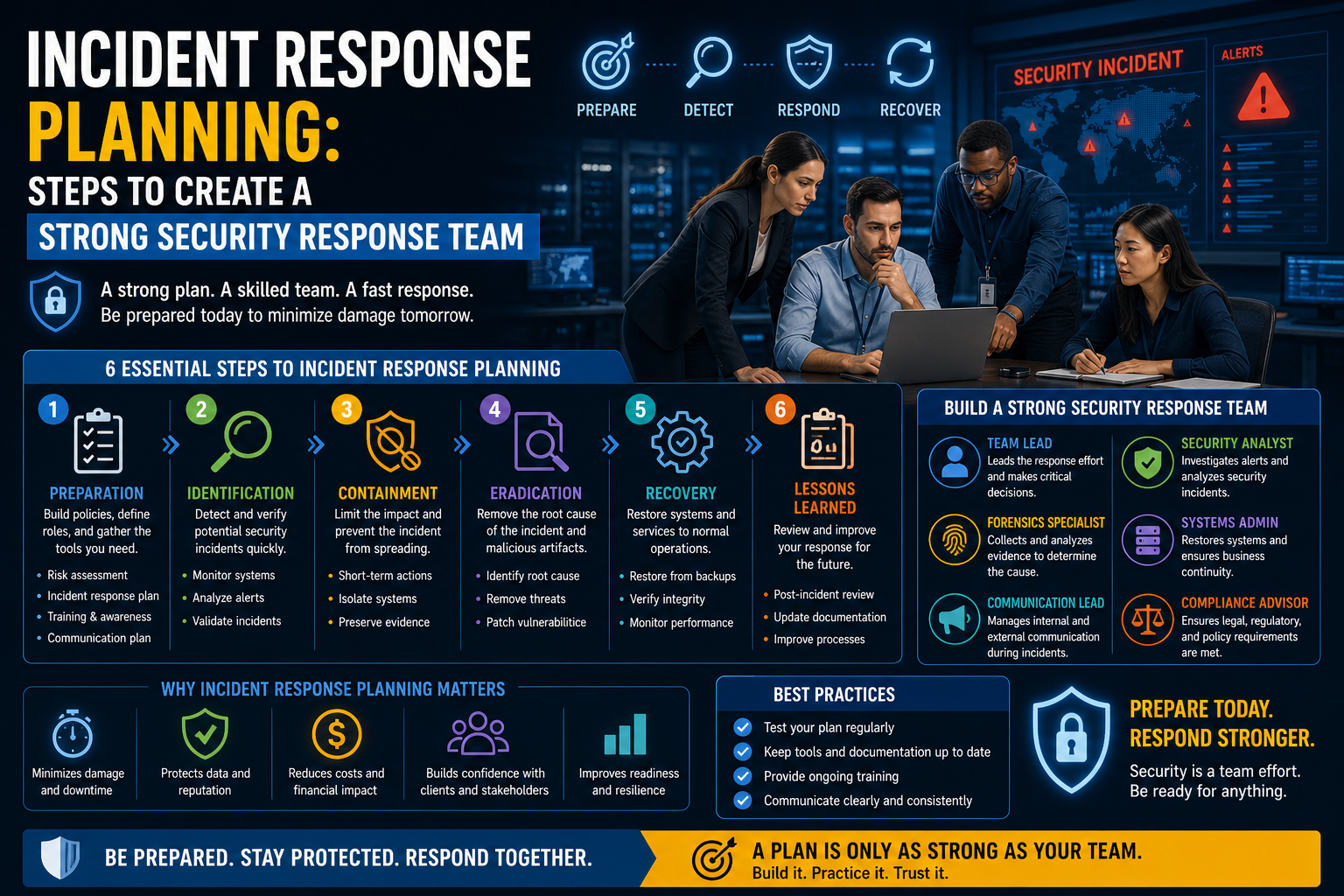
Every organization that uses computers, cloud services, mobile devices, or connected systems faces security risk. Some threats are minor annoyances, while others can interrupt operations, expose confidential data, damage reputation, or create legal consequences. Because cyber incidents can happen without warning, businesses need a structured way to react quickly and effectively. That is where an incident response team becomes essential.
An incident response team is a group of people responsible for preparing for, identifying, containing, investigating, and recovering from security incidents. These incidents may include ransomware attacks, phishing campaigns, unauthorized access, insider misuse, malware infections, data leaks, denial-of-service attacks, or suspicious behavior inside the network. The team exists to reduce confusion during stressful situations and to make sure the right actions happen at the right time.
Many organizations imagine incident response as something only large enterprises need. In reality, any business that depends on digital systems benefits from having a response capability. A small company may only need a compact team with clearly assigned responsibilities, while a large enterprise may require a dedicated department with specialists in multiple areas. Size changes the structure, but the purpose remains the same: detect problems early, limit damage, and restore normal operations.
When a company lacks a response team, incidents often become chaotic. Staff members may not know who should lead the investigation, which systems should be isolated, how to communicate with leadership, or what evidence must be preserved. Valuable time can be lost in debates and confusion. Attackers often rely on this delay. A prepared response team removes uncertainty by following tested procedures and clear lines of authority.
An effective team does more than react after damage occurs. It also studies risks, improves defenses, trains employees, reviews previous incidents, and strengthens the organization over time. In mature environments, incident response becomes part of daily business resilience rather than a separate emergency function.
Why Every Business Needs a Defined Response Capability
Security incidents can affect every part of an organization. A malware outbreak may stop production systems. A compromised email account can be used to deceive customers. A stolen laptop may contain sensitive data. A cloud misconfiguration could expose internal files. Even a small event can become expensive if handled slowly or incorrectly.
The cost of poor response is often larger than the cost of prevention tools alone. Downtime, emergency consulting fees, lost revenue, regulatory penalties, customer distrust, and internal disruption can all grow rapidly after an unmanaged incident. Businesses sometimes focus heavily on prevention technologies while underestimating the importance of response readiness. Yet no defense system is perfect. Sooner or later, something will bypass controls, fail unexpectedly, or be caused by human error.
A defined response capability creates discipline during uncertainty. Instead of reacting emotionally, the organization follows a plan. Instead of assigning blame immediately, it gathers evidence. Instead of making isolated decisions, departments coordinate through established channels. This approach protects both operations and reputation.
Organizations also need response teams because many incidents require decisions beyond technology. Should a service be temporarily shut down? Must customers be informed? Does the legal department need to review notification obligations? Should law enforcement be contacted? Should external forensic experts be engaged? These choices require cross-functional coordination, not only technical skill.
Another reason response readiness matters is speed. Many security events become worse over time. Attackers move laterally, encrypt more systems, steal more data, or create persistence mechanisms the longer they remain active. Fast containment can dramatically reduce impact. A trained team recognizes warning signs and knows how to act without waiting for lengthy approval chains.
What an Incident Response Team Actually Does
People often assume the team only appears when alarms go off. In practice, its responsibilities begin long before any emergency and continue after the immediate crisis ends.
Preparation is one of the most important duties. The team creates procedures, escalation paths, contact lists, access methods, logging standards, evidence handling rules, communication templates, and recovery playbooks. It works with other departments to understand critical systems and business priorities.
Monitoring and detection are another core function. Team members review alerts, investigate suspicious activity, validate reports from users, and determine whether events are harmless or serious. Strong detection reduces the time attackers remain unnoticed.
When an incident is confirmed, the team coordinates containment. This may include disabling accounts, blocking malicious traffic, isolating infected machines, revoking credentials, removing compromised devices from the network, or pausing vulnerable services.
After containment comes investigation and eradication. The team identifies how the incident happened, what systems were affected, what data was accessed, and whether hidden persistence remains. Without proper investigation, organizations risk reinfection or repeated compromise.
Recovery focuses on safely returning systems to normal operations. This can involve restoring backups, rebuilding servers, resetting credentials, validating configurations, and closely monitoring restored services.
Finally, post-incident review is essential. The team documents timelines, decisions, mistakes, strengths, technical findings, and lessons learned. This information improves future readiness and may support compliance or legal requirements.
The Difference Between Events and Incidents
Not every alert deserves a full emergency response. Security tools generate many events every day: failed logins, blocked spam emails, vulnerability scan findings, firewall denials, suspicious downloads, or unusual user behavior. These events may be normal noise, false positives, or early warning signs.
An incident is an event that threatens confidentiality, integrity, availability, safety, or business continuity. For example, one failed login attempt may be routine, but thousands from multiple countries may indicate credential attacks. A single suspicious email may be harmless if blocked, but a successful phishing attempt that compromises an executive mailbox is a serious incident.
A mature team knows how to classify severity and avoid overreacting to minor issues while still escalating genuine threats quickly. Clear triage criteria help prevent alert fatigue and wasted effort.
Core Principles of a Strong Response Function
Technology matters, but principles matter more. Organizations with expensive tools can still fail if they lack discipline and coordination.
The first principle is clarity. Everyone must know who owns decisions, who communicates externally, who manages technical containment, and who approves disruptive actions. Ambiguity wastes time.
The second principle is speed with control. Teams need authority to move quickly, but actions should still be documented and deliberate. Disconnecting the wrong systems or deleting evidence can worsen the situation.
The third principle is evidence preservation. During stressful incidents, people often focus only on restoring service. Yet logs, disk images, screenshots, access records, and timelines may be crucial for understanding what happened. Destroying evidence can create long-term problems.
The fourth principle is communication. Silence creates rumors, panic, and conflicting narratives. Stakeholders need timely updates, even when all answers are not yet known.
The fifth principle is continuous improvement. Every incident reveals weaknesses. Strong teams learn and adapt rather than repeating the same mistakes.
Building the Right Team Structure
No universal model fits every organization. The right structure depends on size, budget, industry, regulatory exposure, operating hours, and technology complexity. However, most teams include several broad responsibilities.
A response manager or coordinator oversees the process, aligns stakeholders, manages priorities, and reports status to leadership. This person may not perform deep technical analysis but must understand both business and security language.
Technical leads guide investigation and containment. They often possess strong knowledge in systems administration, networking, cloud platforms, identity management, and security tooling.
Analysts or responders perform triage, monitor alerts, gather evidence, run queries, inspect logs, and execute containment tasks.
Specialists may be involved as needed. These can include cloud engineers, forensic investigators, malware analysts, legal advisors, privacy officers, communications staff, HR representatives, or external consultants.
Smaller organizations may combine several roles into one person. Larger enterprises may separate them into full departments with 24/7 coverage.
Skills That Matter Most
Many people think incident response is purely technical, but success requires a mix of abilities.
Technical skill is obviously important. Responders need to understand operating systems, networks, identity systems, email security, cloud environments, endpoint behavior, logging tools, and common attack methods. They should know how attackers gain access, move laterally, escalate privileges, and hide activity.
Analytical thinking is equally important. Security investigations rarely present perfect information. Responders must connect weak signals, compare timelines, challenge assumptions, and avoid jumping to conclusions.
Communication skill is often underestimated. During an incident, technical staff may need to explain risks to executives, coordinate with departments, or calm anxious users. Clear language prevents confusion.
Stress tolerance matters because incidents can happen late at night, during holidays, or under intense business pressure. Calm decision-making is valuable when others are panicking.
Curiosity is another strong trait. Good responders ask how something happened, why controls failed, and what unseen risks may still exist.
Discipline is critical because evidence handling, documentation, and procedural consistency protect the organization long after the incident ends.
Internal Teams, External Help, or Hybrid Models
Some businesses maintain a fully internal response team. This offers familiarity with internal systems, faster access, and stronger alignment with company culture. However, hiring and retaining talent can be difficult.
Others rely heavily on outsourced providers. This may reduce staffing burden and provide access to specialized expertise. However, external teams need time to understand the environment and may depend on contract scope or availability during major events.
Many organizations choose a hybrid model. Internal staff handle day-to-day monitoring and initial triage, while outside experts support complex incidents, forensic investigations, threat hunting, or after-hours coverage.
The best model depends on business needs, not trends. A small company may gain more value from a hybrid model than from trying to build a large internal team too early.
Defining Authority Before a Crisis Happens
One of the biggest causes of failed response is delayed decision-making. If responders discover active ransomware but need hours of approvals before isolating systems, damage may spread dramatically.
Authority should be defined in advance. Which actions can the team take immediately? Who can approve shutdown of production systems? Who authorizes customer communication? Who contacts regulators? Who engages outside counsel?
This does not mean giving unlimited power without oversight. It means establishing pre-approved thresholds and escalation routes so urgent decisions happen quickly.
Leadership should support responders publicly. If the team fears punishment for every decisive action, members may hesitate when speed matters most.
Understanding Business Priorities
Technical severity does not always equal business severity. A minor issue on a critical payment platform may matter more than a serious issue on a low-value test server. That is why responders must understand business context.
Which systems generate revenue? Which services customers depend on daily? Which data is highly sensitive? Which platforms support payroll, healthcare, logistics, or safety functions? Which systems have legal reporting obligations?
Without this context, teams may focus effort in the wrong place. Incident response should protect what matters most to the organization, not simply what seems most dramatic technically.
Common Threats Organizations Must Prepare For
Phishing remains one of the most common entry points. Attackers impersonate trusted contacts, steal credentials, deliver malware, or trick employees into transferring funds.
Ransomware continues to disrupt organizations worldwide. Attackers encrypt files, steal data, and demand payment while operations are paralyzed.
Credential attacks use leaked passwords, password spraying, brute force attempts, or session theft to access accounts.
Insider threats may involve malicious intent, negligence, or accidental exposure. Employees can misuse privileges or unknowingly bypass controls.
Cloud misconfigurations expose storage buckets, weak access policies, or unprotected administrative interfaces.
Supply chain incidents occur when trusted vendors, software updates, or service providers become attack vectors.
Distributed denial-of-service attacks flood services and disrupt availability.
Device theft and lost hardware still matter, especially when encryption or remote wipe controls are weak.
Each organization should prioritize threats based on its own environment rather than generic fear.
The Importance of Documentation
In emergencies, memory becomes unreliable. People forget exact times, actions taken, who approved decisions, or which systems were touched. Good documentation solves this problem.
Incident records should include detection time, alerts received, affected assets, actions taken, communication milestones, decisions made, evidence collected, and recovery steps. This record supports lessons learned, audits, insurance claims, legal reviews, and future training.
Documentation should be practical, not excessive. During active response, notes must be quick and usable. Detailed reporting can be completed afterward.
Creating a Culture That Supports Response
A team cannot succeed in a hostile culture. If employees fear reporting mistakes, phishing clicks may stay hidden. If departments resist security collaboration, investigations slow down. If leadership ignores preparedness, responders lack resources.
Organizations should encourage prompt reporting without unnecessary blame. Users who report suspicious emails or accidental mistakes early often prevent larger incidents.
Security teams should build relationships before crises occur. When IT operations, HR, legal, communications, and executives already trust one another, coordination during incidents becomes much easier.
Training also supports culture. Staff should know how to report concerns, recognize suspicious behavior, and understand why response procedures exist.
Metrics That Show Readiness
Measuring response performance helps leaders understand whether the program is improving. Useful metrics may include time to detect, time to contain, time to recover, repeat incident rates, phishing reporting rates, patching speed for exploited vulnerabilities, and completion of lessons learned actions.
Metrics should drive improvement, not vanity. Counting huge numbers of alerts closed means little if true incidents remain unnoticed.
Qualitative measures matter too. Did communication work well? Were stakeholders informed? Did recovery steps cause new problems? Did staff understand roles?
Why Preparation Outweighs Heroics
Popular stories often celebrate heroic responders who save the day during a major attack. While dedication matters, relying on heroics is risky. Sustainable success comes from preparation: tested backups, updated contacts, practiced exercises, clear authority, centralized logs, asset inventories, and trained people.
Organizations that prepare well often appear calm during incidents because much of the hard work was done beforehand. Those that neglect preparation may depend on last-minute improvisation, which increases cost and uncertainty.
Starting Small and Growing Wisely
Some organizations delay building response capability because they think they need a large budget or elite specialists first. That belief creates unnecessary risk. A modest but organized program is better than none.
A small business can start with clear reporting channels, basic logging, backup testing, defined roles, emergency contacts, simple playbooks, and access to outside support when needed. Over time, it can mature into advanced monitoring, tabletop exercises, automation, and specialized expertise.
Incident response maturity is a journey. What matters most is taking practical steps now rather than waiting for a perfect future state.
Designing Roles and Responsibilities Inside an Incident Response Team
Once an organization accepts the need for a formal incident response capability, the next challenge is designing a team that can actually function under pressure. Many businesses assume that buying security software or hiring one skilled analyst is enough. In reality, successful response depends on clearly assigned responsibilities, decision-making authority, communication discipline, and the ability to coordinate across departments. Even highly talented professionals can struggle when roles are vague or overlapping.
An incident rarely affects only one technical area. A phishing breach may involve email systems, identity platforms, finance processes, user awareness, legal review, and public messaging. A ransomware event may impact servers, backups, business continuity planning, vendors, insurance, executive leadership, and customer operations. Because incidents spread across organizational boundaries, the response team must be built with both technical and business functions in mind.
The structure of a team should reflect the company’s size, complexity, and risk exposure. A small business may rely on a compact group where one person handles multiple responsibilities. A multinational organization may operate around the clock with separate units for detection, threat intelligence, forensics, crisis communications, and governance. Neither model is automatically better. What matters is whether the design supports fast and coordinated action.
Some organizations make the mistake of copying the structure of larger enterprises without understanding their own needs. They create titles and layers of management but fail to improve readiness. Others stay too informal for too long, assuming everyone will “figure it out” when something happens. The most effective approach is practical design: assign only the roles that add value, define responsibilities clearly, and rehearse how those roles interact during pressure.
The Importance of Role Clarity During a Crisis
When a serious security event begins, confusion spreads quickly if no one knows who owns what. Multiple people may start investigating the same issue while nobody informs leadership. Technical staff may disconnect systems without considering business impact. Legal obligations may be missed because no one thought to involve compliance teams. Valuable hours can be lost simply because ownership was unclear.
Role clarity solves this problem. Team members should know their core duties before the incident starts. They should understand who leads technical containment, who manages evidence, who communicates with executives, who tracks decisions, who coordinates vendors, and who approves business disruption steps. This does not mean rigid bureaucracy. It means reducing chaos.
Clear responsibilities also reduce stress. People perform better when expectations are known. During tense incidents, responders should not waste energy asking who is in charge or whether they are allowed to act. They should be able to focus on solving the problem.
Another benefit of role clarity is accountability. After an incident, the organization can review what worked and what failed more fairly when responsibilities were known in advance. Without defined ownership, lessons learned become vague and blame-driven rather than constructive.
Leadership Roles That Keep the Team Organized
Every response capability needs leadership, even if the organization is small. Leadership roles do not always require the deepest technical skill. Their main purpose is to coordinate people, priorities, and communication while enabling specialists to work effectively.
The response manager or incident coordinator often acts as the operational leader during events. This person ensures the right people are engaged, meetings are structured, updates are issued, and blockers are removed. They maintain focus on timelines, dependencies, and escalation points. In some organizations this role rotates depending on availability.
Strong coordinators remain calm under pressure. They listen to technical details but translate them into decisions. They understand when to escalate and when to let analysts continue working without interruption. They also protect responders from excessive noise, such as repeated status requests from multiple leaders.
Another leadership role may exist at the program level rather than during live incidents. This could be a security manager responsible for staffing, budget planning, vendor selection, metrics, policy approval, and long-term improvement. During active incidents, this person may support executive alignment while the operational coordinator runs the response.
Leadership credibility matters. If team members do not trust the coordinator’s judgment or communication style, friction increases during already stressful moments. Respect is built through preparation, fairness, and demonstrated competence over time.
The Technical Lead as a Decision Engine
While managers coordinate, technical leads guide the investigation itself. This role is often one of the most demanding in the team because it requires wide knowledge, rapid analysis, and practical decision-making.
The technical lead interprets alerts, prioritizes hypotheses, directs containment steps, validates evidence quality, and helps determine scope. They may advise whether systems should be isolated, credentials reset, logs collected, or backups restored. They also help separate facts from assumptions when pressure mounts.
Strong technical leads are not merely brilliant engineers. They know how to communicate uncertainty. In many incidents, the team does not yet know exactly what happened. Poor leads make overconfident claims too early. Strong leads explain what is known, what is suspected, and what evidence is still needed.
This role often bridges multiple domains. Modern environments combine cloud services, endpoints, identity systems, mobile devices, software-as-a-service platforms, and legacy infrastructure. Technical leads must understand how compromise in one area may affect others.
Because the role can be exhausting, organizations should avoid dependence on a single expert whenever possible. Cross-training and deputy leads help reduce burnout and single points of failure.
Analysts and Responders on the Front Line
Analysts and responders are often the first people to see suspicious activity. They review alerts, validate user reports, inspect logs, enrich indicators, and escalate genuine threats. In many organizations, they are the backbone of day-to-day security operations.
Their work requires patience and discipline. Security tools generate large volumes of noise. Analysts must distinguish harmless anomalies from real danger without becoming numb to constant alerts. They need strong pattern recognition and careful documentation habits.
During active incidents, responders may execute containment actions such as disabling accounts, isolating devices, blocking malicious domains, updating firewall rules, or collecting volatile evidence. They may coordinate directly with IT support teams to access systems or assist affected users.
Because they frequently interact with detection tools, responders often identify gaps before leadership does. They may notice missing logs, weak alert tuning, recurring phishing themes, or asset inventory issues. Organizations should listen to these operational insights.
Career development is important in these roles. Repetitive alert handling without growth opportunities leads to fatigue. Rotations into engineering, threat hunting, forensics, or automation can help retain talented staff.
Forensic and Investigation Specialists
Some incidents require deeper examination than standard response workflows provide. This is where forensic specialists become valuable. They preserve evidence, analyze compromised systems, reconstruct attacker timelines, and identify root causes with a level of detail needed for legal, regulatory, or strategic purposes.
Digital forensics may involve disk imaging, memory analysis, artifact review, deleted file recovery, malware behavior inspection, and chain-of-custody procedures. These tasks require specialized knowledge and tools.
Forensic work is especially useful when organizations need to answer difficult questions such as whether sensitive data was accessed, how long the attacker was present, whether lateral movement occurred, or whether multiple incidents are connected.
Not every company needs full-time forensic staff. Many use external specialists when necessary. However, internal responders should still understand the basics of evidence preservation. Accidentally wiping logs, rebuilding systems too early, or allowing uncontrolled access can destroy valuable investigative data.
Forensics should not delay urgent containment when damage is ongoing. Strong teams balance business urgency with evidence needs, choosing practical steps that protect both operations and investigation quality.
Threat Intelligence and Proactive Support Roles
Response teams often focus only on reacting, but proactive support roles can significantly improve outcomes. Threat intelligence personnel track attacker techniques, current campaigns, exploited vulnerabilities, fraud trends, and industry-specific threats.
This information helps responders prioritize risk. For example, if a new phishing campaign is targeting finance departments across the sector, suspicious payment-related emails deserve extra scrutiny. If attackers are exploiting a specific remote access product, patching and monitoring that product become urgent.
Threat intelligence also improves containment. Knowing common persistence methods or infrastructure associated with certain threat actors can help teams search more effectively.
Proactive support may also include threat hunting teams that search environments for signs of compromise before alerts occur. They investigate unusual behaviors, weak signals, or patterns that automated tools may miss.
In smaller organizations, these functions may be part-time responsibilities rather than dedicated roles. Even basic awareness of current threats can meaningfully improve readiness.
IT Operations as a Critical Partner
Incident response cannot succeed without strong cooperation from IT operations teams. Security teams may identify the problem, but operations teams often control the systems needed to implement changes.
Server administrators may isolate hosts, restore backups, patch vulnerabilities, or validate performance after recovery. Network engineers may block traffic, segment environments, or capture packet data. Identity administrators may disable accounts, rotate privileged credentials, or enforce stronger authentication. Cloud engineers may update policies, snapshots, or access controls.
If security and operations teams distrust one another, response becomes slow and adversarial. Security may demand changes without appreciating uptime concerns. Operations may resist urgent action because it disrupts service. Mature organizations build partnerships before incidents occur.
Shared exercises are valuable. When operations teams participate in tabletop scenarios and live drills, they better understand why certain actions matter. Security teams also learn operational realities such as maintenance windows, dependencies, and recovery constraints.
Respectful collaboration matters more than formal org charts. In many incidents, operations staff are as important to success as security specialists.
Executive Leadership and Decision Authority
Executives are not expected to analyze malware or interpret logs. Their role is different but equally important. They make risk decisions, allocate resources, approve major business impacts, and shape organizational tone during crises.
For example, leadership may need to decide whether to shut down a revenue-generating platform to prevent spread, whether to engage outside advisors, whether to notify partners early, or whether emergency spending is justified. These are business judgments informed by technical input.
Executives also influence culture. If they treat security incidents as embarrassing failures to hide at all costs, staff may delay reporting. If they support transparent and measured handling, teams respond more effectively.
During crises, leadership should avoid micromanaging technical details. Requiring constant status interruptions can slow the people solving the problem. Better practice is establishing scheduled updates with clear decision points.
Strong executives ask practical questions: What is affected? What is the current business impact? What are the options and trade-offs? What help does the team need? What is the next update time?
Legal, Privacy, and Compliance Responsibilities
Many incidents create obligations beyond technology repair. Laws, contracts, regulations, and industry standards may require timely action. That is why legal, privacy, and compliance functions should be integrated into planning rather than called at the last minute.
Legal teams help assess notification duties, evidence sensitivity, contractual commitments, law enforcement considerations, privilege strategy, and wording of formal communications. Privacy specialists evaluate whether personal data was exposed and what jurisdictions may apply.
Compliance teams may determine whether sector-specific rules require reporting or documentation. They can also help align incident records with audit expectations.
These functions are especially important in cross-border organizations where multiple regulatory frameworks may apply simultaneously. Timing matters. Delays or incorrect statements can increase exposure.
Security teams should not guess legal obligations on their own. Likewise, legal teams should receive accurate technical facts rather than speculation. Mutual trust between these groups improves outcomes.
Human Resources and Insider Matters
Not all incidents come from outside attackers. Some involve employees, contractors, or former staff. Others involve user mistakes that require sensitive handling. Human resources plays an important role in these scenarios.
If an employee account is misused, HR may help coordinate interviews, access suspension procedures, device return processes, or disciplinary steps. If an insider intentionally damages systems, HR coordination with legal and security becomes critical.
Even when no malicious intent exists, incidents may affect staff data or workplace morale. Transparent and respectful communication helps preserve trust.
Security teams should avoid treating all user errors as misconduct. Employees who accidentally click phishing links or mishandle files may need coaching rather than punishment. Overly harsh reactions discourage future reporting.
HR can also support wellness. Major incidents often create long hours and stress for responders. Encouraging rest, rotation, and reasonable expectations helps sustain performance.
Communications and Reputation Management
A technically contained incident can still become a reputational crisis if communication is poor. Customers, employees, partners, regulators, and media may all seek answers. That is why communications professionals are valuable members of the broader response framework.
Their role includes preparing internal updates, reviewing external statements, aligning tone with facts, and ensuring consistency across channels. They help prevent speculation, contradictory messaging, or accidental disclosure of inaccurate details.
Timing matters greatly. Saying too little for too long can create distrust. Saying too much too early can spread incorrect information. Good communicators work closely with security and legal teams to balance speed and accuracy.
Internal communication is often overlooked. Employees need guidance about system outages, password resets, phishing follow-ups, or approved talking points. If internal staff feel uninformed, rumors spread quickly.
Prepared templates for common scenarios can save time during stressful moments.
Training and Awareness Functions
One of the best ways to reduce incident volume is to strengthen user behavior. Training teams help build that human defense layer.
Awareness programs can teach phishing recognition, password hygiene, safe data handling, device security, reporting procedures, and common fraud tactics. For technical teams, training may include secure administration practices, patching discipline, cloud security fundamentals, or evidence handling basics.
Training should not be dull or fear-driven. People remember practical examples more than generic warnings. Short, relevant, recurring guidance is often more effective than long annual presentations.
Response teams benefit when users know how to report suspicious events quickly. Many incidents are first discovered by observant employees rather than automated tools.
Training teams also support lessons learned. If repeated incidents involve similar mistakes, awareness content can be updated to target that behavior.
Building Coverage for Nights, Weekends, and Holidays
Attackers do not follow business hours. A response model that only works from nine to five leaves large exposure gaps. Organizations need a realistic plan for off-hours coverage.
Larger enterprises may run round-the-clock security operations with multiple shifts. Mid-sized organizations may use on-call rotations where responders can be contacted after hours. Smaller businesses may rely on managed monitoring providers paired with internal escalation contacts.
Whatever the model, expectations must be clear. Who receives urgent alerts at night? How quickly must they respond? What thresholds justify waking leadership? Which systems require immediate action versus next-business-day review?
Burnout is a real risk in on-call environments. Fair rotations, backup coverage, escalation discipline, and compensatory time help maintain sustainability.
Testing after-hours processes is important. Many organizations discover outdated phone numbers, muted alerts, or unclear ownership only during real emergencies.
The Value of Playbooks and Standard Operating Procedures
Even skilled professionals benefit from written guidance during stressful events. Playbooks provide step-by-step frameworks for common scenarios such as ransomware, phishing compromise, lost devices, privileged account misuse, or cloud exposure.
A good playbook does not replace judgment. It accelerates routine decisions and ensures important steps are not forgotten. For example, a ransomware playbook may remind teams to isolate affected systems, preserve logs, validate backups, assess spread, notify leadership, and coordinate recovery priorities.
Playbooks should be concise, practical, and regularly updated. Documents nobody can navigate during a crisis have little value.
They should also reflect the actual environment. Generic templates copied from elsewhere often fail because internal tools, contacts, and systems differ.
Avoiding Common Structural Mistakes
Many organizations unintentionally weaken their response capability through avoidable design errors.
One mistake is centralizing every decision in a single senior leader. This creates bottlenecks and delays. Authority should be distributed appropriately.
Another mistake is assuming security alone owns every incident task. In reality, operations, legal, HR, and communications often carry major responsibilities.
Some companies overemphasize titles while underinvesting in training. Fancy role names mean little if staff lack practical experience.
Others neglect succession planning. If only one person knows how to lead ransomware recovery or access critical logs, the organization remains fragile.
Another common error is failing to document lessons learned into actual improvements. Repeating the same confusion after each incident signals structural weakness.
Growing the Team Over Time
Response capability should evolve with the organization. A startup may begin with shared responsibilities and external support. As systems expand and regulatory obligations increase, more formal roles become necessary.
Growth should be based on evidence. Frequent after-hours alerts may justify additional staffing. Repeated cloud incidents may justify a cloud security specialist. Long investigation times may justify better tooling or forensic expertise.
Not every maturity step requires hiring. Automation, training, cross-skilling, and improved processes can significantly increase capacity.
Leadership should review whether the current model still matches business reality. Expansion into new regions, acquisitions, remote work changes, or new products can all shift risk patterns.
Creating a Team That Works Under Pressure
The strongest incident response teams are not defined by headcount or expensive tools. They are defined by coordination, trust, adaptability, and clear ownership. During calm periods, these qualities may seem invisible. During crises, they determine whether the organization responds with discipline or disorder.
Designing the right roles is therefore not an administrative exercise. It is a resilience strategy. When people know their responsibilities, communicate well, and support one another, the organization can face difficult incidents with far greater confidence and control.
Strengthening and Sustaining an Incident Response Program
Creating an incident response team is only the beginning. Once roles are assigned and procedures are documented, the real challenge is keeping the program effective over time. Cyber threats change constantly, business systems evolve, and staff members move into new roles. A response team that was well prepared last year may struggle today if it is not regularly maintained and improved.
One of the most important ways to sustain readiness is through regular practice. Tabletop exercises allow teams to walk through realistic scenarios such as ransomware attacks, insider misuse, cloud account compromise, or major service outages. These sessions help participants understand responsibilities, identify gaps, and improve communication before a real emergency occurs. Live simulations can also be valuable for technical teams that need hands-on experience under pressure.
Reviewing past incidents is equally important. Every alert, outage, phishing attempt, or confirmed breach contains lessons. Strong organizations examine what happened, how quickly it was detected, what decisions were effective, and where delays occurred. The purpose of this review should be improvement rather than blame. If people fear punishment, they may hide mistakes instead of helping the organization learn.
Technology must also be refreshed continuously. Logging systems, monitoring tools, backup platforms, endpoint protection, and identity controls should be reviewed often to ensure they still meet operational needs. As attackers adopt new techniques, outdated tools can create blind spots. Even the best team cannot respond well if it lacks visibility into what is happening across the environment.
Training should never stop. Incident responders need ongoing development in areas such as cloud security, malware trends, digital forensics, scripting, threat hunting, and communication skills. Non-technical employees also need awareness training so they can recognize suspicious behavior and report it quickly. Many incidents are first noticed by observant users rather than automated systems.
Another key factor is resilience. Response work can be stressful, especially during nights, weekends, or high-pressure events involving leadership attention. Burnout weakens decision-making and increases turnover. Organizations should rotate responsibilities fairly, encourage time off after major incidents, and ensure staffing levels are realistic. A tired team is a vulnerable team.
Executive support remains essential long after the team is formed. Leaders should review metrics such as detection speed, containment time, repeat incidents, and unresolved risks. They should also fund improvements when weaknesses are identified. Without visible leadership backing, response teams often struggle to gain cooperation from other departments.
Communication processes should be tested regularly as well. Contact lists become outdated, escalation paths change, and new stakeholders appear as the business grows. Simple administrative issues can create major delays during a crisis if they are ignored.
Most importantly, the incident response team should adapt as the business changes. New cloud platforms, remote work models, acquisitions, regulatory obligations, or expanded customer services all create new risks. The response program must evolve with them.
An effective incident response capability is not a one-time project. It is a living function that improves through practice, learning, investment, and strong teamwork. Organizations that treat it as an ongoing discipline are far better prepared when serious incidents inevitably occur.
Conclusion
Building an effective incident response team is one of the smartest steps any organization can take to protect its systems, data, and reputation. Security incidents can happen at any time, and no business is completely immune to threats such as phishing, ransomware, insider misuse, or service disruption. What often separates successful organizations from struggling ones is not whether an incident occurs, but how quickly and professionally it is handled.
A well-structured response team brings order to difficult situations. It ensures that responsibilities are clear, communication remains controlled, and decisions are made with both technical and business priorities in mind. From leadership and analysts to legal, HR, operations, and communications staff, each role contributes to limiting damage and restoring normal operations efficiently.
Preparation is just as important as live response. Strong teams invest in planning, training, testing, and continuous improvement. They learn from previous incidents, update playbooks, strengthen tools, and adapt to new risks as technology changes. This ongoing effort creates resilience and helps the organization respond with confidence instead of panic.
It is also important to remember that incident response is not only about technology. It depends on teamwork, trust, accountability, and support from leadership. Even smaller organizations with limited resources can create an effective response capability by defining roles, improving communication, and using outside expertise when needed.
In the modern digital environment, readiness is a business necessity. Organizations that build and maintain capable incident response teams place themselves in a far stronger position to face uncertainty, reduce disruption, and recover faster when challenges arise.