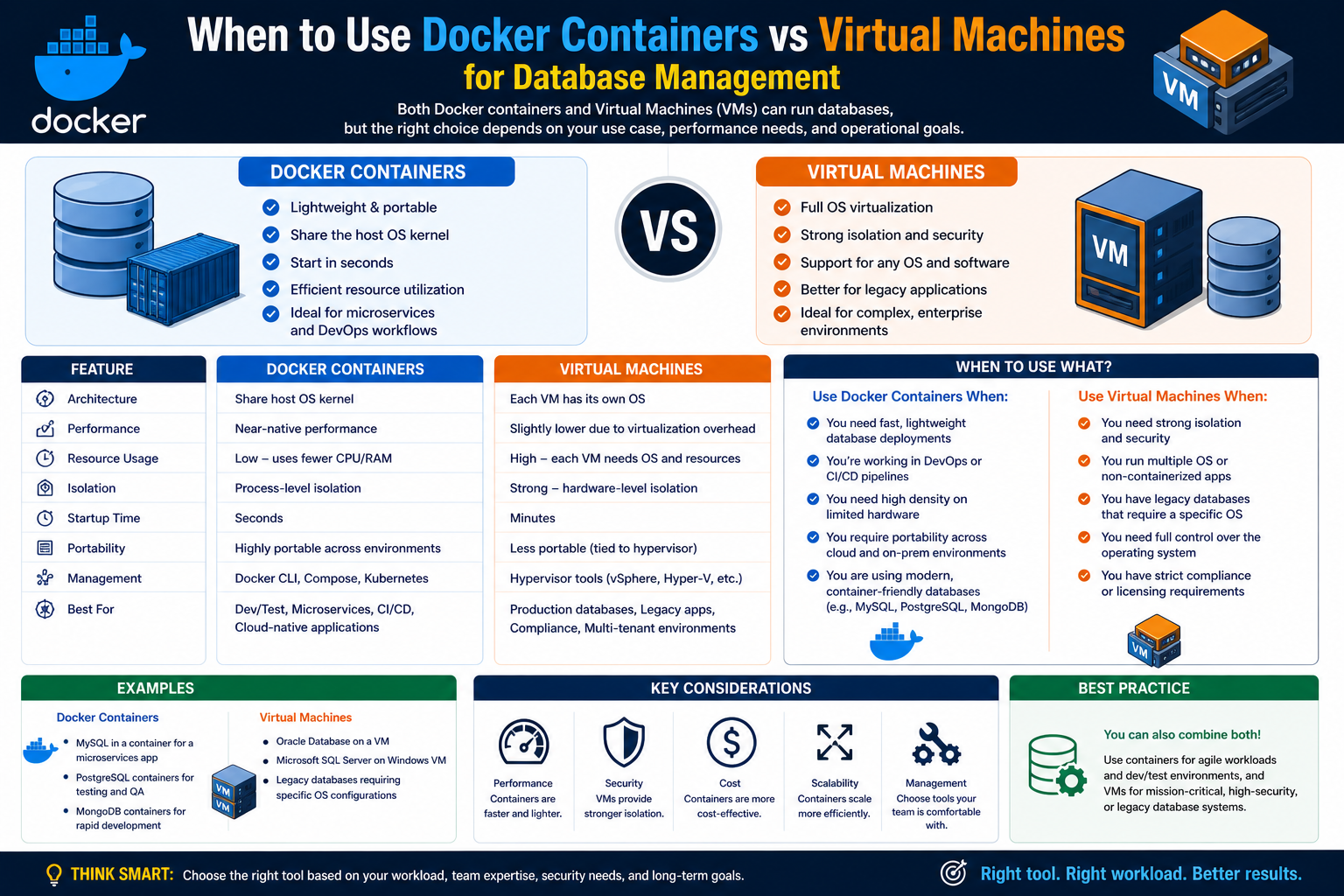
The decision between running databases in Docker containers or on virtual machines has become one of the most discussed architectural choices in modern infrastructure design. Both technologies are widely used in production environments, yet they represent fundamentally different philosophies in how computing resources are packaged, isolated, and managed.
To understand which approach fits databases better, it is important to first move beyond surface-level comparisons and look at how each system actually behaves under the hood. Databases are not ordinary applications—they are state-heavy, performance-sensitive systems that require careful handling of storage, memory, and consistency. This makes the choice of environment especially critical.
Docker containers and virtual machines both provide isolation, but they do so in very different ways. That difference influences everything from performance to scalability, from backup strategies to failure recovery. Understanding these differences is the foundation for making informed infrastructure decisions.
The Architectural Philosophy Behind Docker Containers
Docker containers are built on the idea of lightweight isolation. Instead of simulating an entire operating system, containers share the host system’s kernel while isolating the application process space. This design dramatically reduces overhead and allows multiple applications to run in a highly efficient environment.
At a conceptual level, a container is not a full machine. It is more like a self-contained execution unit that carries everything an application needs to run—libraries, dependencies, runtime settings—while relying on the host system for core operating system functionality.
This shared-kernel approach is what makes containers fast and portable. They start almost instantly, consume fewer resources, and can be replicated easily across different environments. However, this same design introduces constraints, especially when dealing with persistent data systems like databases.
Databases are inherently stateful. They continuously read, write, and update data, and that data must remain consistent even if the system restarts or moves to another host. Containers, by default, are designed to be ephemeral, meaning they are expected to be disposable and easily replaceable. This mismatch between container design and database behavior is one of the central challenges in using Docker for production databases.
The Virtual Machine Model and Its Foundation
Virtual machines take a completely different approach. Instead of sharing the host operating system, each VM runs a full guest operating system on top of a hypervisor. This creates a fully isolated environment that behaves like an independent physical machine.
Every VM includes its own kernel, system libraries, and resource allocation layer. This makes virtual machines significantly heavier than containers, but also more self-contained and predictable.
For databases, this model aligns more naturally with traditional infrastructure design. Databases have historically been deployed on dedicated servers or tightly controlled environments where the system behaves consistently over long periods. VMs preserve that familiarity while still offering the flexibility of virtualization.
The isolation provided by VMs is also stronger in a structural sense. Since each VM runs its own operating system, issues in one VM are far less likely to affect others on the same host. This level of separation can be important in environments where data integrity and stability are top priorities.
Understanding State and Persistence in Database Systems
One of the most important factors in choosing between Docker and virtual machines for databases is how each handles state. State refers to the data that persists over time—records stored in tables, cached values, indexes, logs, and transaction histories.
Databases are fundamentally stateful systems. They are designed to maintain continuity, ensuring that data remains intact even in the event of system restarts or failures. This makes persistence a critical requirement.
Virtual machines handle state in a very straightforward way. Since a VM behaves like a complete computer, all data written to its virtual disk persists just as it would on a physical machine. When the VM shuts down and restarts, it resumes with the same disk state intact.
Docker containers, by contrast, introduce a more complex relationship with persistence. By default, containers are stateless. When a container stops, its internal file system is not guaranteed to persist. This design is intentional, as containers are meant to be lightweight and replaceable units.
To support databases inside containers, external storage mechanisms are typically used. This means the actual database files are stored outside the container itself, often on mounted volumes or external storage systems. When the container starts, it reconnects to this external data source.
This separation between compute and storage introduces flexibility but also adds architectural complexity. The system must ensure that storage remains consistent and accessible even if containers are recreated or scaled horizontally.
Resource Management and Performance Behavior
Performance is a critical factor when running databases, and both Docker and virtual machines handle resources differently.
Virtual machines allocate fixed resources such as CPU, memory, and storage at the hypervisor level. Each VM is given a defined share of the host system, and those resources are generally reserved for that VM alone. This predictability makes performance easier to reason about.
In database workloads, predictability is often more important than raw speed. Consistent query response times, stable memory usage, and controlled disk I/O patterns are essential for maintaining database health.
Containers, on the other hand, operate more dynamically. They use the host system’s kernel and share resources more fluidly. This allows for higher density—more workloads can run on the same hardware—but it also introduces variability.
Under heavy load, multiple containers may compete for CPU cycles, memory, or disk bandwidth. While container orchestration systems can help manage this, the underlying shared environment still requires careful tuning.
That said, containers can deliver excellent performance when properly configured. Because they avoid the overhead of running full operating systems, they often start faster and consume fewer baseline resources than VMs. For certain database workloads, especially those that benefit from rapid scaling, this can be a significant advantage.
The Impact of Isolation on Database Stability
Isolation is another key difference between Docker containers and virtual machines. Isolation refers to how separated one workload is from another within the same physical infrastructure.
Virtual machines provide strong isolation at the hardware abstraction level. Each VM operates as though it has its own dedicated machine. This separation reduces the risk of interference between workloads and improves fault containment.
For databases, this can be particularly valuable. If one VM experiences a crash or memory leak, it is less likely to impact other VMs on the same host. This isolation also simplifies troubleshooting, since each environment is self-contained.
Containers provide a lighter form of isolation. They isolate processes but share the same underlying kernel. While this makes them more efficient, it also means that certain types of system-level issues can have broader effects.
Kernel-level vulnerabilities or resource exhaustion at the host level can impact all containers running on that system. For database workloads that require strict reliability guarantees, this difference in isolation model can be significant.
Data Consistency and Risk Considerations
Databases must ensure data consistency at all times, even in the face of failures, restarts, or network disruptions. This makes risk management a central concern when choosing an infrastructure platform.
Virtual machines simplify many aspects of this problem because they behave like traditional servers. Standard database configurations, backup procedures, and recovery strategies work the same way they would on physical hardware.
Containers introduce additional layers that must be managed carefully. Since containers can be recreated or moved frequently, ensuring that data remains consistent across container lifecycles requires careful orchestration.
This often involves externalizing data storage and ensuring synchronization between compute instances and persistent storage layers. While this model enables flexibility and scalability, it also introduces more moving parts into the system.
More moving parts generally mean more potential points of failure. In database systems where reliability is critical, this trade-off must be carefully evaluated.
Why Database Behavior Matters More Than Deployment Style
A common mistake in infrastructure design is focusing too heavily on deployment technology rather than application behavior. The decision between Docker and virtual machines should not be based solely on modern trends or tooling preferences.
Instead, it should be based on how the database itself behaves under load, how it manages state, and how it responds to scaling demands.
Some databases are designed with horizontal scaling in mind, meaning they naturally distribute data across multiple nodes. Others are optimized for vertical scaling, relying on increased hardware power rather than distribution.
These differences influence how well a database fits into containerized environments versus virtualized environments. Systems that expect rapid scaling and distributed architecture tend to align more naturally with container-based deployment models. Systems that prioritize stability and consistent performance often align better with virtual machines.
The Role of Storage Architecture in Deployment Decisions
Storage architecture plays a central role in determining whether Docker or virtual machines are more suitable for database workloads.
In virtual machine environments, storage is typically integrated directly into the VM’s disk system. This creates a straightforward mapping between database files and underlying storage hardware.
In containerized environments, storage is often decoupled from the container itself. This separation allows containers to be more flexible and portable, but it also requires careful design of storage layers to ensure durability and consistency.
External storage systems, distributed file systems, or network-attached storage are commonly used to support containerized databases. These systems must be carefully configured to avoid performance bottlenecks or data inconsistency issues.
The complexity of storage design is often one of the most important factors influencing whether containers are appropriate for a database workload.
Early Architectural Trade-offs Between Docker and VMs
At a high level, the choice between Docker and virtual machines for databases is a trade-off between flexibility and simplicity, between scalability and predictability, and between modern infrastructure patterns and traditional stability models.
Containers offer agility, rapid deployment, and efficient resource usage. Virtual machines offer stability, strong isolation, and simpler persistence models.
Understanding these trade-offs is essential before moving into more advanced considerations such as scaling strategies, orchestration systems, and hybrid deployment models, which shape how databases behave in real-world production environments.
Scaling Behavior and How It Changes the Database Deployment Decision
When evaluating Docker containers versus virtual machines for databases, scaling behavior becomes one of the most decisive factors. Databases do not scale in a simple, linear way like stateless applications. Their scaling depends on data distribution, replication strategies, consistency requirements, and the ability of the system to handle concurrent read and write operations without degrading performance.
Virtual machines traditionally support vertical scaling more naturally. This means increasing CPU, memory, or storage resources assigned to a single database instance. In many database systems, especially relational databases, this model aligns closely with how they were originally designed to operate. A single, powerful machine handles the workload, and scaling is achieved by upgrading the underlying hardware resources allocated to that machine.
Docker containers, however, encourage horizontal scaling. Instead of making one instance larger, the system creates multiple smaller instances that work together. This approach is commonly used in distributed systems where workloads can be split across nodes. Containers are particularly well suited to this because they can be created and destroyed quickly, allowing orchestration systems to adjust capacity in real time.
The difference in scaling philosophy creates a fundamental tension when running databases in containers. Databases are not always naturally designed for horizontal scaling. Some require careful coordination between nodes, conflict resolution strategies, and replication mechanisms that ensure consistency across distributed environments. While containers enable this architecture, they do not simplify it.
Virtual machines, on the other hand, simplify scaling by keeping the database instance singular and stable. Instead of distributing complexity across multiple nodes, the system focuses on strengthening a single instance. This often results in more predictable performance but limits elasticity.
Stateful Workloads and the Challenge of Container Ephemerality
Databases are inherently stateful systems. Every transaction, update, and query can modify the underlying dataset. This makes persistence a critical requirement, and any infrastructure hosting a database must ensure that data survives restarts, crashes, and migrations.
Containers introduce a challenge because they are fundamentally ephemeral. A container is designed to be disposable. It can be created, destroyed, and replaced at any time. This makes it ideal for stateless applications but problematic for systems that depend on continuous state retention.
To make databases work inside containers, engineers typically separate compute from storage. The container runs the database engine, while the actual data resides in persistent volumes or external storage systems. When a container is restarted or replaced, it reconnects to the same storage layer and resumes operation.
While this architecture works, it introduces additional layers of complexity. Now the reliability of the database depends not only on the container but also on the storage system, the orchestration layer, and the network connecting them.
Virtual machines avoid this complexity by keeping compute and storage tightly coupled. The database operates within a full operating system environment where storage behaves like a local disk. This reduces abstraction layers and simplifies troubleshooting.
However, simplicity does not always mean better scalability or flexibility. The container model, despite its complexity, enables dynamic environments where databases can be migrated, replicated, and scaled with minimal downtime when properly configured.
Orchestration Systems and Their Role in Containerized Databases
Running databases in containers is rarely done manually. Instead, orchestration systems manage container lifecycle, scaling, and networking. These systems introduce automation that helps overcome some of the inherent challenges of containerized stateful applications.
In a container-based database environment, orchestration tools handle tasks such as restarting failed containers, distributing workloads across nodes, and maintaining service discovery between database instances. They can also enforce rules about how many replicas of a database should exist and where they should be placed.
This level of automation is powerful, but it also introduces additional abstraction layers. The database is no longer simply an application running on a machine. It becomes part of a distributed system managed by a control plane.
Virtual machines do not require this level of orchestration for basic database deployment. A VM can run a database server much like a traditional physical machine. While orchestration tools can still be used in VM environments, they are not strictly necessary for basic functionality.
This difference has implications for operational complexity. Containerized databases rely more heavily on automation systems to ensure reliability, while VM-based databases rely more on stable infrastructure and manual or semi-automated management practices.
Resource Contention and Multi-Tenancy Considerations
In modern infrastructure environments, multiple applications often share the same physical hardware. This multi-tenancy introduces the risk of resource contention, where different workloads compete for CPU, memory, or disk access.
Virtual machines mitigate this issue by allocating dedicated resource blocks to each instance. Once resources are assigned, they are generally reserved for that VM. This creates predictable performance boundaries, which is especially important for databases that require consistent response times.
Containers share the underlying operating system kernel and often share hardware resources more dynamically. This allows for higher density, meaning more workloads can run on the same machine. However, it also increases the risk of resource contention.
In database environments, resource contention can lead to latency spikes, slow query performance, or even system instability under heavy load. While container orchestration systems can impose limits and reservations on resource usage, the shared nature of the environment still introduces variability.
Virtual machines reduce this variability by isolating workloads more strictly. This is one of the reasons they are often preferred in environments where performance predictability is more important than density.
Network Behavior and Communication Overhead
Databases rarely operate in isolation. They often communicate with application servers, caching layers, analytics systems, and other database nodes. The way networking is handled in Docker versus virtual machines can significantly affect performance and complexity.
In virtual machine environments, each VM behaves like a separate machine on a network. It has its own network stack, IP address, and routing configuration. This makes network behavior relatively straightforward and predictable.
In containerized environments, networking is abstracted through virtual network interfaces and overlay networks. Containers may share host-level networking resources or be connected through software-defined networking layers.
While this enables flexible service discovery and dynamic scaling, it also introduces additional overhead. Network packets may traverse multiple abstraction layers before reaching their destination, which can increase latency in high-throughput database environments.
For databases that rely heavily on fast inter-node communication, such as distributed NoSQL systems, network performance becomes especially important. Even small delays can impact consistency and replication speed.
Virtual machines tend to offer more stable and predictable networking behavior, while containers offer more flexibility and dynamic connectivity.
Deployment Velocity and Infrastructure Adaptability
One of the most significant advantages of containers is deployment speed. Containers can be created and started in seconds, making it easy to spin up new database instances for testing, scaling, or failover scenarios.
This rapid deployment capability enables highly dynamic infrastructure environments. New database replicas can be added quickly, and failed instances can be replaced almost instantly.
Virtual machines, while flexible, generally take longer to provision. Booting a full operating system, initializing services, and configuring environments introduces more latency compared to containers.
In development environments, this difference is particularly noticeable. Containers allow developers to quickly replicate production-like database environments locally, test changes, and iterate faster.
However, in production environments where stability is more important than speed of deployment, virtual machines often provide a more controlled and predictable lifecycle.
Fault Isolation and Recovery Behavior
Fault isolation refers to how well a system contains failures and prevents them from spreading. In database systems, fault isolation is critical because failures can lead to data corruption, downtime, or inconsistent state.
Virtual machines provide strong fault isolation because each VM operates independently with its own operating system. If a database instance crashes within a VM, the impact is typically contained within that VM.
Containers provide process-level isolation, but they still share the host operating system kernel. If a critical kernel-level issue occurs, it may impact multiple containers simultaneously.
Recovery behavior is also different. In containerized environments, failed containers are often automatically restarted or replaced by orchestration systems. This leads to fast recovery times but may obscure underlying issues if not properly monitored.
In virtual machine environments, recovery often involves restarting the VM or failing over to another instance. While this may take longer, it also provides clearer visibility into system-level failures.
Data Replication Strategies in Container vs VM Environments
Replication is a core concept in database architecture. It ensures that data is duplicated across multiple systems to provide redundancy and improve availability.
In virtual machine environments, replication is typically handled at the database level. The VM acts as a stable host, and replication processes operate within that controlled environment.
In containerized environments, replication often becomes more dynamic. Containers may be added or removed from a replication cluster based on demand. This flexibility allows systems to scale quickly but requires careful coordination to ensure consistency.
Distributed databases that support automatic sharding and replication are better suited to container environments. These systems are designed to handle node churn and dynamic scaling.
Traditional relational databases often require more stable replication topologies, making virtual machines a more natural fit.
Security Boundaries and Isolation Depth
Security is another critical factor in choosing between Docker and virtual machines for databases. Both technologies provide isolation, but the depth of that isolation differs significantly.
Virtual machines provide hardware-level isolation through hypervisors. Each VM operates as a separate machine, which reduces the risk of cross-environment interference.
Containers rely on kernel-level isolation mechanisms such as namespaces and control groups. While these mechanisms are effective, they are still dependent on a shared kernel.
This shared kernel introduces a larger attack surface compared to virtual machines. If a vulnerability is discovered at the kernel level, it could potentially affect all containers on the host system.
For database systems that handle sensitive or critical data, this difference in isolation depth is an important consideration.
Security in container environments can be strengthened through additional layers such as strict access controls, hardened host systems, and runtime monitoring. However, these measures add complexity to the overall system architecture.
Operational Complexity and Long-Term Maintenance
Over time, the operational complexity of a system becomes just as important as its initial performance characteristics. Databases are long-lived systems that often run continuously for years, making maintainability a key concern.
Virtual machines offer a relatively stable operational model. Once a VM is configured, it tends to remain consistent over time. Updates are applied in a controlled manner, and the system behavior remains predictable.
Containerized databases require more dynamic management. Containers may be updated, replaced, or rescheduled frequently. While this enables agility, it also requires robust monitoring and automation to maintain stability.
Long-term maintenance of containerized databases often depends on the maturity of the surrounding infrastructure. Without proper tooling and operational discipline, complexity can grow quickly.
Virtual machines tend to evolve more slowly, which can make them easier to manage in environments where stability is prioritized over rapid change.
Hybrid Approaches Emerging in Modern Systems
In many real-world environments, the decision is not strictly between Docker and virtual machines. Instead, hybrid approaches are increasingly common.
Some systems use virtual machines as the base infrastructure layer while running containers inside them. This approach combines the strong isolation of VMs with the flexibility of containers.
In such architectures, databases may still run directly on virtual machines, while supporting services run in containers. Alternatively, containerized databases may run inside VM-backed clusters to improve isolation and security.
This blending of technologies reflects the fact that neither approach is universally superior. Each has strengths that can complement the other when used appropriately.
Production Readiness and Real-World Database Deployment Patterns
When databases move from development environments into production, the decision between Docker containers and virtual machines becomes less about theory and more about operational reality. Production systems are judged not only on performance, but also on stability, predictability, recovery behavior, and the ability to withstand unpredictable load conditions.
In real-world environments, databases rarely operate in isolation. They support applications, APIs, analytics pipelines, reporting systems, and sometimes even machine learning workflows. This means the database layer becomes one of the most critical components in an entire infrastructure stack.
Virtual machines have traditionally dominated production database deployments because they align closely with established operational models. A database running inside a VM behaves similarly to one running on a physical server. This familiarity reduces operational surprises, which is especially valuable in high-stakes environments.
Containers, however, have steadily gained traction in production systems due to their flexibility and scalability. They enable rapid deployment, easier replication, and more dynamic infrastructure patterns. But production readiness in containerized databases depends heavily on how well the surrounding ecosystem is designed and maintained.
The difference between the two approaches becomes most visible under stress conditions—high traffic spikes, partial system failures, or infrastructure degradation. In these situations, the behavior of the database environment determines whether the system gracefully adapts or begins to degrade.
High Availability and System Resilience
High availability is a core requirement for modern databases. Systems are expected to remain operational even when individual components fail. Both Docker and virtual machines can support high availability, but they do so in different ways.
In virtual machine environments, high availability is often achieved through redundancy at the infrastructure level. Multiple VM instances can be deployed across different physical hosts. If one VM fails, another can take over, often through failover mechanisms managed by clustering software or load balancers.
This approach is relatively straightforward because each VM is a self-contained system. Failover typically involves redirecting traffic or restarting services on another VM instance. The underlying database remains stable because its state is preserved within the VM’s storage system.
In containerized environments, high availability is typically managed through orchestration systems that continuously monitor container health. If a container fails, it is automatically replaced or rescheduled on another node. This makes recovery extremely fast, often within seconds.
However, the challenge lies in maintaining consistent state across rapidly changing container instances. Since containers are designed to be ephemeral, ensuring that they reconnect correctly to persistent storage and maintain replication integrity requires careful orchestration.
High availability in container systems is powerful but dependent on a more complex ecosystem. Virtual machines provide high availability through more traditional, slower-moving mechanisms that are often easier to reason about.
Database Backup Strategies and Recovery Models
Backup and recovery strategies differ significantly between Docker-based and VM-based database deployments.
In virtual machine environments, backups are often taken at the disk or image level. Since a VM behaves like a complete machine, capturing its state is relatively straightforward. Snapshots can be created, stored, and restored with predictable results.
This model works particularly well for databases because it preserves not only the data but also the environment configuration. Recovery involves restoring the VM to a previous state, which often results in minimal discrepancies.
In containerized environments, backups are more complex because the container itself does not contain the full state of the system. Instead, the database data is stored externally. This means backup strategies must focus on persistent storage layers rather than the container runtime.
Recovery in container systems involves reconstructing the environment: launching a new container, attaching it to the correct storage volume, and ensuring that configuration and replication settings are correctly applied.
While this process can be automated, it introduces additional steps compared to VM-based recovery. The advantage is that containers can be restored quickly and scaled dynamically after recovery, but the underlying system requires more coordination.
Backup consistency becomes especially important in containerized databases because multiple replicas may be running simultaneously. Ensuring that backups reflect a consistent point in time across distributed nodes is more challenging than in single-instance VM environments.
Performance Tuning and Optimization Differences
Performance optimization is a critical aspect of database management, and both Docker and virtual machines require different tuning approaches.
In virtual machine environments, performance tuning is often focused on the guest operating system and database configuration. Since resources are allocated in a more static manner, administrators can fine-tune CPU allocation, memory usage, and disk I/O behavior with relatively predictable outcomes.
Database engines running inside VMs benefit from this stability. They can be optimized for consistent workloads, and performance changes tend to be easier to analyze because the environment is stable.
In containerized environments, performance tuning is more dynamic. Containers share host system resources, which means performance can vary depending on what else is running on the same host.
This requires more careful resource isolation using limits and quotas. CPU shares, memory boundaries, and I/O throttling must be configured to ensure that database containers do not interfere with other workloads.
Additionally, containerized databases often rely on external storage systems, which can introduce variability in disk performance. Network-attached storage or distributed file systems may behave differently under load compared to local VM storage.
As a result, performance tuning in container environments is less about static configuration and more about managing dynamic resource allocation.
Observability, Monitoring, and System Visibility
Monitoring database systems is essential for maintaining performance, reliability, and security. However, the level of visibility differs between Docker and virtual machine environments.
Virtual machines provide a straightforward monitoring model. Since each VM behaves like a full machine, traditional monitoring tools can track CPU usage, memory consumption, disk activity, and network traffic at a granular level.
This makes it easier to correlate system behavior with database performance. If a slowdown occurs, administrators can inspect the VM directly to identify resource bottlenecks.
In containerized environments, monitoring becomes more layered. Containers exist within a shared host system, and multiple containers may contribute to overall resource usage patterns.
This requires specialized monitoring tools that can differentiate between container-level metrics and host-level metrics. Observability systems must track not only the database container but also the orchestration layer and underlying infrastructure.
While container environments offer rich telemetry data, interpreting that data often requires more expertise. The abstraction layers that make containers flexible also make them more complex to observe.
Migration Strategies and Portability Considerations
One of the strongest advantages of Docker containers is portability. Containers can be moved across environments with minimal changes, making them ideal for development, testing, and cloud-native deployments.
A database running inside a container can be replicated across multiple environments quickly. This makes it easier to maintain consistency between development, staging, and production systems.
However, database portability is not always straightforward. While the container itself is portable, the underlying data must also be moved or synchronized. This introduces challenges related to data consistency, version compatibility, and storage integration.
Virtual machines are less portable in comparison. A VM image can be moved between environments, but the process is often heavier and slower. VM migration involves transferring large disk images and ensuring compatibility between hypervisors or cloud platforms.
Despite this, VMs provide a more self-contained migration model. Since the entire system is encapsulated within the VM, migration tends to preserve the full environment state more reliably.
In contrast, container migration requires careful coordination between compute and storage layers.
Consistency Models and Distributed Database Behavior
Modern databases often use distributed architectures, especially in large-scale systems. These architectures introduce complexity around consistency, replication, and data synchronization.
Virtual machines tend to support more traditional consistency models. Databases running in VMs often rely on established replication protocols that assume relatively stable node environments.
This stability simplifies consistency management because nodes do not frequently disappear or reappear.
In containerized environments, nodes may be more dynamic. Containers can be scaled up or down rapidly, which introduces variability in the cluster topology.
Distributed databases running in containers must therefore be designed to handle frequent changes in node availability. This often requires more sophisticated consensus algorithms and replication strategies.
While container-based distributed systems can be highly scalable, they require careful engineering to maintain consistency guarantees under dynamic conditions.
Cost Efficiency and Infrastructure Utilization
Cost is often a deciding factor in infrastructure decisions, especially in large-scale deployments.
Containers are generally more resource-efficient than virtual machines because they share the host operating system and avoid the overhead of running multiple guest operating systems.
This allows higher density—more database instances can run on the same physical hardware. In environments where resource utilization is a priority, this can lead to significant cost savings.
Virtual machines, while heavier, provide more predictable resource allocation. This predictability can be valuable in environments where performance consistency is more important than maximizing hardware utilization.
However, the higher overhead of VMs can lead to increased infrastructure costs, especially when scaling horizontally requires provisioning many separate VM instances.
The cost trade-off often comes down to whether the organization prioritizes efficiency or simplicity.
Security Hardening and Operational Risk Management
Security considerations play a major role in database deployment decisions. Both Docker and virtual machines can be secured effectively, but the approaches differ.
Virtual machines benefit from strong isolation boundaries. Since each VM runs its own operating system, security breaches are typically contained within that VM unless hypervisor-level vulnerabilities exist.
This makes VMs attractive in environments with strict security requirements or regulatory constraints.
Containers rely on shared kernel isolation, which introduces a larger shared attack surface. While container security mechanisms are robust, they depend heavily on proper configuration and ongoing maintenance.
Container security often involves additional layers such as runtime scanning, restricted privileges, and hardened host environments.
Operational risk management in container environments requires continuous attention to updates, patching, and configuration management.
VM environments tend to have slower-moving security models but benefit from simpler isolation structures.
Long-Term Evolution of Database Infrastructure Choices
Over time, infrastructure choices tend to evolve rather than remain static. Many organizations start with virtual machines for database workloads due to their simplicity and reliability. As systems grow and scaling demands increase, containers are gradually introduced to improve flexibility and deployment speed.
In some cases, databases remain on virtual machines while surrounding services migrate to containerized environments. In other cases, hybrid models emerge where containers run inside virtual machines to combine isolation with flexibility.
This evolution reflects a broader trend in infrastructure design: moving from static, hardware-like systems toward dynamic, software-defined environments.
However, databases remain one of the most conservative components in this evolution due to their critical role in system integrity.
Conclusion
The decision to run databases in Docker containers or virtual machines is not a simple matter of picking a “better” technology. It is ultimately a question of architectural priorities, operational maturity, and the specific behavior of the database workload itself. Both approaches are capable of supporting production-grade database systems, but they achieve reliability, performance, and scalability through very different mechanisms.
Virtual machines represent a more traditional infrastructure model. They provide strong isolation, predictable performance, and a stable operating environment that closely resembles physical servers. This makes them particularly well-suited for databases that prioritize consistency, long-term stability, and minimal operational complexity. Relational databases, in many cases, still align naturally with virtual machine environments because their design assumptions often depend on stable storage, controlled scaling, and predictable resource allocation.
Docker containers, on the other hand, represent a more modern and dynamic infrastructure approach. They excel in environments where agility, rapid deployment, and horizontal scaling are essential. Containers allow database instances to be created, replicated, and replaced quickly, making them highly attractive in distributed systems and cloud-native architectures. However, this flexibility comes with increased architectural complexity, especially when dealing with stateful systems like databases.
One of the most important distinctions between the two lies in how they handle state and persistence. Virtual machines embed storage and compute within a single, self-contained unit, making persistence straightforward and intuitive. Containers separate compute from storage, requiring external volumes or distributed storage systems to maintain data integrity. While this separation enables scalability and portability, it also introduces additional dependencies that must be carefully managed to avoid data inconsistency or performance degradation.
Another critical factor is operational predictability. Virtual machines tend to behave consistently over time, which simplifies monitoring, troubleshooting, and performance tuning. Containers, by contrast, operate in more dynamic environments where workloads may shift, scale, or restart frequently. This requires more sophisticated orchestration and monitoring systems to maintain visibility and control over database behavior.
From a scalability perspective, containers offer clear advantages in distributed environments. They are designed to work seamlessly with orchestration platforms that can automatically scale services based on demand. This makes them ideal for modern applications that experience variable traffic patterns or require rapid elasticity. However, databases must be carefully engineered to take advantage of this model, especially when consistency and replication are involved.
Virtual machines remain strong in scenarios where vertical scaling is sufficient and where system stability is more important than rapid elasticity. Increasing CPU, memory, or storage within a VM is often simpler and more predictable than managing distributed database clusters across multiple container instances.
Security and isolation also play a significant role in the decision-making process. Virtual machines provide a stronger isolation boundary due to their reliance on hypervisors and separate operating systems. This reduces the risk of cross-workload interference and can be advantageous in environments with strict compliance requirements. Containers rely on shared kernel architecture, which introduces a different security model that depends heavily on proper configuration, hardening, and continuous monitoring.
Cost efficiency is another dimension worth considering. Containers generally offer better hardware utilization because they are lightweight and allow higher density of workloads on the same infrastructure. Virtual machines, while more resource-intensive, provide predictable allocation that can simplify capacity planning in stable environments.
In practice, many modern systems do not rely exclusively on one approach. Instead, hybrid architectures are increasingly common. Databases may run on virtual machines for stability, while supporting services operate in containers for flexibility. In some cases, containers are even deployed inside virtual machines, combining the benefits of both models to balance isolation and agility.
Ultimately, the right choice depends on the nature of the database workload and the priorities of the organization. If the primary goal is maximum stability, simplicity, and predictable performance, virtual machines remain a strong and reliable foundation. If the goal is rapid scaling, automation, and cloud-native flexibility, Docker containers offer powerful advantages—provided the additional complexity is properly managed.
There is no universal winner in this comparison. Instead, there is a spectrum of trade-offs between control and flexibility, stability and agility, simplicity and scalability. Understanding these trade-offs allows architects and engineers to design database systems that not only perform well today but continue to operate reliably as infrastructure demands evolve over time.