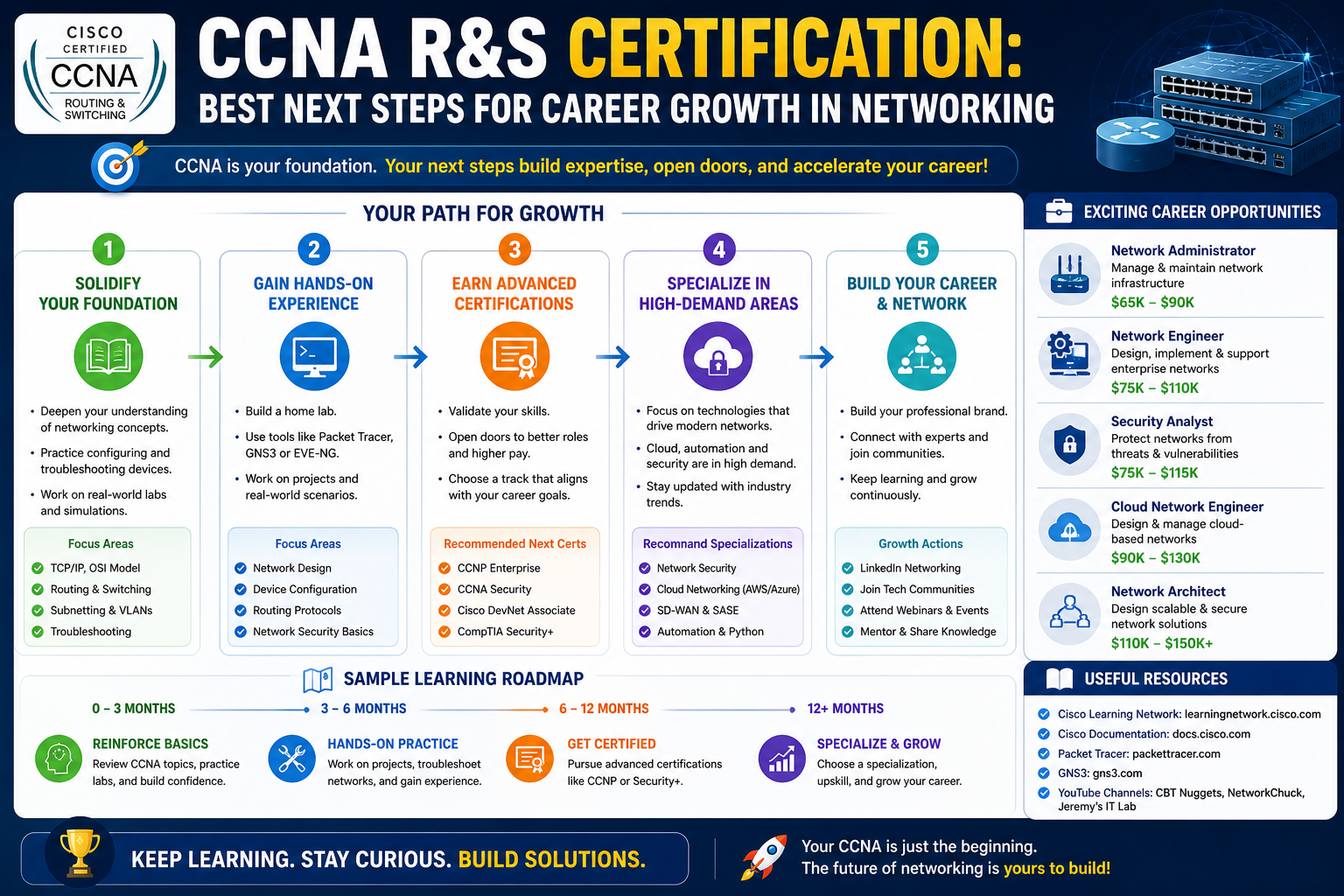
Earning the Cisco CCNA Routing and Switching certification marks a significant transition point in an IT professional’s journey. It is not just another line on a résumé; it signals that you have developed a structured understanding of how modern networks operate at a foundational level. This includes core concepts such as IP addressing, subnetting, routing principles, switching behavior, network troubleshooting, and basic infrastructure services.
In practical terms, this certification shows that you can interpret how data moves across networks and how different devices communicate within enterprise environments. More importantly, it demonstrates that you have built a disciplined approach to problem-solving in networking scenarios rather than relying on guesswork or surface-level familiarity.
However, the value of CCNA does not exist in isolation. Its true impact becomes visible when it is placed within the context of real-world environments. Some professionals step into roles where Cisco equipment dominates daily operations, while others find themselves in hybrid environments where multiple vendors coexist. There are also cases where networking is only one part of a broader IT responsibility.
This variation is exactly why the period immediately after earning CCNA is so important. It is the stage where direction matters as much as knowledge.
Evaluating Your Current or Future Work Environment
Before deciding on the next certification or skill path, it is essential to understand the environment you are working in—or aiming to work in. The IT industry is not uniform. Even two organizations with similar sizes can operate entirely different technology stacks.
In some organizations, Cisco infrastructure is deeply embedded. Routers, switches, firewalls, and wireless systems may all come from Cisco, and network engineers are expected to operate strictly within that ecosystem. In such environments, progressing toward advanced Cisco certifications feels like a natural extension of your CCNA foundation.
In other organizations, the infrastructure is vendor-diverse. You might encounter a mix of Cisco, Juniper, Microsoft-based systems, cloud platforms, and open-source technologies. Here, flexibility becomes more valuable than specialization. Professionals in such environments are often expected to understand concepts that transcend vendor boundaries rather than focusing only on one ecosystem.
There are also organizations where networking is abstracted into cloud-managed services. In these environments, traditional routing and switching tasks are less visible, but underlying networking knowledge remains critical for troubleshooting and optimization.
Understanding where you fit—or where you want to fit—helps you avoid a common mistake: pursuing certifications that do not align with your actual career environment. CCNA gives you options, but direction still needs to be intentional.
The Shift from Certification Learning to Career Strategy
Many professionals initially approach CCNA as a goal in itself. Once achieved, it is common to feel a sense of completion. However, in reality, CCNA should be viewed as the beginning of a more structured career strategy rather than an endpoint.
At this stage, the focus should shift from “what do I study next” to “what role do I want to grow into.” This subtle change in mindset has a significant impact on long-term career progress.
For example, someone aiming to become a network operations engineer will follow a different path compared to someone interested in network design or cybersecurity. Similarly, someone targeting cloud infrastructure roles may gradually move away from traditional networking depth and focus more on integration and automation.
The CCNA certification provides a shared foundation, but career paths begin to diverge quickly after it. This divergence is where professionals either gain momentum or lose direction.
Instead of rushing into the next certification, it becomes important to analyze job roles, understand required skills, and observe how experienced professionals operate in real environments. This reflection helps ensure that your next step is purposeful rather than reactive.
Strengthening Core Networking Understanding Beyond CCNA
Although CCNA covers a wide range of networking fundamentals, it only scratches the surface of what enterprise networking involves. After certification, the next stage of growth involves deepening your conceptual understanding and improving your ability to troubleshoot complex issues.
One of the most important areas to strengthen is routing behavior in dynamic environments. In real-world networks, routing is rarely static or simple. Networks frequently involve multiple routing protocols interacting with each other, route redistribution, failover mechanisms, and policy-based routing decisions. Understanding how these components interact under real conditions is essential for higher-level roles.
Switching is another area where deeper knowledge becomes valuable. While CCNA introduces VLANs and trunking, enterprise environments require a stronger understanding of redundancy protocols, spanning tree optimization, and advanced switching architectures designed for scalability and high availability.
Another critical area is network troubleshooting methodology. CCNA introduces basic diagnostic commands and approaches, but professional environments demand a more structured troubleshooting mindset. This includes isolating issues across multiple layers, identifying patterns in network behavior, and understanding how symptoms in one area may originate from a completely different segment of the infrastructure.
As you build experience, you begin to move from reactive troubleshooting to predictive thinking. This shift is what distinguishes entry-level professionals from mid-level engineers.
Understanding the Importance of Specialization vs Generalization
One of the biggest decisions after CCNA is whether to specialize or broaden your skill set. Both paths are valid, but they lead to different career outcomes.
Specialization involves focusing deeply on one area of networking or IT. This could be advanced routing and switching, network security, data center infrastructure, or service provider networks. Specialization often leads to roles that require deep technical expertise and offer higher responsibility within a specific domain.
On the other hand, generalization involves expanding your knowledge across multiple domains. This might include cloud platforms, system administration, cybersecurity basics, virtualization, or even automation tools. Generalists are often valued in smaller organizations or hybrid environments where flexibility is more important than deep specialization.
CCNA gives you the flexibility to choose either direction. However, the decision should not be rushed. It is often better to observe the kind of tasks you enjoy and the problems you naturally gravitate toward solving.
Some professionals enjoy deep technical challenges and prefer working on complex network designs or troubleshooting. Others prefer variety and exposure to multiple systems. Recognizing your natural inclination helps guide your next learning steps more effectively.
Exploring the Cisco Certification Ladder Without Pressure
After CCNA, many professionals immediately look toward higher certifications. While this is a logical path, it is not mandatory to rush upward.
The next major level in Cisco’s structured pathway typically involves more advanced certifications that focus on enterprise-scale networking. These certifications build upon CCNA concepts but introduce significantly more complexity, including advanced routing strategies, large-scale network design principles, and infrastructure optimization techniques.
However, moving upward in certification does not always mean immediate career advancement. Many professionals benefit from spending time consolidating CCNA knowledge in real-world environments before attempting advanced certifications. Practical exposure often makes advanced concepts easier to understand later.
It is also important to recognize that certification progression is not linear for everyone. Some professionals may temporarily move sideways into related fields such as network security or cloud networking before returning to advanced routing paths later.
The key idea is that certification paths are flexible frameworks rather than strict ladders. Understanding this flexibility helps reduce pressure and allows more thoughtful decision-making.
Expanding Awareness of Multi-Vendor Networking Environments
Although Cisco dominates much of the networking industry, modern IT environments rarely rely on a single vendor. After CCNA, it becomes important to recognize how networking concepts apply beyond Cisco devices.
The core principles you learned—such as routing, switching, subnetting, and network communication—remain consistent across platforms. However, implementations vary. Exposure to multi-vendor environments helps reinforce your conceptual understanding rather than tying your knowledge to a single system.
In many organizations, Cisco devices may coexist with other networking solutions, virtualization platforms, and cloud-based infrastructure. Understanding how these systems interact improves your adaptability and makes you more effective in real-world roles.
This awareness also prevents over-specialization too early in your career. While Cisco expertise is valuable, the ability to interpret networking behavior across different systems increases long-term career flexibility.
Developing a Professional Identity in Networking
After earning CCNA, one of the less discussed but important aspects of career development is forming a professional identity. This involves understanding how you position yourself within the IT industry.
Some professionals identify strongly as network engineers, focusing primarily on infrastructure, routing, and switching. Others may begin identifying as infrastructure engineers, bridging networking with systems and cloud environments. Others still may shift toward security-focused roles where networking is only one component of a broader security strategy.
Your certification does not define your identity, but it influences how you begin to shape it. CCNA provides a shared foundation, but your experiences, interests, and chosen direction determine how your career evolves.
At this stage, reflection becomes important. Instead of asking only what certification to pursue next, it becomes useful to ask what kind of professional problems you want to solve regularly.
Recognizing the Role of Real-World Exposure
Certifications provide structured knowledge, but real expertise develops through exposure to actual systems. After CCNA, the importance of hands-on experience becomes more pronounced.
Working with live networks introduces complexities that cannot be fully captured in theoretical study. These include unexpected outages, configuration conflicts, legacy systems, and performance issues that require creative troubleshooting.
This is also the stage where many professionals begin to understand the difference between knowing a concept and applying it under pressure. Real environments demand faster thinking, clearer judgment, and a deeper understanding of how systems behave under stress.
Over time, this exposure reinforces and expands the knowledge gained from CCNA, turning theoretical understanding into practical skill.
Building a Long-Term Perspective After CCNA
The most important shift after earning CCNA is adopting a long-term perspective. Networking careers are built gradually through continuous learning and experience accumulation. CCNA is an entry point into a much larger ecosystem of skills and opportunities.
At this stage, patience becomes as important as ambition. Rapid certification accumulation without practical grounding often leads to shallow understanding. On the other hand, combining certification knowledge with real-world exposure creates a strong foundation for advanced roles.
The early phase after CCNA should be viewed as exploration. It is a time to observe different IT domains, understand industry expectations, and gradually align your skills with your interests and strengths.
Transitioning from Entry-Level Knowledge to Professional Networking Roles
After achieving the CCNA Routing and Switching certification, the next phase in your development is less about learning isolated concepts and more about understanding how those concepts operate inside real job roles. At this point, networking knowledge begins to transform into professional responsibility.
In real environments, networking tasks are rarely isolated. Instead, they are part of larger operational systems that include security, server management, cloud integration, and user support. This means your role as a CCNA-certified professional may vary widely depending on the organization’s size and structure.
In some workplaces, you may be directly involved in configuring routers, switches, and access points. In others, you might primarily focus on monitoring network performance, troubleshooting incidents, or coordinating with senior engineers. The key shift is that you are no longer just learning how networks function—you are now expected to contribute to their stability and performance.
This transition is often where professionals begin to understand the gap between certification knowledge and operational expertise. While CCNA provides the foundation, real-world environments introduce complexity that requires judgment, prioritization, and structured thinking.
Advancing Toward Higher-Level Networking Expertise
One of the most natural progressions after CCNA is moving toward more advanced networking expertise. This stage is where professionals begin to specialize in enterprise-level network design, scalability, and performance optimization.
At a deeper level, advanced networking involves understanding how large-scale systems are built to support thousands or even millions of users. This includes hierarchical network design, redundancy planning, load balancing strategies, and high-availability architectures.
Unlike entry-level networking, where the focus is on connectivity and basic configuration, advanced networking requires you to think in terms of systems rather than devices. You begin to evaluate how changes in one part of the network affect performance in another.
This stage also introduces more complex routing behaviors. Networks are no longer static or simple; they involve multiple routing domains, failover scenarios, and policy-driven traffic decisions. Understanding how these systems interact is essential for maintaining enterprise-grade infrastructure.
As professionals move deeper into this level, they often begin preparing for more specialized certifications that reflect real-world enterprise demands. However, the real value lies not in the certification itself, but in the ability to design, troubleshoot, and optimize complex network environments.
Understanding the Role of Network Operations and Support Engineering
Not all CCNA-certified professionals move directly into design or architecture roles. Many begin their careers in network operations centers or support environments, where the primary focus is maintaining system uptime and resolving incidents.
In these roles, the work is often structured around monitoring alerts, responding to outages, and ensuring that network services remain stable. While this may seem reactive at first, it is actually one of the most valuable learning environments for early-career professionals.
Working in operations exposes you to real-world problems that cannot be replicated in lab environments. These include intermittent connectivity issues, hardware failures, configuration mismatches, and performance degradation under load. Each incident becomes a learning opportunity that strengthens your troubleshooting mindset.
Over time, professionals in operations roles develop a deeper intuition for how networks behave under stress. They learn to recognize patterns, anticipate failures, and identify root causes more efficiently. This experience becomes a strong foundation for future roles in engineering or architecture.
It is also in these environments that soft skills begin to matter more. Communication, documentation, and coordination with other teams become essential parts of daily work. Networking is no longer just technical; it becomes collaborative.
Expanding Into Network Security Roles
One of the most common and impactful directions after CCNA is transitioning into network security. As organizations increasingly prioritize cybersecurity, professionals with strong networking foundations are highly valued in security-focused roles.
Network security builds directly on routing and switching knowledge. Understanding how data moves across networks is essential for identifying vulnerabilities, detecting anomalies, and implementing protective measures.
In security roles, you may encounter responsibilities such as configuring firewalls, managing access control policies, monitoring intrusion detection systems, and analyzing traffic for suspicious behavior. These tasks require a strong understanding of normal network behavior so that abnormal patterns can be detected effectively.
What makes CCNA particularly valuable in this field is its focus on foundational networking principles. Without understanding how networks function, it becomes difficult to secure them properly. Security is not just about blocking threats—it is about understanding how systems communicate and where risks may arise.
As professionals grow in this direction, they often develop a mindset shift. Instead of only asking how a network works, they begin to ask how it can be exploited and how those risks can be mitigated.
This transition from connectivity-focused thinking to risk-aware thinking is one of the defining changes when moving into cybersecurity-oriented roles.
Moving Toward Cloud-Focused Networking Careers
Another major direction after CCNA is cloud networking. As more organizations move infrastructure into cloud environments, traditional networking skills are increasingly applied in virtualized and distributed systems.
Cloud networking introduces a new layer of abstraction. Instead of configuring physical devices, professionals work with virtual networks, software-defined infrastructure, and scalable cloud services. However, the underlying principles remain the same: routing, connectivity, security, and performance.
What changes is the environment in which these principles are applied. Cloud platforms allow networks to be created, modified, and scaled dynamically. This introduces new challenges such as managing distributed architectures, optimizing latency, and ensuring secure communication between cloud and on-premise systems.
For CCNA-certified professionals, this transition can feel both familiar and new. The foundational knowledge remains relevant, but the implementation shifts from hardware-based configurations to software-defined environments.
Cloud networking roles often require understanding how traditional networking concepts map into cloud architectures. This includes virtual private networks, load balancing systems, and hybrid connectivity models.
As professionals gain experience in this area, they begin to see networking as a flexible, software-driven discipline rather than a purely hardware-based one.
Exploring Data Center and Infrastructure Specialization
Data centers represent another important specialization path after CCNA. These environments are the backbone of enterprise IT operations, supporting applications, storage systems, and large-scale computing workloads.
Working in data center environments requires a deeper understanding of high-performance networking, redundancy, and scalability. Unlike traditional office networks, data center networks are designed for speed, reliability, and massive data throughput.
Professionals in this field often deal with technologies such as virtualization, storage networking, and high-speed switching architectures. The complexity is significantly higher, and the expectations for uptime and performance are extremely strict.
CCNA provides the foundational knowledge required to enter this field, but real expertise develops through exposure to large-scale systems and structured learning of advanced concepts.
One of the key differences in data center networking is the level of precision required. Small configuration changes can have large-scale impacts, making careful planning and testing essential.
As professionals progress in this direction, they often begin to understand networking as part of a larger infrastructure ecosystem that includes compute, storage, and application delivery systems.
Understanding Automation and the Shift Toward Software-Driven Networking
Modern networking is increasingly influenced by automation and programmability. After CCNA, many professionals begin to encounter tools and concepts that allow networks to be managed programmatically rather than manually.
This shift changes the way networks are operated. Instead of configuring devices individually, professionals can define policies and automate repetitive tasks. This improves efficiency and reduces the risk of human error.
Automation also introduces a new way of thinking about networking. Networks are no longer static configurations but dynamic systems that can adapt to changing requirements.
For CCNA-certified professionals, this transition can initially feel outside the traditional networking scope. However, the underlying logic remains consistent. Automation simply applies programming principles to networking tasks.
As this area grows in importance, professionals who understand both networking fundamentals and automation concepts become increasingly valuable. They are able to bridge the gap between traditional infrastructure and modern software-driven environments.
Developing Troubleshooting Depth and Analytical Thinking
One of the most critical skills that evolves after CCNA is troubleshooting ability. While the certification introduces basic diagnostic techniques, real-world environments require far deeper analytical thinking.
Troubleshooting in professional environments is rarely straightforward. Issues may originate from multiple layers of the network stack, and symptoms may not directly point to the root cause. This requires structured thinking and methodical investigation.
Experienced professionals develop a systematic approach to problem-solving. They begin by isolating the scope of the issue, identifying potential causes, testing hypotheses, and narrowing down possibilities until the root cause is found.
This process requires patience and attention to detail. It also requires an understanding of how different systems interact, including servers, applications, and network devices.
Over time, troubleshooting becomes less about memorizing commands and more about understanding behavior. This shift is what separates junior-level professionals from experienced engineers.
Strengthening Collaboration and Communication Skills in Technical Teams
As networking professionals advance beyond CCNA, technical skills alone are no longer sufficient. Communication and collaboration become essential parts of daily work.
Network engineers frequently interact with system administrators, security teams, cloud engineers, and business stakeholders. Each group has different priorities and levels of technical understanding.
Being able to explain technical issues clearly and concisely becomes a valuable skill. It ensures that problems are resolved efficiently and that teams remain aligned during incidents or projects.
Documentation also becomes increasingly important. Clear records of configurations, changes, and troubleshooting steps help maintain system stability and reduce future errors.
In many cases, the ability to communicate effectively can have as much impact on career progression as technical ability.
Building a Personalized Learning Direction After CCNA
At this stage of your career, learning becomes more personalized. Instead of following a fixed curriculum, you begin to choose areas that align with your interests and career goals.
Some professionals focus deeply on networking technologies and pursue advanced infrastructure roles. Others shift toward security, cloud computing, or automation. Some adopt hybrid roles that combine multiple disciplines.
The CCNA certification serves as a foundation, but it does not define your limits. It provides the flexibility to explore different paths while maintaining a strong understanding of core networking principles.
The most effective approach is often gradual exploration. Exposure to different domains helps clarify long-term interests and prevents premature specialization.
Over time, this exploration naturally leads to a more defined career direction, shaped by both experience and preference.
Evolving From Network Fundamentals to Enterprise-Level Thinking
After CCNA Routing and Switching, your career progression shifts from learning how networks work to understanding how entire IT ecosystems operate at scale. This is where technical knowledge begins to merge with architectural thinking, operational awareness, and strategic decision-making.
At the CCNA level, most professionals focus on individual devices and configurations—routers, switches, VLANs, routing protocols, and basic troubleshooting. However, in enterprise environments, networks are not treated as isolated systems. They are part of a larger infrastructure that supports business applications, cloud services, security frameworks, and end-user productivity.
This shift requires a broader perspective. Instead of asking how a specific device is configured, you begin asking how the entire system behaves under load, how it scales during growth, and how it recovers during failure scenarios.
Enterprise-level thinking also involves understanding dependencies. A network issue may not originate from the network itself. It could be caused by server misconfiguration, application latency, security policies, or even cloud service limitations. Recognizing these interdependencies is a critical step in professional growth.
Strengthening Architectural Awareness in Networking
One of the most important developments after CCNA is the ability to understand network architecture rather than just configuration. Architecture refers to how systems are designed, structured, and interconnected to meet performance, security, and scalability requirements.
In enterprise environments, networks are typically designed in hierarchical layers. These layers separate functions such as access, distribution, and core routing. Each layer serves a specific purpose and contributes to overall system stability.
As professionals grow, they begin to understand why these designs exist rather than just how to implement them. For example, redundancy is not just a configuration feature; it is a design principle that ensures availability during failures. Similarly, segmentation is not just about VLANs; it is about controlling traffic flow and improving security posture.
Architectural awareness also includes understanding design trade-offs. Every network decision involves balancing cost, performance, complexity, and scalability. Professionals who can evaluate these trade-offs become valuable contributors to infrastructure planning and decision-making processes.
Transitioning Into Senior Technical Responsibilities
As experience increases beyond CCNA, professionals gradually move into more senior technical responsibilities. These roles often involve ownership of network segments, participation in infrastructure projects, and involvement in design discussions.
At this stage, expectations change significantly. You are no longer only responsible for executing configurations—you are expected to understand the impact of those configurations on the broader environment.
Senior-level responsibilities may include planning network upgrades, optimizing performance, supporting large-scale deployments, and ensuring system reliability. These tasks require a deeper level of accountability and technical confidence.
Decision-making also becomes more complex. Instead of following predefined instructions, you may need to evaluate multiple solutions and recommend the most appropriate one based on technical and business considerations.
This stage is where professionals begin to transition from implementers to contributors in design and strategy discussions.
Developing Expertise in Network Optimization and Performance Tuning
One of the key areas of growth after CCNA is learning how to optimize network performance. In real-world environments, networks must support high traffic loads, diverse applications, and strict performance expectations.
Optimization involves identifying bottlenecks, improving traffic flow, and ensuring efficient resource utilization. This requires a strong understanding of how data moves across the network and how different components interact under load.
For example, latency issues may not always be caused by the network itself. They may result from inefficient routing paths, overloaded devices, or misconfigured services. Identifying these issues requires analytical thinking and careful observation of network behavior.
Bandwidth management is another important aspect of optimization. Networks must be designed to prioritize critical traffic while ensuring fairness and stability for all users. This often involves implementing quality of service policies and traffic shaping strategies.
Over time, professionals develop an intuition for performance-related issues. They learn to recognize patterns that indicate underlying inefficiencies and take proactive steps to resolve them before they impact users.
Expanding Into Security Integration and Defense-Oriented Networking
As IT environments become more complex, networking and security are increasingly integrated. After CCNA, many professionals move toward roles that involve both infrastructure management and security enforcement.
In modern environments, networks are not only designed for connectivity but also for protection. Every connection represents a potential risk, and every system must be secured against unauthorized access, data leaks, and malicious activity.
This shift introduces concepts such as segmentation for security, access control policies, encrypted communication, and threat monitoring. Networking professionals in these roles must understand both how data flows and how it can be protected.
Security integration requires a mindset shift. Instead of focusing solely on enabling connectivity, professionals must also consider how to restrict and monitor it. This includes identifying abnormal behavior, enforcing compliance rules, and responding to security incidents.
The combination of networking and security expertise is highly valuable because it allows professionals to design systems that are both efficient and secure.
Advancing Toward Automation-Driven Infrastructure Management
Modern IT environments are increasingly driven by automation. After CCNA, professionals begin encountering systems where manual configuration is gradually replaced by automated processes.
Automation allows repetitive tasks to be executed consistently and efficiently. It also reduces human error and improves scalability. In large environments, automation is not optional—it is essential.
This shift changes how networks are managed. Instead of configuring devices individually, professionals define policies and workflows that automatically apply configurations across systems.
Automation also introduces the concept of infrastructure as code, where network configurations are treated as programmable entities rather than static settings. This allows for version control, testing, and rapid deployment.
For networking professionals, this requires learning how to think in structured, logical workflows. It is no longer enough to understand networking concepts; you must also understand how those concepts can be translated into automated systems.
Over time, professionals who combine networking expertise with automation skills become highly sought after, as they can bridge traditional infrastructure and modern DevOps-style environments.
Exploring Cloud Integration and Hybrid Network Environments
Cloud computing has significantly changed the networking landscape. After CCNA, many professionals begin working in environments where traditional on-premise networks coexist with cloud-based infrastructure.
Hybrid environments require understanding how on-premise systems connect with cloud platforms, how data is transferred securely between environments, and how network performance is maintained across distributed systems.
Cloud networking introduces concepts such as virtual networks, cloud routing, distributed load balancing, and global connectivity architectures. While the environment is different, the underlying networking principles remain consistent.
However, the implementation changes significantly. Instead of configuring physical devices, professionals work with virtualized resources that can be created and modified dynamically.
This flexibility introduces new challenges. Networks must be designed to scale automatically, adapt to changing workloads, and maintain consistent performance across regions.
Professionals who understand both traditional networking and cloud environments are able to design more effective hybrid solutions.
Understanding the Role of Infrastructure Reliability and High Availability
As networks grow in complexity, ensuring reliability becomes one of the most important responsibilities. After CCNA, professionals begin to work with systems that must remain operational at all times.
High availability refers to designing systems that continue functioning even when individual components fail. This involves redundancy, failover mechanisms, and distributed architectures.
Reliability also involves proactive monitoring. Instead of reacting to failures, professionals use monitoring tools and performance metrics to identify potential issues before they escalate.
In enterprise environments, downtime can have significant business impact. This increases the importance of careful planning, testing, and validation of network changes.
Professionals in this area must think in terms of resilience. Every system should be designed with failure in mind, ensuring that services remain available under adverse conditions.
Strengthening Problem-Solving Depth and Incident Response Skills
As professionals progress beyond CCNA, they often take on more responsibility in incident response situations. These are scenarios where systems are disrupted and immediate action is required to restore service.
Incident response requires calm thinking under pressure. It involves quickly identifying the scope of the issue, isolating affected systems, and applying corrective actions.
Unlike routine troubleshooting, incidents often involve incomplete information and time constraints. This makes structured thinking essential.
Experienced professionals develop the ability to prioritize actions based on impact and urgency. They focus first on restoring service, then on identifying root causes, and finally on implementing long-term fixes.
This skill set becomes increasingly valuable in senior roles, where quick and effective decision-making is critical.
Building Cross-Domain Technical Awareness
After CCNA, one of the most important career developments is gaining awareness of adjacent technical domains. Networking does not exist in isolation; it interacts closely with systems, security, cloud, and application layers.
Understanding how these domains connect improves overall effectiveness. For example, a network issue may be caused by server overload, security policies, or application misconfiguration.
Cross-domain awareness allows professionals to collaborate more effectively with other technical teams. It also reduces misdiagnosis and improves troubleshooting efficiency.
Over time, professionals who understand multiple domains become more versatile and capable of handling complex infrastructure environments.
Moving Toward Leadership and Strategic Influence
As technical expertise grows, some professionals begin transitioning into leadership-oriented roles. These roles focus less on direct configuration and more on planning, coordination, and strategic decision-making.
Leadership in IT infrastructure involves guiding technical teams, planning network evolution, and aligning infrastructure decisions with business goals.
This requires a combination of technical knowledge and communication skills. Leaders must be able to understand technical challenges while also explaining their impact in business terms.
Strategic influence also involves long-term planning. Instead of focusing only on immediate issues, professionals begin considering how infrastructure will evolve over time and what investments are required to support future growth.
Developing a Long-Term Professional Identity in IT Infrastructure
At this stage of development, professionals begin to define their long-term identity in the IT industry. Some continue specializing in advanced networking, while others move into architecture, security, cloud engineering, or leadership roles.
The CCNA certification remains a foundational milestone in this journey. It provides the essential understanding required to navigate complex systems and make informed decisions.
However, long-term success depends on continuous learning, adaptability, and exposure to evolving technologies. IT infrastructure is constantly changing, and professionals must evolve alongside it.
Career growth after CCNA is not defined by a single path. It is shaped by experience, curiosity, and the willingness to explore different areas of technology while building on a strong networking foundation.
Additional Perspective: Sustaining Growth Beyond Technical Certification Stages
As your career moves further away from the CCNA level, one of the most important realizations is that technical certification milestones become less about “promotion steps” and more about markers of evolving capability. At this stage, growth is no longer defined by how many exams you pass, but by how effectively you can apply knowledge in increasingly unpredictable environments.
One of the most defining aspects of long-term IT careers is the gradual shift from reactive learning to proactive mastery. Early in your journey, you typically learn technologies because you need them for a specific exam or job task. Later, you begin learning because you can anticipate where technology is heading and position yourself ahead of demand. This subtle shift separates professionals who remain static from those who continue advancing.
Another key development is the increasing importance of judgment. Technical knowledge alone is no longer enough. Two engineers may understand the same routing protocol or security mechanism, but the more experienced professional will consistently make better decisions about when, where, and why to apply that knowledge. This ability comes only from exposure, reflection, and repeated problem-solving in real systems.
As environments become more complex, ambiguity becomes a constant factor. Documentation may be incomplete, systems may behave inconsistently, and multiple overlapping technologies may obscure root causes. In these situations, success depends less on memorized commands and more on structured reasoning. Professionals must learn to break problems into smaller parts, eliminate unlikely causes systematically, and validate assumptions through testing rather than speculation.
Communication also becomes increasingly important at this stage. Technical experts are often required to explain issues to non-technical stakeholders who are affected by outages, delays, or system changes. The ability to translate complex networking behavior into clear, understandable language becomes a valuable professional skill. It builds trust and ensures that decisions are made with a shared understanding of risks and priorities.
Another often overlooked aspect of long-term growth is adaptability. Technologies that are widely used today may evolve or be replaced within a few years. Professionals who remain rigid in their skill sets risk stagnation. Those who stay adaptable by continuously exploring adjacent technologies—such as cloud networking, automation, or security integration—maintain relevance across industry shifts.
At a deeper level, sustained success in IT infrastructure also depends on mindset. The most effective professionals tend to view problems as systems rather than isolated incidents. Instead of focusing only on fixing immediate issues, they ask why problems occur in the first place and how similar issues can be prevented in the future. This systems thinking approach leads to more stable and efficient environments over time.
Ultimately, progression beyond CCNA is less about following a fixed path and more about building a dynamic career framework. Each experience contributes to a broader understanding of how technology, business, and human decision-making intersect. Over time, this accumulated perspective becomes more valuable than any single certification, shaping professionals who can operate confidently across complex and evolving IT landscapes.
Conclusion
Earning the CCNA Routing and Switching certification is a defining milestone, but its real significance becomes clear only after you move beyond it. It represents the point where theoretical understanding of networking begins to transform into practical career direction. From this stage onward, your growth is no longer limited to memorizing concepts or passing exams; it becomes about how you apply knowledge in real systems, adapt to evolving technologies, and develop a professional identity within the IT industry.
What makes CCNA especially valuable is the flexibility it provides. It does not lock you into a single career path. Instead, it opens multiple directions—advanced networking, cybersecurity, cloud computing, infrastructure engineering, and even leadership roles. Each of these paths builds on the same foundational principles you learned during your CCNA journey, but they expand into different domains based on your interests, opportunities, and workplace environment.
However, the most important shift after CCNA is not technical—it is mental. You move from structured learning to continuous exploration. In the early stages of your career, progress is often guided by certification syllabi and predefined study paths. Later, your development depends on real-world exposure, curiosity, and the ability to learn from complex, sometimes unpredictable environments. This is where true professional growth begins.
Another key takeaway is that networking does not exist in isolation. As you advance, you begin to see how deeply it connects with other areas such as security, cloud systems, automation, and application performance. Understanding these relationships allows you to contribute more effectively in cross-functional teams and make better technical decisions that align with business goals.
At the same time, your role evolves beyond implementation. You gradually move into areas that require analysis, planning, and problem-solving at scale. Instead of simply configuring devices, you start evaluating system-wide impacts, optimizing performance, and ensuring reliability across entire infrastructures. This transition marks the difference between entry-level knowledge and professional expertise.
Long-term success in IT is ultimately built on adaptability. Technologies will continue to change, platforms will evolve, and new tools will emerge. Professionals who remain flexible, continuously learn, and expand their understanding across domains will always remain relevant. CCNA gives you the foundation, but your ability to grow beyond it determines your career trajectory.
In the end, CCNA is not the destination—it is the beginning of a much larger journey. What follows is a path shaped by experience, decision-making, and continuous learning. The opportunities available after CCNA are wide and varied, but they all share one common requirement: a willingness to keep evolving with the technology landscape rather than standing still.