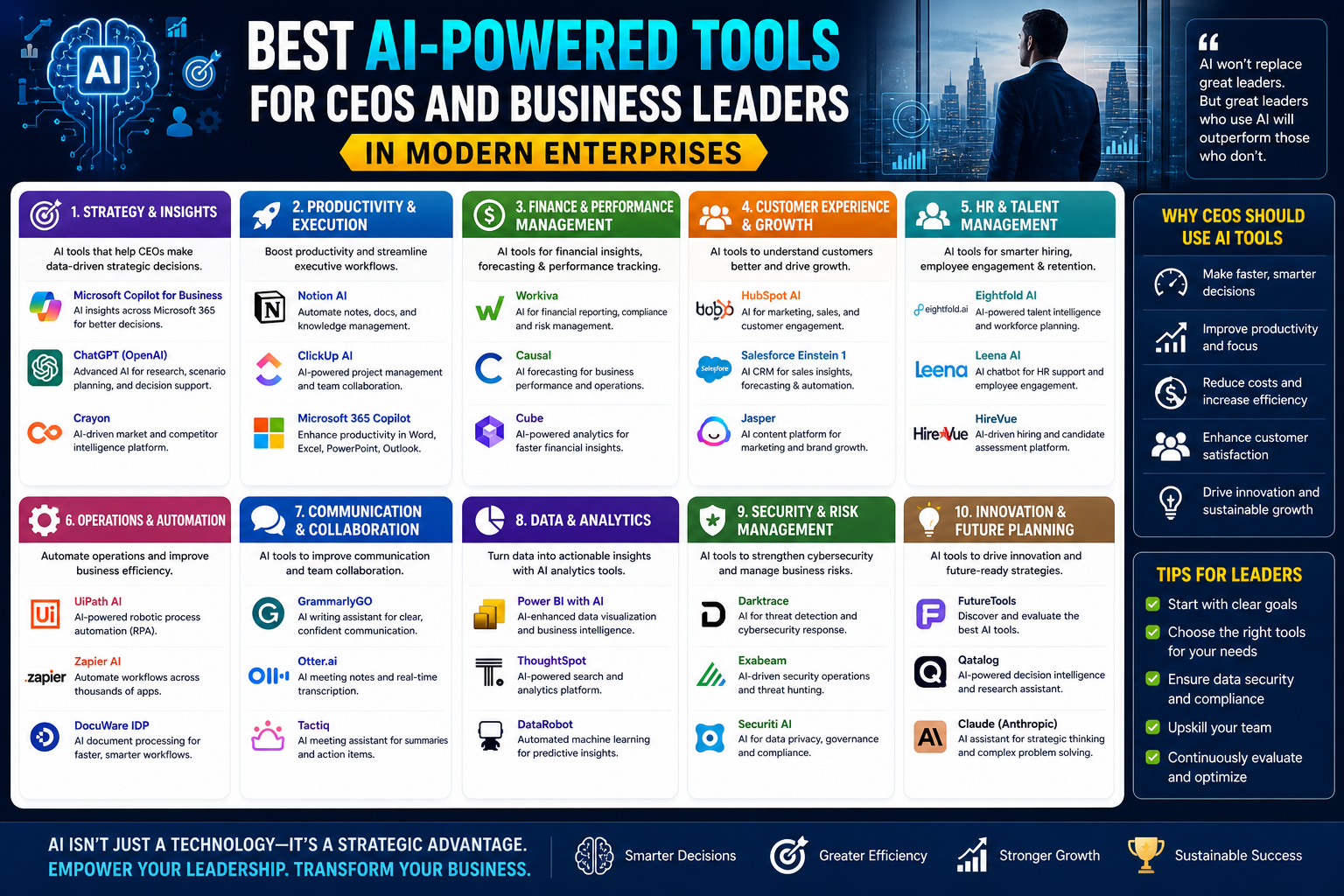
Artificial intelligence has moved far beyond its early association with experimental technology or specialized research environments. Today, it sits at the core of how organizations operate, compete, and grow. For business leaders, AI is no longer an optional enhancement layered on top of existing systems. It has become a foundational capability that influences decision-making, operational structure, customer engagement, and long-term strategic planning.
At its core, AI for business leaders refers to the practical and strategic use of intelligent systems that can process data, recognize patterns, and support decision-making at scale. These systems are designed to extend human capability rather than replace leadership judgment. In many ways, AI functions as an analytical partner—one that can process vast amounts of information far more quickly than traditional methods, allowing leaders to focus on interpretation, direction, and execution.
The shift toward AI-driven leadership reflects a broader transformation in how businesses operate. In the past, decision-making was often based on experience, intuition, and limited data samples. While these elements remain valuable, they are no longer sufficient in environments where markets change rapidly, customer expectations evolve continuously, and competition operates globally. AI introduces a new layer of intelligence that allows leaders to respond with greater speed, accuracy, and foresight.
Why AI Has Become Central to Business Strategy
The growing importance of AI in leadership stems from its ability to solve three fundamental business challenges: complexity, speed, and scale. Modern organizations generate enormous volumes of data from operations, customer interactions, financial systems, and external markets. Processing this information manually is not only inefficient but often impossible at a meaningful depth.
AI addresses this challenge by identifying patterns and insights that would otherwise remain hidden. It can analyze historical trends, detect anomalies, and generate predictive models that support better planning. For business leaders, this means decisions are no longer constrained by limited visibility. Instead, they are informed by continuous streams of structured intelligence.
Speed is another critical factor. In highly competitive industries, delays in decision-making can lead to missed opportunities or operational inefficiencies. AI systems reduce the time required to transform raw data into actionable insights. This enables leaders to respond more quickly to emerging trends, shifting customer behavior, or supply chain disruptions.
Finally, AI provides scalability. As organizations grow, the complexity of managing operations increases exponentially. Traditional management systems often struggle to keep pace with this expansion. AI, however, can scale alongside the business, maintaining consistency and efficiency across multiple departments, regions, and workflows.
How AI Is Reshaping Decision-Making at the Executive Level
One of the most significant impacts of AI is its influence on executive decision-making. Business leaders are increasingly moving away from purely intuition-based approaches and adopting data-driven frameworks supported by intelligent systems.
AI enhances decision-making by offering predictive insights rather than simply descriptive reports. Instead of only explaining what has already happened, AI tools can suggest what is likely to happen next. This shift from reactive to proactive decision-making fundamentally changes how leaders approach strategy.
For example, AI can identify early signals of market shifts by analyzing customer behavior, economic indicators, and competitor activity. It can also simulate different scenarios, allowing leaders to evaluate potential outcomes before committing to a decision. This level of foresight reduces uncertainty and supports more confident strategic planning.
Importantly, AI does not replace leadership judgment. Instead, it strengthens it. The final decision still rests with human leaders, but that decision is informed by deeper, more comprehensive insights than ever before.
The Growing Intersection Between AI and Business Intelligence
Business intelligence has long been a cornerstone of organizational strategy, but AI has significantly expanded its capabilities. Traditional business intelligence tools focused on reporting historical data through dashboards and static visualizations. While useful, these tools were limited in their ability to interpret or predict future outcomes.
AI-enhanced business intelligence systems go much further. They incorporate machine learning models that continuously improve as they process new data. This allows them to adapt to changing conditions and refine their predictions over time. As a result, business leaders gain access to dynamic insights rather than static reports.
This evolution has made business intelligence more accessible and actionable. Leaders no longer need to rely solely on data analysts to interpret complex datasets. AI systems can highlight key trends, identify risks, and even recommend actions in real time. This democratization of insight allows decision-making to happen closer to the operational level, increasing responsiveness across the organization.
AI as a Catalyst for Organizational Transformation
Beyond decision-making and analytics, AI plays a transformative role in reshaping entire organizations. Its influence extends across departments, including finance, marketing, operations, human resources, and customer service.
In operations, AI helps streamline workflows by identifying inefficiencies and automating repetitive tasks. This reduces manual workload and allows teams to focus on higher-value activities. In finance, AI improves forecasting accuracy and supports more precise budgeting. In marketing, it enables hyper-personalized campaigns based on customer behavior and preferences. In human resources, AI assists in talent acquisition, employee engagement analysis, and workforce planning.
This widespread integration of AI leads to a more connected and efficient organization. Data flows more freely between departments, and decisions are made with greater alignment across the enterprise. Over time, this creates a more agile and adaptive business structure.
The Shift from Traditional Leadership to AI-Augmented Leadership
The introduction of AI into business environments is also changing the nature of leadership itself. Traditional leadership models emphasized experience, hierarchical decision-making, and structured planning cycles. While these principles remain relevant, they are being enhanced by AI-driven capabilities.
AI-augmented leadership focuses on adaptability, continuous learning, and data-informed judgment. Leaders are expected to interpret complex analytical outputs and translate them into actionable strategies. This requires a new blend of skills that combines technical understanding with strategic thinking.
Rather than replacing leadership roles, AI expands them. Leaders now operate in environments where information is more abundant, but interpretation becomes more critical. The ability to ask the right questions, evaluate model outputs, and guide AI-driven processes is becoming a defining characteristic of modern executive capability.
The Importance of Understanding AI Fundamentals for Leaders
While business leaders do not need to become technical experts in machine learning or data science, they do need a strong conceptual understanding of how AI works. This includes awareness of how data is collected, how models are trained, and how predictions are generated.
Without this understanding, there is a risk of over-reliance on AI outputs without proper interpretation. AI systems are powerful, but they are not infallible. They depend on the quality of data they are trained on and the assumptions built into their models. Leaders who understand these limitations are better equipped to use AI responsibly and effectively.
This foundational knowledge also enables better communication between leadership teams and technical specialists. When executives understand the basics of AI systems, they can set clearer expectations, ask more informed questions, and ensure that technology investments align with business objectives.
Challenges Business Leaders Face When Adopting AI
Despite its advantages, AI adoption is not without challenges. One of the most common barriers is organizational readiness. Many businesses struggle to integrate AI into existing systems due to outdated infrastructure or fragmented data sources. Without clean, well-structured data, AI systems cannot perform effectively.
Another challenge is cultural resistance. Employees may be hesitant to adopt AI tools due to concerns about job displacement or changes in workflow. Leaders must address these concerns by emphasizing that AI is designed to augment human work rather than replace it.
There is also the challenge of trust. AI systems operate using complex algorithms that are not always transparent. This can make it difficult for leaders to fully understand how certain decisions are made. Building trust in AI requires transparency, proper governance, and continuous validation of results.
Finally, cost and implementation complexity can be significant barriers. While AI offers long-term value, initial deployment often requires investment in infrastructure, training, and integration. Leaders must carefully evaluate these costs against expected benefits to ensure sustainable adoption.
The Strategic Mindset Required for AI Adoption
Successful AI adoption is not just a technological shift; it is a strategic transformation. Business leaders must approach AI with a clear vision of how it supports organizational goals. Rather than viewing AI as a standalone tool, it should be seen as part of a broader ecosystem that enhances performance across multiple dimensions.
This mindset involves focusing on outcomes rather than technology itself. The key question is not what AI can do, but what business problems it can solve. Whether the goal is improving efficiency, increasing revenue, enhancing customer experience, or reducing risk, AI should be aligned with measurable objectives.
Leaders must also adopt a long-term perspective. AI implementation is not a one-time project but an ongoing process of refinement and improvement. As systems evolve and data accumulates, AI capabilities become more sophisticated, delivering greater value over time.
Building the Foundation for AI-Driven Leadership
The journey toward AI-driven leadership begins with awareness and education. Leaders must first understand what AI is capable of and how it fits into their organizational context. This includes identifying areas where AI can deliver immediate value as well as areas where long-term transformation is possible.
From there, organizations can begin experimenting with targeted use cases. These early initiatives help build familiarity with AI systems and demonstrate their practical benefits. Over time, these experiments evolve into larger strategic deployments that reshape core business functions.
A critical part of this foundation is establishing data readiness. High-quality, well-organized data is essential for effective AI performance. Without it, even the most advanced systems will produce limited results. Leaders must prioritize data governance, integration, and accessibility as part of their AI strategy.
Equally important is fostering a culture of continuous learning. AI is a rapidly evolving field, and staying informed is essential for maintaining competitiveness. Organizations that encourage ongoing education and experimentation are better positioned to adapt to future developments.
The Expanding AI Tool Landscape in Modern Enterprises
As organizations deepen their adoption of artificial intelligence, the variety of available tools has expanded significantly. For business leaders, this creates both opportunity and complexity. On one hand, there are more capabilities than ever before to improve efficiency, enhance decision-making, and accelerate growth. On the other hand, the sheer volume of tools can make it difficult to determine which solutions actually deliver meaningful business value.
AI tools are no longer limited to experimental platforms or specialized technical systems. They now exist across nearly every business function, from financial forecasting and customer engagement to operations management and strategic planning. Each category of tools serves a distinct purpose, yet they often overlap in their ability to process data, automate workflows, and generate insights.
Understanding these categories is essential for leaders who want to implement AI effectively. Rather than adopting tools randomly or based on trends, successful organizations evaluate AI solutions based on their alignment with business objectives, operational maturity, and long-term scalability.
AI Tools for Data Intelligence and Business Insight Generation
One of the most influential categories of AI tools focuses on data analysis and insight generation. These systems transform raw data into structured intelligence that leaders can use to guide decisions. In many organizations, this category forms the foundation of AI adoption because it directly influences strategic planning.
Modern data intelligence tools go beyond traditional reporting systems. Instead of simply displaying historical performance, they use machine learning algorithms to detect patterns, identify anomalies, and generate forecasts. This allows business leaders to understand not only what has happened but also what is likely to happen next.
A key advantage of these tools is their ability to integrate multiple data sources. Businesses often operate with fragmented systems, where data is stored across departments such as sales, finance, marketing, and operations. AI-powered analytics platforms unify this data into a single view, enabling more accurate and comprehensive analysis.
For executives, this means decision-making becomes more evidence-based and less dependent on fragmented reports or departmental interpretations. Leaders can evaluate performance metrics in real time, compare scenarios, and identify growth opportunities with greater precision.
Another important feature of data intelligence tools is visualization. Complex datasets are translated into dashboards and interactive models that make insights easier to understand. This reduces the dependency on technical analysts and allows leaders to engage directly with data in a meaningful way.
AI-Driven Automation and the Transformation of Operational Workflows
Automation is one of the most widely recognized applications of artificial intelligence in business environments. However, modern AI-driven automation goes far beyond simple task replacement. It now plays a central role in redesigning entire workflows and improving operational efficiency at scale.
AI automation tools are designed to handle repetitive, time-consuming tasks that traditionally required manual effort. These tasks may include invoice processing, data entry, scheduling, report generation, and system monitoring. By automating these processes, organizations reduce operational overhead and minimize human error.
For business leaders, the impact of automation is twofold. First, it increases productivity by allowing employees to focus on higher-value activities such as strategy, innovation, and customer engagement. Second, it improves consistency by ensuring that routine processes are executed in a standardized and reliable manner.
However, the most significant transformation occurs when automation is applied at the workflow level rather than at the task level. Instead of automating isolated activities, AI systems can coordinate entire sequences of operations across departments. For example, a customer request can trigger automated responses in sales, support, logistics, and finance simultaneously.
This level of integration creates a more agile and responsive organization. It also reduces delays caused by manual handoffs between departments, allowing businesses to operate with greater speed and coordination.
AI Systems for Enhancing Customer Experience and Relationship Management
Customer experience has become one of the most critical differentiators in competitive markets, and AI plays a major role in shaping how organizations engage with their customers. AI-powered customer experience systems analyze behavior, preferences, and interaction history to deliver more personalized and effective engagement strategies.
These systems are commonly integrated into customer relationship management environments. They help businesses understand customer sentiment, predict future behavior, and identify opportunities for upselling or retention. By analyzing communication patterns and engagement data, AI can determine which customers are at risk of leaving and recommend proactive interventions.
From a leadership perspective, this enables a shift from reactive customer service to predictive customer engagement. Instead of responding to problems after they occur, organizations can anticipate customer needs and address them proactively.
AI also enhances personalization at scale. Traditional personalization strategies often rely on broad segmentation, but AI enables highly individualized experiences. Every customer interaction can be tailored based on real-time data, creating a more relevant and engaging experience.
In addition, AI-powered systems support communication efficiency. They can prioritize support tickets, suggest responses, and route inquiries to the most appropriate teams. This reduces response times and improves customer satisfaction while maintaining operational efficiency.
Strategic Forecasting and Scenario Planning with AI
Strategic planning has always been a core responsibility of business leadership, but AI has introduced new levels of precision and flexibility into this process. AI-powered forecasting tools allow organizations to model future scenarios based on historical data, market conditions, and predictive variables.
These systems use advanced algorithms to simulate multiple potential outcomes. Instead of relying on a single forecast, leaders can evaluate a range of scenarios and assess their implications. This helps organizations prepare for uncertainty and make more resilient strategic decisions.
One of the key advantages of AI-driven forecasting is its ability to incorporate external data sources. Traditional planning models often rely heavily on internal performance data, but AI systems can integrate economic indicators, industry trends, competitor behavior, and even geopolitical factors.
This broader perspective allows leaders to anticipate disruptions and identify opportunities earlier. For example, shifts in consumer demand can be detected before they fully materialize in sales data, giving organizations a competitive advantage in adjusting their strategies.
AI also improves financial planning by increasing accuracy in budgeting and resource allocation. By analyzing historical spending patterns and operational performance, AI systems can recommend more efficient distribution of resources across departments.
AI in Communication, Collaboration, and Organizational Alignment
Communication is another area where artificial intelligence is reshaping business operations. In large organizations, maintaining alignment across teams can be challenging, especially when teams are distributed across different regions and time zones. AI-powered communication tools help bridge this gap by improving clarity, efficiency, and accessibility of information.
These systems can summarize meetings, extract key action points, and highlight important decisions. This reduces the cognitive load on employees and ensures that critical information is not lost in lengthy discussions or documentation.
AI also supports real-time transcription and translation, making it easier for global teams to collaborate effectively. This enhances inclusivity and reduces communication barriers across languages and cultures.
From a leadership perspective, AI-driven communication tools improve transparency. Executives can quickly review summarized updates from multiple teams without needing to attend every meeting. This allows for more efficient oversight and faster decision-making.
Additionally, AI can analyze communication patterns within organizations. It can identify bottlenecks, detect collaboration gaps, and highlight areas where information flow is inefficient. These insights help leaders optimize organizational structure and improve overall productivity.
The Role of AI in Risk Management and Operational Stability
Risk management is a critical function for any organization, and AI has significantly enhanced the ability to identify, assess, and mitigate risks. Traditional risk management approaches often rely on historical data and periodic reviews, but AI introduces continuous monitoring and real-time analysis.
AI systems can detect anomalies in financial transactions, supply chain operations, or system performance. These anomalies may indicate potential risks such as fraud, operational failures, or security breaches. Early detection allows organizations to respond proactively rather than reactively.
In financial environments, AI is used to monitor market volatility and assess investment risks. It can analyze large datasets to identify patterns that signal potential instability, helping leaders make more informed investment decisions.
In operational contexts, AI helps ensure continuity by predicting equipment failures, supply chain disruptions, or resource shortages. This predictive capability reduces downtime and improves resilience across the organization.
Cybersecurity is another area where AI plays a crucial role. Intelligent systems can detect unusual network activity, identify potential threats, and respond to security incidents in real time. This enhances organizational protection against increasingly sophisticated cyberattacks.
Integration Challenges and the Importance of System Compatibility
While AI tools offer significant benefits, integrating them into existing business environments presents challenges. Many organizations operate with legacy systems that were not designed to support modern AI capabilities. This can create compatibility issues that slow down implementation.
Data integration is one of the most common obstacles. AI systems require access to high-quality, structured data to function effectively. However, many organizations have data stored in silos across different platforms. Without proper integration, AI tools cannot deliver accurate or meaningful insights.
Another challenge is system interoperability. Businesses often use multiple software solutions across departments, and ensuring that AI tools can communicate with these systems is essential for seamless operation. Without integration, AI adoption may remain fragmented and inefficient.
Leaders must also consider scalability when selecting AI tools. A solution that works well for a small team may not perform effectively at an enterprise level. Ensuring that systems can grow alongside the organization is critical for long-term success.
Organizational Readiness for AI Implementation
Successful AI adoption depends not only on technology but also on organizational readiness. This includes cultural, structural, and operational factors that influence how effectively AI tools are adopted and utilized.
One of the most important aspects of readiness is leadership alignment. Executives must share a clear vision for how AI will be used within the organization. Without this alignment, AI initiatives may become fragmented or lack strategic direction.
Employee readiness is equally important. Teams must understand how AI tools fit into their workflows and how they can use them effectively. This often requires training and change management initiatives to ensure smooth adoption.
Data maturity is another critical factor. Organizations with well-structured and accessible data are better positioned to implement AI successfully. Without strong data foundations, even the most advanced AI systems will struggle to deliver value.
Finally, governance structures must be established to oversee AI usage. This includes defining ethical guidelines, ensuring compliance with regulations, and monitoring system performance. Strong governance ensures that AI is used responsibly and effectively across the organization.
Moving from AI Adoption to AI Integration at Scale
As organizations progress beyond early experimentation with artificial intelligence, the focus naturally shifts from adoption to integration at scale. This transition marks a significant maturity stage in how businesses use AI. At this point, AI is no longer confined to isolated tools or pilot projects. Instead, it becomes embedded across core business functions, influencing how decisions are made, how work is executed, and how value is created.
Scaling AI successfully requires more than deploying additional tools. It demands a coordinated strategy that aligns technology, people, processes, and governance. Without this alignment, organizations risk creating fragmented systems where AI capabilities exist in pockets but fail to deliver enterprise-wide impact.
At scale, AI becomes part of the organizational infrastructure. It is embedded in workflows, integrated into decision-making systems, and continuously optimized based on feedback and performance data. This level of integration transforms AI from a support tool into a core driver of business performance.
The Shift Toward Enterprise-Wide AI Architecture
One of the most important aspects of scaling AI is the development of a unified enterprise architecture. Rather than using disconnected systems across departments, organizations begin to build interconnected AI ecosystems that allow data and insights to flow seamlessly.
This architecture typically includes data pipelines, machine learning models, analytics platforms, automation engines, and user-facing applications. These components work together to ensure that AI insights are consistently available across the organization.
A unified architecture also reduces duplication of effort. In many organizations, different teams independently develop similar AI capabilities, leading to inefficiencies and inconsistencies. A centralized approach ensures that AI models are reusable, standardized, and governed under a common framework.
For business leaders, this shift represents a move toward strategic control over AI investments. Instead of managing individual tools, leadership teams oversee an integrated system that supports multiple use cases simultaneously.
Embedding AI into Core Business Processes
At the heart of AI transformation is the embedding of intelligence into everyday business processes. This means that AI is not treated as an external layer but as an integral part of how work is performed.
In operational environments, this can involve AI-driven workflows that automatically adjust based on real-time conditions. For example, supply chain systems can dynamically reroute shipments based on weather patterns or demand fluctuations. Financial systems can adjust forecasts automatically as new data becomes available. Customer service platforms can prioritize issues based on urgency and sentiment analysis.
This level of integration allows organizations to become more adaptive. Rather than relying on static processes, businesses operate through intelligent systems that respond continuously to changing conditions.
For leaders, this shift requires a new way of thinking about process design. Instead of defining rigid workflows, they must design adaptive systems that incorporate AI decision points throughout the process lifecycle.
Leadership Evolution in the Age of Artificial Intelligence
As AI becomes more deeply embedded in organizations, the role of leadership undergoes a fundamental transformation. Traditional leadership models were based on control, hierarchy, and structured decision-making processes. In AI-driven environments, these models evolve toward adaptability, data fluency, and system thinking.
Modern leaders are no longer expected to make decisions based solely on experience or intuition. Instead, they are expected to interpret AI-generated insights, evaluate probabilistic outcomes, and guide organizations through complex, data-rich environments.
This requires a shift in leadership mindset. Rather than acting as sole decision-makers, leaders become orchestrators of intelligence systems. They guide how AI is used, interpret its outputs, and ensure that decisions align with organizational values and strategic objectives.
Another important aspect of this evolution is trust in data-driven systems. Leaders must develop the ability to balance AI recommendations with human judgment. While AI can process vast amounts of data, it does not understand context, ethics, or organizational culture in the same way humans do.
The most effective leaders are those who can integrate both perspectives—leveraging AI for analytical depth while applying human judgment for strategic direction.
The Rise of AI-Augmented Decision Ecosystems
In advanced organizations, decision-making is no longer a linear process. Instead, it becomes an ecosystem where humans and AI systems collaborate continuously. This is often referred to as an AI-augmented decision environment.
In such environments, AI systems provide real-time insights, simulations, and recommendations. Human leaders interpret these outputs, apply contextual understanding, and make final decisions. Over time, the system learns from these decisions and improves its recommendations.
This creates a feedback loop where both human intelligence and machine intelligence continuously enhance each other. The result is faster, more accurate, and more adaptive decision-making across the organization.
For example, in financial planning, AI systems may generate multiple budget scenarios based on market conditions. Leaders evaluate these scenarios, adjust assumptions, and select the most appropriate strategy. The AI system then learns from these decisions and refines future predictions.
This collaborative model represents a significant departure from traditional decision-making structures. It requires organizations to rethink how authority, accountability, and insight generation are distributed.
Building a Data-Centric Organizational Culture
A successful AI transformation is not only technological but also cultural. At the core of this transformation is the development of a data-centric culture where decisions are consistently informed by evidence rather than assumption.
In a data-centric organization, data is treated as a strategic asset. It is collected systematically, stored securely, and made accessible across departments. More importantly, it is actively used in decision-making processes at all levels of the organization.
Leadership plays a crucial role in shaping this culture. When executives consistently use data to support decisions, it sets a standard for the rest of the organization. Over time, this creates an environment where data-driven thinking becomes the norm.
However, building this culture requires more than access to tools. It requires training, mindset shifts, and organizational reinforcement. Employees must understand how to interpret data, how to use AI-generated insights, and how to incorporate these insights into their daily work.
Without this cultural foundation, even the most advanced AI systems will fail to deliver meaningful impact.
Scaling AI Governance and Ethical Responsibility
As AI becomes more deeply integrated into business operations, governance becomes increasingly important. Organizations must ensure that AI systems are used responsibly, transparently, and ethically.
AI governance involves establishing rules, frameworks, and oversight mechanisms that guide how AI is developed and deployed. This includes ensuring data privacy, preventing bias, maintaining transparency, and complying with regulatory requirements.
One of the key challenges in AI governance is ensuring fairness in algorithmic decision-making. AI systems are only as unbiased as the data they are trained on. If historical data contains biases, those biases may be reflected in AI outputs. Leaders must therefore implement processes to detect and mitigate bias in AI systems.
Transparency is another critical factor. Leaders must be able to understand how AI systems arrive at their conclusions. This does not necessarily require full technical transparency but does require interpretability at a functional level.
Ethical considerations also extend to workforce impact. As AI automates certain tasks, organizations must consider how roles will evolve and how employees will be supported through transitions. Responsible leadership involves ensuring that AI adoption contributes to workforce development rather than displacement without support.
Talent Transformation and the Future of AI Skills in Leadership
As AI becomes central to business operations, the skills required for leadership and workforce roles are evolving. Technical expertise is becoming more important, but equally important is the ability to work alongside intelligent systems.
For business leaders, this means developing a combination of strategic, analytical, and technological competencies. Leaders do not need to become engineers, but they must understand how AI systems function, how data is used, and how insights are generated.
At the same time, organizations must invest in upskilling their workforce. Employees across all levels need to develop AI literacy, including the ability to interpret data, use AI tools effectively, and understand the implications of automated decision-making.
This transformation also creates new roles within organizations. Positions focused on AI ethics, data governance, machine learning operations, and AI strategy are becoming increasingly common. These roles bridge the gap between technical implementation and business strategy.
Over time, organizations that invest in talent transformation are better positioned to fully realize the benefits of AI integration.
AI as a Driver of Continuous Business Innovation
One of the most powerful impacts of AI is its ability to drive continuous innovation. Unlike traditional systems that require periodic updates or redesigns, AI systems continuously learn and improve based on new data.
This creates a dynamic environment where innovation is not a one-time event but an ongoing process. Organizations can test new ideas, evaluate outcomes quickly, and refine strategies in real time.
For example, in product development, AI can analyze customer feedback, usage patterns, and market trends to identify opportunities for improvement. This allows businesses to iterate more quickly and bring better products to market faster.
In marketing, AI can continuously optimize campaigns based on performance data. In operations, it can identify inefficiencies and suggest improvements automatically. Across all functions, AI enables a culture of experimentation and rapid iteration.
For leaders, this means embracing a mindset of continuous adaptation. Rather than relying on long planning cycles, organizations must become comfortable with ongoing change and real-time optimization.
Long-Term Organizational Impact of AI Transformation
Over time, the integration of AI fundamentally reshapes how organizations operate. Businesses become more data-driven, more responsive, and more efficient. Decision-making becomes faster and more accurate. Operations become more streamlined and adaptive.
However, the most significant transformation is structural. Organizations evolve from rigid hierarchies into dynamic, intelligent systems where information flows continuously and decisions are distributed more broadly.
This structural change enhances resilience. Organizations that effectively integrate AI are better able to respond to disruptions, adapt to market changes, and identify new opportunities.
It also enhances competitiveness. In many industries, AI adoption becomes a key differentiator between organizations that lead and those that follow.
Ultimately, AI becomes not just a tool but a defining element of how modern organizations function and evolve in an increasingly complex and data-driven world.
Strengthening AI Maturity and Long-Term Competitive Positioning
As organizations continue advancing their artificial intelligence capabilities, the focus gradually shifts from implementation and scaling toward long-term maturity. AI maturity is not defined simply by how many tools an organization uses, but by how deeply intelligence is embedded into strategic thinking, operational execution, and organizational learning.
At higher levels of maturity, AI becomes less visible as a standalone system and more visible as an embedded capability. It quietly influences pricing decisions, supply chain optimization, customer engagement strategies, and workforce planning. Instead of being treated as a separate initiative, it becomes part of the organizational DNA.
One of the key indicators of AI maturity is the organization’s ability to self-optimize. In less mature environments, AI systems require frequent human intervention, tuning, and oversight. In more advanced environments, systems begin to refine themselves based on continuous feedback loops. These feedback loops allow models to improve prediction accuracy, reduce operational inefficiencies, and adapt to shifting market conditions with minimal manual adjustment.
Another important dimension of maturity is cross-functional intelligence integration. In early stages of AI adoption, different departments often use AI independently. Marketing may use AI for campaign optimization, finance for forecasting, and operations for automation, but these systems remain disconnected. As maturity increases, organizations begin to unify these capabilities into shared intelligence frameworks. This allows insights generated in one area to influence decisions across multiple departments, creating a more cohesive and synchronized enterprise.
For example, a shift in customer demand detected by marketing analytics can automatically inform inventory planning, financial forecasting, and supply chain logistics. This interconnected intelligence significantly improves organizational responsiveness and reduces decision lag.
AI maturity also depends heavily on the organization’s ability to manage complexity. As AI systems grow, they often become more difficult to monitor and govern. Mature organizations address this challenge by implementing layered governance structures that balance autonomy with control. These structures ensure that AI systems operate within defined ethical, operational, and strategic boundaries while still maintaining flexibility to learn and adapt.
Another defining characteristic of mature AI-driven organizations is their approach to experimentation. Rather than treating innovation as a separate function, they embed experimentation into everyday operations. AI systems enable rapid testing of ideas, continuous performance measurement, and fast iteration cycles. This creates a culture where learning is constant and improvement is ongoing rather than periodic.
In such environments, failure is not viewed as a setback but as a source of valuable data. Each iteration provides insights that refine both human decision-making and machine learning models. Over time, this creates a self-reinforcing cycle of improvement that strengthens the organization’s competitive position.
From a leadership perspective, maintaining AI maturity requires sustained commitment. Leaders must continuously evaluate whether AI initiatives are aligned with strategic goals, whether data infrastructure remains robust, and whether employees are equipped to work effectively with evolving systems. This ongoing oversight ensures that AI does not stagnate or drift away from business objectives.
Equally important is the ability to anticipate future developments. Artificial intelligence is a rapidly evolving field, and new capabilities emerge frequently. Organizations that maintain a forward-looking perspective are better positioned to adopt emerging technologies early and integrate them effectively into their existing ecosystems.
In the long term, the most successful organizations are those that treat AI not as a destination but as a continuous journey of refinement. They recognize that AI maturity is not a fixed state but an evolving capability that grows alongside the organization itself, shaping how it competes, innovates, and delivers value in an increasingly intelligent business landscape.
Conclusion
Artificial intelligence has moved from a supporting technology to a central force shaping how organizations operate, compete, and grow. Across every stage of business—from early strategy formation to large-scale execution—AI now influences how leaders interpret information, make decisions, and design systems that respond to an increasingly complex world.
For business leaders, the most important shift is not simply the adoption of new tools, but the transformation in mindset that AI demands. Leadership is no longer defined solely by experience or intuition, but by the ability to work with data-driven systems, interpret predictive insights, and guide organizations through continuous change. This evolution does not reduce the importance of human judgment; rather, it enhances it by providing deeper visibility into patterns, risks, and opportunities that were previously difficult to detect.
Across data analysis, automation, customer engagement, forecasting, and communication, AI has demonstrated its ability to improve efficiency and unlock new levels of performance. Yet its true value lies not in isolated applications, but in its ability to connect systems, unify decision-making, and enable organizations to operate as intelligent, adaptive ecosystems.
At the same time, successful AI adoption requires more than technology deployment. It depends on strong data foundations, clear governance structures, cultural readiness, and continuous learning. Organizations that fail to address these areas may implement AI tools without realizing their full potential. In contrast, those that invest in alignment between people, processes, and systems are able to scale AI in meaningful and sustainable ways.
Leadership plays a defining role in this transformation. Executives must ensure that AI is not treated as a short-term initiative, but as a long-term strategic capability. This includes setting clear objectives, encouraging experimentation, supporting workforce development, and maintaining ethical oversight. In doing so, leaders create environments where AI enhances human capability rather than replacing it, and where innovation becomes a continuous process rather than a periodic effort.
As AI continues to evolve, its influence on business will only deepen. Organizations will increasingly rely on intelligent systems not just for analysis, but for real-time decision support, predictive planning, and autonomous execution of complex workflows. This will further redefine what it means to be competitive in modern markets, where speed, adaptability, and intelligence become key differentiators.
Ultimately, the organizations that succeed in the age of artificial intelligence will be those that embrace it as an integrated part of their identity. They will view AI not as a tool to be adopted, but as a capability to be developed—one that shapes strategy, strengthens operations, and enhances leadership itself. In this way, AI becomes not just a technological advancement, but a lasting foundation for smarter, more resilient, and more forward-thinking enterprises.