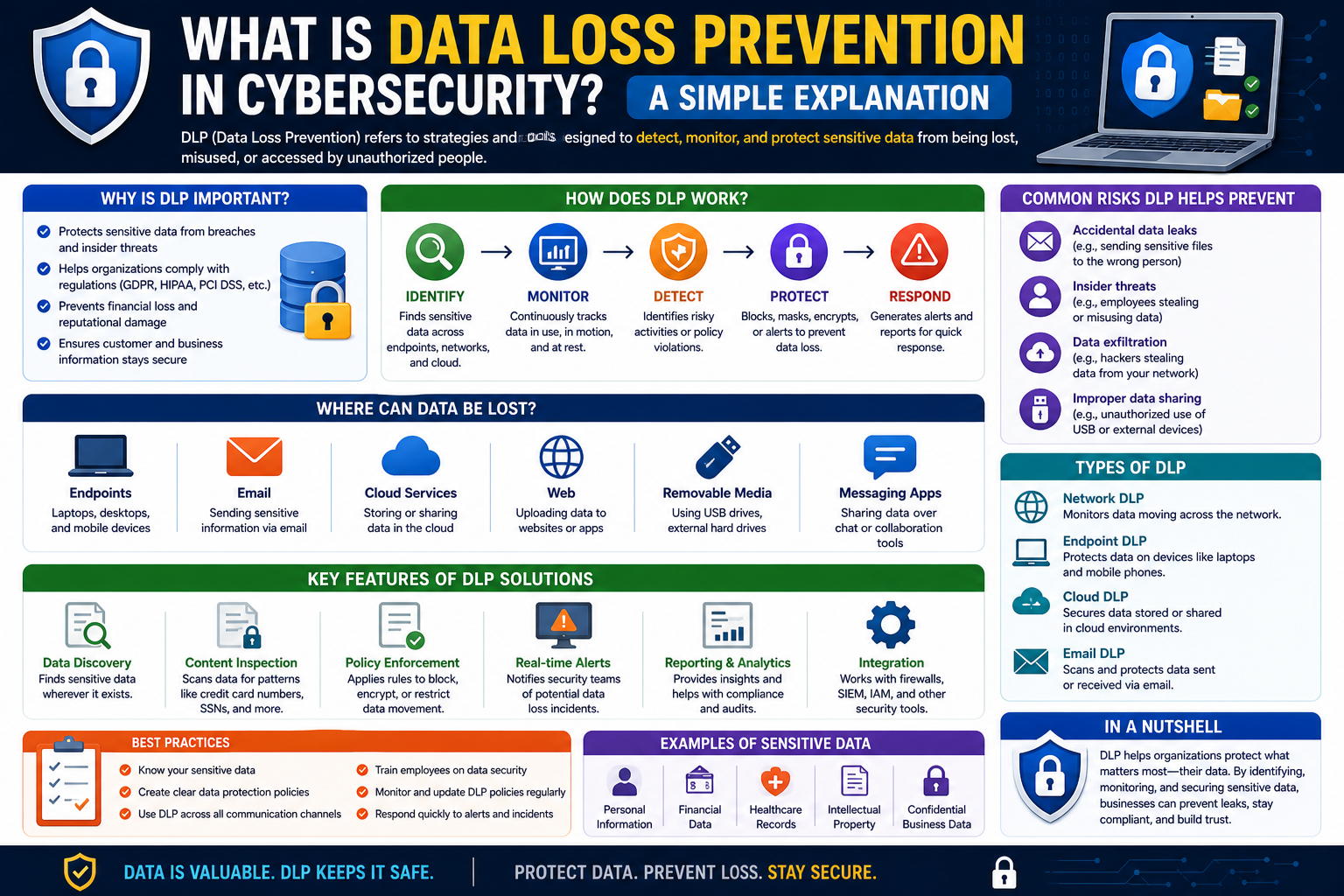
Data Loss Prevention, commonly known as DLP, refers to a structured approach that organizations use to ensure sensitive information does not leave their control in an unauthorized way. At its core, DLP is about protecting data from being exposed, stolen, or misused, whether by accident or through malicious intent.
In modern digital systems, data is constantly being created, shared, stored, and transmitted. This continuous movement increases the risk of exposure. Sensitive information such as customer records, financial details, intellectual property, and internal communications can easily become vulnerable if proper controls are not in place. DLP addresses this challenge by combining technology, policies, and monitoring practices that work together to safeguard data throughout its lifecycle.
Rather than functioning as a single tool, DLP is better understood as a framework. It includes multiple layers of protection that focus on identifying sensitive data, controlling how it is used, and preventing it from leaving approved environments without authorization. This makes DLP an essential part of modern cybersecurity strategies, especially for organizations handling large volumes of critical or regulated information.
Why Data Security Has Become a Critical Priority
The importance of protecting data has increased significantly in recent years due to several converging factors. One of the most influential is the rise in cyberattacks. Attackers are no longer relying on simple methods; instead, they use advanced techniques that are harder to detect and prevent. These include phishing campaigns, ransomware attacks, insider exploitation, and sophisticated malware designed to bypass traditional security systems.
At the same time, organizations have become more data-driven than ever before. Businesses rely heavily on digital information to operate efficiently, make decisions, and serve customers. This means that the amount of sensitive data being stored and processed has increased dramatically. The more data an organization holds, the greater the risk of exposure if proper safeguards are not implemented.
Another factor contributing to the importance of data security is regulatory pressure. Governments and industry bodies around the world have introduced strict rules for handling personal and sensitive data. These regulations require organizations to demonstrate that they are actively protecting data from misuse or unauthorized access. Failure to comply can result in financial penalties and reputational damage.
As a result, data protection is no longer optional. It has become a fundamental requirement for operational stability, customer trust, and legal compliance.
The Core Purpose and Function of Data Loss Prevention
DLP systems are designed to perform three main functions: identifying sensitive data, monitoring how it moves, and enforcing rules to control its usage. Each of these functions plays a critical role in preventing data leaks and ensuring that information remains secure.
The first function, data identification, involves detecting sensitive information within an organization’s systems. This can include personal identification data, financial records, confidential business documents, and other types of information that require protection. DLP systems use predefined rules, patterns, and contextual analysis to recognize this data, even when it is embedded in complex files or communication streams.
The second function, monitoring, focuses on tracking how data is accessed and transferred. This includes observing user activity across devices, networks, and cloud platforms. By monitoring data movement, DLP systems can detect unusual or unauthorized behavior that may indicate a potential security risk.
The third function, enforcement, involves applying security policies that control what can happen with sensitive data. For example, a system may block an email containing confidential information, restrict file transfers to external devices, or alert administrators when suspicious activity is detected.
Together, these functions allow organizations to maintain visibility and control over their data at all times.
Understanding the Different States of Data
To fully understand how DLP works, it is important to recognize that data exists in multiple states. Each state represents a different stage in the data lifecycle, and each one presents unique security challenges.
The first state is data at rest. This refers to information that is stored in databases, file systems, or cloud storage environments. Even though the data is not actively being used, it remains vulnerable to unauthorized access if storage systems are compromised. Protecting data at rest typically involves encryption, access controls, and secure storage configurations.
The second state is data in motion. This refers to data that is being transmitted between systems, such as through emails, file transfers, or network communications. Data in motion is particularly vulnerable because it can be intercepted during transmission if proper security measures are not in place. Encryption and secure communication protocols are commonly used to protect data in this state.
The third state is data in use. This refers to data that is actively being accessed or processed by users or applications. In this state, data is often temporarily decrypted, making it more vulnerable to exposure. Security measures such as endpoint protection, application monitoring, and strict access controls are used to minimize risk during active use.
DLP systems are designed to protect data across all three states, ensuring continuous security regardless of how the data is being handled.
How Sensitive Data Is Identified and Classified
A key component of any DLP strategy is the ability to identify and classify sensitive data. Without proper classification, it becomes difficult to determine what information requires protection and how strict the controls should be.
Data classification involves categorizing information based on its level of sensitivity and importance. Common categories include public data, internal data, confidential data, and highly sensitive data. Each category has different security requirements depending on the potential impact of exposure.
For example, public data may be freely accessible without restrictions, while confidential data may require strict access controls and encryption. Highly sensitive data, such as financial records or personal identification information, often requires the highest level of protection.
DLP systems use a combination of methods to identify sensitive data. These methods include pattern recognition, keyword detection, contextual analysis, and metadata inspection. In more advanced systems, machine learning techniques may also be used to improve accuracy over time.
Accurate classification is essential because it determines how data will be handled throughout its lifecycle. If data is incorrectly classified, it may either be overprotected, leading to inefficiencies, or underprotected, increasing the risk of exposure.
Monitoring Data Movement Across Digital Environments
Once data has been identified and classified, the next step in DLP is monitoring how it moves across systems. This is a critical function because data is most vulnerable when it is being transferred or accessed.
Modern organizations use a variety of platforms, including local servers, cloud services, and mobile devices. Data often moves between these environments, making it difficult to track without specialized tools. DLP systems provide centralized visibility into this movement, allowing security teams to understand where data is going and how it is being used.
Monitoring includes tracking email communications, file transfers, cloud uploads, and even copy-paste actions on endpoints. When unusual activity is detected, such as a large volume of sensitive data being transferred to an external location, the system can trigger alerts or automatically block the action.
This level of visibility is essential for detecting both external threats and internal risks. In many cases, data breaches occur not because of external hackers but due to accidental actions or misuse by authorized users.
Preventing Unauthorized Data Transfers
One of the most important functions of DLP is preventing unauthorized data transfers. This involves enforcing rules that determine how and where sensitive information can be shared.
Organizations typically define policies that specify acceptable use of data. For example, certain types of information may only be shared within internal systems and not sent externally. DLP systems enforce these policies by blocking or restricting actions that violate them.
Prevention mechanisms can include blocking emails containing sensitive content, preventing file uploads to unauthorized cloud services, or restricting the use of removable storage devices. These controls help ensure that sensitive data does not leave the organization without proper authorization.
In addition to blocking actions, DLP systems may also provide user notifications. These alerts inform users when they are attempting to perform an action that violates policy, allowing them to correct their behavior before a security incident occurs.
The Role of Context in Data Protection
Modern DLP systems do not rely solely on static rules. Instead, they use contextual analysis to make more accurate decisions about data security. Context refers to the circumstances surrounding data usage, including who is accessing it, where it is being accessed from, and how it is being used.
For example, accessing sensitive data from a secure internal network may be considered safe, while accessing the same data from an unknown external location may trigger a security alert. Similarly, transferring a small amount of data internally may be allowed, while transferring large volumes externally may be blocked.
Contextual awareness helps reduce false positives and improves the accuracy of security decisions. It ensures that legitimate business activities are not unnecessarily disrupted while still protecting against potential threats.
The Relationship Between DLP and Organizational Security Culture
While technology plays a major role in data protection, human behavior is equally important. Many data loss incidents occur due to user mistakes rather than deliberate attacks. This includes sending sensitive information to the wrong recipient, using unsecured devices, or falling victim to phishing attempts.
DLP systems are most effective when combined with a strong security culture. This involves educating employees about data protection practices and ensuring they understand their responsibilities when handling sensitive information.
When users are aware of security policies and understand the importance of data protection, they are less likely to engage in risky behavior. This significantly reduces the likelihood of accidental data leaks and strengthens the overall effectiveness of DLP systems.
Evolution of Data Loss Prevention in Modern Systems
DLP has evolved significantly over time. Early systems focused primarily on monitoring network traffic and blocking obvious data transfers. However, modern environments are far more complex, requiring more advanced approaches.
Today’s DLP solutions integrate with cloud platforms, mobile devices, and remote work environments. They also incorporate artificial intelligence and machine learning to improve detection accuracy and adapt to new threats.
This evolution reflects the changing nature of data usage. As organizations continue to adopt digital transformation strategies, DLP systems must adapt to ensure that data remains protected across increasingly complex environments.
Building Blocks of a Modern Data Loss Prevention System
A modern Data Loss Prevention system is built from multiple interconnected components that work together to monitor, detect, and control the flow of sensitive information. Instead of relying on a single protective layer, DLP solutions operate as a distributed security model that spans endpoints, networks, and cloud environments.
At the foundation of any DLP system is the data inspection engine. This component analyzes information as it moves through systems and compares it against predefined security policies. It is responsible for identifying sensitive content using pattern matching, fingerprinting, keyword recognition, and contextual analysis.
Above this engine sits the policy management layer, which defines the rules that govern how data should be handled. These policies determine what constitutes sensitive data, who can access it, and what actions are permitted or blocked. Policies are usually customized to reflect an organization’s operational needs and compliance obligations.
Another essential component is the monitoring and reporting module. This provides visibility into how data is being accessed and used across the organization. It generates alerts, logs events, and produces reports that help security teams identify risks and investigate incidents.
Finally, enforcement mechanisms apply the actual controls that prevent unauthorized actions. These mechanisms may block file transfers, restrict email communications, encrypt sensitive content, or isolate compromised endpoints.
Together, these building blocks form a unified defense system that protects data throughout its lifecycle.
Endpoint-Based Data Loss Prevention and Device-Level Security
Endpoint DLP focuses on protecting data directly at the device level, such as laptops, desktops, and mobile devices. Since endpoints are often where users interact with sensitive data, they represent one of the most critical areas for enforcement.
Endpoint protection systems monitor user activity in real time. This includes tracking file access, clipboard usage, printing actions, and data transfers to external devices such as USB drives. By observing these activities, endpoint DLP can detect attempts to copy or move sensitive information outside authorized boundaries.
One of the key advantages of endpoint-based protection is its ability to enforce policies even when the device is offline. This is particularly important in remote work environments where users may not always be connected to the corporate network.
Endpoint DLP also plays a major role in preventing insider threats. Employees with legitimate access to systems may unintentionally or intentionally misuse data. By enforcing strict controls at the device level, organizations can reduce the risk of unauthorized data exfiltration.
Device-level encryption is another important feature in endpoint protection. When data is encrypted on a device, it becomes unreadable without proper authentication. This ensures that even if a device is lost or stolen, sensitive information remains protected.
Network-Centric Monitoring and Traffic Inspection Systems
Network-based DLP focuses on analyzing data as it moves across internal and external communication channels. This includes monitoring emails, web traffic, file transfers, and application communications.
At the core of network DLP is deep packet inspection, a technique that examines the contents of data packets traveling across the network. This allows the system to identify sensitive information even if it is hidden within encrypted or complex data streams.
Network DLP systems are typically deployed at strategic points within an organization’s infrastructure, such as gateways or routers. These points act as checkpoints where data can be inspected before it leaves the network.
When sensitive data is detected, network DLP systems can take several actions. These include blocking the transmission, quarantining the data, or sending alerts to administrators. In some cases, the system may also require additional authentication before allowing the transfer.
Network-based protection is particularly effective for preventing external data leaks. It ensures that sensitive information does not leave the organization without proper authorization, regardless of the device or application being used.
Cloud-Focused Data Protection in Distributed Environments
As organizations increasingly rely on cloud services, DLP systems have evolved to include cloud-based protection mechanisms. Cloud DLP is designed to secure data stored and processed in cloud environments such as SaaS applications, cloud storage platforms, and virtual infrastructure.
One of the primary challenges in cloud environments is the lack of physical control over data. Unlike traditional systems where data resides on internal servers, cloud data is distributed across external infrastructures. This makes visibility and control more complex.
Cloud DLP systems address this challenge by integrating directly with cloud service providers. They monitor data uploads, downloads, sharing permissions, and user activity within cloud applications.
These systems can detect when sensitive data is being shared publicly or transferred outside approved regions. They can also enforce encryption policies and restrict access based on user roles or geographic location.
Another important feature of cloud DLP is its ability to enforce consistent policies across multiple cloud platforms. This ensures that data remains protected even when it moves between different services or environments.
Policy Engineering and Rule-Based Data Governance
At the heart of any DLP strategy lies policy engineering, which involves designing rules that define how data should be handled. These policies form the backbone of data governance and determine how security controls are applied.
Policy creation begins with identifying business requirements. Organizations must determine what types of data need protection and under what conditions access should be allowed or restricted. This requires collaboration between IT teams, legal departments, and business units.
Once requirements are defined, policies are translated into enforceable rules. These rules may include conditions such as blocking external sharing of financial data, restricting access to customer records, or requiring encryption for sensitive communications.
Policies must be carefully balanced to avoid disrupting normal business operations. Overly strict policies can hinder productivity, while overly lenient policies can leave data vulnerable.
Effective policy engineering also involves continuous refinement. As business needs evolve and new threats emerge, policies must be updated to reflect changing conditions.
Advanced Data Classification Techniques and Sensitivity Modeling
Data classification is a fundamental aspect of DLP, but modern systems go far beyond simple labeling. Advanced classification techniques use multiple layers of analysis to determine the sensitivity of data.
Pattern-based classification identifies structured data such as credit card numbers, social security identifiers, or account details using predefined formats. This method is highly effective for recognizing standardized information.
Content-based classification examines the actual content of documents or messages. It analyzes keywords, phrases, and contextual clues to determine whether information is sensitive.
Machine learning-based classification adds another layer of intelligence by learning from historical data. These systems can identify patterns that may not be explicitly defined in rules, improving detection accuracy over time.
Metadata classification evaluates information such as file type, ownership, creation date, and access history. This helps determine the context in which data is being used.
By combining these techniques, DLP systems can build a comprehensive understanding of data sensitivity and apply appropriate protection measures.
Internal Threat Detection and Behavioral Risk Analysis
While external cyberattacks often receive significant attention, internal threats represent a major risk to data security. These threats can come from employees, contractors, or partners who have legitimate access to systems but misuse that access.
Internal threats can be accidental or intentional. Accidental threats occur when users unknowingly violate security policies, such as sending sensitive files to the wrong recipient or storing data in unsecured locations. Intentional threats involve deliberate actions to steal or leak information.
Behavioral risk analysis is used to detect internal threats by monitoring user activity patterns. DLP systems establish a baseline of normal behavior and then identify deviations that may indicate suspicious activity.
For example, if a user suddenly begins downloading large volumes of sensitive data or accessing files outside their usual scope of work, the system may flag this behavior for further investigation.
Risk scoring models are often used to evaluate the severity of potential threats. These models consider factors such as user role, access history, and activity patterns to determine the level of risk associated with a specific action.
Incident Containment and Automated Response Mechanisms
When a potential data loss event is detected, rapid response is essential to minimize damage. Modern DLP systems include automated response mechanisms that can take immediate action without waiting for manual intervention.
These responses may include blocking data transfers, revoking access permissions, isolating affected devices, or terminating active sessions. The goal is to contain the incident before sensitive data is exposed.
In addition to automated actions, DLP systems also provide detailed incident logs that help security teams investigate what happened. These logs include information such as user activity, data movement, and system alerts.
Incident containment strategies are often integrated with broader security frameworks, allowing DLP systems to work alongside intrusion detection systems, endpoint protection tools, and security information platforms.
Encryption Strategies Across Data Environments
Encryption plays a central role in protecting sensitive information across all stages of its lifecycle. In DLP systems, encryption is used to ensure that even if data is intercepted or accessed without authorization, it cannot be read or used.
Data at rest is typically encrypted using storage-level encryption methods. This ensures that stored files and databases remain protected even if physical storage systems are compromised.
Data in transit is protected using secure communication protocols that encrypt information as it moves across networks. This prevents interception during transmission.
Data in use presents a more complex challenge because it must be decrypted temporarily for processing. Advanced techniques such as memory encryption and secure enclaves help reduce exposure during this state.
Encryption works hand in hand with DLP policies to ensure that sensitive data remains protected regardless of its location or usage.
Integration of DLP with Identity and Access Control Systems
Identity and access management systems play a crucial role in supporting DLP strategies. These systems determine who has access to specific data and what actions they are allowed to perform.
By integrating DLP with identity systems, organizations can enforce more precise access controls. This allows policies to be based not only on data type but also on user identity, role, and behavior.
Role-based access control ensures that users only have access to the information they need to perform their tasks. This reduces the risk of unnecessary exposure.
Multi-factor authentication adds an additional layer of security by requiring users to verify their identity through multiple methods before accessing sensitive data.
When combined with DLP systems, identity management creates a strong foundation for controlling data access and preventing unauthorized usage.
Designing a Scalable Data Loss Prevention Architecture
Building a Data Loss Prevention system that can scale across an entire organization requires more than just deploying security tools. It requires a carefully designed architecture that aligns with how data flows through modern digital environments. In large enterprises, data is rarely stored in a single location. Instead, it moves across endpoints, cloud platforms, third-party services, and internal applications. A scalable DLP architecture must be able to monitor and protect data across all of these layers without creating performance bottlenecks or operational complexity.
A typical enterprise DLP architecture is divided into three primary layers: endpoint controls, network enforcement points, and centralized management systems. Each layer plays a distinct role in protecting data. Endpoint controls focus on user devices, network enforcement handles data in transit, and centralized management coordinates policies, reporting, and analytics.
The centralized management layer is especially important because it provides a unified view of all data protection activities. Without centralization, organizations would struggle to maintain consistent policies across different systems. This layer also enables administrators to define rules once and apply them across multiple environments.
Scalability is achieved through modular deployment. Instead of relying on a single monolithic system, modern DLP solutions distribute processing across multiple components. This reduces strain on individual systems and allows the architecture to expand as data volume increases.
Data Discovery and Continuous Classification at Scale
One of the biggest challenges in implementing DLP is identifying where sensitive data actually exists within an organization. Large enterprises often store data across thousands of systems, making manual identification impossible.
Data discovery tools solve this problem by automatically scanning storage systems, databases, cloud repositories, and endpoints to locate sensitive information. These tools use pattern recognition and contextual analysis to detect data such as personal records, financial details, and confidential documents.
Once data is discovered, it must be continuously classified. Static classification is not sufficient because data changes over time. A document that was once considered non-sensitive may become sensitive due to updates or new regulatory requirements.
Continuous classification ensures that data is always evaluated based on its current context. This dynamic approach allows DLP systems to adapt to changing business environments and maintain accurate protection levels.
Automated tagging is often used to simplify classification. Tags are metadata labels that describe the sensitivity level of data. These tags allow DLP systems to quickly apply appropriate policies without reanalyzing the content each time.
Integration of DLP with Zero Trust Security Models
Modern cybersecurity strategies increasingly rely on Zero Trust principles, which assume that no user or system should be trusted by default. Every access request must be verified, regardless of whether it originates from inside or outside the network.
DLP fits naturally into Zero Trust architectures because both focus on strict access control and continuous verification. While Zero Trust determines who can access systems, DLP determines what they can do with the data once access is granted.
In a Zero Trust environment, DLP systems enforce granular policies that control how data is used. Even authenticated users are restricted based on context, behavior, and data sensitivity.
For example, a user may be allowed to access a document but not permitted to download or share it externally. This level of control ensures that data remains protected even if credentials are compromised.
Zero Trust integration also improves visibility. Every data interaction is logged and analyzed, allowing security teams to detect anomalies and respond quickly to potential threats.
Cloud-Native DLP and Distributed Work Environments
The shift toward cloud computing has fundamentally changed how organizations manage data security. Traditional perimeter-based security models are no longer sufficient because data is no longer confined to internal networks.
Cloud-native DLP systems are designed specifically for distributed environments. They integrate directly with cloud platforms and provide real-time monitoring of data stored and processed in services such as cloud storage, collaboration tools, and SaaS applications.
One of the key advantages of cloud-native DLP is its ability to scale dynamically. As organizations increase their cloud usage, DLP systems automatically adjust to handle increased data volume and activity.
These systems also provide centralized visibility across multiple cloud providers. This is important because many organizations use a combination of cloud services rather than relying on a single provider.
Cloud-native DLP also supports API-based enforcement. Instead of relying on traditional network inspection, it interacts directly with cloud applications to enforce policies at the source of data creation and sharing.
The Role of Artificial Intelligence in Modern DLP Systems
Artificial intelligence has become a major driving force in the evolution of Data Loss Prevention. Traditional rule-based systems are effective for detecting known patterns, but they struggle with new or evolving threats. AI enhances DLP by enabling systems to learn, adapt, and improve over time.
Machine learning models analyze large volumes of data activity to identify patterns that may indicate risk. These models can detect subtle anomalies that would be difficult for rule-based systems to recognize.
For example, AI can identify unusual data access patterns that suggest insider threats, even if no explicit policy violation has occurred. It can also detect changes in user behavior that may indicate compromised accounts.
Natural language processing is another AI capability used in DLP systems. It allows systems to understand the context of documents and communications, improving the accuracy of sensitive data detection.
AI-driven DLP systems also reduce false positives. By learning from historical decisions, they become better at distinguishing between legitimate and suspicious activity.
Insider Threat Management and Behavioral Analytics
Insider threats remain one of the most complex challenges in data security. Unlike external attackers, insiders already have authorized access to systems, making their actions harder to detect.
Behavioral analytics plays a key role in identifying potential insider threats. This approach involves establishing a baseline of normal user behavior and then detecting deviations from that baseline.
Behavioral indicators may include unusual login times, excessive data downloads, or access to systems outside of a user’s typical responsibilities. When such anomalies are detected, DLP systems can trigger alerts or enforce restrictions.
Risk scoring systems are often used to assess the severity of insider threats. These systems assign risk levels based on multiple factors, including user activity, access privileges, and historical behavior.
By continuously analyzing behavior, DLP systems can detect threats early and reduce the potential for data loss.
Data Loss Prevention in Regulated Industries
Different industries have unique data protection requirements based on regulatory frameworks. DLP systems are often customized to meet these specific compliance needs.
In the financial sector, data protection focuses on securing transaction records, account details, and payment information. Regulations require strict controls over how this data is stored and transmitted.
In healthcare, sensitive patient information must be protected according to strict privacy laws. DLP systems ensure that medical records are only accessible to authorized personnel and cannot be shared improperly.
In government environments, data classification plays a critical role in national security. Information is often categorized into multiple sensitivity levels, each with strict handling requirements.
DLP systems help organizations in these industries maintain compliance by enforcing consistent policies, generating audit logs, and providing visibility into data usage.
Challenges in Implementing Effective DLP Systems
Despite its importance, implementing DLP is not without challenges. One of the most common difficulties is balancing security with usability. Overly strict policies can disrupt workflows and frustrate users, while overly relaxed policies can leave data exposed.
Another challenge is managing false positives. When DLP systems incorrectly flag legitimate activity as suspicious, it can lead to unnecessary disruptions and reduced productivity.
Complex IT environments also make implementation difficult. Organizations often use a mix of legacy systems, cloud services, and third-party applications, each with different security requirements.
Another issue is data sprawl. As organizations generate more data, it becomes increasingly difficult to track and classify everything accurately.
Finally, maintaining policy consistency across multiple platforms is a significant challenge. Without proper governance, policies may become fragmented and ineffective.
Measuring the Effectiveness of Data Loss Prevention
To ensure that DLP systems are working effectively, organizations must continuously measure performance using specific metrics.
One key metric is the number of prevented data incidents. This measures how often the system successfully blocks unauthorized data transfers.
Another important metric is false positive rate. A high number of false positives may indicate that policies are too strict or improperly configured.
Incident response time is also critical. This measures how quickly security teams can respond to detected threats.
Data visibility coverage is another metric that evaluates how much of the organization’s data is being monitored and protected.
By analyzing these metrics, organizations can refine their DLP strategies and improve overall effectiveness.
Limitations of Traditional DLP Approaches
While DLP systems are highly effective, they are not without limitations. Traditional systems often rely heavily on predefined rules, which may not be flexible enough to handle evolving threats.
They may also struggle with encrypted data. Although encryption is essential for security, it can limit the ability of DLP systems to inspect content.
Another limitation is scalability in highly dynamic environments. As organizations adopt more cloud services and remote work models, traditional DLP architectures may struggle to keep up.
Additionally, DLP systems can generate large volumes of alerts, which may overwhelm security teams if not properly managed.
These limitations highlight the need for continuous improvement and integration with other security technologies.
Future Directions in Data Loss Prevention Technology
The future of DLP is closely tied to advancements in automation, artificial intelligence, and integrated security frameworks. As data environments become more complex, DLP systems will need to become more intelligent and adaptive.
One major trend is the shift toward unified data security platforms. Instead of using separate tools for different aspects of data protection, organizations are moving toward integrated systems that combine DLP, access control, and threat detection.
Another emerging trend is real-time adaptive policy enforcement. This allows systems to dynamically adjust security rules based on current risk levels and user behavior.
Increased use of predictive analytics is also expected. These systems will not only detect threats but also predict potential data loss events before they occur.
As organizations continue to adopt digital transformation strategies, DLP systems will evolve into more proactive and autonomous security solutions capable of operating in highly dynamic environments.
Expanding Real-World Applications and Operational Depth of DLP Systems
Data Loss Prevention systems are not only theoretical security frameworks; they actively operate in day-to-day enterprise environments where data is constantly moving, changing, and being accessed by different users and systems. One of the most important real-world applications of DLP is in securing collaboration tools. Modern workplaces rely heavily on platforms for messaging, file sharing, and real-time document editing. While these tools improve productivity, they also increase the risk of accidental data exposure. DLP systems integrate with these platforms to monitor shared content, ensuring that sensitive files are not sent to unauthorized users or external domains.
Another significant application is in email security. Email remains one of the most common channels for data leakage. Employees may unintentionally send confidential documents to the wrong recipient or include sensitive information in an unsecured message. DLP systems scan outgoing emails in real time, identifying sensitive content before it leaves the organization. If a violation is detected, the email can be blocked, quarantined, or encrypted automatically depending on policy settings.
File transfer monitoring is another critical use case. Organizations often need to share large volumes of data across departments, partners, or external vendors. However, not all file transfers are safe. DLP systems inspect file movements across FTP, cloud uploads, and removable storage devices. When unusual transfer patterns are detected, such as bulk copying of sensitive files, the system can immediately intervene.
In regulated environments, DLP plays a central role in audit readiness. Many industries require detailed records of how sensitive data is accessed and used. DLP systems generate continuous logs that document every interaction with protected information. These logs help organizations demonstrate compliance during audits and investigations, reducing legal and financial risk.
Another important operational area is data minimization. DLP systems help enforce the principle that users should only access the minimum amount of data necessary for their tasks. By restricting unnecessary exposure, organizations reduce the overall attack surface and limit the potential impact of breaches.
DLP also supports data lifecycle management. Information does not remain static; it is created, modified, archived, and eventually deleted. DLP policies ensure that sensitive data is properly handled at each stage of its lifecycle. For example, outdated sensitive documents may be automatically flagged for secure deletion or archival encryption.
Integration with threat intelligence systems further enhances DLP effectiveness. By combining internal monitoring with external threat data, organizations can identify risks that are part of broader attack campaigns. If a known malicious actor is detected interacting with systems, DLP policies can be tightened dynamically to prevent data exposure.
Finally, DLP systems contribute to organizational resilience by reducing recovery time after incidents. When a potential breach occurs, detailed logs and automated containment actions allow security teams to quickly understand what data was affected and how to respond. This reduces downtime and limits damage to business operations.
As digital environments continue to expand, the role of Data Loss Prevention becomes even more deeply embedded in every layer of security infrastructure, ensuring that sensitive information remains protected regardless of where it travels or how it is used.
Conclusion
Data Loss Prevention has become a central pillar of modern cybersecurity because it addresses one of the most persistent and high-impact risks faced by organizations: the unauthorized exposure of sensitive information. In an environment where data moves constantly across endpoints, cloud platforms, applications, and communication channels, maintaining control over that data is no longer a simple technical task. It requires a coordinated system of technologies, policies, and human awareness working together to ensure that information remains protected at every stage of its lifecycle.
One of the most important lessons from understanding DLP is that data protection cannot rely on a single layer of defense. Instead, it must operate as a continuous process that spans identification, monitoring, enforcement, and response. Sensitive information must first be accurately recognized, then tracked as it moves through systems, and finally governed by clear rules that determine how it can be used. Without this structured approach, even well-secured environments can experience data leaks due to human error, misconfiguration, or evolving cyber threats.
Another key takeaway is the importance of adaptability. Modern organizations are no longer confined to traditional network boundaries. Remote work, cloud adoption, and third-party integrations have expanded the digital landscape significantly. As a result, DLP systems must evolve to operate in distributed environments where data is constantly shifting between devices and platforms. This requires not only advanced technology but also flexible policies that can adjust to new risks and business requirements.
Equally important is the role of human behavior in data security. Many data loss incidents are not caused by external attackers but by internal users who may not fully understand security policies or the sensitivity of the information they handle. This highlights the need for ongoing awareness, training, and cultural alignment within organizations. When users understand the importance of data protection and how their actions impact security, the effectiveness of DLP systems increases significantly.
It is also clear that automation and intelligence are shaping the future of DLP. As data volumes grow and threats become more sophisticated, manual monitoring alone is no longer sufficient. Intelligent systems that can analyze behavior, detect anomalies, and respond in real time are becoming essential for maintaining effective protection. These advancements allow organizations to move from reactive security models to more proactive and predictive approaches.
Ultimately, Data Loss Prevention is not just about preventing data from leaving an organization. It is about maintaining trust, ensuring compliance, protecting intellectual property, and safeguarding the continuity of business operations. In a world where data is one of the most valuable assets, the ability to control and protect that data determines not only security posture but also long-term resilience and success.