Modern organizations operate in environments where change is constant, customer expectations shift quickly, and technology evolves faster than traditional planning cycles can handle. In such conditions, rigid project management approaches often struggle to keep up. This is where Scrum has gained strong relevance. Scrum is a lightweight framework designed to help teams deliver value in small, iterative steps while continuously adapting to feedback and changing requirements.
At its core, Scrum is not just a process but a way of organizing work. It emphasizes collaboration, transparency, inspection, and adaptation. Instead of trying to define every detail of a project upfront, Scrum encourages teams to work in short cycles, learn from outcomes, and adjust direction as needed. This approach has become particularly effective in software development, product design, and other complex knowledge-based industries.
In workplaces where speed and flexibility matter, Scrum helps reduce uncertainty. Teams are not locked into long-term plans that may become irrelevant. Instead, they operate in short iterations that allow frequent reassessment. This shift in mindset is one of the reasons Scrum has become deeply embedded in modern Agile organizations.
The increasing adoption of Scrum across industries has also created a demand for professionals who understand how to implement and support it effectively. This is where structured validation of skills, such as certification, becomes relevant. Employers want assurance that individuals understand not only the theory behind Scrum but also how it applies in real-world team environments.
Rise of Agile and Scrum Demand in the Industry
Over the past decade, Agile methodologies have moved from niche software development practices to mainstream organizational strategy. Companies in technology, finance, healthcare, retail, and even government sectors have embraced Agile principles to improve responsiveness and efficiency.
The driving force behind this shift is the need to deliver value faster. Traditional project management often follows linear phases—planning, execution, testing, and delivery. While this structure works in predictable environments, it becomes less effective when requirements evolve during the process. Agile methods, particularly Scrum, solve this challenge by breaking work into smaller increments that can be continuously reviewed and improved.
Scrum has emerged as one of the most widely used Agile frameworks because of its simplicity and adaptability. It provides a clear structure without being overly prescriptive, making it suitable for teams of different sizes and industries. As a result, organizations increasingly look for professionals who can guide teams through Scrum practices effectively.
This growing demand has elevated the importance of Scrum-related credentials in hiring decisions. Employers often prefer candidates who can demonstrate familiarity with Agile principles rather than those who only have theoretical knowledge. As Agile becomes a default operating model in many organizations, the ability to understand and apply Scrum is no longer optional—it is increasingly expected.
What the Professional Scrum Master Certification Represents
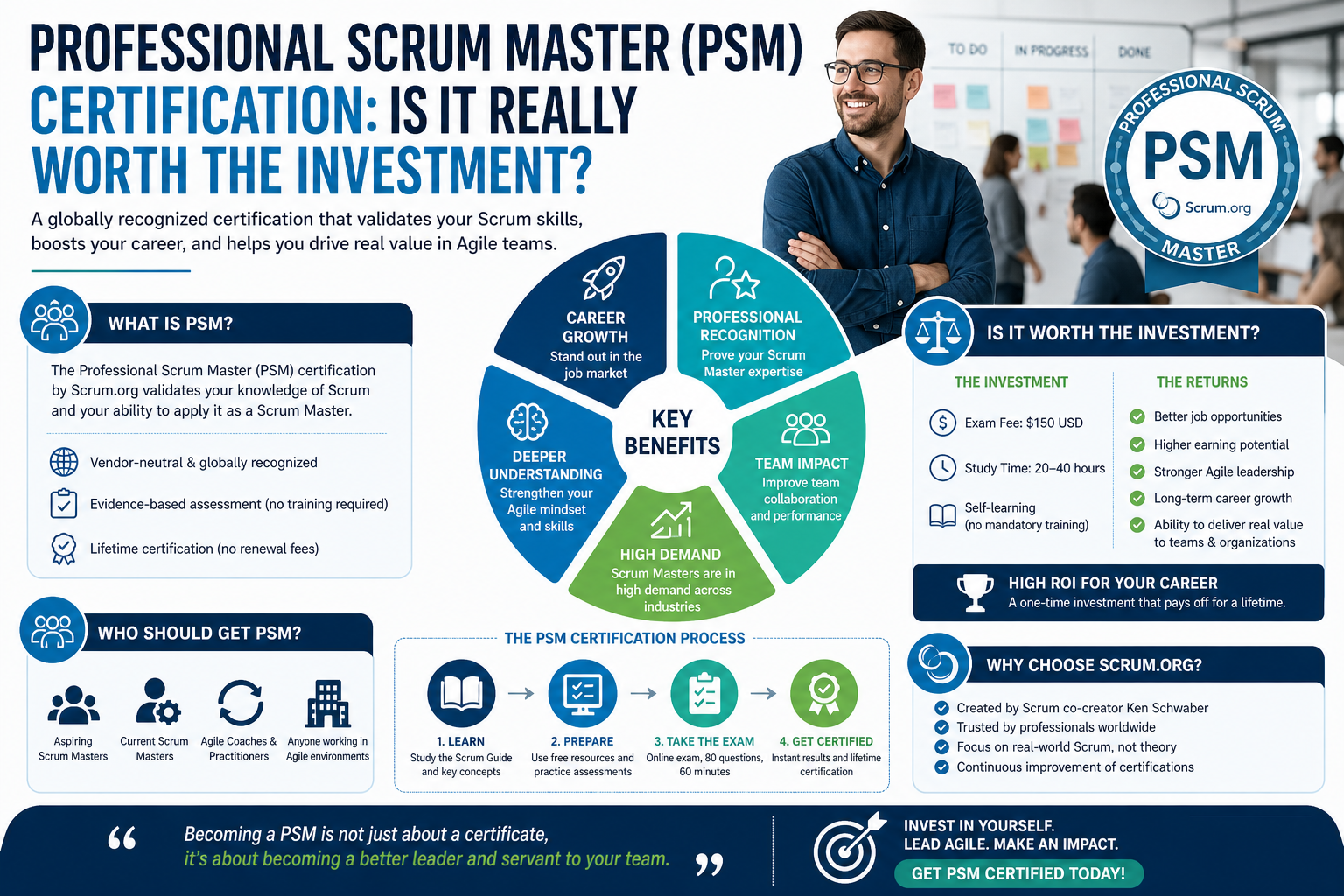
The Professional Scrum Master certification is designed to validate a person’s understanding of Scrum principles and their ability to apply them in real-world environments. It is not simply an academic qualification but a recognition of practical knowledge in Agile team facilitation and delivery.
This certification focuses on how Scrum teams function, how Scrum Masters support those teams, and how Agile values influence decision-making. Rather than emphasizing memorization, it assesses whether individuals understand how Scrum operates in dynamic scenarios.
One of the key aspects of this certification is its global recognition. It is widely acknowledged across industries and regions, making it a portable credential for professionals working in international or distributed teams. This global acceptance contributes to its appeal for individuals seeking career mobility.
Another important characteristic is its focus on foundational mastery. It is not limited to advanced practitioners; instead, it is often pursued by individuals at different stages of their careers. Whether someone is transitioning into Agile roles or already working within Scrum environments, the certification serves as a structured way to validate understanding.
The value of this certification lies not only in passing an assessment but in the learning process itself. Preparing for it requires individuals to study Scrum theory deeply and understand how it applies to real-world team dynamics.
Core Principles Behind the Scrum Master Role
To understand the value of the certification, it is important to understand the role it represents. The Scrum Master is not a traditional manager or team leader in the conventional sense. Instead, the role is centered around facilitation, guidance, and enabling team effectiveness.
A Scrum Master helps ensure that Scrum practices are understood and followed by the team. This includes supporting collaboration, removing obstacles that hinder progress, and helping the team improve continuously. The role is often described as a servant-leader position because its primary focus is enabling others rather than directing them.
One of the core responsibilities is ensuring that Scrum events—such as planning sessions, daily coordination, reviews, and retrospectives—are conducted effectively. These events are not merely meetings but structured opportunities for alignment, reflection, and improvement.
Another important aspect is fostering a culture of continuous improvement. Scrum Masters encourage teams to regularly reflect on their performance and identify ways to become more efficient. This involves not only process improvements but also strengthening communication and teamwork.
The role also requires a strong understanding of team dynamics. Scrum Masters often work with diverse individuals, each with different skills and perspectives. Balancing these dynamics while maintaining focus on shared goals is a key part of the role.
How the Scrum Master Fits Within Agile Teams
In a Scrum environment, teams are typically structured around three primary roles: the Product Owner, the Development Team, and the Scrum Master. Each role has a distinct responsibility, and together they form a balanced system of accountability and collaboration.
The Product Owner focuses on defining what needs to be built and prioritizing work based on business value. The Development Team is responsible for delivering the actual product increment. The Scrum Master, meanwhile, ensures that the process supporting this work runs smoothly.
Unlike traditional project managers, Scrum Masters do not assign tasks or control workflows. Instead, they support the team by facilitating communication and ensuring that Scrum principles are followed correctly. This distinction is important because it reflects the shift from command-based management to collaborative delivery.
In practice, Scrum Masters often act as coaches. They help teams understand Agile principles, improve their workflows, and become more self-organizing over time. A self-organizing team is one that can manage its own work without constant external direction, which is a key goal of Scrum.
The Scrum Master also plays a role in bridging communication between the team and external stakeholders. This ensures that expectations are aligned and that the team is not disrupted by unclear or conflicting demands.
Skills Measured in Professional Scrum Master Certification
The certification evaluates a broad range of skills related to Scrum knowledge and application. One of the primary areas is understanding Scrum theory and values. This includes familiarity with transparency, inspection, and adaptation, which are the foundational pillars of Scrum.
Another key area is knowledge of roles and responsibilities within a Scrum team. Candidates are expected to understand how different roles interact and how responsibilities are distributed to ensure smooth collaboration.
The certification also focuses on Scrum events. Understanding the purpose and structure of each event is essential. This includes how planning sessions help define work, how daily coordination supports progress tracking, how reviews enable stakeholder feedback, and how retrospectives drive continuous improvement.
Scrum artifacts are another important area. These include items such as the product backlog and sprint backlog, which represent work items and their status. Understanding how these artifacts support transparency and planning is crucial.
In addition to structural knowledge, the certification also emphasizes behavioral aspects. This includes servant leadership, coaching techniques, and facilitation skills. These soft skills are essential for enabling teams to function effectively within Scrum frameworks.
Candidates are expected to apply this knowledge in practical scenarios, which means understanding not just definitions but also real-world implications.
Why Organizations Value Scrum Knowledge
Organizations value Scrum knowledge because it directly impacts how efficiently teams deliver work. In environments where speed and adaptability are important, Scrum provides a structured yet flexible way of managing projects.
One of the main advantages is improved visibility. Scrum frameworks make work progress more transparent, allowing stakeholders to understand what is being developed and where potential challenges exist. This transparency reduces uncertainty and improves decision-making.
Another advantage is faster feedback cycles. Because work is delivered in short iterations, organizations can gather feedback early and make necessary adjustments. This reduces the risk of investing heavily in solutions that do not meet user needs.
Scrum also encourages collaboration across roles and departments. Instead of isolated workstreams, teams operate in a shared environment where communication is continuous. This helps reduce misunderstandings and improves alignment with business goals.
For employers, having team members who understand Scrum means fewer process inefficiencies and better project outcomes. It also means teams are more adaptable when priorities change, which is increasingly common in modern business environments.
Early Career vs Experienced Professionals Perspective
For individuals early in their careers, learning Scrum provides a structured entry point into Agile environments. It helps build foundational understanding of how modern teams operate and introduces key concepts that are widely used across industries.
Early-career professionals often benefit from Scrum knowledge because it improves their ability to collaborate effectively in team settings. It also makes them more attractive to employers who prioritize Agile experience, even at entry-level positions.
For experienced professionals, Scrum knowledge often serves a different purpose. It helps formalize existing experience and provides a recognized framework for skills they may already be practicing. This is especially relevant for individuals who have worked in project management, software development, or product roles.
Experienced professionals may also use Scrum knowledge to transition into leadership roles. Understanding how teams operate within Agile frameworks can support career growth into positions that involve coordination, facilitation, or strategic planning.
In both cases, Scrum knowledge provides a shared language that is widely understood across organizations. This makes it easier for professionals to work in diverse environments and adapt to different team structures.
Common Misconceptions About Scrum Master Certification
One common misconception is that obtaining Scrum knowledge automatically makes someone a project manager or team leader. In reality, the Scrum Master role is distinct from traditional management roles. It focuses more on facilitation and coaching than on direct authority or control.
Another misconception is that Scrum is only relevant for software development. While it originated in software engineering, Scrum principles are now used in many industries, including marketing, operations, and product design. Its flexibility makes it applicable to any environment that deals with complex work and evolving requirements.
Some also believe that certification alone guarantees career advancement. While it can improve opportunities, its real value depends on how knowledge is applied in practice. Organizations place significant importance on real-world experience alongside formal credentials.
There is also a misunderstanding that Scrum is a rigid set of rules. In reality, it is a framework designed to be adapted based on context. Teams are encouraged to adjust practices while staying aligned with core principles.
Setting the Context for Career Value
The growing adoption of Agile methodologies has reshaped how organizations approach project delivery. As part of this shift, structured understanding of Scrum has become increasingly relevant for professionals across different roles.
The Professional Scrum Master certification exists within this broader context of Agile transformation. It represents a standardized way of demonstrating knowledge of Scrum principles and their application in team environments. Its relevance is closely tied to how widely Scrum is used in modern organizations and how important collaboration and adaptability have become in professional settings.
As industries continue to evolve toward iterative delivery models, the demand for individuals who understand these frameworks is expected to remain strong.
How Professional Scrum Master Exams Evaluate Real Understanding
The Professional Scrum Master certification exam is designed in a way that goes beyond simple memorization. Instead of asking direct textbook definitions, it evaluates how well a candidate understands Scrum principles in practical and often ambiguous situations. This approach reflects the reality of Agile environments, where decisions are rarely black and white.
The exam is structured to test comprehension of how Scrum works as a system rather than isolated facts. Candidates are expected to understand interactions between roles, events, and artifacts, and how these components influence each other in real projects. This systems-level thinking is what separates superficial knowledge from genuine Scrum mastery.
Unlike traditional exams that reward repetition of learned material, Scrum assessments often present scenario-based questions. These scenarios require candidates to analyze situations and choose the most appropriate response based on Agile principles. This makes preparation more about understanding behavior and decision-making than memorizing rules.
The intention behind this design is to ensure that certified professionals are capable of applying Scrum effectively in real-world environments where complexity is common and solutions are not always obvious.
Understanding the Structure and Cognitive Demands of the Exam
The exam format typically consists of multiple-choice questions that are carefully crafted to test layered understanding. Many questions may appear simple at first glance, but they often include subtle distinctions that require careful interpretation.
One of the key challenges candidates face is the presence of closely related answer options. These options are designed to assess whether the test-taker truly understands Scrum values or is simply guessing based on familiarity with terminology.
The cognitive demand of the exam is relatively high because it requires contextual thinking. Candidates must evaluate not just what Scrum prescribes, but why certain actions align better with Agile principles than others.
Time management is another important factor. While the questions themselves may not be lengthy, the mental effort required to analyze each scenario can be significant. This means candidates must maintain focus and avoid rushing through questions without proper evaluation.
The structure encourages deep comprehension rather than surface-level preparation, making it necessary for candidates to develop both conceptual clarity and situational awareness.
Depth of Scrum Knowledge Required for Success
Success in the Professional Scrum Master certification requires a strong grasp of foundational Scrum concepts. However, understanding these concepts at a deeper level is what truly makes a difference in performance.
For example, knowing the definition of Scrum events is not enough. Candidates must also understand the purpose behind each event and how it contributes to team efficiency and transparency. This includes recognizing how each event supports inspection and adaptation within a sprint cycle.
Similarly, understanding roles within Scrum involves more than memorizing responsibilities. It requires insight into how these roles interact dynamically. The Scrum Master, for instance, is not just a facilitator but also a coach who influences team behavior and helps remove systemic obstacles.
Scrum artifacts also require layered understanding. A product backlog is not just a list of tasks; it is a living document that evolves based on feedback and changing priorities. Understanding this evolution is crucial for answering scenario-based questions correctly.
The depth of knowledge required ensures that certified individuals are capable of functioning effectively in real Agile environments rather than relying on theoretical familiarity alone.
Common Challenges Faced by Candidates During Preparation
Many candidates underestimate the conceptual complexity of Scrum until they begin preparing for certification. One of the most common challenges is shifting from traditional thinking to Agile thinking.
Individuals who come from structured project management backgrounds often find it difficult to adapt to Scrum’s flexible and iterative nature. In traditional environments, planning is detailed and predictive, whereas Scrum emphasizes adaptability and continuous improvement.
Another challenge is understanding the difference between doing Scrum and understanding Scrum. Some candidates have worked in Agile teams but may not fully understand the reasoning behind certain practices. This can lead to confusion when faced with scenario-based questions.
Misinterpretation of Scrum roles is also common. For example, candidates sometimes assume that the Scrum Master has authority over task assignment or decision-making, which is not aligned with Agile principles. This misunderstanding can lead to incorrect responses in exam situations.
Time pressure during preparation is another issue. Because Scrum involves multiple interconnected concepts, candidates often struggle to organize their study approach effectively. Without a structured learning path, it becomes difficult to cover all necessary areas in depth.
Developing Real-World Scrum Thinking Instead of Memorization
One of the most important shifts required during preparation is moving away from memorization and toward real-world thinking. Scrum is designed to function in dynamic environments, and the certification reflects that philosophy.
Instead of learning definitions in isolation, candidates benefit more from understanding how Scrum behaves as a system. For example, rather than memorizing what a sprint retrospective is, it is more valuable to understand how it improves team performance over time.
Real-world thinking involves recognizing patterns in team behavior and understanding how Scrum practices influence those patterns. This includes observing how teams respond to feedback, how priorities shift during a sprint, and how communication flows between roles.
This type of thinking is developed through exposure to real or simulated Scrum environments. Even individuals without direct experience can build this mindset by studying scenarios and analyzing how Scrum principles apply in different contexts.
The ability to think in this way is what enables professionals to succeed not only in the exam but also in actual Scrum roles within organizations.
Study Approaches That Strengthen Conceptual Understanding
Effective preparation for Scrum certification requires a structured approach that prioritizes understanding over repetition. One of the most effective methods is breaking down Scrum into its core components and studying each one in relation to the others.
Instead of studying roles, events, and artifacts separately, it is more effective to analyze how they interact. This interconnected understanding helps candidates answer complex scenario-based questions with greater accuracy.
Another useful approach is scenario analysis. This involves reading real or hypothetical situations and determining how Scrum principles would apply. This method helps build decision-making skills that are essential for the exam.
Active reflection is also important. After studying a concept, candidates benefit from asking how it would apply in a real team environment. This encourages deeper processing of information and strengthens long-term retention.
Consistency in study habits plays a significant role as well. Regular exposure to Scrum concepts over time leads to better comprehension than short, intensive study sessions.
Importance of Practice in Reinforcing Agile Thinking
While theoretical understanding is essential, practice plays a crucial role in reinforcing Agile thinking. Engaging with practical scenarios helps bridge the gap between knowledge and application.
Practice allows candidates to experience the complexity of real-world decision-making. Instead of relying on memorized answers, they learn to evaluate situations based on context and principles.
This process also helps identify gaps in understanding. When candidates struggle with certain scenarios, it highlights areas that require further study. Over time, this iterative learning process improves both confidence and competence.
Another benefit of practice is improved familiarity with question patterns. While the exam is not predictable, repeated exposure to similar scenario structures helps candidates become more comfortable with interpreting questions accurately.
Practice also encourages mental discipline. It trains individuals to think critically under time constraints, which is an important skill during the actual exam.
Developing an Agile Mindset Beyond the Framework
Scrum is not just a set of rules; it is built on an Agile mindset. Developing this mindset is essential for both certification success and real-world application.
An Agile mindset emphasizes adaptability, collaboration, and continuous improvement. It encourages individuals to view challenges as opportunities for learning rather than fixed obstacles.
One key aspect of this mindset is openness to change. In Agile environments, change is expected rather than avoided. Teams are encouraged to adjust their approach based on feedback and evolving requirements.
Another important aspect is focus on value delivery. Instead of concentrating solely on completing tasks, Agile thinking emphasizes delivering meaningful outcomes that benefit users or customers.
Collaboration is also central to the Agile mindset. Scrum relies heavily on communication and shared responsibility. Individuals must be willing to work closely with others and contribute to collective success.
Developing this mindset often requires unlearning traditional approaches to work and adopting a more flexible and iterative perspective.
How Scrum Master Skills Apply Across Industries
Although Scrum originated in software development, its principles are now applied across a wide range of industries. This expansion reflects the versatility of Agile thinking in managing complex work environments.
In product development environments, Scrum helps teams manage evolving customer needs and deliver incremental improvements. It allows organizations to respond quickly to market changes and user feedback.
In marketing teams, Scrum is used to manage campaigns and content production. Iterative planning helps teams adjust strategies based on performance data and audience response.
In finance and operations, Scrum supports process improvement and project coordination. It helps teams break down large initiatives into manageable steps and improve transparency across departments.
Even in healthcare and education, Scrum principles are being adapted to improve workflow efficiency and collaboration. The focus on continuous improvement makes it suitable for environments where adaptability is essential.
This cross-industry applicability increases the value of Scrum knowledge for professionals seeking versatile career opportunities.
Career Roles That Commonly Require Scrum Knowledge
Scrum knowledge is increasingly relevant in a variety of professional roles. One of the most common is the Scrum Master role itself, which focuses on facilitating Agile processes and supporting team efficiency.
Product Owners also rely heavily on Scrum knowledge to manage priorities and ensure that development work aligns with business goals. Their role requires constant interaction with stakeholders and development teams.
Project managers transitioning into Agile environments benefit from Scrum understanding as they adapt to more flexible delivery models. While their responsibilities may shift, their ability to manage coordination remains valuable.
Software developers working in Agile teams also benefit from understanding Scrum principles. It helps them participate more effectively in sprint planning and improve collaboration with other team members.
Business analysts, QA engineers, and UX designers also find Scrum knowledge useful as it helps them integrate more effectively into cross-functional teams.
How Employers Evaluate Scrum Certification in Hiring
Employers view Scrum certification as an indicator of structured knowledge and commitment to Agile practices. However, it is rarely treated as a standalone qualification for hiring decisions.
Instead, it is used as a supporting factor alongside experience and practical skills. Employers often look for evidence that candidates can apply Scrum principles effectively in real environments.
The certification helps differentiate candidates who have formal understanding from those who may only have informal exposure to Agile practices. It signals that the individual has invested time in learning structured methodologies.
In many cases, employers also use certification as a baseline requirement for Agile-related roles. This means it can help candidates pass initial screening stages more easily.
However, long-term career growth depends more on practical application than certification alone. Organizations value individuals who can demonstrate results through effective team collaboration and delivery outcomes.
Transitioning into Scrum-Focused Roles
Transitioning into Scrum roles often involves a combination of learning, experience, and mindset adjustment. Individuals typically begin by gaining exposure to Agile environments through team participation.
Over time, they develop familiarity with Scrum practices such as sprint planning, daily coordination, and retrospectives. This experience helps build confidence in understanding team dynamics.
Formal certification can support this transition by providing structured knowledge and validating understanding. It also helps individuals communicate their skills more effectively to potential employers.
The transition process is often gradual, especially for those coming from traditional project management or non-technical backgrounds. It requires openness to new ways of working and willingness to adapt to iterative processes.
As professionals gain experience, they often move into more specialized Agile roles, including Scrum Master, Agile coach, or product-focused positions, depending on their interests and strengths.
Real-World Application of Scrum Master Skills in Teams
Scrum Master skills are most valuable when applied in real team environments rather than theoretical discussions. In practice, Scrum is about enabling teams to work more effectively together, and the Scrum Master plays a central role in making that happen.
In real-world settings, teams often face challenges such as unclear requirements, shifting priorities, communication gaps, and delivery pressure. The Scrum Master helps navigate these challenges by reinforcing Scrum principles and encouraging structured collaboration.
One of the most visible applications of Scrum Master skills is facilitating team communication. In many organizations, teams include members from different disciplines such as development, design, testing, and business analysis. Each group may have different priorities and perspectives. The Scrum Master helps align these perspectives so that the team can work toward a shared goal.
Another practical responsibility is ensuring that Scrum events are productive. In many teams, meetings can become unfocused or repetitive without proper facilitation. The Scrum Master ensures that sprint planning, daily coordination, reviews, and retrospectives remain goal-oriented and efficient.
Beyond meetings, Scrum Masters also help teams manage work flow. They encourage transparency so that everyone understands what is being worked on and what remains. This visibility helps reduce confusion and improves accountability within the team.
In high-performing teams, Scrum Masters often act as coaches rather than directors. They guide teams to solve their own problems rather than providing direct solutions. This approach strengthens team independence over time and reduces reliance on external intervention.
How Scrum Supports Modern Product Development Cycles
Modern product development is rarely linear. Requirements evolve based on customer feedback, market changes, and internal strategy shifts. Scrum is designed to handle this uncertainty through iterative development cycles.
In a Scrum environment, work is divided into short time periods known as sprints. Each sprint focuses on delivering a usable increment of the product. This approach allows teams to continuously refine their work based on feedback.
Product development cycles benefit from this structure because it reduces the risk of building the wrong solution. Instead of waiting months or years for a final product release, teams can validate ideas early and adjust direction as needed.
The Product Owner plays a key role in this cycle by prioritizing work based on business value. However, the Scrum Master ensures that the process supporting this prioritization runs smoothly and efficiently.
Developers also benefit from this structure because it provides clarity on what needs to be delivered in each cycle. This reduces ambiguity and improves focus during development work.
Over time, Scrum helps organizations move from predictive planning to adaptive planning. This shift is essential in industries where customer expectations change rapidly.
Impact of Scrum on Team Productivity and Collaboration
One of the most significant advantages of Scrum is its impact on team productivity. By breaking work into smaller increments, teams can focus on delivering value continuously rather than waiting for long project cycles to complete.
This incremental approach reduces the cognitive load on teams. Instead of managing large, complex projects all at once, they can focus on smaller, manageable pieces of work.
Scrum also improves collaboration by encouraging frequent communication. Daily coordination sessions ensure that team members are aware of each other’s progress and challenges. This reduces duplication of effort and prevents misunderstandings.
Another important factor is transparency. In Scrum environments, work progress is visible to all team members. This visibility helps identify bottlenecks early and allows teams to address issues before they escalate.
Retrospectives also play a key role in improving productivity. These sessions allow teams to reflect on their performance and identify areas for improvement. Over time, this leads to continuous enhancement of workflows and team dynamics.
Scrum does not automatically guarantee productivity improvements, but when implemented effectively, it creates conditions that support higher efficiency and better collaboration.
Leadership Skills Developed Through Scrum Master Practice
Scrum Master roles are closely associated with leadership development. However, this form of leadership is different from traditional hierarchical leadership models. It is based on influence rather than authority.
One of the primary leadership skills developed through Scrum Master practice is facilitation. Scrum Masters learn how to guide discussions, manage group dynamics, and ensure that conversations remain productive.
Another important skill is conflict resolution. In team environments, disagreements are inevitable. Scrum Masters help address these conflicts constructively so that they do not negatively impact team performance.
Coaching is another key leadership skill. Instead of giving direct instructions, Scrum Masters encourage team members to think critically and find their own solutions. This approach helps build long-term problem-solving capability within teams.
Emotional intelligence is also an important aspect of Scrum leadership. Understanding team morale, identifying stress points, and supporting individuals during challenges are all part of the role.
Over time, these leadership skills extend beyond Scrum environments and become valuable in broader organizational contexts.
Organizational Benefits of Implementing Scrum at Scale
When organizations adopt Scrum at scale, the benefits extend beyond individual teams. One of the most significant advantages is improved alignment across departments.
Large organizations often struggle with coordination between multiple teams working on different parts of a product. Scrum provides a structured framework that improves synchronization between these teams.
Another benefit is faster decision-making. Because Scrum emphasizes transparency, stakeholders have access to up-to-date information about progress and challenges. This reduces delays caused by uncertainty or lack of visibility.
Scalability is another important factor. Scrum can be applied to multiple teams working in parallel while maintaining consistency in delivery practices. This helps organizations manage large and complex projects more effectively.
Scrum also supports risk reduction. By delivering work in small increments, organizations can identify issues early and adjust their approach before problems become critical.
Over time, organizations that implement Scrum effectively often experience improved adaptability, better resource utilization, and higher customer satisfaction.
Career Growth Opportunities Linked to Scrum Expertise
Scrum expertise opens up a wide range of career opportunities across industries. One of the most common career paths is becoming a Scrum Master, where individuals focus on facilitating Agile processes and supporting team performance.
Another career direction is product ownership. Product Owners work closely with stakeholders and development teams to define priorities and ensure that products deliver value.
Many professionals also transition into Agile coaching roles. These roles involve guiding multiple teams or entire organizations in adopting and improving Agile practices.
Project managers often use Scrum knowledge to transition into Agile project leadership roles. While their responsibilities may evolve, their ability to manage delivery remains valuable.
Software developers and engineers can also move into technical leadership positions where Scrum knowledge helps them coordinate with cross-functional teams.
Business analysts and UX professionals also benefit from Scrum expertise as it allows them to integrate more effectively into iterative development environments.
Scrum knowledge does not limit career options; instead, it expands them by providing a flexible foundation for multiple roles.
Factors That Influence the Value of Scrum Certification
The value of Scrum certification is influenced by several factors beyond the credential itself. One of the most important factors is practical application. Individuals who actively apply Scrum principles in real environments tend to gain more value from certification than those who only study theory.
Industry context also plays a role. In organizations that actively use Agile frameworks, Scrum certification is more relevant and valuable. In contrast, in traditional environments, its impact may be less immediate.
Experience level is another important factor. For beginners, certification provides foundational understanding and helps enter Agile roles. For experienced professionals, it serves as validation of existing knowledge.
Geographic and market conditions also influence value. In regions where Agile adoption is high, Scrum certification is often more recognized by employers.
Another factor is complementary skills. Scrum knowledge combined with technical, analytical, or leadership skills tends to create stronger career advantages.
Ultimately, the value of certification is not fixed but depends on how it is applied and integrated into professional practice.
Misalignment Between Expectations and Reality in Scrum Roles
One of the challenges in Scrum careers is the mismatch between expectations and reality. Many individuals enter Scrum roles expecting traditional management authority, but Scrum operates differently.
Scrum Masters do not have direct control over team members or task assignments. Instead, their influence is indirect and based on facilitation and coaching.
This difference can sometimes lead to confusion, especially for professionals transitioning from hierarchical roles. Adjusting to a facilitation-based role requires a shift in mindset.
Another common misconception is that Scrum guarantees smooth project execution. While Scrum improves structure and transparency, it does not eliminate challenges such as unclear requirements or resource constraints.
Teams still need to manage complexity, uncertainty, and interpersonal dynamics. Scrum provides a framework for handling these challenges but does not remove them entirely.
Understanding this reality is important for professionals considering Scrum-related roles.
Evolution of Agile Practices Beyond Traditional Scrum
While Scrum remains widely used, Agile practices continue to evolve. Many organizations now combine Scrum with other frameworks or adapt it to suit their specific needs.
Hybrid approaches are increasingly common, where Scrum is integrated with Kanban, Lean, or DevOps practices. These combinations help organizations address different types of work more effectively.
Some teams also modify Scrum events or roles to better align with their workflows. This flexibility reflects the adaptable nature of Agile thinking.
Despite these variations, the core principles of Scrum—transparency, inspection, and adaptation—remain central to most implementations.
This evolution highlights that Scrum is not a fixed system but a foundation that can be adapted over time.
Long-Term Relevance of Scrum Master Skills in Technology and Business
Scrum Master skills are likely to remain relevant as long as organizations continue to operate in uncertain and fast-changing environments. The need for structured collaboration, iterative delivery, and continuous improvement is not limited to any single industry.
As technology continues to evolve, product development cycles are expected to become even faster. This increases the importance of frameworks that support adaptability.
Business environments are also becoming more interconnected and complex. Organizations must respond quickly to market changes, customer feedback, and technological advancements.
In this context, Scrum Master skills provide a stable foundation for managing complexity. They help teams stay aligned, focused, and adaptable.
Even as new frameworks and methodologies emerge, the core principles behind Scrum are likely to remain influential in shaping how teams work together in the future.
Conclusion
The Professional Scrum Master certification continues to hold strong relevance in today’s fast-moving, Agile-driven work environment because it focuses on a skill set that modern organizations actively depend on. As companies shift away from rigid, long-term project planning and move toward iterative delivery models, the ability to understand and apply Scrum principles has become increasingly valuable. This certification serves as a structured way to demonstrate that understanding in a way that is widely recognized across industries.
One of the key strengths of the Professional Scrum Master credential is that it does not simply validate theoretical knowledge. Instead, it emphasizes practical understanding of how Scrum functions in real teams. This includes knowledge of team roles, sprint cycles, backlog management, and the principles of servant leadership. More importantly, it assesses whether professionals can apply these concepts in realistic situations where decisions are not always straightforward.
The value of the certification also depends on how it is used in a professional journey. For individuals new to Agile environments, it provides a strong foundation that helps them understand how modern teams operate. It introduces structured thinking around collaboration, iterative delivery, and continuous improvement. For experienced professionals, it serves as validation of existing knowledge and strengthens credibility when working in leadership or coordination roles.
Another important aspect is career flexibility. Scrum knowledge is not limited to software development alone. It is widely used in product management, business operations, marketing, and even non-technical industries that require adaptive planning. This makes the certification a versatile asset for professionals who want to expand their career opportunities across different domains.
However, it is also important to recognize that certification alone does not guarantee career advancement. Its real value emerges when combined with practical experience, strong communication skills, and the ability to work effectively within teams. Organizations are not only looking for certified individuals but for professionals who can contribute to smoother workflows, better collaboration, and improved delivery outcomes.
Ultimately, the Professional Scrum Master certification is worth it for those who are serious about working in Agile environments and developing long-term skills in team facilitation, process improvement, and adaptive planning. It represents more than a credential; it reflects a mindset that is increasingly essential in modern workplaces. As industries continue to evolve and prioritize flexibility, transparency, and speed, the importance of Scrum-based thinking is likely to grow even further.