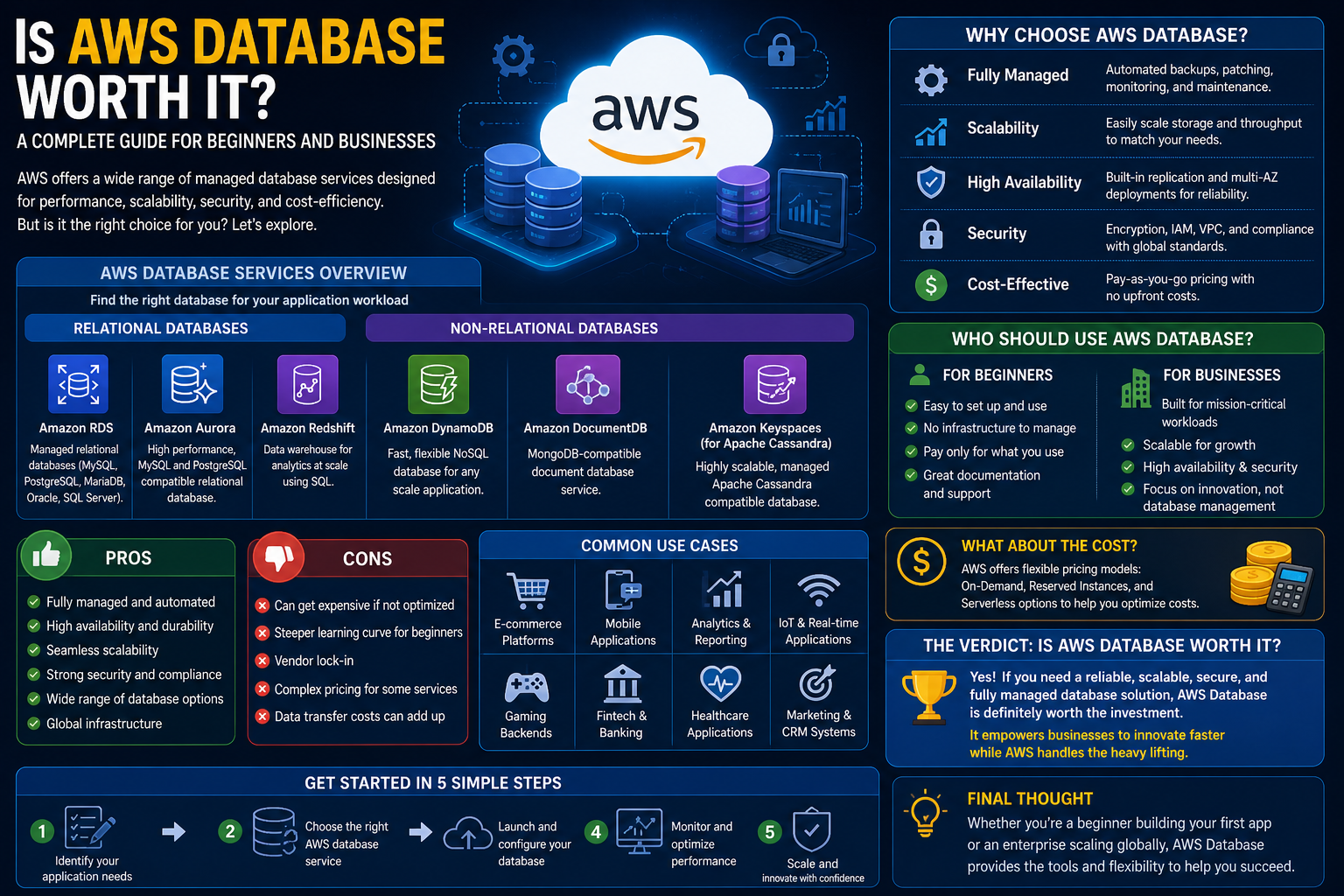
Modern digital systems are built on data in ways that were difficult to imagine a few decades ago. Every online transaction, mobile application, streaming platform, financial system, healthcare record, and even simple website interaction produces structured or unstructured information that needs to be stored, processed, and retrieved efficiently. As organizations grow, so does the volume, variety, and velocity of this data. What was once a backend technical concern has now become a core driver of business success.
In earlier computing eras, databases were often treated as supporting infrastructure. They existed quietly in the background, managed by specialized administrators who ensured systems ran smoothly. Today, however, databases sit at the center of decision-making. Businesses depend on them not only for storing records but also for generating insights, powering analytics, enabling automation, and supporting real-time services.
This shift has changed how companies think about database systems. Instead of relying on a single type of database or a static architecture, organizations now need flexible solutions that can adapt to changing workloads. A retail company, for example, might require a relational database for transactions, a non-relational system for customer behavior tracking, and a data warehouse for large-scale analytics—all at the same time.
As a result, database professionals are no longer just system maintainers. They are expected to understand business requirements, interpret technical constraints, and design solutions that align both. This increasing complexity is one of the reasons specialized knowledge in cloud database ecosystems has become so valuable.
The Evolution from Traditional Databases to Cloud Ecosystems
Traditional databases were typically hosted on-premises, meaning companies had to purchase hardware, install database software, and manage everything within their own data centers. While this approach gave organizations control, it also introduced limitations in scalability, cost efficiency, and flexibility.
Scaling a traditional database often required purchasing additional servers or upgrading existing infrastructure. This process was not only expensive but also time-consuming. Downtime, performance bottlenecks, and hardware failures were common challenges that required constant attention from database teams.
The shift toward cloud computing transformed this landscape. Instead of managing physical infrastructure, organizations could now rely on cloud providers to handle storage, compute power, security, and maintenance. This allowed businesses to focus more on data usage and less on infrastructure management.
Cloud-based database systems introduced features such as automatic scaling, managed backups, high availability, and global distribution. These capabilities significantly reduced operational burden while increasing system reliability. However, they also introduced a new level of complexity: instead of managing a single database system, professionals now needed to understand multiple cloud-based database models, each optimized for different use cases.
This evolution also changed the role of decision-making in database architecture. Choosing the right database is no longer just about performance or storage capacity. It involves evaluating workload types, access patterns, latency requirements, cost optimization, and integration with other cloud services.
As organizations increasingly adopt cloud-first strategies, the demand for professionals who understand these systems deeply continues to grow.
Understanding the AWS Database Ecosystem
Among cloud providers, AWS offers one of the most extensive collections of database services, each designed for specific workloads and performance needs. Rather than relying on a single database engine, AWS provides a suite of specialized options that can be combined depending on application requirements.
Relational database services remain a foundational part of this ecosystem. These systems are designed for structured data, strong consistency, and transactional integrity. They are commonly used in applications such as financial systems, order processing, and inventory management.
Alongside relational databases, AWS also provides non-relational (NoSQL) database options. These are designed for flexibility, scalability, and high-speed access to large volumes of unstructured or semi-structured data. They are often used in real-time applications, gaming systems, IoT platforms, and content management systems.
In addition to these, AWS includes services for in-memory caching, data warehousing, and graph-based data modeling. Each service addresses a specific type of workload challenge, such as low-latency access, analytical processing, or complex relationship mapping between data entities.
What makes this ecosystem particularly complex is not just the number of services, but how they interact with each other. A single application may rely on multiple database types simultaneously, each serving a different purpose within the same architecture. Understanding how and when to use each service requires more than operational knowledge—it requires architectural thinking.
This layered ecosystem is one of the reasons database specialization in cloud environments is considered advanced. Professionals must not only understand how individual services work but also how they fit into larger system designs.
What Specialty-Level Database Expertise Represents
Specialty-level expertise in databases goes beyond basic administration or implementation tasks. It represents a deeper understanding of how data systems behave under different conditions and how to design solutions that meet specific business requirements.
At this level, professionals are expected to evaluate complex scenarios where multiple factors must be balanced. For example, a system may require high availability across regions, low latency for end users, strong consistency for financial transactions, and cost efficiency at scale. Achieving all of these simultaneously requires careful selection and configuration of database services.
Specialty-level knowledge also involves understanding trade-offs. Every database design decision comes with advantages and limitations. A highly scalable system may sacrifice consistency, while a strongly consistent system may introduce latency. A cost-efficient solution may require additional engineering effort to maintain performance. Recognizing these trade-offs and making informed decisions is a key part of advanced database expertise.
Another important aspect of this level of knowledge is adaptability. Cloud environments evolve rapidly, with new features, services, and best practices emerging frequently. Professionals at this level must be able to continuously update their understanding and apply new concepts to real-world scenarios.
This depth of knowledge is what distinguishes general database familiarity from architectural expertise. It is not enough to know how to operate a database system; one must also understand why certain systems are chosen over others in specific contexts.
The Role of Modern Database Professionals in Organizations
The responsibilities of database professionals have expanded significantly in cloud-driven environments. Instead of focusing solely on maintenance and troubleshooting, they are now deeply involved in system design, planning, and optimization.
One of the most important aspects of this role is understanding business requirements. Database professionals must translate operational needs into technical solutions. This involves analyzing how data is used, how often it is accessed, what performance expectations exist, and how the system should behave under peak load conditions.
They are also responsible for ensuring that data systems remain reliable and secure. This includes implementing backup strategies, managing access controls, monitoring system health, and responding to performance issues. In cloud environments, these tasks are often automated or managed through services, but professionals still need to configure and oversee them effectively.
Another critical responsibility is supporting system evolution. As organizations grow, their data requirements change. A system that once handled small workloads may need to scale globally or support real-time analytics. Database professionals must ensure that architectures can evolve without disrupting operations.
In many organizations, these professionals also collaborate closely with developers, cloud architects, and business stakeholders. Their role becomes a bridge between technical implementation and business strategy, ensuring that data systems align with organizational goals.
Core Responsibilities in Database System Design and Management
Designing and managing database systems in cloud environments involves several interconnected responsibilities. One of the primary tasks is selecting appropriate database models based on workload characteristics. This requires understanding whether the system needs structured data storage, flexible schema design, high-speed caching, or analytical processing capabilities.
Migration is another major responsibility. Many organizations transition from traditional systems to cloud-based environments, and this process requires careful planning. Data must be transferred without loss, downtime must be minimized, and compatibility between systems must be maintained.
Once systems are deployed, ongoing management becomes essential. This includes monitoring performance metrics, optimizing queries, managing storage usage, and ensuring system availability. Cloud environments provide tools for automation, but human oversight is still necessary to ensure optimal configuration.
Security is also a central concern. Protecting sensitive data involves configuring encryption, managing identity and access policies, and ensuring compliance with regulatory requirements. Database professionals must understand both technical and organizational security standards.
Troubleshooting is another critical area. When systems experience performance degradation or unexpected behavior, professionals must quickly identify root causes and implement solutions. This often requires deep understanding of system internals and interaction between different cloud services.
Workload-Driven Thinking in Database Architecture
One of the most important shifts in modern database design is the move toward workload-driven decision-making. Instead of selecting databases based on familiarity or preference, professionals must analyze the specific needs of each application.
Different workloads behave in different ways. Some require fast read and write operations, while others prioritize complex queries and large-scale analysis. Some systems must handle unpredictable traffic spikes, while others operate under stable and predictable conditions.
Understanding these patterns is essential for choosing the right database strategy. For example, a social media application may prioritize low-latency data retrieval and horizontal scaling, while a banking system may require strict transactional consistency and reliability.
Workload-driven thinking also involves anticipating future growth. A system that works well at a small scale may not perform efficiently as data volume increases. Professionals must design systems that can adapt to changing demands without requiring complete redesigns.
This approach requires both technical knowledge and analytical thinking. It is not enough to understand database features; one must also understand how those features align with real-world usage patterns.
Relational and Non-Relational Decision Complexity in Cloud Systems
One of the most important architectural decisions in cloud database design is choosing between relational and non-relational systems. Relational databases are built around structured schemas, relationships between tables, and strong consistency guarantees. They are ideal for applications where data integrity is critical.
Non-relational databases, on the other hand, offer flexibility in schema design and can handle large-scale, distributed data more efficiently. They are often used in scenarios where speed and scalability are more important than strict structure.
In cloud environments, this decision is not always straightforward. Many modern applications require both types of databases simultaneously. A single system may use a relational database for transactional data and a non-relational system for user activity logs or session data.
The complexity increases when considering factors such as global distribution, latency requirements, and cost optimization. Each database type behaves differently under load, and understanding these behaviors is essential for designing efficient systems.
Professionals must also consider integration between different systems. Data often flows between relational and non-relational databases, requiring synchronization strategies and careful architecture planning.
The Importance of Architectural Thinking in Database Expertise
Advanced database knowledge is not limited to operational tasks. It involves understanding how entire systems are structured and how different components interact with each other.
Architectural thinking requires professionals to step back from individual database operations and consider the broader system. This includes evaluating how data flows through applications, how services communicate, and how performance is affected by design decisions.
In cloud environments, this becomes even more important due to the distributed nature of systems. Databases may be spread across multiple regions, integrated with various services, and accessed by users from different parts of the world.
Professionals who develop this level of thinking are able to design systems that are not only functional but also scalable, efficient, and resilient. They can anticipate potential issues before they occur and design systems that adapt to changing conditions.
Introduction to the Depth of AWS Database Specialization Domains
The structure of advanced database certification reflects the complexity of real-world database responsibilities. Instead of focusing on a single skill area, it evaluates multiple dimensions of database expertise.
These areas typically include designing database solutions based on workloads, deploying and migrating databases, managing operational tasks, monitoring performance, troubleshooting issues, and ensuring security.
Each of these domains represents a critical aspect of working with cloud-based databases. Together, they form a comprehensive view of what it means to design and manage modern data systems in large-scale environments.
Understanding these domains provides insight into the level of knowledge required to operate effectively in cloud database roles, where technical decisions have direct impact on system performance, cost, and reliability.
Deep Dive into AWS Database Specialization and Real-World Architectural Demands
As cloud adoption expands across industries, database systems are no longer isolated technical components. They form the backbone of entire digital ecosystems, influencing application performance, customer experience, and business scalability. In this environment, AWS database services stand out because they offer a wide range of specialized tools designed for different types of workloads. Understanding how these tools are applied in real-world scenarios is essential for anyone working toward advanced database expertise.
The complexity of modern systems means that database professionals are expected to think beyond individual queries or maintenance tasks. Instead, they must understand how entire systems behave under pressure, how data flows across services, and how architectural decisions impact cost, performance, and reliability. This level of understanding is central to advanced AWS database specialization and is reflected in the kinds of scenarios professionals are expected to handle in real environments.
The Growing Complexity of Cloud Database Ecosystems
Cloud database ecosystems have evolved into multi-layered environments where different services interact continuously. Unlike traditional systems where a single relational database might handle most tasks, cloud architectures distribute responsibilities across multiple specialized services.
For example, one part of an application may rely on a relational database for structured transactional data, while another part uses a NoSQL database for high-speed, flexible data storage. Meanwhile, caching layers may be introduced to reduce latency, and analytics systems may process large-scale historical data separately.
This distribution of responsibilities improves scalability and performance, but it also introduces architectural complexity. Each component behaves differently under load, has its own scaling rules, and requires specific configuration strategies. Understanding how these components interact is a key skill for professionals working with cloud databases.
In many organizations, this complexity is not optional. Applications are expected to serve global user bases, operate 24/7, and handle unpredictable spikes in traffic. Cloud-based database systems make this possible, but only when designed correctly.
Workload Analysis as a Core Design Principle
One of the most important skills in modern database architecture is workload analysis. Instead of starting with a database service and forcing it to fit a problem, professionals must first understand the nature of the workload itself.
Workloads differ in several ways. Some are read-heavy, meaning they involve frequent data retrieval operations. Others are write-heavy, requiring fast ingestion of large volumes of data. Some workloads are transactional, requiring strict consistency, while others are analytical, focusing on large-scale data processing.
Understanding these characteristics is essential because each type of workload aligns with different database technologies. A system optimized for transactional consistency may perform poorly under analytical workloads, and vice versa.
Workload analysis also involves understanding usage patterns. For example, an application might experience predictable daily traffic cycles, or it might have unpredictable spikes due to external events. These patterns influence how databases should be scaled and configured.
In cloud environments, workload analysis becomes even more important because resources are elastic. This means systems can scale up or down dynamically, but only if they are designed with the right assumptions.
Database Design Decisions in Distributed Systems
Distributed systems introduce additional complexity into database design. Unlike single-server architectures, distributed systems spread data across multiple nodes, regions, or availability zones. This improves reliability and scalability but introduces challenges such as latency, consistency, and synchronization.
One of the key design decisions in distributed systems is how data is partitioned. Partitioning determines how data is divided across multiple storage units. Poor partitioning strategies can lead to performance bottlenecks, uneven resource usage, or increased latency.
Another important consideration is replication. Replication ensures that data is copied across multiple locations to improve availability and fault tolerance. However, replication introduces challenges related to consistency, as updates must be synchronized across all copies of the data.
Database professionals must also consider trade-offs between consistency and availability. In distributed systems, it is often impossible to achieve both perfect consistency and perfect availability simultaneously. This trade-off is a fundamental concept in cloud architecture and plays a major role in database design decisions.
Understanding these principles is essential for building systems that remain reliable under real-world conditions, especially when operating at global scale.
Migration Challenges in Cloud Database Environments
Migrating databases from traditional environments to cloud platforms is one of the most complex tasks in modern data engineering. It involves transferring not just data, but also application logic, performance expectations, and system dependencies.
One of the first challenges in migration is compatibility. Different database systems have different structures, query languages, and optimization strategies. Ensuring that data can be transferred without loss or corruption requires careful planning.
Another challenge is downtime management. Many applications cannot afford long periods of unavailability, so migrations must be performed in stages or using techniques that allow systems to remain operational during the transition.
Performance is another critical factor. A system that performs well in an on-premises environment may behave differently in the cloud due to network latency, storage architecture, or service configuration differences. Professionals must test and optimize systems after migration to ensure they meet performance expectations.
Data consistency during migration is also a major concern. When systems are transitioned incrementally, there is a risk of data mismatch between old and new systems. Proper synchronization strategies must be implemented to prevent inconsistencies.
Migration is not just a technical process; it is also an architectural transformation. It often requires rethinking how data is stored, accessed, and processed in the new environment.
Operational Management in Cloud Database Systems
Once a database system is deployed in a cloud environment, ongoing operational management becomes a critical responsibility. Unlike traditional systems where administrators manually monitor hardware and software, cloud environments provide automated tools for monitoring and management.
However, automation does not eliminate the need for human oversight. Professionals must still interpret performance metrics, identify anomalies, and make configuration adjustments when necessary.
Operational management includes tasks such as monitoring query performance, optimizing storage usage, managing backups, and ensuring system availability. These tasks require continuous attention, especially in high-traffic systems.
Another important aspect of operational management is capacity planning. Even though cloud systems can scale dynamically, professionals must still anticipate future demand and ensure that systems are configured to handle growth efficiently.
Cost management is also a key responsibility. Cloud databases operate on usage-based pricing models, meaning inefficient configurations can lead to unexpected costs. Professionals must balance performance requirements with cost efficiency.
Monitoring, Diagnostics, and Performance Optimization
Monitoring is a fundamental part of database management in cloud environments. Systems generate large volumes of metrics, logs, and performance data that must be analyzed to ensure optimal operation.
Key performance indicators include query latency, throughput, CPU utilization, memory usage, and storage performance. By analyzing these metrics, professionals can identify bottlenecks and optimize system performance.
Diagnostics involves identifying the root causes of performance issues or system failures. This often requires analyzing query execution plans, reviewing system logs, and understanding how different components interact.
Performance optimization is an ongoing process. It may involve adjusting indexing strategies, modifying query structures, changing database configurations, or redesigning data models.
In distributed cloud systems, performance optimization becomes even more complex due to network latency and cross-region data transfer. Professionals must consider both local and global performance factors when making optimization decisions.
Security Considerations in Cloud Database Architectures
Security is a critical aspect of cloud database management. As data becomes more valuable, protecting it from unauthorized access, corruption, or loss becomes a top priority.
Security in cloud databases involves multiple layers. At the infrastructure level, encryption ensures that data is protected both at rest and in transit. At the access level, identity and permission management controls who can view or modify data.
Another important aspect is auditing. Systems must maintain detailed records of data access and changes to ensure accountability and compliance with regulatory requirements.
Database professionals must also consider network security. This includes configuring secure communication channels, isolating database environments, and preventing unauthorized external access.
In addition to technical measures, security also involves policy design. Organizations must define clear rules for data access, retention, and usage. These policies must be implemented consistently across all systems.
Security is not a one-time setup but an ongoing process that evolves as systems grow and threats change.
The Role of Automation in Modern Database Management
Automation has transformed the way databases are managed in cloud environments. Tasks that once required manual intervention can now be handled by automated systems.
Backup processes, scaling operations, and performance monitoring are often automated to reduce operational overhead. This allows professionals to focus more on architecture and optimization rather than routine maintenance.
However, automation also introduces new challenges. Automated systems must be carefully configured to ensure they behave correctly under different conditions. Misconfigured automation can lead to performance issues or unexpected costs.
Professionals must also understand how to design systems that leverage automation effectively. This includes defining rules for scaling, setting thresholds for alerts, and configuring automated recovery processes.
Automation enhances efficiency, but it does not replace the need for expertise. Instead, it shifts the focus from manual tasks to system design and oversight.
Decision-Making in Multi-Database Environments
Modern applications rarely rely on a single database type. Instead, they use multiple database systems to handle different parts of their workload. This creates a multi-database environment where decision-making becomes more complex.
Professionals must decide which database is best suited for each component of an application. This requires understanding the strengths and limitations of each system and how they align with specific workload requirements.
For example, transactional systems may require strong consistency and structured schemas, while real-time analytics systems may prioritize speed and flexibility. Choosing the right combination of databases is essential for system efficiency.
Integration between different database systems is another important consideration. Data often needs to flow between systems, requiring synchronization strategies and data transformation processes.
Decision-making in these environments requires both technical expertise and strategic thinking. Professionals must consider not only how systems function individually but also how they work together as a unified architecture.
Career Relevance of Advanced Database Expertise in Cloud Systems
As organizations continue to adopt cloud technologies, the demand for professionals who understand complex database systems continues to grow. Database expertise is no longer limited to maintenance tasks; it now includes system design, optimization, and strategic planning.
Professionals who understand cloud database ecosystems are often involved in high-level architectural decisions. They help organizations choose the right technologies, design scalable systems, and ensure that data infrastructure aligns with business goals.
This level of responsibility requires both technical depth and broad system awareness. It also requires the ability to adapt to new technologies as cloud platforms evolve.
Advanced database expertise is particularly valuable in organizations that rely heavily on data-driven decision-making. In these environments, database systems are not just support tools but critical components of business operations.
Expanding Responsibilities in Modern Database Roles
The responsibilities of database professionals have expanded significantly with the rise of cloud computing. In addition to traditional tasks such as maintenance and optimization, professionals are now involved in system design, cloud migration planning, and performance engineering.
They are also expected to collaborate closely with developers, architects, and business stakeholders. This requires strong communication skills and the ability to translate technical concepts into business-relevant insights.
As systems become more complex, the role of database professionals continues to evolve. They are no longer just system operators but key contributors to architectural strategy and business scalability planning.
Transitioning from Operational Roles to Architectural Ownership
As database systems become more distributed and cloud-native, the expectations placed on database professionals evolve significantly. Many begin their careers focused on operational responsibilities such as maintaining systems, handling backups, optimizing queries, and resolving performance issues. These tasks remain important, but they represent only one layer of a much broader responsibility spectrum.
The transition toward architectural ownership happens when professionals begin to influence how systems are designed rather than only how they are maintained. Instead of reacting to issues, they start anticipating them during the design phase. This shift requires a change in mindset from operational execution to structural thinking.
In architectural roles, the focus moves toward long-term system behavior. Questions such as how a system will scale over time, how data flows across services, and how resilience is maintained during failures become central considerations. These are not issues that can be solved after deployment; they must be addressed during design.
This level of responsibility also involves evaluating trade-offs at a system-wide level. A decision that improves performance in one component may introduce complexity elsewhere. Architectural ownership requires balancing these competing priorities in a way that aligns with organizational goals.
Professionals who operate at this level often act as advisors to engineering teams. They help define how databases should be structured across applications, ensuring consistency, scalability, and reliability across the entire ecosystem. This shift from execution to design is one of the defining characteristics of advanced cloud database expertise.
How Organizations Evaluate Database Expertise in Cloud Environments
Organizations assess database expertise using a combination of practical performance, problem-solving ability, and architectural understanding. In cloud environments, technical knowledge alone is not sufficient. Employers look for professionals who can apply that knowledge in dynamic, real-world scenarios.
One of the key evaluation factors is decision-making ability. Professionals are often presented with complex scenarios involving multiple database options, each with different strengths and limitations. The ability to justify why one solution is more appropriate than another is a critical skill.
Another important factor is adaptability. Cloud systems evolve rapidly, and organizations value professionals who can adjust to new services, updates, and architectural patterns. Static knowledge quickly becomes outdated, so continuous learning and flexibility are essential.
Communication skills also play a significant role in evaluation. Database professionals must often explain technical decisions to non-technical stakeholders. This requires clarity, structure, and the ability to translate technical complexity into business impact.
Practical experience is another major consideration. Organizations often look for evidence that professionals have worked with real systems under real constraints. This includes handling performance issues, managing migrations, and designing scalable architectures.
Ultimately, expertise is evaluated not just by what a professional knows, but by how effectively they apply that knowledge to solve problems in evolving environments.
Decision Frameworks Used in Modern Data Architecture
Modern database design relies heavily on structured decision-making frameworks. These frameworks help professionals evaluate complex systems in a consistent and logical manner.
One common approach involves analyzing workload characteristics before selecting any database technology. Instead of starting with a tool, professionals begin with the problem. They assess whether the workload is transactional, analytical, real-time, or event-driven.
Another framework focuses on scalability requirements. Systems must be evaluated based on expected growth, traffic variability, and geographic distribution. This helps determine whether a single-region or multi-region architecture is more appropriate.
Consistency requirements also play a major role in decision-making. Some applications require strict data consistency, while others can tolerate eventual consistency for improved performance. Understanding this trade-off is essential when designing distributed systems.
Cost considerations are another key factor. Cloud environments operate on usage-based pricing models, meaning architectural decisions directly impact financial efficiency. Professionals must balance performance requirements with budget constraints.
Finally, resilience and fault tolerance are evaluated. Systems must be designed to handle failures gracefully without significant disruption. This includes considering redundancy, failover strategies, and recovery mechanisms.
These frameworks help ensure that database decisions are not made arbitrarily but are instead grounded in structured analysis and long-term thinking.
The Strategic Value of Cloud Database Expertise in Enterprise Systems
In enterprise environments, database systems are deeply connected to business strategy. They are not just technical infrastructure but core enablers of digital transformation. As organizations increasingly rely on data-driven decision-making, the importance of robust database architecture continues to grow.
Cloud database expertise plays a strategic role in enabling scalability. Enterprises must handle growing volumes of data while maintaining performance and reliability. Without well-designed database systems, this becomes difficult to achieve.
Another strategic aspect is agility. Businesses need to respond quickly to market changes, customer demands, and operational shifts. Flexible database architectures allow organizations to adapt systems without major disruptions.
Data integration is also a key strategic factor. Enterprises often operate multiple systems across departments, regions, and platforms. Cloud database expertise helps ensure that these systems can communicate effectively and share data consistently.
Security and compliance are equally important at the enterprise level. Organizations must adhere to regulatory standards and protect sensitive information. Database professionals contribute to this by implementing secure architectures and ensuring proper access controls.
Overall, cloud database expertise is not just a technical skill but a strategic asset that supports organizational growth, efficiency, and resilience.
Common Misunderstandings About Cloud Database Specialization
One common misunderstanding about cloud database specialization is that it is primarily focused on tool usage. In reality, advanced expertise is less about knowing specific commands or features and more about understanding architectural principles.
Another misconception is that cloud databases eliminate the need for deep technical knowledge. While cloud platforms automate many tasks, they also introduce new complexities related to distributed systems, scaling behavior, and service integration. Understanding these complexities is essential for effective design.
Some also believe that database specialization is limited to backend roles. However, in modern environments, database expertise intersects with multiple disciplines, including application development, data engineering, and system architecture.
There is also a tendency to underestimate the importance of decision-making in database roles. Many assume that databases are purely technical systems, but in reality, they involve continuous evaluation of trade-offs between performance, cost, and reliability.
Finally, some professionals assume that experience with one database system is sufficient. While foundational knowledge is transferable, cloud ecosystems require understanding multiple services and how they interact within larger architectures.
Real-World Scenarios That Test Advanced Database Thinking
Advanced database expertise is often tested through complex real-world scenarios rather than theoretical knowledge. These scenarios typically involve multiple constraints that must be balanced simultaneously.
One common scenario involves designing systems that must handle sudden spikes in traffic without performance degradation. This requires understanding scaling mechanisms, caching strategies, and load distribution techniques.
Another scenario involves migrating large-scale systems without downtime. This requires careful coordination between old and new systems, ensuring data consistency throughout the transition.
Global applications present another challenge. Systems must operate across multiple regions while maintaining acceptable latency levels for users worldwide. This involves distributed architecture design and careful data replication strategies.
Failure recovery scenarios also test advanced thinking. Systems must be designed to recover quickly from unexpected failures without data loss or significant disruption.
In many cases, these scenarios are not isolated but interconnected. A system may need to handle scaling, migration, and global distribution simultaneously. This complexity is what makes advanced database roles both challenging and intellectually demanding.
Building Depth in Relational and Non-Relational Mastery
Deep understanding of relational and non-relational systems requires more than familiarity with their features. It involves understanding how they behave under different conditions and how they complement each other in modern architectures.
Relational systems excel in structured environments where data integrity and relationships are critical. They are often used in systems where accuracy and consistency are non-negotiable.
Non-relational systems provide flexibility in handling unstructured or semi-structured data. They are designed for scalability and performance in environments where schema flexibility is important.
Advanced professionals understand that these systems are not competitors but complementary tools. Many modern applications use both types of databases simultaneously to achieve different objectives.
Mastery involves knowing when to use each type, how to integrate them, and how to manage data flow between them. It also involves understanding performance implications and scalability constraints.
This dual understanding is essential for designing systems that are both efficient and adaptable in cloud environments.
The Intersection of Data Engineering, DevOps, and Database Roles
Modern cloud environments blur the boundaries between traditional technical roles. Database professionals increasingly find themselves working alongside data engineers and DevOps teams.
Data engineering focuses on building pipelines that move and transform data across systems. Database expertise is essential in ensuring that these pipelines are efficient and reliable.
DevOps practices emphasize automation, monitoring, and continuous delivery. Database systems must integrate with these practices to ensure smooth deployment and operation.
This intersection creates a more holistic approach to system design. Instead of isolated responsibilities, teams collaborate across disciplines to build end-to-end solutions.
Database professionals contribute by ensuring data consistency, optimizing storage systems, and designing scalable architectures that support broader system goals.
This collaborative environment requires strong technical understanding as well as the ability to work across different domains.
Long-Term Career Pathways Enabled by Cloud Database Specialization
Cloud database specialization opens multiple long-term career pathways. Professionals may move into architectural roles where they design large-scale systems across organizations.
Others may specialize further in areas such as performance engineering, focusing on optimizing high-load systems for efficiency and speed.
Some may transition into cloud consultancy roles, advising organizations on database strategy, migration planning, and system optimization.
There are also opportunities in data platform engineering, where professionals build foundational systems that support analytics, machine learning, and application development.
As organizations continue to expand their cloud adoption, the demand for professionals with deep database expertise remains strong. These roles often involve high levels of responsibility and influence over critical business systems.
Intellectual Skills Required for High-Level Database Problem Solving
High-level database problem solving requires a combination of analytical thinking, system awareness, and structured reasoning. Professionals must be able to break down complex systems into smaller components and understand how each part contributes to overall behavior.
Pattern recognition is another important skill. Many database issues follow recurring patterns related to scaling, latency, or data distribution. Recognizing these patterns helps in diagnosing and resolving problems more efficiently.
Systems thinking is essential for understanding how changes in one part of the architecture affect other components. This holistic perspective is critical in distributed cloud environments.
Logical reasoning also plays a key role. Professionals must evaluate multiple possible solutions and determine the most effective approach based on constraints and requirements.
Finally, adaptability is crucial. Cloud systems evolve continuously, and professionals must be able to update their understanding and apply new concepts effectively in changing environments.
Conclusion
Cloud databases have become one of the most important foundations of modern digital systems, shaping how organizations store, process, and use data at scale. As businesses continue to generate increasing volumes of information, the need for flexible, scalable, and reliable database solutions has grown far beyond traditional on-premises approaches. This shift has elevated database expertise from a purely operational function into a strategic discipline that directly influences business performance and technological innovation.
Within this landscape, AWS database services represent a comprehensive ecosystem designed to address a wide variety of workload requirements. Instead of relying on a single database model, organizations can now choose from relational, non-relational, in-memory, and analytical systems depending on the nature of their applications. This flexibility has enabled companies to build more efficient architectures, but it has also introduced greater complexity in decision-making and system design.
The AWS Certified Database – Specialty certification reflects this complexity by focusing on advanced-level understanding rather than basic operational skills. It emphasizes the ability to design, evaluate, and manage database solutions across diverse scenarios, including workload analysis, migration strategies, performance optimization, monitoring, and security. More importantly, it highlights the importance of architectural thinking—where professionals must consider not just how databases function individually, but how they interact within larger systems.
As explored throughout the discussion, modern database professionals are no longer limited to maintenance roles. They are expected to act as architects, advisors, and problem-solvers who can align technical solutions with business objectives. This involves evaluating trade-offs between performance, cost, scalability, and reliability, while also anticipating future system growth and evolving application demands.
The increasing reliance on distributed systems and cloud-native architectures further amplifies the importance of this expertise. In such environments, data is often spread across multiple services and regions, requiring careful coordination to maintain consistency and availability. Professionals who understand these dynamics are better equipped to design resilient systems that can withstand real-world challenges such as traffic spikes, system failures, and global user demand.
At the same time, the role of automation and managed services has transformed how database systems are operated. While routine tasks are increasingly automated, the need for skilled professionals has not diminished. Instead, it has shifted toward higher-level responsibilities such as system design, optimization, and strategic planning. This evolution makes deep database knowledge more valuable than ever, particularly in organizations that depend heavily on data-driven decision-making.
Ultimately, advanced cloud database expertise represents a combination of technical depth, analytical thinking, and architectural awareness. It enables professionals to move beyond isolated tasks and contribute meaningfully to the design of scalable, efficient, and secure systems. As cloud adoption continues to grow across industries, this expertise will remain a critical driver of innovation, efficiency, and long-term technological success.