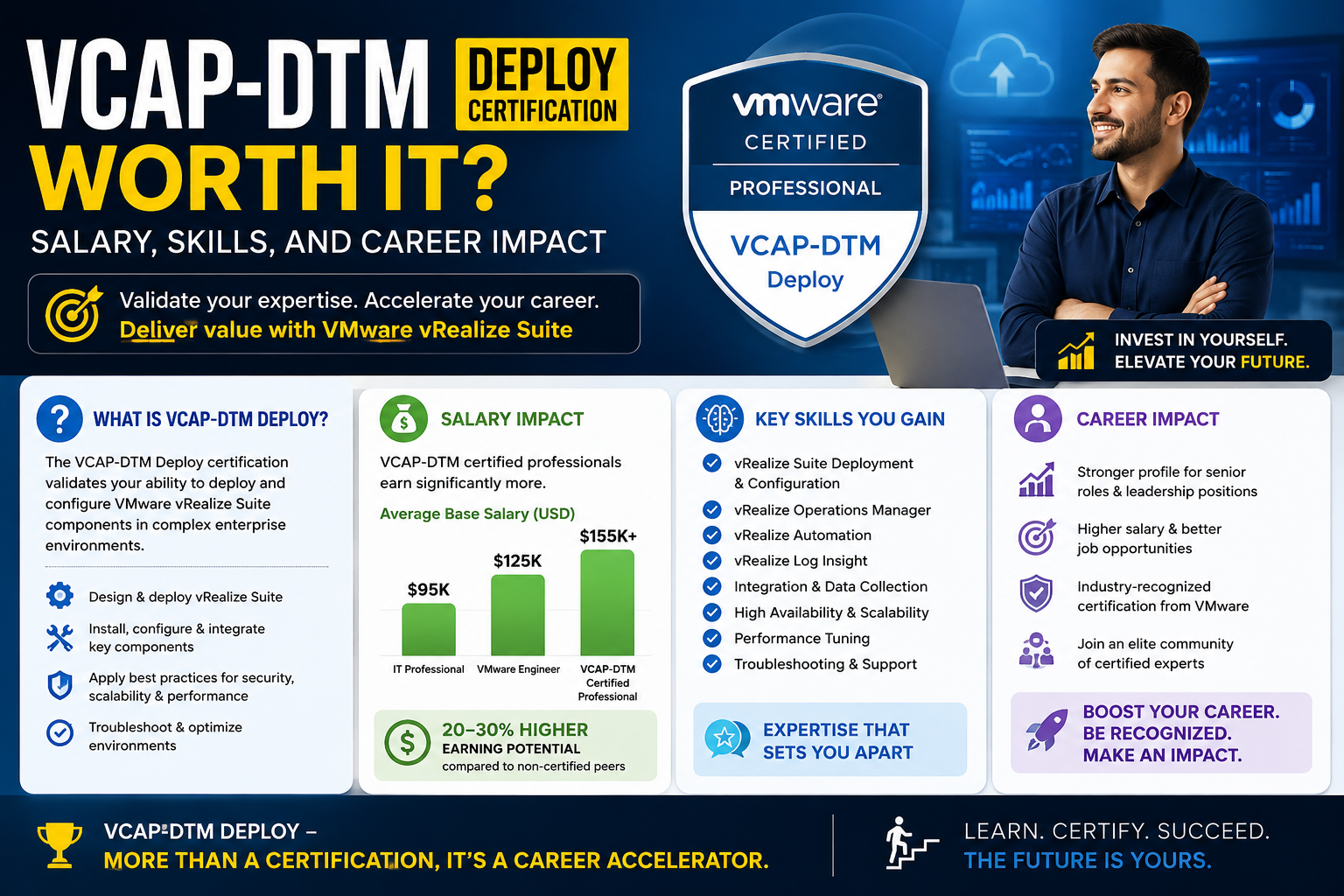
In modern enterprise IT environments, virtualization has become a foundational technology, and VMware continues to play a major role in shaping how organizations design and manage digital workspaces. As businesses expand their reliance on virtual desktops and mobility solutions, the need for skilled professionals who can deploy, manage, and troubleshoot VMware Horizon environments has grown significantly.
Among VMware’s advanced certifications, the VCAP-DTM Deploy stands out as a hands-on, technically demanding qualification focused on real-world implementation skills. Unlike entry-level or knowledge-based certifications, this credential is designed for professionals who already work deeply with VMware infrastructure and want to validate their ability to deploy and optimize complex desktop environments.
However, the certification is not just about technical validation. It also represents a serious commitment of time, effort, and financial resources. This raises an important question for many IT professionals: is pursuing the VCAP-DTM Deploy truly worth it in terms of career advancement and practical value?
To answer that, it is necessary to break down what the certification represents, the skills it develops, the difficulty involved, and how it fits into real-world job roles within enterprise IT environments./
The Role of VCAP-DTM Deploy in VMware’s Certification Ecosystem
VMware’s certification structure is layered to reflect increasing levels of expertise. At the foundation, professionals typically begin with associate or professional-level certifications that introduce core virtualization and desktop management concepts. From there, the path moves into more advanced certifications designed for specialists.
The VCAP-DTM Deploy sits at the advanced professional level and focuses specifically on the implementation side of VMware Horizon environments. This means the certification is not centered on theoretical design or high-level concepts, but rather on the actual deployment, configuration, and optimization of enterprise desktop infrastructure.
Unlike entry-level certifications that may rely on multiple-choice assessments, this credential is typically evaluated through a practical lab-based environment. Candidates are required to demonstrate their ability to perform tasks such as configuring Horizon components, integrating supporting VMware products, and resolving real-time technical issues under time constraints.
This approach makes the certification particularly valuable in environments where hands-on expertise is critical. Employers are not just looking for theoretical understanding but for professionals who can actively build and maintain stable, scalable virtual desktop systems.
Another important aspect of its position in VMware’s ecosystem is its role as a stepping stone toward expert-level credentials. Professionals who complete both advanced design and deployment certifications can progress toward higher-level design expert certifications, which are intended for architects and senior consultants. This makes the VCAP-DTM Deploy not just an endpoint, but part of a longer professional trajectory.
Skills and Technical Depth Required for the Certification
The VCAP-DTM Deploy is widely recognized as a challenging certification because it requires a deep understanding of multiple interconnected technologies. Candidates are expected to be comfortable working across several layers of infrastructure, not just VMware Horizon itself.
At the core of the certification is VMware Horizon, which is used to deliver virtual desktops and applications to end users. However, successful deployment of Horizon requires knowledge of several supporting systems. These include virtualization platforms, user environment management tools, identity services, and storage configurations.
Professionals pursuing this certification must understand how these components interact in a live enterprise environment. For example, configuring virtual desktops is not just about provisioning machines, but also ensuring proper integration with user authentication systems and applying consistent policies across environments.
Another key area is performance optimization. In real-world deployments, virtual desktop environments must be tuned for responsiveness and stability. This includes managing resource allocation, monitoring system performance, and resolving bottlenecks that may affect user experience.
Troubleshooting is also a major component of the skill set. Candidates must be able to identify and resolve issues that arise in complex environments where multiple systems depend on each other. These issues can range from login failures and connectivity problems to performance degradation and configuration conflicts.
Additionally, the certification requires familiarity with Windows environments, since virtual desktops often run Windows operating systems. Understanding user profiles, group policies, and system-level configurations is essential for successful deployment and maintenance.
What makes this certification particularly demanding is the expectation that candidates not only know these systems individually but also understand how they function together in a production environment. This level of integration knowledge is what separates advanced professionals from general administrators.
Career Impact and Professional Relevance
One of the most important considerations when evaluating the VCAP-DTM Deploy is its impact on career development. In enterprise IT environments, certifications often serve as indicators of specialization and technical capability, and this credential is no exception.
Professionals who earn this certification typically work in roles such as infrastructure engineers, virtualization specialists, or senior system administrators. In these positions, the ability to deploy and manage VMware Horizon environments is directly relevant to daily responsibilities.
The certification can also be valuable for individuals aspiring to move into more senior technical roles. Because it demonstrates both depth and practical ability, it often serves as evidence that a professional is capable of handling complex infrastructure projects independently.
In organizations that rely heavily on virtual desktop infrastructure, this certification can contribute to greater job stability and responsibility. Professionals with this level of expertise are often involved in critical system deployments and upgrades, which makes their role essential to business continuity.
However, it is also important to recognize that this specialization can lead to a narrower job market. VMware-focused roles are typically concentrated in larger enterprises or organizations with significant virtualization needs. As a result, while the certification can increase expertise and value within a specific domain, it may not be as broadly applicable across all IT roles.
For professionals who are already working in VMware-heavy environments, this certification can be a strong career enhancer. For those outside of such environments, its value depends on whether they intend to specialize further in virtualization technologies.
Challenges, Costs, and Commitment Involved
One of the defining characteristics of the VCAP-DTM Deploy is the level of investment required to pursue it. This includes not only financial cost but also time and effort.
The exam itself is known for its complexity and time pressure. Because it is based on practical scenarios rather than theoretical questions, candidates must be prepared to perform technical tasks in a simulated environment. This requires not only knowledge but also speed, accuracy, and confidence under pressure.
Preparation for the certification typically involves extensive hands-on practice. Unlike simpler certifications that can be passed through memorization, this exam demands real experience with system deployment and troubleshooting. As a result, professionals often spend significant time working in lab environments to simulate real-world conditions.
The financial aspect is also a consideration. In addition to exam fees, candidates often invest in training resources and supporting materials. While these are not mandatory, they are frequently used due to the difficulty of the exam content.
Another challenge is the prerequisite structure. Before attempting this certification, professionals are expected to have already earned foundational VMware credentials and gained practical experience. This means the certification is not suitable for beginners or those new to virtualization.
Despite these challenges, many professionals view the difficulty as part of its value. A certification that requires significant effort tends to carry more weight in professional environments because it signals a higher level of competence.
Another important aspect to consider is how the VCAP-DTM Deploy certification reflects real enterprise expectations. Modern IT environments are increasingly hybrid, combining on-premises infrastructure with cloud-integrated services, and VMware skills often sit at the center of this transition. Professionals who understand how to deploy and stabilize Horizon environments are better positioned to support digital workspace initiatives, remote work strategies, and large-scale endpoint management. This makes the certification particularly relevant for organizations prioritizing secure, scalable user access. While demanding, the credential helps bridge the gap between theoretical knowledge and operational execution, which is often what distinguishes senior engineers from general system administrators in competitive IT teams.
Conclusion
The value of the VCAP-DTM Deploy certification ultimately depends on a professional’s career direction and level of involvement with VMware technologies. For individuals working in enterprise environments where VMware Horizon is a core component of infrastructure, this certification can be a powerful validation of real-world skills. It demonstrates not only theoretical understanding but also the ability to deploy, configure, and troubleshoot complex virtual desktop systems under pressure.
Its greatest strength lies in its practical focus. Unlike certifications that emphasize memorization or conceptual knowledge, this credential requires hands-on performance in realistic scenarios. This makes it particularly meaningful for employers who need professionals capable of handling production environments with minimal supervision.
However, the certification is not universally necessary. Its technical depth, cost, and preparation requirements make it most suitable for professionals who are already committed to a VMware-focused career path. For those outside this specialization, its return on investment may be less significant.
In essence, the VCAP-DTM Deploy is worth pursuing for those who want to deepen their expertise in virtualization and position themselves as advanced VMware practitioners. It is less about general IT career advancement and more about establishing authority within a highly specialized technical domain.