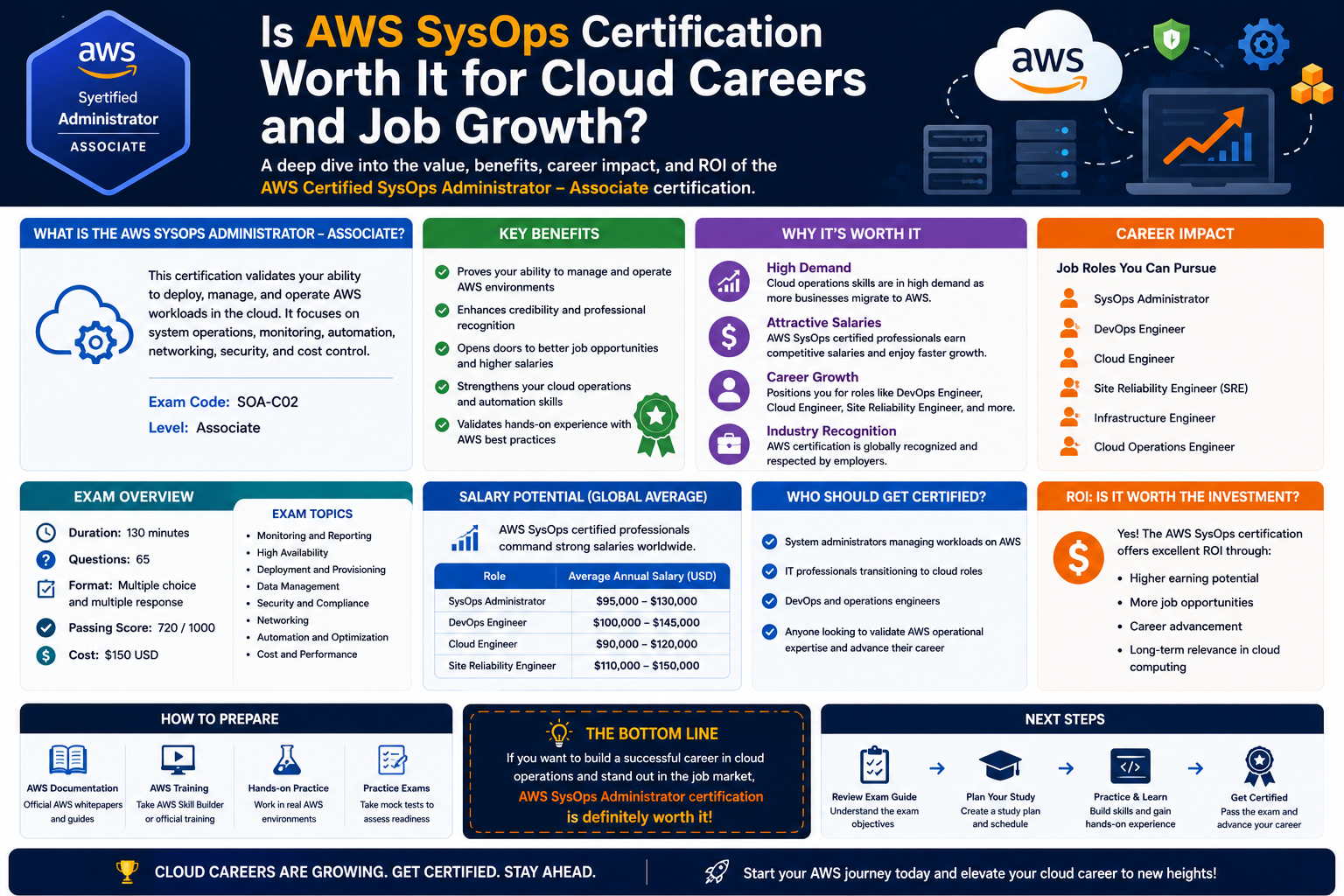
Cloud computing has shifted from being an optional skill in IT to a core requirement in many organizations. Among the major cloud platforms, Amazon Web Services has established itself as a leading choice for businesses of all sizes due to its wide service offerings, scalability, and global infrastructure. As more companies migrate their systems to the cloud, the need for professionals who can manage, operate, and maintain these environments continues to grow rapidly.
Within this ecosystem, the AWS Certified SysOps Administrator – Associate level certification stands out as a role-focused credential aimed at system administrators and operations professionals. It is designed to validate the ability to handle real-world operational tasks in AWS environments, such as managing deployments, maintaining system performance, and ensuring secure and reliable cloud operations.
Unlike entry-level cloud certifications that focus on basic concepts, this certification demands a deeper understanding of how AWS services interact in production environments. It emphasizes operational responsibility, meaning professionals are expected to not only understand cloud services but also know how to manage them under practical conditions where uptime, performance, and security are critical.
The exam structure itself reflects this complexity. It covers multiple domains such as deployment, monitoring, automation, security, networking, and data management. Each of these areas represents essential responsibilities that system administrators face when working with cloud infrastructure. Because of this, the certification is often considered challenging and best suited for individuals who already have hands-on experience with AWS.
At the same time, the growing reliance on cloud infrastructure across industries has made these skills highly valuable. Organizations are increasingly looking for professionals who can ensure that cloud systems remain stable, cost-efficient, and secure while supporting business operations. This shift has led many IT professionals to consider whether investing time and effort into this certification is a worthwhile career decision.
Core Skills and Operational Knowledge Covered in AWS SysOps
One of the most defining aspects of the AWS SysOps certification is its focus on practical operational skills rather than purely theoretical knowledge. It is designed to ensure that professionals can actively manage cloud environments and respond to real-world challenges effectively.
A major area covered is deployment and provisioning. In a cloud environment, resources must be created, configured, and scaled according to demand. SysOps professionals are expected to understand how to deploy applications efficiently while maintaining consistency and minimizing downtime. This includes working with automated deployment tools and understanding how infrastructure can be managed as code to improve reliability and repeatability.
Another critical domain is monitoring and reporting. Cloud systems require constant observation to ensure they are performing optimally. Professionals in this role must be able to interpret system metrics, logs, and alerts to identify potential issues before they impact users. This requires a strong understanding of performance indicators and the ability to take corrective action when needed.
Security and compliance also play a major role in the certification. AWS environments must be protected against unauthorized access and potential vulnerabilities. SysOps administrators are expected to implement identity and access management controls, configure secure network environments, and ensure data protection policies are followed. This includes understanding encryption, secure communication channels, and compliance requirements relevant to organizational policies.
Networking is another essential area. Cloud infrastructure depends heavily on properly configured networks to ensure services can communicate effectively. Professionals must understand virtual private networks, routing, load balancing, and connectivity between cloud and on-premises systems. Misconfigurations in this area can lead to performance issues or security risks, making it a critical skill set.
Data management is equally important. Organizations rely on cloud systems to store and process large amounts of data, and SysOps professionals must know how to manage storage solutions, ensure data availability, and implement backup and recovery strategies. This ensures that data remains accessible even in the event of system failures.
Automation is also a key theme throughout the certification. Modern cloud environments rely heavily on automation to reduce manual work and improve efficiency. Professionals are expected to understand how to automate repetitive tasks, scale systems dynamically, and manage infrastructure using predefined templates and scripts. This reduces human error and allows systems to respond more effectively to changing demands.
Together, these skills create a comprehensive foundation for managing cloud operations at scale. The certification is not just about understanding AWS services individually but about knowing how to combine them to build stable, secure, and efficient systems.
Career Relevance and Real-World Scenarios for AWS SysOps Professionals
The value of the AWS SysOps certification becomes clearer when viewed through real-world career scenarios. Many IT professionals find themselves in roles where cloud systems are becoming an increasingly important part of their responsibilities. In such environments, operational expertise in AWS can significantly enhance both job performance and career growth.
For system administrators transitioning into cloud environments, this certification acts as a bridge between traditional infrastructure management and modern cloud operations. These professionals often already understand server management, networking basics, and system troubleshooting. However, cloud environments introduce new concepts such as elastic scaling, distributed architecture, and automated provisioning. The certification helps formalize this transition by providing structured knowledge of how these systems operate in AWS.
In organizations that are actively migrating to the cloud, SysOps professionals play a critical role in ensuring smooth transitions. Migrating workloads from on-premises systems to cloud infrastructure requires careful planning and execution. Professionals must ensure that applications remain functional during migration, data integrity is maintained, and performance is not compromised. This often involves working with hybrid environments where both cloud and traditional systems coexist.
For professionals already working in cloud-based operations, the certification reinforces and expands their capabilities. These individuals are often responsible for maintaining large-scale environments where uptime and performance are critical. The ability to monitor systems effectively, respond to incidents quickly, and optimize resource usage becomes essential. The certification helps validate these skills and introduces best practices that improve operational efficiency.
Another important scenario involves organizations that rely heavily on cloud-native applications. In such environments, systems are designed to be highly scalable and distributed. SysOps professionals ensure that these systems remain stable under varying workloads. This may involve scaling resources during peak usage, optimizing performance during high traffic periods, and ensuring that systems recover quickly from failures.
In all these scenarios, the underlying value of the certification lies in its focus on practical problem-solving. It equips professionals with the ability to make informed decisions when managing cloud systems, rather than relying solely on theoretical understanding or trial-and-error approaches. This makes them more effective in roles that require quick thinking and technical precision.
Difficulty Level, Experience Requirements, and Learning Curve
The AWS SysOps certification is widely regarded as one of the more challenging associate-level certifications within the AWS ecosystem. This is largely due to its emphasis on real-world operational knowledge rather than conceptual understanding alone.
Although there are no formal prerequisites to attempt the exam, it is strongly recommended that candidates have hands-on experience working with AWS services. Typically, at least one year of practical exposure to cloud environments is considered beneficial. This experience helps candidates understand how different services interact and how operational decisions impact system performance and security.
The learning curve is shaped by the breadth of topics covered. Unlike certifications that focus on a single area such as development or architecture, SysOps requires familiarity with multiple domains simultaneously. Candidates must understand how to deploy applications, monitor systems, manage security configurations, and troubleshoot issues across complex environments.
One of the more challenging aspects is the emphasis on troubleshooting and operational decision-making. Instead of simply recalling information, candidates are often required to analyze scenarios and determine the most appropriate solution. This requires not only technical knowledge but also practical judgment developed through experience.
Networking and security topics can also present difficulties for those who have not worked extensively in these areas. Understanding how cloud networks are structured, how traffic flows between services, and how security policies are enforced requires careful study and hands-on practice.
Despite its difficulty, the certification offers a structured path for developing advanced cloud operations skills. It encourages professionals to think critically about system design and management, which is essential for roles that involve maintaining production environments.
Conclusion
The AWS Certified SysOps Administrator – Associate certification represents a significant step for IT professionals who want to build or strengthen their careers in cloud operations. It focuses on practical, real-world skills that are directly applicable to managing modern cloud environments, including deployment, monitoring, security, networking, and automation.
Its value becomes especially clear in today’s technology landscape, where organizations increasingly depend on cloud infrastructure for their core operations. Professionals who can effectively manage these environments are in high demand, as they play a crucial role in ensuring system reliability, performance, and security.
While the certification is challenging and requires hands-on experience with AWS, it also provides a structured way to develop deeper operational expertise. It is particularly beneficial for system administrators, cloud operators, and IT professionals involved in infrastructure management or cloud migration projects.
Ultimately, the decision to pursue this certification depends on career goals and current experience level. For those aiming to grow in cloud-focused roles, it offers a strong foundation for advancing technical skills and taking on more complex responsibilities in the evolving world of cloud computing.