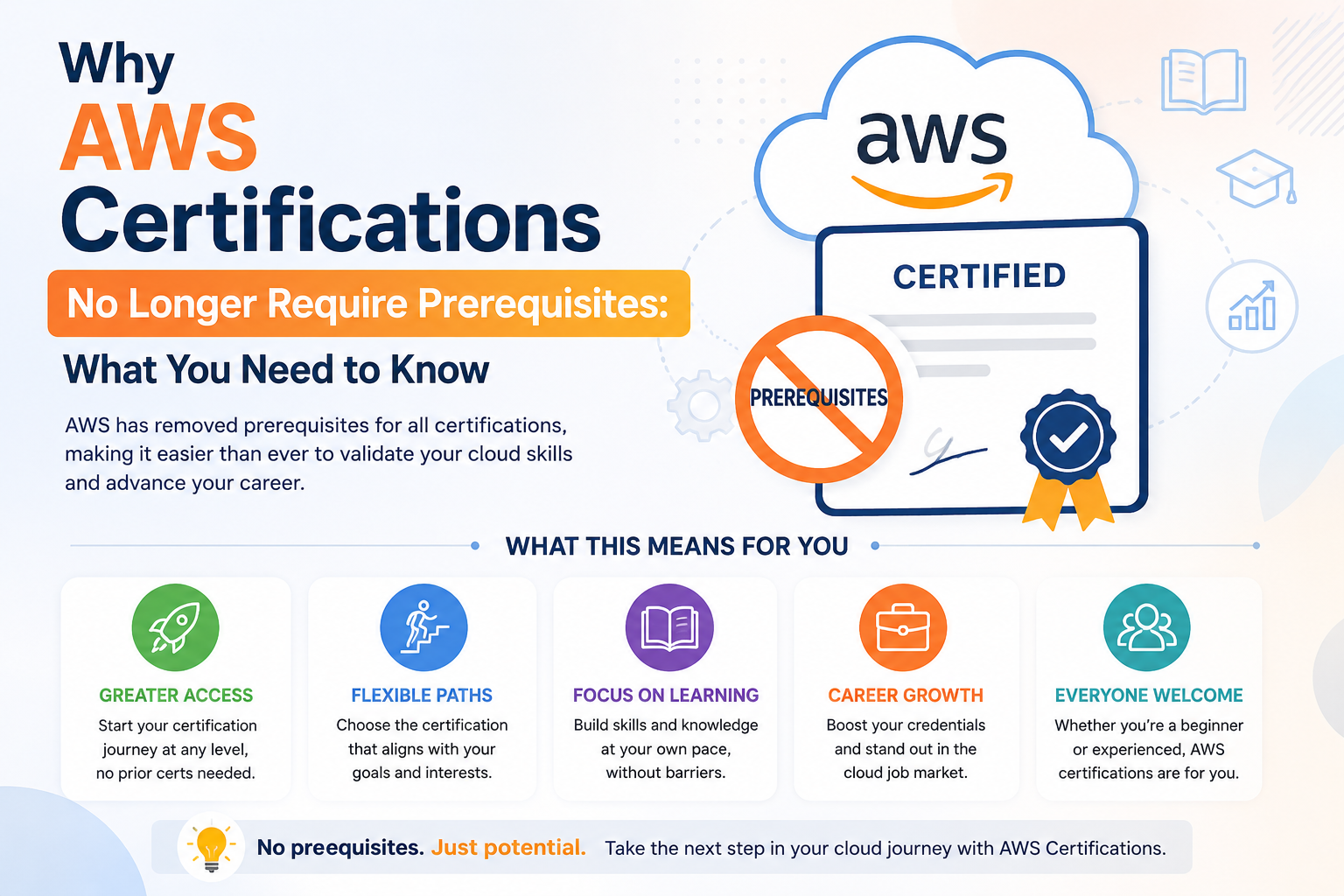
Over the years, cloud computing has shifted from being a specialized technical domain into a mainstream foundation for modern digital systems. As organizations increasingly depend on cloud platforms for storage, computing, networking, and application delivery, the demand for skilled professionals has grown significantly. In response to this demand, certification programs evolved to help validate knowledge and guide learning paths for individuals entering the field.
AWS certifications originally followed a structured progression model designed to ensure that candidates built foundational understanding before advancing to more complex topics. This meant that individuals were expected to complete entry-level or associate-level certifications before attempting higher-level professional or specialty exams. The structure resembled a traditional academic progression, where each stage prepared the learner for the next.
However, as the cloud industry matured, feedback from professionals and employers began to highlight limitations in this rigid pathway. Many experienced IT professionals already possessed the necessary knowledge for advanced certifications but were still required to complete lower-level exams first. This created delays, redundancy, and frustration among candidates who felt their prior experience was not being fully recognized.
To address these concerns, AWS moved away from strict prerequisites and introduced a more flexible approach based on recommended knowledge instead of mandatory exam dependencies. This shift allowed candidates to choose their certification path based on their current skills and professional experience rather than following a fixed sequence.
This change also reflects a broader shift in the technology industry, where learning is becoming more modular and skill-based rather than linear. Professionals now have the flexibility to focus on specific areas of expertise without being constrained by earlier stages that may not align with their career goals. While this approach increases accessibility, it also places greater responsibility on candidates to assess their readiness before attempting higher-level exams.
The removal of prerequisites does not reduce the importance of structured learning. Instead, it acknowledges that experience in real-world environments can be just as valuable as formal certification progression. Many professionals already work across multiple cloud services, making rigid pathways less relevant in practice.
At the same time, this change has introduced a new level of personal accountability. Without enforced prerequisites, individuals must now independently evaluate whether they possess the depth of understanding required for each certification level. This makes self-assessment and preparation more critical than ever.
Understanding Recommended Knowledge Versus Formal Requirements
The most significant shift introduced by AWS is the transition from mandatory prerequisites to recommended knowledge. While this may appear to be a minor adjustment in terminology, it fundamentally changes how candidates approach certification preparation.
Previously, a candidate could not register for a higher-level exam without completing the required lower-level certification. This created a controlled pathway that ensured a standardized learning sequence. The advantage of this system was clarity. Candidates always knew exactly what they needed to complete next. However, it also created inefficiencies for individuals who already possessed equivalent or higher-level experience.
With the introduction of recommended knowledge, AWS now provides guidance instead of enforcement. Candidates are informed about the skills, experience, and understanding typically needed to succeed in a given exam, but they are not restricted from attempting it.
This approach places emphasis on readiness rather than sequence. It encourages professionals to evaluate their own capabilities honestly. If a candidate has practical experience in cloud architecture or system deployment, they may choose to attempt an advanced certification without completing earlier stages.
However, this flexibility comes with an important challenge. Without enforced prerequisites, it becomes easier for candidates to underestimate the complexity of advanced exams. Recommended knowledge serves as a benchmark, but it is not a guarantee of success. Candidates who ignore these guidelines may find themselves unprepared for the depth and scope of exam content.
The distinction between requirement and recommendation is particularly important in technical fields. A requirement defines a strict condition that must be met, while a recommendation provides guidance based on expected outcomes. In the context of AWS certifications, recommendations are designed to align candidate preparation with real-world job expectations.
This model also reflects the nature of cloud computing itself. In real-world environments, professionals are rarely restricted to linear learning paths. Instead, they develop skills across multiple domains simultaneously, often based on project needs rather than structured curricula.
By adopting this approach, AWS acknowledges the diversity of learning backgrounds among candidates. Some may come from academic settings, while others may have years of industry experience. Recommended knowledge allows both groups to engage with certification exams in a way that reflects their actual skill level rather than their position in a predefined sequence.
How AWS Certification Levels Work in the New Structure
Even though prerequisites have been removed, AWS certifications still follow a clear hierarchical structure designed to represent increasing levels of expertise. This structure includes foundational, associate, professional, and specialty levels, each representing a distinct stage of skill development.
Foundational certifications are designed for individuals who are new to cloud computing. These exams focus on basic concepts such as cloud principles, core AWS services, and general understanding of cloud economics. They are intended to build awareness rather than deep technical expertise.
Associate-level certifications represent the next stage and focus on practical implementation skills. At this level, candidates are expected to understand how AWS services are used in real environments. This includes configuration, deployment, and basic troubleshooting across different roles such as development, system administration, and architecture.
Professional-level certifications are significantly more advanced and are designed for individuals with substantial hands-on experience. These exams focus on complex system design, multi-service integration, and large-scale architectural decision-making. Candidates are expected to demonstrate the ability to design and manage enterprise-level cloud solutions.
Specialty certifications focus on highly specific domains such as security, networking, and data analytics. These exams require deep expertise in a particular area rather than broad general knowledge. They are intended for professionals who already have significant industry experience and want to validate advanced specialization.
In the updated model, candidates are free to move between these levels based on their experience rather than following a mandatory progression. This means a professional with sufficient real-world expertise may choose to attempt a professional or specialty certification without first completing lower-level exams.
However, each level still builds on increasing complexity. While there is no enforced sequence, the content naturally assumes familiarity with foundational concepts. This ensures that certifications remain meaningful indicators of skill, even without formal prerequisites.
The flexibility introduced in this structure benefits experienced professionals the most, as it allows them to validate their expertise without unnecessary repetition. At the same time, it requires less experienced candidates to be more careful in selecting their exam path, ensuring they do not skip essential learning stages.
Preparing Effectively Without Relying on Prerequisites
With the removal of mandatory prerequisites, preparation has become a more individualized process. Candidates can no longer rely on a structured pathway to automatically guide their learning. Instead, they must take responsibility for assessing their readiness and identifying knowledge gaps.
Effective preparation begins with understanding the exam expectations. Each certification level requires a different depth of knowledge, and candidates must align their preparation accordingly. Foundational exams require conceptual understanding, while professional and specialty exams demand practical experience and problem-solving ability.
Hands-on practice plays a central role in preparation. Cloud technologies are best understood through direct interaction rather than theoretical study alone. Working with cloud environments allows candidates to develop familiarity with services, configurations, and real-world scenarios.
Self-assessment is equally important. Without prerequisites, it becomes necessary for candidates to evaluate whether they truly understand the material at the required depth. This can be challenging, especially for advanced certifications where the scope is broad and complex.
Another important aspect of preparation is consistency. Cloud concepts are interconnected, and understanding often builds gradually over time. Regular exposure to different services and use cases helps reinforce learning and improve retention.
It is also important to approach preparation with realistic expectations. The absence of prerequisites does not reduce exam difficulty. Instead, it shifts responsibility entirely to the candidate. Those who underestimate this change may find themselves unprepared despite having access to the exam.
Ultimately, successful preparation depends on aligning personal experience with exam expectations. Candidates who take the time to evaluate their skills honestly and prepare accordingly are more likely to succeed, regardless of the path they choose.
Conclusion
The removal of prerequisites in AWS certification represents a significant shift in how cloud skills are validated and developed. While it introduces greater flexibility and accessibility, it also places more responsibility on individuals to assess their own readiness before attempting exams. The new model emphasizes recommended knowledge rather than enforced progression, allowing professionals to choose certification paths that align with their experience.
This change reflects the evolving nature of cloud computing, where skills are often gained through practical experience rather than structured sequences. However, it does not reduce the importance of preparation or depth of understanding required for advanced certifications. Instead, it reinforces the idea that success depends on genuine knowledge and practical ability rather than simply following a predefined path.
Candidates who approach certifications with discipline, self-awareness, and adequate preparation are likely to benefit from this flexibility. In contrast, those who ignore recommended guidance may find the exams more challenging than expected. The shift ultimately encourages a more personalized and experience-driven approach to professional development in cloud computing.