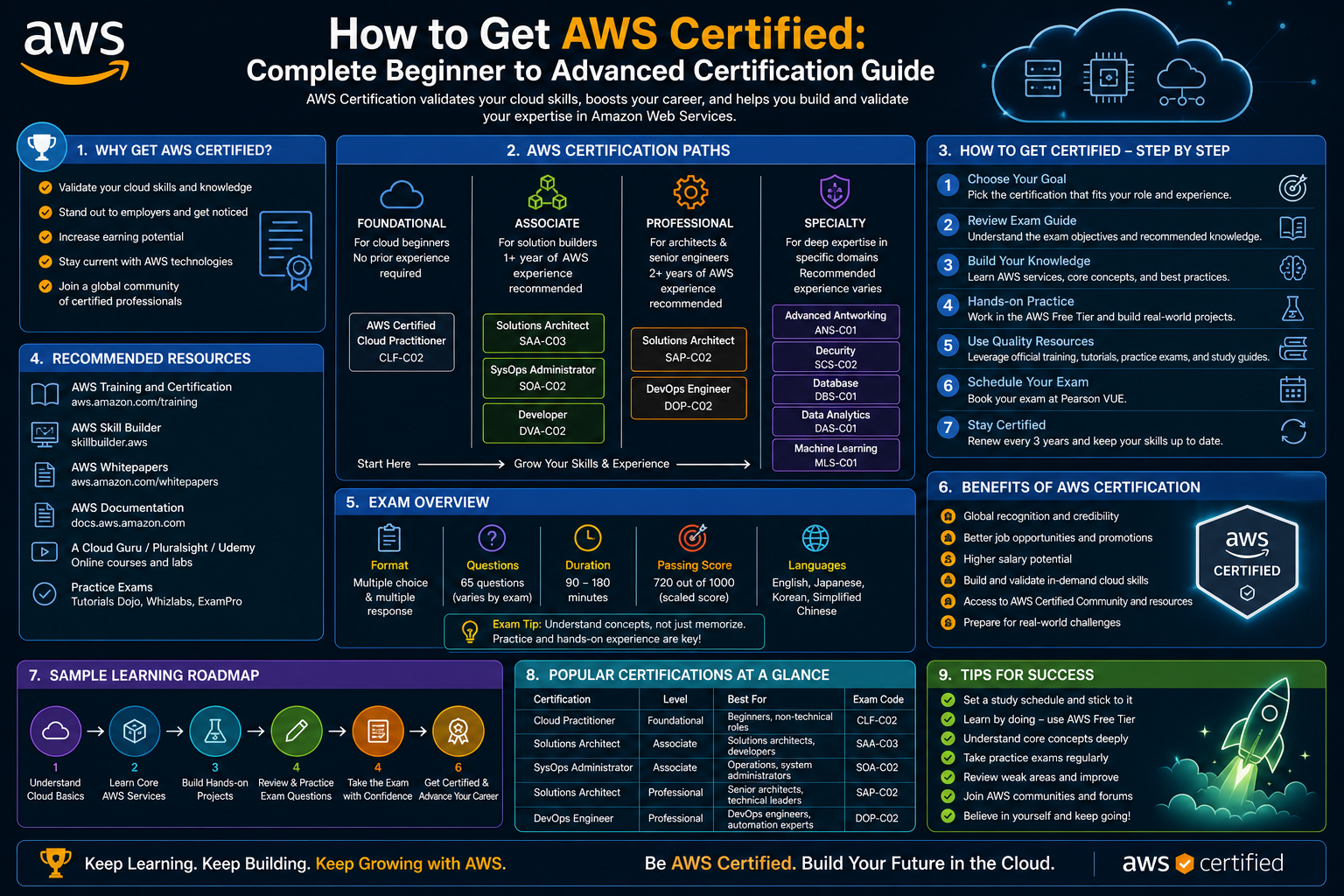
Amazon Web Services, widely known as AWS, is one of the most influential cloud computing platforms in the world. It provides a vast collection of on-demand computing resources that individuals, startups, enterprises, and government organizations can access over the internet. Instead of investing heavily in physical servers, data centers, and networking hardware, organizations can rely on AWS to deliver computing power, storage, databases, machine learning tools, analytics services, and much more on a flexible pay-as-you-go model.
At its core, AWS transforms the traditional IT infrastructure model. Rather than owning and maintaining physical systems, businesses can provision digital resources within minutes and scale them up or down depending on demand. This flexibility is one of the key reasons AWS has become a dominant force in the global cloud market. It enables organizations to innovate faster, reduce operational costs, and focus more on application development rather than infrastructure management.
AWS operates across multiple geographic regions worldwide, each consisting of multiple isolated data centers. This global infrastructure ensures high availability, reliability, and fault tolerance. Applications hosted on AWS can be distributed across regions to minimize downtime and improve performance for users across different locations.
The Growing Importance of AWS in the Cloud Industry
Cloud computing has rapidly shifted from being a modern IT trend to becoming the backbone of digital transformation. Businesses across all industries now depend on cloud platforms for hosting applications, managing data, and supporting critical operations. Within this ecosystem, AWS holds a leading position due to its maturity, service diversity, and scalability.
The cloud market itself is expanding at a remarkable pace. Organizations are migrating workloads from on-premises systems to cloud environments to achieve better agility and efficiency. AWS plays a central role in this transition by offering solutions that cater to virtually every IT requirement, from simple web hosting to complex artificial intelligence systems.
One of the major strengths of AWS is its extensive service portfolio. It includes computing services like virtual servers, storage systems for data management, managed database services, networking tools, security frameworks, and advanced technologies such as machine learning, Internet of Things (IoT), and big data analytics. This broad range allows companies to build fully integrated digital ecosystems within a single cloud platform.
As cloud adoption continues to rise, AWS skills have become highly valuable in the IT job market. Organizations are actively seeking professionals who understand how to design, deploy, and manage cloud-based solutions effectively. This growing demand has led to the development of structured certification programs designed to validate AWS expertise.
Why AWS Skills Are in High Demand
The shift toward cloud computing has created a significant skills gap in the IT industry. Traditional infrastructure knowledge alone is no longer sufficient. Modern IT roles require familiarity with cloud platforms, automation, distributed systems, and scalable architecture design.
AWS skills are particularly in demand because many enterprises rely on AWS for their production environments. Professionals who understand AWS can help organizations migrate systems, optimize costs, improve security, and build scalable applications.
Several factors contribute to the high demand for AWS expertise:
Cloud adoption across industries is increasing rapidly as companies modernize their IT infrastructure.
Businesses require scalable systems that can handle unpredictable workloads efficiently.
Security and compliance requirements have become more complex, requiring specialized cloud knowledge.
Organizations are focusing on automation and DevOps practices, which are deeply integrated with cloud platforms.
Data-driven decision-making has made cloud-based analytics and machine learning essential.
As a result, AWS certifications have become a recognized benchmark for validating cloud skills and knowledge in a structured way.
Understanding AWS Certification as a Professional Pathway
AWS certification is a structured credentialing system designed to validate an individual’s understanding of AWS services and cloud concepts. It provides a standardized way to demonstrate technical competence and practical knowledge in cloud computing.
The certification program is organized into four main levels, each representing a different stage of expertise:
Foundational level focuses on basic cloud concepts and AWS fundamentals.
Associate level covers role-based technical skills for specific job functions.
Professional level represents advanced architectural and operational expertise.
Specialty level focuses on deep knowledge in specific technical domains.
This layered structure allows individuals to progress gradually from basic understanding to advanced specialization. Each level builds upon the previous one, ensuring a logical learning pathway for professionals at different stages of their careers.
AWS certifications are widely recognized in the IT industry and are often used by employers as a benchmark for hiring, promotion, and role assignment decisions. They help ensure that professionals have a consistent understanding of AWS services and best practices.
Structure of the AWS Certification Levels
The AWS certification framework is designed to accommodate a wide range of learners, from beginners entering the cloud field to experienced professionals specializing in advanced technologies.
At the foundational level, the focus is on understanding core cloud concepts, AWS global infrastructure, and basic services. This level is ideal for individuals who are new to cloud computing and want to build a strong conceptual base.
The associate level introduces role-based certifications that align with common job functions such as solutions architecture, development, and systems operations. This level requires hands-on experience and a deeper understanding of AWS services.
The professional level is more advanced and focuses on complex architectural design, multi-tier applications, and enterprise-scale solutions. It is intended for experienced professionals who work extensively with AWS in production environments.
The specialty level focuses on niche domains such as networking, security, machine learning, and databases. These certifications require in-depth technical expertise in a specific area of AWS.
This structured approach allows professionals to choose a certification path that aligns with their career goals and technical interests.
Foundational Level: Entry into AWS Cloud Concepts
The foundational level of AWS certification serves as an introduction to cloud computing and AWS services. It is designed for individuals who may not have deep technical experience but want to understand the basics of cloud technology.
At this stage, the focus is on developing a conceptual understanding of how cloud computing works and how AWS delivers its services. Key areas include understanding cloud architecture principles, identifying core AWS services, and learning about pricing models and billing structures.
Security is also an important part of this level. Candidates are introduced to basic cloud security concepts, including shared responsibility models, identity management, and access control mechanisms.
The foundational certification is particularly useful for business professionals, project managers, and individuals transitioning into cloud-related roles. It helps establish a common language for discussing cloud technologies within organizations.
Although it is an entry-level certification, it plays a critical role in building confidence and preparing learners for more advanced AWS certifications.
AWS Global Infrastructure and Service Model
To understand AWS effectively, it is important to grasp its global infrastructure model. AWS operates a highly distributed system of data centers organized into regions and availability zones.
A region represents a geographical area containing multiple data centers. Each region is isolated from others to ensure data sovereignty and fault tolerance. Within each region, there are multiple availability zones, which are physically separate data centers designed to provide redundancy and high availability.
This architecture allows AWS to deliver services with minimal downtime and high resilience. If one availability zone experiences an issue, workloads can automatically fail over to another zone within the same region.
AWS services are designed to take advantage of this infrastructure model. For example, computing services can be deployed across multiple availability zones to ensure continuous operation, while storage services can replicate data across regions for disaster recovery.
Understanding this infrastructure is essential for designing reliable and scalable cloud solutions.
Core AWS Service Categories
AWS offers a wide range of services grouped into different categories based on functionality. These categories form the foundation of cloud architecture on AWS.
Compute services provide virtual servers and processing power for running applications. These services allow users to deploy applications without managing physical hardware.
Storage services enable users to store and retrieve data in scalable and durable environments. These services support everything from simple file storage to large-scale data archiving.
Database services offer managed database solutions that eliminate the need for manual database administration. They support various database types including relational, NoSQL, and in-memory databases.
Networking services provide tools for creating secure and scalable network architectures within the cloud. These services enable communication between resources and external systems.
Security services focus on identity management, access control, encryption, and compliance monitoring. They ensure that cloud environments remain secure and protected.
Together, these service categories form the building blocks of modern cloud applications.
Introduction to AWS Certification Progression
AWS certification progression follows a structured path that allows learners to advance from basic to expert-level knowledge. This progression is designed to align with real-world job roles and responsibilities.
At the beginning of the journey, learners focus on understanding cloud fundamentals and AWS core services. As they progress, they begin to specialize in specific roles such as architecture, development, or operations.
Advanced certifications require deeper knowledge of system design, scalability, security, and performance optimization. Specialty certifications allow professionals to focus on highly specific domains such as machine learning or network architecture.
This progression ensures that individuals can continuously develop their skills in alignment with industry requirements.
Role of AWS Certification in Professional Development
AWS certification plays a significant role in career development within the IT industry. It provides a structured way to validate skills and demonstrate expertise in cloud technologies.
For individuals entering the IT field, certification can serve as a strong foundation for career growth. It helps build confidence and provides a clear learning path for developing technical skills.
For experienced professionals, certification can enhance credibility and open opportunities for advanced roles. It also helps professionals stay updated with evolving technologies and best practices.
Organizations also benefit from having certified professionals on their teams. It ensures that cloud systems are designed and managed according to industry standards and best practices.
Overall, AWS certification contributes to both individual career growth and organizational success in cloud adoption.
Moving Beyond Foundations into Practical Cloud Roles
After gaining a foundational understanding of AWS and general cloud computing principles, the next stage in the certification journey focuses on applying that knowledge in real-world technical roles. This is where AWS Associate-level certifications become important, as they are designed to validate job-specific skills rather than purely conceptual understanding.
At this stage, learners are expected to move from theoretical awareness to practical implementation. The focus shifts toward designing systems, building applications, managing infrastructure, and operating cloud environments. These certifications are closely aligned with common IT roles in organizations that actively use AWS as part of their production systems.
The Associate level serves as a bridge between beginner knowledge and advanced cloud architecture. It is often considered the most important stage for professionals aiming to enter cloud-related job roles because it reflects hands-on capabilities rather than just awareness of cloud concepts.
Overview of AWS Associate Certification Structure
AWS Associate certifications are structured around three primary role categories. Each certification targets a different career path and skill set, allowing professionals to specialize based on their job responsibilities and interests.
The three main Associate certifications include solutions architecture, software development, and systems operations. While each certification has a different focus, they all share a common expectation: the ability to work with AWS services in practical, real-world scenarios.
Candidates at this level are expected to understand how AWS services interact with each other, how to deploy applications in cloud environments, and how to maintain operational efficiency. They are also expected to follow best practices for scalability, security, and cost management.
Unlike foundational certifications, Associate-level exams require hands-on experience. This means learners are expected to have worked with AWS services in practical environments, whether through professional roles, labs, or personal projects.
AWS Certified Solutions Architect – Associate Level Understanding
One of the most widely recognized certifications at this level focuses on solution architecture. This certification is designed for individuals responsible for designing systems and applications that run on AWS infrastructure.
A solutions architect plays a critical role in ensuring that applications are scalable, reliable, and cost-efficient. They are responsible for selecting appropriate AWS services based on application requirements and designing architectures that can handle changing workloads.
At this level, professionals learn how to translate business requirements into technical solutions. This includes choosing appropriate compute resources, storage systems, and networking configurations.
A key aspect of this role is understanding architectural principles such as fault tolerance, high availability, and performance optimization. These principles guide how systems are designed to handle failures, traffic spikes, and long-term scalability.
Security is also an important consideration. Solutions architects must ensure that systems are designed with proper access control, encryption, and compliance requirements in mind.
Cost optimization is another critical responsibility. AWS offers many different pricing models and service options, and architects must choose configurations that balance performance with budget constraints.
AWS Certified Developer – Associate Level Perspective
The developer-focused Associate certification is designed for individuals who build and maintain applications that run on AWS infrastructure. This role emphasizes software development skills combined with cloud integration knowledge.
Developers working in AWS environments are expected to understand how applications interact with cloud services. This includes working with APIs, managing data storage, handling authentication, and integrating various AWS services into application workflows.
A major focus of this role is application deployment. Developers must understand how to deploy applications in cloud environments using scalable and automated processes. This includes working with continuous integration and continuous deployment practices, even though the certification itself focuses more on AWS-native tools and services.
Another important aspect is debugging and troubleshooting cloud-based applications. Developers must be able to identify performance issues, resolve service integration problems, and optimize application behavior in distributed environments.
Security also plays a significant role in development. Applications must be designed with secure authentication mechanisms, proper access control, and safe data handling practices.
This certification helps bridge the gap between traditional software development and modern cloud-native application development.
AWS Certified SysOps Administrator – Associate Level Responsibilities
The systems operations certification focuses on managing and maintaining AWS infrastructure. This role is heavily operational and is typically associated with system administrators and IT operations professionals.
SysOps administrators are responsible for deploying, monitoring, and managing cloud systems to ensure they run efficiently and reliably. This includes maintaining system performance, managing resource utilization, and ensuring operational stability.
One of the key responsibilities in this role is monitoring system health. Administrators must track metrics such as CPU usage, memory consumption, network traffic, and application performance.
Another important area is automation. AWS provides tools that allow administrators to automate repetitive tasks such as backups, scaling, and system updates. Automation helps improve efficiency and reduce the risk of human error.
SysOps professionals also handle incident response and troubleshooting. When systems experience failures or performance issues, they must quickly identify the root cause and apply corrective actions.
Cost management is also part of this role. Administrators must ensure that resources are being used efficiently and that unnecessary costs are minimized.
Migration is another key responsibility. SysOps administrators often help move applications and workloads from on-premises environments to AWS cloud infrastructure.
Importance of Hands-On Experience at Associate Level
Unlike foundational certifications, Associate-level certifications require a strong emphasis on practical experience. Understanding theoretical concepts alone is not sufficient to succeed at this stage.
Hands-on experience allows professionals to become familiar with AWS interfaces, service configurations, and real-world scenarios. It also helps build confidence in designing and managing cloud systems.
Working with actual AWS environments helps learners understand how different services interact. For example, how compute services connect with storage systems, or how networking configurations affect application performance.
Practical experience also helps in developing problem-solving skills. Many AWS scenarios require troubleshooting complex issues that cannot be solved through memorization alone.
This hands-on approach is essential for preparing for real-world job roles in cloud computing environments.
Transition from Associate to Professional Level Skills
The Associate level serves as a foundation for more advanced AWS certifications. As professionals gain experience, they begin to move toward more complex architectural and operational challenges.
The transition from Associate to Professional level involves a shift from task-based skills to system-level thinking. Instead of focusing on individual services, professionals begin to design entire cloud ecosystems.
This transition requires a deeper understanding of scalability, reliability, security, and cost optimization at an enterprise level. It also requires the ability to manage complex systems with multiple interconnected components.
At this stage, professionals are expected to handle large-scale architectures that support multiple applications and services across different environments.
Role of AWS Services in Associate-Level Workflows
AWS provides a wide range of services that are commonly used at the Associate level. These services form the foundation for building, deploying, and managing cloud applications.
Compute services are used to run applications and processing workloads. These services allow users to scale resources based on demand.
Storage services are used to store application data, backups, and media files. They provide flexible and durable storage options.
Database services are used to manage structured and unstructured data. These services eliminate the need for manual database administration.
Networking services are used to connect cloud resources securely and efficiently. They allow communication between different parts of an application architecture.
Monitoring and logging services help track system performance and detect issues in real time. They provide insights into application behavior and infrastructure health.
Security services ensure that cloud environments remain protected from unauthorized access and vulnerabilities.
Understanding how these services work together is essential for building effective cloud solutions.
Designing Scalable and Reliable Cloud Systems
One of the key skills developed at the Associate level is the ability to design scalable and reliable systems. Scalability refers to the ability of a system to handle increasing workloads without performance degradation.
AWS provides several mechanisms to achieve scalability, including automatic scaling of resources and distributed system architecture. These mechanisms allow applications to adjust dynamically based on demand.
Reliability refers to the ability of a system to continue functioning correctly even in the presence of failures. AWS supports reliability through redundant infrastructure and failover mechanisms.
Designing reliable systems involves distributing workloads across multiple availability zones and ensuring that backup systems are in place.
These design principles are critical for building production-ready cloud applications.
Security Practices in Associate-Level AWS Environments
Security is an integral part of cloud computing at all levels, including the Associate level. AWS provides a shared responsibility model, where both AWS and customers are responsible for different aspects of security.
At this level, professionals learn how to manage identity and access control, secure data storage, and implement encryption mechanisms.
Access control ensures that only authorized users can access specific resources. Encryption protects data both at rest and in transit.
Security best practices also include monitoring system activity, detecting anomalies, and responding to potential threats.
Understanding these security principles is essential for maintaining secure cloud environments.
Operational Efficiency and Cost Awareness
One of the key benefits of AWS is its flexible pricing model, but this also introduces the need for careful cost management. Associate-level professionals must understand how different services contribute to overall cloud costs.
Operational efficiency involves using resources effectively to avoid unnecessary expenses. This includes selecting appropriate service types, optimizing resource usage, and removing unused components.
AWS provides tools that help track usage and analyze cost patterns. Professionals at this level are expected to use these insights to make informed decisions about resource allocation.
Balancing performance and cost is a critical skill in cloud environments.
Practical Role Alignment in the IT Industry
Associate-level AWS certifications align closely with real-world IT roles. These roles include system administrators, application developers, and solutions designers.
In many organizations, professionals with Associate-level certifications are responsible for managing day-to-day cloud operations. They ensure that applications remain functional, secure, and efficient.
These roles often serve as stepping stones to more advanced positions in cloud architecture and DevOps engineering.
The experience gained at this level provides a strong foundation for career growth in cloud computing.
Advancing Beyond Operational Skills into Enterprise Cloud Engineering
At the Professional and Specialty level of AWS certification, the focus shifts significantly from operational execution to strategic design, large-scale architecture, and deep technical specialization. While Associate-level certifications emphasize working with individual AWS services and managing day-to-day cloud tasks, the higher levels demand a broader, system-wide understanding of how cloud environments function at enterprise scale.
Professionals at this stage are expected to design, optimize, and govern complex systems that may span multiple regions, support global user bases, and integrate with hybrid or multi-cloud environments. The expectation is not just to understand AWS services individually, but to architect them as part of highly resilient, secure, and cost-efficient ecosystems.
This stage is where cloud computing becomes less about tools and more about architecture, decision-making, and trade-offs. Every design choice affects performance, scalability, security, and long-term operational sustainability.
The Role of AWS Professional-Level Expertise in Modern IT
Professional-level AWS certifications represent the highest tier of general cloud architecture and operations expertise. These certifications are intended for individuals who already have substantial experience working with cloud environments and are capable of handling complex design challenges.
At this level, professionals are expected to think in terms of systems rather than isolated services. Instead of configuring individual components, they design end-to-end solutions that integrate compute, storage, networking, security, and automation into unified architectures.
A major aspect of this expertise involves understanding distributed systems at scale. Cloud applications are rarely confined to a single server or location. Instead, they are distributed across multiple nodes, availability zones, and sometimes multiple regions.
This introduces challenges such as latency management, data consistency, fault tolerance, and system synchronization. Professionals must design systems that can continue functioning even when individual components fail.
Another key responsibility at this level is governance. Enterprises require strict control over how cloud resources are provisioned, accessed, and monitored. This includes defining policies, implementing compliance frameworks, and ensuring alignment with organizational standards.
AWS Certified Solutions Architect – Professional Level Depth
The Professional-level Solutions Architect certification is one of the most advanced architecture-focused credentials in the AWS ecosystem. It is designed for individuals responsible for designing large-scale, mission-critical cloud systems.
At this level, architectural decisions are significantly more complex than at the Associate level. Instead of choosing between a few services, professionals must evaluate entire system designs and determine how different architectural patterns interact with business requirements.
A key focus is designing highly available systems that can withstand failures without impacting users. This involves distributing workloads across multiple availability zones and regions, implementing failover strategies, and ensuring redundancy at every critical layer.
Another important aspect is migration of complex systems. Many organizations operate legacy applications that were not originally designed for cloud environments. Moving these systems to AWS requires careful planning to avoid downtime, data loss, or performance degradation.
Professionals must also design systems that support rapid scaling. This means ensuring that applications can automatically adjust to changes in traffic without manual intervention. Elasticity becomes a core principle in system design.
Cost optimization is another major responsibility at this level. Large-scale systems can become expensive if not properly designed. Professionals must evaluate trade-offs between performance, reliability, and cost efficiency.
Security also plays a deeper role at this stage. Instead of simply applying security controls, professionals must design security into the architecture itself. This includes network segmentation, encryption strategies, identity management, and compliance enforcement.
AWS Certified DevOps Engineer – Professional Level Perspective
The DevOps Engineer Professional certification focuses on automation, continuous delivery, and operational efficiency at scale. It is designed for professionals who manage complex deployment pipelines and infrastructure automation systems.
At this level, the focus is on creating fully automated environments where applications can be built, tested, and deployed with minimal manual intervention. This requires deep understanding of infrastructure as code, continuous integration systems, and automated deployment pipelines.
Monitoring and observability become critical responsibilities. Professionals must design systems that provide real-time insights into application performance, infrastructure health, and system behavior.
This includes setting up logging systems, defining performance metrics, and creating alerting mechanisms that allow teams to respond quickly to issues.
Another major aspect of this role is resilience engineering. Systems must be designed to recover automatically from failures. This includes implementing self-healing mechanisms, automated failover systems, and redundancy strategies.
Security automation is also an important focus. Instead of manually applying security controls, DevOps engineers design systems that automatically enforce security policies and compliance requirements.
Operational efficiency is central to this certification. The goal is to reduce manual effort while increasing system reliability and deployment speed.
AWS Specialty Certifications and Deep Technical Focus
Beyond the Professional level, AWS offers Specialty certifications that focus on specific technical domains. These certifications are designed for professionals who want to demonstrate deep expertise in a particular area of cloud technology.
Unlike broader certifications, Specialty credentials focus on narrow but highly advanced topics such as networking, security, machine learning, databases, and data analytics.
These certifications require not only theoretical knowledge but also extensive hands-on experience in specialized environments.
Professionals at this level are often involved in solving highly complex technical problems that require deep understanding of both AWS services and the underlying technologies they support.
AWS Certified Advanced Networking – Specialty Expertise
The Advanced Networking Specialty certification focuses on designing and managing complex network architectures in cloud and hybrid environments.
Networking in cloud computing is significantly more complex than traditional on-premises networking. It involves managing virtual networks, routing traffic across regions, and integrating cloud systems with existing enterprise infrastructure.
Professionals in this area must understand how to design secure and scalable network architectures that support high-performance applications.
This includes configuring virtual private networks, managing routing policies, and optimizing network performance across distributed systems.
Hybrid connectivity is another important area. Many organizations operate both cloud and on-premises systems, requiring seamless communication between the two environments.
Advanced networking professionals must ensure that data flows securely and efficiently across these environments without introducing latency or bottlenecks.
Automation also plays a role in networking, where repetitive configuration tasks are managed programmatically to reduce errors and improve consistency.
AWS Certified Security – Specialty Depth of Protection
The Security Specialty certification is designed for professionals responsible for securing AWS environments at an advanced level. This includes protecting data, applications, and infrastructure from internal and external threats.
Security in cloud environments is multi-layered. It involves identity management, data encryption, network security, monitoring, and compliance enforcement.
Professionals at this level must design security architectures that protect systems at every layer.
Identity and access management is a key area of focus. This involves ensuring that users and systems have appropriate access levels and that permissions are tightly controlled.
Encryption is another critical area. Data must be protected both at rest and in transit using strong encryption methods.
Security monitoring involves continuously analyzing system activity to detect anomalies and potential threats.
Compliance is also a major responsibility. Many organizations must adhere to strict regulatory requirements, and security professionals ensure that cloud systems meet these standards.
AWS Certified Data Analytics – Specialty Insight
The Data Analytics Specialty certification focuses on processing and analyzing large volumes of data in cloud environments.
Modern organizations generate massive amounts of data from various sources, including applications, sensors, and user interactions. This data must be collected, processed, and analyzed to generate meaningful insights.
Data analytics professionals design systems that can handle large-scale data processing efficiently.
This includes building data pipelines, managing data storage systems, and implementing analytical frameworks.
A key challenge in this area is handling unstructured and semi-structured data. Unlike traditional databases, modern data systems must process diverse data formats in real time.
Performance optimization is also critical. Data systems must be able to process large datasets quickly without excessive resource consumption.
Automation plays an important role in data processing, allowing workflows to operate continuously without manual intervention.
AWS Certified Machine Learning – Specialty Understanding
The Machine Learning Specialty certification focuses on designing, building, and deploying machine learning models in cloud environments.
Machine learning involves training systems to recognize patterns in data and make predictions or decisions based on that data.
Professionals in this area must understand both machine learning algorithms and cloud infrastructure.
A key responsibility is selecting appropriate machine learning models based on business requirements.
Another important aspect is data preparation. Machine learning systems require clean, structured data for training and evaluation.
Model deployment is also critical. Once trained, models must be integrated into production systems where they can generate real-time predictions.
Scalability is an important consideration, as machine learning workloads can be resource-intensive.
AWS Certified Database – Specialty Expertise
The Database Specialty certification focuses on designing and managing database systems in cloud environments.
Databases are a critical component of most applications, and selecting the right database architecture is essential for performance and scalability.
Professionals in this area must understand different database models, including relational and non-relational systems.
They are responsible for designing database architectures that meet performance, availability, and consistency requirements.
Migration of existing databases into cloud environments is also a key responsibility.
Performance tuning and optimization are important aspects of database management, ensuring that systems respond quickly under load.
Integration of AWS Specialties in Enterprise Systems
Specialty domains do not exist in isolation. In real-world enterprise systems, networking, security, data analytics, and machine learning often work together.
For example, a machine learning system may rely on secure data pipelines, optimized network architectures, and high-performance databases.
Similarly, analytics systems require secure access controls and scalable storage solutions.
This integration highlights the importance of cross-domain knowledge even at the Specialty level.
Evolution of Cloud Architecture Thinking
At the Professional and Specialty levels, cloud architecture becomes more strategic and less operational. Professionals must think in terms of long-term system design rather than individual service configurations.
Architectural decisions must consider scalability over years, not just immediate needs.
This includes anticipating future growth, evolving security threats, and changing business requirements.
Cloud systems must be designed to adapt over time without requiring complete redesigns.
Real-World Impact of Advanced AWS Expertise
Advanced AWS expertise plays a critical role in modern digital infrastructure. Large organizations rely on cloud architects and specialists to design systems that support millions of users globally.
These professionals ensure that applications remain available, secure, and efficient under heavy workloads.
They also contribute to innovation by enabling organizations to adopt new technologies such as artificial intelligence, real-time analytics, and automated systems.
Their work directly impacts business performance, user experience, and technological advancement.
The Strategic Value of AWS Expertise in Enterprise Transformation
As organizations mature in their cloud adoption journey, AWS expertise evolves from a technical skillset into a strategic business capability. At the Professional and Specialty levels, cloud professionals are no longer just implementing systems—they are shaping how entire organizations operate digitally.
One of the most important impacts of advanced AWS knowledge is its role in enterprise transformation. Many companies begin their cloud journey by migrating simple workloads such as websites or internal applications. However, as confidence grows, they start moving mission-critical systems such as financial platforms, customer databases, and global supply chains into the cloud.
This transition requires careful planning and deep architectural insight. Cloud professionals must ensure that systems are not only migrated successfully but also optimized for cloud-native performance. This often involves redesigning applications to take advantage of distributed computing, automation, and elastic scaling.
Another major area where advanced AWS expertise becomes critical is operational resilience. Modern businesses cannot afford prolonged downtime, especially in sectors such as finance, healthcare, and e-commerce. Cloud architects and specialists design systems that are capable of recovering automatically from failures, ensuring continuity even under unexpected conditions.
This resilience is achieved through redundancy, multi-region deployment strategies, and automated recovery mechanisms. These design patterns require a strong understanding of AWS infrastructure behavior under stress conditions.
In addition, data strategy becomes a central concern at this level. Organizations increasingly rely on real-time data for decision-making, customer experience optimization, and predictive analytics. AWS specialists in data and machine learning domains play a crucial role in designing systems that can process and analyze vast amounts of data efficiently.
This includes not only technical implementation but also architectural decisions about how data flows through systems, how it is stored, and how it is accessed securely. Poorly designed data systems can lead to bottlenecks, inconsistencies, and performance degradation, making expertise in this area highly valuable.
Security continues to grow in importance as cloud environments expand. At an advanced level, security is no longer treated as a separate function but as an integrated part of every architectural decision. Cloud professionals must ensure that every layer of the system—from network design to application logic—adheres to strict security principles.
This includes designing systems that can defend against evolving cyber threats, ensuring compliance with regulatory frameworks, and maintaining visibility into system activity across large-scale environments.
Automation also becomes a defining characteristic of advanced AWS environments. Manual processes are no longer scalable in enterprise systems. Instead, professionals design automated workflows for deployment, monitoring, scaling, and recovery. This reduces operational overhead while improving consistency and reliability.
Ultimately, advanced AWS expertise enables organizations to innovate faster. By leveraging cloud-native architectures, businesses can experiment with new ideas, launch products more quickly, and scale successful initiatives globally without traditional infrastructure limitations.
Conclusion
AWS certification represents far more than a structured learning path or a collection of technical exams. It reflects a broader shift in how modern technology systems are designed, deployed, and managed. As organizations continue to move away from traditional on-premises infrastructure and toward cloud-native ecosystems, the importance of validated cloud expertise has become central to IT careers and enterprise strategy.
Across all levels—Foundational, Associate, Professional, and Specialty—the AWS certification framework builds a progressive understanding of cloud computing. It begins with basic concepts such as cloud fundamentals and core services, then expands into practical role-based skills, and ultimately reaches advanced architectural design and deep technical specialization. This layered structure ensures that professionals are not only learning isolated tools but are developing a complete mental model of how cloud systems operate at scale.
One of the most important outcomes of pursuing AWS certification is the development of structured thinking. Cloud environments are inherently complex, involving distributed systems, interconnected services, and constantly changing workloads. Professionals who engage with AWS training and certification pathways learn how to break down this complexity into manageable components. They begin to understand how compute, storage, networking, security, and automation interact to form cohesive systems.
This systems-level thinking becomes especially important at higher certification levels. Professional and Specialty certifications emphasize decision-making in complex environments where there are often multiple valid solutions. In these situations, the ability to evaluate trade-offs—such as cost versus performance, or scalability versus simplicity—becomes a critical skill. AWS-certified professionals are trained to make these decisions based on architectural principles rather than guesswork or isolated experience.
Another significant value of AWS certification lies in its alignment with real-world job roles. Unlike purely theoretical learning, AWS certifications are designed around practical responsibilities such as building applications, managing infrastructure, designing architectures, and securing systems. This makes the knowledge directly applicable to industry needs, allowing professionals to transition more effectively into cloud-focused roles.
As organizations continue to scale their cloud usage, the demand for individuals who can design reliable, secure, and efficient systems continues to grow. AWS-certified professionals often find themselves working on high-impact projects that influence business performance, customer experience, and operational efficiency. Their expertise contributes directly to how organizations innovate and compete in digital markets.
Security and governance also play a central role in the value of AWS expertise. In modern cloud environments, security is not a separate function but an integrated design principle. AWS-certified professionals understand how to implement identity management, encryption, monitoring, and compliance frameworks as part of the architecture itself. This proactive approach to security is essential in an era where cyber threats are increasingly sophisticated.
Similarly, automation and scalability are key themes that run throughout AWS learning paths. Certified professionals are trained to design systems that can automatically adjust to changing workloads, recover from failures, and minimize manual intervention. This not only improves efficiency but also enhances system reliability and reduces operational risk.
From a career perspective, AWS certification can significantly enhance professional opportunities. It signals to employers that an individual has validated knowledge of cloud systems and can contribute effectively to cloud-related projects. However, beyond job opportunities, it also encourages continuous learning. The cloud computing landscape evolves rapidly, and AWS certifications help professionals stay aligned with new services, architectural patterns, and industry best practices.
Ultimately, AWS certification is not just about passing exams or memorizing services. It represents a mindset of adaptability, structured problem-solving, and continuous improvement. It prepares individuals to work in environments where technology is constantly evolving and where scalable, secure, and efficient systems are essential to success.
As cloud adoption continues to expand globally, the value of AWS expertise will only grow stronger. Professionals who invest in understanding AWS at a deep level position themselves at the center of this transformation, contributing not only to their own career growth but also to the advancement of modern digital infrastructure as a whole.