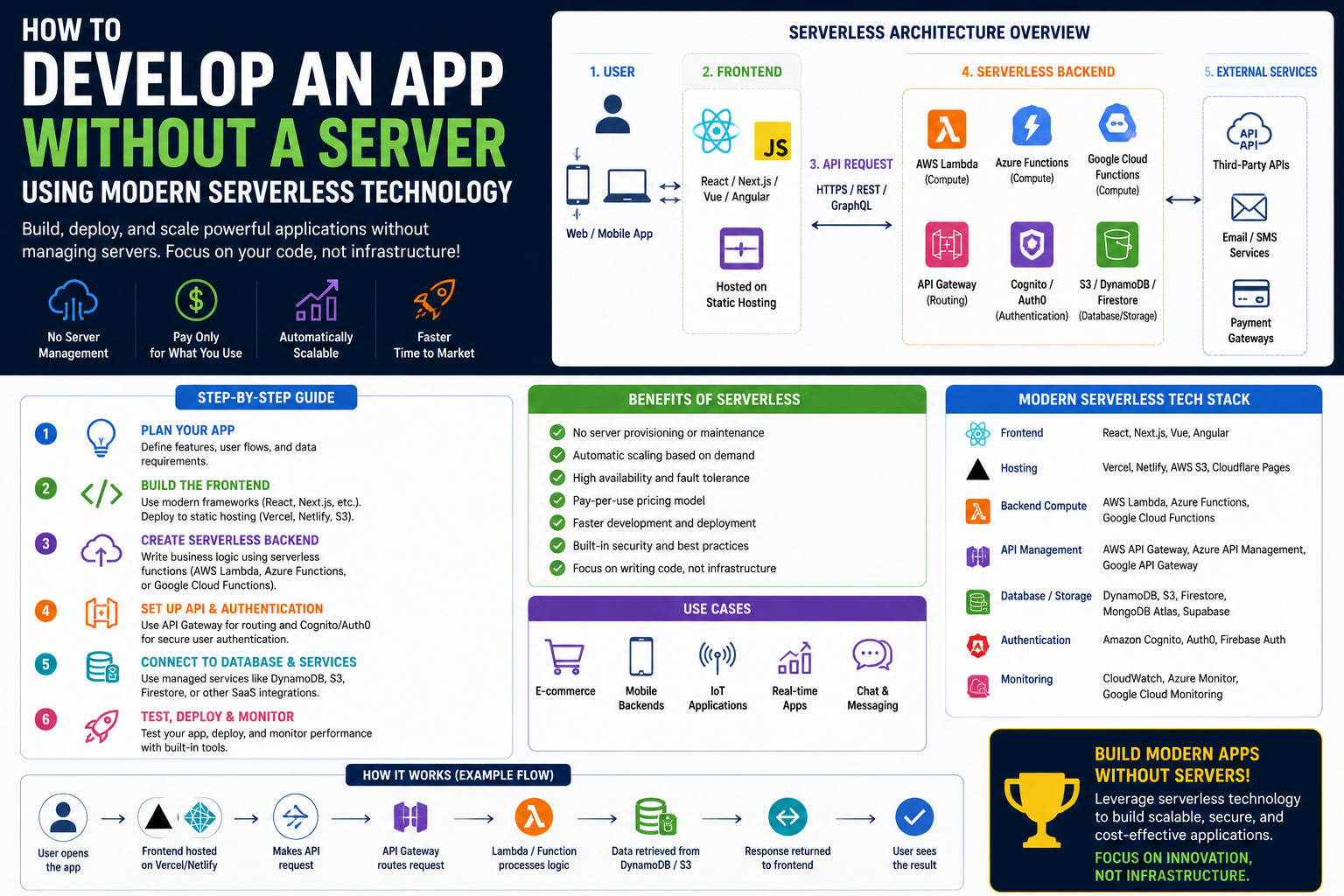
In today’s digital world, building a web or mobile application no longer requires the traditional approach of managing physical or even virtual servers. What once demanded significant infrastructure, maintenance teams, and high operational budgets can now be achieved with far simpler, more flexible technologies. This shift has opened the door for independent developers, small teams, and even solo creators to build scalable applications without worrying about server management.
One of the most important innovations driving this change is serverless computing. Despite its name, serverless does not mean that servers no longer exist. Instead, it refers to a model where developers no longer need to manage or even think about servers directly. The infrastructure is handled by cloud providers, allowing developers to focus purely on writing application logic.
To understand how this works and why it has become so popular, it is important to explore how applications were traditionally built and how serverless architecture has transformed that process.
The Traditional Way of Building Applications
Before serverless computing became widely adopted, building an application typically required setting up and managing a server environment. A server acts as the backbone of any application, handling requests from users, processing data, and communicating with databases or external services.
For example, when a user logs into a website, the server is responsible for verifying credentials, retrieving user data, and sending the appropriate response back to the browser or mobile app. This requires constant availability and high reliability.
However, managing servers comes with several challenges. Organizations must ensure that hardware is properly maintained, software is updated, and security vulnerabilities are addressed. Servers also need redundancy, meaning backup systems must be in place to prevent downtime in case of failure.
Even in virtual environments where cloud-based servers are used, there are still responsibilities such as scaling resources, monitoring performance, and paying for idle capacity. If traffic suddenly increases, the system must be manually or automatically scaled to handle the load. If traffic decreases, resources may still be paid for even if they are not fully utilized.
These challenges make traditional server-based development expensive and complex, especially for small teams or independent developers.
The Rise of Serverless Computing
Serverless computing emerged as a solution to reduce this operational burden. Instead of managing servers, developers write small units of code that are executed only when needed. These units are triggered by events such as user actions, API calls, or system updates.
When a function is triggered, the cloud provider automatically allocates resources to run it. Once the task is completed, those resources are released. This means there is no need to maintain a constantly running server.
This model introduces a major shift in how applications are designed. Instead of thinking in terms of full server systems, developers focus on individual functions that perform specific tasks. These functions can be combined to build complete applications.
One of the key benefits of this approach is efficiency. Resources are only used when necessary, which reduces costs and improves scalability. Applications can automatically handle sudden spikes in traffic without manual intervention.
Understanding How Serverless Architecture Works
At its core, serverless architecture is built around the concept of event-driven execution. This means that code is executed in response to specific events rather than running continuously.
When an event occurs, such as a user uploading an image or submitting a form, the system triggers a corresponding function. This function is executed in a temporary environment that is created on demand. Once the function completes its task, the environment is destroyed.
This approach removes the need for permanent infrastructure. Instead of running a full application server 24/7, only the necessary code runs when required.
Cloud providers handle all underlying infrastructure, including hardware maintenance, load balancing, scaling, and security. Developers interact only with their code and configuration settings.
This abstraction is what makes serverless computing so powerful. It allows developers to focus entirely on building features rather than managing systems.
Building Applications with AWS Lambda
One of the most widely used tools in serverless computing is AWS Lambda. It allows developers to run code without provisioning or managing servers. Code written for Lambda is executed in response to events such as HTTP requests, database updates, or file uploads.
Each Lambda function is independent and stateless, meaning it does not store information between executions. If persistent storage is required, external services such as databases or storage systems are used.
This design makes applications highly modular. Each function performs a specific task, such as processing payments, resizing images, or validating user input.
AWS Lambda also integrates with other cloud services, making it possible to build complete backend systems without traditional servers. For example, it can work with storage services to process uploaded files or with databases to manage user data.
The flexibility of Lambda allows developers to build everything from simple automation scripts to complex backend systems.
API Management Without Servers
A key component of serverless applications is the use of APIs. APIs allow different parts of an application to communicate with each other. In traditional systems, APIs are hosted on servers that continuously listen for requests.
In a serverless model, API management is also handled by cloud services. When a request is received, it is routed to the appropriate function for processing.
This means that developers do not need to build or maintain dedicated API servers. Instead, they define endpoints that trigger specific functions when accessed.
This approach simplifies application architecture and reduces operational overhead. It also improves scalability, as API requests are automatically distributed across available resources.
Cost Efficiency and Resource Optimization
One of the most attractive aspects of serverless computing is its cost structure. In traditional server-based systems, organizations pay for uptime regardless of usage. Even when traffic is low, resources remain active and incur costs.
Serverless computing, on the other hand, follows a pay-per-use model. Costs are based on the number of function executions and the time required to complete them.
This means that applications with low or variable traffic can operate at significantly lower costs. For example, a function that runs for only a few milliseconds will cost only a fraction of a cent.
This pricing model encourages efficient code design. Developers are incentivized to optimize functions to run quickly and consume fewer resources.
Scalability Without Manual Intervention
Scalability is one of the biggest advantages of serverless computing. In traditional systems, scaling requires planning, configuration, and sometimes even manual intervention.
Serverless platforms automatically scale applications based on demand. If the number of users increases suddenly, the system automatically allocates more resources to handle the load. When demand decreases, resources are scaled down automatically.
This elasticity ensures that applications remain responsive under all conditions without requiring developers to manage infrastructure manually.
It also eliminates the risk of over-provisioning or under-provisioning resources, which is common in traditional systems.
Limitations and Considerations
While serverless computing offers many advantages, it is not suitable for every use case. One of the main limitations is cold start latency. When a function has not been used for some time, it may take longer to initialize when triggered.
Another consideration is execution time limits. Serverless functions are typically designed for short-lived tasks. Long-running processes may not be suitable for this model.
Additionally, because applications are built from multiple small functions, managing complex workflows can sometimes become challenging. Proper architecture design is essential to ensure maintainability.
Despite these limitations, serverless computing continues to evolve and improve, making it suitable for an increasing number of applications.
Conclusion
Serverless computing has fundamentally changed the way applications are built and deployed. By removing the need to manage servers, it allows developers to focus entirely on writing application logic and delivering value to users. This shift has made it possible for individuals and small teams to create scalable, production-ready applications without the burden of infrastructure management.
Through event-driven execution, automatic scaling, and pay-per-use pricing, serverless architecture offers a highly efficient and flexible approach to modern software development. Tools like AWS Lambda demonstrate how powerful this model can be when combined with APIs and cloud services.
However, like any technology, it is not without limitations. Understanding when and how to use serverless computing is key to building effective systems. With proper design and planning, it can significantly reduce costs, improve scalability, and simplify application development.
As serverless computing continues to evolve and mature, it is expected to become an even more foundational part of modern software development. Its growing capabilities are reshaping how applications are designed, built, and deployed by removing much of the traditional complexity tied to infrastructure management. Developers can focus more on solving real user problems and delivering features quickly rather than spending time on server maintenance or scaling concerns. This shift is especially important for startups, independent developers, and small teams, as it significantly lowers entry barriers and reduces operational costs. In the long term, serverless technology is likely to accelerate innovation across industries by enabling rapid prototyping, faster deployment cycles, and highly scalable systems that adapt automatically to demand, ultimately transforming how digital products are created and delivered worldwide.