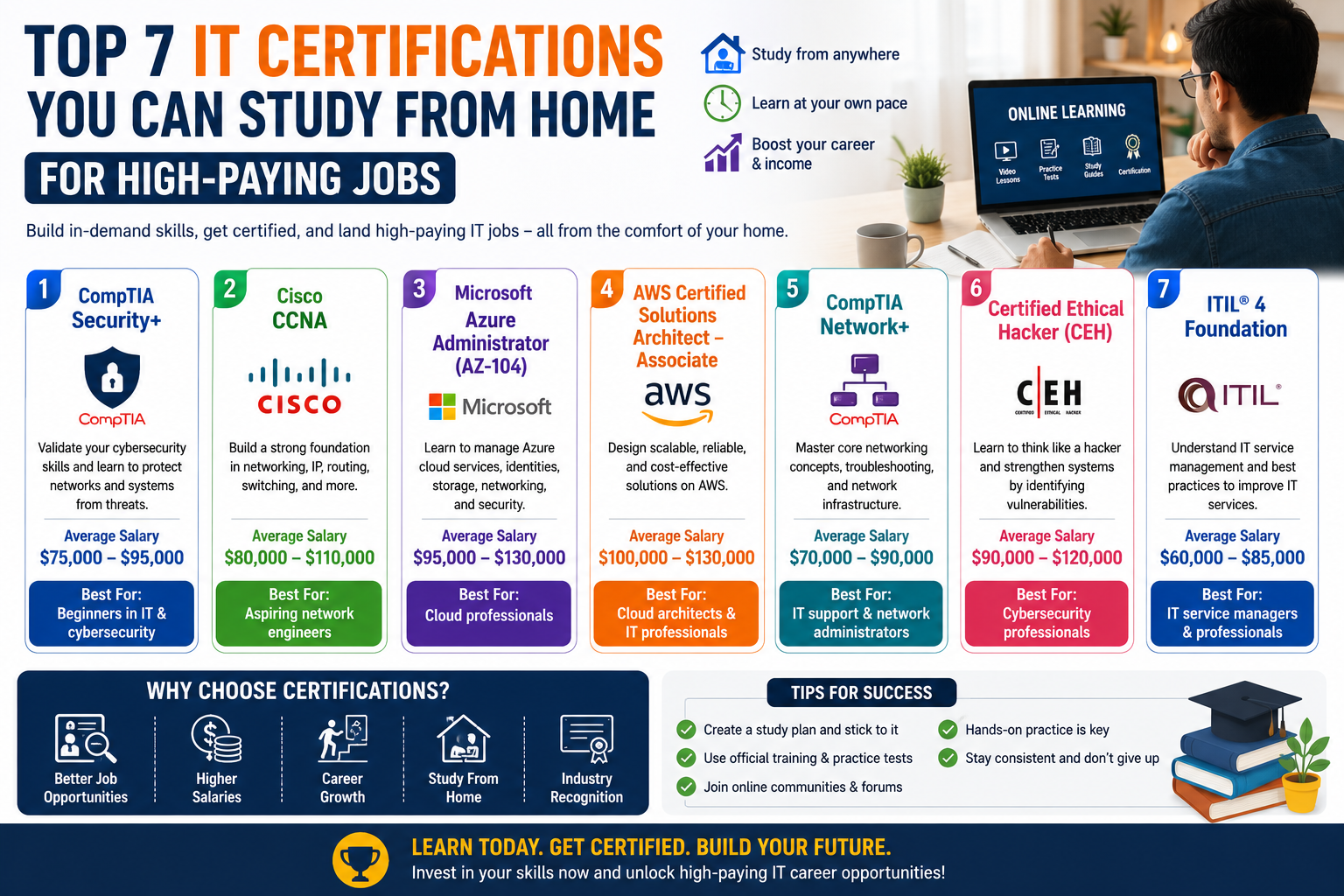
Information technology has become one of the most flexible and opportunity-rich career paths in the modern workforce. One of its biggest advantages is that many of the foundational and advanced skills can be learned remotely, making it possible for learners to develop professional-level expertise without attending a physical classroom. For beginners stepping into the field and experienced professionals aiming to upgrade their skill set, IT certifications provide a structured way to build credibility, deepen technical understanding, and improve job prospects.
What makes certifications especially valuable today is their alignment with real industry needs. Employers increasingly look for practical, demonstrable skills rather than just academic backgrounds. Certifications validate that a candidate understands essential technologies such as cloud computing, networking, cybersecurity, system administration, and endpoint management. They also help professionals stay relevant in a fast-changing environment where tools and platforms evolve rapidly.
Another major benefit of studying certifications from home is flexibility. Learners can progress at their own pace, revisit complex topics, and balance their studies with work or other responsibilities. Some certifications can be completed in a matter of weeks, while others may take longer depending on prior experience. Regardless of the timeline, consistent effort and structured learning often lead to strong outcomes.
The following sections explore seven of the most valuable IT certifications that can be studied remotely. Each one plays a unique role in shaping a well-rounded IT career and opens doors to different areas of the technology industry.
Microsoft Azure Administrator Certification
The Microsoft Azure Administrator certification is designed for individuals who want to work with cloud-based infrastructure and services. As organizations continue migrating their operations to cloud platforms, Azure has become one of the most widely adopted solutions in the industry. This certification focuses on managing cloud resources, configuring virtual networks, handling storage solutions, and maintaining overall system performance within the Azure environment.
One of the key strengths of this certification is its practical approach. It requires learners to understand how cloud services function in real business environments. Candidates are expected to manage subscriptions, implement security controls, monitor system health, and ensure that cloud resources are optimized for performance and cost efficiency. These responsibilities mirror real-world tasks performed by cloud administrators in enterprise settings.
Studying this certification from home allows learners to interact with virtual labs and simulation environments that replicate cloud infrastructures. This hands-on experience is essential because cloud computing is highly practical in nature. Understanding how different components interact helps build confidence and prepares learners for real operational challenges.
Professionally, this certification is often considered a gateway into cloud engineering and DevOps roles. It builds a strong foundation for more advanced certifications and cloud architecture paths. Individuals who complete this certification often find themselves better prepared for roles involving system administration, cloud support, and infrastructure management in modern IT environments.
Microsoft Azure Fundamentals Certification
The Microsoft Azure Fundamentals certification serves as an entry point into cloud computing for beginners. It is ideal for individuals who have little to no prior experience with cloud technologies but want to understand the basic concepts and services offered by Azure.
This certification focuses on foundational knowledge such as cloud concepts, core Azure services, pricing models, and basic security principles. It is not heavily technical compared to advanced certifications, but it plays a crucial role in building awareness of how cloud systems operate. Understanding these basics is essential before moving on to more complex certifications like Azure Administrator or Azure Solutions Architect.
One of the biggest advantages of this certification is that it helps learners transition from traditional IT environments to cloud-based systems. Many professionals who start in on-premise infrastructure roles use this certification as a stepping stone toward cloud-focused careers. It introduces essential terminology and concepts that are frequently used across the IT industry.
Studying this certification from home is relatively manageable because the material is structured in a beginner-friendly way. It allows learners to build confidence without being overwhelmed by technical complexity. It also helps non-technical professionals, such as project managers or business analysts, understand cloud systems better.
Overall, this certification is an excellent starting point for anyone looking to enter the cloud computing space and build a long-term career in IT.
CompTIA Security+ Certification
The CompTIA Security+ certification is one of the most respected entry-level cybersecurity certifications in the industry. It focuses on essential security principles such as threat detection, risk management, network security, identity management, and incident response. As cyber threats continue to increase globally, this certification has become highly valuable for organizations seeking skilled security professionals.
What makes Security+ particularly important is its vendor-neutral approach. It does not focus on a single platform or technology, but instead teaches universal security concepts applicable across different systems and environments. This allows professionals to work in a wide range of industries and technical setups.
The certification also introduces learners to practical security scenarios. These include identifying vulnerabilities, implementing secure network configurations, and responding to potential breaches. Understanding these concepts is essential for roles in cybersecurity analysis, IT auditing, and system protection.
Studying Security+ from home provides flexibility for learners to explore theoretical concepts alongside practical applications. It encourages the development of critical thinking skills, especially when analyzing security risks and designing protective measures. Many learners also use virtual labs to simulate real-world cyberattack scenarios, which helps strengthen problem-solving abilities.
Professionally, Security+ is often considered a baseline requirement for cybersecurity roles. It can lead to opportunities in security operations centers, network security teams, and IT compliance departments. It also serves as a foundation for more advanced cybersecurity certifications in the future.
CompTIA Network+ Certification
The CompTIA Network+ certification focuses on networking concepts that form the backbone of all IT systems. It covers topics such as network design, configuration, troubleshooting, and network security. Since nearly every organization relies on network infrastructure, this certification is highly relevant across multiple industries.
One of the key benefits of Network+ is its vendor-neutral nature. It teaches foundational networking principles that apply to different technologies and hardware systems. This includes understanding how data moves across networks, how devices communicate, and how connectivity issues are resolved.
The certification also emphasizes troubleshooting skills, which are essential for IT professionals. Network issues are among the most common technical problems in organizations, and being able to diagnose and resolve them efficiently is a valuable skill. Learners develop the ability to analyze network performance and identify potential failures before they become critical.
Studying this certification from home allows learners to experiment with simulated network environments. This helps build practical knowledge of routing, switching, and network protocols. It also reinforces theoretical concepts through hands-on practice.
Career-wise, Network+ is often considered a stepping stone into roles such as network administrator, IT support specialist, or infrastructure technician. It provides a strong foundation for more advanced networking certifications and specialized career paths.
CompTIA A+ Certification
The CompTIA A+ certification is widely recognized as the starting point for many IT careers. It focuses on fundamental technical skills required for entry-level IT support roles. This includes hardware troubleshooting, operating systems, software installation, and basic networking concepts.
What makes this certification particularly valuable is its broad coverage of essential IT knowledge. It prepares learners to handle everyday technical issues such as device setup, system maintenance, and user support. These skills are crucial in help desk and technical support environments.
The certification also introduces learners to basic cybersecurity principles, mobile device management, and cloud fundamentals. This ensures that candidates have a well-rounded understanding of modern IT environments, even at an entry-level stage.
Studying A+ from home is especially beneficial for beginners because it allows them to learn at a comfortable pace. The material is structured in a way that gradually builds confidence and technical understanding. Practical experience can also be gained through home lab setups or virtual environments.
From a career perspective, CompTIA A+ is often the first certification employers look for when hiring IT support staff. It demonstrates that a candidate has the foundational skills required to handle technical responsibilities in real-world settings.
Conclusion
IT certifications have become one of the most effective ways to build a successful career in technology, especially for individuals who prefer flexible learning from home. They offer structured knowledge, practical skills, and industry recognition that can significantly improve career opportunities. Whether starting from scratch or advancing an existing career, certifications provide a clear path for growth and specialization.
The seven certifications discussed represent a balanced mix of foundational and advanced skills across cloud computing, cybersecurity, networking, and system administration. Each one contributes uniquely to building a strong IT skill set. Some focus on entry-level knowledge, while others prepare learners for more complex enterprise environments.
By choosing the right certification based on career goals and committing to consistent study, learners can gradually progress into high-demand roles within the IT industry. With dedication and practical experience, these certifications can serve as powerful stepping stones toward long-term professional success in the ever-evolving world of technology. They also strengthen problem-solving abilities, improve adaptability to new tools, and build confidence for tackling real-world IT challenges in competitive global environments.