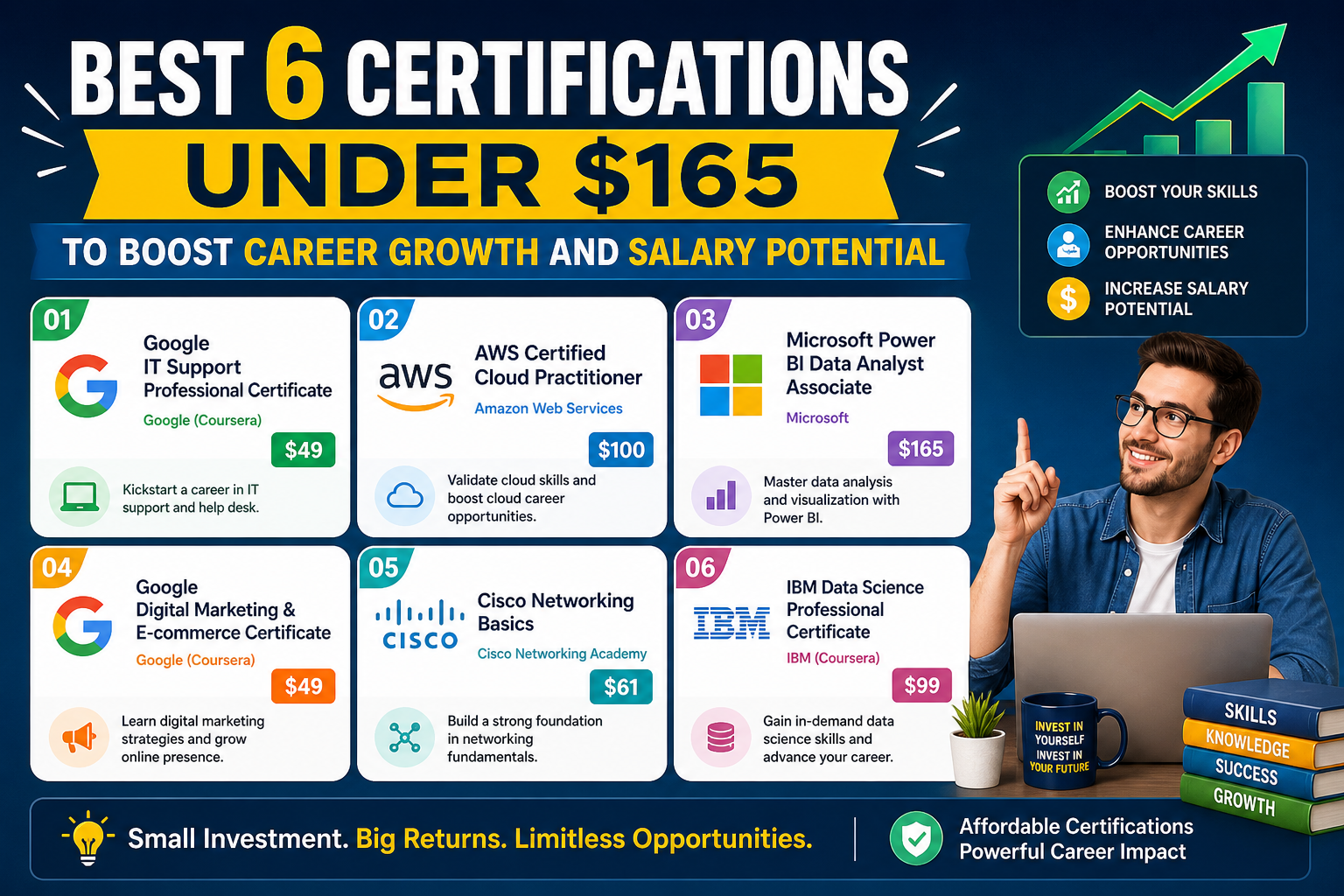
In the modern technology job market, skills often matter more than formal degrees. Employers increasingly look for candidates who can demonstrate practical knowledge in specific areas such as cloud computing, networking, cybersecurity, and system administration. This shift has made IT certifications one of the most direct pathways to better job opportunities and higher salaries. However, there is a common misconception that earning certifications always requires a large financial investment. While it is true that many advanced credentials can be expensive, there are still several valuable certifications available at a much lower cost that can help individuals enter the industry or transition into higher-paying roles.
For beginners or professionals looking to pivot into IT, entry-level certifications serve as a critical foundation. They validate essential knowledge, build confidence, and help candidates stand out in competitive hiring environments. More importantly, they provide a structured learning path that gradually leads toward advanced expertise without requiring significant upfront spending. These certifications are particularly useful for individuals who are just starting out, changing careers, or trying to move up from entry-level technical support roles.
Another important advantage of affordable certifications is accessibility. Many learners do not have the resources to invest thousands of dollars into training programs or advanced exams. Lower-cost certifications open the door for a broader range of people to enter the field, including students, self-learners, and professionals from unrelated industries. This accessibility helps diversify the IT workforce and ensures that motivated individuals can progress based on effort and capability rather than financial background.
While each certification has its own focus area, most entry-level options are designed to build fundamental understanding. These include basic networking concepts, cloud computing principles, operating system knowledge, virtualization fundamentals, and introductory cybersecurity awareness. Even though these topics may appear simple on the surface, they form the backbone of nearly every IT role. Without a strong grasp of these fundamentals, it becomes difficult to succeed in more advanced technical environments.
The certifications discussed in this article are selected based on their affordability and career impact. Each one costs significantly less than many professional-level certifications while still offering meaningful value in terms of job readiness and salary growth potential. They are particularly useful for individuals aiming to move beyond general support roles into more specialized positions such as cloud technician, junior network engineer, system administrator, or cybersecurity analyst.
The goal of this discussion is not only to highlight cost-effective certifications but also to explain how they fit into broader career development. Each certification represents a stepping stone toward more advanced opportunities. By strategically selecting and completing these credentials, individuals can build a strong portfolio of technical skills without incurring heavy financial burdens.
Building a Cloud Foundation with Entry-Level Cloud Certification
Cloud computing has become one of the most dominant forces in modern IT infrastructure. Organizations across industries are migrating their systems, applications, and data to cloud platforms due to their scalability, flexibility, and cost efficiency. As a result, professionals with cloud knowledge are in high demand. Even entry-level cloud understanding can significantly increase employability, making cloud-focused certifications one of the most valuable starting points for aspiring IT professionals.
An entry-level cloud certification typically introduces learners to fundamental cloud concepts such as service models, deployment models, virtual infrastructure, and basic cloud security practices. These concepts are essential for understanding how modern applications are hosted and managed. Unlike traditional on-premise systems, cloud environments require a different mindset, focusing more on distributed systems, automation, and resource optimization.
One of the key benefits of starting with a foundational cloud certification is that it provides a clear overview of how cloud services are structured. Many beginners find cloud computing overwhelming due to the wide range of tools and services available. A structured certification helps simplify this complexity by breaking down core ideas into manageable concepts. This includes understanding the differences between infrastructure as a service, platform as a service, and software as a service, as well as learning how cloud billing and resource allocation work.
Beyond theoretical knowledge, entry-level cloud certifications also help learners develop practical awareness of how cloud environments are used in real-world scenarios. For example, businesses use cloud systems to host websites, store data, run applications, and manage workloads across global regions. Understanding these use cases helps learners connect technical concepts to actual business needs, which is highly valued by employers.
Another important aspect of cloud fundamentals is security. Even at an entry level, it is essential to understand how cloud providers secure data, manage access control, and protect against unauthorized usage. Security in the cloud is shared between the provider and the customer, meaning professionals must understand their responsibilities in protecting sensitive information. This foundational knowledge is critical for anyone planning to pursue advanced roles in cloud architecture or cybersecurity.
From a career perspective, cloud certifications can serve as a gateway into multiple job roles. Entry-level positions such as cloud support associate, junior cloud technician, or IT support specialist often require at least a basic understanding of cloud platforms. As organizations continue to adopt cloud-first strategies, this demand is expected to grow, making early exposure to cloud concepts a strong advantage.
One of the most important characteristics of cloud-focused certifications is their scalability in career development. Starting with foundational knowledge allows professionals to later specialize in areas such as cloud architecture, DevOps engineering, cloud security, or data engineering. Each of these advanced paths builds upon the same core principles introduced at the entry level.
It is also worth noting that cloud computing is not limited to a single technology provider. The concepts learned at the foundational level are generally transferable across different platforms and systems. This means that once an individual understands the core principles, they can adapt more easily to various cloud environments used by different organizations. This flexibility increases long-term career mobility and reduces dependency on a single technology ecosystem.
In addition to technical skills, entry-level cloud certifications also help develop problem-solving abilities. Working with cloud concepts often involves understanding system design, identifying resource requirements, and evaluating cost efficiency. These skills are valuable not only in cloud roles but across a wide range of IT positions.
Entry Into Networking Through Foundational Infrastructure Certification
Networking remains one of the most important pillars of information technology. Every digital system relies on networks to communicate, share data, and function effectively. Whether it is cloud computing, cybersecurity, or system administration, networking knowledge plays a central role in almost every IT discipline. For this reason, entry-level networking certifications are often considered a strong starting point for anyone entering the industry.
A foundational networking certification typically introduces essential concepts such as IP addressing, routing, switching, network topologies, and basic security principles. These topics form the core structure of how devices communicate within and between networks. Understanding these fundamentals allows learners to visualize how data travels across systems and how different devices interact in a connected environment.
One of the most important concepts covered in networking fundamentals is the structure of local area networks. This includes understanding how devices such as computers, printers, and servers connect within a limited geographic area. Learners also gain insight into how routers and switches manage traffic and ensure data is delivered to the correct destination. These basic principles are essential for troubleshooting and maintaining network performance.
Another key area of study is internet connectivity. This involves understanding how local networks connect to larger global systems through service providers. Concepts such as DNS, IP addressing, and subnetting are introduced to help learners understand how devices are identified and how data is routed efficiently across different networks. These topics may appear technical at first, but they are essential for anyone working in IT infrastructure.
Security is also an important component of foundational networking knowledge. Even at an entry level, professionals must understand basic security practices such as controlling access to networks, identifying potential vulnerabilities, and implementing simple protective measures. As cyber threats continue to evolve, understanding network security fundamentals is becoming increasingly important across all IT roles.
From a career development perspective, networking certifications provide a clear pathway into roles such as network support technician, junior network administrator, or IT infrastructure assistant. These roles often serve as stepping stones toward more advanced positions in network engineering and cybersecurity. Employers value candidates who understand networking fundamentals because they form the basis of nearly all IT operations.
Another advantage of learning networking at an early stage is the ability to troubleshoot technical issues effectively. Many IT support roles require professionals to diagnose and resolve connectivity problems. A strong understanding of networking principles allows individuals to quickly identify the source of issues and apply appropriate solutions. This not only improves job performance but also increases confidence when working in technical environments.
Hands-on experience is also an important part of learning networking fundamentals. Even without expensive equipment, learners can simulate network environments using virtual tools or basic home setups. This practical exposure helps reinforce theoretical knowledge and improves understanding of how real systems operate. Over time, this combination of theory and practice builds a strong foundation for more advanced technical roles.
Strengthening IT Fundamentals with Microsoft-Based Entry Certification
In addition to cloud and networking, system administration remains a core area of IT infrastructure. Many organizations rely heavily on operating systems, servers, and enterprise software to manage their daily operations. Entry-level certifications focused on system fundamentals provide learners with essential knowledge about how these systems function and interact.
A foundational certification in this area typically covers topics such as operating system basics, database concepts, software development principles, and introductory server management. These areas are crucial for understanding how enterprise environments are structured and maintained. Even though these concepts may seem broad, they provide a necessary foundation for many specialized IT careers.
One of the key benefits of system-focused certifications is exposure to enterprise environments. Many organizations use complex systems that require careful management and configuration. Entry-level certifications help learners understand how these systems are set up and maintained, including user management, system updates, and basic troubleshooting.
Another important area covered in foundational system certifications is database management. Even at a basic level, understanding how data is stored, organized, and retrieved is essential for many IT roles. Databases are used in nearly every application, from websites to business software, making this knowledge highly valuable.
These certifications also introduce learners to basic cloud integration concepts, as modern enterprise systems often combine traditional infrastructure with cloud-based services. Understanding how these environments interact helps professionals adapt to hybrid IT systems, which are increasingly common in the industry.
From a career perspective, system-focused certifications can lead to roles such as system support technician, junior administrator, or IT operations assistant. These positions provide valuable hands-on experience and often serve as entry points into more advanced roles in system engineering or infrastructure management.
Another important aspect of these certifications is their role in developing problem-solving skills. Working with systems often involves diagnosing errors, managing updates, and ensuring smooth operation across multiple components. These tasks require attention to detail and analytical thinking, both of which are highly valued in IT careers.
By building a strong foundation in system fundamentals, learners position themselves for long-term success in the technology field. These skills not only support entry-level roles but also serve as a base for advanced certifications in cloud computing, cybersecurity, and enterprise architecture.
Expanding Career Paths Through Virtualization Fundamentals
As IT environments continue to evolve, virtualization has become one of the most important technologies powering modern infrastructure. Instead of relying on a separate physical machine for every application or service, organizations now use virtualization to run multiple virtual machines on a single physical server. This approach improves efficiency, reduces hardware costs, and allows for more flexible resource management.
For individuals entering the IT field, virtualization knowledge is a valuable stepping stone because it bridges traditional system administration and modern cloud computing. Even though cloud platforms often receive more attention today, they are built on the same virtualization principles that have been used in data centers for years. Understanding these fundamentals provides a strong technical advantage and makes it easier to transition into more advanced infrastructure roles.
A foundational virtualization certification typically introduces learners to the core concepts of virtual machines, hypervisors, and virtual infrastructure management. At its core, virtualization is about abstraction. Instead of interacting directly with physical hardware, systems are divided into virtual environments that behave like independent machines. Each virtual machine operates with its own operating system, applications, and resources, even though they share the same physical host.
One of the most important concepts in virtualization is the hypervisor. This is the software layer that allows multiple virtual machines to run on a single physical system. There are different types of hypervisors, each with its own architecture and use case. Understanding how hypervisors manage resources such as CPU, memory, and storage is essential for anyone working in virtualized environments. It also helps explain how large-scale data centers operate efficiently with limited physical infrastructure.
Another key area covered in entry-level virtualization learning is virtual machine lifecycle management. This includes creating, configuring, monitoring, and decommissioning virtual machines. In real-world environments, IT professionals must constantly manage these processes to ensure optimal system performance. For example, virtual machines may need to be adjusted based on workload demands or migrated between hosts to balance system usage.
Storage management is also an important part of virtualization. Instead of relying on local physical storage, virtual environments often use shared storage systems that can be accessed by multiple servers. This allows for greater flexibility and easier data management, but it also requires careful configuration to avoid performance issues or data conflicts. Understanding how virtual storage works is essential for maintaining system stability in enterprise environments.
Networking within virtual environments is another critical topic. Virtual machines still need to communicate with each other and with external systems, which means they require virtual networking configurations. These networks operate similarly to physical networks but are managed through software. Learning how virtual switches, network adapters, and routing configurations work helps professionals understand how data flows within virtual infrastructures.
From a career perspective, virtualization knowledge opens the door to several job roles. These include junior virtualization technician, data center support specialist, and infrastructure assistant. These positions are often found in organizations that rely heavily on server-based applications and require efficient management of computing resources. As experience grows, professionals can move into more advanced roles such as virtualization engineer or cloud infrastructure specialist.
One of the key advantages of learning virtualization at an early stage is its direct connection to cloud computing. Many cloud platforms are built on virtualization technologies, meaning that understanding virtual machines and hypervisors provides a strong foundation for cloud-related careers. This overlap makes virtualization knowledge highly valuable for long-term career development.
Virtualization also introduces important concepts related to system optimization. Because multiple virtual machines share the same physical hardware, resource allocation becomes a critical factor. IT professionals must learn how to balance workloads, monitor system performance, and ensure that no single machine consumes more than its fair share of resources. These skills are essential in both virtualized and cloud-based environments.
Another important aspect of virtualization is disaster recovery. Virtual machines can often be backed up, duplicated, or restored more easily than physical systems. This makes virtualization a key component of modern business continuity planning. Understanding how virtual snapshots and backups work helps professionals contribute to system reliability and data protection strategies.
Building Practical IT Skills Through Structured Online Certification Programs
While technical certifications often focus on specific technologies, some programs are designed to provide a broader introduction to IT support and system administration. These structured learning paths are particularly useful for beginners who may not yet know which area of IT they want to specialize in. Instead of focusing on a single technology, these programs cover a wide range of foundational topics that are applicable across multiple IT roles.
One of the key strengths of these programs is their emphasis on practical, real-world skills. Rather than focusing solely on theory, learners are introduced to tasks such as troubleshooting hardware issues, configuring operating systems, managing user accounts, and understanding basic networking concepts. These skills are directly applicable in entry-level IT support roles, where professionals are often responsible for resolving day-to-day technical issues.
Operating systems form a major part of this learning path. Understanding how different operating systems function is essential for IT support roles, as users may be working across various platforms. This includes knowledge of file systems, command-line interfaces, software installation, and system configuration. Even at a basic level, this understanding helps professionals diagnose and resolve technical problems more effectively.
Hardware fundamentals are also an important component. IT support professionals often need to identify and resolve issues related to physical devices such as computers, printers, and peripherals. Understanding how hardware components interact with software systems helps in diagnosing problems such as performance slowdowns, connectivity issues, or device failures.
Another critical area of study is networking fundamentals. While advanced networking certifications dive deep into technical details, entry-level programs focus on basic connectivity concepts. This includes understanding how devices connect to networks, how IP addresses work, and how to troubleshoot common connectivity issues. These skills are essential for IT support roles, where network-related problems are among the most common issues encountered.
Cybersecurity awareness is also introduced at a foundational level. Even though these programs do not focus on advanced security engineering, they emphasize the importance of safe computing practices. This includes understanding how to recognize potential security threats, avoid common vulnerabilities, and follow best practices for protecting data. As cybersecurity becomes increasingly important across all industries, even basic awareness can significantly improve job performance.
One of the most valuable aspects of structured IT support programs is their ability to prepare learners for real-world job environments. Many entry-level IT roles require professionals to interact with users, troubleshoot issues under pressure, and manage multiple tasks simultaneously. These programs help develop not only technical skills but also communication and problem-solving abilities.
From a career perspective, completing a broad IT support certification can lead to roles such as help desk technician, IT support specialist, or desktop support analyst. These positions serve as entry points into the IT industry and often provide opportunities for advancement into more specialized fields such as networking, system administration, or cybersecurity.
Another advantage of these programs is their accessibility. They are often designed for individuals with little to no prior IT experience, making them ideal for career changers. The structured nature of the learning path ensures that even complex topics are introduced gradually, allowing learners to build confidence as they progress.
These certifications also help establish a strong foundation for lifelong learning in IT. Because the field is constantly evolving, professionals must continuously update their skills. Starting with a broad understanding of IT fundamentals makes it easier to adapt to new technologies and pursue more advanced certifications in the future.
Introduction to Cybersecurity Operations in Entry-Level Certification Paths
As digital systems become more interconnected, cybersecurity has become one of the most critical areas of IT. Organizations of all sizes face increasing threats from cyberattacks, data breaches, and malicious activity. This has created a growing demand for professionals who understand how to detect, analyze, and respond to security incidents.
Entry-level cybersecurity operations certifications are designed to introduce learners to the fundamentals of security monitoring and threat detection. These programs focus on building awareness of how cyber threats operate and how security teams respond to them. Unlike general IT certifications, cybersecurity-focused paths emphasize analytical thinking and incident response.
One of the primary concepts covered in cybersecurity operations is threat identification. This involves understanding different types of cyber threats, such as malware, phishing attacks, unauthorized access attempts, and network intrusions. Learners are introduced to the methods attackers use to exploit vulnerabilities and how these threats can be detected early.
Another important area is security monitoring. In real-world environments, security teams continuously monitor systems for unusual activity. Entry-level cybersecurity training helps learners understand how monitoring tools work and what types of indicators may signal a potential security issue. This includes analyzing logs, reviewing alerts, and identifying patterns of suspicious behavior.
Incident response is also a key focus. When a security threat is detected, organizations must respond quickly to minimize damage. Entry-level training introduces the basic steps involved in responding to incidents, including containment, investigation, and recovery. Understanding this process helps learners appreciate the importance of structured response strategies in maintaining system security.
Network security plays a central role in cybersecurity operations. Since most attacks target network systems, understanding how data flows through networks is essential for identifying vulnerabilities. Learners gain insight into how firewalls, intrusion detection systems, and other security tools help protect network infrastructure.
Another important aspect is endpoint security. Devices such as laptops, desktops, and mobile devices are often entry points for cyberattacks. Entry-level cybersecurity training helps learners understand how to secure these endpoints and prevent unauthorized access. This includes basic concepts such as antivirus protection, software updates, and access control measures.
From a career perspective, entry-level cybersecurity certifications can lead to roles such as security operations center analyst, junior cybersecurity technician, or IT security assistant. These positions are often the first step toward more advanced careers in cybersecurity engineering, ethical hacking, or digital forensics.
One of the key advantages of starting in cybersecurity operations is the rapid growth of the field. As cyber threats continue to evolve, organizations are investing heavily in security teams. This creates ongoing demand for skilled professionals who can help protect systems and data.
Cybersecurity also offers strong long-term career potential because it intersects with nearly every area of IT. Whether working in cloud computing, networking, or system administration, security knowledge enhances overall effectiveness. This makes entry-level cybersecurity training a valuable addition to any IT career path.
Another important benefit of cybersecurity education is the development of analytical thinking skills. Security professionals must constantly evaluate data, identify patterns, and make decisions based on incomplete information. These skills are highly transferable and valuable in many other technical fields as well.
By gaining early exposure to cybersecurity operations, learners position themselves for future specialization in one of the most in-demand areas of technology.
Structured Entry Into Cisco Networking and Security-Oriented Career Paths
Networking knowledge becomes significantly more powerful when it starts to shift from general understanding into structured vendor-based frameworks. One of the most widely recognized ecosystems in IT networking is built around Cisco technologies. Many enterprise networks across the world rely on Cisco hardware and software solutions, which means that familiarity with Cisco concepts can provide a strong advantage when entering infrastructure-related roles.
Entry-level Cisco certifications are designed to introduce learners to structured networking environments where devices, protocols, and configurations follow standardized enterprise practices. Instead of focusing only on general networking theory, these certifications guide learners into practical network design, troubleshooting, and implementation scenarios that mirror real-world IT environments.
At the foundational level, learners are introduced to how small networks are built and maintained. This includes understanding how devices connect within a local environment, how data flows between different nodes, and how network performance is monitored. These concepts form the backbone of nearly every IT infrastructure, whether in small businesses or large multinational organizations.
One of the key learning areas in Cisco-based entry pathways is device configuration. Networking devices such as routers and switches must be configured properly to ensure smooth communication between systems. This involves setting up interfaces, assigning IP addresses, and defining routing rules that determine how data is transmitted across networks. Even at a beginner level, this hands-on exposure helps learners understand how complex networks are structured.
Another important concept is segmentation within networks. Large networks are often divided into smaller, manageable sections to improve performance and security. This process helps reduce congestion and makes it easier to isolate and troubleshoot issues. Understanding how segmentation works is essential for anyone aiming to work in network administration or infrastructure support roles.
Security is also a central part of Cisco-based learning paths. Even basic networking environments require protection from unauthorized access and data breaches. Entry-level knowledge includes understanding how access controls, authentication methods, and basic firewall rules help secure networks. This foundation becomes especially important as professionals move toward more advanced cybersecurity roles.
From a career perspective, Cisco-oriented certifications can serve as a direct pathway into technical support and network-focused positions. These include roles such as network support assistant, junior network technician, and infrastructure support specialist. These positions often involve monitoring network performance, resolving connectivity issues, and assisting in the maintenance of enterprise systems.
As experience grows, individuals can transition into more advanced roles such as network engineer or security analyst. The structured nature of Cisco learning paths makes it easier to progress step by step, building on foundational knowledge before moving into more complex topics such as advanced routing, switching, and network security architecture.
One of the most valuable aspects of Cisco-based learning is its real-world applicability. Many of the concepts introduced at the entry level directly reflect the technologies used in enterprise environments. This means that learners are not only preparing for certification exams but also developing practical skills that can be applied immediately in workplace settings.
Another important benefit is the emphasis on troubleshooting. Network issues are common in IT environments, and professionals must be able to quickly identify and resolve them. Entry-level Cisco training introduces systematic approaches to diagnosing problems, such as checking connectivity, analyzing configurations, and interpreting network behavior. These problem-solving skills are highly valued across all IT disciplines.
Building Enterprise IT Knowledge Through Microsoft Ecosystem Fundamentals
Enterprise environments often rely heavily on structured software ecosystems, and one of the most widely used is built around Microsoft technologies. Understanding how these systems operate provides a strong advantage for individuals entering IT support, system administration, and infrastructure management roles.
Entry-level Microsoft-focused certifications are designed to introduce learners to fundamental concepts related to operating systems, databases, and enterprise applications. These areas form the core of many organizational IT systems and are essential for maintaining business operations.
Operating system knowledge is one of the most critical components. Enterprise environments typically rely on centralized system management, where multiple devices and users are controlled through structured administrative frameworks. Understanding how operating systems manage files, applications, and user permissions is essential for maintaining system stability.
User management is another important topic. In enterprise systems, users are often assigned specific roles and permissions based on their job functions. Entry-level knowledge includes understanding how to create and manage user accounts, assign access rights, and ensure proper authentication processes. These tasks are fundamental in IT support and system administration roles.
Database fundamentals are also introduced at this stage. Organizations rely heavily on structured data systems to store and manage information. Even at a basic level, understanding how data is organized, retrieved, and maintained is crucial for IT professionals. This knowledge becomes increasingly important as individuals move into roles involving data management or application support.
Another key area is software lifecycle management. Enterprise applications require regular updates, maintenance, and troubleshooting. Entry-level learning introduces the concept of managing software installations, applying updates, and ensuring compatibility across systems. These tasks are essential for maintaining operational efficiency in business environments.
From a career development perspective, Microsoft ecosystem knowledge can lead to roles such as IT support technician, desktop support analyst, and junior system administrator. These positions often serve as entry points into larger IT departments, where professionals can gain hands-on experience with enterprise systems.
As professionals gain experience, they can move into more advanced roles involving server administration, cloud integration, or enterprise system architecture. The foundational knowledge gained at the entry level provides a strong base for understanding complex IT infrastructures.
Another important aspect of Microsoft-based learning is its relevance across industries. Many organizations, regardless of size or sector, rely on Microsoft technologies for their daily operations. This widespread usage makes these skills highly transferable and valuable in a variety of job markets.
Transitioning Into Security Operations Through Cisco Cybersecurity Pathways
Cybersecurity has become one of the fastest-growing fields in technology, driven by the increasing number of digital threats facing organizations worldwide. Entry-level cybersecurity pathways within Cisco’s ecosystem focus on preparing learners for roles in security monitoring, threat analysis, and incident response.
These learning paths introduce the concept of security operations centers, where teams continuously monitor systems for suspicious activity. Understanding how these environments function is essential for anyone entering the cybersecurity field. Security operations rely on constant vigilance, data analysis, and rapid response to potential threats.
One of the primary areas of focus is threat detection. Learners are introduced to different types of cyber threats, including malware, phishing attempts, and unauthorized access attempts. Understanding how these threats operate helps professionals recognize early warning signs and take appropriate action.
Security monitoring tools play a key role in this process. These tools collect and analyze data from across network systems, helping identify unusual behavior or potential breaches. Entry-level knowledge includes understanding how alerts are generated and how security teams interpret this information.
Incident response is another critical component. When a security threat is detected, organizations must follow structured procedures to contain and resolve the issue. This includes isolating affected systems, analyzing the source of the attack, and restoring normal operations. Even at a beginner level, understanding this process helps learners appreciate the importance of coordinated security efforts.
Network security fundamentals are also emphasized. Since most cyberattacks target network infrastructure, understanding how networks are protected is essential. This includes learning about access control mechanisms, encryption principles, and basic firewall configurations.
Endpoint security is another important topic. Devices such as computers and mobile devices often serve as entry points for attacks. Entry-level cybersecurity training helps learners understand how to secure these endpoints through software updates, authentication controls, and protective monitoring.
From a career perspective, cybersecurity entry paths can lead to roles such as security operations analyst, junior security technician, or IT security support specialist. These positions are often the first step toward more advanced careers in ethical hacking, digital forensics, or security engineering.
One of the key advantages of cybersecurity as a career path is its continuous demand. As digital systems expand, the need for security professionals continues to grow. This makes entry-level cybersecurity training a valuable long-term investment in career development.
Another important aspect is the development of analytical thinking skills. Cybersecurity professionals must constantly evaluate data, identify patterns, and make decisions under pressure. These skills are highly transferable and beneficial across many other IT domains.
Expanding Entry-Level IT Knowledge Through Flexible Learning Models
Not all IT certifications follow traditional exam-based structures. Some learning paths are designed to provide a more flexible and gradual introduction to IT concepts. These programs often combine multiple areas of study, including networking, operating systems, security, and troubleshooting, into a single structured learning experience.
One of the key advantages of these flexible programs is their accessibility. They are often designed for individuals with little to no prior technical experience, making them ideal for career changers. Instead of requiring prior knowledge, they start with basic concepts and gradually build toward more advanced topics.
These programs typically emphasize practical learning. Instead of focusing solely on theory, learners are encouraged to engage with real-world scenarios. This includes troubleshooting system issues, understanding how networks function, and exploring basic security practices. This hands-on approach helps reinforce learning and improves retention.
Communication skills are also an important part of these learning paths. IT professionals often work closely with non-technical users, meaning they must be able to explain technical issues in simple terms. Entry-level programs help develop this ability by encouraging clear documentation and structured problem-solving approaches.
Another important aspect is adaptability. Because IT environments change rapidly, professionals must be able to learn new technologies quickly. Flexible learning programs help develop this adaptability by exposing learners to a wide range of topics rather than focusing on a single specialization.
From a career perspective, these programs can lead to entry-level IT support roles that serve as gateways into more specialized fields. Once individuals gain practical experience, they can transition into areas such as cloud computing, networking, cybersecurity, or system administration.
One of the most important benefits of these programs is confidence building. Many beginners feel overwhelmed when entering the IT field due to its technical complexity. Structured learning paths help reduce this barrier by breaking down complex topics into manageable steps.
Maximizing Value From Low-Cost Certification Strategies in IT Careers
One of the most important aspects of building a successful IT career is understanding how to maximize value from affordable certifications. While technical knowledge is essential, strategic planning plays a significant role in long-term career growth.
Low-cost certifications are particularly valuable because they allow individuals to explore multiple areas of IT without significant financial risk. This flexibility enables learners to experiment with different fields such as networking, cybersecurity, and cloud computing before committing to a specific career path.
Another important strategy is layering certifications. Instead of focusing on a single credential, learners can gradually build a combination of certifications that complement each other. For example, combining networking knowledge with security fundamentals creates a strong foundation for cybersecurity roles.
Practical experience is also essential. Certifications alone are not enough to guarantee career success. Employers often look for candidates who can apply their knowledge in real-world environments. This means that hands-on practice, even in small or simulated environments, is critical for reinforcing learning.
Time management is another key factor. Many entry-level certifications are designed to be completed within a relatively short timeframe. This allows learners to progress quickly and move on to more advanced topics. Setting clear learning goals helps maintain consistency and motivation throughout the certification journey.
Career progression should also be viewed as a long-term process. Entry-level certifications are not endpoints but starting points. Each credential builds toward more advanced opportunities, creating a structured pathway for continuous development.
By approaching IT certification strategically, individuals can build strong technical foundations, gain practical experience, and position themselves for higher-paying roles in the technology industry.
Conclusion
The path into IT does not have to begin with expensive certifications or complex academic programs. As the technology industry continues to evolve, it has become increasingly clear that structured, entry-level certifications can provide a powerful and accessible gateway into high-demand roles. What makes these certifications particularly valuable is not just their affordability, but their ability to deliver practical, career-relevant skills that align closely with real-world job requirements.
Across cloud computing, networking, system administration, and cybersecurity, the foundational knowledge introduced at the entry level plays a critical role in shaping long-term career success. Each certification acts as a building block, gradually introducing learners to essential technical concepts while allowing them to explore different areas of IT before committing to a specialization. This flexibility is especially important in a field that is constantly changing, where adaptability and continuous learning are key to staying relevant.
One of the most important takeaways from exploring low-cost certification pathways is that career growth in IT is rarely linear. Many professionals begin in support roles, where they gain hands-on experience troubleshooting systems, assisting users, and maintaining infrastructure. Over time, this experience combines with certifications to open doors to more advanced positions in engineering, architecture, and security. The certifications themselves are not the end goal but rather tools that support progression along this journey.
Another key insight is the importance of practical understanding over theoretical knowledge alone. While certification exams validate foundational concepts, real value comes from applying that knowledge in real environments. Whether configuring a network, managing virtual machines, or identifying security threats, hands-on experience strengthens confidence and deepens technical ability. This combination of learning and application is what ultimately drives career advancement.
Affordability also plays a major role in accessibility. By reducing financial barriers, entry-level certifications allow a wider range of individuals to enter the IT field, including career changers, students, and self-taught learners. This inclusivity strengthens the industry by bringing in diverse perspectives and encouraging talent development based on skill and effort rather than financial resources.
At the same time, it is important to recognize that certifications alone are not sufficient. Long-term success in IT requires curiosity, persistence, and a willingness to continuously learn. Technology evolves rapidly, and professionals must evolve with it. Those who treat certification as the beginning of a broader learning journey, rather than a final achievement, are the ones most likely to build sustainable and rewarding careers.
Ultimately, affordable IT certifications represent an opportunity—an entry point into a vast and dynamic industry filled with growth potential. With the right mindset and a structured approach, these low-cost pathways can lead to high-value careers, proving that success in technology is not determined by how much is spent, but by how effectively knowledge is gained and applied over time.