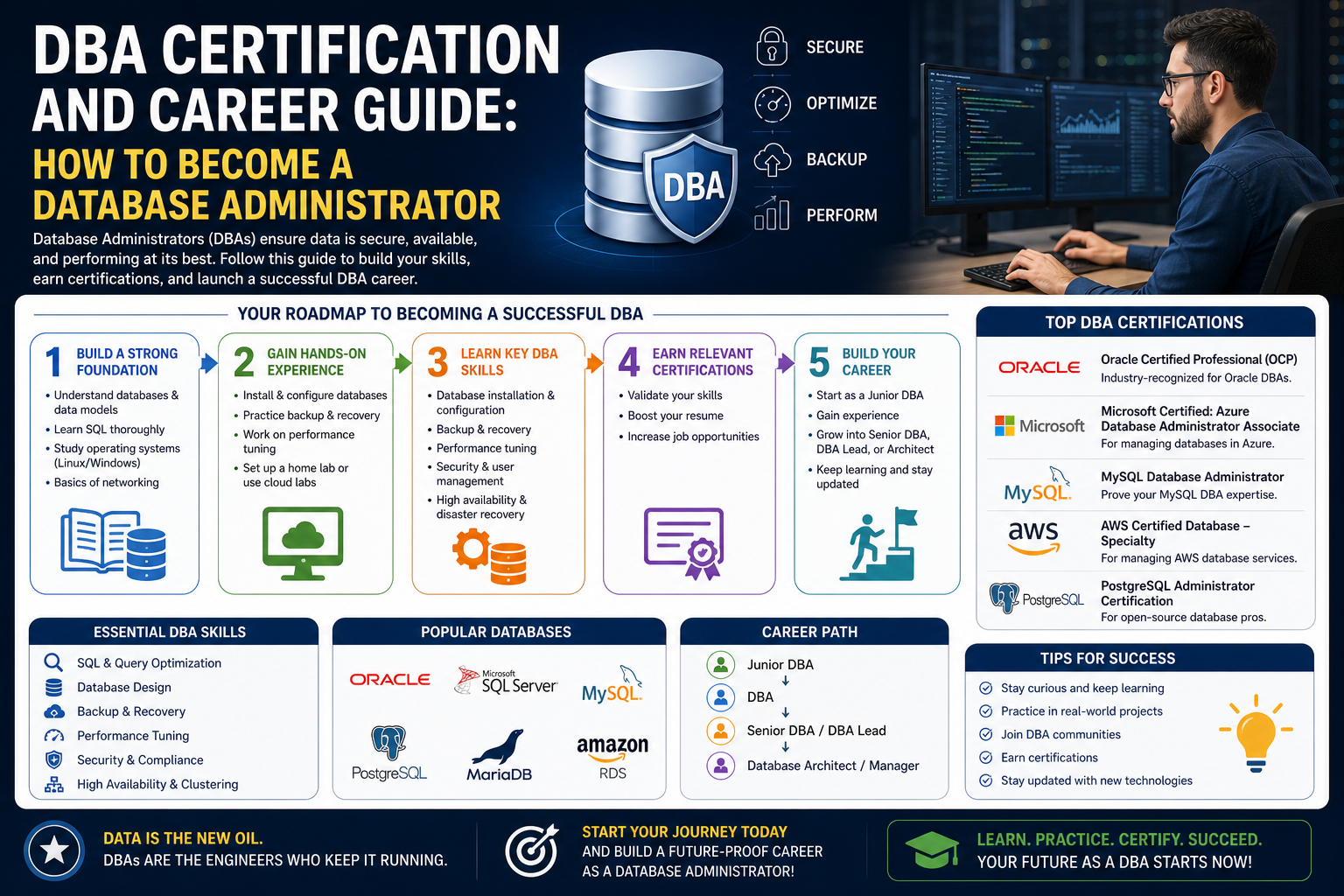
In today’s digital-driven world, nearly every organization depends on data to function effectively. From customer records and financial transactions to operational systems and analytics, data has become one of the most valuable resources a company can possess. Ensuring that this data is accurate, secure, and readily available is not a simple task. This responsibility largely falls on database administrators, commonly known as DBAs.
A DBA is a specialized IT professional who manages and maintains databases, ensuring that they operate efficiently and remain accessible when needed. Without proper database management, organizations would face data loss, system failures, performance issues, and security vulnerabilities. Because of this critical responsibility, DBAs are considered essential members of IT teams across industries such as banking, healthcare, retail, government, and technology.
What makes the role even more significant is that data systems are constantly growing in size and complexity. Organizations are no longer dealing with small, isolated databases. Instead, they operate large-scale systems that must support thousands or even millions of users simultaneously. This evolution has increased the demand for skilled professionals who can manage such environments reliably and efficiently.
Core Responsibilities of a Database Administrator
Although the exact duties of a DBA can vary depending on the organization, industry, and size of the IT infrastructure, there are several core responsibilities that are commonly associated with the role.
One of the primary responsibilities is installing and configuring database systems. This involves setting up database software, configuring it according to organizational requirements, and ensuring that it integrates smoothly with existing systems. Proper installation is crucial because it forms the foundation for everything that follows.
Another major responsibility is maintaining database performance. As data grows, databases can become slow or inefficient if not properly managed. DBAs continuously monitor system performance, identify bottlenecks, and apply optimization techniques to ensure that data can be retrieved and stored efficiently. This often includes tuning queries, adjusting configurations, and managing system resources.
Security management is another critical area. Databases often contain sensitive information such as personal details, financial records, and proprietary business data. DBAs are responsible for implementing security measures that protect this data from unauthorized access. This includes managing user permissions, applying encryption where necessary, and ensuring compliance with security policies.
Backup and recovery is also a vital function. Data loss can occur due to hardware failure, human error, cyberattacks, or natural disasters. DBAs design and implement backup strategies to ensure that data can be restored in such situations. They also regularly test recovery processes to ensure that backups are reliable and functional.
In addition to technical tasks, DBAs often provide support to users and other IT teams. This may involve troubleshooting database-related issues, assisting developers in optimizing applications, and helping analysts access and interpret data correctly. In many organizations, DBAs act as a bridge between technical systems and business users.
Some DBAs are also involved in database design and development. This includes structuring databases in a way that supports business requirements, defining relationships between data sets, and ensuring that systems are scalable for future growth. In smaller organizations, a DBA may take on a wide range of tasks, while in larger enterprises, responsibilities may be more specialized.
Why the DBA Role Is Considered Challenging
The role of a DBA is widely regarded as one of the more challenging positions in the IT field. This is not only due to the technical complexity involved but also because of the level of responsibility associated with managing critical data systems.
One of the main challenges is the need for constant availability. Databases often need to operate 24 hours a day, seven days a week. Any downtime can have serious consequences for business operations. As a result, DBAs must ensure that systems are always stable, often working outside of standard hours to perform maintenance or resolve issues.
Another challenge is the rapid pace of technological change. Database technologies continue to evolve, with new tools, systems, and methodologies being introduced regularly. DBAs must continuously update their knowledge to stay effective in their roles. This requires a commitment to lifelong learning and adaptability.
Handling large volumes of data is also increasingly complex. Modern databases can contain massive amounts of information that must be processed efficiently. Ensuring performance under such conditions requires deep technical understanding and strong problem-solving skills.
Security threats add another layer of difficulty. With cyberattacks becoming more sophisticated, DBAs must stay vigilant and proactive in protecting sensitive information. A single vulnerability can lead to significant consequences, making security a top priority at all times.
Key Skills Required to Become a Successful DBA
To succeed as a database administrator, a combination of technical and analytical skills is required. While formal education can provide a foundation, practical skills and hands-on experience are equally important.
One of the most important technical skills is knowledge of database management systems. These systems are the software platforms used to create, manage, and manipulate databases. Understanding how these systems work is essential for performing DBA tasks effectively.
Another crucial skill is proficiency in query languages, especially SQL (Structured Query Language). SQL is used to interact with databases, retrieve data, update records, and manage structures. A strong understanding of SQL allows DBAs to perform a wide range of tasks efficiently and accurately.
System administration skills are also important. DBAs often work closely with operating systems, servers, and network configurations. Understanding how these components interact helps in troubleshooting issues and optimizing performance.
Problem-solving ability is another key requirement. Database environments can be complex, and issues may arise unexpectedly. A good DBA must be able to analyze problems, identify root causes, and implement effective solutions quickly.
Attention to detail is equally important. Even small errors in database configuration or query design can lead to significant issues. DBAs must be precise in their work to ensure system stability and data integrity.
Communication skills should not be overlooked. DBAs often interact with developers, analysts, and non-technical users. Being able to explain technical concepts in simple terms is valuable in ensuring smooth collaboration across teams.
Understanding Database Systems and Technologies
A foundational step toward becoming a DBA is understanding different types of database systems. The most common type is the relational database, which organizes data into structured tables with defined relationships. These systems are widely used in business environments due to their reliability and efficiency.
Relational databases rely heavily on structured query languages to manage data. They are ideal for applications that require consistency and accuracy, such as financial systems and enterprise applications.
In addition to relational databases, there are also non-relational or NoSQL databases. These systems are designed to handle unstructured or semi-structured data and are often used in applications that require high scalability and flexibility, such as social media platforms and big data analytics.
Each database type has its strengths and weaknesses, and a skilled DBA should understand when and how to use each one. In many modern environments, organizations use a combination of both relational and non-relational systems.
Familiarity with popular database platforms is also important. Different organizations may use different systems depending on their needs. Learning how these platforms operate provides practical insight into real-world database management.
The Early Career Path Toward Becoming a DBA
Most database administrators do not begin their careers directly in DBA roles. Instead, they typically start in entry-level IT positions and gradually progress toward database specialization. This gradual progression allows individuals to build foundational skills and gain practical experience.
Entry-level IT support roles are often the starting point. In these positions, individuals gain exposure to basic system administration, troubleshooting, and user support. While these roles may not directly involve database management, they provide valuable experience in IT environments and help build problem-solving skills.
As individuals gain experience, they may begin working with databases in indirect ways, such as assisting with backups, restoring data, or supporting applications that rely on databases. These tasks provide early exposure to database systems and help build confidence in handling data-related responsibilities.
During this stage, it is important to actively seek learning opportunities. Many IT environments offer hands-on exposure to different systems, and taking initiative can significantly accelerate career growth. Even informal learning through experimentation and observation can be valuable.
Building Practical Experience in IT Environments
Practical experience plays a critical role in transitioning toward a DBA career. While theoretical knowledge provides a foundation, real-world experience helps develop the skills needed to handle complex systems.
Working in IT support roles allows individuals to understand how organizations use technology in day-to-day operations. This includes understanding how systems interact, how users depend on data, and how issues are resolved in real environments.
Over time, individuals may be exposed to more advanced tasks involving databases. These may include monitoring database performance, assisting with system maintenance, or supporting application development teams.
Gaining exposure to different types of systems is also beneficial. Working with diverse technologies helps build adaptability and broadens technical understanding. This diversity of experience is valuable when transitioning into a specialized role such as database administration.
Developing a Strong Foundation in Data Concepts
Before moving into advanced database administration tasks, it is essential to understand fundamental data concepts. These include how data is stored, organized, retrieved, and manipulated within systems.
Understanding how tables, records, and relationships work in relational databases is particularly important. These concepts form the building blocks of database design and management.
It is also important to understand data integrity principles. This includes ensuring that data remains accurate, consistent, and reliable throughout its lifecycle. DBAs play a key role in maintaining these principles in real-world systems.
Normalization is another important concept. It involves organizing data in a way that reduces redundancy and improves efficiency. A strong understanding of normalization helps in designing effective database structures.
Preparing for the Transition Toward Advanced DBA Responsibilities
As individuals gain experience and develop their skills, they gradually move closer to more advanced database responsibilities. This transition typically involves taking on more complex tasks, learning advanced database concepts, and working more closely with database systems.
At this stage, individuals may begin focusing more heavily on performance optimization, security management, and database architecture. These areas require deeper technical understanding and greater responsibility.
The transition toward a full DBA role is often gradual, involving continuous learning and increasing levels of responsibility over time.
One of the most important milestones in becoming a database administrator is developing strong proficiency in database query languages. These languages are the primary tools used to interact with databases, retrieve information, modify records, and manage structures. Among them, SQL (Structured Query Language) remains the most widely used and essential language in relational database environments.
SQL is not just a tool for simple data retrieval. It is a powerful language that allows DBAs to create and manage entire database systems. A deep understanding of SQL involves more than knowing basic commands. It includes mastering complex queries, understanding how queries are executed, and optimizing them for performance.
As databases grow in size, poorly written queries can significantly impact system performance. A skilled DBA must be able to analyze query execution plans, identify inefficiencies, and restructure queries to reduce load on the system. This requires both theoretical knowledge and hands-on practice.
Advanced SQL usage also involves working with stored procedures, triggers, and functions. These elements allow DBAs to automate tasks, enforce business rules, and maintain consistency across database operations. Understanding how and when to use these tools is essential for maintaining efficient database environments.
In addition to SQL, DBAs may also encounter procedural extensions of SQL used in specific database systems. These extensions allow for more advanced programming capabilities within the database environment. Mastering these tools helps DBAs build more robust and automated systems.
Understanding Database Architecture in Depth
To become an effective database administrator, it is important to understand how database systems are structured internally. Database architecture refers to the design and organization of database components and how they interact with each other.
At a fundamental level, most database systems consist of a storage engine, a query processor, memory management components, and transaction management systems. Each of these components plays a specific role in ensuring that data is stored, retrieved, and managed efficiently.
The storage engine is responsible for physically storing data on disk. It determines how data is organized, indexed, and retrieved. A DBA must understand how different storage mechanisms affect performance and reliability.
The query processor interprets and executes database queries. It determines the most efficient way to retrieve data based on the query provided. Understanding how query optimization works allows DBAs to improve system performance significantly.
Memory management is another critical aspect of database architecture. Databases use memory to cache frequently accessed data, reducing the need for disk access. A DBA must understand how memory allocation affects performance and how to configure it properly.
Transaction management ensures that database operations are completed reliably. This includes maintaining data consistency, handling concurrent operations, and ensuring that changes can be rolled back in case of failure. Understanding transaction concepts such as ACID properties is essential for maintaining data integrity.
Mastering Database Performance Tuning
As databases grow in size and usage increases, performance tuning becomes one of the most important responsibilities of a DBA. Performance tuning involves identifying bottlenecks and optimizing system resources to ensure smooth and efficient operation.
One of the primary areas of performance tuning is query optimization. Poorly written queries can slow down an entire system. DBAs analyze query execution plans to understand how queries are processed and identify areas for improvement.
Indexing is another critical aspect of performance tuning. Indexes allow databases to locate data more efficiently without scanning entire tables. However, improper indexing can also degrade performance, so DBAs must carefully design and manage indexes based on usage patterns.
System resource management also plays a major role in performance. This includes monitoring CPU usage, memory consumption, and disk input/output operations. DBAs must ensure that resources are allocated efficiently and that no single process overwhelms the system.
Another important aspect is database design optimization. Poorly designed databases can lead to redundancy, inefficiency, and slow performance. DBAs often review and refine database structures to ensure they are optimized for both storage and retrieval.
Monitoring tools are commonly used to track system performance over time. These tools provide insights into system behavior, allowing DBAs to detect anomalies and address issues before they become critical.
Strengthening Backup and Recovery Strategies
Data protection is one of the most critical responsibilities of a database administrator. Organizations rely heavily on DBAs to ensure that data is not lost under any circumstances. This makes backup and recovery strategies a fundamental part of database management.
Backup strategies involve creating copies of data at regular intervals. These backups can be full, incremental, or differential depending on the requirements of the organization. Each type of backup serves a specific purpose in ensuring data availability.
A full backup creates a complete copy of the database, while incremental backups only store changes made since the last backup. Differential backups store changes since the last full backup. A well-designed backup strategy often involves a combination of these methods.
Recovery processes are equally important. In the event of data loss or corruption, DBAs must be able to restore systems quickly and accurately. This requires not only having backups but also ensuring that recovery procedures are well-tested and reliable.
Testing recovery processes is a critical practice that is often overlooked. A backup is only useful if it can be successfully restored. DBAs regularly simulate recovery scenarios to ensure that systems can be restored within acceptable timeframes.
In addition to traditional backups, modern database environments often use real-time replication techniques. These systems continuously copy data to backup locations, ensuring minimal data loss in case of failure.
Strengthening Database Security Practices
Database security is a growing concern in modern IT environments. With increasing cyber threats and data breaches, DBAs must take proactive measures to secure sensitive information.
One of the most basic security practices involves user authentication and authorization. DBAs control who has access to the database and what actions they are allowed to perform. Properly managing user roles is essential for preventing unauthorized access.
Data encryption is another important security measure. Sensitive data is often encrypted both at rest and in transit to prevent interception or misuse. DBAs must understand how encryption works and how to implement it effectively.
Monitoring and auditing are also key components of database security. DBAs track database activity to detect suspicious behavior or unauthorized access attempts. Audit logs provide a record of all actions performed within the system, which can be used for investigation and compliance purposes.
Security patch management is another critical responsibility. Database systems frequently receive updates that address vulnerabilities. DBAs must ensure that systems are kept up to date to protect against known threats.
In addition to technical measures, security also involves following best practices such as minimizing user privileges, regularly reviewing access permissions, and enforcing strong password policies.
Exploring Cloud-Based Database Environments
With the rise of cloud computing, many organizations are moving their database systems to cloud platforms. This shift has introduced new opportunities and challenges for database administrators.
Cloud-based databases offer scalability, flexibility, and reduced infrastructure management. However, they also require DBAs to adapt to new tools and management approaches.
In cloud environments, many traditional administrative tasks are automated. This allows DBAs to focus more on optimization, configuration, and data management rather than hardware maintenance.
Understanding cloud architecture is important for modern DBAs. This includes knowledge of virtual machines, distributed systems, and managed database services. Each cloud platform offers different tools and services for database management.
Data migration is another important aspect of cloud databases. Moving data from on-premises systems to cloud environments requires careful planning to ensure data integrity and minimal downtime.
Security in cloud environments also differs from traditional systems. DBAs must understand shared responsibility models and how security is managed between cloud providers and organizations.
Working with Different Types of Database Systems
A well-rounded database administrator must be familiar with multiple types of database systems. While relational databases remain the most common, non-relational systems are increasingly important in modern applications.
Relational databases organize data into structured tables with predefined relationships. They are ideal for applications that require consistency and structured data storage.
Non-relational databases, on the other hand, are designed to handle unstructured or semi-structured data. They are often used in applications that require flexibility and scalability, such as real-time analytics and large-scale web applications.
Each type of database has its strengths and limitations. A skilled DBA must understand when to use each system and how to manage them effectively.
Hybrid environments are also becoming more common. Many organizations use both relational and non-relational systems to meet different business needs. Managing such environments requires adaptability and broad technical knowledge.
Developing Troubleshooting and Problem-Solving Skills
Troubleshooting is one of the most important skills for a database administrator. When issues arise, DBAs must quickly identify the cause and implement effective solutions.
Common database issues include performance degradation, connectivity problems, data corruption, and configuration errors. Each of these issues requires a systematic approach to diagnose and resolve.
A good troubleshooting process begins with identifying symptoms and gathering relevant information. DBAs then analyze logs, monitor system behavior, and isolate potential causes.
Understanding system dependencies is also important. Database issues are often caused by external factors such as network problems, application errors, or hardware failures.
Effective problem-solving requires both technical knowledge and logical thinking. DBAs must be able to evaluate different scenarios and choose the most appropriate solution based on available information.
Gaining Practical Exposure Through Real-World Systems
Hands-on experience is essential for mastering database administration. Working with real systems allows individuals to apply theoretical knowledge and develop practical skills.
This experience may involve managing test environments, working with sample databases, or assisting in live production systems under supervision.
Practical exposure helps build confidence in handling complex systems and prepares individuals for real-world challenges. It also helps develop familiarity with common tools and workflows used in database management.
Over time, this experience becomes the foundation for advanced DBA responsibilities, including system design, optimization, and large-scale database management.
Operating Database Systems at Enterprise Scale
As database administrators progress in their careers, they eventually move beyond basic operational tasks and begin working with large-scale enterprise systems. At this level, the complexity of database environments increases significantly. Instead of managing a single database or a small group of servers, DBAs may be responsible for systems that support global applications, multiple business units, or mission-critical services that cannot afford downtime.
Enterprise database environments are designed to handle high volumes of transactions, massive datasets, and thousands of concurrent users. These systems often run across multiple servers, data centers, or cloud regions. As a result, DBAs must understand how distributed systems work and how data flows between different components.
One of the biggest challenges in enterprise environments is maintaining consistency and reliability across all systems. Data must remain synchronized, even when it is stored in multiple locations. This requires careful planning and a strong understanding of replication strategies, synchronization mechanisms, and conflict resolution techniques.
At this level, DBAs are no longer just system maintainers. They become architects of data systems, ensuring that databases are designed to support business growth, scalability, and resilience under heavy demand.
High Availability and Fault-Tolerant Database Design
Modern organizations expect their systems to be available at all times. Even a few minutes of downtime can result in financial loss, operational disruption, or damage to reputation. Because of this, high availability becomes a central focus for senior database administrators.
High availability refers to the design and implementation of systems that remain operational even when components fail. DBAs achieve this through redundancy, failover systems, and continuous monitoring.
Failover systems automatically switch operations to backup servers when a primary system fails. This ensures that users experience minimal disruption. DBAs must carefully configure these systems and regularly test them to ensure they function correctly during real failures.
Fault tolerance goes even further by designing systems that can continue operating even when multiple components fail simultaneously. This requires advanced architectural planning, including redundant storage, distributed processing, and real-time data replication.
DBAs working in high-availability environments must also consider latency, network reliability, and geographic distribution. Systems that span multiple regions must balance speed and consistency while maintaining reliability across all locations.
Database Clustering and Distributed Architectures
Clustering is a key technique used in modern database systems to improve performance and reliability. A database cluster consists of multiple servers that work together as a single system. This allows workloads to be distributed across multiple machines, improving both performance and fault tolerance.
In clustered environments, data is often shared or replicated across nodes. If one node fails, another can take over without disrupting service. This requires careful synchronization and coordination between systems.
Distributed database architectures take this concept even further by spreading data across multiple physical locations. These systems are designed to handle massive scalability requirements and are commonly used by large organizations and global platforms.
Managing distributed systems requires a deep understanding of data partitioning, consistency models, and network communication. DBAs must ensure that data remains accurate and accessible, even when it is distributed across different geographic regions.
Advanced Replication Strategies and Data Synchronization
Replication is a critical component of modern database management. It involves copying data from one database to another to ensure availability, redundancy, and performance optimization.
There are several types of replication strategies used in enterprise environments. Synchronous replication ensures that data is written to multiple systems simultaneously, providing strong consistency. However, it may introduce latency due to the need for coordination between systems.
Asynchronous replication, on the other hand, allows data to be copied with a delay. This improves performance but introduces the possibility of temporary inconsistencies between systems. DBAs must carefully choose the appropriate replication strategy based on business requirements.
Conflict resolution becomes important when multiple systems update the same data simultaneously. DBAs must define rules for determining which changes take precedence and how conflicts are resolved.
Replication is also widely used for disaster recovery, allowing organizations to maintain copies of data in separate locations. This ensures that data can be restored quickly in the event of a system failure or catastrophic event.
Disaster Recovery Planning and Business Continuity
Disaster recovery is one of the most critical responsibilities for advanced DBAs. It involves preparing systems to recover from unexpected failures such as hardware crashes, cyberattacks, natural disasters, or human error.
A disaster recovery plan defines how data will be restored, how systems will be brought back online, and how business operations will continue during recovery. DBAs play a central role in designing and implementing these plans.
One key concept in disaster recovery is recovery time objective (RTO), which defines how quickly systems must be restored after a failure. Another is recovery point objective (RPO), which defines how much data loss is acceptable.
DBAs must design systems that meet these requirements while balancing cost, complexity, and performance. This often involves maintaining backup data centers, redundant systems, and real-time replication.
Regular testing of disaster recovery plans is essential. Without testing, organizations cannot be confident that their systems will recover successfully during real incidents. DBAs simulate failure scenarios to ensure that recovery processes work as expected.
Automation and Scripting in Database Management
As database environments grow in complexity, manual administration becomes inefficient and error-prone. Automation plays a key role in modern database administration, allowing repetitive tasks to be executed consistently and efficiently.
DBAs often use scripting to automate tasks such as backups, monitoring, performance tuning, and user management. Automation reduces the risk of human error and ensures that processes are executed consistently across systems.
Automated monitoring systems can detect performance issues, security threats, and system failures in real time. These systems alert DBAs immediately, allowing them to respond quickly to potential problems.
Automation also plays a major role in deployment processes. Database updates, schema changes, and configuration modifications can be automated to ensure consistency across environments.
In advanced environments, automation is integrated into broader system management frameworks. This allows databases to be managed as part of a larger ecosystem that includes applications, networks, and infrastructure.
Performance Optimization at Scale
Performance optimization becomes significantly more complex in large-scale database environments. DBAs must consider not only individual queries but also system-wide performance under heavy workloads.
At this level, performance tuning involves analyzing system-wide metrics, identifying bottlenecks across multiple layers, and optimizing both hardware and software configurations.
Load balancing is an important technique used to distribute traffic across multiple servers. This prevents any single system from becoming overwhelmed and ensures consistent performance for users.
Caching mechanisms are also widely used to reduce database load. Frequently accessed data is stored in memory or intermediate systems, reducing the need for repeated database queries.
DBAs must also consider indexing strategies at scale. Poor indexing decisions can have a significant impact on performance when dealing with large datasets. Indexes must be carefully designed, monitored, and adjusted over time.
Data Governance and Regulatory Compliance
As data becomes more valuable and sensitive, organizations must comply with strict regulations regarding data handling and protection. DBAs play an important role in ensuring compliance with these regulations.
Data governance involves defining policies for how data is stored, accessed, and managed. DBAs help enforce these policies through technical controls and system configurations.
Compliance requirements may include data retention policies, access controls, encryption standards, and audit logging. DBAs must ensure that systems are configured to meet these requirements consistently.
Audit trails are particularly important in regulated industries. They provide a record of all database activity, allowing organizations to track changes and investigate incidents when necessary.
Failure to comply with regulatory requirements can result in legal penalties and financial losses. Therefore, DBAs must stay informed about relevant regulations and ensure that systems remain compliant at all times.
Database Migration and System Upgrades
Database migration is a complex process that involves moving data from one system to another. This may involve upgrading database software, changing platforms, or moving to cloud environments.
Migration projects require careful planning to ensure data integrity and minimal downtime. DBAs must analyze existing systems, design migration strategies, and test processes before implementation.
Data validation is a critical step in migration. After data is transferred, DBAs must verify that it remains accurate and complete. Any inconsistencies must be identified and corrected.
System upgrades also require careful coordination. Upgrading database software can introduce compatibility issues or performance changes. DBAs must test upgrades in controlled environments before applying them to production systems.
In large organizations, migrations may involve multiple phases and require coordination between different teams. DBAs often act as central coordinators in these projects, ensuring that all technical aspects are handled correctly.
Specialization Paths in Database Administration
As DBAs gain experience, they often choose to specialize in specific areas of database management. Specialization allows professionals to focus on particular aspects of database systems and develop deeper expertise.
One common specialization is systems database administration, which focuses on infrastructure, performance, and system-level management. These DBAs work closely with hardware, operating systems, and network configurations.
Another specialization is application database administration. This role focuses on supporting application development teams, optimizing database structures for specific applications, and ensuring that software interacts efficiently with databases.
Some DBAs specialize in database security, focusing on protecting systems from unauthorized access, breaches, and vulnerabilities. This includes encryption, access control, and security auditing.
Others focus on data architecture, designing large-scale database systems that support business requirements. This role requires a deep understanding of both technical systems and business processes.
Working with Data Warehousing and Analytics Systems
Modern organizations rely heavily on data analytics to make informed business decisions. This has led to the growth of data warehousing systems, which are designed to store and analyze large volumes of historical data.
DBAs working in this area manage systems that support reporting, business intelligence, and data analysis. These systems are optimized for read-heavy workloads and complex queries.
Data warehousing requires a different approach compared to transactional databases. Data is often aggregated, transformed, and structured specifically for analysis purposes.
DBAs must ensure that data flows efficiently from operational systems into analytical systems. This involves managing data pipelines, transformation processes, and storage optimization.
Leadership Roles and Strategic Responsibilities
As database administrators advance in their careers, they may transition into leadership roles. In these positions, they are responsible not only for technical systems but also for guiding teams, making strategic decisions, and aligning database systems with business objectives.
Leadership responsibilities include planning database strategies, managing teams of DBAs, and coordinating with other IT departments. Communication and organizational skills become increasingly important at this stage.
Senior DBAs also play a role in long-term technology planning. They evaluate new technologies, assess their impact on existing systems, and make recommendations for future adoption.
In many organizations, senior DBAs act as advisors to executive teams, helping them understand how data systems support business goals and decision-making processes.
Incident Response and Critical System Recovery
In large-scale environments, system failures and incidents are inevitable. DBAs must be prepared to respond quickly and effectively when problems occur.
Incident response involves identifying the issue, assessing its impact, and implementing corrective actions. In critical systems, response time is extremely important.
DBAs often work under pressure during incidents, coordinating with multiple teams to restore systems as quickly as possible. Clear communication and structured response procedures are essential.
Post-incident analysis is also an important part of the process. DBAs review what caused the issue, how it was resolved, and how similar problems can be prevented in the future.
Evolving Responsibilities in Modern Database Ecosystems
The role of a database administrator continues to evolve as technology advances. Modern DBAs are no longer limited to traditional database management tasks. Instead, they operate in complex ecosystems that include cloud platforms, automation systems, distributed architectures, and advanced analytics platforms.
This evolution requires continuous adaptation, learning, and expansion of skills. DBAs must stay current with emerging technologies while maintaining strong foundational knowledge of database principles.
The profession increasingly blends elements of systems engineering, software development, data science, and infrastructure management, creating a highly dynamic and versatile career path.
Continuous Learning and Long-Term Adaptation in DBA Careers
A key reality of working as a database administrator is that the role never becomes static. Even after reaching senior or specialized positions, DBAs must continue evolving with changes in technology, data systems, and organizational needs. This continuous learning is not optional; it is a core part of remaining effective in the field.
Database technologies change frequently. New versions of database systems introduce performance improvements, security enhancements, and architectural changes. At the same time, organizations adopt new ways of working, such as cloud-native applications, containerized environments, and distributed microservices. Each of these shifts directly impacts how databases are designed, deployed, and maintained.
A DBA who relies only on previously learned methods may quickly find their skills becoming outdated. For this reason, long-term success depends on maintaining curiosity and regularly updating technical knowledge. This includes understanding new storage models, learning improved optimization techniques, and becoming familiar with evolving automation frameworks.
Another important aspect of long-term DBA growth is adaptability across environments. Many organizations operate hybrid systems that combine on-premises databases with cloud-based infrastructure. Managing such environments requires flexibility and the ability to apply core database principles across different platforms, each with its own tools and limitations.
In addition, the increasing importance of data-driven decision-making means DBAs are more involved in strategic planning than ever before. They are expected to understand how data supports business intelligence, analytics, and artificial intelligence systems. This requires not only technical expertise but also an understanding of how data is used at a business level.
Communication skills also continue to grow in importance over time. As DBAs move into more advanced roles, they interact more frequently with executives, developers, security teams, and analysts. The ability to explain complex database concepts in simple terms becomes essential for effective collaboration and decision-making.
Ultimately, the DBA career path is defined by continuous progression rather than a fixed endpoint. Each stage introduces new responsibilities, deeper technical challenges, and broader organizational influence. Those who succeed in the field are those who remain committed to learning, adapting, and expanding their understanding of both technology and business needs.
In addition to technical mastery, successful long-term DBAs also develop strong judgment skills. They learn when to prioritize performance over cost, when to introduce automation versus manual control, and when to redesign systems instead of patching existing ones. These decisions often have wide-reaching impacts on organizational efficiency and reliability. Over time, experienced DBAs become trusted advisors in technology planning discussions because they understand both the limitations and potential of data systems. Their role extends beyond maintenance into shaping how organizations store, access, and leverage information. This blend of technical depth and strategic awareness is what defines a mature, highly capable database professional.
Conclusion
Becoming a database administrator is a long-term professional journey that blends technical expertise, problem-solving ability, and continuous learning. DBAs play a central role in modern organizations by ensuring that data—the foundation of nearly every digital system—is secure, accessible, and efficiently managed. As businesses increasingly depend on data-driven decision-making, the importance of skilled database professionals continues to grow.
The path to becoming a DBA typically begins with foundational IT experience, where individuals develop essential technical skills and gain exposure to real-world systems. From there, learning database concepts, mastering SQL, and understanding system architecture provide the core knowledge required to progress. Practical experience, whether through workplace exposure or hands-on practice environments, strengthens these skills and prepares individuals for more advanced responsibilities.
As professionals move forward in their careers, the scope of their work expands significantly. They begin handling performance optimization, backup and recovery strategies, security management, and large-scale database systems. In more advanced roles, DBAs work with distributed environments, cloud platforms, and enterprise-level architectures that require careful planning and deep technical understanding.
What makes this career particularly dynamic is its constant evolution. New technologies, changing business needs, and growing data volumes ensure that database administration never remains the same for long. Successful DBAs are those who stay adaptable, continuously update their knowledge, and remain open to new tools and approaches.
Ultimately, a career in database administration offers both challenge and opportunity. It demands precision, responsibility, and dedication, but it also provides strong career growth, high demand across industries, and the chance to work with critical systems that power modern organizations. With the right combination of skills, experience, and ongoing learning, individuals can build a strong and rewarding career as a database administrator.