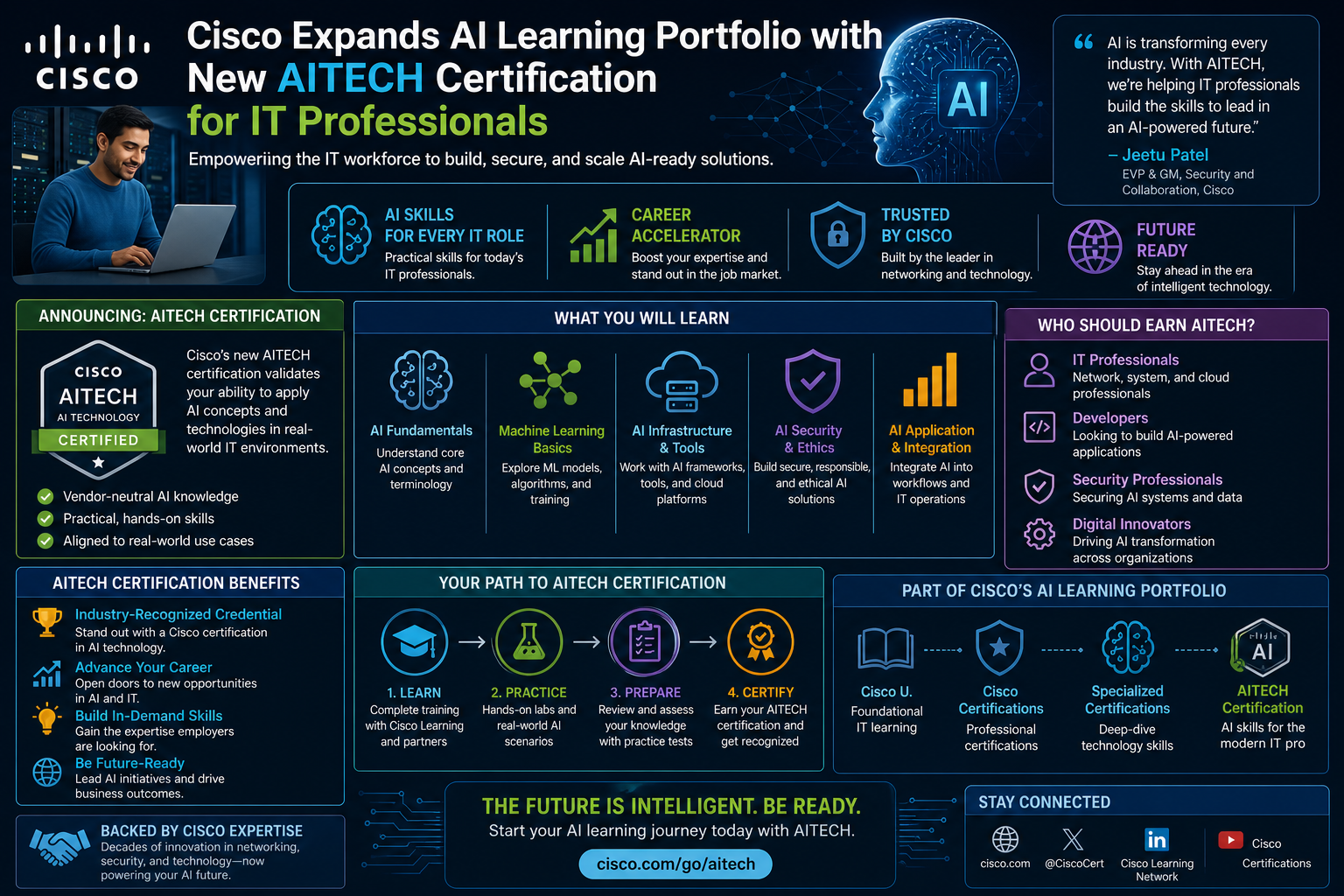
Artificial intelligence has moved beyond research labs and futuristic discussions. It now plays an active role in the systems that organizations use every day. Networks rely on intelligent monitoring tools, security platforms use machine learning to detect threats, and software teams increasingly use generative AI to speed up coding tasks. Because of this shift, employers are looking for professionals who understand not only the theory behind AI, but also how to apply it in real operational environments.
Many IT workers have heard the common terms associated with artificial intelligence. They may know about machine learning, automation, natural language models, and data analytics. However, knowing the vocabulary is very different from being able to deploy tools, manage workflows, and solve real business problems with AI. This difference between awareness and capability has become one of the biggest skills gaps in modern technology teams.
As businesses adopt smarter systems, they need people who can connect AI with practical infrastructure. That means using AI to improve operations, automate routine tasks, support troubleshooting, analyze large data sets, and build better digital experiences. The demand is no longer limited to data scientists or researchers. Network engineers, system administrators, cloud specialists, cybersecurity analysts, and developers are all expected to understand how AI affects their work.
This is why technical AI learning paths have become increasingly important. Organizations want structured ways to help employees build relevant, job-ready skills. Rather than focusing only on high-level concepts, these learning paths emphasize hands-on tasks, tool usage, design thinking, and implementation strategies.
A growing number of professionals also recognize that AI knowledge can strengthen career prospects. Technology roles are evolving quickly, and workers who combine traditional infrastructure expertise with AI capabilities may have a stronger advantage in hiring and advancement. In many companies, the ability to automate workflows or improve decision-making through AI is already becoming a valuable differentiator.
The expansion of specialized AI certifications reflects this market reality. Employers want signals that candidates can do more than discuss AI trends. They want evidence of practical competence. Certifications designed around real-world use cases can help provide that confidence, especially when they focus on tasks performed in production environments.
Why Traditional IT Skills Alone Are No Longer Enough
For years, IT careers were built around core disciplines such as networking, servers, operating systems, databases, and security. These skills remain essential, but they are no longer the full picture. Modern infrastructure is increasingly intelligent, automated, and data-driven.
Consider network operations. In the past, administrators manually configured devices, checked logs, and responded to alerts. Today, AI tools can detect anomalies, predict failures, recommend changes, and even assist with remediation. Professionals still need networking expertise, but they also need to understand how AI systems gather telemetry, identify patterns, and trigger automation.
The same is true in cybersecurity. Security teams once relied heavily on manual investigation and signature-based tools. Now, machine learning helps identify suspicious behavior, correlate events, and prioritize incidents. Analysts who understand AI-assisted detection can work more efficiently and make faster decisions.
Software development has changed as well. AI-powered coding assistants can generate boilerplate code, explain functions, suggest fixes, and help refactor applications. Developers who know how to use these tools effectively can increase productivity while maintaining quality.
Cloud operations represent another major area of transformation. Cloud environments generate massive amounts of operational data. AI systems can analyze performance metrics, forecast demand, optimize costs, and improve resource allocation. Engineers who can combine cloud skills with AI awareness are better equipped to manage complex environments.
As these examples show, traditional technical skills are still necessary, but they need to be complemented by new capabilities. IT professionals must know how to evaluate AI outputs, identify limitations, manage data quality, and integrate intelligent tools responsibly.
The Difference Between AI Awareness and AI Capability
Many professionals have attended webinars, read articles, or experimented with public AI tools. This exposure is useful, but it does not automatically translate into workplace capability. Real technical environments introduce challenges that casual users rarely face.
For example, generating code with AI in a personal project is different from using AI in enterprise software development. Production systems require version control, security reviews, testing standards, documentation, and maintainability. AI-generated output must be evaluated carefully before it becomes part of a business application.
Similarly, asking a chatbot for insights from a spreadsheet is different from performing enterprise data analysis. Real business data can be incomplete, inconsistent, sensitive, or stored across multiple systems. Effective use of AI requires cleaning data, understanding context, validating findings, and protecting privacy.
Deployment creates another gap between awareness and competence. Many people understand that large language models exist, but fewer know how to integrate them into workflows, choose hosting models, manage latency, control costs, or monitor accuracy over time.
This is where structured technical training becomes valuable. It helps learners move beyond surface-level familiarity into repeatable, reliable skills. Instead of asking what AI is, professionals learn how to use it safely and effectively in day-to-day operations.
AI as an Operational Tool Rather Than a Standalone Trend
One of the most important shifts happening in technology is that AI is becoming embedded inside existing tools rather than existing separately. This means professionals may use AI every day without opening a dedicated AI application.
Monitoring platforms now include anomaly detection features. Help desk systems use AI to categorize tickets. Security tools prioritize threats using behavioral analytics. Development environments provide coding suggestions. Search tools summarize internal knowledge bases. Collaboration platforms generate notes and action items.
Because AI is increasingly woven into normal workflows, technical workers need to understand how to work alongside it. They need to know when to trust outputs, when to verify results, and when human judgment should override automation.
This also changes the mindset required for AI learning. Instead of treating AI as a separate specialty relevant only to researchers, organizations increasingly treat it as an operational skill similar to scripting, troubleshooting, or system design.
Professionals who recognize this shift early may adapt more successfully. They can position themselves not as outsiders trying to learn a new trend, but as experienced practitioners upgrading the tools they already use.
The Role of AI in Modern Network Environments
Networking has traditionally focused on connectivity, routing, switching, wireless performance, and uptime. Those priorities remain central, but AI is adding a new layer of intelligence to network operations.
Modern networks generate enormous volumes of telemetry data. Devices produce logs, performance metrics, health indicators, and traffic patterns continuously. Human teams can struggle to interpret this information quickly enough, especially in large environments.
AI tools help by identifying anomalies that may signal faults, congestion, misconfigurations, or security risks. Instead of manually reviewing thousands of events, engineers can focus on prioritized insights.
Predictive maintenance is another growing use case. By analyzing historical patterns, AI systems may identify devices likely to fail or links likely to degrade. This allows proactive maintenance rather than reactive emergency work.
User experience monitoring is also improving. AI can correlate wireless performance, application latency, and endpoint behavior to identify root causes faster. Rather than guessing whether the issue lies in the device, network, or application, teams can narrow problems more efficiently.
Automation adds further value. Once an issue is identified, workflows may trigger alerts, generate tickets, or apply approved remediation steps automatically.
For network professionals, this means future expertise includes both infrastructure knowledge and intelligent operations awareness.
How AI Is Changing Software Development
Few technical areas have felt AI’s impact as directly as software development. Code generation tools have become common across many teams, helping developers write functions, create templates, generate tests, and explain unfamiliar code.
Used properly, these tools can save time and reduce repetitive work. A developer may ask for starter code, then customize it for the project’s needs. AI can also help refactor legacy functions into cleaner structures or translate logic between programming languages.
Debugging support is another major advantage. Developers can paste error messages, request possible causes, or ask for step-by-step troubleshooting guidance. While human review remains necessary, AI can shorten the path to resolution.
Documentation often improves as well. Teams can generate summaries, comments, or onboarding notes more quickly. This helps maintain knowledge continuity across projects.
However, AI-assisted development also requires discipline. Generated code may contain inefficiencies, security flaws, outdated methods, or incorrect assumptions. Teams need strong review practices, testing pipelines, and coding standards.
The most effective developers are not those who blindly accept AI output. They are those who know how to guide the tool, evaluate responses, refine results, and integrate them responsibly into professional workflows.
Data Skills Are Becoming Essential for Everyone
Data analysis is no longer limited to analysts and scientists. Nearly every IT role now interacts with data in some form. Engineers examine logs, administrators review performance trends, security teams analyze events, and managers rely on metrics.
AI increases the value of these activities by making large volumes of data easier to explore. Natural language interfaces allow users to ask questions in plain language. Pattern detection can reveal anomalies quickly. Summarization tools help teams understand trends without manually reading endless records.
Still, effective results depend on foundational data skills. Professionals need to understand data quality, structure, context, and limitations. AI cannot fully compensate for poor inputs.
For example, duplicate records, missing fields, inconsistent timestamps, and incomplete labeling can distort findings. If teams do not recognize these issues, they may trust misleading outputs.
This is why modern AI learning often includes data preparation and interpretation. Professionals benefit from learning how to clean data, transform formats, validate sources, and question results critically.
These skills improve decision-making whether or not advanced AI is involved.
Multi-Step Workflows and Intelligent Automation
Many people imagine AI as a single tool answering questions. In reality, some of the most powerful business use cases involve multi-step workflows.
A workflow might begin with collecting information from a monitoring system. AI then summarizes the issue, checks a knowledge base for similar incidents, drafts a remediation plan, opens a support ticket, and notifies the right team. Humans remain in control, but repetitive coordination work is reduced.
Another workflow could involve customer support. Incoming messages are categorized, sentiment is assessed, previous history is reviewed, recommended responses are generated, and urgent cases are escalated.
These systems combine automation, decision logic, integrations, and AI models. They require thoughtful design rather than simple prompting.
Professionals who understand workflow architecture can create much greater value than those who only use standalone chat tools. They help organizations transform processes, not just individual tasks.
This is one reason technical AI training increasingly emphasizes orchestration and system thinking.
Responsible Use and Realistic Expectations
Excitement around AI can lead to unrealistic assumptions. Some believe AI can instantly replace skilled workers or solve every inefficiency automatically. In practice, results depend heavily on implementation quality, governance, and human oversight.
AI can accelerate work, but it also introduces risks. Outputs may be inaccurate, biased, insecure, or incomplete. Sensitive data may require careful handling. Automated decisions may need audit trails and accountability.
Responsible professionals treat AI as a tool requiring management. They establish review processes, define acceptable use cases, monitor performance, and continuously improve systems.
They also understand where AI adds the most value. Repetitive tasks, large-scale pattern recognition, summarization, and first-draft generation often benefit greatly. Complex judgment, relationship management, ethics, and strategic decisions still rely strongly on humans.
Organizations that combine optimism with discipline are more likely to succeed than those driven only by hype.
Career Value of Technical AI Credentials
As employers sort through applicants claiming AI experience, validated credentials may become more useful. A structured certification can signal that someone has studied relevant topics, completed practical exercises, and understands common implementation patterns.
For early-career professionals, credentials may help demonstrate readiness when direct workplace experience is limited. For experienced workers, they can show commitment to staying current as the industry evolves.
The strongest value often comes when certification supports real hands-on practice. Knowledge alone is less persuasive than the ability to discuss use cases, explain workflows, and demonstrate applied thinking.
In interviews, candidates who can speak concretely about automation pipelines, data preparation, prompt reliability, deployment trade-offs, and operational monitoring may stand out more than those who only repeat headlines about AI.
Why the Timing Matters Now
Technology transitions create windows of opportunity. When cloud computing expanded, those who learned early often advanced quickly. When cybersecurity demand surged, professionals who specialized gained strong career momentum.
AI appears to be another such transition. It is influencing networking, development, operations, security, and business decision-making simultaneously. That breadth makes it especially significant.
The current moment may be particularly valuable because many organizations are still in early adoption stages. They are experimenting, building governance models, and identifying useful workflows. Professionals who develop practical skills now may be well positioned to guide these initiatives.
Waiting until AI capabilities become universal could make differentiation harder. Learning during the growth phase may offer stronger advantages.
Building a Practical Learning Mindset
For anyone beginning the AI journey, mindset matters as much as tools. The goal should not be memorizing buzzwords or chasing every trend. Instead, focus on practical outcomes.
Ask how AI can save time in your current role. Identify repetitive tasks that might be automated. Consider what data you already use and how analysis could improve it. Think about where decisions are delayed because information is hard to process.
Then build incrementally. Learn prompting basics, workflow design, data literacy, automation principles, and governance habits. Practice with realistic scenarios rather than abstract theory alone.
Professionals who approach AI as a productivity and problem-solving discipline often gain more lasting value than those who treat it as a novelty.
Evolution of AI Technical Roles in Infrastructure
The integration of artificial intelligence into IT environments has quietly reshaped what technical roles look like inside modern organizations. Where infrastructure teams once focused primarily on uptime, configuration, and troubleshooting, they are now expected to work with systems that learn, adapt, and optimize themselves over time. This shift is not just about using new tools. It is about understanding a new layer of intelligence embedded within the systems professionals already manage.
In traditional environments, infrastructure behavior was largely deterministic. A server either responded or it did not. A network route either worked or failed. Storage either performed within expected thresholds or degraded. Troubleshooting relied heavily on logs, rules, and known failure patterns.
AI-driven environments introduce probabilistic behavior into this structure. Systems may predict failures before they occur, adjust performance dynamically based on demand, or modify workflows based on learned patterns. This creates a new kind of operational complexity where outcomes are influenced by models trained on historical and real-time data rather than fixed configurations alone.
As a result, technical professionals are increasingly expected to interpret AI-driven decisions. They must understand why a system flagged a certain event, how a model reached a conclusion, and what data influenced a recommendation. This does not require deep mathematical research expertise, but it does require practical fluency in how AI systems behave in operational contexts.
Roles such as network engineer, system administrator, DevOps engineer, and security analyst are gradually expanding into hybrid positions. These roles now include responsibilities such as validating AI outputs, tuning automation behavior, and ensuring that intelligent systems remain aligned with business requirements.
This evolution is also creating a stronger connection between infrastructure and software development. AI systems often depend on APIs, microservices, and data pipelines that must be designed, deployed, and maintained by technical teams. The boundary between infrastructure and application logic is becoming less rigid, and professionals are expected to operate comfortably across both domains.
Core Architecture of AI-Driven IT Systems
To understand how AI is applied in technical environments, it is useful to examine the structure of modern AI-driven systems. These systems are rarely standalone applications. Instead, they function as interconnected layers that combine data processing, model inference, orchestration, and monitoring.
At the foundation is data ingestion. Systems collect information from logs, network devices, applications, user interactions, and external sources. This data is often unstructured or semi-structured, requiring transformation before it can be used effectively.
The next layer involves data processing and storage. Here, raw information is cleaned, normalized, enriched, and organized into formats suitable for analysis. Data pipelines play a critical role in ensuring consistency and reliability. Without clean data, even the most advanced AI models produce unreliable results.
Above this layer sits the model inference engine. This is where AI models process inputs and generate outputs such as predictions, classifications, summaries, or recommendations. These models may be pre-trained, fine-tuned, or dynamically updated depending on the system design.
Surrounding the model layer is orchestration logic. This determines when models are called, how outputs are handled, and what downstream actions should occur. Orchestration can involve workflows that trigger alerts, initiate automation scripts, or feed results into other systems.
Finally, monitoring and feedback loops ensure that the system remains accurate and stable over time. AI models are not static. Their performance can degrade if data patterns change or if system conditions evolve. Continuous monitoring helps detect issues such as drift, bias, or reduced accuracy.
Together, these layers form an AI-driven ecosystem rather than a single tool. Professionals working in this environment must understand how each component interacts with the others.
Generative AI in Code and Automation Workflows
One of the most widely adopted applications of artificial intelligence in technical environments is generative AI for code and automation. This capability allows systems to produce structured outputs based on natural language input or contextual prompts.
In software development workflows, generative AI can assist in creating boilerplate code, suggesting improvements, and translating logic between languages. However, its role extends beyond simple code generation. It also helps engineers explore design alternatives, identify potential inefficiencies, and speed up iteration cycles.
In infrastructure automation, generative AI can support scripting tasks that previously required manual effort. For example, it may help construct configuration templates, generate deployment scripts, or outline orchestration sequences for multi-service environments.
The real value of generative AI in these contexts lies in acceleration rather than replacement. It reduces time spent on repetitive or foundational tasks, allowing engineers to focus on architecture, validation, and optimization.
However, this efficiency introduces new responsibilities. Generated outputs must be reviewed carefully to ensure correctness, security, and alignment with organizational standards. AI-generated code may not always follow best practices or account for system-specific constraints.
Professionals working with these tools must develop a strong sense of evaluation. They need to recognize when an output is appropriate, when it requires modification, and when it should be discarded entirely.
In automation workflows, generative AI can also assist in designing multi-step processes. Instead of manually defining every step, engineers can describe desired outcomes, and the system can propose structured workflows. These workflows may include conditional logic, data transformations, and integration points.
This capability makes automation more accessible but also increases the importance of governance. As workflows become easier to generate, they must also be carefully managed to prevent unintended consequences or inefficiencies.
Data Engineering Foundations for AI Operations
Data is the foundation of every AI system. Without structured, reliable, and meaningful data, even the most advanced models cannot function effectively. This is why data engineering plays a central role in AI-driven environments.
Data engineering involves collecting, transforming, storing, and delivering data in a usable format. In AI operations, this process becomes even more critical because models depend heavily on input quality.
One of the key challenges in AI systems is data diversity. Information may come from multiple sources such as network devices, application logs, user activity streams, cloud services, and external APIs. Each source may use different formats, update frequencies, and levels of reliability.
Data engineers must unify this information into consistent structures. This often involves cleaning inconsistent values, handling missing data, removing duplicates, and aligning time-based records.
Another important aspect is data labeling and context. AI models learn from patterns in historical data, but those patterns must be meaningful. Proper labeling ensures that models understand what different inputs represent and how they relate to outcomes.
In operational environments, data pipelines must also be efficient and scalable. As systems grow, the volume of data can increase dramatically. Pipelines must handle real-time ingestion as well as batch processing without introducing delays or bottlenecks.
Data validation is another crucial step. Before feeding data into AI models, systems must ensure that it meets quality standards. Invalid or corrupted data can significantly reduce model accuracy.
Professionals working with AI systems benefit from understanding these data engineering principles, even if they are not dedicated data engineers. This knowledge helps them troubleshoot issues, interpret model behavior, and design better workflows.
Multi-Step AI Workflows and Agentic Systems
AI systems are increasingly moving beyond single-response interactions into multi-step workflows. These workflows involve sequences of actions where AI components interact with tools, data sources, and other systems to achieve a goal.
In a multi-step workflow, an AI system might first interpret a request, then gather relevant data, analyze it, generate a plan, execute specific actions, and finally report results. Each step may involve different models or services working together.
This approach is often described as agent-like behavior, where systems appear to “act” autonomously within defined boundaries. These agentic systems do not operate independently of humans; instead, they follow structured rules, permissions, and constraints.
For example, in an IT operations environment, a multi-step workflow might begin when a system detects a performance issue. The AI then collects diagnostic data, compares it to historical patterns, identifies likely causes, suggests remediation steps, and triggers an automated response if approved.
In another scenario, a development workflow might involve analyzing a feature request, generating code suggestions, testing compatibility with existing modules, and preparing deployment instructions.
The complexity of these workflows requires careful design. Each step must be clearly defined, with controlled inputs and outputs. Dependencies between steps must be managed to prevent cascading errors.
One of the key challenges in agentic systems is maintaining reliability. Since multiple components interact, a failure in one part of the workflow can affect the entire process. This makes error handling and validation essential design elements.
Professionals working with these systems need to understand how tasks are decomposed, how decisions are made at each stage, and how results are validated before execution.
Model Selection, Fine-Tuning, and RAG Concepts
AI systems often rely on pre-trained models that can be adapted for specific use cases. Choosing the right model and customizing it appropriately is an important technical skill in AI operations.
Model selection involves evaluating different models based on performance, speed, cost, and suitability for the task. Some models may excel at language understanding, while others are better suited for classification or prediction tasks.
Fine-tuning is the process of adjusting a pre-trained model using domain-specific data. This allows organizations to tailor model behavior to their unique requirements. However, fine-tuning requires careful preparation of training data and evaluation of results to avoid introducing bias or reducing general performance.
Another widely used approach is retrieval-augmented generation. In this method, models are combined with external data sources. Instead of relying solely on internal training knowledge, the system retrieves relevant information from databases or documents before generating a response.
This approach helps improve accuracy and reduces the risk of outdated or incomplete information. It is particularly useful in environments where knowledge changes frequently or where precision is critical.
Understanding when to use fine-tuning versus retrieval-based approaches is an important decision-making skill. Fine-tuning may provide deeper specialization, while retrieval systems offer flexibility and easier updates.
Professionals working in AI environments must also consider trade-offs such as computational cost, latency, and maintenance complexity when selecting approaches.
AI Pipelines in Production Environments
AI pipelines represent the full lifecycle of data and model processing in operational systems. These pipelines connect data ingestion, processing, model inference, output handling, and monitoring into a continuous flow.
In production environments, pipelines must be reliable, scalable, and efficient. They often operate under strict performance requirements and must handle real-time or near-real-time data.
A typical AI pipeline begins with data collection. This is followed by preprocessing steps such as cleaning, normalization, and transformation. The processed data is then passed to a model for inference.
After inference, results are evaluated and routed to appropriate systems. This may include dashboards, automation tools, alerting systems, or downstream applications.
Pipelines must also include mechanisms for error handling. If data is missing or corrupted, the system must decide whether to retry, skip, or flag the issue.
Version control is another important aspect. Models, datasets, and pipeline configurations may change over time. Maintaining traceability ensures that results can be reproduced and audited when necessary.
In advanced environments, pipelines may also include continuous learning mechanisms. These systems can retrain models based on new data, allowing them to adapt over time.
Monitoring, Security, and Governance in AI Systems
As AI becomes embedded in operational environments, monitoring and governance become critical responsibilities. Unlike traditional systems, AI-driven tools can change behavior based on data inputs, making them less predictable if not properly managed.
Monitoring involves tracking model performance, system latency, data quality, and output accuracy. If performance drops or behavior changes unexpectedly, alerts must be triggered so that engineers can investigate.
Security is another important concern. AI systems often process sensitive data, which must be protected against unauthorized access. Additionally, models themselves can be vulnerable to manipulation if exposed to malicious inputs.
Governance ensures that AI systems are used responsibly and align with organizational policies. This includes defining acceptable use cases, setting boundaries for automation, and ensuring transparency in decision-making processes.
Bias detection is also part of governance. Since models learn from historical data, they may unintentionally reflect biases present in that data. Regular evaluation helps reduce these risks.
Together, monitoring, security, and governance form the foundation for trustworthy AI systems in production environments.
Hands-On Lab Thinking and Scenario-Based Learning
Practical understanding of AI systems is best developed through scenario-based learning. Instead of focusing only on theory, learners benefit from working through realistic operational situations.
These scenarios might involve diagnosing system performance issues, designing automation workflows, analyzing data inconsistencies, or evaluating AI-generated outputs.
Hands-on practice helps bridge the gap between conceptual knowledge and real-world application. It encourages learners to think critically about how systems behave under different conditions.
In AI environments, this often means experimenting with different workflows, testing model responses, adjusting parameters, and observing outcomes.
Scenario-based learning also helps develop problem-solving skills. Rather than memorizing steps, learners develop the ability to adapt to new situations, identify root causes, and design effective solutions.
This type of experience is especially valuable in AI-driven systems, where unexpected behavior can occur due to data changes, model updates, or system interactions.
Real-World Deployment Challenges in AI-Enabled IT Environments
As artificial intelligence becomes more embedded in operational systems, deploying AI solutions in real environments introduces challenges that go far beyond initial setup or model selection. In controlled environments, AI tools may appear straightforward, performing well on sample data or during testing. However, once these systems are exposed to real traffic, unpredictable inputs, and production workloads, new complexities emerge.
One of the most common challenges is variability in data. In real-world environments, data is rarely clean or consistent. Network logs may vary between devices, application metrics may fluctuate depending on load, and user-generated inputs can be unpredictable. AI systems trained on ideal or static datasets may struggle when faced with this variability.
Latency is another critical factor. In production systems, speed matters. If an AI model takes too long to process information, it can disrupt workflows or reduce usability. Engineers must balance accuracy with performance, sometimes choosing simpler models or optimized architectures to maintain responsiveness.
Scalability also plays a significant role. As organizations grow, the volume of data and number of AI-driven processes increase. Systems that work well in small environments may fail under large-scale conditions unless they are designed with distributed processing, load balancing, and efficient resource management in mind.
Integration with existing infrastructure can be equally challenging. AI systems rarely operate in isolation. They must connect with legacy systems, cloud platforms, APIs, and monitoring tools. Ensuring compatibility across diverse environments requires careful planning and flexible architecture design.
Another issue is maintaining reliability over time. AI models can degrade as conditions change. This phenomenon, often referred to as model drift, occurs when the underlying patterns in data evolve. Without continuous monitoring and periodic updates, performance may decline gradually without immediate detection.
These deployment challenges highlight why practical AI knowledge is so important. Understanding theory alone is not enough. Professionals must also understand how systems behave under real constraints and how to adapt when conditions change.
Operational Decision-Making with AI Assistance
AI is increasingly being used not only to automate tasks but also to support decision-making in IT environments. However, this does not mean replacing human judgment. Instead, AI acts as an analytical layer that provides insights, recommendations, and predictions that humans interpret and act upon.
In operational environments, decision-making often involves analyzing large amounts of data under time pressure. For example, when a network incident occurs, engineers must quickly determine the root cause, assess impact, and choose corrective actions. AI systems can assist by highlighting anomalies, correlating events, and suggesting likely causes.
However, these suggestions are not final decisions. They must be validated by experienced professionals who understand the broader system context. AI might identify a spike in traffic as unusual, but a human operator may recognize it as a legitimate business event such as a scheduled release or promotional campaign.
This collaboration between human expertise and AI-driven analysis creates a more efficient decision-making process. AI handles pattern recognition and data processing, while humans provide contextual understanding and final judgment.
In security operations, this collaboration becomes even more critical. AI tools can detect suspicious behavior, flag potential threats, and prioritize alerts. But determining whether an activity is truly malicious often requires deeper investigation. Analysts must interpret AI outputs carefully to avoid false positives or missed threats.
The effectiveness of AI-assisted decision-making depends heavily on trust and transparency. Professionals need to understand how AI systems reach conclusions. Without this understanding, there is a risk of either over-reliance or under-utilization of AI recommendations.
Building this trust requires systems that provide explainability, clear output reasoning, and consistent behavior. It also requires training professionals to interpret AI outputs critically rather than accepting them blindly.
The Shift Toward Continuous AI Learning Systems
Traditional IT systems are relatively static. Once configured, they remain stable until manually updated. AI-driven systems, however, operate differently. They are dynamic and often require continuous learning and adaptation.
Continuous learning systems are designed to evolve over time as they receive new data. Instead of remaining fixed, models are periodically retrained or fine-tuned to reflect current conditions. This allows them to remain accurate even as environments change.
In operational contexts, this is particularly important. Network traffic patterns, user behavior, and application workloads can all change rapidly. A model trained on outdated data may no longer produce reliable results.
Continuous learning introduces both opportunities and challenges. On one hand, systems become more adaptive and resilient. On the other hand, frequent updates increase complexity and require strong version control and validation processes.
One challenge is ensuring that updates do not introduce unintended consequences. A model that improves performance in one area may reduce accuracy in another. This makes testing and validation essential before deploying updates into production.
Another challenge is maintaining stability. Constant changes can lead to unpredictable behavior if not carefully managed. Organizations must strike a balance between adaptability and consistency.
To manage continuous learning effectively, systems often include feedback loops. These loops collect performance data, user feedback, and system metrics, which are then used to improve future iterations of the model.
This creates a cycle of ongoing improvement, but it also requires disciplined monitoring and governance to ensure that changes remain beneficial.
Human Roles in an Increasingly Automated Environment
As AI systems become more capable, a common concern is whether human roles in IT will diminish. In reality, the nature of these roles is changing rather than disappearing. Humans remain essential, but their responsibilities are shifting toward oversight, design, interpretation, and strategic decision-making.
Routine tasks such as log analysis, basic troubleshooting, and repetitive configuration are increasingly being automated. This allows professionals to focus on higher-value work that requires reasoning, creativity, and contextual understanding.
One of the key human responsibilities in AI-driven environments is validation. AI systems can generate outputs quickly, but humans must verify whether those outputs are correct, relevant, and safe. This includes reviewing automated recommendations, checking data accuracy, and ensuring compliance with policies.
Another important role is system design. Humans define how AI tools are integrated into workflows, what data they use, and how decisions are executed. Even the most advanced AI systems operate within boundaries set by human designers.
Interpretation is also critical. AI systems can produce complex outputs that require contextual understanding. Professionals must interpret these outputs in relation to business goals, operational constraints, and real-world conditions.
Strategic decision-making remains firmly human-led. While AI can provide insights, it cannot fully understand organizational priorities, ethical considerations, or long-term consequences. These decisions require judgment that goes beyond data analysis.
In this evolving landscape, the most valuable professionals are those who can bridge the gap between AI systems and business needs. They understand both the technical mechanisms and the operational impact of AI-driven tools.
Security Considerations in AI-Integrated Systems
Security becomes more complex when AI is integrated into IT environments. Traditional security models focus on protecting systems, networks, and data from unauthorized access or malicious activity. AI introduces additional layers that must also be secured.
One major concern is data integrity. AI systems rely heavily on data, and if that data is manipulated or corrupted, the system’s outputs may become unreliable. Ensuring that data sources are secure and trustworthy is essential.
Another concern is model manipulation. In some cases, attackers may attempt to influence AI systems by feeding them misleading inputs. This can lead to incorrect predictions or decisions. Protecting models from such interference is an important aspect of AI security.
Access control is also critical. AI systems often interact with sensitive data and operational tools. Ensuring that only authorized users and systems can access or modify AI components helps reduce risk.
There is also the issue of output reliability. AI-generated recommendations may have unintended consequences if used without proper validation. Security teams must ensure that automated actions are appropriately controlled and monitored.
Monitoring plays a key role in maintaining security. Continuous observation of system behavior helps detect unusual patterns that may indicate attacks, failures, or misconfigurations.
As AI systems become more autonomous, security models must evolve to address new types of risks. This includes protecting not just infrastructure, but also algorithms, data pipelines, and decision-making processes.
Conclusion
The rise of artificial intelligence within IT environments is not a distant transformation—it is already reshaping how infrastructure, software, security, and operations function on a daily basis. What was once considered an advanced or experimental capability has now become a practical component of modern technology systems. AI is no longer limited to data science teams or research groups; it is actively influencing how networks are managed, how applications are developed, and how operational decisions are made across entire organizations.
As this shift continues, the gap between theoretical understanding and practical application becomes more visible. Many IT professionals are already familiar with AI concepts, but fewer have experience applying them in real-world environments where systems are complex, data is imperfect, and performance demands are high. This is where structured, hands-on learning becomes especially important. It helps bridge the gap between knowing about AI and being able to use it effectively in production scenarios.
At the same time, the role of IT professionals is evolving rather than disappearing. Instead of focusing only on manual configuration and repetitive tasks, professionals are increasingly expected to work alongside intelligent systems. This includes validating AI-generated outputs, designing automated workflows, interpreting system recommendations, and ensuring that AI tools operate safely and efficiently within defined boundaries. Human judgment remains essential, particularly in areas involving security, ethics, and strategic decision-making.
Ultimately, success in this new environment depends on a balanced skill set—technical knowledge, practical experience, and the ability to work effectively with intelligent systems. Those who develop this combination will not only keep pace with industry change but also help shape the future direction of technology itself.