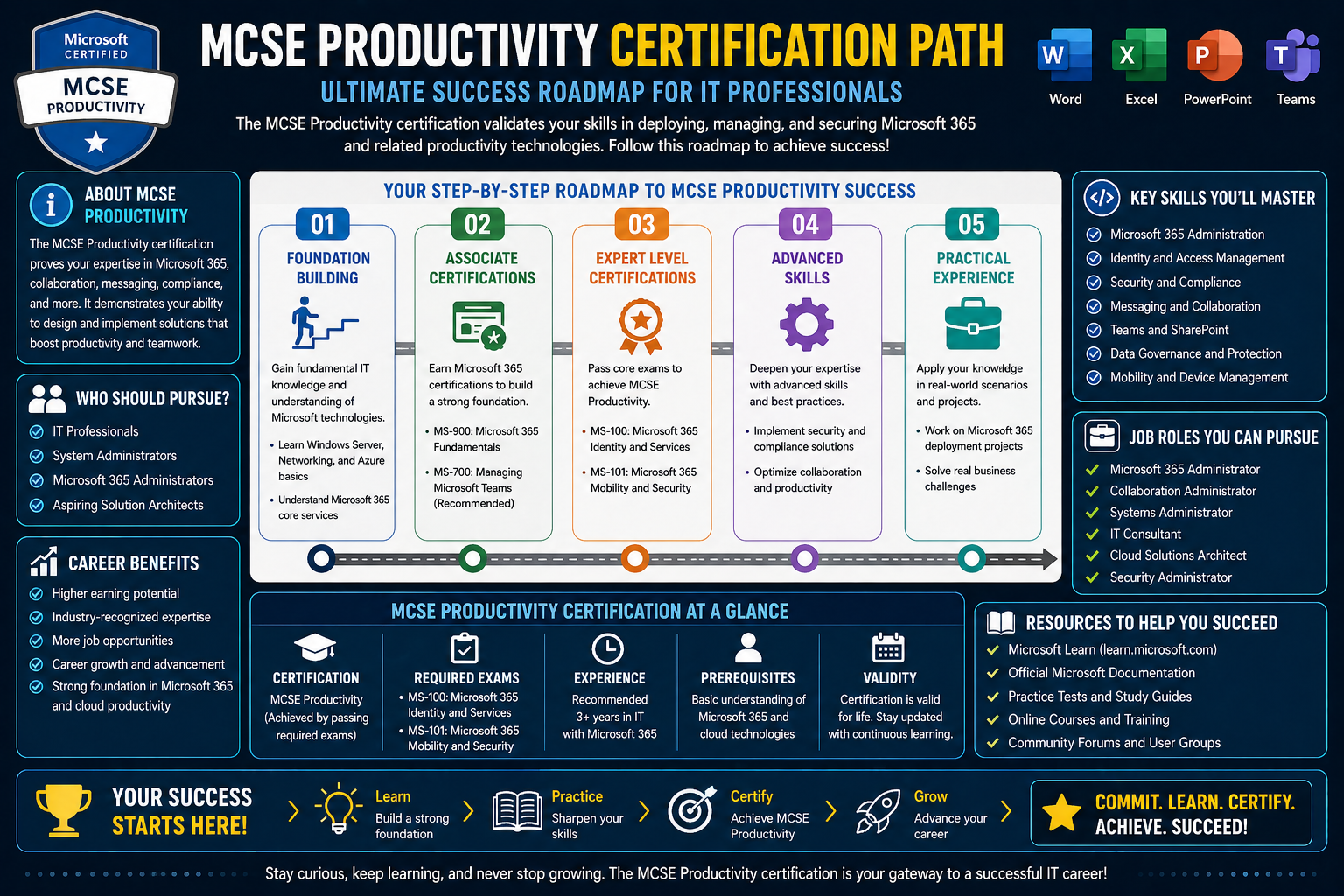
The MCSE Productivity certification represents an advanced level of technical expertise designed for professionals working within enterprise Microsoft environments. It focuses on validating the ability to manage, deploy, and support core productivity platforms that organizations rely on for communication, collaboration, and information management. This certification sits at a higher tier of technical achievement and is intended for individuals who already have substantial experience in IT systems administration or infrastructure management.
At its core, the certification reflects a shift in enterprise technology toward integrated digital workplaces. Organizations no longer rely on isolated systems for email, document sharing, or communication tools. Instead, they expect seamless interaction between platforms that support daily operations. The MCSE Productivity pathway aligns with this shift by emphasizing technologies that work together to improve efficiency, security, and accessibility across business environments.
The certification is structured to allow flexibility in specialization. Rather than following a rigid single-track model, candidates are provided with a selection of exam paths that allow them to tailor their expertise according to their professional interests or organizational requirements. This flexibility ensures that professionals can focus on areas that are most relevant to their roles, whether that involves messaging systems, collaborative platforms, or unified communication tools.
Another defining aspect of this certification landscape is its focus on real-world applicability. The skills validated through MCSE Productivity are not theoretical; they are directly tied to operational responsibilities within enterprise IT departments. This includes managing server environments, ensuring system reliability, supporting end users, and maintaining secure communication channels across distributed networks.
The certification also reflects the broader evolution of IT roles. Modern administrators are expected to do more than maintain systems—they are expected to optimize performance, enhance user productivity, and contribute to digital transformation initiatives. MCSE Productivity aligns with these expectations by emphasizing both technical proficiency and strategic understanding of enterprise productivity ecosystems.
In addition, the certification is designed to remain relevant in rapidly changing technological environments. As organizations transition toward cloud-based infrastructure and hybrid systems, professionals holding this certification are expected to adapt to new deployment models and management practices. This ensures that the certification remains aligned with current industry demands rather than outdated technological frameworks.
Overall, the MCSE Productivity certification landscape represents a convergence of technical depth, practical application, and evolving enterprise needs. It provides a structured yet flexible pathway for IT professionals aiming to advance their careers in systems administration, collaboration technologies, and enterprise infrastructure management.
Role of Productivity in Modern IT Infrastructure
Productivity within IT infrastructure refers to the systems and tools that enable employees to communicate, collaborate, and complete tasks efficiently. In modern organizations, productivity platforms are no longer optional components; they are foundational elements that directly influence operational success. The MCSE Productivity certification emphasizes this importance by focusing on technologies that form the backbone of enterprise communication and collaboration.
Modern IT infrastructure is built around interconnected services that must function seamlessly across departments, locations, and devices. Email systems, messaging platforms, document management tools, and conferencing solutions all contribute to a unified digital workspace. When these systems are well-integrated, organizations experience improved workflow efficiency, reduced communication delays, and enhanced decision-making capabilities.
A major aspect of productivity in IT infrastructure is reliability. Organizations depend on continuous access to communication and collaboration tools, and any disruption can significantly impact operations. IT professionals working in this domain are responsible for ensuring system uptime, managing backups, and implementing redundancy strategies that minimize downtime risks.
Security also plays a critical role in productivity infrastructure. As organizations handle increasing volumes of sensitive data, ensuring secure communication channels becomes essential. IT administrators must implement policies and configurations that protect data integrity while allowing users to collaborate effectively. This balance between accessibility and security is a central theme in productivity-focused IT roles.
Scalability is another important factor. As organizations grow, their productivity systems must adapt to increasing user demands without compromising performance. This requires careful planning of server resources, network capacity, and system architecture. Professionals working with MCSE Productivity technologies are often involved in designing solutions that support long-term organizational growth.
Furthermore, productivity systems are closely tied to user experience. Employees rely on these tools daily, and any complexity or inefficiency can reduce overall performance. IT professionals must therefore ensure that systems are not only functional but also intuitive and accessible. This involves optimizing configurations, managing updates, and supporting end users in their interactions with enterprise platforms.
In modern IT infrastructure, productivity is not an isolated function but an integrated outcome of multiple systems working together. The MCSE Productivity certification emphasizes this interconnected nature by preparing professionals to manage complex environments where communication, collaboration, and data management converge into a unified operational framework.
Core Technologies Covered in the MCSE Productivity Ecosystem
The MCSE Productivity ecosystem is built around several core Microsoft technologies that are widely used in enterprise environments. These technologies form the foundation of modern organizational communication and collaboration systems, and each plays a distinct role in supporting business operations.
One of the central technologies in this ecosystem is Microsoft Exchange Server. Exchange Server is responsible for managing email communication, calendars, contacts, and scheduling functions within organizations. It ensures that messaging systems are reliable, secure, and accessible across different devices and platforms. IT professionals working with Exchange Server must understand how to configure mail flow, manage storage systems, and implement security protocols that protect organizational communication.
Another key component is SharePoint Server, which focuses on document management and collaboration. SharePoint enables organizations to store, organize, and share information across teams. It supports intranet portals, document libraries, and workflow automation, making it a critical tool for knowledge management. Administrators must be skilled in configuring sites, managing permissions, and ensuring that content is accessible to authorized users while maintaining security standards.
Skype for Business is also part of the MCSE Productivity ecosystem, focusing on real-time communication and conferencing. It enables instant messaging, voice calls, video conferencing, and online meetings. This technology is essential for organizations with distributed teams, as it supports seamless communication across geographic boundaries. IT professionals must ensure proper configuration of communication policies, network optimization, and integration with other enterprise systems.
These technologies are often deployed in both on-premises and hybrid environments. This means that professionals must understand not only traditional server-based configurations but also cloud integration strategies. The ability to manage hybrid systems is increasingly important as organizations transition toward cloud-based productivity platforms.
Each of these technologies requires a deep understanding of infrastructure components such as Active Directory, network configuration, and storage management. They also require knowledge of security frameworks, including authentication, encryption, and access control mechanisms. Together, these technologies form a comprehensive ecosystem that supports enterprise productivity at scale.
The MCSE Productivity certification ensures that professionals are capable of managing these systems individually and as part of an integrated environment. This includes troubleshooting issues, optimizing performance, and ensuring seamless interoperability between different platforms.
In addition to technical management, these technologies also require strategic implementation. IT professionals must understand how to align system capabilities with organizational goals, ensuring that productivity tools enhance rather than hinder business operations. This strategic perspective is a key element of advanced expertise in the MCSE Productivity domain.
Prerequisite Skills and Foundational Knowledge
Before pursuing the MCSE Productivity certification, professionals are expected to possess a strong foundation in IT infrastructure and system administration. This foundational knowledge ensures that candidates can effectively understand and manage the complex technologies covered in the certification.
A key prerequisite is familiarity with server operating systems and network environments. IT professionals should understand how servers function within enterprise networks, including how they are configured, maintained, and secured. This includes knowledge of directory services, user management, and network protocols that support communication between systems.
Experience with Microsoft environments is particularly important. Candidates are expected to have hands-on experience with Windows Server systems and productivity platforms such as Office-related services. This experience helps build the practical skills needed to manage enterprise-scale deployments.
Understanding virtualization concepts is also essential. Many modern IT infrastructures rely on virtualized environments to improve efficiency and scalability. Professionals should be familiar with virtual machine deployment, resource allocation, and performance monitoring within virtual systems.
Another important area of foundational knowledge is networking. IT professionals must understand how data flows across networks, how routing and switching operate, and how network security is implemented. These concepts are critical when managing productivity systems that rely on stable and secure communication channels.
Security principles also form a key part of the foundational skill set. Professionals must understand authentication methods, encryption techniques, and access control mechanisms. These skills are essential for protecting sensitive organizational data and ensuring compliance with security standards.
In addition, problem-solving and troubleshooting skills are critical. IT environments are complex, and issues can arise across multiple layers of infrastructure. Professionals must be able to diagnose problems efficiently and implement effective solutions without disrupting business operations.
Finally, a strong understanding of system integration is important. Productivity platforms do not operate in isolation; they interact with multiple systems across an organization. Professionals must understand how these integrations work and how to maintain consistency across different platforms.
These foundational skills collectively prepare candidates for the advanced responsibilities associated with MCSE Productivity technologies. Without this base knowledge, managing enterprise productivity systems would be significantly more challenging and less effective.
Evolution from On-Premises to Cloud-Integrated Systems
The IT industry has undergone a major transformation in recent years, shifting from traditional on-premises infrastructure to cloud-integrated environments. This evolution has significantly impacted how productivity systems are deployed, managed, and maintained within organizations.
In traditional environments, organizations relied heavily on physical servers located within their own data centers. These systems required extensive maintenance, hardware management, and manual configuration. While effective, they often lacked flexibility and scalability, making it difficult to adapt to changing business needs.
The introduction of cloud computing has changed this model. Cloud-integrated systems allow organizations to host applications and services in virtual environments that can be accessed from anywhere. This has led to increased flexibility, reduced infrastructure costs, and improved scalability.
MCSE Productivity Technologies have evolved alongside this shift. Many of the systems covered in the certification now support hybrid deployment models, where organizations combine on-premises infrastructure with cloud-based services. This allows businesses to gradually transition to the cloud while maintaining control over critical systems.
Hybrid environments require a different set of skills compared to traditional infrastructure. IT professionals must understand how to manage both local servers and cloud services simultaneously. This includes configuring synchronization between systems, managing identity services across platforms, and ensuring consistent performance across environments.
Cloud integration also introduces new considerations for security and compliance. Data stored in cloud environments must be protected using advanced security measures, and organizations must ensure compliance with regulatory requirements. IT professionals must therefore understand cloud security frameworks and governance models.
Another important aspect of this evolution is scalability. Cloud-based systems allow organizations to scale resources up or down based on demand. This dynamic capability improves efficiency and reduces waste, but it also requires careful monitoring and management to ensure optimal performance.
The transition to cloud-integrated systems has also improved collaboration capabilities. Employees can now access productivity tools from multiple devices and locations, enabling more flexible work environments. This has become increasingly important in modern workplaces where remote and hybrid work models are common.
Overall, the evolution from on-premises to cloud-integrated systems has reshaped the landscape of IT productivity infrastructure. Professionals working in this domain must adapt to these changes and develop skills that align with modern deployment models.
Skills Development Areas for MCSE Productivity Professionals
Professionals pursuing expertise in MCSE Productivity technologies must develop a wide range of technical and operational skills. These skills extend beyond basic system administration and focus on advanced capabilities required to manage enterprise productivity environments.
One of the primary skill areas is system configuration and management. Professionals must be able to deploy and configure complex server environments that support communication and collaboration tools. This includes managing services, configuring system policies, and ensuring optimal performance across infrastructure components.
Another important skill area is identity and access management. In enterprise environments, controlling user access to systems and data is critical. Professionals must understand how to manage authentication systems, assign permissions, and implement access control policies that ensure security without hindering productivity.
Performance optimization is also a key area of development. IT systems must operate efficiently to support large numbers of users and high volumes of data. Professionals must be able to monitor system performance, identify bottlenecks, and implement improvements that enhance overall efficiency.
Troubleshooting and diagnostic skills are equally important. When issues arise, IT professionals must be able to quickly identify the root cause and implement solutions. This requires a deep understanding of system architecture and interdependencies between different components.
Communication and collaboration skills also play a significant role. IT professionals often work as part of larger teams and must coordinate with other departments to implement and maintain systems. Effective communication ensures that technical solutions align with organizational needs.
In addition, professionals must develop skills in automation and process optimization. Many modern IT environments rely on automated processes to reduce manual workload and improve efficiency. Understanding how to implement and manage these processes is increasingly important.
Security management is another critical skill area. Professionals must be able to implement security policies, monitor system activity, and respond to potential threats. This includes both preventive and reactive security measures.
Together, these skill development areas form a comprehensive framework for professionals working in MCSE Productivity environments. Mastery of these skills enables IT professionals to effectively manage complex enterprise systems and support organizational productivity goals.
Industry Relevance and Organizational Impact
MCSE Productivity Technologies play a significant role in modern industries by supporting the core communication and collaboration needs of organizations. These systems are widely used across sectors, including finance, healthcare, education, government, and corporate enterprises.
One of the key impacts of these technologies is improved operational efficiency. By integrating communication, messaging, and collaboration tools into a unified system, organizations can streamline workflows and reduce delays in information exchange. This leads to faster decision-making and improved productivity across teams.
Another important impact is enhanced organizational communication. Modern businesses often operate across multiple locations and time zones. Productivity systems enable seamless communication between employees regardless of geographic boundaries, ensuring that teams remain connected and coordinated.
Data management and security are also significantly improved through these systems. Organizations handle large volumes of sensitive information, and productivity platforms provide structured ways to store, access, and protect this data. IT professionals play a crucial role in ensuring that these systems remain secure and compliant with industry standards.
Scalability is another major benefit. As organizations grow, their IT systems must be able to accommodate increased demand. MCSE Productivity Technologies supports scalable solutions that allow businesses to expand without compromising performance or reliability.
Additionally, these systems support digital transformation initiatives. Many organizations are transitioning toward more digital and automated workflows, and productivity platforms are central to this transformation. They enable organizations to modernize operations and improve overall efficiency.
The industry relevance of the MCSE Productivity extends to career development as well. Professionals with expertise in these technologies are highly valued in the job market due to their ability to manage critical enterprise systems. This demand reflects the importance of productivity platforms in modern business environments.
Through these various impacts, MCSE Productivity technologies continue to shape the way organizations operate, communicate, and evolve in an increasingly digital world.
Professional Roles Supported by MCSE Productivity Expertise
The skills associated with the MCSE Productivity certification open the door to a variety of professional roles within the IT industry. These roles are typically centered around system administration, infrastructure management, and enterprise communication systems.
One common role is that of a systems administrator. Professionals in this position are responsible for managing and maintaining IT infrastructure, including servers, networks, and productivity systems. They ensure that systems remain operational, secure, and efficient.
Another important role is systems engineer. These professionals focus on designing and implementing IT solutions that meet organizational needs. They work with complex systems and are often involved in planning infrastructure architecture and integration strategies.
IT managers also benefit from MCSE Productivity expertise. In this role, professionals oversee IT teams and ensure that technology systems align with business objectives. They are responsible for strategic planning, resource management, and system optimization.
Senior systems engineers represent a more advanced role that involves managing large-scale infrastructure environments. These professionals handle complex deployments and are often responsible for troubleshooting critical system issues.
Additionally, collaboration specialists and messaging administrators focus specifically on communication systems such as email platforms, conferencing tools, and collaboration environments. They ensure that these systems function effectively and support organizational communication needs.
Across all these roles, MCSE Productivity expertise provides a strong foundation for managing enterprise-level IT systems. Professionals in these positions are expected to combine technical knowledge with strategic thinking to support organizational success.
Navigating the MCSE Productivity Exam Framework
The MCSE Productivity certification exam framework is structured around practical enterprise scenarios rather than isolated theoretical knowledge. Each exam within the certification pool evaluates a candidate’s ability to apply technical concepts to real organizational environments where productivity systems must remain stable, secure, and continuously available. The framework is designed to reflect the complexity of managing Microsoft-based enterprise solutions across messaging, collaboration, and communication platforms.
Candidates are assessed through a variety of question formats that simulate real administrative tasks. These formats are intended to measure not only knowledge but also decision-making ability under operational constraints. The exam environment often presents situations involving system failures, configuration conflicts, or deployment requirements that mirror real-world IT challenges. This approach ensures that certified professionals are capable of handling enterprise-level responsibilities.
A defining aspect of this framework is its emphasis on scenario-based problem solving. Instead of focusing on memorization, the exams require an understanding of how systems interact within a larger infrastructure. This includes recognizing dependencies between services, identifying root causes of issues, and selecting appropriate solutions based on organizational priorities.
Time management also plays an important role in the exam structure. Candidates must process complex information within limited timeframes, reflecting the pace of real IT operations where decisions often need to be made quickly and accurately. This reinforces the importance of both technical expertise and analytical thinking.
The framework is designed to remain aligned with evolving enterprise technologies. As Microsoft platforms continue to develop, the exam content is periodically updated to reflect changes in system architecture, deployment models, and administrative practices. This ensures that certification holders maintain relevance in modern IT environments.
Design Principles Behind Enterprise Messaging Systems
Enterprise messaging systems form the backbone of organizational communication, and their design is guided by principles of reliability, scalability, and security. These systems are expected to handle large volumes of data while maintaining consistent performance and ensuring uninterrupted communication between users.
A fundamental design principle is high availability. Messaging systems must remain operational even in the event of hardware failures or network disruptions. This is achieved through redundant infrastructure components and distributed system architecture. IT professionals must understand how to configure these systems to minimize downtime and ensure continuous service delivery.
Scalability is another critical design consideration. As organizations grow, messaging systems must accommodate increasing numbers of users and higher data volumes. This requires a flexible architecture that allows resources to be expanded without disrupting existing services. Proper planning ensures that system performance remains stable under varying workloads.
Security is deeply integrated into the messaging system design. Since these systems handle sensitive organizational communication, they must incorporate encryption, authentication, and access control mechanisms. Protecting data integrity and preventing unauthorized access are essential responsibilities of IT administrators managing these environments.
Efficiency also plays a key role. Messaging systems must process and deliver information quickly to support real-time communication. This involves optimizing server performance, managing storage effectively, and ensuring that network resources are used efficiently.
Finally, integration capability is an important design principle. Enterprise messaging systems must interact seamlessly with other productivity tools such as collaboration platforms and document management systems. This interconnectedness ensures a unified communication environment across the organization.
SharePoint Architecture in Large-Scale Organizations
SharePoint architecture in large-scale organizations is designed to support complex collaboration and content management requirements. It provides a structured environment where users can store, organize, and share information across teams and departments.
At the core of SharePoint architecture is the concept of site collections and web applications. These components allow organizations to segment content logically while maintaining centralized control over security and administration. Proper structuring ensures that data remains organized and accessible based on organizational hierarchy and user roles.
Database management is a critical component of SharePoint architecture. Content databases store documents, lists, and configuration data, requiring careful planning to ensure performance and scalability. IT professionals must understand how to distribute data across multiple databases to prevent performance bottlenecks in large environments.
Service applications within SharePoint provide specialized functionality such as search capabilities, user profile management, and metadata services. These applications operate independently but integrate seamlessly to deliver a unified user experience. Managing these services requires a deep understanding of system dependencies and configuration relationships.
Load balancing is also an essential aspect of SharePoint architecture. In large-scale deployments, traffic must be distributed across multiple servers to ensure consistent performance. This prevents system overload and ensures that users experience minimal delays when accessing content.
Security architecture within SharePoint is based on role-based access control. Permissions are carefully structured to ensure that users can only access information relevant to their responsibilities. This reduces the risk of data exposure while maintaining operational efficiency.
Exchange Server Operational Deep Dive
Exchange Server operates as a critical messaging platform within enterprise environments, managing email communication, scheduling, and organizational contacts. Its operational structure is built around components that ensure reliable message delivery and secure data handling.
Mailbox databases form the foundation of Exchange Server operations. These databases store user emails and related data, requiring careful management to ensure performance and data integrity. IT professionals must monitor database health, manage storage allocation, and implement backup strategies to prevent data loss.
Transport services are responsible for routing messages between users within and outside the organization. These services ensure that emails are delivered efficiently and securely across different network boundaries. Understanding message flow is essential for diagnosing delivery issues and optimizing system performance.
Client access services enable users to connect to Exchange Server through various devices and applications. These services must support multiple protocols and ensure consistent access across platforms. Proper configuration ensures that users can access their email regardless of device type or location.
High availability configurations in Exchange Server environments are essential for maintaining uninterrupted service. These configurations often involve database replication and server redundancy to ensure that messaging services remain operational during failures.
Security mechanisms within Exchange Server include spam filtering, malware protection, and encryption protocols. These features protect organizational communication from external threats and ensure compliance with security policies.
Unified Communications and Skype for Business Workflows
Unified communications systems integrate multiple communication methods into a single platform, allowing users to interact through messaging, voice, video, and conferencing tools. Skype for Business plays a central role in enabling these capabilities within enterprise environments.
The workflow of unified communications begins with user presence management. This feature allows systems to display user availability status, enabling efficient communication scheduling and reducing unnecessary interruptions. Presence data is continuously updated based on user activity.
Instant messaging forms a core component of communication workflows. It enables real-time text-based communication between users, supporting quick exchanges of information without requiring formal email communication.
Voice and video communication capabilities extend the functionality of unified systems by enabling direct interaction between users regardless of geographic location. These features require optimized network configurations to ensure quality and reliability.
Meeting and conferencing tools allow groups of users to collaborate in real time. These systems support screen sharing, presentation delivery, and collaborative discussions, making them essential for remote and distributed teams.
Integration with other enterprise systems enhances the functionality of unified communications platforms. By connecting with email and collaboration tools, these systems create a seamless communication environment across the organization.
Hybrid Infrastructure Integration Strategies
Hybrid infrastructure environments combine on-premises systems with cloud-based services to create flexible and scalable IT architectures. Integration strategies for these environments focus on ensuring seamless communication and data consistency between different platforms.
A key strategy involves identity synchronization. This ensures that user accounts remain consistent across both local and cloud environments. Proper synchronization allows users to access services without requiring separate credentials for different systems.
Data replication is another important aspect of hybrid integration. Information must be consistently updated across environments to ensure accuracy and reliability. This requires careful configuration of synchronization schedules and conflict resolution mechanisms.
Network connectivity plays a crucial role in hybrid environments. Reliable communication channels must be established between on-premises systems and cloud services to ensure uninterrupted data flow. Network performance directly impacts system efficiency.
Security integration is essential in hybrid architectures. Organizations must implement consistent security policies across all environments to protect data and maintain compliance. This includes encryption, access control, and monitoring systems.
Operational consistency ensures that users experience a unified system regardless of where services are hosted. This requires careful alignment of configurations, policies, and system behavior across environments.
Identity Management and Directory Synchronization Models
Identity management is a foundational element of enterprise IT systems, ensuring that users are properly authenticated and authorized across multiple platforms. Directory synchronization models support this by maintaining consistent identity information across environments.
Centralized identity management systems provide a single source of truth for user credentials and access permissions. This simplifies administration and improves security by reducing inconsistencies across systems.
Directory synchronization ensures that identity data is replicated between on-premises directories and cloud-based services. This process maintains consistency and enables seamless user access across platforms.
Authentication mechanisms verify user identities before granting access to systems. These mechanisms may include password-based authentication, multi-factor authentication, and token-based systems.
Authorization models define what resources users can access after authentication. These models are typically based on roles and permissions that align with organizational structure.
Identity lifecycle management involves managing user accounts from creation to deletion. This includes updating permissions, handling role changes, and ensuring that inactive accounts are properly deactivated.
Security Architecture in Productivity Environments
Security architecture in productivity environments is designed to protect communication, collaboration, and data management systems from unauthorized access and threats. It is built on multiple layers of protection that work together to safeguard enterprise information.
Authentication systems ensure that only authorized users can access productivity platforms. These systems rely on secure credential verification processes that prevent unauthorized entry.
Encryption is used to protect data both in transit and at rest. This ensures that sensitive information cannot be intercepted or accessed without proper authorization.
Access control mechanisms regulate user permissions within systems. These controls ensure that users only have access to the information necessary for their roles.
Threat detection systems monitor activity within productivity environments to identify potential security risks. These systems analyze behavior patterns and alert administrators to suspicious activity.
Compliance frameworks guide the implementation of security policies to ensure that organizations meet regulatory requirements. These frameworks help maintain data integrity and legal compliance.
Performance Optimization Across Distributed Systems
Performance optimization in distributed productivity systems focuses on ensuring that all components of an enterprise environment operate efficiently and reliably. This involves monitoring system behavior, identifying inefficiencies, and implementing improvements across infrastructure layers.
Resource allocation plays a key role in performance optimization. Systems must be configured to distribute computing power, memory, and storage efficiently across workloads to prevent bottlenecks.
Network optimization ensures that data flows efficiently between systems. This includes reducing latency, improving bandwidth utilization, and ensuring stable connectivity across distributed environments.
Load balancing distributes user requests across multiple servers to prevent overload and maintain consistent performance. This ensures that no single system becomes a point of failure.
Caching mechanisms improve system responsiveness by storing frequently accessed data closer to users. This reduces the need for repeated data retrieval from central systems.
Monitoring tools provide visibility into system performance, allowing administrators to identify and address issues proactively before they impact users.
Migration Planning and System Transition Approaches
Migration planning involves transitioning systems from one environment to another while minimizing disruption to business operations. This process requires careful analysis, preparation, and execution to ensure successful outcomes.
Assessment of existing systems is the first step in migration planning. This involves evaluating current infrastructure, identifying dependencies, and determining migration requirements.
Data transfer strategies ensure that information is moved securely and accurately between systems. This may involve staged migration approaches to reduce risk.
System compatibility analysis ensures that new environments can support existing applications and services. This prevents operational issues after migration.
Risk management is essential in migration planning. Potential risks must be identified and mitigation strategies developed to prevent system failures or data loss.
Validation processes confirm that migrated systems function correctly after transition. This ensures that all services are operational and performing as expected.
Operational Troubleshooting Methodologies
Troubleshooting methodologies in enterprise productivity environments involve systematic approaches to identifying and resolving system issues. These methodologies are designed to minimize downtime and restore functionality efficiently.
Problem identification is the first step in troubleshooting. This involves recognizing symptoms and gathering information about system behavior.
Root cause analysis is used to determine the underlying cause of issues. This requires examining system components and understanding their interactions.
Isolation techniques help narrow down the source of problems by separating different system elements and testing their functionality independently.
Resolution implementation involves applying fixes or adjustments to restore system functionality. This must be done carefully to avoid introducing new issues.
Validation ensures that the issue has been fully resolved and that systems are functioning correctly after troubleshooting.
Enterprise Collaboration Workload Management
Enterprise collaboration workload management focuses on balancing system resources to support communication and collaboration activities across organizations. This ensures that productivity tools remain responsive and efficient under varying levels of demand.
Workload distribution is essential for maintaining system stability. Tasks are allocated across servers and services to prevent overload and ensure consistent performance.
Priority management ensures that critical tasks receive appropriate system resources. This helps maintain operational efficiency during peak usage periods.
Resource monitoring provides insight into system usage patterns, allowing administrators to adjust configurations based on demand.
Scalability planning ensures that systems can accommodate increased workloads without performance degradation. This involves preparing infrastructure to handle future growth.
Optimization strategies focus on improving system efficiency by reducing unnecessary resource consumption and streamlining operational processes.
Advanced Career Growth Pathways in MCSE Productivity Ecosystem
The MCSE Productivity certification represents more than a technical credential; it functions as a structured gateway into advanced IT career development. Professionals who reach this level are typically expected to move beyond routine system administration and into roles that influence infrastructure design, enterprise strategy, and digital transformation initiatives. Career progression in this domain is shaped by increasing responsibility, deeper technical specialization, and broader organizational impact.
One of the most common advancement paths leads toward senior systems administration roles. In these positions, professionals are responsible for overseeing large-scale environments where productivity platforms must remain stable, secure, and highly available. The complexity of these environments requires not only technical expertise but also the ability to coordinate system changes across multiple departments without disrupting business operations.
Another significant progression route is toward infrastructure engineering. Professionals in this area focus on designing and optimizing enterprise systems rather than simply maintaining them. This includes planning deployment architectures, integrating new technologies, and ensuring that systems can scale efficiently as organizational needs evolve. Infrastructure engineers must understand both current operational requirements and future growth expectations.
IT management roles represent another career direction. These positions shift the focus from hands-on technical tasks to strategic oversight. IT managers are responsible for aligning technology systems with business objectives, managing teams of technical specialists, and ensuring that infrastructure investments deliver measurable value. Strong communication skills and leadership abilities become essential in these roles, alongside technical understanding.
Specialization is also a key aspect of career growth. Many professionals choose to focus on specific technologies within the MCSE Productivity ecosystem, such as messaging systems, collaboration platforms, or unified communication environments. This specialization allows for deeper technical mastery and often leads to roles that involve complex system optimization or enterprise architecture design.
Consulting roles are another potential pathway. Experienced professionals with MCSE Productivity expertise often transition into advisory positions where they help organizations design, implement, and optimize productivity systems. These roles require a strong combination of technical knowledge and business understanding, as consultants must tailor solutions to diverse organizational needs.
Across all these pathways, continuous learning remains essential. The IT industry evolves rapidly, and professionals must stay updated with new system updates, deployment models, and security practices. Career advancement in this field is closely tied to adaptability and the willingness to expand technical and strategic skill sets over time.
Strategic Importance of Productivity Systems in Digital Transformation
Productivity systems play a central role in digital transformation initiatives across modern organizations. These systems enable businesses to transition from traditional operational models to digitally integrated environments where communication, collaboration, and data management are unified into seamless workflows.
At the core of digital transformation is the need to improve operational efficiency. Productivity systems reduce manual processes by automating communication and document management tasks. This allows employees to focus on higher-value activities rather than repetitive administrative work. The result is improved productivity and faster business execution.
Another important aspect is enhanced collaboration. Digital transformation relies on breaking down communication barriers between departments and locations. Productivity platforms enable real-time collaboration through messaging, shared documents, and virtual meetings, allowing teams to work together regardless of physical location.
Data-driven decision-making is also supported through modern productivity systems. These platforms store and organize large volumes of information that can be accessed and analyzed to support strategic decisions. This improves organizational responsiveness and planning accuracy.
Flexibility is a key requirement in digital transformation. Organizations must be able to adapt quickly to changing market conditions and operational demands. Productivity systems support this flexibility by providing scalable and accessible tools that can be adjusted as needed.
Security transformation is another critical component. As organizations become more digitally connected, protecting sensitive data becomes increasingly important. Productivity systems incorporate advanced security features that support secure communication and controlled access to information.
Ultimately, productivity systems serve as the foundation upon which digital transformation is built. Without reliable communication and collaboration platforms, organizations cannot effectively implement broader digital strategies.
Conclusion
The MCSE Productivity certification represents a significant milestone for IT professionals who aim to work with enterprise-level communication, collaboration, and infrastructure systems. It is not simply a credential that validates technical knowledge, but a structured pathway that reflects real-world responsibilities within modern IT environments. The technologies associated with this certification, including messaging systems, collaboration platforms, and unified communication tools, form the backbone of how organizations operate in a digitally connected world.
As enterprises continue to evolve, the demand for professionals who can manage complex productivity environments continues to grow. Organizations rely heavily on systems that enable seamless communication, secure data exchange, and efficient teamwork across distributed locations. The MCSE Productivity certification aligns directly with these needs by preparing professionals to handle both the technical and operational challenges of enterprise systems.
One of the most important aspects of this certification is its focus on adaptability. IT environments are no longer static, and professionals must be capable of working across hybrid infrastructures that combine on-premises systems with cloud-based services. This requires continuous learning, strong problem-solving skills, and the ability to integrate multiple technologies into a unified operational framework.
Career opportunities associated with this certification are diverse and span across systems administration, infrastructure engineering, IT management, and specialized technical roles. Each of these paths requires not only technical expertise but also strategic thinking and an understanding of how technology supports broader business goals.
Ultimately, the MCSE Productivity certification reflects the evolving nature of enterprise IT. It emphasizes practical application, system integration, and long-term adaptability in a rapidly changing technological landscape. For professionals seeking to advance in the IT industry, it provides a strong foundation for both career growth and technical mastery, enabling them to contribute meaningfully to modern digital workplaces and organizational transformation initiatives.