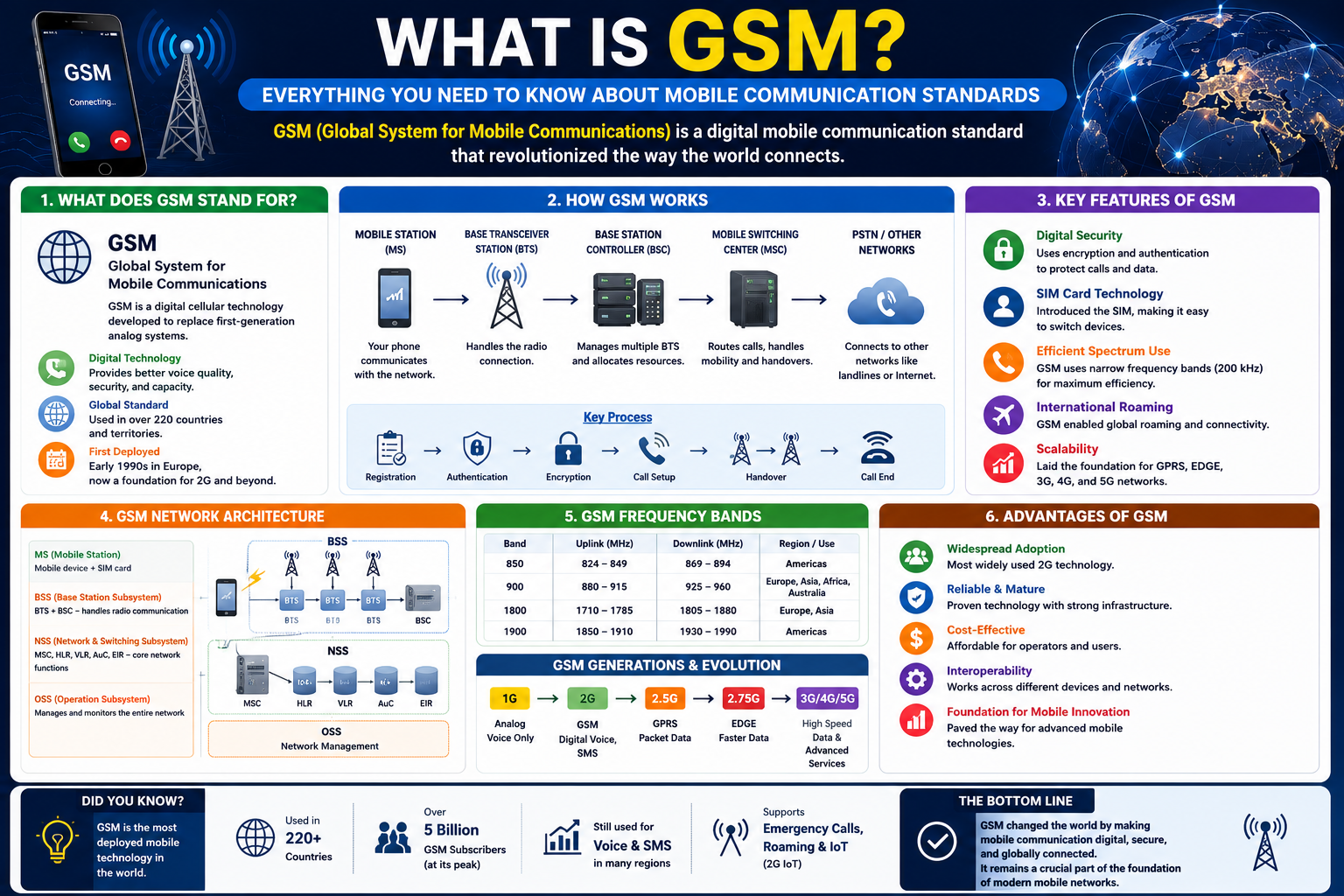
GSM (Global System for Mobile Communications) is one of the most important technologies in the history of mobile communication. It represents a standardized system that allows mobile phones to connect and communicate across different regions, networks, and even countries. Before GSM was introduced, mobile communication systems were fragmented, meaning each country or region often used incompatible technologies. As a result, mobile phones were limited to specific areas and could not function globally.
The introduction of GSM solved this major limitation by creating a unified global standard. This allowed mobile devices to work seamlessly across networks that supported GSM technology. At its core, GSM is responsible for enabling voice calls, text messaging, and basic data services through a structured and efficient communication system. It uses digital signaling instead of analog transmission, which significantly improved the clarity, security, and reliability of mobile communication.
One of the most significant contributions of GSM is the introduction of SIM (Subscriber Identity Module) cards. These small chips store user identity and network information, making it possible for users to switch devices without losing their mobile number or service access. This innovation played a key role in increasing flexibility for mobile users worldwide.
GSM also introduced the concept of international roaming, which allows users to use their mobile phones outside their home country by connecting to partner networks. This feature transformed global travel and communication by ensuring people remained connected regardless of location.
Over time, GSM became the foundation for modern mobile communication systems. Even though newer technologies like 3G, 4G, and 5G have emerged, GSM still plays a critical role in many regions, especially for basic communication services and machine-to-machine communication systems.
How GSM Networks Work: Core Architecture and Components
The GSM network is built on a structured architecture that ensures smooth communication between mobile devices and the network infrastructure. It is divided into multiple interconnected components, each responsible for handling specific tasks such as signal transmission, call management, and user authentication.
At the most basic level, GSM networks rely on a system of radio communication towers that connect mobile phones to the core network. These towers form the first point of contact between a device and the communication system. When a user makes a call or sends a message, the signal is transmitted from the phone to the nearest tower, which then forwards it through the network.
The architecture of GSM is generally divided into three main subsystems: the Base Station Subsystem, the Network Switching Subsystem, and the Operation Support Subsystem.
The Base Station Subsystem is responsible for handling radio communication. It includes base transceiver stations that send and receive signals from mobile devices, as well as base station controllers that manage multiple towers in a specific area. This subsystem ensures that signals are transmitted efficiently and that mobile devices remain connected even when moving between coverage areas.
The Network Switching Subsystem acts as the central core of the GSM system. It is responsible for routing calls, managing user mobility, and connecting mobile users to other networks such as landlines or international systems. It contains important databases that store subscriber information, location data, and authentication details. These databases ensure that only authorized users can access network services.
The Operation Support Subsystem is used for monitoring and maintaining the entire GSM network. It helps network operators track performance, detect issues, and manage system upgrades. This subsystem ensures that the network remains stable and efficient under varying levels of usage.
Together, these components form a highly organized communication system that allows GSM networks to handle millions of users simultaneously while maintaining reliable connectivity.
GSM Features, Services, and Real-World Applications
GSM technology offers a wide range of features and services that have made it one of the most widely adopted mobile communication standards in the world. Its core services include voice communication, SMS (Short Message Service), and basic data transmission. These services form the foundation of modern mobile communication.
Voice communication in GSM is transmitted digitally, which improves clarity and reduces noise compared to older analog systems. This ensures that conversations remain understandable even over long distances or in areas with weaker signals. GSM also uses compression techniques to optimize bandwidth usage, allowing more users to communicate simultaneously within the same network infrastructure.
SMS messaging is another key feature introduced by GSM. It allows users to send short text messages quickly and efficiently without requiring a voice call. This service became extremely popular due to its simplicity, reliability, and low cost. Over time, SMS evolved into a widely used communication method for personal, business, and even automated system notifications.
GSM also supports data services, although in its original form, data speeds were relatively limited. These early data capabilities allowed users to access basic internet services, send emails, and use simple mobile applications. Although modern networks now offer much faster speeds, GSM laid the foundation for mobile internet connectivity.
One of the most important real-world applications of GSM is roaming. International roaming enables users to use their mobile phones outside their home network by connecting to partner networks in other countries. This feature is essential for global communication and travel, ensuring that users remain reachable regardless of location.
GSM is also widely used in industries beyond personal communication. It plays a key role in transportation systems, emergency services, banking systems, and remote monitoring technologies. Many automated systems rely on GSM for machine-to-machine communication, such as smart meters, security systems, and tracking devices.
Because of its reliability and wide coverage, GSM continues to be used in rural and remote areas where newer technologies may not be fully available. Its simplicity and stability make it a long-lasting communication solution even in modern times.
Security, Limitations, and Evolution Toward Modern Networks
Security has always been an important aspect of GSM technology. From its early development, GSM introduced encryption methods to protect user communication. These security mechanisms were designed to prevent unauthorized access and ensure that calls and messages remained private.
GSM uses authentication systems to verify the identity of users through SIM cards. When a device connects to a network, the system checks whether the SIM is valid and authorized. This prevents unauthorized devices from accessing network services. GSM also uses encryption algorithms to secure voice and data transmission, ensuring that communication cannot be easily intercepted.
However, despite these advancements, GSM security has limitations. Some of its original encryption methods are now considered outdated and vulnerable to modern attacks. As technology has advanced, more sophisticated security threats have emerged, making older GSM encryption methods less effective. This is one of the reasons why newer technologies like 4G and 5G use stronger and more advanced security systems.
Another limitation of GSM is its relatively low data speed compared to modern networks. While GSM was revolutionary at its time, it cannot support the high-speed internet requirements of today’s applications such as video streaming, online gaming, and cloud computing. This has led to the development of more advanced mobile technologies that offer significantly higher performance.
Despite these limitations, GSM has not disappeared. Instead, it has evolved alongside newer technologies. In many regions, GSM is still used as a backup communication system or for basic connectivity. It is also widely used in IoT (Internet of Things) devices that require low power and stable long-distance communication.
The transition from GSM to modern networks like 3G, 4G, and 5G represents a natural evolution of mobile communication. Each new generation builds upon the foundation laid by GSM, improving speed, security, and functionality while maintaining compatibility in certain areas.
Conclusion
GSM has played a foundational role in shaping modern mobile communication systems. It introduced the first global standard that allowed mobile devices to function across different networks and regions, transforming the way people communicate worldwide. Its innovations, such as SIM cards, roaming, and digital transmission, created a flexible and efficient communication environment that continues to influence modern technologies.
Although newer mobile technologies have surpassed GSM in speed and capabilities, its importance remains significant. It still supports basic communication services and continues to be used in areas where advanced infrastructure is not yet available. GSM also serves as a backbone for various industrial and IoT applications, proving its long-term relevance.
The evolution of GSM highlights the continuous progress of communication technology, where each generation builds on the strengths of the previous one. Understanding GSM provides valuable insight into how global mobile networks operate and how they have developed into the advanced systems used today.
Even in today’s highly advanced digital world, GSM remains a reliable fallback system, ensuring connectivity in emergencies and remote environments where modern networks may fail. Its simplicity, wide coverage, and proven stability make it a lasting technology that still supports millions of devices worldwide. Moreover, GSM’s design principles continue to influence newer standards, especially in areas like authentication, mobility management, and network interoperability. As communication technology keeps evolving, GSM stands as a milestone that demonstrates how a well-designed global standard can shape decades of innovation and connectivity.