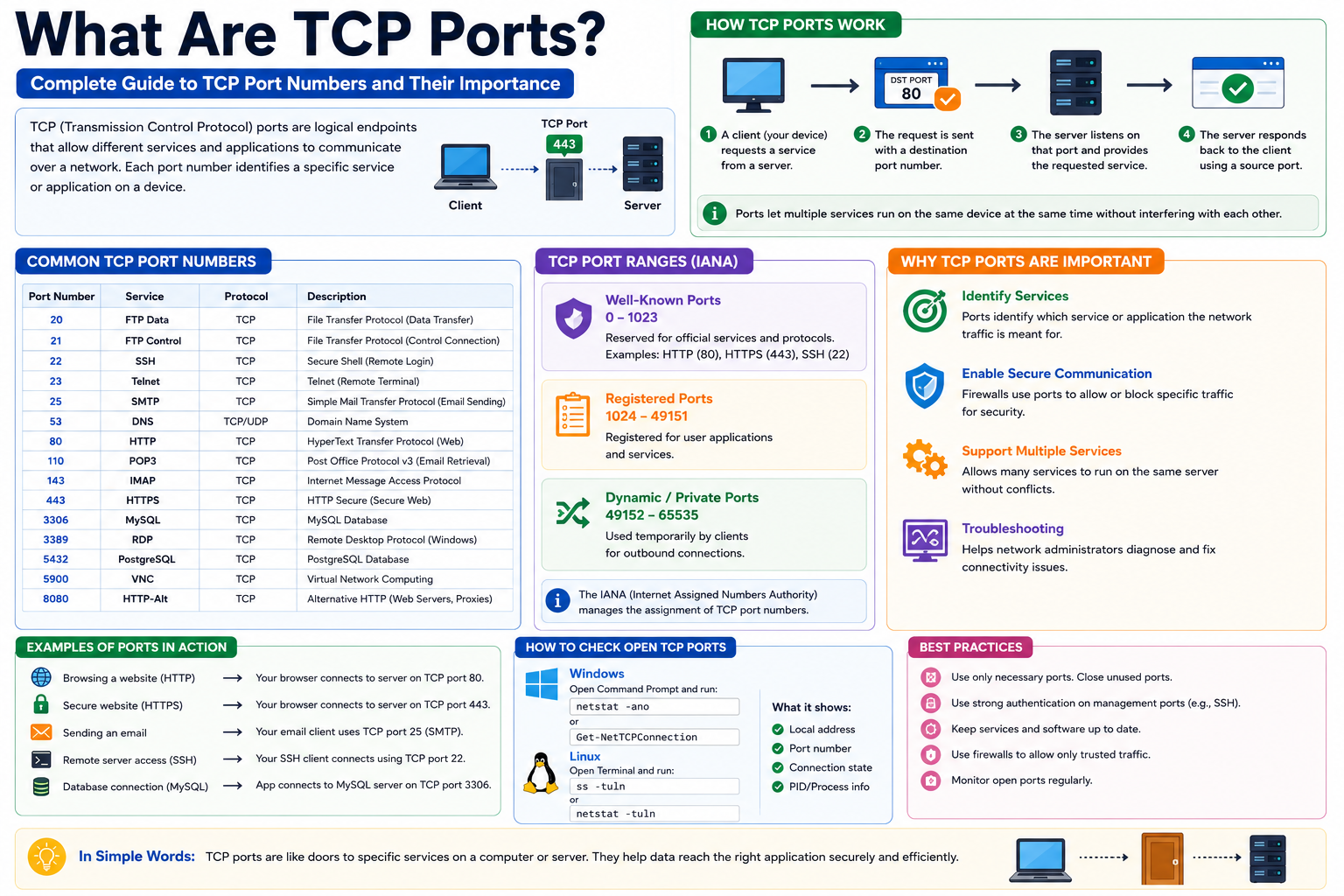
In modern computer networks, communication happens at a massive scale and speed. Every time you open a website, send an email, stream a video, or use an online application, your device is exchanging data with other systems across the internet. To make this possible in an organized and reliable way, networks rely on a system of rules and identifiers. One of the most important elements in this system is the concept of TCP ports.
A TCP port is a logical communication endpoint used to identify specific services or applications running on a device. While an IP address identifies a device on a network, a port identifies the specific service inside that device. This separation is what allows a single computer to handle many different types of network activity at the same time without confusion.
For example, a device might be running a web browser, email client, file-sharing application, and messaging service simultaneously. Each of these services communicates through different TCP ports, ensuring that data is delivered to the correct application. Without ports, incoming data would have no clear destination once it reached a device.
TCP ports are standardized globally, meaning every device and operating system follows the same numbering rules. This consistency is essential for the internet to function smoothly. When data is sent across a network, it is tagged with both an IP address and a port number, ensuring accurate delivery from one application to another.
How TCP Enables Reliable Communication
To understand TCP ports properly, it is important to first understand Transmission Control Protocol, commonly known as TCP. TCP is one of the core communication protocols used in networking and is part of the TCP/IP model that powers the internet.
TCP is a connection-oriented protocol, meaning it establishes a stable connection between two devices before data is transferred. This process ensures that both sender and receiver are ready for communication. Once the connection is established, TCP manages how data is broken into packets, sent, received, and reassembled in the correct order.
One of the key strengths of TCP is its reliability. It includes mechanisms for error checking, acknowledgment of received data, and retransmission of lost packets. If any part of the data does not arrive correctly, TCP automatically requests it again, ensuring complete and accurate delivery.
This makes TCP ideal for applications where accuracy is more important than speed alone. Activities such as web browsing, file transfers, and email communication rely heavily on TCP because missing or corrupted data could lead to serious issues.
TCP works closely with IP (Internet Protocol). While IP handles the routing of data between devices, TCP ensures that the data is delivered correctly and in order. Together, they form the foundation of most internet communication.
Within this system, TCP ports act as the final destination points inside a device. Once TCP delivers data to the correct device using an IP address, the port ensures it reaches the right application.
What Are TCP Ports and How They Are Organized
TCP ports are numerical identifiers ranging from 0 to 65535. This range exists because ports are represented using a 16-bit number system, which naturally allows for this total number of possible values.
These ports are divided into different categories based on their usage. The first group includes well-known ports, which range from 0 to 1023. These ports are reserved for essential and widely used services. For example, web traffic typically uses port 80 for standard connections and port 443 for secure connections. Email services, file transfer protocols, and other core internet functions also rely on well-known ports.
The second category includes registered ports, ranging from 1024 to 49151. These ports are assigned to specific software applications and services that are not part of the core system but are still widely used. Many enterprise applications and custom services operate within this range.
The final category is dynamic or private ports, ranging from 49152 to 65535. These ports are typically used temporarily by applications when they need to establish outbound connections. For example, when you open a website, your browser may use a dynamic port on your device to communicate with the server’s fixed port.
This structured system ensures that no two services conflict with each other. It also allows millions of devices and applications to communicate simultaneously without interference.
Ports play a critical role in keeping network communication organized. Without them, a device would not be able to differentiate between multiple incoming data streams, leading to confusion and data errors.
TCP Sockets and How Data Travels Between Applications
A TCP socket is a combination of an IP address and a port number. It represents a complete communication endpoint used in network interactions. While a port identifies a service, a socket identifies both the service and the device it is running on.
Sockets are essential because they allow multiple connections to exist at the same time between different devices and applications. For instance, a web server can handle thousands of users simultaneously because each connection is managed using a unique socket.
When a client device wants to communicate with a server, it creates a socket connection. This connection includes the client’s IP address and port, as well as the server’s IP address and port. Once established, data can flow between both ends reliably.
This system also allows multiple services to run on the same device using different ports. For example, a single server might host a website on one port while running a database service on another. Even though both services share the same IP address, sockets ensure that traffic is delivered to the correct destination.
Sockets are also important for maintaining persistent communication. Many applications, such as messaging platforms or online games, rely on continuous data exchange. Sockets help maintain these long-term connections without requiring constant re-establishment.
By combining IP addresses and port numbers, sockets create a structured communication model that allows the internet to function efficiently at scale.
Real-World Uses of TCP Ports and Network Security
TCP ports are not just technical concepts; they are actively used in everyday digital communication. Every time you browse the internet, stream content, or access cloud services, TCP ports are working behind the scenes to manage data flow.
Web servers, for example, commonly use ports 80 and 443. Email systems use ports such as 25, 110, and 143 depending on the type of service. File transfer services use other dedicated ports. These standardized assignments ensure that systems across the world can communicate without manual configuration.
In enterprise environments, TCP ports are even more important. Organizations run multiple services on internal networks, including databases, internal websites, and communication tools. Each of these services must be assigned specific ports to avoid conflicts.
Security is another major area where TCP ports play a key role. Firewalls monitor and control traffic based on port numbers. By allowing or blocking specific ports, administrators can control which services are accessible from outside or inside the network.
For example, if a company wants to restrict access to certain internal systems, it can block the ports associated with those services. Similarly, only approved ports may be opened for external communication, reducing the risk of unauthorized access.
TCP ports are also useful in troubleshooting network issues. If a service is not working, checking whether the correct port is open and listening can help identify the problem. Tools that monitor active connections often display port activity, helping administrators detect unusual behavior or unauthorized connections.
Malware and unauthorized applications sometimes attempt to use unexpected ports to communicate externally. Monitoring port usage helps detect such suspicious activity and improve overall network security.
Conclusion
TCP ports are a fundamental part of modern networking, enabling devices and applications to communicate in an organized and efficient manner. While IP addresses identify devices, ports ensure that data reaches the correct service within those devices. This separation of roles allows multiple applications to operate simultaneously on a single system without interference.
By working alongside TCP, ports help maintain reliable and structured communication across the internet. They support everything from web browsing and email to cloud computing and enterprise systems. The structured numbering system of ports ensures global consistency, making it possible for devices around the world to communicate seamlessly.
Beyond functionality, TCP ports also play a crucial role in security and network management. Firewalls, monitoring tools, and system administrators rely on port numbers to control traffic, prevent unauthorized access, and troubleshoot connectivity issues. This makes them an essential component in maintaining safe and efficient networks.
As digital systems continue to grow in complexity, TCP ports remain a silent but critical part of how information moves across networks. Understanding how they work provides valuable insight into the structure and behavior of modern communication systems. They help ensure that millions of applications can run simultaneously without conflict, even on a single device, by clearly separating different types of network traffic. This organization is what makes services like streaming, cloud computing, and online collaboration possible on a global scale. As networks expand further with IoT devices and advanced applications, the importance of TCP ports will continue to increase, supporting faster, safer, and more reliable communication across increasingly interconnected systems.