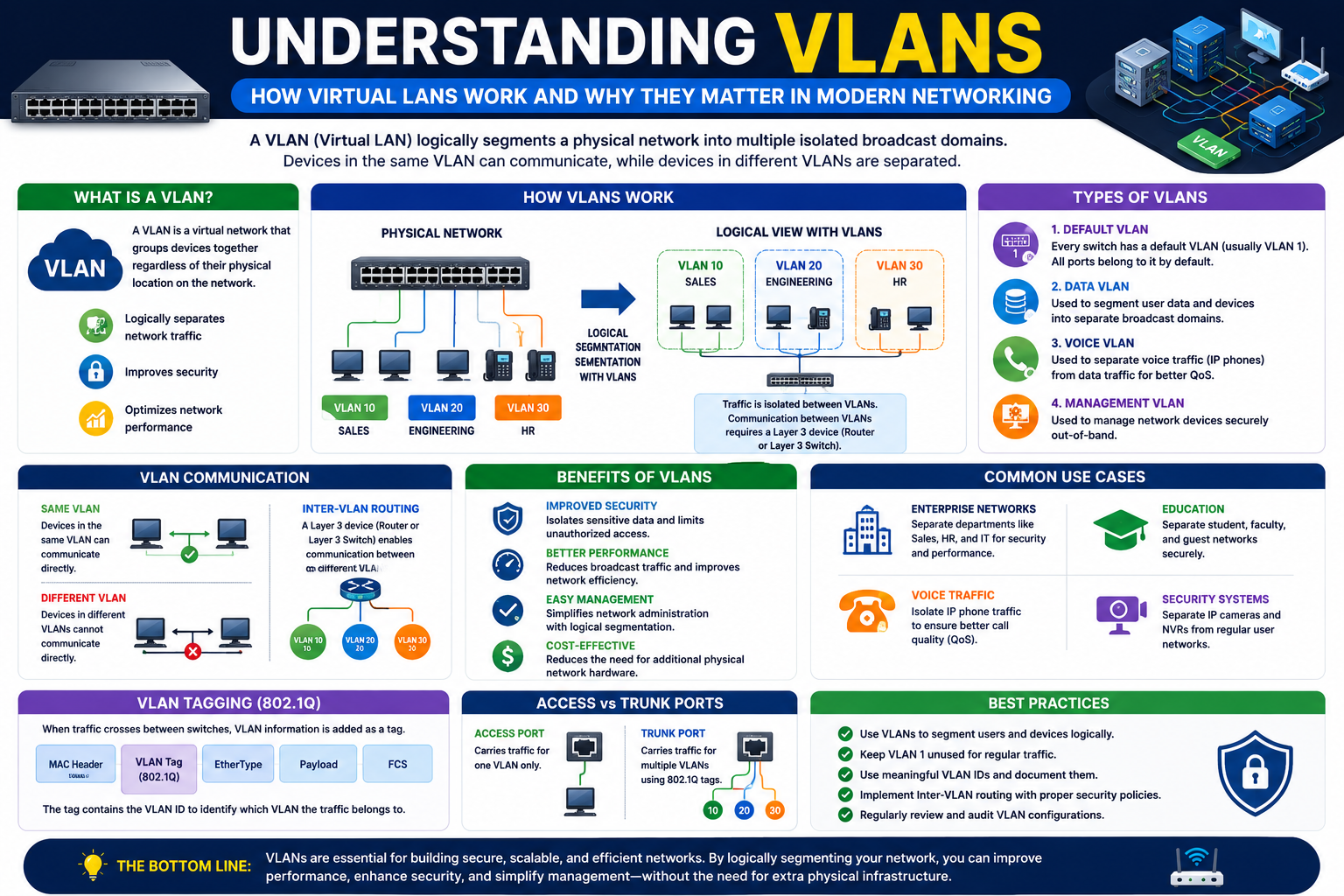
In modern networking environments, efficiency, security, and scalability are essential. As organizations grow, so does the number of connected devices, users, and applications relying on the same network infrastructure. This growth often leads to congestion, performance issues, and security challenges if everything remains within a single network structure. Virtual Local Area Networks, commonly known as VLANs, provide a practical solution to these challenges by logically dividing a physical network into multiple isolated segments.
A VLAN allows network administrators to separate devices into different groups, even if they are connected to the same physical switches. This logical separation improves performance by reducing unnecessary traffic and enhances security by restricting access between different groups. Instead of relying on physical separation, VLANs use configuration-based segmentation, making networks more flexible and easier to manage.
To fully understand VLANs, it is important to explore how traditional networks function, why they struggle at scale, and how VLANs solve these problems in a structured and efficient way.
What VLANs Are and How They Work Conceptually
A VLAN, or Virtual Local Area Network, is a method of dividing a single physical network into multiple logical networks. Although devices may be connected to the same switch or infrastructure, VLANs make them behave as if they are on completely separate networks.
The key idea behind VLANs is logical segmentation. Instead of physically separating cables and hardware, VLANs use software-based configuration to assign devices to different network groups. Each group operates independently, even though they share the same underlying physical infrastructure.
When a device is placed into a VLAN, it can only communicate directly with other devices in the same VLAN unless routing is explicitly configured. This creates controlled communication boundaries within the network.
For example, devices in a finance department can be placed in one VLAN, while devices in a sales department can be placed in another. Even though both departments use the same switches, their traffic remains isolated. This improves security, reduces unnecessary data exchange, and ensures better control over network behavior.
At its core, VLAN technology introduces structure into large networks by organizing devices into manageable and efficient segments without requiring physical separation.
How Normal LANs Operate and Why Broadcast Traffic Becomes a Problem
To understand why VLANs are necessary, it is important to first examine how a traditional Local Area Network (LAN) operates. In a standard LAN, all devices connected to a switch typically belong to the same network segment. This means they share the same broadcast domain.
In such environments, devices frequently send broadcast messages. These broadcasts are used for essential tasks such as discovering other devices, requesting IP addresses, and locating network services. While these messages are necessary, they are sent to every device on the network.
In small networks, this broadcast communication is not a major issue. However, as the number of devices increases, broadcast traffic grows significantly. Every device receives every broadcast, whether it needs the information or not. This leads to unnecessary processing and network congestion.
As networks scale from tens to hundreds or even thousands of devices, broadcast traffic can consume a large portion of available bandwidth. This results in slower performance, increased latency, and reduced efficiency across the entire network.
Another limitation of traditional LANs is that all devices are part of the same IP subnet. This means there is little control over which devices can communicate freely. Without segmentation, all traffic is visible within the same broadcast domain, which can also raise security concerns.
These challenges highlight the need for a more efficient method of organizing network traffic, which is where VLANs become essential.
Types of VLANs and Their Functional Roles
VLANs are not all used in the same way. Different types of VLANs exist to serve specific purposes within a network environment, each designed to handle a particular type of traffic or function.
A default VLAN is the initial VLAN assigned to all switch ports when a device is first configured. In many systems, this is VLAN 1. It acts as the baseline network before any custom segmentation is applied.
A data VLAN is used for regular user traffic. This includes activities such as file sharing, internet browsing, and application usage. Data VLANs are the most common type and are often created to separate departments or user groups within an organization.
A voice VLAN is specifically designed for voice communication systems such as IP telephony. Voice traffic requires high priority and low latency, so separating it ensures clearer and more reliable communication. This also allows quality of service mechanisms to prioritize voice packets over other types of traffic.
A management VLAN is used for administrative access to network devices. Tasks such as configuration, monitoring, and maintenance are performed through this VLAN. By isolating management traffic, networks gain an additional layer of security and reduce exposure to unauthorized access.
A native VLAN is used in environments where untagged traffic is transmitted across trunk links. It ensures compatibility with devices that do not support VLAN tagging and helps maintain proper communication across interconnected switches.
Each VLAN type plays a specific role in maintaining structure, efficiency, and security within complex network systems.
Benefits of VLANs in Network Performance and Security
One of the most significant advantages of VLANs is improved network performance. By dividing a large network into smaller broadcast domains, VLANs reduce unnecessary traffic. Devices only receive relevant broadcasts from their own VLAN, which decreases congestion and improves overall speed.
VLANs also enhance security by isolating sensitive data. For example, separating departments such as human resources, finance, and IT ensures that users cannot easily access information outside their assigned VLAN. This logical separation helps prevent unauthorized access and limits potential damage from internal threats.
Another benefit is improved network organization. VLANs allow administrators to group users based on function rather than physical location. This is especially useful in large organizations where employees may be spread across multiple floors or buildings but still need to be grouped logically.
Scalability is also a key advantage. As organizations grow, VLANs make it easier to add new users or departments without redesigning the entire network. New VLANs can be created and assigned without changing physical infrastructure.
Additionally, VLANs support better resource management. By separating different types of traffic, such as voice, data, and management, networks can prioritize critical services and maintain consistent performance even under heavy load.
VLAN Membership Assignment Methods and Configuration Approaches
Assigning devices to VLANs can be done in several ways, depending on the design and requirements of the network.
One common method is port-based assignment. In this approach, each switch port is manually assigned to a specific VLAN. Any device connected to that port automatically becomes part of the assigned VLAN. This method is simple and widely used in environments where devices remain fixed in place.
Another method is MAC address-based assignment. Here, VLAN membership is determined by the device’s hardware address. The switch identifies the device and assigns it to the appropriate VLAN regardless of which port it is connected to. This method provides flexibility for users who move between locations frequently.
A third method is protocol-based assignment. In this approach, VLAN membership is determined based on the type of traffic being transmitted. For example, voice traffic may be assigned to one VLAN, while data traffic is assigned to another. This helps optimize traffic handling and ensures that different types of communication are properly separated.
Each method offers different advantages, and network administrators often combine them to achieve a balanced and efficient network design.
How VLANs Work Across Multiple Switches Using Logical Segmentation
VLANs are not limited to a single switch. They can operate across multiple interconnected switches, allowing organizations to build large, unified networks while maintaining logical separation.
This is made possible through a process known as trunking. A trunk link carries traffic for multiple VLANs between switches. Each frame sent across a trunk link is tagged with VLAN information, allowing the receiving switch to identify which VLAN it belongs to.
When a broadcast is sent from a device in one VLAN, it is forwarded only to ports assigned to that same VLAN, even if those ports exist on different switches. The VLAN tag ensures that traffic remains properly segmented across the entire network infrastructure.
This capability allows organizations to create campus-wide or enterprise-wide VLAN structures where departments can be separated logically, regardless of physical location. It also ensures consistency and scalability across complex networks.
Conclusion
VLAN technology plays a crucial role in modern networking by providing a flexible and efficient way to organize large and complex systems. Instead of relying on physical separation, VLANs use logical segmentation to divide networks into smaller, more manageable parts. This approach significantly reduces broadcast traffic, improves performance, and enhances security by limiting unnecessary communication between devices.
As networks continue to grow in size and complexity, VLANs offer a scalable solution that allows organizations to maintain control without redesigning physical infrastructure. They enable better traffic management, improved resource allocation, and stronger security boundaries between different user groups and services.
By combining performance optimization with logical isolation, VLANs have become a foundational technology in enterprise networking, supporting everything from daily business operations to advanced communication systems.