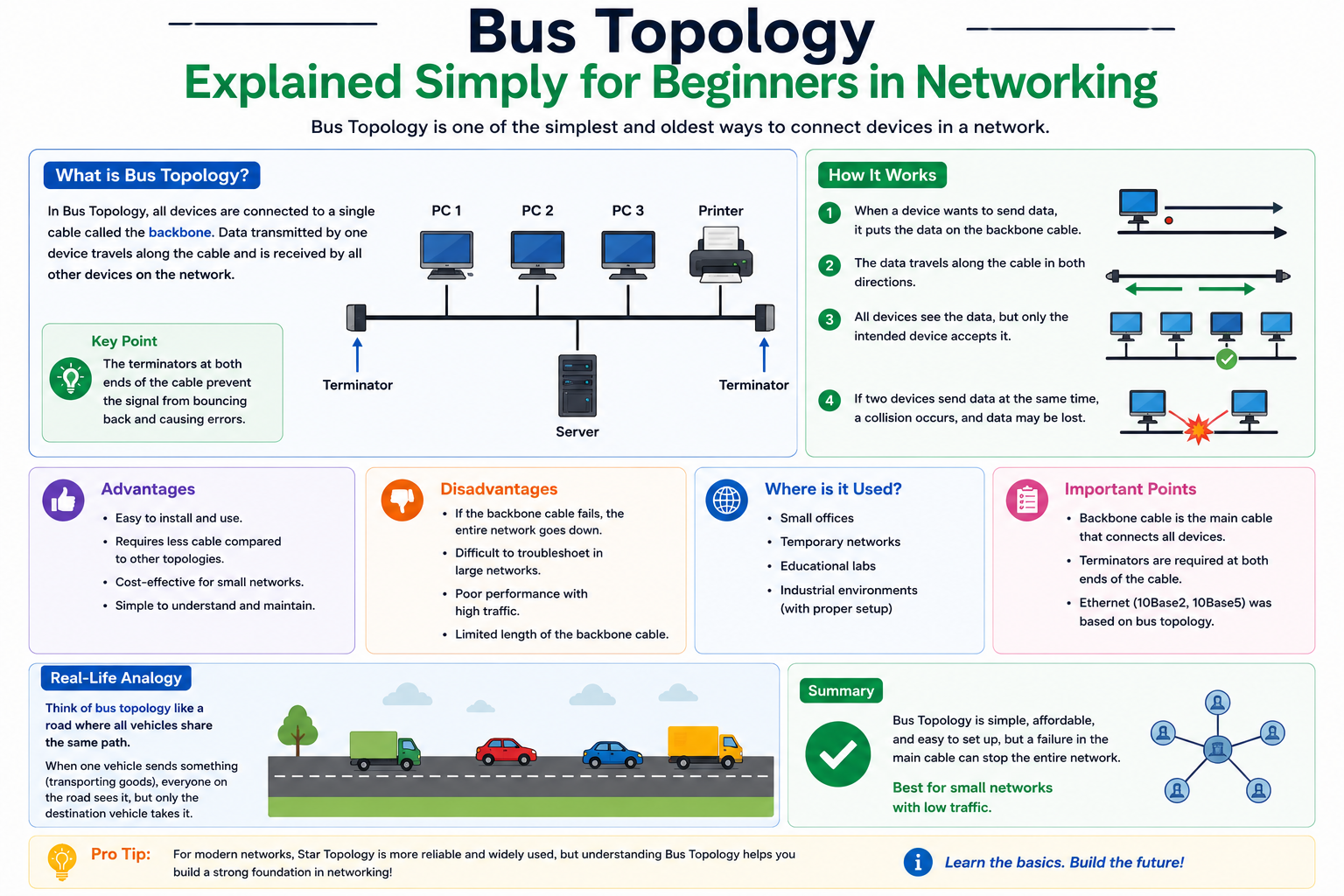
Bus topology is one of the simplest and earliest forms of network design used in computer networking. It describes a layout in which all devices are connected to a single shared communication line, often referred to as a backbone or bus. In this structure, data travels along the same path and is available to every connected device. Each device checks whether the transmitted data is intended for it and either processes it or ignores it.
This type of arrangement was widely used in early local area networks due to its simplicity and low cost. Unlike more complex network designs, bus topology does not require a central controlling device, which reduces both hardware requirements and setup complexity. Because of this, it became a practical choice for small-scale networking environments where performance demands were relatively low.
At its core, bus topology reflects a linear communication model. All nodes share the same transmission medium, meaning only one device can successfully transmit data at a time. This shared nature introduces both advantages and limitations, which play an important role in determining where and how bus topology can be effectively used.
Although modern networking has largely shifted toward more scalable and reliable designs, understanding bus topology remains important. It forms the foundation for learning more advanced network structures and helps explain how early communication systems operated.
How Bus Topology Works in a Network
The working principle of bus topology is based on a single communication channel that connects all devices in a linear fashion. This channel carries all data transmissions across the network. When a device sends information, the data is broadcast across the entire bus so that every connected device receives the signal simultaneously.
Each data packet includes an address that identifies the intended recipient. As the data travels along the bus, every device checks this address. Only the device with the matching address accepts and processes the data, while all others simply ignore it. This method ensures that communication remains organized even though all devices share the same transmission line.
One important characteristic of bus topology is its half-duplex communication behavior. This means that data can travel in both directions along the bus, but not at the same time. If two or more devices attempt to send data simultaneously, a collision may occur. When this happens, the signals interfere with each other, causing data loss or corruption. To resolve this, devices must retransmit the data after a random delay.
The absence of a central controlling device makes the system more straightforward but also more vulnerable to congestion. As the number of devices increases, the likelihood of data collisions also rises, which can significantly reduce network efficiency. Therefore, timing and coordination play a crucial role in maintaining smooth communication within a bus topology network.
Structure and Components of Bus Topology
The physical structure of bus topology is relatively simple compared to other network designs. It consists primarily of a single main cable that serves as the backbone for data transmission. This cable is typically coaxial or, in some cases, twisted pair wiring, depending on the network setup and requirements.
Devices such as computers, printers, or other network nodes are connected directly to this backbone using connectors or drop lines. These connections allow each device to tap into the shared communication medium without interrupting the flow of data along the bus.
At both ends of the main cable, terminators are installed. These terminators play a critical role in absorbing signals and preventing them from reflecting back into the network. Without termination, signals would bounce back and forth along the cable, leading to interference and communication errors.
Network interface cards within each device also contribute to the communication process by enabling the device to send and receive signals through the bus. Although the structure is minimalistic, proper installation of these components is essential for ensuring stable performance.
The simplicity of this structure is one of its defining features. However, it also means that any fault in the main cable can affect the entire network. This dependency on a single communication line makes the physical design both efficient and fragile at the same time.
Advantages of Bus Topology in Networking
Bus topology offers several advantages that made it popular in early network implementations, especially in small-scale environments. One of its most notable benefits is simplicity. Because all devices are connected to a single cable, the overall design is easy to understand, configure, and maintain.
The installation process is also straightforward. Fewer cables are required compared to more complex topologies, which reduces setup time and effort. This simplicity makes it suitable for temporary or small network installations where advanced infrastructure is not necessary.
Cost efficiency is another major advantage. Since bus topology requires minimal hardware, it is generally more affordable to implement. There is no need for expensive central devices or complex wiring systems, which makes it an economical choice for basic networking needs.
Additionally, expanding the network can be relatively easy in small setups. New devices can be added by simply connecting them to the main cable, provided that there is available capacity and proper configuration.
For environments where network traffic is low and performance demands are minimal, bus topology can still serve as a functional and practical solution. Its straightforward nature allows users to focus on basic connectivity without dealing with complex network management tasks.
Disadvantages and Limitations of Bus Topology
Despite its simplicity, bus topology comes with several significant limitations that affect its performance and reliability. One of the most critical issues is the presence of a single point of failure. Since all devices depend on a single backbone cable, any damage or fault in this cable can cause the entire network to stop functioning.
Another major limitation is network congestion. As more devices are added, the amount of data transmitted across the shared bus increases. This leads to frequent collisions, where multiple signals interfere with each other. When collisions occur, devices must retransmit data, which reduces overall network efficiency.
Scalability is also a concern. Bus topology does not perform well in large networks because performance decreases as the number of connected devices grows. The shared communication medium becomes overloaded, resulting in slower data transmission and increased latency.
Security is another limitation. Since all devices receive transmitted data, there is a higher risk of unauthorized interception if proper safeguards are not in place. This makes bus topology less suitable for environments where data privacy is a priority.
Finally, troubleshooting can become difficult when problems occur. Identifying the exact point of failure in a long cable can be time-consuming, especially in larger setups. These limitations have contributed to the decline of bus topology in modern networking environments.
Modern Relevance and Comparison with Other Topologies
In contemporary networking, bus topology is rarely used in large-scale systems. However, it remains an important concept for understanding how network structures evolved. Many modern topologies have built upon its basic principles while addressing its weaknesses.
For example, star topology uses a central device to manage communication between nodes, reducing the risk of collisions and improving reliability. Ring topology connects devices in a circular manner, allowing data to flow in a controlled direction. Mesh topology provides multiple pathways for data, enhancing redundancy and fault tolerance. Tree topology combines elements of multiple designs to support hierarchical network structures.
Compared to these modern approaches, bus topology is less efficient but far simpler. Its main value today lies in educational contexts and in understanding foundational networking principles. In some specialized or legacy systems, simplified versions of bus-based communication may still be observed, but they are not common in large-scale infrastructure.
Understanding bus topology also helps clarify why modern networks prioritize scalability, redundancy, and performance optimization. It represents an early stage in networking design that influenced the development of more advanced systems.
Some laboratory environments use bus-based configurations for educational purposes, allowing students to study basic networking behavior. It is also sometimes used in small-scale experimental setups where network traffic is minimal and easy to manage.
Conclusion
Bus topology represents one of the most fundamental concepts in computer networking. It is built on the idea of a single shared communication line through which all devices transmit and receive data. Its simplicity made it an early standard for small networks, offering an easy and cost-effective way to connect multiple devices without complex infrastructure.
However, this simplicity also introduces several limitations. The reliance on a single backbone creates a risk of total network failure if the cable is damaged. Additionally, performance issues such as data collisions, congestion, and scalability challenges make it unsuitable for modern large-scale networks.
Despite these drawbacks, bus topology continues to hold educational value. It provides a clear foundation for understanding how data flows in a network and how different topological designs address communication challenges. By studying it, one gains insight into the evolution of networking technology and the reasons behind the development of more advanced topologies.
Today, while it is largely replaced by more efficient and reliable systems, bus topology remains an essential concept in the study of computer networks and continues to serve as a stepping stone for understanding more complex network architectures.