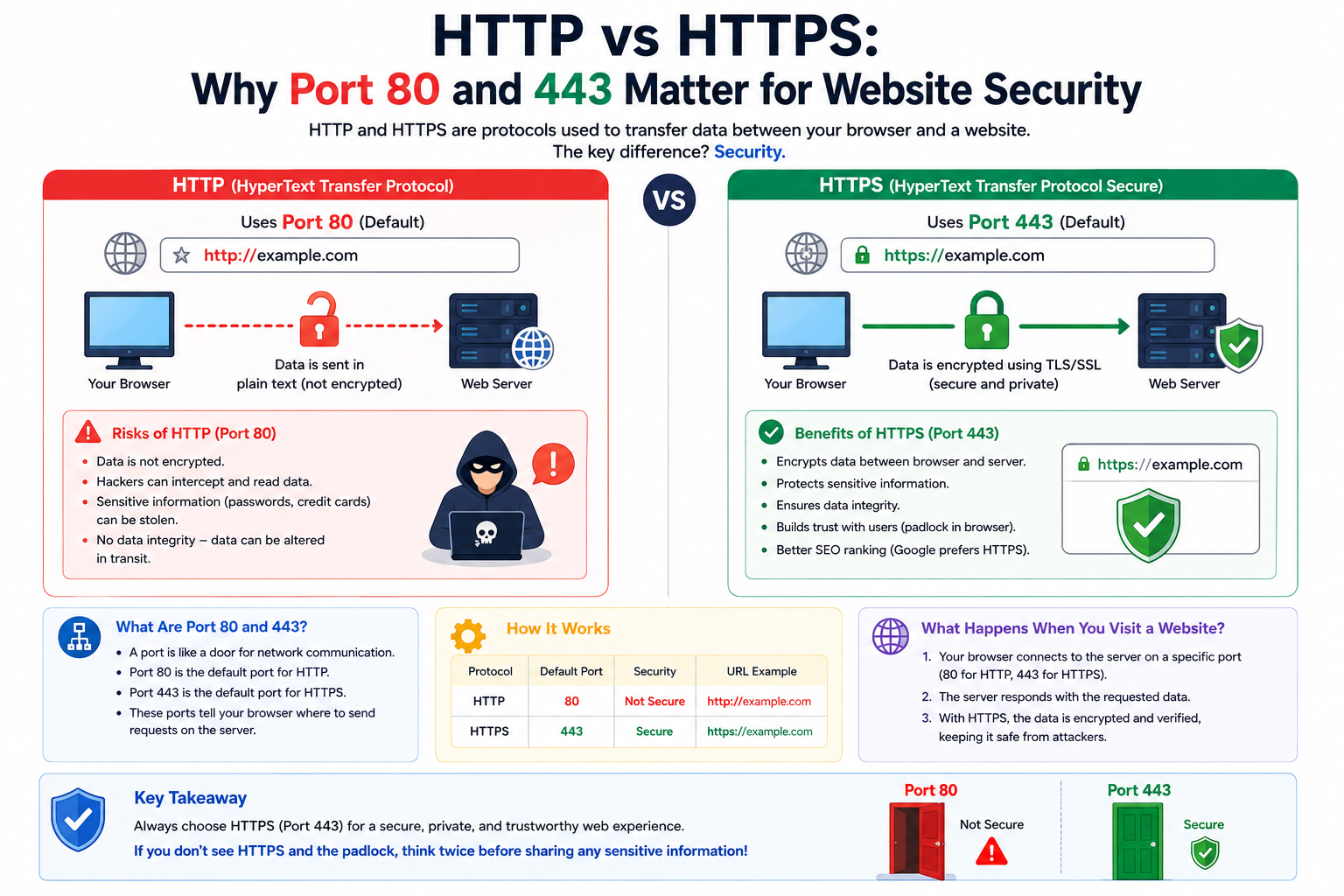
Every time you open a website, send a message, or load an online application, your device is silently communicating through a system of rules and pathways known as network ports. Among these, port 80 and port 443 are the most widely used in modern internet communication. They act as standardized entry points that allow browsers and servers to exchange information in a structured way.
Ports themselves are not physical objects but logical channels inside a device’s networking system. Think of them as numbered doors that direct traffic to the correct service. When you type a web address into a browser, your request is automatically directed to one of these doors depending on whether the connection is secure or not.
Port 80 is traditionally associated with standard web traffic, while port 443 handles secure communication. Both serve the same fundamental purpose—delivering web content—but they differ significantly in how they protect the data being transmitted. This distinction forms the foundation of modern internet security practices and influences how websites are built, accessed, and trusted today.
Port 80 Fundamentals: The Foundation of HTTP Communication
Port 80 is the default channel used by the HyperText Transfer Protocol (HTTP), which is one of the earliest and most basic methods for transferring web data. When a browser requests a webpage without specifying security requirements, it typically uses this port automatically.
HTTP communication over port 80 is straightforward. A browser sends a request to a server, and the server responds with the requested content, such as HTML files, images, or scripts. This request-response model is simple and efficient, which is one of the reasons it became the foundation of early web communication.
However, port 80 does not include any built-in protection for the data being exchanged. Everything sent through it is transmitted in plain text. This means that anyone with access to the network path can potentially view or intercept the information. Despite this limitation, port 80 played a crucial role in the growth of the internet by enabling fast and unrestricted access to web content during its early development stages.
Technical Behavior of Port 80 in Network Communication
Behind the scenes, port 80 operates using the Transmission Control Protocol (TCP), which ensures that data is delivered reliably between devices. TCP establishes a structured connection before any information is exchanged. This process involves a sequence of synchronization steps that confirm both sender and receiver are ready for communication.
Once the connection is established, data is divided into smaller packets and transmitted across the network. TCP ensures that these packets arrive in the correct order and are reassembled properly at the destination. If any packet is lost during transmission, it is resent automatically, ensuring reliability.
Port 80 functions at the application layer of network communication, working alongside lower-level protocols that manage routing and delivery. While it ensures reliability through TCP, it does not provide confidentiality. This separation of responsibility is important because it highlights that port 80 is designed for accessibility and efficiency rather than security.
As internet usage expanded, this lack of protection became a significant concern, especially for sensitive transactions such as logins, payments, and personal data exchanges.
Security Limitations and Risks Associated with Port 80
The primary weakness of port 80 lies in its lack of encryption. Since data is transmitted in plain text, it becomes vulnerable to interception. Attackers on the same network can capture and read sensitive information such as usernames, passwords, or personal messages.
This vulnerability becomes even more serious in unsecured environments like public Wi-Fi networks. In such cases, malicious actors can exploit network traffic using interception techniques to monitor or modify data without detection.
Another risk is data manipulation. Because there is no verification mechanism built into HTTP, transmitted content can be altered in transit. This opens the door to various attacks where users may receive modified or malicious versions of legitimate web pages.
Additionally, port 80 traffic is susceptible to redirection attacks, where users are unknowingly sent to fake websites designed to mimic real ones. These weaknesses demonstrate why port 80 is now considered unsuitable for handling sensitive or confidential communication in modern internet environments.
Port 443: The Secure Foundation of HTTPS Communication
Port 443 is the standard port used by HyperText Transfer Protocol Secure (HTTPS). Unlike port 80, it is designed specifically to protect data during transmission. It achieves this by combining standard HTTP communication with encryption protocols that safeguard information from unauthorized access.
When a website uses port 443, all data exchanged between the browser and the server is encrypted before transmission. This means that even if the data is intercepted, it cannot be easily understood or altered. This encryption is what makes secure online activities such as banking, shopping, and authentication possible.
Modern browsers also visually indicate the use of port 443 through security symbols, helping users identify secure websites. Over time, this secure communication method has become the default standard for most websites, replacing the older and less secure HTTP model.
Port 443 has effectively become the backbone of trusted internet communication, ensuring that users can interact with online services safely and privately.
How TLS Encryption Secures Communication on Port 443
The security of port 443 is built on Transport Layer Security (TLS), a cryptographic protocol that protects data during transmission. TLS works by encrypting information before it leaves the sender and decrypting it only when it reaches the intended recipient.
The process begins with a handshake between the client and server. During this handshake, both parties agree on encryption methods and exchange cryptographic keys. Once this secure connection is established, all further communication is encrypted.
TLS uses a combination of asymmetric and symmetric encryption. Asymmetric encryption is used during the initial handshake to securely exchange keys, while symmetric encryption is used for faster data transmission afterward. This combination ensures both security and efficiency.
An important feature of TLS is data integrity verification. It ensures that transmitted data has not been altered during transit. If any modification is detected, the connection is rejected. This makes port 443 highly resistant to interception, tampering, and impersonation attacks.
Certificates, Trust, and Identity Verification in HTTPS
A key component of secure communication on port 443 is the digital certificate system. These certificates act as digital identity cards for websites, confirming that a server is legitimate and trustworthy.
When a browser connects to a secure website, it checks the website’s certificate to verify its authenticity. This certificate contains information about the website owner and a public encryption key used to establish a secure connection.
If the certificate is valid and trusted, the browser proceeds with the connection. If it is expired, invalid, or untrusted, the browser may display a warning, alerting the user to potential risks.
This verification process prevents impersonation attacks, where malicious websites attempt to mimic legitimate ones. By ensuring that users are connecting to the correct server, certificates play a crucial role in maintaining trust across the internet.
Without this system, secure communication over port 443 would not be reliable, as attackers could easily impersonate websites and intercept sensitive information.
Real-World Differences Between Port 80 and Port 443 Usage
In practical terms, the difference between port 80 and port 443 is most noticeable in everyday browsing behavior. Websites using port 80 load content without encryption, while those using port 443 establish a secure connection before displaying content.
Modern browsers increasingly prioritize secure connections, often redirecting users from HTTP to HTTPS automatically. This shift reflects a broader trend toward improving user safety and data protection across the internet.
Web developers also prefer port 443 because it builds trust with users. Secure websites are more likely to be visited, especially when handling sensitive actions like login forms or payment processing.
Another difference lies in user perception. Secure websites display visual indicators such as padlock symbols, which signal safety. In contrast, non-secure connections may trigger warnings or be flagged by browsers.
As a result, port 443 has become the standard for most modern websites, while port 80 is now primarily used for redirection or legacy systems.
Conclusion
Port 80 and port 443 represent two foundational approaches to internet communication, each reflecting a different era of web development. Port 80 enabled the early growth of the internet by providing a simple and efficient way to transfer web content, but its lack of security makes it unsuitable for modern use involving sensitive information. Port 443, on the other hand, introduces encryption and authentication through TLS, ensuring that data remains private and protected during transmission. As online threats continue to evolve, secure communication has become essential rather than optional. This shift has made HTTPS the dominant standard across most websites, reinforcing trust and safety in digital interactions.
Ultimately, the transition from HTTP to HTTPS is not just a technical upgrade but a fundamental improvement in how trust is established on the internet. It reflects a global priority toward privacy, data integrity, and user protection in every digital exchange, strengthening resilience against cyber threats and ensuring safer communication across modern connected systems worldwide.