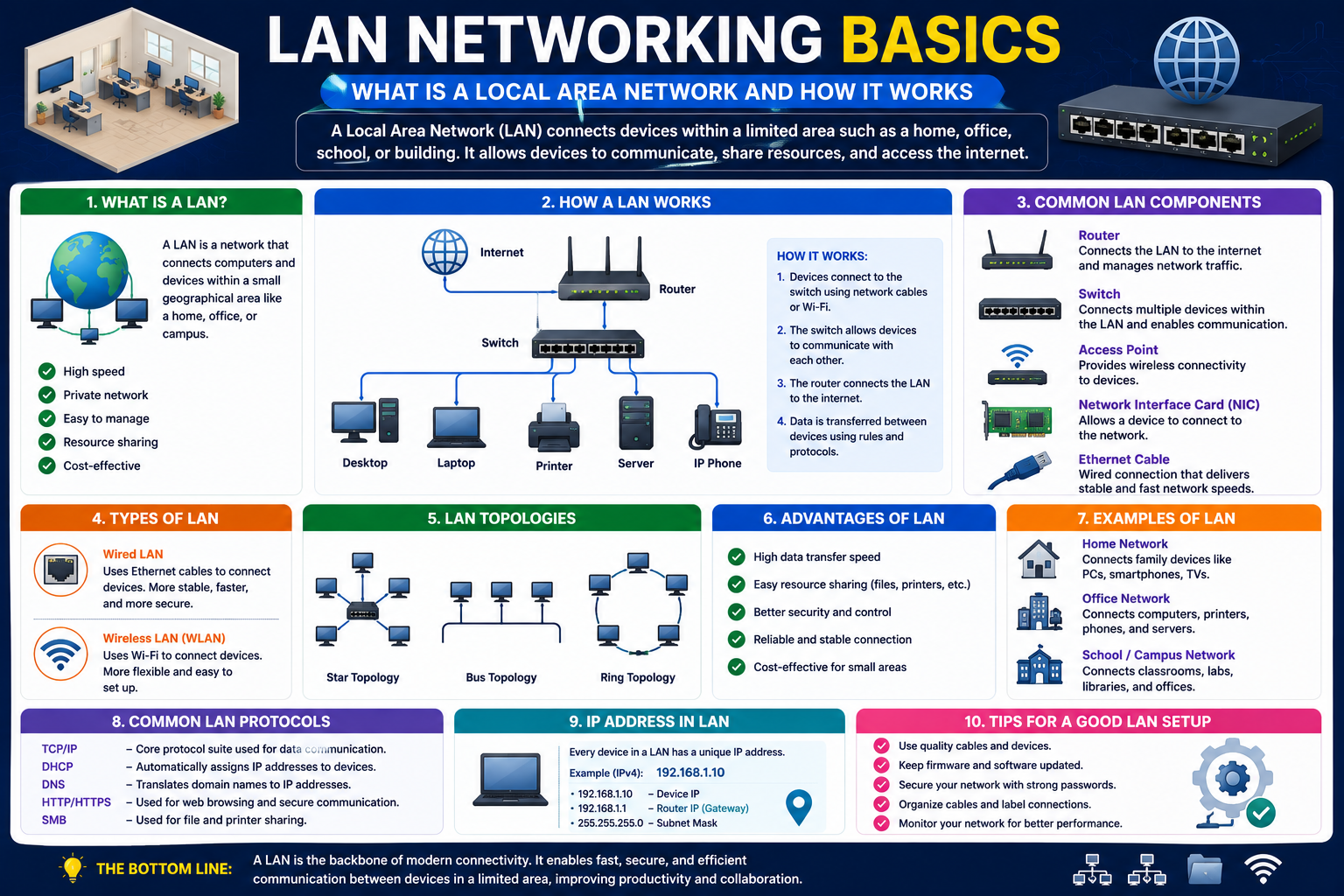
A Local Area Network (LAN) is one of the most fundamental concepts in computer networking, forming the backbone of communication in homes, schools, offices, and many other environments. At its core, a LAN is a system that connects multiple computing devices within a limited geographic area so they can communicate and share resources efficiently. This area could be as small as a single room or as large as a corporate campus, but it remains geographically restricted compared to wide-scale networks like the internet.
A LAN enables devices such as computers, printers, scanners, servers, and smartphones to interact seamlessly. Instead of each device operating independently, they become part of a unified network where data and resources can be shared quickly and securely. This interconnected environment significantly reduces redundancy and improves operational efficiency.
Over time, LAN technology has evolved alongside advancements in networking hardware and communication protocols. Early LANs were simple and limited in speed and capability, but modern LANs support high-speed data transfer, multimedia streaming, cloud connectivity, and enterprise-level applications. Today, LANs are essential for both personal and organizational computing environments.
Core Components That Form a LAN
A functional LAN depends on several interconnected components that work together to enable communication and resource sharing. Each component plays a specific role in ensuring that data flows smoothly between devices.
At the heart of most LANs is a networking device often referred to as a switch. A switch connects multiple devices within the network and directs data only to the intended recipient rather than broadcasting it to all devices. This improves efficiency and reduces unnecessary network traffic. In larger networks, additional devices such as routers are used to connect the LAN to external networks like the internet. A router acts as a gateway, managing traffic between internal devices and external destinations.
Another essential component is the Network Interface Card (NIC), which is installed in every device that connects to the LAN. The NIC allows devices to send and receive data over the network by converting digital signals into a format suitable for transmission.
Cabling and wireless access points are also crucial. Wired LANs typically use Ethernet cables, while wireless LANs rely on access points to transmit signals. The standard used for wired connections is Ethernet, which provides reliable and high-speed data transmission.
In modern environments, wireless connectivity is equally important. Wi-Fi allows devices to connect without physical cables, offering flexibility and mobility within the network.
Finally, IP addressing systems ensure that every device within the LAN has a unique identity. This allows data packets to be correctly delivered to the intended destination.
How Data Moves Within a LAN
The movement of data within a LAN is based on structured communication rules that ensure accuracy, speed, and reliability. When a device sends information, it is broken down into smaller units known as data packets. These packets travel through the network and are reassembled at their destination.
One of the most important protocols governing this process is TCP/IP. This set of communication rules ensures that data is transmitted reliably between devices, whether they are on the same network or across the internet. TCP handles the delivery and ordering of packets, while IP is responsible for addressing and routing them.
Within a LAN, switches play a key role in directing traffic efficiently. When a packet arrives at a switch, it examines the destination address and forwards the data only to the appropriate device. This reduces unnecessary traffic and improves performance.
Routers become essential when data needs to leave the LAN and reach external networks. They analyze destination IP addresses and determine the best path for data transmission.
Wireless LANs operate similarly but rely on radio signals instead of cables. Access points transmit and receive data, allowing devices like laptops and smartphones to communicate without physical connections.
Overall, LAN communication is designed to be fast, organized, and efficient, ensuring minimal delays even when multiple devices are actively exchanging data.
Types and Architectures of LAN
LANs can be categorized based on their structure, communication method, and design architecture. Understanding these types helps in selecting the right configuration for specific environments.
One of the most common distinctions is between wired and wireless LANs. Wired LANs use physical cables such as Ethernet to connect devices, offering high speed and stability. Wireless LANs rely on radio signals, providing mobility and ease of installation but sometimes sacrificing speed or consistency depending on interference.
Another classification is based on architecture: peer-to-peer and client-server models. In a peer-to-peer LAN, all devices have equal status and can share resources directly with one another. This model is simple and suitable for small networks. In contrast, a client-server architecture centralizes control, where a dedicated server manages resources and provides services to client devices. This model is widely used in businesses due to its scalability and security.
LANs can also vary in topology, which refers to the physical or logical arrangement of devices. Common topologies include star, bus, and ring structures. The star topology is the most widely used today, where all devices connect to a central switch or hub, improving fault tolerance and ease of management.
Each LAN type and architecture is chosen based on factors such as network size, performance requirements, budget, and security considerations.
Advantages and Real-World Applications of LAN
LANs provide numerous benefits that make them essential in modern digital environments. One of the most significant advantages is resource sharing. Devices connected within a LAN can share printers, storage systems, applications, and internet connections, reducing costs and improving efficiency.
Another key advantage is high-speed communication. Because LANs cover limited distances, they typically offer faster data transfer rates compared to wide-area networks. This makes them ideal for environments where quick access to data is critical.
LANs also improve collaboration. In office environments, employees can easily share files, communicate, and work on shared projects in real time. Centralized data storage systems allow for better organization and backup management.
Security is another important benefit. LANs can be controlled internally, allowing administrators to manage access permissions, monitor traffic, and protect against unauthorized access.
In real-world applications, LANs are used extensively in educational institutions, businesses, hospitals, and government organizations. Schools use LANs to connect computer labs, administrative systems, and digital learning platforms. Businesses rely on LANs for internal communication, data processing, and operational management. Homes also use LANs to connect smart devices, gaming systems, and internet-enabled appliances.
Challenges and Maintenance Considerations
Despite their advantages, LANs also come with certain challenges that require proper planning and maintenance. One major issue is scalability. As the number of connected devices increases, the network must be expanded with additional hardware such as switches and routers. Without proper planning, performance can degrade due to congestion.
Security is another concern. Although LANs are more secure than public networks, they are still vulnerable to internal threats, unauthorized access, and malware if not properly protected. Firewalls, encryption, and access control policies are essential for maintaining security.
Network congestion can also occur when too many devices attempt to use the network simultaneously. This can lead to delays and reduced performance. Proper bandwidth management and network segmentation help address this issue.
Maintenance is an ongoing requirement for LANs. Devices must be updated regularly, cables checked for damage, and configurations optimized to ensure smooth operation. Troubleshooting skills are also important for identifying and resolving connectivity issues quickly.
Proper design and regular monitoring are essential for maintaining a stable and efficient LAN environment.
Additionally, LAN technology continues to evolve with increasing demands for speed, reliability, and scalability. Modern LANs are now integrating advanced features such as virtualization, cloud connectivity, and software-defined networking, which allow administrators to manage networks more efficiently and flexibly. These improvements make it easier to adapt LAN infrastructures to changing organizational needs without significant physical upgrades.
Conclusion
A Local Area Network (LAN) remains one of the most important building blocks of modern communication systems. It enables devices within a limited area to connect, share data, and access shared resources efficiently and securely. From homes to large enterprises, LANs form the foundation of digital interaction by supporting everything from simple file sharing to complex enterprise applications.
The strength of a LAN lies in its ability to combine multiple technologies such as switches, routers, and communication protocols into a unified system. With the support of structured communication standards like TCP/IP and transmission technologies such as Ethernet and Wi-Fi, LANs deliver fast and reliable connectivity that meets the demands of today’s digital environments.
Beyond connectivity, LANs improve productivity by enabling collaboration, reducing operational costs, and centralizing resource management. They also enhance security by allowing controlled access to internal systems and data. However, effective LAN management requires careful planning, regular maintenance, and attention to scalability and security challenges.
As technology continues to evolve, LANs will remain essential in supporting emerging innovations such as cloud computing, smart devices, and automated systems. Understanding how LANs function provides a strong foundation for anyone looking to explore networking, whether for academic purposes or real-world applications in professional environments.