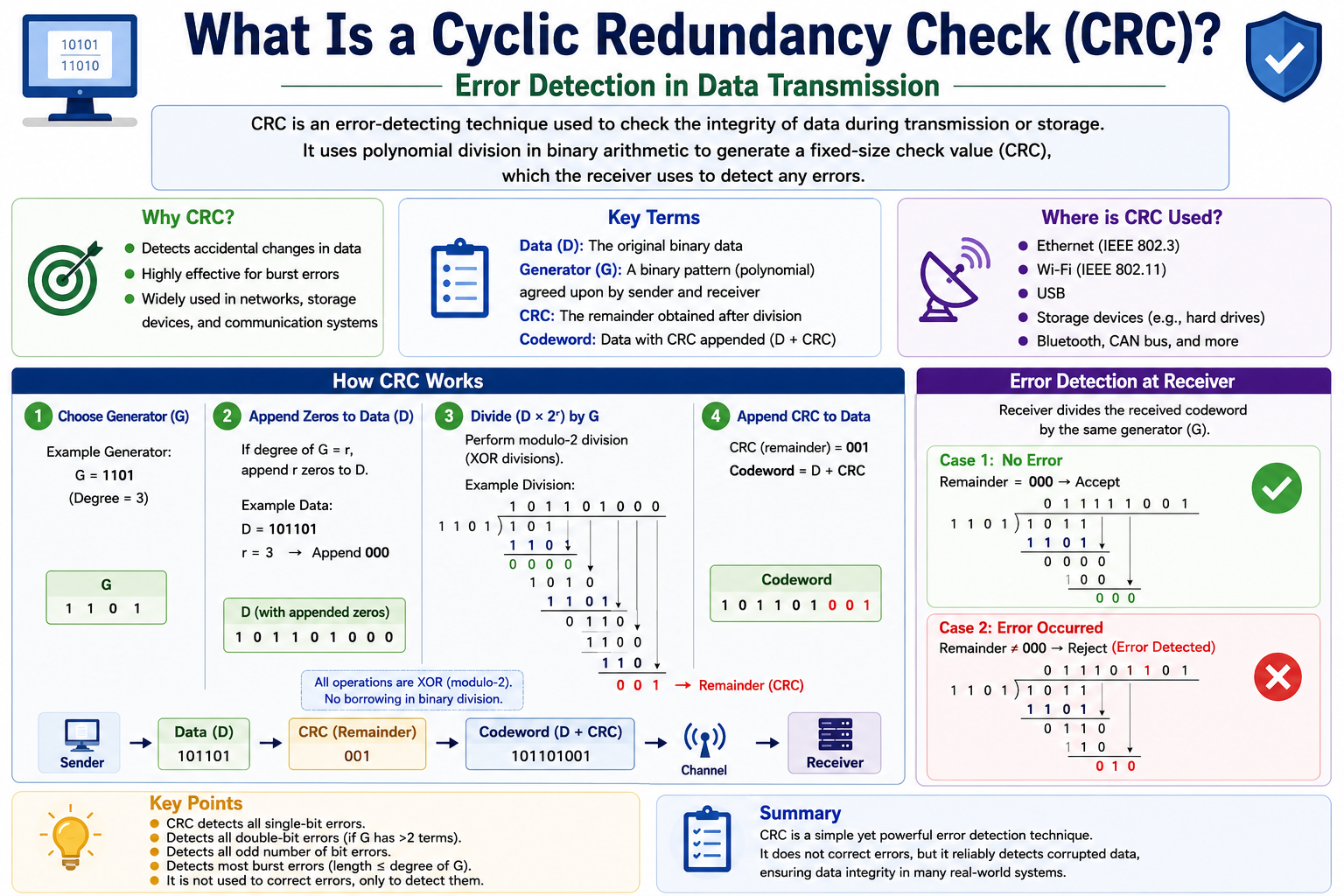
A Cyclic Redundancy Check, commonly known as CRC, is a widely used error-detection technique in digital communication systems. Its primary purpose is to ensure that data transmitted from one device reaches another without corruption or unintended modification. In simple terms, CRC helps verify whether the information received is exactly the same as the information sent.
When data moves across networks—whether through cables, wireless signals, or storage systems—it can sometimes get altered due to interference, hardware issues, or transmission faults. CRC acts as a safeguard against these issues by attaching a calculated value, known as a checksum, to the original data. This checksum allows the receiving system to check if the data remains intact.
To understand CRC in a practical sense, imagine sending a sealed box through a courier service. Before shipping, you record the weight and seal the box with tamper-evident tape. When the box arrives, the recipient checks the weight and seal. If anything differs, it indicates possible tampering or damage. CRC performs a similar role, but in a mathematical and digital form rather than a physical one.
At its core, CRC is not about correcting errors but detecting them. Once an error is detected, the system can request retransmission of the data or take corrective measures depending on the communication protocol in use.
The Core Working Principle of CRC in Digital Systems
CRC operates using binary mathematics, specifically polynomial division. While the underlying calculations are complex, the concept is straightforward: the data being transmitted is treated like a long binary number, and a predefined mathematical formula is applied to generate a checksum.
This checksum is appended to the original data before transmission. When the data arrives at its destination, the same calculation is performed again. If the newly generated checksum matches the one that was sent, the data is considered valid. If not, an error is detected.
The strength of CRC lies in its ability to detect even small changes in data. A single altered bit during transmission can produce a completely different checksum. This makes CRC highly reliable for detecting accidental corruption.
Unlike simple error checks such as parity bits, CRC is much more robust because it considers patterns of bits rather than just counting ones or zeros. This allows it to detect more complex errors, including burst errors where multiple consecutive bits are affected.
In modern communication systems, CRC is embedded in almost every layer of data transmission, from network packets to storage devices, ensuring consistent integrity checks throughout digital environments.
Understanding CRC Algorithms and Their Variants
CRC is not a single fixed method but a family of algorithms that vary in complexity and strength. The most commonly used versions include CRC-8, CRC-16, and CRC-32. Each version differs in the size of the checksum it generates and the level of error detection capability it provides.
CRC-8 generates an 8-bit checksum, making it lightweight and fast but less reliable for detecting complex errors. It is often used in simple embedded systems where processing power is limited.
CRC-16 produces a 16-bit checksum, offering a balance between speed and reliability. It is widely used in communication protocols where moderate error detection is sufficient.
CRC-32 generates a 32-bit checksum and is one of the most robust forms of CRC. It is commonly used in networking protocols, file verification systems, and data storage applications due to its high accuracy in detecting errors.
The choice of CRC algorithm depends on a tradeoff between performance and reliability. Smaller CRCs require less computational power but are more prone to collisions, where different data produces the same checksum. Larger CRCs reduce this risk significantly but require more processing resources.
A collision does not necessarily mean data corruption has gone undetected in every case, but it represents a theoretical limitation of any checksum-based system. The larger the checksum space, the lower the probability of such collisions occurring.
CRC in Network Communication and Data Integrity
In networking environments, CRC plays a crucial role in ensuring that data packets are transmitted accurately between devices. Every time data is sent over a network, it is broken into smaller units called frames or packets. Each of these packets includes a CRC value.
When a packet arrives at its destination, the receiving device recalculates the CRC value using the same algorithm. If the calculated value matches the transmitted value, the packet is accepted. If not, the packet is discarded or flagged for retransmission.
This process is essential because network transmissions are exposed to a wide range of potential disruptions. Electrical interference, signal degradation, faulty cables, or hardware malfunctions can all introduce errors into transmitted data.
CRC helps identify these issues quickly by detecting inconsistencies in data integrity. This is especially important in high-speed networks where even minor errors can lead to significant performance degradation or data loss.
Beyond simple error detection, CRC also contributes to network monitoring. Repeated CRC mismatches may indicate deeper issues such as failing network hardware or environmental interference affecting transmission quality. Network administrators often monitor CRC error rates to identify and resolve these underlying problems before they escalate.
In secure communication environments, CRC also plays an indirect role in detecting potential tampering. While it is not designed as a security mechanism, mismatched checksums can sometimes indicate unauthorized modification of data during transmission.
Causes of CRC Errors and Their Impact on Systems
CRC errors occur when the checksum calculated at the receiving end does not match the checksum sent with the data. These errors can arise from various physical and technical factors.
One of the most common causes is electrical interference. Network cables and wireless signals can be affected by nearby electronic devices, power lines, or radio frequency interference. This interference can distort signals and lead to corrupted data.
Faulty or damaged cables are another major source of CRC errors. Physical wear and tear, bent connectors, or poor-quality wiring can disrupt the smooth flow of data, causing bits to flip or drop during transmission.
Hardware issues within networking devices can also contribute to CRC errors. For example, a malfunctioning network interface card or overheating equipment may fail to process data correctly, resulting in mismatches during checksum verification.
When CRC errors occur frequently, they can have serious consequences. Packet loss becomes more common, leading to reduced network performance. Applications may experience delays, interruptions, or complete failure in data transfer.
In critical systems, persistent CRC errors can lead to downtime and operational disruption. This is why continuous monitoring and maintenance of network infrastructure are essential for maintaining reliable communication.
Understanding the root cause of CRC errors allows system administrators to take corrective action, whether by replacing faulty hardware, improving cable management, or reducing environmental interference.
The Role of CRC in Modern Digital Reliability
CRC has become a foundational element of digital reliability across computing systems. It is used not only in networking but also in storage devices, file transfers, and communication protocols.
In storage systems such as hard drives and SSDs, CRC helps ensure that data remains intact when read from or written to memory. If corruption is detected, systems can attempt recovery or request retransmission from backup sources.
In file transfers, CRC or similar checksum mechanisms verify that downloaded files are identical to the original versions. This prevents corrupted or incomplete files from being used, which could otherwise lead to software failures or security vulnerabilities.
CRC is also embedded in communication standards across various technologies, including Ethernet, wireless networks, and industrial communication systems. Its widespread adoption highlights its efficiency and reliability in maintaining data integrity.
One of the key strengths of CRC is its simplicity combined with effectiveness. It does not require complex encryption or heavy processing, making it suitable for real-time systems where speed is essential.
Despite the emergence of more advanced error-detection and correction methods, CRC remains widely used due to its balance of performance, accuracy, and computational efficiency.
Conclusion
Cyclic Redundancy Check is one of the most important mechanisms used in digital communication systems to maintain data integrity. By generating a mathematical checksum for transmitted data and verifying it at the receiving end, CRC ensures that any form of corruption or alteration during transmission is quickly identified. This makes it an essential component in networking, storage systems, and data transfer technologies.
The strength of CRC lies in its simplicity and reliability. It provides fast error detection without requiring heavy computational resources, making it suitable for both small-scale devices and large network infrastructures. Although it does not correct errors directly, it plays a crucial role in triggering retransmissions or corrective processes when inconsistencies are detected.
From network cables to wireless signals and storage devices, CRC operates silently in the background, safeguarding the accuracy of digital communication. Its ability to detect even minor data changes makes it indispensable in maintaining trust and consistency in modern computing systems.
As digital communication continues to expand, CRC remains a foundational technology that supports stable, reliable, and efficient data exchange across virtually every connected system, ensuring accuracy, integrity, and consistent performance worldwide.