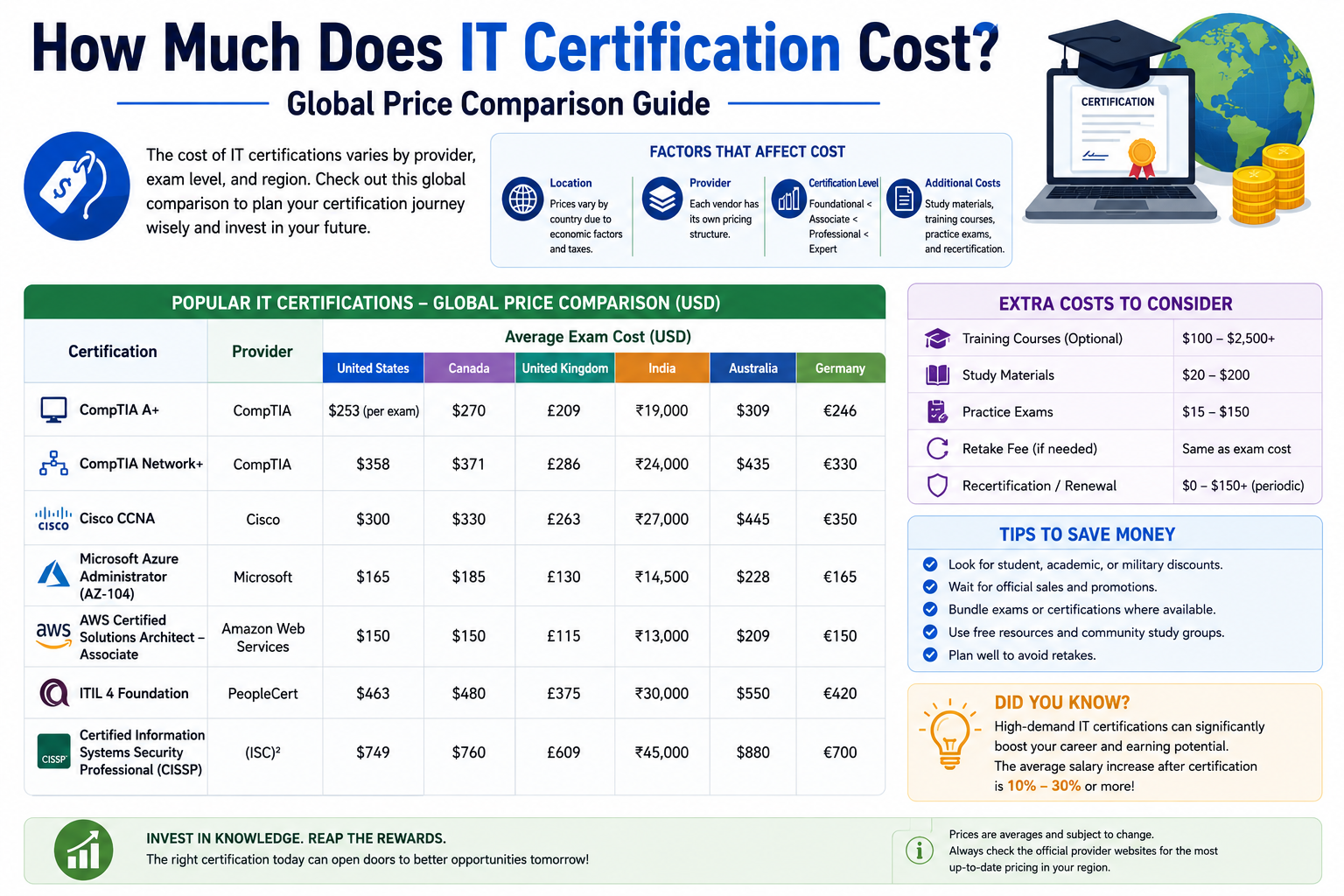
IT certifications have become one of the most recognized ways to validate technical skills in the modern technology landscape. They are widely used by professionals to demonstrate expertise in networking, cloud computing, cybersecurity, system administration, and many other areas. However, one of the most common questions people ask before starting this journey is how much these certifications actually cost and what factors influence their pricing.
The reality is that IT certification costs are not fixed. They vary widely depending on the vendor, the difficulty level of the certification, and the depth of knowledge required. Some entry-level exams may cost less than a hundred dollars, while advanced expert-level certifications can reach several thousand dollars per attempt. This wide range often surprises beginners who assume certification pricing is more standardized.
Another important aspect to understand is that the exam fee is only part of the total investment. While it represents the official cost set by certification providers, candidates often spend additional money on preparation materials, practice environments, and sometimes multiple exam attempts. These indirect costs can significantly increase the overall financial commitment.
Despite these variations, certification pricing generally follows a predictable structure. Entry-level certifications are the most affordable because they are designed to introduce foundational concepts. Intermediate certifications cost more due to their broader scope and technical depth. Expert-level certifications are the most expensive because they require advanced knowledge, hands-on skills, and often complex practical exams.
Understanding this structure helps learners plan their certification journey more effectively. It also allows professionals to choose certifications that match both their career goals and financial capacity.
Entry-Level IT Certifications and Their Cost Structure
Entry-level IT certifications are designed for beginners who are new to the field or transitioning from non-technical backgrounds. These certifications typically focus on foundational concepts such as basic networking, hardware understanding, cloud fundamentals, or introductory cybersecurity principles. Because they are meant to be accessible, they are usually priced at the lower end of the certification spectrum.
In many cases, entry-level certifications range from around one hundred to a few hundred dollars. This pricing reflects the fact that they do not require extensive prior experience or advanced technical knowledge. The exams are generally shorter and less complex compared to higher-level certifications, making them more affordable to administer and evaluate.
Despite their lower cost, entry-level certifications play a crucial role in career development. They act as stepping stones toward more advanced qualifications and help candidates build confidence in their technical abilities. Employers often view them as proof that a candidate has a solid understanding of fundamental IT concepts.
Another reason these certifications are relatively inexpensive is their accessibility. They are designed to attract a large number of learners, including students and career changers. Keeping the price affordable encourages more people to enter the IT field, which helps address the global demand for skilled professionals.
However, even though the exam fee is low, candidates should still consider preparation costs. Study guides, online learning platforms, and practice labs can add to the overall expense. For beginners, these resources are often essential for passing the exam on the first attempt.
Entry-level certifications are not just about affordability; they are about accessibility and opportunity. They provide a starting point for individuals who want to build a long-term career in information technology without facing a significant financial barrier at the beginning.
Intermediate and Professional Certification Costs Across Major Vendors
As professionals progress in their careers, they often pursue intermediate or professional-level certifications. These certifications are significantly more expensive than entry-level exams because they cover advanced technical concepts and require deeper practical understanding.
At this level, certification costs typically range from a few hundred dollars to around seven hundred dollars per exam, depending on the provider and specialization. The increased price reflects both the complexity of the exam content and the value it delivers in the job market.
Networking certifications from major vendors, for example, often fall into this category. These certifications test knowledge in areas such as routing, switching, security, and enterprise infrastructure. They are widely recognized in the industry and are often required for mid-level IT roles.
Cloud certifications also fall into the professional category and have become increasingly important due to the widespread adoption of cloud technologies. These certifications assess skills in cloud architecture, deployment, and management. Their pricing reflects the high demand for cloud professionals in the global job market.
Another factor influencing cost at this level is exam structure. Many professional certifications require candidates to pass multiple exams or modules. In such cases, the total cost includes each individual exam fee, which can increase the overall investment significantly.
Despite the higher cost, professional certifications are often considered worthwhile because they directly impact earning potential and job opportunities. Employers value these certifications as they demonstrate both theoretical knowledge and practical ability.
In addition to exam fees, candidates at this level often invest more in structured training programs and hands-on labs. This is because professional certifications require not just memorization but real-world problem-solving skills.
Expert-Level Certifications and Their High Financial Commitment
Expert-level IT certifications represent the highest tier of technical validation in the industry. These certifications are designed for highly experienced professionals who already have years of practical exposure in their respective fields. As expected, they come with the highest costs.
In many cases, expert-level certifications can cost over two thousand dollars per attempt, and in some cases even more when multiple exam components are required. These certifications often include both written exams and practical lab-based assessments, which significantly increases their complexity and cost.
The high price is primarily due to the advanced nature of the evaluation process. Candidates are not only tested on theoretical knowledge but also on their ability to design, configure, troubleshoot, and manage complex systems under real-world conditions. This level of assessment requires sophisticated testing environments and expert evaluation, both of which contribute to the cost.
Another important factor is accessibility. Expert-level certifications are often limited in availability, with fewer testing centers or scheduled lab sessions. This logistical limitation can also increase associated travel and accommodation expenses, adding to the total financial burden.
Despite the high cost, these certifications are highly respected in the IT industry. They often serve as benchmarks for senior engineering roles and leadership positions in technical teams. Many professionals consider them long-term career investments rather than short-term expenses.
It is also common for candidates to attempt these exams multiple times before passing, which can significantly increase total costs. This makes preparation extremely important, as each attempt represents a substantial financial commitment.
Additional Costs Beyond Exam Fees
While exam fees are the most visible part of certification pricing, they are not the only expense candidates should consider. In fact, the total cost of earning an IT certification can be much higher once additional factors are included.
One of the most significant additional costs is study material. Candidates often rely on books, digital courses, video lectures, and practice exams to prepare effectively. These resources can vary in price depending on their depth and quality, and over time they can add up to a substantial amount.
Another hidden cost is hands-on practice. Many certifications require practical experience, which often means setting up virtual labs or using cloud environments. While some tools are free, others may require paid subscriptions or usage fees.
Retake fees are another important consideration. If a candidate does not pass the exam on the first attempt, they must pay the full exam fee again. This makes proper preparation essential, especially for higher-level certifications where costs are significantly higher.
Travel and accommodation can also become major expenses, particularly for advanced certifications that require in-person lab exams. In such cases, candidates may need to travel to designated testing centers, sometimes in different cities or countries.
Time investment should also be considered as an indirect cost. Preparing for certification exams often requires weeks or months of dedicated study, which may impact work schedules or personal time.
When all these factors are combined, the total cost of certification can be much higher than the exam fee alone. This is why careful planning is essential before beginning any certification journey.
Conclusion
The cost of IT certifications varies widely depending on the level, vendor, and complexity of the exam. Entry-level certifications remain relatively affordable, making them accessible to beginners entering the IT field. Professional certifications require a higher financial commitment due to their advanced nature and industry relevance. Expert-level certifications represent the highest investment, often involving complex exams, practical labs, and additional travel expenses.
Beyond exam fees, candidates must also consider preparation materials, retake costs, and time investment, all of which contribute to the total expense. While these costs can add up, they reflect the value and credibility that certifications bring to a professional career.
Despite the financial commitment, IT certifications continue to play a critical role in career advancement, skill validation, and professional recognition. They remain one of the most structured and widely accepted methods for proving technical expertise in the global technology industry.