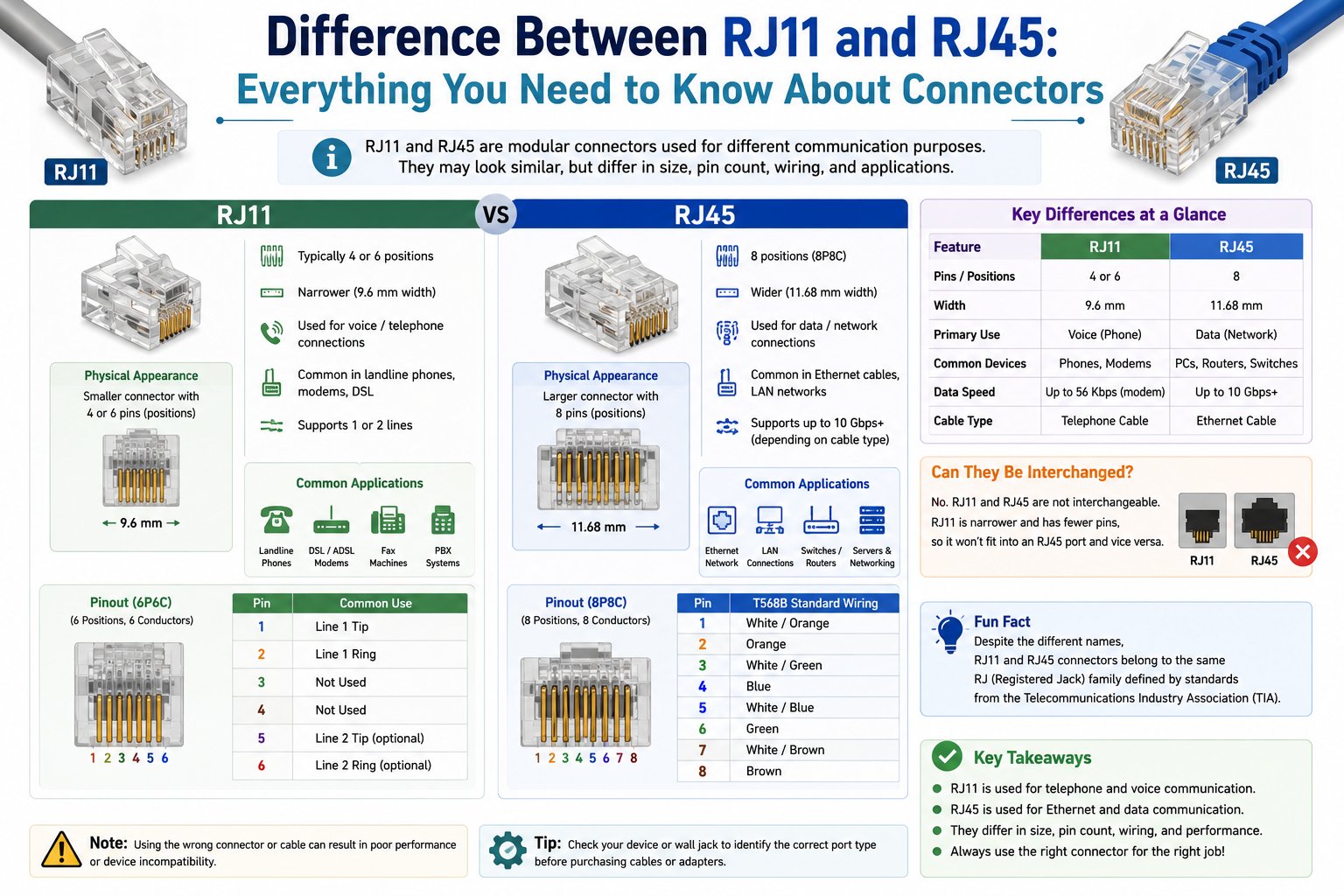
Understanding the difference between RJ11 and RJ45 connectors is essential in both networking and everyday communication systems. Although these two connectors often look similar at first glance, they serve entirely different purposes and operate in very different technological environments. RJ11 is primarily associated with traditional telephone systems, while RJ45 is the standard connector used in modern Ethernet networks.
In a world where digital communication dominates almost every aspect of life, knowing how these connectors function helps in understanding how voice and data travel through physical cables. From home internet setups to enterprise-level networking infrastructures, RJ45 plays a central role, while RJ11 remains relevant in legacy telephone systems and specific communication setups. This article explores both connectors in detail, explaining their structure, function, usage, and key differences in a clear and accessible way.
Understanding RJ11: The Traditional Telephone Connector
RJ11 is one of the oldest and most widely recognized connectors in telecommunications. It is primarily used for analog voice communication, most commonly in landline telephone systems. The term RJ11 refers to a Registered Jack standard that was developed to support simple voice transmission over copper telephone lines.
Physically, RJ11 connectors are small and typically use a 6-position modular plug, although usually only 2 or 4 wires are actually connected. This limited wiring structure is sufficient for transmitting analog voice signals, which do not require the high bandwidth needed for digital data transfer. Because of this, RJ11 is ideal for basic voice communication rather than complex data transmission.
The way RJ11 works is rooted in analog signal transmission. When a person speaks into a telephone handset, their voice is converted into an electrical analog signal. This signal travels through twisted copper wires and is received by another telephone, where it is converted back into sound. This process is continuous and wave-based, meaning the signal closely resembles the original sound waveform without being broken into digital units.
RJ11 is commonly associated with Plain Old Telephone Service (POTS), a system that has been in use for decades. Even though modern communication technologies have largely replaced analog systems, RJ11 is still found in many households, office buildings, elevators, security systems, and fax machines. It remains useful in environments where simple voice communication is sufficient or where legacy infrastructure is still in place.
One of the key limitations of RJ11 is its inability to handle high-speed data. Since it was designed specifically for voice transmission, it lacks the wiring capacity and shielding required for modern internet communication. However, its simplicity and reliability have allowed it to remain in use for basic communication needs.
Understanding RJ45: The Standard for Modern Ethernet Networks
RJ45 is the most widely used connector in modern networking environments. It is primarily associated with Ethernet connections, which are used to transmit digital data between computers, routers, switches, and other network devices. Unlike RJ11, RJ45 is designed specifically for high-speed digital communication.
RJ45 connectors use an 8-position, 8-pin configuration, which allows for four twisted pairs of wires inside an Ethernet cable. These cables are typically categorized as Cat5, Cat5e, Cat6, or higher, depending on their performance capabilities. The additional wiring capacity allows RJ45 to support significantly higher data transfer speeds and improved signal stability.
At the core of RJ45 communication is digital signaling. Instead of transmitting continuous waveforms like analog systems, RJ45-based Ethernet networks use binary data—represented as ones and zeros. These binary signals are transmitted as voltage changes over copper wires. This allows computers and network devices to interpret data accurately and efficiently.
One of the key advantages of RJ45 is its ability to support high-speed internet connections. It is commonly used in Local Area Networks (LANs), connecting devices within homes, offices, data centers, and enterprise environments. Whether it is connecting a computer to a router or linking multiple switches in a large network, RJ45 is the standard connector.
RJ45 also benefits from improved noise reduction techniques. The twisted pair design of Ethernet cables helps minimize electromagnetic interference and crosstalk, ensuring stable and reliable data transmission. This is essential in environments where multiple electronic devices operate in close proximity.
In addition to computers and networking equipment, RJ45 is also used in VoIP phones, security cameras, gaming consoles, and smart devices. Its versatility and high performance make it a foundational component of modern digital infrastructure.
Key Differences Between RJ11 and RJ45
Although RJ11 and RJ45 connectors may appear similar in shape, their internal structure, function, and application are significantly different. Understanding these differences is crucial for anyone working with networking or communication systems.
One of the most noticeable differences is physical size and pin configuration. RJ11 connectors are smaller and typically use 2 to 4 wires, while RJ45 connectors are larger and contain 8 wires. This difference directly affects their capabilities. RJ11 is limited to low-bandwidth analog signals, while RJ45 supports high-speed digital data transmission.
Another major difference lies in the type of signal each connector carries. RJ11 is designed for analog voice communication, which involves continuous wave signals that represent sound. This makes it suitable for telephone conversations but not for digital data processing. RJ45, on the other hand, transmits digital signals in binary form. These signals are structured and can be processed by computers and network devices.
Speed and performance also separate the two connectors. RJ11 connections are relatively slow and are not suitable for internet browsing or streaming. They are designed only for voice communication and limited data services like DSL in some cases. RJ45 supports significantly higher speeds, often ranging from hundreds of megabits to multiple gigabits per second, depending on the cable category and network equipment.
Another important difference is their usage environment. RJ11 is mostly found in older communication systems and landline telephone networks. It is commonly used in residential phone lines and legacy communication equipment. RJ45 is used in modern networking environments, including home internet setups, corporate networks, and data centers.
Compatibility is also a key distinction. RJ45 connectors cannot be properly used in RJ11 ports due to size and pin differences. However, RJ11 connectors can sometimes physically fit into RJ45 ports, but they do not function correctly and may damage network performance if used improperly.
The wiring structure further highlights the difference. RJ11 typically uses a simple two-wire system for basic communication, while RJ45 uses four twisted pairs that allow for complex data transmission with error correction and signal stability features.
These differences make it clear that RJ11 and RJ45 are not interchangeable, even though they may appear similar to the untrained eye.
Practical Applications of RJ11 and RJ45 in Everyday Life
RJ11 and RJ45 connectors continue to play important roles in different areas of communication technology, even though their usage has evolved over time.
RJ11 is still commonly used in traditional telephone systems. Many households still rely on landline phones, especially in regions where mobile coverage is limited or unreliable. RJ11 is also used in fax machines, alarm systems, and certain security devices. In some rural areas, DSL internet services still rely on telephone lines using RJ11-based infrastructure, although this is gradually becoming less common.
RJ45, on the other hand, dominates modern networking. It is the backbone of internet connectivity in homes, offices, schools, and data centers. Every wired internet connection typically relies on RJ45 connectors to link devices to routers or switches. This ensures stable and high-speed communication between devices.
In professional environments, RJ45 is essential for building Local Area Networks (LANs). It allows multiple computers to communicate, share resources, and access centralized servers. This makes it a critical component in business operations, cloud computing infrastructure, and enterprise systems.
RJ45 is also widely used in smart technology. Devices such as IP cameras, smart TVs, gaming consoles, and VoIP phones rely on Ethernet connections for reliable performance. In environments where wireless signals may be unstable, RJ45 provides a more secure and consistent connection.
While RJ11 continues to serve limited legacy functions, RJ45 has become the standard for all modern digital communication. Its ability to support high-speed data transfer makes it indispensable in today’s connected world.
Conclusion
RJ11 and RJ45 connectors represent two distinct stages in the evolution of communication technology. RJ11 belongs to an earlier era of analog voice communication, where simplicity and basic functionality were the primary requirements. It was designed to support landline telephones and other low-bandwidth communication devices, and it continues to serve these limited purposes in certain environments today. Its structure, with fewer pins and a smaller size, reflects its narrow focus on transmitting voice signals rather than complex data.
RJ45, in contrast, represents the modern standard for digital networking. Built with eight pins and multiple twisted wire pairs, it is capable of supporting high-speed Ethernet connections and complex digital communication. It plays a central role in internet connectivity, powering everything from home networks to large-scale enterprise systems. Its ability to transmit binary data efficiently makes it essential in today’s digital infrastructure.
Although both connectors may appear similar, their functions are fundamentally different and not interchangeable. RJ11 remains relevant in legacy systems, while RJ45 continues to expand with advancements in networking technology. Together, they illustrate the transition from analog communication to the digital, interconnected world we rely on today.