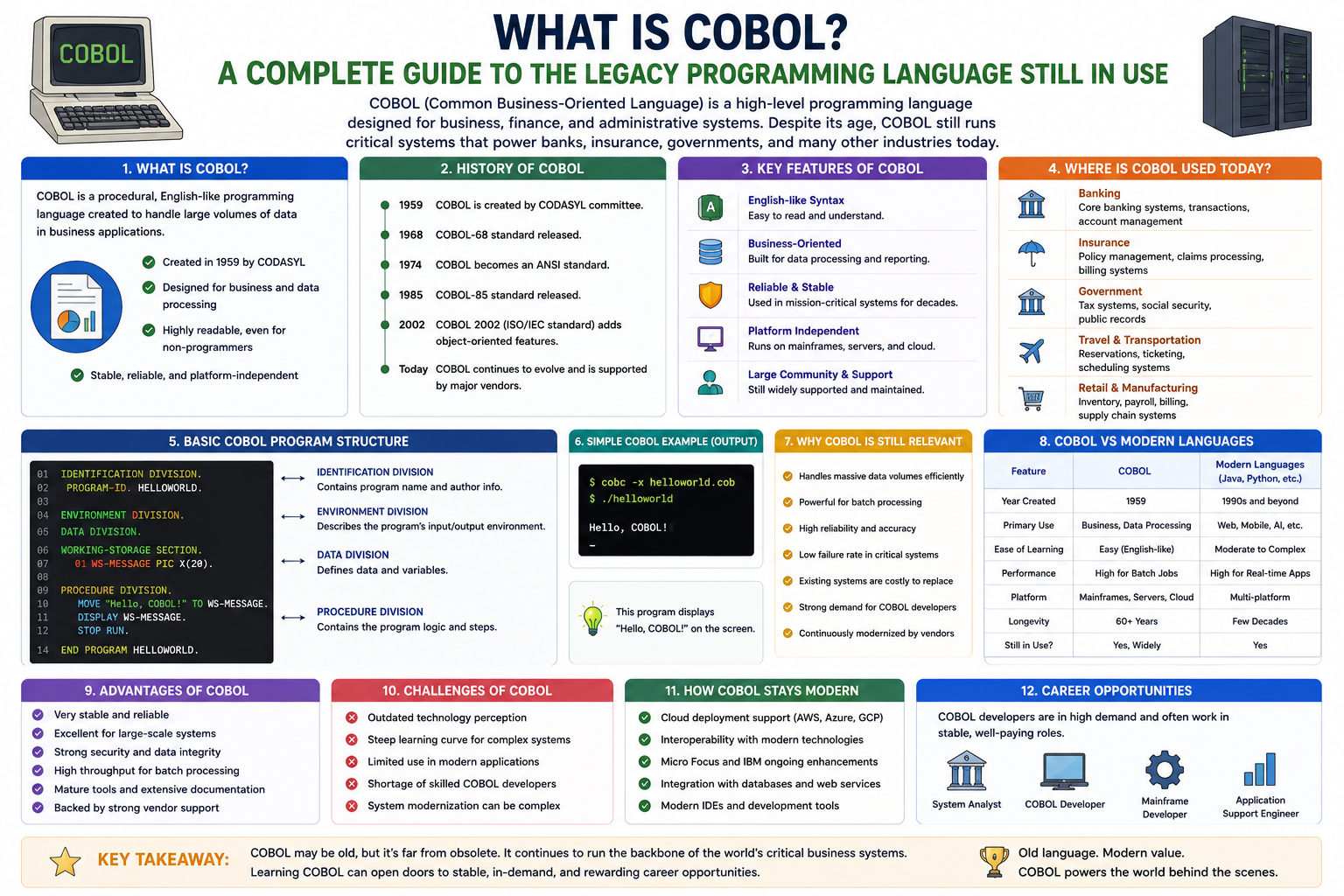
COBOL, short for Common Business-Oriented Language, was created in 1959 during a time when computers were becoming increasingly important to governments and large organizations. The goal behind its design was simple but powerful: to create a programming language that business professionals—not just mathematicians or engineers—could understand and rely on.
Unlike many modern programming languages that focus on compact syntax or technical elegance, COBOL was designed with readability as its core principle. Its structure closely resembles plain English, allowing instructions to be written in a way that feels almost like business documentation. This made it especially appealing to organizations that needed reliable systems but did not necessarily have large teams of highly specialized programmers.
At its core, COBOL is a procedural language. This means it operates step by step, with each instruction executed in a specific order. Instead of focusing on abstract data models or reusable objects, COBOL programs explicitly describe how tasks should be carried out from start to finish. This approach made it easier for early developers and business analysts to collaborate, since the logic of the program often mirrored real-world business processes such as payroll, inventory tracking, or financial transactions.
One of the defining features of COBOL is its strict structure. Every part of a program must be clearly defined, including how data is stored, what format it follows, and how it should be processed. While this level of detail can feel rigid compared to modern languages, it also reduces ambiguity, which is critical in systems where accuracy is essential. Even a small mistake, such as a missing punctuation mark, can cause the program to fail. This strictness reflects COBOL’s focus on stability and predictability rather than flexibility.
Over time, COBOL became deeply embedded in large-scale systems, particularly in industries that require high-volume, high-reliability processing. Banks, insurance companies, and government agencies adopted it widely because it could handle large amounts of data consistently and efficiently. Once these systems were built, they were rarely replaced due to the enormous cost and risk involved in rewriting them.
Today, despite being more than six decades old, COBOL continues to operate quietly behind the scenes of many critical systems. While newer languages have emerged with more modern features and broader capabilities, COBOL remains deeply integrated into infrastructure that cannot afford failure.
Why COBOL Systems Still Run Critical Industries Today
Although COBOL is considered a legacy programming language, its presence in modern systems is still remarkably strong. Many industries continue to depend on it not because it is modern, but because it is deeply embedded in systems that are extremely difficult to replace.
One of the most significant areas where COBOL remains essential is banking. A large portion of financial transaction processing still relies on COBOL-based systems. Every day, millions of ATM withdrawals, deposits, transfers, and account updates are processed through these systems. These operations require extreme reliability, as even a small error could result in financial discrepancies affecting thousands or even millions of customers.
Insurance companies are another major user of COBOL. These organizations handle vast amounts of structured data, including policy records, claims processing, and customer histories. COBOL’s ability to process large datasets consistently makes it well-suited for these tasks, even though the underlying technology is considered outdated by modern standards.
Government systems also rely heavily on COBOL. Many public services, tax systems, and social benefit programs were built decades ago using COBOL and continue to function today. Replacing these systems is not a simple task. They often contain millions of lines of code that have evolved over time through continuous updates and patches. In many cases, the original developers are no longer available, and documentation is incomplete or missing.
One of the key reasons COBOL persists is the concept of “if it works, don’t fix it.” These systems handle extremely sensitive operations where stability is more important than modernization. Rewriting them introduces risks such as data loss, system downtime, or unexpected errors in financial calculations. Because of this, organizations often choose to maintain existing COBOL systems rather than replace them entirely.
Another important factor is cost. Migrating from COBOL to a modern programming language is not just a technical challenge—it is also a massive financial undertaking. It requires rewriting business logic, testing every possible scenario, and ensuring that the new system behaves exactly like the old one. For large organizations, this can take years or even decades.
As a result, COBOL continues to power critical systems behind the scenes, even though many of the developers who originally built these systems are no longer active in the workforce.
The Growing COBOL Skills Gap and Maintenance Challenges
One of the biggest challenges facing COBOL today is the shortage of skilled developers who understand it. Many of the programmers who learned COBOL during its peak usage are now approaching retirement age. At the same time, newer generations of developers tend to focus on modern languages such as Python, JavaScript, or Java, which are more commonly used in contemporary software development.
This creates a widening skills gap. Organizations that still rely on COBOL systems often struggle to find professionals who can maintain or update their codebases. In some cases, companies must rely on a very small pool of specialists who have experience with these legacy systems. This scarcity makes maintenance more expensive and increases the risk of system failure if something goes wrong.
Another major issue is documentation. Many COBOL systems were built decades ago and have been modified repeatedly over time. As different developers made changes, documentation was often not updated consistently. This means that in many systems, the code itself is the only source of truth. Understanding what the system does requires reading through thousands or even millions of lines of code without clear explanations.
This lack of documentation becomes even more problematic when original developers are no longer available. New programmers may be forced to work on systems they did not design and do not fully understand. This increases the difficulty of troubleshooting and makes system upgrades extremely risky.
Modern developers also face a psychological barrier when working with COBOL. Compared to newer languages, COBOL can feel verbose, rigid, and outdated. It requires strict formatting and detailed declarations, which can be frustrating for those used to more flexible programming environments. As a result, fewer developers are willing to invest time in learning it.
Despite these challenges, organizations cannot simply abandon COBOL systems. Many of these systems are mission-critical, and any disruption could have serious consequences. This creates a difficult situation where companies must balance the need for modernization with the reality of maintaining legacy infrastructure.
To address this issue, some organizations are slowly transitioning away from COBOL by rewriting small parts of their systems or gradually integrating modern technologies alongside existing ones. However, this process is slow, complex, and requires careful planning.
Another important dimension of COBOL’s ongoing presence is the way it has quietly shaped expectations around reliability in computing. Unlike modern software environments, where frequent updates and rapid deployment cycles are common, COBOL-based systems were built in an era where stability over long periods was the priority. As a result, many of these systems have been running for decades with minimal interruption, reinforcing the idea that if a system is working correctly, it should not be changed unnecessarily. This mindset has influenced how large organizations think about risk, especially in sectors where financial accuracy and data integrity are critical.
Even as modernization efforts continue, COBOL often remains at the core of hybrid systems where newer technologies are layered on top rather than replacing the original code. This allows organizations to benefit from modern interfaces, cloud connectivity, and improved user experiences while still relying on COBOL for backend processing. However, this coexistence also increases complexity, as it requires maintaining compatibility between very different generations of technology.
Conclusion
COBOL remains one of the most important examples of how long-lasting software systems can become in the world of technology. Although it was designed more than sixty years ago, it continues to support essential operations in banking, insurance, and government services. Its original purpose—to provide a readable and reliable language for business systems—has allowed it to survive far beyond its expected lifespan.
The continued use of COBOL is not a result of preference, but necessity. Many of the systems built with it are deeply integrated into global financial and administrative infrastructure. Replacing them is not only expensive but also risky, as even minor errors could disrupt critical services that millions of people rely on daily.
At the same time, the shortage of skilled COBOL developers presents a growing challenge. As experienced programmers retire and fewer newcomers learn the language, organizations face increasing pressure to maintain systems that are difficult to understand and update. This has led to a complex situation where modern technology coexists with legacy systems that cannot easily be removed.
Ultimately, COBOL represents both the strength and the limitations of long-term software design. It highlights how technology can outlive its creators and continue shaping the modern world in ways that are often invisible but deeply significant.