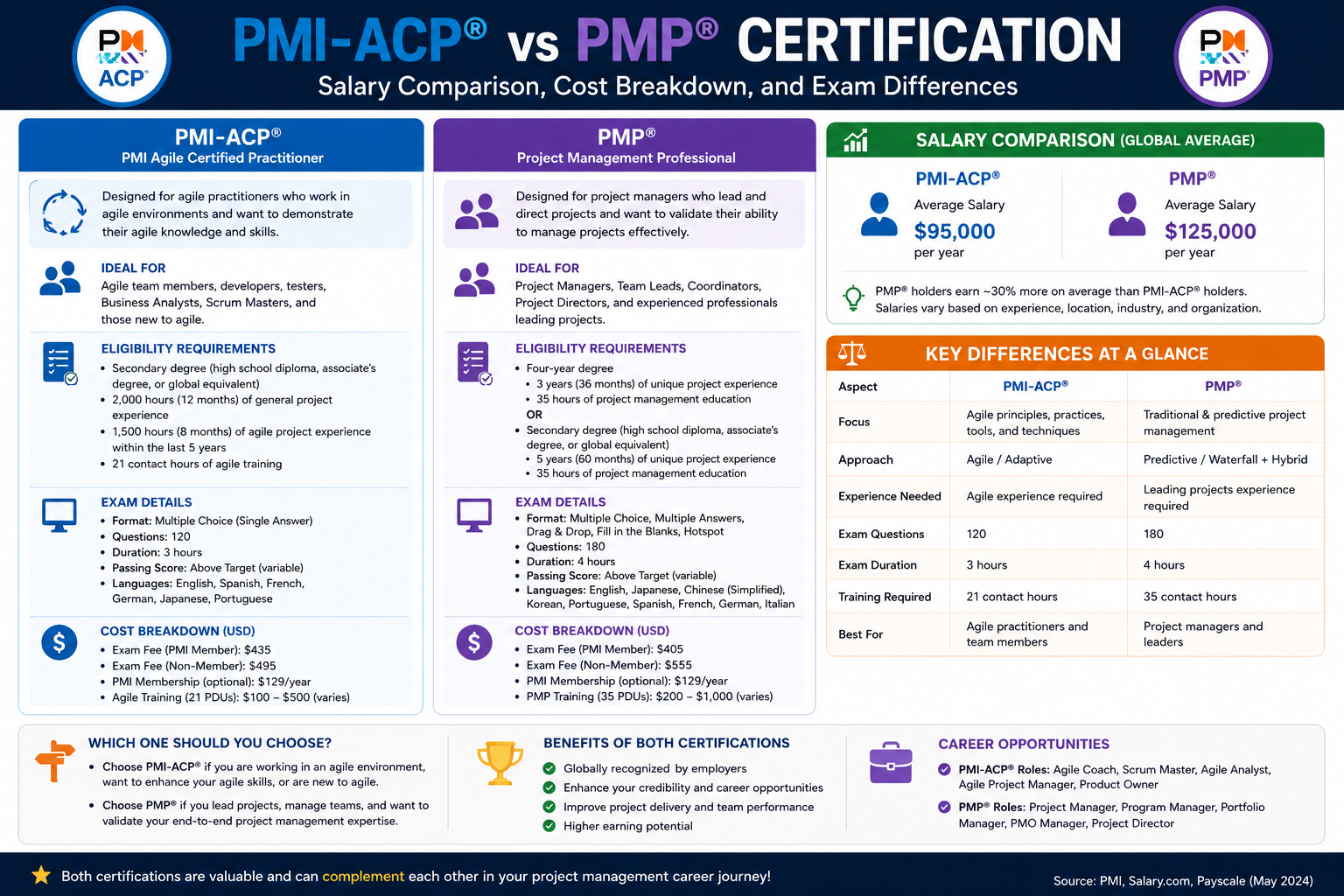
The PMI-ACP and PMP certifications are two of the most recognized credentials in the field of project management, both awarded by the Project Management Institute. While they share a common foundation in professional project management principles, they are built on very different philosophies and are designed for different working environments.
The PMP certification is rooted in traditional project management practices, often referred to as the Waterfall approach. This method focuses on structured planning, clearly defined phases, and strict control over scope, time, and cost. It is widely used in industries where predictability, documentation, and formal approval processes are essential.
In contrast, the PMI-ACP certification is centered on Agile methodologies. Agile emphasizes adaptability, collaboration, and iterative development. Instead of following a fixed plan from start to finish, Agile teams work in short cycles, continuously improving the product based on feedback and changing requirements.
As industries evolve and digital transformation accelerates, both approaches have become valuable. Many organizations now blend traditional and Agile methods to create hybrid models that combine structure with flexibility. This shift has made both certifications relevant, depending on the type of work environment and project demands.
PMP Certification: Structure, Scope, and Professional Focus
The PMP certification represents a long-established standard in project management. It is designed for professionals who manage large-scale projects that require detailed planning and strict control. These projects often operate in environments where changes must be carefully managed due to budget limitations, regulatory requirements, or organizational constraints.
PMP-certified professionals are expected to have a deep understanding of the full project lifecycle. This includes initiating a project, planning its execution, managing resources, monitoring progress, and closing it successfully. Each phase requires careful coordination and documentation to ensure that the project stays aligned with its original goals.
One of the defining strengths of the PMP approach is its predictability. Projects are planned extensively before execution begins, which reduces uncertainty and helps stakeholders understand what to expect. This makes it particularly useful in industries such as construction, manufacturing, healthcare systems, and government projects, where changes can be costly or risky.
Another important aspect of PMP is its emphasis on leadership and governance. A PMP-certified professional is not only responsible for managing tasks but also for leading teams, communicating with stakeholders, and ensuring that project objectives align with business goals. This requires both technical knowledge and strong interpersonal skills.
Because of its comprehensive nature, PMP is often considered a more advanced certification. It requires significant real-world project management experience, as well as formal training. This ensures that certified professionals are well-prepared to handle complex and high-responsibility roles.
PMI-ACP Certification: Agile Thinking and Adaptive Project Delivery
The PMI-ACP certification reflects a more modern approach to project management. It is designed for professionals working in environments where change is frequent and flexibility is essential. Instead of following a rigid plan, Agile project management focuses on continuous improvement and rapid delivery of value.
Agile methods originated in software development but have since expanded into many other industries. Today, Agile is used in product development, marketing, engineering, and even business operations. The PMI-ACP certification recognizes this shift and validates a professional’s ability to work effectively in Agile environments.
A key feature of Agile is its iterative nature. Projects are broken down into smaller parts, often called iterations or sprints. After each cycle, teams review progress, gather feedback, and adjust their approach if needed. This allows for faster adaptation to changing requirements and improves the overall quality of the final outcome.
Collaboration is another core principle of Agile. Teams are encouraged to work closely with stakeholders throughout the project, ensuring that feedback is continuously incorporated. This reduces the risk of delivering a final product that does not meet user expectations.
The PMI-ACP certification covers several Agile frameworks, including Scrum, Kanban, Lean, and extreme programming principles. Rather than focusing on a single method, it provides a broad understanding of Agile practices, making professionals versatile and adaptable.
This certification is particularly valuable in fast-moving industries such as technology, digital services, and startups, where requirements evolve quickly and innovation is a priority.
Methodology Differences and Work Environment Impact
The most significant difference between PMP and PMI-ACP lies in their underlying methodologies. PMP follows a predictive model, while PMI-ACP follows an adaptive model.
In predictive project management, the majority of planning is completed before execution begins. The project follows a structured path, and deviations are carefully controlled. This approach works well when requirements are stable and clearly defined from the beginning.
In adaptive project management, planning and execution happen simultaneously. Instead of trying to define everything upfront, teams accept that requirements may change over time. This flexibility allows for faster response to market changes or customer feedback.
These differences significantly affect how teams operate. PMP environments tend to have clearly defined roles and responsibilities, with a strong focus on documentation and formal approvals. PMI-ACP environments are more collaborative and dynamic, with teams often self-organizing and making decisions collectively.
Neither approach is inherently better; they simply serve different purposes. The choice between them depends on the nature of the work and the expectations of stakeholders.
Experience Requirements and Professional Entry Paths
The entry requirements for PMP and PMI-ACP certifications reflect their different levels of complexity and focus.
PMP typically requires several years of project management experience. This ensures that candidates have already developed practical skills in managing teams, budgets, and project timelines. In addition, formal training is required to ensure familiarity with standardized project management processes.
PMI-ACP, on the other hand, requires less overall experience but expects candidates to have specific exposure to Agile environments. This makes it more accessible to professionals who are newer to project management or who have worked primarily in Agile teams.
This difference makes PMI-ACP a common starting point for individuals entering Agile-focused roles, while PMP is often pursued by those aiming for senior project management positions.
Career Impact and Professional Opportunities
Both certifications offer strong career benefits, but they tend to lead to different types of roles and opportunities.
PMP-certified professionals are often found in leadership positions managing large, complex projects. Their responsibilities typically include overseeing budgets, coordinating cross-functional teams, and ensuring that projects are delivered according to plan. These roles are common in industries with structured processes and long project timelines.
PMI-ACP-certified professionals are more likely to work in dynamic environments where rapid change is expected. They may serve as Agile coaches, Scrum Masters, or product-oriented project managers. Their focus is often on improving team performance, increasing delivery speed, and enhancing customer satisfaction.
Salary expectations for both certifications are generally strong, but they can vary depending on industry, experience, and geographic location. Agile roles often command competitive salaries due to the growing demand for flexibility and innovation in project delivery.
Many organizations now prefer professionals who understand both approaches. This hybrid skill set allows project managers to adapt to different types of projects and lead teams in both structured and flexible environments.
In modern organizations, the line between traditional and Agile project management is becoming increasingly blurred. Many companies no longer rely on a single methodology for all their projects. Instead, they adopt hybrid approaches that combine the structured planning of PMP with the flexibility of PMI-ACP practices. This blended model allows teams to benefit from clear direction while still adapting quickly to change when needed.
For project managers, this evolution means that holding knowledge of both frameworks is becoming more valuable than ever. Even if a professional is certified in one approach, understanding the principles of the other improves decision-making and enhances leadership capability. For example, a PMP-trained manager working in a traditionally structured environment may still incorporate Agile techniques to improve team communication or accelerate delivery cycles. Similarly, a PMI-ACP practitioner may apply structured planning tools from PMP to better manage scope and timelines.
As industries continue to evolve with digital transformation, automation, and global competition, the demand for adaptable project managers is expected to grow. Employers increasingly look for professionals who can shift between methodologies depending on project needs rather than strictly following one approach.
Conclusion
The PMI-ACP and PMP certifications represent two distinct but equally valuable approaches to project management. PMP is built on structure, planning, and control, making it ideal for environments where predictability and governance are essential. PMI-ACP, on the other hand, focuses on adaptability, collaboration, and iterative progress, making it well-suited for fast-changing industries where responsiveness is critical.
Choosing between the two depends largely on your career direction and the type of projects you want to manage. If you prefer long-term planning, formal processes, and leadership in large-scale initiatives, PMP aligns well with those goals. If you are drawn to flexible environments, rapid delivery cycles, and continuous improvement, PMI-ACP may be a better fit.
In today’s evolving professional landscape, many organizations are no longer strictly traditional or fully Agile. Instead, they combine both approaches to balance stability with adaptability. This trend has increased the value of professionals who understand both methodologies.
Ultimately, the most effective project managers are those who can adapt their approach to the needs of the project. Whether through PMP, PMI-ACP, or a combination of both, mastering project management principles opens the door to diverse opportunities and long-term career growth.