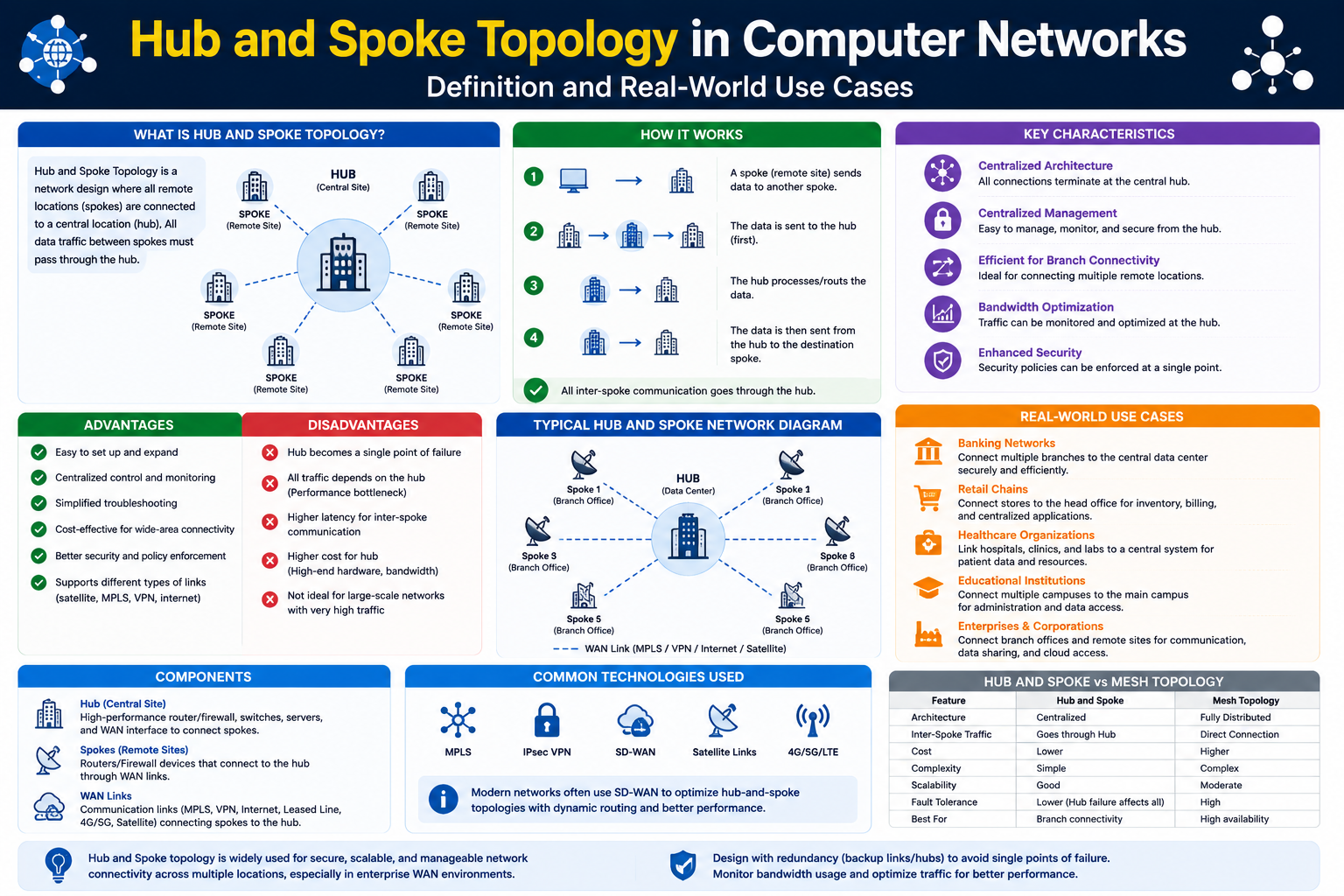
Hub and spoke topology is one of the most widely used network designs in modern communication systems. It is based on a simple idea: all devices in a network communicate through a central point known as the hub. Instead of devices directly exchanging data with each other, every message is first sent to the hub, which then forwards it to the intended destination. This structure creates a controlled and organized communication environment that is easy to manage and monitor.
The popularity of this topology comes from its simplicity. It reduces the complexity of direct connections between multiple devices and replaces them with a single centralized system. This makes it especially useful in environments where large numbers of devices need to communicate efficiently without creating a tangled network structure.
Another reason for its widespread use is its scalability. New devices can be added to the network without requiring major changes to existing connections. They simply connect to the hub, and the system continues to function smoothly. This flexibility makes it suitable for growing organizations that need a stable yet expandable network foundation.
Hub and spoke topology is also commonly associated with better security control. Since all data passes through a central point, monitoring and managing traffic becomes more straightforward. Administrators can easily track communication, identify issues, and enforce security policies from a single location.
Understanding Network Topology in Computer Systems
Before diving deeper into hub and spoke structure, it is important to understand what network topology means in a broader sense. Network topology refers to the arrangement of different devices within a computer network. It describes how computers, servers, printers, and other devices are connected and how data flows between them.
There are two main types of topology representation: physical and logical. Physical topology refers to the actual layout of cables and devices, while logical topology describes how data moves within the network regardless of physical design. Both perspectives are important for understanding how communication takes place.
Different types of network topologies exist to serve different needs. Some are designed for speed, others for redundancy, and some for simplicity. Common structures include bus, ring, mesh, star, tree, and hub and spoke. Each has its own advantages and disadvantages depending on the size and requirements of the network.
Network designers choose a topology based on several factors such as cost, scalability, performance needs, and maintenance requirements. A small office may use a simple design, while a large enterprise may require a more structured and controlled system. Understanding these basic principles helps in appreciating why hub and spoke topology is preferred in many scenarios.
Core Concept of Hub and Spoke Architecture
At the heart of hub and spoke topology is the idea of centralization. The hub acts as the main control point, while all other devices, known as spokes, connect directly to it. The spokes do not communicate with each other directly; instead, all communication flows through the hub.
This design simplifies the entire communication process. When one device wants to send data to another, it sends it to the hub first. The hub then analyzes the data and forwards it to the correct destination. This ensures that all traffic is organized and follows a predictable path.
The hub itself can be a physical device such as a server, switch, or router, or it can be a software-based system in modern virtual networks. Its primary responsibility is to manage traffic flow efficiently and ensure that data reaches the correct endpoint without conflict or duplication.
This structure is especially useful in environments where control and visibility are important. Since all communication passes through one central point, it becomes easier to implement policies, monitor activity, and maintain consistency across the network.
How Hub and Spoke Topology Works in Practice
The working mechanism of hub and spoke topology is straightforward but highly structured. When a device (spoke) sends data, the information is broken into packets. These packets are transmitted to the hub instead of directly going to another device.
Once the hub receives the data, it examines the destination address contained within the packet. After identifying the correct recipient, it forwards the packet accordingly. This process repeats for every communication request within the network.
This method ensures that no direct device-to-device communication takes place. Instead, the hub acts as an intermediary for all interactions. This reduces complexity and helps prevent data conflicts or routing errors.
The centralized nature of this system also allows for better traffic control. The hub can prioritize certain types of data, manage bandwidth allocation, and prevent network congestion. It essentially acts as a traffic controller that regulates the flow of information across the entire system.
Although this approach is efficient in many cases, it also means that the hub becomes a critical point in the network. If the hub fails, communication across the entire network may be affected.
Role of the Central Hub in the Network
The central hub is the most important component in this topology. It is responsible for managing all communication between devices and ensuring that data is delivered correctly and efficiently.
One of its primary functions is data routing. Every packet of information must pass through the hub before reaching its destination. The hub reads the packet’s destination information and decides where it should be forwarded.
In addition to routing, the hub also plays a key role in monitoring network activity. Since all data flows through it, administrators can use the hub to observe traffic patterns, detect unusual behavior, and identify potential security threats.
Another important function is configuration management. The hub allows administrators to apply security rules, update system settings, and control access permissions from a single point. This centralized control reduces the complexity of managing large networks.
The hub also contributes to network stability by managing traffic flow. It can prevent data collisions and ensure that communication remains smooth even when multiple devices are active at the same time.
Communication Behavior of Spoke Devices
Spoke devices are the endpoints of the network, such as computers, printers, or other connected systems. These devices do not communicate directly with each other. Instead, they rely entirely on the hub for all communication.
When a spoke device sends data, it does not need to know the exact location of the recipient. It only sends the information to the hub, which handles the rest of the process. This removes the need for complex routing logic on individual devices.
This structure simplifies device configuration because each spoke only needs to know how to reach the hub. There is no requirement for direct knowledge of other devices in the network.
However, this dependency on the hub also means that spoke devices cannot function independently in terms of communication. If the hub becomes unavailable, communication between spokes is interrupted.
Despite this limitation, spoke-based communication remains highly efficient in controlled environments where centralized management is preferred.
Real-World Applications of Hub and Spoke Topology
Hub and spoke topology is widely used in many real-world systems where centralized control is important. One common example is corporate networks, where branch offices connect to a central headquarters server.
Another example can be found in transportation systems, where a central hub such as an airport or distribution center connects multiple destinations. Each endpoint depends on the central hub for coordination and routing.
It is also commonly used in cloud computing environments. Cloud servers act as central hubs, while user devices connect as spokes. This allows efficient management of data storage, processing, and distribution.
Large-scale communication systems also rely on this topology to manage traffic efficiently. By centralizing control, organizations can ensure consistency and reliability across their networks.
Advantages of Hub and Spoke Structure
One of the main advantages of hub and spoke topology is its simplicity. The structure is easy to understand, design, and implement, even in large networks.
Another major advantage is centralized control. Since all communication passes through the hub, administrators can easily monitor and manage network activity from a single point.
Scalability is also a key benefit. New devices can be added to the network without disrupting existing connections. They simply connect to the hub and become part of the system.
Security is another important advantage. Centralized monitoring allows for better detection of threats and easier enforcement of security policies.
Finally, troubleshooting becomes much easier because issues can often be traced back to the hub or a specific spoke connection.
Conclusion
Hub and spoke topology remains one of the most practical and widely used network designs in modern computing environments. Its centralized structure simplifies communication by routing all data through a single hub, making it easier to manage, monitor, and secure the network. This design reduces complexity, improves scalability, and allows for efficient control over traffic flow.
However, its reliance on a central hub also introduces certain risks, particularly the possibility of network disruption if the hub fails. Despite this, its benefits often outweigh its limitations, especially in environments where centralized control and easy management are priorities.
As networks continue to grow in size and complexity, hub and spoke topology continues to serve as a foundational model for understanding how structured communication systems operate in both traditional and modern digital infrastructures.