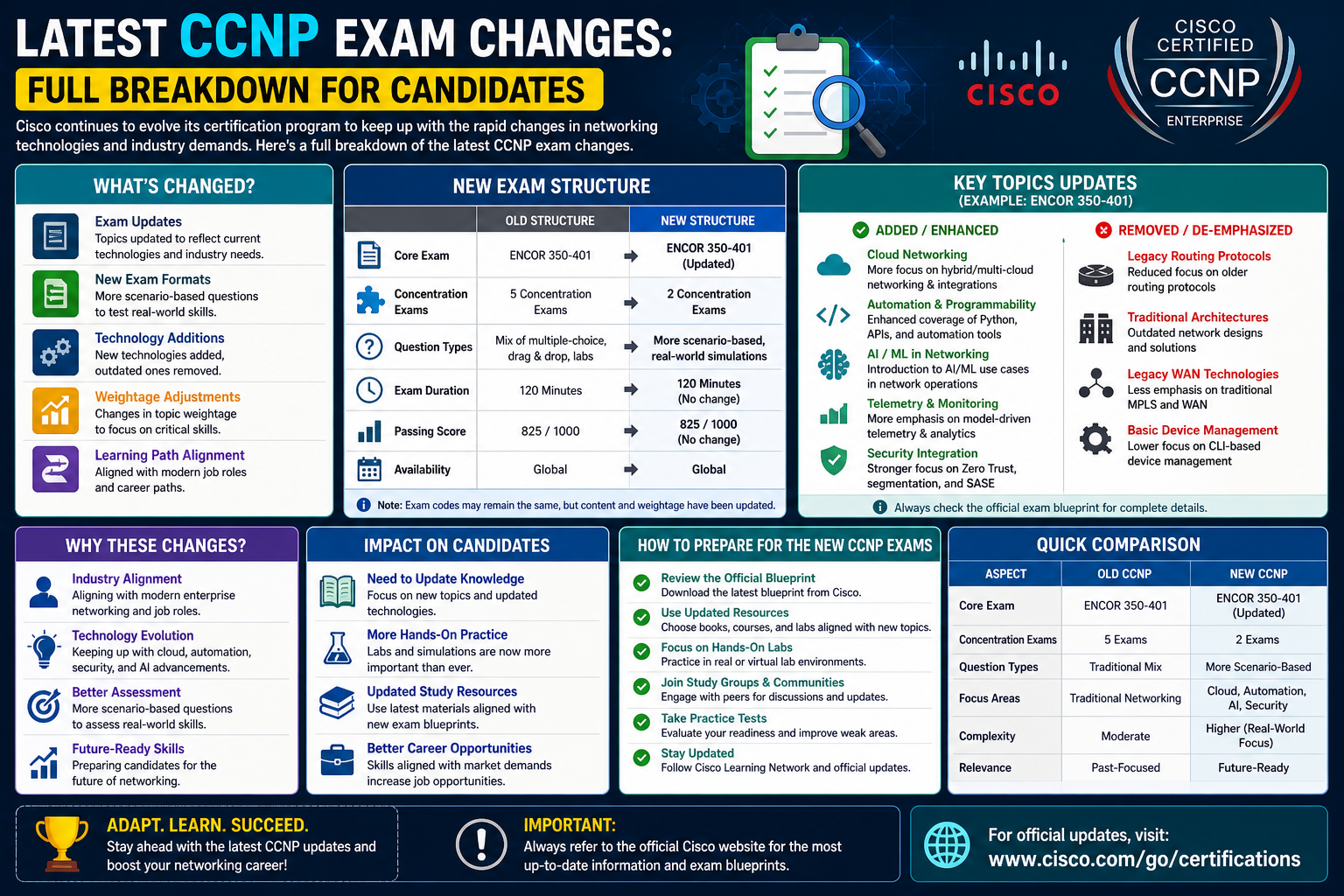
Cisco certifications have long been considered a benchmark for measuring networking expertise, and the updates introduced in 2023 mark one of the most significant refinements in recent years. Rather than simply refreshing exam questions or adjusting minor technical details, Cisco is reshaping how its certification paths align with modern enterprise infrastructure. This evolution reflects the increasing complexity of networking environments, where traditional on-premises systems are now deeply integrated with cloud platforms, distributed applications, and automated infrastructure.
The changes announced for 2023 are not isolated adjustments but part of a broader strategy to keep certification content aligned with real-world industry requirements. As organizations adopt hybrid cloud models and software-defined architectures, networking professionals are expected to manage systems that extend far beyond conventional routing and switching. Cisco’s certification updates reflect this shift by introducing new exam content, revising existing domains, and emphasizing emerging technologies that are now central to enterprise operations.
One of the most noticeable aspects of this evolution is the introduction of new certification components that directly address cloud connectivity and hybrid infrastructure. Instead of treating cloud networking as a peripheral topic, Cisco is integrating it into the core certification journey. This signals a clear recognition that cloud integration is no longer optional knowledge but a fundamental skill set for modern network engineers.
At the same time, Cisco is maintaining the structured tier system of its certifications, including associate, professional, and expert levels. However, within this structure, the content is becoming more dynamic. The emphasis is shifting from memorizing static technologies to understanding adaptable systems that evolve with business needs. This includes increased focus on automation, programmability, and intent-based networking, all of which play a central role in current IT environments.
The 2023 updates also highlight Cisco’s commitment to maintaining certification relevance in a rapidly changing technological landscape. Networking is no longer limited to physical devices and localized infrastructures. Instead, it spans across global cloud providers, hybrid environments, and virtualized services. As a result, certification content must evolve continuously to reflect these realities rather than lag behind them.
Another key aspect of this evolution is the way Cisco is refining its certification roadmap. By clearly defining release timelines and introducing new exam tracks, Cisco is providing greater transparency into how professionals can plan their learning paths. This is especially important for individuals preparing for professional-level certifications like CCNP, where exam content changes can significantly impact study strategies.
Why Cisco is Restructuring CCNP Exams
The restructuring of CCNP exams in 2023 is not an arbitrary change but a response to several major shifts in the networking industry. One of the primary reasons behind this update is the growing demand for skills that extend beyond traditional network engineering. Today’s networks are not only more complex but also more interconnected, requiring professionals to understand multiple layers of infrastructure, including cloud platforms, security systems, and automation frameworks.
Cisco has recognized that the previous structure of certification content, while still valuable, needed to evolve to better reflect how networks are actually designed and operated in modern organizations. Many enterprises now operate hybrid environments that combine on-premises infrastructure with multiple cloud services. This requires network engineers to understand not just connectivity but also orchestration, scalability, and cross-platform integration.
Another important factor driving the restructuring is the increasing adoption of software-defined networking. Technologies such as SD-WAN and automated network provisioning have fundamentally changed how networks are managed. Instead of manually configuring individual devices, engineers now work with centralized systems that define network behavior through software policies. This shift requires a different set of skills, which Cisco is now embedding into its updated certification framework.
Cisco is also responding to the rapid growth of cloud-native technologies. Applications are increasingly being developed and deployed in cloud environments, meaning that networking professionals must understand how data flows between distributed systems. This includes knowledge of secure connectivity, performance optimization, and cloud-based routing strategies. By updating CCNP exams, Cisco is ensuring that certified professionals are equipped to handle these modern challenges.
Additionally, the restructuring reflects the need for continuous alignment between certification content and industry expectations. Technology cycles are becoming shorter, and what was considered advanced knowledge a few years ago may now be standard practice. Cisco’s quarterly review approach ensures that certification content remains relevant and up to date, reducing the gap between learning material and real-world application.
The CCNP updates also emphasize flexibility in specialization. Rather than forcing all candidates through a rigid set of topics, the certification structure allows professionals to focus on specific areas that align with their career goals. This includes enterprise networking, collaboration systems, and data center technologies, each of which is evolving in response to different industry demands.
Major Shift Toward Cloud Connectivity and Hybrid Networking
One of the most significant themes in the 2023 Cisco certification updates is the strong focus on cloud connectivity and hybrid networking. This shift reflects the reality that most modern enterprises no longer operate within a purely on-premises environment. Instead, they rely on a combination of private data centers, public cloud platforms, and edge computing systems that must work together seamlessly.
Hybrid networking has become the backbone of enterprise IT strategy. Organizations are increasingly distributing workloads across multiple environments to improve scalability, resilience, and performance. This creates a need for networking professionals who understand how to design and manage connectivity between these diverse systems.
Cisco’s updated certification framework recognizes this need by placing greater emphasis on cloud integration technologies. Rather than treating cloud networking as a separate specialization, it is now integrated into core professional-level knowledge. This means that network engineers are expected to understand how cloud services interact with traditional infrastructure, including routing, security, and application delivery.
The rise of hybrid environments has also increased the importance of secure connectivity. Data is no longer confined to a single location, which introduces new challenges related to encryption, authentication, and traffic management. Network professionals must now ensure that communication between cloud and on-premises systems remains secure while maintaining performance and reliability.
Another important aspect of this shift is the growing role of automation in hybrid networking. Managing complex environments manually is no longer feasible at scale. Instead, organizations rely on automated systems that can dynamically adjust network configurations based on workload demands. This requires professionals to understand not only networking principles but also automation tools and programmable infrastructure.
Cisco’s certification updates reflect these realities by incorporating topics that address both the design and operational aspects of hybrid networking. This includes understanding how to implement scalable architectures, manage distributed workloads, and ensure consistent performance across different environments.
Introduction to the New ENCC Exam and Its Role
A major highlight of the 2023 updates is the introduction of a new concentration exam focused on cloud connectivity, known as the Designing and Implementing Cloud Connectivity exam (ENCC). This exam represents a significant expansion of the CCNP Enterprise track and reflects Cisco’s recognition of cloud integration as a critical networking discipline.
The ENCC exam is designed for professionals who are responsible for building and managing networks that extend into cloud environments. This includes designing connectivity solutions that link on-premises infrastructure with cloud platforms, ensuring secure and efficient data transfer between distributed systems, and optimizing network performance in hybrid environments.
Unlike traditional networking exams that focus primarily on routing, switching, and infrastructure design, ENCC places strong emphasis on cloud-related technologies. This includes virtual private networks, software-defined wide area networking, and cloud-native connectivity solutions. These technologies are essential for organizations that rely on distributed applications and remote infrastructure.
The introduction of ENCC also highlights Cisco’s recognition that cloud networking is no longer a specialized niche but a core competency. Network engineers are increasingly expected to understand how cloud platforms interact with enterprise systems, and how to design architectures that support scalability, resilience, and flexibility.
Another important aspect of ENCC is its focus on real-world application. Rather than testing theoretical knowledge alone, the exam is designed to assess practical understanding of how cloud connectivity solutions are deployed and managed in enterprise environments. This includes scenarios involving hybrid cloud integration, multi-site connectivity, and secure access management.
The creation of ENCC also signals a broader shift in Cisco’s certification philosophy. Instead of treating cloud technologies as optional add-ons, they are now fully integrated into the professional certification pathway. This ensures that certified professionals are equipped with the skills needed to operate in modern IT environments where cloud and on-premises systems are deeply interconnected.
Key Technologies Covered in Cloud Connectivity Track
The cloud connectivity focus introduced in the 2023 updates encompasses several key technologies that are essential for modern network design. Among these, virtual private networking plays a central role. VPN technologies enable secure communication between distributed systems, allowing organizations to extend their internal networks across public infrastructure without compromising security.
Another critical technology is software-defined wide area networking. SD-WAN has transformed how enterprises manage connectivity between branch offices, data centers, and cloud environments. By centralizing control and using intelligent routing policies, SD-WAN improves performance, reduces costs, and enhances flexibility. Understanding how to design and deploy SD-WAN solutions is now a core requirement for network professionals working in cloud-integrated environments.
Cloud-native networking is also a major component of the updated certification focus. As applications are increasingly developed and deployed in cloud environments, networking professionals must understand how these applications communicate within distributed systems. This includes knowledge of microservices architecture, container networking, and dynamic scaling.
In addition to these technologies, the cloud connectivity track emphasizes secure architecture design. Security is a fundamental concern in hybrid environments, where data flows across multiple platforms and locations. Professionals must be able to implement encryption, access control, and monitoring systems that ensure data integrity and compliance.
Performance optimization is another important area of focus. Cloud-based systems must deliver consistent performance regardless of location or traffic load. This requires an understanding of traffic engineering, latency management, and load balancing strategies that can adapt to changing conditions.
Together, these technologies form the foundation of modern cloud-connected networks. By incorporating them into certification content, Cisco is ensuring that professionals are prepared to design and manage infrastructure that meets the demands of today’s digital enterprises.
How ENCC Reflects Modern Enterprise Network Demands
The introduction of ENCC is closely aligned with the evolving needs of enterprise networks. Organizations today require infrastructure that is not only reliable but also flexible enough to support rapid changes in business operations. This includes the ability to scale resources dynamically, integrate new technologies quickly, and maintain secure connectivity across distributed environments.
ENCC reflects these demands by focusing on practical skills that are directly applicable to real-world scenarios. Network engineers are expected to understand how to design systems that support hybrid cloud environments, where workloads may move between on-premises infrastructure and cloud platforms based on demand.
This flexibility is essential for modern businesses that operate in highly competitive and fast-changing markets. The ability to adapt network infrastructure quickly can provide a significant advantage in terms of performance, cost efficiency, and user experience.
Another important aspect reflected in ENCC is the increasing importance of resilience. Enterprise networks must be able to maintain functionality even in the event of failures or disruptions. This requires knowledge of redundancy strategies, failover mechanisms, and distributed architecture design.
The emphasis on cloud connectivity also highlights the shift toward decentralized infrastructure. Rather than relying on a single data center, organizations are distributing their resources across multiple environments. This requires network engineers to understand how to manage complex interconnections while maintaining consistency and control.
By aligning certification content with these realities, ENCC ensures that professionals are not only learning theoretical concepts but also developing the skills needed to operate in modern enterprise environments where cloud integration is the norm rather than the exception.
Impact of ENCC on CCNP Enterprise Certification Structure
The introduction of ENCC has a significant impact on the overall structure of the CCNP Enterprise certification path. Traditionally, CCNP Enterprise focused heavily on core networking technologies such as routing, switching, and wireless infrastructure. While these areas remain important, the addition of ENCC expands the scope of the certification to include cloud-centric networking.
This expansion reflects a broader transformation in how networking roles are defined. Modern network engineers are no longer limited to managing physical infrastructure. Instead, they are expected to work across multiple environments, including cloud platforms and virtualized systems.
ENCC also increases the level of specialization available within the CCNP Enterprise track. Professionals can now choose to focus on cloud connectivity as a distinct area of expertise, allowing them to align their certification journey with specific career goals.
At the same time, the integration of ENCC ensures that cloud networking is not treated as an isolated skill. Instead, it is connected to broader enterprise networking principles, ensuring that professionals maintain a holistic understanding of network architecture.
This structural change also reflects Cisco’s broader strategy of integrating emerging technologies into its certification framework in a way that maintains consistency while expanding relevance.
CCNP Enterprise Exam Structure Changes and New Blueprint Direction
The CCNP Enterprise certification underwent one of its most notable structural refinements in 2023, reflecting Cisco’s ongoing effort to align enterprise networking skills with modern infrastructure demands. While the certification still maintains its two-exam requirement—one core exam and one concentration exam—the content of both has been updated to reflect current technologies, deployment models, and operational expectations.
At the center of this certification is the core exam, which serves as the foundational requirement for all CCNP Enterprise candidates. This exam is designed to validate a broad understanding of enterprise networking concepts, including routing, switching, infrastructure services, and automation principles. In the updated version, Cisco has refined these topics to incorporate more real-world scenarios that reflect hybrid environments and software-defined architectures.
The updated blueprint places increased emphasis on automation and programmability. This is a direct response to the industry-wide shift toward infrastructure as code and intent-based networking. Instead of focusing solely on manual configuration, candidates are now expected to understand how network devices can be managed through centralized controllers and automated workflows.
Another important change in the enterprise structure is the deeper integration of wireless technologies and SD-WAN solutions. These are no longer treated as separate or advanced topics but are now considered essential components of enterprise networking knowledge. This reflects how organizations increasingly rely on distributed connectivity models that span multiple sites, cloud platforms, and remote users.
The updated blueprint also emphasizes operational visibility and assurance. Network monitoring, telemetry, and performance analytics have become critical components of enterprise infrastructure management. As a result, candidates are expected to understand how to use data-driven insights to optimize network performance and troubleshoot issues proactively.
Overall, the CCNP Enterprise blueprint update reflects a shift from traditional infrastructure management toward a more dynamic, software-driven networking environment where automation, scalability, and observability are central themes.
Evolution of the ENCOR Core Exam and Its Updated Focus
The ENCOR exam, officially known as Implementing Cisco Enterprise Network Core Technologies, remains the cornerstone of the CCNP Enterprise certification. However, its updated version introduces several refinements that align it more closely with modern enterprise networking requirements.
One of the most significant changes in ENCOR is the expanded focus on automation technologies. While automation was previously an emerging topic, it is now fully integrated into the core knowledge base. Candidates are expected to understand how automation tools interact with network devices, how APIs are used to manage configurations, and how orchestration platforms simplify network operations.
The updated ENCOR exam also introduces deeper coverage of virtualization technologies. This includes not only traditional virtualization concepts but also modern approaches such as containerized networking environments and virtual network functions. These technologies are increasingly important as organizations move toward cloud-native infrastructure models.
Routing and switching fundamentals remain a critical part of the exam, but the emphasis has shifted toward understanding how these technologies operate in complex, multi-layered environments. Instead of focusing on isolated configurations, candidates must now understand how routing decisions are influenced by policy-based management and software-defined controls.
Another key update in ENCOR is the enhanced focus on security integration. Rather than treating security as a separate domain, the exam now incorporates security principles throughout the networking lifecycle. This includes secure device access, encrypted communication, and network segmentation strategies.
The ENCOR update also reflects Cisco’s broader push toward operational intelligence. Candidates are expected to understand how telemetry data is collected and used to improve network performance. This includes familiarity with analytics tools and monitoring systems that provide real-time visibility into network behavior.
Overall, the updated ENCOR exam represents a shift from traditional infrastructure knowledge toward a more integrated, automated, and intelligence-driven approach to enterprise networking.
CCNP Collaboration Certification Updates and Modern Communication Systems
The CCNP Collaboration certification has also undergone significant updates in 2023, reflecting the rapid evolution of enterprise communication systems. As organizations increasingly rely on unified communication platforms, video conferencing solutions, and cloud-based collaboration tools, Cisco has adjusted its certification structure to align with these changes.
The core collaboration exam focuses on the implementation and management of modern communication technologies. This includes voice systems, video infrastructure, messaging platforms, and conferencing solutions. The updated version places greater emphasis on cloud-based collaboration architectures, which have become the standard in many organizations.
One of the most important changes in the collaboration track is the increased focus on cloud integration. Traditional on-premises communication systems are now often integrated with cloud-based services, requiring professionals to understand hybrid deployment models. This includes knowledge of call control systems, cloud gateways, and distributed communication platforms.
Another major update is the expansion of automation and programmability within collaboration systems. Modern communication platforms are no longer static systems but dynamic environments that can be configured and managed through APIs and automation tools. This shift requires collaboration engineers to understand how to integrate communication systems into broader IT workflows.
The collaboration certification also reflects the growing importance of user experience and system reliability. In modern enterprises, communication systems must deliver consistent performance across multiple devices and locations. As a result, candidates are expected to understand how to optimize call quality, manage bandwidth, and ensure system resilience.
Security has also become a more prominent component of the collaboration track. With the rise of remote work and distributed teams, communication systems are increasingly exposed to external networks. This requires strong authentication mechanisms, encryption protocols, and secure access policies.
The updated collaboration certification structure ensures that professionals are equipped to manage modern communication environments that are highly integrated, cloud-driven, and user-focused.
Transformation of CCNP Data Center Certification and Infrastructure Design
The CCNP Data Center certification has been updated to reflect the growing complexity of modern data center environments. As organizations scale their digital infrastructure, data centers are no longer isolated facilities but interconnected systems that support cloud computing, virtualization, and application-centric architectures.
The core data center exam focuses on implementing and operating data center technologies, including compute, storage, and network infrastructure. The updated version places increased emphasis on automation, virtualization, and software-defined infrastructure.
One of the most significant changes in the data center certification is the expanded focus on application-centric infrastructure. Modern data centers are designed to support applications rather than just hardware systems. This requires a shift in thinking from device-level configuration to application-level performance optimization.
The updated blueprint also includes deeper coverage of Cisco’s application-centric infrastructure model. This approach allows network behavior to be defined based on application requirements, ensuring that resources are allocated dynamically based on workload demands.
Storage networking remains an important part of the certification, but its role has evolved to reflect modern distributed storage systems. Candidates are expected to understand how storage solutions integrate with virtualized environments and cloud platforms.
Another key update is the increased emphasis on automation within data center environments. Manual configuration is no longer practical at scale, so professionals must understand how to use automation tools to manage infrastructure efficiently. This includes scripting, orchestration, and policy-based management systems.
The data center certification also reflects the growing importance of resilience and high availability. Modern data centers must be designed to handle failures without impacting application performance. This requires knowledge of redundancy mechanisms, load balancing, and disaster recovery strategies.
Overall, the updated data center certification aligns closely with modern enterprise needs, where infrastructure must be flexible, automated, and application-aware.
CCNP Exam Versioning and Blueprint Revisions Explained
One of the most important aspects of the 2023 Cisco certification updates is the introduction of new exam versions, often labeled as v1.1 updates. These version changes may appear minor at first glance, but they often include important adjustments to exam content, structure, and focus areas.
Version updates typically reflect changes in technology trends, product updates, and industry practices. Rather than redesigning entire exams, Cisco refines existing blueprints to ensure they remain aligned with current networking environments.
In many cases, these updates involve adding new technologies while removing outdated ones. For example, legacy routing methods or older infrastructure services may be replaced with modern equivalents that better reflect current enterprise deployments.
Another important aspect of blueprint revisions is the rebalancing of exam domains. Some topics may receive increased weight due to their growing importance in real-world environments, while others may be reduced in emphasis.
These changes are carefully designed to ensure that certification remains relevant without requiring candidates to completely restart their preparation. However, they do require updated study strategies, as even small changes in blueprint structure can significantly affect exam preparation.
Cisco also uses blueprint revisions to introduce emerging technologies into certification pathways. This ensures that professionals are exposed to new concepts such as cloud integration, automation, and intent-based networking as part of their certification journey.
Overall, exam versioning is a key part of Cisco’s strategy to keep certifications aligned with evolving industry demands while maintaining continuity for learners.
Retirement of Legacy CCNP Concentration Exams and Transition Strategy
As part of the 2023 certification updates, Cisco announced the retirement of several older CCNP concentration exams. These retirements are part of a broader effort to streamline certification pathways and ensure that all exam content reflects current technologies.
When concentration exams are retired, they are typically replaced with updated versions that include modern technologies and revised blueprints. This ensures that candidates are always studying relevant material that aligns with current industry practices.
The retirement process also encourages professionals to transition toward newer certification paths. Instead of continuing with outdated technologies, candidates are guided toward updated exams that reflect modern networking environments.
For learners who are already in the process of preparing for a retiring exam, timing becomes an important factor. If the exam is near its retirement date, candidates must decide whether to complete the current version or transition to the updated one.
Cisco provides overlap periods during which both old and new exams are available. This allows flexibility for learners while ensuring a smooth transition between certification versions.
The retirement strategy also helps maintain the long-term value of certifications. By removing outdated exams, Cisco ensures that certified professionals are validated against current industry standards rather than legacy technologies.
Overall, exam retirement is not simply a removal process but part of a structured transition that supports continuous learning and certification relevance.
Impact of Certification Updates on Professional Skill Development
The 2023 CCNP updates have a significant impact on how networking professionals develop their skills. Rather than focusing on isolated technical knowledge, the updated certification framework encourages a more holistic understanding of enterprise infrastructure.
One of the most important changes is the increased emphasis on adaptability. Networking professionals must now be capable of working across multiple environments, including on-premises systems, cloud platforms, and hybrid infrastructures.
Automation skills have also become essential. Professionals are expected to understand how to use tools and technologies that reduce manual configuration and improve operational efficiency. This includes working with APIs, orchestration systems, and policy-driven networking models.
Another key development is the growing importance of cross-domain knowledge. Instead of specializing in a single area, networking professionals must understand how different systems interact. This includes networking, security, cloud computing, and application delivery.
The updated certification structure also encourages continuous learning. As technologies evolve rapidly, professionals must stay up to date with new developments in order to remain competitive in the job market.
Overall, the CCNP updates are shaping a new generation of networking professionals who are more versatile, more technically diverse, and better prepared for modern enterprise environments.
CCNP Automation, Programmability, and the Shift Toward Software-Driven Networking
One of the most defining themes in the 2023 CCNP updates is the deep integration of automation and programmability into nearly every certification track. This is no longer treated as an advanced or optional skill set. Instead, it has become a foundational expectation for anyone pursuing professional-level networking certification.
The reason for this shift is simple: modern networks are too large, too dynamic, and too complex to be managed manually. Enterprises are operating infrastructure that spans data centers, multiple cloud providers, branch offices, remote users, and edge environments. In such systems, manual configuration is not only inefficient but also prone to inconsistency and error.
Automation changes this model by allowing networks to be managed through software-defined policies rather than individual device configurations. Instead of logging into routers and switches one by one, engineers define desired outcomes, and automation systems handle implementation across the network.
This approach is closely tied to the concept of intent-based networking. In intent-based models, the engineer defines what the network should achieve rather than how each device should be configured. The system then translates that intent into operational configurations across the infrastructure. This abstraction is a major shift in how networking is understood and practiced.
Cisco’s updated CCNP framework reflects this evolution by embedding automation topics directly into core exams like ENCOR, as well as concentration exams across enterprise, collaboration, and data center tracks. Candidates are expected to understand not only what automation tools exist, but also how they function in real enterprise environments.
This includes knowledge of APIs, which serve as the communication layer between software systems and network devices. APIs allow external applications to interact with network infrastructure, enabling automation, monitoring, and orchestration. Understanding how APIs work is now essential for modern network engineers.
In addition, candidates are expected to understand configuration management tools and automation frameworks. These systems allow organizations to standardize configurations, reduce human error, and maintain consistency across large-scale deployments.
Another important aspect of programmability is the use of data models. Instead of configuring devices using vendor-specific commands, engineers increasingly work with structured data formats that define network behavior in a more consistent and scalable way.
All of these changes reflect a broader industry transformation where networking is becoming more software-defined. The CCNP updates ensure that professionals are not only aware of this shift but are also capable of working within it effectively.
The Growing Importance of SD-WAN in Enterprise Environments
Software-Defined Wide Area Networking, commonly known as SD-WAN, has become one of the most important technologies in modern enterprise networking. Its inclusion and expanded coverage in CCNP updates highlight just how critical it has become in real-world deployments.
Traditional WAN architectures were designed for a time when most applications were hosted in centralized data centers. Branch offices connected to headquarters through fixed, often expensive, private links. This model worked well when traffic patterns were predictable and centralized.
However, the rise of cloud computing and distributed applications has fundamentally changed traffic flows. Today, users access applications hosted in multiple cloud environments, and data flows between branches, data centers, and cloud platforms continuously.
SD-WAN addresses this challenge by introducing intelligent traffic routing and centralized control. Instead of relying on static routing paths, SD-WAN dynamically selects the best path for traffic based on application requirements, network conditions, and policy rules.
In the updated CCNP framework, SD-WAN is no longer treated as a niche specialization. It is integrated into enterprise networking knowledge because it has become a standard part of modern infrastructure.
Candidates are expected to understand how SD-WAN solutions are designed, deployed, and managed. This includes knowledge of overlay and underlay networks, policy-based routing, and centralized orchestration.
Security is also a key part of SD-WAN design. Since traffic often traverses public networks, encryption and secure tunneling are essential components. Professionals must understand how secure communication is maintained across distributed environments.
Another important aspect is performance optimization. SD-WAN systems are designed to improve application performance by intelligently routing traffic based on real-time network conditions. This requires understanding of metrics such as latency, jitter, and packet loss.
The inclusion of SD-WAN in CCNP updates reflects its role as a core enterprise technology rather than an advanced add-on. It is now a fundamental part of how modern networks are built and managed.
Hybrid Cloud Networking and Its Expanding Role in CCNP Certification
Hybrid cloud networking has become one of the most important architectural models in modern IT environments. It combines on-premises infrastructure with public and private cloud services, allowing organizations to balance control, scalability, and cost efficiency.
The CCNP updates in 2023 place significant emphasis on hybrid cloud connectivity because it reflects how most enterprises now operate. Very few organizations rely solely on on-premises systems or purely cloud-based infrastructure. Instead, they use a combination of both.
In hybrid environments, networking becomes significantly more complex. Data must move seamlessly between local systems and cloud platforms, often across multiple providers. This requires strong understanding of routing, security, and performance optimization across diverse environments.
One of the key challenges in hybrid networking is maintaining consistent security policies. Data moving between environments must be protected using encryption, authentication, and access control mechanisms. Network engineers must ensure that security is enforced uniformly across all systems.
Another challenge is performance consistency. Cloud services may be located in different geographic regions, and network latency can vary significantly. Engineers must design architectures that minimize delays and ensure reliable application performance.
The CCNP updates reflect these challenges by integrating hybrid cloud concepts into core certification content. Candidates are expected to understand how cloud services connect with enterprise networks and how data flows between distributed systems.
This includes knowledge of cloud connectivity models, virtual networking components, and integration strategies. Professionals must also understand how to troubleshoot issues that arise in hybrid environments, where multiple systems interact simultaneously.
Hybrid cloud networking is not just a technical concept; it is a fundamental shift in how organizations design and operate infrastructure. The CCNP updates ensure that certified professionals are prepared to work in this environment.
Network Assurance, Observability, and Data-Driven Operations
Another major theme in the 2023 CCNP updates is the growing importance of network assurance and observability. Modern networks generate vast amounts of data, and organizations increasingly rely on this data to maintain performance, security, and reliability.
Network assurance refers to the ability to ensure that a network is operating as intended. This involves continuous monitoring, validation, and analysis of network behavior. Instead of reacting to problems after they occur, engineers can now proactively identify and resolve issues before they impact users.
Observability takes this concept further by providing deep visibility into network systems. It involves collecting telemetry data from devices, applications, and services to understand how the entire system behaves.
In updated CCNP exams, candidates are expected to understand how telemetry data is used to monitor network health. This includes knowledge of performance metrics, event analysis, and automated alerting systems.
Data-driven operations are becoming central to modern networking. Instead of relying solely on manual troubleshooting, engineers use analytics tools to identify patterns, detect anomalies, and optimize performance.
This shift also aligns with the broader trend toward automation. When combined with automation systems, network assurance tools can trigger automatic responses to detected issues, reducing downtime and improving reliability.
The inclusion of observability in CCNP certification reflects the reality that modern networks are no longer static systems. They are dynamic environments that require continuous monitoring and adjustment.
Career Impact of CCNP 2023 Updates on Networking Professionals
The 2023 CCNP updates have a direct impact on the career development of networking professionals. As certification content evolves, so do the skills expected in the job market.
One of the most important outcomes of these updates is the increased demand for professionals who understand both traditional networking and modern cloud-based infrastructure. Employers are no longer looking for specialists in a single area but rather individuals who can operate across multiple domains.
Automation skills have become particularly valuable. Professionals who understand how to implement and manage automated networks are in high demand because they help organizations reduce operational costs and improve efficiency.
Cloud connectivity knowledge is another key career differentiator. As more organizations adopt hybrid cloud models, professionals who understand how to integrate cloud services with enterprise networks are becoming essential.
Security knowledge is also increasingly important. With networks spanning multiple environments, security must be embedded into every layer of infrastructure. Professionals who understand secure design principles are better positioned for advanced roles.
The CCNP certification continues to serve as a strong indicator of professional capability. However, the updated structure ensures that certified individuals are aligned with current industry practices rather than outdated technologies.
These changes also create clearer pathways toward advanced certifications. For those aiming for expert-level credentials, the updated CCNP framework provides a more relevant foundation for future growth.
The Future Direction of Cisco Certifications Beyond 2023
The 2023 updates are part of a larger trend that will likely continue in the coming years. Cisco is moving toward a certification model that is more dynamic, continuously updated, and closely aligned with real-world technologies.
One of the key directions is increased integration of cloud-native technologies. As cloud adoption continues to grow, future certification updates will likely include deeper coverage of cloud networking, containerized environments, and distributed systems.
Another likely trend is further expansion of automation and AI-driven networking. As artificial intelligence becomes more integrated into IT operations, networking professionals will need to understand how intelligent systems influence network behavior.
Cisco is also expected to continue refining its certification roadmap to ensure faster adaptation to industry changes. This may include more frequent blueprint updates and faster integration of emerging technologies.
Overall, the direction of Cisco certifications is moving toward a more flexible, technology-driven model that reflects the rapid pace of change in the networking industry.
Conclusion
The 2023 CCNP certification updates represent a clear turning point in how Cisco is aligning professional networking credentials with the realities of modern IT infrastructure. Rather than focusing only on incremental changes to exam topics, these updates reflect a broader transformation in the networking landscape—one shaped by cloud adoption, automation, hybrid architectures, and software-driven operations.
Across all CCNP tracks, the most noticeable shift is the stronger emphasis on cloud integration and hybrid networking. Organizations are no longer operating within isolated on-premises environments. Instead, they rely on interconnected systems that span data centers, multiple cloud providers, and remote edge locations. This complexity demands professionals who understand not just traditional routing and switching, but also how to design and manage seamless connectivity across distributed platforms.
The introduction of new exam content such as cloud connectivity-focused topics and updated concentration exams highlights Cisco’s effort to ensure certification remains relevant in this evolving environment. Skills like SD-WAN deployment, automation through APIs, and network programmability are no longer advanced concepts reserved for specialists—they are now core expectations for enterprise-level networking professionals.
Another major theme in these updates is automation and operational intelligence. Networks today must be scalable, adaptable, and self-optimizing. Manual configuration alone can no longer support the speed and scale required by modern organizations. As a result, CCNP candidates are now expected to understand how automation tools, telemetry data, and orchestration systems work together to maintain efficient and reliable network operations.
Security and observability also play a much larger role than in previous certification versions. With infrastructure spanning multiple environments, maintaining visibility and enforcing consistent security policies has become more complex and more critical. The updated CCNP structure reflects this by embedding security and monitoring concepts across multiple exam domains rather than treating them as separate topics.
Overall, the 2023 CCNP updates signal a shift from traditional network engineering toward a more integrated, software-defined discipline. Networking professionals are now expected to operate at the intersection of infrastructure, cloud, security, and automation. This creates a more demanding but also more rewarding skill set, opening opportunities in advanced enterprise roles and future expert-level certifications.
For learners and professionals, these changes reinforce an important reality: networking is no longer static. It is continuously evolving alongside the technologies it supports. Staying current is not just beneficial—it is essential for long-term career growth. The CCNP updates serve as both a roadmap and a challenge, encouraging professionals to build skills that match the pace of modern digital transformation.