Modern computer networks are expected to move huge amounts of data quickly and reliably across offices, campuses, branch locations, and cloud-connected environments. Every second, routers make decisions about where information should travel and which path should be used to reach a destination efficiently. As networks continue growing in size and complexity, those routing decisions become more difficult to manage. A routing method that works perfectly in a small office may become inefficient in a large enterprise with hundreds of routers and thousands of connected devices. This challenge is one of the primary reasons Open Shortest Path First, commonly known as OSPF, became such an important routing protocol in modern networking.
OSPF was designed to solve many of the limitations found in older routing protocols. Earlier protocols often relied on periodically sending complete routing tables to neighboring routers, regardless of whether changes had occurred. While that method worked in smaller environments, it consumed unnecessary bandwidth and forced routers to process constant updates. As networks expanded, those repeated updates placed additional strain on processor resources and slowed overall performance. OSPF introduced a far more intelligent system by allowing routers to share only meaningful changes while maintaining a synchronized understanding of the network topology.
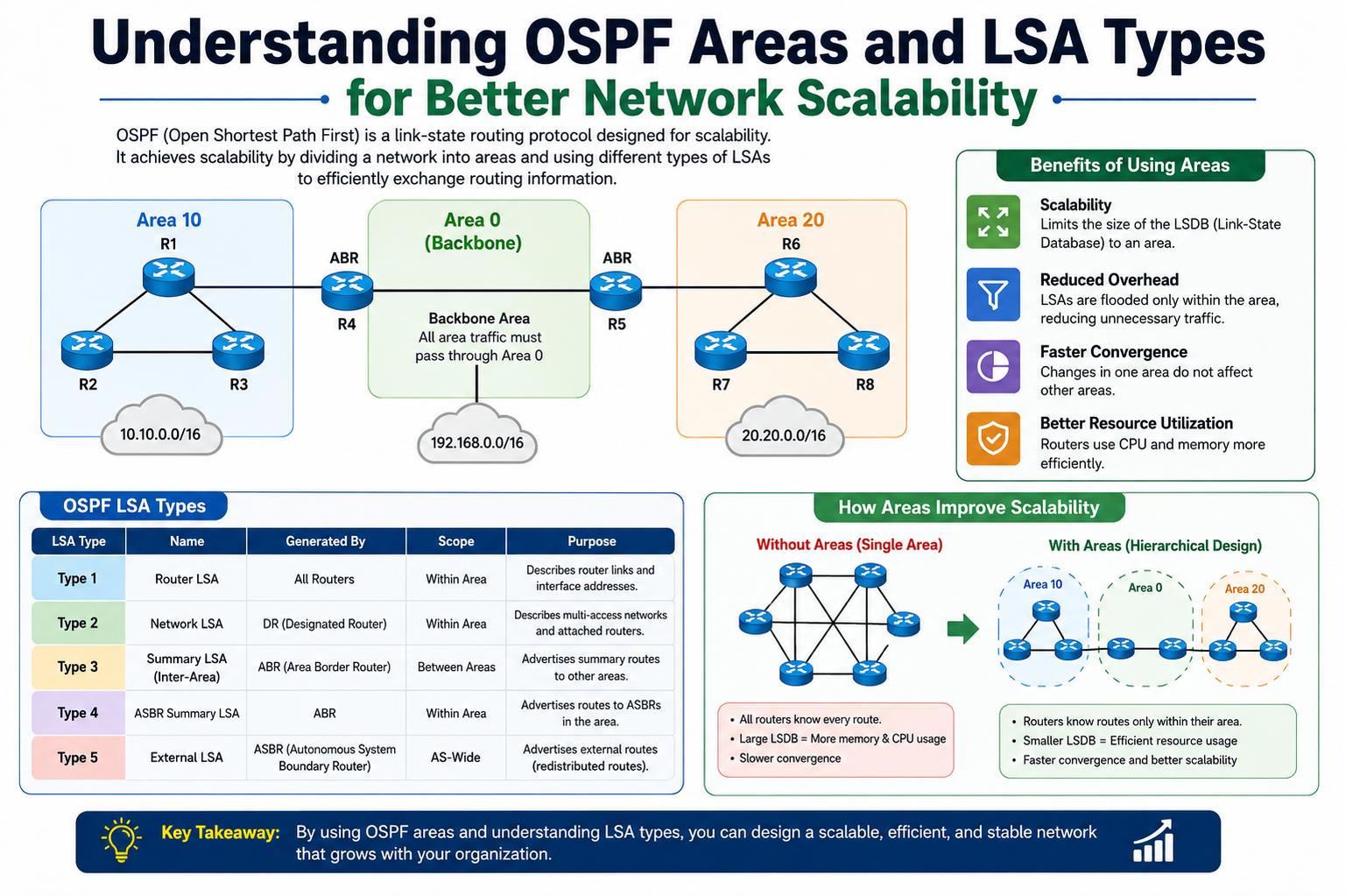
At the center of OSPF’s design are two major concepts: areas and Link-State Advertisements, or LSAs. These two components work together to create scalable and efficient routing environments. Areas divide the network into logical sections, while LSAs provide the communication system routers use to exchange topology information. Together, they reduce unnecessary routing overhead and allow large networks to remain stable and manageable.
To understand why OSPF is considered one of the most effective interior routing protocols, it is important to first understand the problems that appear when networks grow without structure. In a very small network, routers can easily maintain information about every connected destination. There are only a few paths to evaluate, and routing decisions remain relatively simple. However, as more routers, links, and networks are added, the amount of routing information grows dramatically. Every router must maintain larger routing tables, process more updates, and perform more calculations whenever changes occur. This can eventually lead to slower convergence, higher CPU usage, and excessive bandwidth consumption.
OSPF addresses this challenge through hierarchical routing. Instead of forcing every router to know every detail about the entire network, OSPF divides the environment into smaller logical sections called areas. An area acts as a boundary that limits the spread of detailed routing information. Routers inside the same area maintain full awareness of their local topology, but they do not need detailed knowledge about the internal structure of other areas. This dramatically reduces the size of the link-state database and improves routing efficiency.
Every OSPF deployment begins with Area 0, also known as the backbone area. Area 0 serves as the central hub of the OSPF architecture and is responsible for carrying routing information between all other areas. Any additional OSPF area must connect to the backbone either directly or through specialized design methods. The backbone ensures that routing information flows properly throughout the network and prevents communication between areas from becoming fragmented. In smaller organizations, Area 0 may be the only area required, but larger enterprises often create multiple areas to improve scalability and reduce routing overhead.
The use of multiple areas provides several important benefits. One of the biggest advantages is the reduction of SPF recalculations. OSPF uses the Shortest Path First algorithm to calculate the best routes through the network. Whenever a topology change occurs, routers must recalculate paths based on updated information. In a flat network where all routers belong to the same area, every topology change may force all routers to perform new calculations. In a multi-area design, however, changes are often contained within the affected area. Routers in other areas remain mostly unaffected, which improves stability and reduces CPU usage.
Another important advantage of area segmentation is reduced LSA flooding. OSPF routers exchange LSAs to describe topology information and routing changes. Without areas, LSAs could spread throughout the entire routing domain, creating unnecessary overhead. Areas limit the scope of many LSAs, ensuring that only relevant routers receive detailed updates. This improves bandwidth efficiency and helps routers maintain smaller databases.
The most common OSPF area type is the standard area. Standard areas allow routers to receive all common types of routing information, including internal routes, inter-area routes, and external routes. This provides complete routing visibility and is often used in environments where routers must communicate freely with multiple network segments. While standard areas are flexible, they may also carry large amounts of routing information in very large environments.
To improve efficiency in specific parts of a network, OSPF supports specialized area types. One of the most widely used is the stub area. A stub area is designed to reduce the amount of external routing information received by routers inside that area. Instead of learning numerous external routes, routers receive a default route that points toward the rest of the network. This keeps routing tables smaller and reduces memory and processor usage. Stub areas are especially useful in branch offices where routers typically send most traffic toward a central location.
OSPF also supports totally stubby areas, which apply even stricter filtering rules. In addition to blocking external routes, totally stubby areas limit inter-area routing information as well. Routers inside these areas usually maintain knowledge only of their local networks and a single default route. This creates extremely small routing tables and allows routers with limited hardware resources to operate more efficiently.
While stub and totally stubby areas improve efficiency, real-world networks often require more flexibility. Some remote sites may need to connect to external routing domains or redistribute routes from another protocol. Traditional stub areas cannot support these requirements because they block external LSAs. To solve this issue, OSPF introduced the Not-So-Stubby Area, commonly called an NSSA. An NSSA behaves like a stub area while still allowing limited external route redistribution through the use of Type 7 LSAs. These LSAs temporarily carry external routing information inside the NSSA before being translated into standard external LSAs by an Area Border Router.
Area Border Routers, often referred to as ABRs, play a critical role in OSPF scalability. ABRs connect multiple areas and control the exchange of routing information between them. Instead of forwarding every detailed topology change into neighboring areas, ABRs summarize and translate routing information to reduce complexity. This process helps keep routing tables manageable and prevents unnecessary updates from spreading throughout the network.
Another important OSPF router type is the Autonomous System Boundary Router, or ASBR. An ASBR connects the OSPF domain to external routing environments. It is responsible for redistributing routes from other protocols or static routing sources into OSPF. Because external routes can significantly increase routing table size, their distribution must be carefully controlled to maintain efficiency.
Route summarization is another major reason OSPF scales effectively. Rather than advertising every subnet individually, OSPF can summarize multiple routes into a single advertisement. This reduces routing table size and limits update propagation across the network. Summarization also improves stability because internal subnet changes may not require updates outside the area if the summary route remains unchanged.
One of the reasons OSPF remains popular in enterprise environments is its fast convergence speed. When a topology change occurs, OSPF quickly floods updated LSAs and recalculates routes. This allows routers to adapt rapidly to failures and restore connectivity with minimal disruption. In environments that support voice traffic, cloud services, video conferencing, and real-time applications, fast convergence is extremely important.
OSPF also uses metrics called costs to determine the best route. Cost values are typically based on bandwidth, meaning faster links receive lower costs and are preferred during route calculations. Administrators can manually adjust these costs to influence routing behavior and create preferred traffic paths.
Before routers can exchange LSAs, they must first establish neighbor relationships using hello packets. These hello messages allow routers to discover one another and verify that key parameters match correctly. Once routers form adjacencies, they synchronize their link-state databases and begin exchanging topology information. Stable neighbor relationships are essential because OSPF depends entirely on accurate and synchronized databases.
The combination of hierarchical areas, efficient LSA handling, fast convergence, route summarization, and intelligent path selection is what allows OSPF to support networks of nearly any size. Whether deployed in a small office or a large multinational enterprise, OSPF provides the scalability and flexibility needed to maintain reliable communication. Understanding these foundational concepts is the first step toward understanding how OSPF areas and LSA types work together to improve overall network efficiency.
Exploring OSPF LSA Types and How Routers Exchange Routing Intelligence
While OSPF areas provide structure and scalability, the protocol still requires a reliable method for routers to communicate with one another. Routers must constantly exchange information about networks, links, interfaces, and topology changes so they can make accurate routing decisions. This communication process is handled through Link-State Advertisements, commonly known as LSAs. LSAs are one of the most important components of OSPF because they allow routers to build and maintain a synchronized understanding of the network.
Every OSPF router generates and processes LSAs. These advertisements describe different parts of the network topology and are shared between routers through a process called flooding. Flooding does not mean uncontrolled traffic. In OSPF, it refers to the organized and controlled distribution of routing information so that every router inside the appropriate area receives updated topology data. Through this mechanism, routers maintain identical link-state databases within the same area.
The link-state database, often abbreviated as LSDB, acts as the foundation of OSPF routing intelligence. Each router stores LSAs inside its LSDB and uses that information to calculate the best routes through the network. The Shortest Path First algorithm analyzes the database and determines the lowest-cost path to every destination. Because every router inside an area shares the same topology information, route calculations remain consistent and predictable.
One of the reasons OSPF is highly scalable is that it does not rely on repeatedly sending entire routing tables. Instead, routers exchange only necessary LSAs when changes occur. Once the database is synchronized, routing traffic becomes minimal unless a topology update takes place. This approach significantly reduces bandwidth usage compared to older routing protocols that continuously broadcast full routing tables.
OSPF uses several different LSA types because different kinds of routing information serve different purposes. Some LSAs describe routers themselves, while others describe networks, summarize routes between areas, or advertise external destinations. By separating routing information into categories, OSPF creates a structured and efficient communication system that scales well even in large enterprise environments.
The most basic and essential advertisement is the Type 1 LSA, also called the Router LSA. Every OSPF router generates Type 1 LSAs to describe its interfaces, neighboring routers, and link states. These LSAs remain inside the local area and never cross area boundaries. This restriction is extremely important because it prevents detailed topology information from flooding throughout the entire OSPF domain. Instead, routers only maintain complete topology awareness within their own area.
When a router connects to several networks, its Type 1 LSA informs neighboring routers about those connections and associated costs. As routers exchange these advertisements, they gradually build a detailed map of the area’s topology. The SPF algorithm then uses this map to determine the shortest available paths. Because Type 1 LSAs form the basis of topology awareness, they are present in every OSPF deployment.
Another critical LSA is the Type 2 LSA, commonly known as the Network LSA. This advertisement is generated only by the Designated Router, or DR, on multi-access networks such as Ethernet segments. In environments where multiple routers share the same broadcast domain, allowing every router to form a full adjacency with every other router would create excessive overhead. OSPF solves this problem by electing a Designated Router to act as the central communication point for that segment.
The DR generates Type 2 LSAs to describe the shared network and identify the routers connected to it. This reduces unnecessary neighbor relationships and simplifies database synchronization. A Backup Designated Router, or BDR, is also elected to provide redundancy in case the DR fails. Together, Type 1 and Type 2 LSAs provide the core topology information routers need to understand local network structure.
As networks grow and multiple areas are introduced, OSPF requires a method for exchanging routing information between those areas. This is handled through Type 3 LSAs, also known as Summary LSAs. Type 3 LSAs are generated by Area Border Routers and advertise networks from one area into another. Instead of exposing complete internal topology details, ABRs summarize reachability information before advertising it across area boundaries.
This summarization process is one of the key reasons OSPF scales effectively. Routers inside one area do not need detailed awareness of every subnet in distant areas. They only need enough information to reach those destinations. By limiting unnecessary detail, Type 3 LSAs help reduce routing table size, minimize SPF calculations, and improve overall network stability.
Route summarization becomes especially valuable in large enterprise environments where hundreds or thousands of subnets may exist. Instead of advertising each subnet individually, an ABR can summarize multiple routes into a single advertisement. This keeps routing information manageable and reduces update propagation when internal topology changes occur.
Another important advertisement is the Type 4 LSA, often called the ASBR Summary LSA. This LSA identifies the location of an Autonomous System Boundary Router. An ASBR is a router that introduces external routes into OSPF from another routing source such as BGP, RIP, EIGRP, or static routing. Routers inside OSPF need to know how to reach the ASBR before they can access those external destinations. Type 4 LSAs provide this information and allow routers to locate the ASBR efficiently.
External routes themselves are advertised through Type 5 LSAs, known as External LSAs. These LSAs are generated by ASBRs whenever routes from outside the OSPF domain are redistributed into OSPF. External routes may include internet destinations, cloud networks, partner connections, or routes learned from other protocols. Because Type 5 LSAs can spread widely throughout the network, they may significantly increase routing table size and database complexity.
To maintain scalability, many organizations carefully control the use of external LSAs. Stub areas are one example of this strategy because they block Type 5 LSAs entirely. Instead of learning every external destination, routers inside a stub area receive a default route that directs traffic toward the rest of the network. This keeps routing tables smaller and reduces resource consumption.
OSPF also supports a specialized LSA called the Type 7 LSA, which is used inside Not-So-Stubby Areas. NSSAs were created to provide flexibility in environments where external redistribution is required inside a mostly restricted area. Instead of introducing Type 5 LSAs directly, external routes are temporarily advertised as Type 7 LSAs within the NSSA. When these advertisements reach the Area Border Router, the ABR converts them into Type 5 LSAs before advertising them to the rest of the OSPF domain.
This translation process allows NSSAs to maintain many of the efficiency benefits of stub areas while still supporting controlled external connectivity. In real-world enterprise environments, this flexibility is extremely useful because branch offices and regional sites often require specialized routing arrangements.
LSAs also include several mechanisms that ensure routing information remains accurate and synchronized. Each LSA contains a sequence number that allows routers to determine whether an advertisement is newer or older than previously received information. Higher sequence numbers indicate more recent updates. LSAs also contain aging timers that eventually remove outdated information from the database. These mechanisms prevent stale routing data from remaining in the network indefinitely.
Reliable flooding is another essential aspect of OSPF communication. Routers acknowledge received LSAs to confirm successful delivery. If acknowledgments are not received, LSAs are retransmitted. This reliability ensures that all routers maintain consistent databases and accurate topology awareness.
Whenever a topology change occurs, such as a failed link or a new router connection, updated LSAs are flooded throughout the appropriate area. Routers then rerun the SPF algorithm to calculate new best paths. Because OSPF reacts quickly to changes, convergence times are typically much faster than those found in older routing protocols.
The Designated Router election process also plays a significant role in efficient LSA handling. On broadcast networks, electing a DR reduces the number of neighbor adjacencies and minimizes synchronization traffic. Instead of every router exchanging LSAs directly with every other router, communication is centralized through the DR and BDR. This improves scalability and reduces unnecessary overhead on shared network segments.
The reason OSPF uses multiple LSA types is to organize routing information intelligently. Different types of data require different handling rules and flooding scopes. Some information should remain local to an area, while other information must travel between areas or throughout the entire OSPF domain. By categorizing LSAs carefully, OSPF ensures that routers receive the information they need without becoming overloaded by unnecessary detail.
This structured communication system is one of the main reasons OSPF remains highly effective in modern enterprise networking. LSAs allow routers to exchange topology information quickly, maintain synchronized databases, and respond rapidly to network changes. Combined with hierarchical area design, they form the foundation of OSPF’s scalability and efficiency.
How OSPF Areas and LSA Types Work Together to Improve Network Efficiency
Understanding OSPF areas and understanding LSA types separately provides only part of the overall picture. The true power of OSPF becomes clear when both concepts are examined together. Areas create logical boundaries inside the network, while LSAs control how routing information moves between those boundaries. Together, they allow OSPF to scale efficiently across large enterprise environments without overwhelming routers or consuming excessive bandwidth.
In any routing protocol, one of the biggest challenges is balancing visibility with efficiency. Routers need enough information to make accurate routing decisions, but too much information can create unnecessary complexity. Large routing tables consume memory, excessive topology updates increase processor usage, and frequent recalculations can slow network performance. OSPF solves these challenges by carefully controlling how routing information is distributed throughout the network.
The interaction between areas and LSAs is the foundation of this control. Different area types determine which LSAs are allowed, filtered, summarized, or translated. This selective handling of routing information allows administrators to design networks that remain stable and scalable even as they grow significantly in size.
At the heart of OSPF is the link-state database. Every router maintains an LSDB that contains information learned through LSAs. Inside a single area, routers share identical topology information because they receive the same Type 1 and Type 2 LSAs. This allows all routers in the area to calculate consistent shortest paths using the SPF algorithm. However, when multiple areas exist, routers no longer need complete visibility into every part of the network. Instead, detailed topology information remains contained within each area.
This containment is one of the primary reasons OSPF performs so efficiently in large networks. Suppose a network includes multiple branch offices connected to a central headquarters. If every router in every branch had to process detailed topology information for the entire enterprise, routing tables would become extremely large and SPF calculations would consume significant CPU resources. By dividing the network into areas, OSPF limits the spread of detailed LSAs and keeps routing operations manageable.
Area Border Routers play a major role in this process. ABRs sit between areas and control the exchange of routing information. Instead of forwarding all Type 1 and Type 2 LSAs directly into neighboring areas, ABRs generate Type 3 summary LSAs that provide simplified reachability information. This allows routers in one area to learn about destinations in another area without needing full topology awareness.
For example, routers inside Area 2 do not need to know every internal subnet and link relationship inside Area 5. They only need enough information to forward traffic toward Area 5 correctly. The ABR provides that summarized information through Type 3 LSAs, reducing database size and limiting unnecessary routing complexity.
Route summarization further improves efficiency. If multiple networks can be represented by a single summarized route, the ABR advertises only the summary instead of every individual subnet. This reduces routing table size and minimizes update propagation across the network. If an internal subnet changes but the summarized route remains valid, routers in other areas do not need to receive additional updates. This containment significantly improves stability.
Stub areas provide another excellent example of how areas and LSAs work together. In a standard OSPF area, routers may receive Type 5 LSAs that advertise external routes from outside the OSPF domain. In large enterprise environments, the number of external routes can become extremely large, especially when organizations connect to cloud providers, internet services, or partner networks. Small branch routers often do not need awareness of every external destination.
Stub areas solve this problem by blocking Type 5 LSAs entirely. Instead of maintaining large external routing tables, routers inside the stub area receive a default route pointing toward the Area Border Router. This dramatically reduces routing overhead while still allowing traffic to reach external destinations efficiently. By filtering specific LSA types, the area reduces memory usage, lowers CPU consumption, and simplifies route selection.
Totally stubby areas apply even stricter controls. In addition to blocking Type 5 LSAs, they also filter many inter-area routes carried by Type 3 and Type 4 LSAs. Routers inside a totally stubby area typically know only about local networks and a default route. This creates extremely small routing tables and allows routers with limited resources to operate efficiently.
However, real-world networks are not always simple enough to use strict stub configurations everywhere. Some remote sites may need to redistribute routes from another routing protocol or maintain connections to external organizations. Traditional stub areas cannot support this because they block external LSAs. This is why OSPF introduced the Not-So-Stubby Area.
An NSSA allows controlled external route redistribution while still limiting unnecessary routing information. Inside the NSSA, external routes are advertised as Type 7 LSAs instead of Type 5 LSAs. These advertisements remain inside the NSSA until they reach the Area Border Router, which translates them into Type 5 LSAs before distributing them elsewhere in the OSPF domain. This mechanism allows organizations to maintain routing flexibility without sacrificing scalability.
The relationship between area design and LSA handling also plays a major role in network stability. In large environments, topology changes occur regularly. Links may fail, routers may reboot, or new networks may be added. Every topology change triggers updated LSAs and SPF recalculations. If the entire network belonged to a single flat area, every router would need to process every change, even if the issue occurred far away.
Hierarchical OSPF design prevents this problem by limiting the scope of topology updates. When a change occurs inside one area, detailed LSAs usually remain confined to that area. Routers in distant areas receive only summarized information if necessary. This containment reduces unnecessary SPF calculations and prevents local instability from affecting the entire network.
Fast convergence is another major benefit of this design. OSPF reacts quickly to topology changes because routers exchange LSAs immediately after detecting failures or updates. The SPF algorithm recalculates routes rapidly, allowing traffic to reroute through alternative paths with minimal disruption. Area segmentation improves convergence efficiency because routers only process detailed changes relevant to their own area.
Bandwidth efficiency is also significantly improved through the interaction between areas and LSAs. Older routing protocols often sent complete routing tables at regular intervals, consuming bandwidth even when no changes occurred. OSPF behaves differently by exchanging only incremental updates after initial synchronization. Since many LSAs remain contained within local areas, unnecessary routing traffic is minimized even further.
The Designated Router election process also contributes to efficient LSA handling. On broadcast networks where multiple routers share the same segment, electing a DR reduces the number of required neighbor adjacencies. Instead of every router exchanging LSAs with every other router, synchronization is centralized through the DR and Backup Designated Router. This significantly reduces routing overhead on Ethernet networks and improves scalability.
OSPF’s cost-based routing system works closely with the link-state database to select optimal paths. Each interface is assigned a cost value, usually based on bandwidth. The SPF algorithm calculates the lowest-cost path to each destination using information learned through LSAs. Administrators can manually adjust costs to influence traffic patterns and create preferred routes for different types of traffic.
One of the reasons OSPF remains highly respected in enterprise networking is its ability to adapt to many different environments. A small business may operate entirely within Area 0 using only standard LSAs, while a global enterprise may deploy dozens of areas with stub, totally stubby, and NSSA configurations to optimize performance. OSPF’s modular design allows administrators to customize routing behavior based on operational requirements.
Modern networks continue evolving with cloud integration, virtualization, and hybrid infrastructures, yet OSPF remains highly relevant because its core design principles are still effective. Organizations still require scalable internal routing, fast failover, efficient bandwidth usage, and predictable convergence behavior. OSPF areas and LSAs continue providing these capabilities in a structured and reliable manner.
The interaction between areas and LSAs ultimately creates a balance between visibility and efficiency. Routers receive enough information to make accurate routing decisions without becoming overloaded by unnecessary topology details. Areas limit complexity, while LSAs provide organized communication between routers. Together, they allow OSPF to support networks ranging from small offices to massive enterprise infrastructures while maintaining stability, scalability, and efficient routing performance.
Advanced OSPF Design Challenges, Real-World Area Planning, and LSA Optimization Strategies
As OSPF networks grow beyond basic implementations, the design challenges become less about enabling routing and more about maintaining long-term efficiency, stability, and predictable behavior under real operational pressure. At scale, even small design decisions—such as how an area is defined or how LSAs are filtered—can significantly influence performance. This is where advanced OSPF planning becomes important, especially in enterprise environments where uptime, convergence speed, and routing efficiency directly affect business operations.
In large-scale deployments, OSPF is rarely left in a simple single-area design. Instead, networks are carefully divided into multiple areas that reflect both physical and logical boundaries. These areas are not created randomly; they are engineered based on traffic flow, organizational structure, and expected growth. A poorly designed area structure can lead to unnecessary LSA flooding, excessive SPF recalculations, and inefficient routing paths, even if OSPF is technically functioning correctly.
One of the most important principles in advanced OSPF design is keeping areas stable and purpose-driven. Each area should represent a meaningful segment of the network rather than an arbitrary collection of routers. For example, separating data center infrastructure from branch office networks helps isolate high-frequency topology changes. In environments where links frequently fluctuate, such as WAN-connected branches, isolating that instability inside its own area prevents it from impacting the rest of the routing domain.
This isolation is one of the most powerful advantages of OSPF. When a topology change occurs inside a single area, only routers within that area must process detailed LSA updates and perform full SPF recalculations. Other areas remain largely unaffected, receiving only summarized information if needed. This containment dramatically reduces the operational impact of network instability.
However, achieving this level of efficiency requires careful control of LSA propagation. Not all LSAs behave the same way, and understanding their interaction with area boundaries is essential for advanced optimization. In particular, Type 3, Type 4, and Type 5 LSAs play a major role in how information is shared between areas.
Type 3 LSAs are central to inter-area communication. Generated by Area Border Routers, they summarize routes from one area before advertising them into another. This summarization reduces routing table size and limits unnecessary detail exposure. In well-designed networks, ABRs are configured to advertise only meaningful route summaries rather than individual subnets. This prevents routing tables from becoming excessively large in other areas and ensures that SPF calculations remain efficient.
Poor summarization design, however, can create inefficiencies. If an ABR advertises overly specific routes, other areas may receive more routing information than necessary. This increases LSDB size and can lead to unnecessary SPF processing. On the other hand, overly broad summarization can hide important routing detail, potentially leading to suboptimal routing decisions. The balance between detail and abstraction is therefore a critical aspect of OSPF design.
Type 5 LSAs introduce another layer of complexity. These external LSAs represent routes that originate outside the OSPF domain, typically injected by redistribution from other routing protocols or static routes. In large environments, external routes can grow rapidly, especially when multiple external connections exist. Without proper control, Type 5 LSAs can overwhelm routing tables and increase processing overhead across the network.
To manage this, network designers often use area-based filtering strategies. Stub areas completely block Type 5 LSAs, forcing routers to rely on a default route instead. This approach works well in environments where external routing detail is unnecessary, such as branch offices with a single exit point. By removing external routing complexity, stub areas significantly improve efficiency and reduce memory usage on smaller routers.
Totally stubby areas extend this concept even further by limiting not only external LSAs but also most inter-area routes. This creates extremely simplified routing environments where routers primarily depend on a default route for non-local traffic. While this design greatly improves efficiency, it must be used carefully, as it reduces routing visibility and increases reliance on upstream routers.
Not-So-Stubby Areas provide a more flexible alternative in environments that require both efficiency and external connectivity. By allowing Type 7 LSAs internally and translating them into Type 5 LSAs at the ABR, NSSAs enable controlled redistribution while still limiting unnecessary routing overhead. This mechanism is especially useful in hybrid environments where branch sites may need to inject limited external routes into a larger OSPF domain.
Beyond LSA filtering, advanced OSPF design also focuses heavily on SPF optimization. The SPF algorithm recalculates routes whenever topology changes occur, and in large networks, these calculations can become resource-intensive. By keeping areas small and stable, administrators reduce the scope of SPF recalculations. Instead of recalculating routes for an entire enterprise, routers only process changes within their own area. This localized processing significantly improves performance and reduces CPU load.
Another important design consideration is the number of routers within each area. While OSPF does not enforce a strict limit, performance can degrade when areas become too large. A large number of routers increases the volume of LSAs, expands the link-state database, and increases the complexity of SPF calculations. Breaking large areas into smaller, logically grouped segments helps maintain performance and ensures that routing updates remain manageable.
In addition to size, network engineers must also consider stability when designing OSPF areas. Highly dynamic environments, where links frequently go up and down, should be isolated whenever possible. If unstable segments are placed in the backbone or shared areas, frequent LSA updates can propagate across the entire network, triggering repeated SPF recalculations. By isolating instability, OSPF ensures that changes remain localized and do not affect unrelated parts of the network.
Area 0, the backbone, requires special attention in all OSPF designs. Since all inter-area traffic flows through the backbone, its stability directly affects the entire routing domain. Any instability in Area 0 can cause widespread routing disruptions. For this reason, backbone areas are typically designed with high redundancy, stable links, and carefully controlled router placement. ABRs connecting to Area 0 must also be carefully selected to ensure consistent routing behavior across the network.
In large-scale deployments, engineers often implement multiple ABRs for redundancy and load distribution. However, this introduces additional complexity in LSA propagation. When multiple ABRs exist, route selection between areas must be consistent to avoid suboptimal routing paths. Summarization and cost manipulation are often used to influence path selection and ensure predictable traffic flow.
Another advanced consideration is LSA refresh behavior. LSAs are periodically refreshed even if no topology changes occur. In large networks, this periodic refresh can generate significant background traffic. Efficient OSPF design minimizes unnecessary LSA churn by carefully controlling area size and LSA distribution scope. Stable networks with well-designed hierarchies naturally reduce the frequency and impact of these refresh operations.
Authentication also plays a role in advanced OSPF environments. While not directly related to LSAs or areas, authentication ensures that only trusted routers participate in OSPF exchanges. This prevents unauthorized devices from injecting false LSAs into the network, which could disrupt routing stability. In secure enterprise environments, authentication is often required on all OSPF-enabled interfaces.
Real-world OSPF deployments often combine multiple optimization techniques simultaneously. An enterprise network might use a backbone area for core routing, several standard areas for data centers, stub areas for branch offices, and NSSAs for sites requiring limited external connectivity. Each area type serves a specific purpose, and LSAs are carefully controlled within and between these areas to maintain efficiency.
The most successful OSPF designs are those that anticipate growth and change. Networks rarely remain static, so area design must account for future expansion. Adding new routers, new sites, or new external connections should not require a complete redesign of the routing architecture. Instead, OSPF’s hierarchical structure allows new areas to be added with minimal disruption, as long as LSA behavior and summarization are properly configured.
Ultimately, advanced OSPF design is about control. Control over how routing information is generated, control over how it is distributed, and control over how much detail each part of the network needs to see. By carefully designing areas and managing LSAs, network engineers can build routing environments that remain fast, stable, and scalable even under heavy load and constant change.
Conclusion
In today’s complex and rapidly expanding network environments, efficient routing is one of the most critical factors that determines overall performance, stability, and scalability. Open Shortest Path First (OSPF) has proven itself as one of the most reliable interior gateway routing protocols because it is built on a structured and intelligent design. The combined use of OSPF areas and Link-State Advertisements (LSAs) is what allows it to handle both small and extremely large network infrastructures with consistent efficiency.
OSPF areas introduce a hierarchical structure that prevents unnecessary overload on routers. Instead of requiring every router to maintain a complete view of the entire network, OSPF divides the network into smaller, manageable sections. Each area maintains its own detailed topology, which significantly reduces the size of routing tables and limits the scope of SPF calculations. This design ensures that network changes remain localized, meaning that a failure or update in one area does not unnecessarily impact the entire routing domain. As a result, networks become more stable, easier to manage, and more scalable.
LSAs complement this structure by controlling how routing information is shared between routers. Every LSA type has a specific function, whether it is describing local router links, representing shared network segments, summarizing routes between areas, or advertising external destinations. This classification of routing information ensures that only relevant data is exchanged, reducing unnecessary bandwidth usage and improving overall efficiency. Instead of flooding the entire network with complete routing tables, OSPF intelligently distributes only the required updates.
When areas and LSAs work together, they create a highly optimized routing environment. Area boundaries limit the spread of detailed topology information, while LSAs ensure that routers still maintain an accurate and synchronized understanding of the network. This balance between information visibility and controlled distribution is what makes OSPF both powerful and efficient. It allows large networks to operate without overwhelming routers or consuming excessive resources.
Additionally, different OSPF area types such as standard areas, stub areas, totally stubby areas, and Not-So-Stubby Areas provide further flexibility. These variations allow network designers to tailor routing behavior based on specific needs, whether the goal is minimizing routing tables in branch offices or supporting external route redistribution in complex environments. This adaptability ensures that OSPF can be deployed in a wide variety of real-world scenarios without compromising performance.
Ultimately, OSPF succeeds because it is not a flat or rigid protocol. It is a structured system built around hierarchy, controlled information flow, and efficient route calculation. The combination of areas and LSAs ensures that networks remain scalable, stable, and responsive even as they grow in size and complexity.